Hierarchical Alignment Decomposition Labels for Hiero Grammar Rules
Gideon Maillette de Buy Wenniger Institute for Logic,
Language and Computation University of Amsterdam
Science Park 904, 1098 XH Amsterdam The Netherlands
gemdbw AT gmail.com
Khalil Sima’an Institute for Logic, Language and Computation
University of Amsterdam
Science Park 904, 1098 XH Amsterdam The Netherlands
k.simaan AT uva.nl
Abstract
Selecting a set of nonterminals for the syn-chronous CFGs underlying the hierarchical phrase-based models is usually done on the basis of a monolingual resource (like a syntac-tic parser). However, a standard bilingual re-source like word alignments is itself rich with reordering patterns that, if clustered some-how, might provide labels of different (pos-sibly complementary) nature to monolingual labels. In this paper we explore a first ver-sion of this idea based on a hierarchical de-composition of word alignments into recursive tree representations. We identify five clus-ters of alignment patterns in which the chil-dren of a node in a decomposition tree are found and employ these five as nonterminal la-bels for the Hiero productions. Although this is our first non-optimized instantiation of the idea, our experiments show competitive per-formance with the Hiero baseline, exemplify-ing certain merits of this novel approach.
1 Introduction
The Hiero model (Chiang, 2007; Chiang, 2005) formulates phrase-based translation in terms of a synchronous context-free grammar (SCFG) limited to the inversion transduction grammar (ITG) (Wu, 1997) family. While the original Hiero approach works with a single nonterminal label (X) (besides the start nonterminal S), more recent work is dedi-cated to devising methods for extracting more elab-orate labels for the phrase-pairs and their abstrac-tions into SCFG producabstrac-tions, e.g., (Zollmann and Venugopal, 2006; Li et al., 2012; Almaghout et al., 2011). All labeling approaches exploit monolin-gual parsers of some kind, e.g., syntactic,
seman-tic or sense-oriented. The rationale behind mono-lingual labeling is often to make the probability dis-tributions over alternative synchronous derivations of the Hiero model more sensitive to linguistically justified monolingual phrase context. For example, syntactic target-language labels in many approaches are aimed at improved target language modeling (fluency, cf. Hassan et al. (2007); Zollmann and Venugopal (2006)), whereas source-language labels provide suitable context for reordering (see Mylon-akis and Sima’an (2011)). It is usually believed that the monolingual labels tend to stand for clus-ters of phrase pairs that are expected to be inter-substitutable, either syntactically or semantically (see Marton et al. (2012) for an illuminating discus-sion).
While we believe that monolingual labeling strategies are sound, in this paper we explore the complementary idea that the nonterminal labels could also signifybilingual properties of the phrase pair, particularly its characteristic word alignment patterns. Intuitively, an SCFG with nonterminal la-bels standing for alignment patterns should put more preference on synchronous derivations that mimic the word alignment patterns found in the training corpus, and thus, possibly allow for better reorder-ing. It is important to stress the fact that these word alignment patterns are complementary to the mono-lingual linguistic patterns and it is conceivable that the two can be combined effectively, but this remains beyond the scope of this article.
The question addressed in this paper is how to se-lect word alignment patterns and cluster them into bilingual nonterminal labels? In this paper we ex-plore a first instantiation of this idea starting out from the following simplifying assumptions:
• The labels come from the word alignments only,
• The labels are coarse-grained, pre-defined clus-ters and not optimized for performance,
• The labels extend the binary set of ITG oper-ators (monotone and inverted) into five such labels in order to cover non-binarizable align-ment patterns.
Our labels are based on our own tree decomposi-tions of word alignments (Sima’an and Maillette de Buy Wenniger, 2011), akin to Normalized Decom-position Trees (NDTs) (Zhang et al., 2008). In this first attempt we explore a set of five nonterminal la-bels that characterize alignment patterns found di-rectly under nodes in the NDT projected for every word alignment in the parallel corpus during train-ing. There is a range of work that exploits the mono-tone and inverted orientations of binary ITG within hierarchical phrase-based models, either as feature functions of lexicalized Hiero productions (Chiang, 2007; Zollmann and Venugopal, 2006), or as labels on non-lexicalized ITG productions, e.g., (Mylon-akis and Sima’an, 2011). As far as we are aware, this is the first attempt at exploring a larger set of such word alignment derived labels in hierarchical SMT. Therefore, we expect that there are many vari-ants that could improve substantially on our strong set of assumptions.
2 Hierarchical SMT models
Hierarchical SMT usually works withweighted in-stantiations of Synchronous Context-Free Gram-mars (SCFGs) (Aho and Ullman, 1969). SCFGs are defined over a finite set of nonterminals (start included), a finite set of terminals and a finite set of synchronous productions. A synchronous pro-duction in an SCFG consists of two context-free productions (source and target) containing the same number of nonterminals on the right-hand side, with a bijective (1-to-1 and onto) function between the source and target nonterminals. Like the standard Hiero model (Chiang, 2007), we constrain our work to SCFGs which involve at most two nonterminals in every lexicalized production.
Given an SCFG G, a source sentences is trans-lated into a target sentencetby synchronous deriva-tions d, each is a finite sequence of well-formed
substitutions of synchronous productions from G, see (Chiang, 2006). Standardly, for complexity rea-sons, most models used make the assumption that the probabilityP(t |s) can be optimized through as single best derivation as follows:
arg max
t P(t|s) = arg maxt
X
d∈G
P(t,d|s) (1)
≈ arg max
d∈G P(t,d
|s) (2)
This approximation can be notoriously problematic for labelled Hiero models because the labels tend to lead to many more derivations than in the orig-inal model, thereby aggravating the effects of this assumption. This problem is relevant for our work and approaches to deal with it are Minimum Bayes-Risk decoding (Kumar and Byrne, 2004; Tromble et al., 2008), Variational Decoding (Li et al., 2009) and soft labeling (Venugopal et al., 2009; Marton et al., 2012; Chiang, 2010).
Given a derivation d, most existing phrase-based models approximate the derivation probabil-ity through a linear interpolation of a finite set of feature functions (Φ(d)) of the derivationd, mostly working with local feature functionsφi of
individ-ual productions, the target side yield string t of d
(target language model features) and other heuristic features discussed in the experimental section:
arg max
d∈G P(t,d|s) ≈ arg maxd∈G
|Φ(d)|
X
i=1
λi×φi (3)
Whereλi is the weight of featureφioptimized over
a held-out parallel corpus by some direct error-minimization procedure like MERT (Och, 2003).
3 Baseline: Hiero Grammars (single label)
gaps may be maximally introduced in this way1, la-beled asX1andX2respectively for distinction. The types of permissible Hiero rules are:
X→ hα, γi (4a)
X→ hαX1β, δX1ζi (4b)
X→ hαX1βX2γ , δX1 ζX2ηi (4c)
X→ hαX1βX2γ , δX2 ζX1ηi (4d)
Here α, β, γ, δ, ζ, η are terminal sequences, pos-sibly empty. Equation 4a corresponds to a normal phrase pair, 4b to a rule with one gap and 4c and 4d to the monotone- and inverting rules respectively.
An important extra constraint used in the original Hiero model is that rules must have at least one pair of aligned words, so that translation decisions are al-ways based on some lexical evidence. Furthermore the sum of terminals and nonterminals on the source side may not be greater than five, and nonterminals are not allowed to be adjacent on the source side.
4 Alignment Labeled Grammars
Labeling the Hiero grammar productions makes rules with gaps more restricted about what broad categories of rules are allowed to substitute for the gaps. In the best case this prevents overgeneraliza-tion, and makes the translation distributions more accurate. In the worst case, however, it can also lead to too restrictive rules, as well as sparse translation distributions. Despite these inherent risks, a number of approaches based on syntactically inspired labels has succeeded to improve the state of the art by using monolingual labels, e.g., (Zollmann and Venugopal, 2006; Zollmann, 2011; Almaghout et al., 2011; Chiang, 2010; Li et al., 2012).
Unlabeled Hiero derivations can be seen as recur-sive compositions of phrase pairs. A single transla-tion may be generated by different derivations (see equation 1), each standing for a choice of com-position rules over a choice of a segmentation of the source-target sentence pair into a bag of phrase pairs. However, a synchronous derivation also in-duces an alignment between the different segments
1The motivation for this restriction to two gaps is mainly a practical computational one, as it can be shown that translation complexity grows exponentially with the number of gaps.
that it composes together. Our goal here is to la-bel the Hiero rules in order to exploit aspects of the alignment that a synchronous derivation induces.
We exploit the idea that phrase pairs can be ef-ficiently grouped into maximally decomposed trees (normalized decomposition trees – NDTs) (Zhang et al., 2008). In an NDT every phrase pair is re-cursively decomposed at every level into the mini-mum number of its phrase constituents, so that the resulting structure is maximal in that it contains the largest number of nodes. In Figure 1 left we show an example alignment and in Figure 1 right its as-sociated NDT. The NDT shows pairs of source and target spans of (sub-) phrase pairs, governed at dif-ferent levels of the tree by their parent node. In our example the root node splits into three phrase pairs, but these three phrase pairs together do not manage to cover the entire phrase pair of the par-ent because of the discontinuous translation struc-ture howe, sind ... schuldigi. Consequently, a par-tially lexicalized structure with three children corre-sponding to phrase pairs and lexical items covering the words left by these phrase pairs is required.
During grammar extraction we determine an Alignment Label for every left-hand-side and gap of every rule we extract. This is done by looking at the NDT that decomposes their corresponding phrase pairs, and determining the complexity of the rela-tion with their direct children in this tree. Complex-ity cases are ordered by preference, where the more simple label corresponding to the choice of maximal decomposition is preferred. We distinguish the fol-lowing five cases, ordered by increasing complexity: 1. Monotonic: If the alignment can be split into
two monotonically ordered parts.
2. Inverted: If the alignment can be split into two inverted parts.
3. Permutation: If the alignment can be factored as a permutation of more than 3 parts.2
4. Complex: If the alignment cannot be factored as a permutation of parts, but the phrase does contain at least one smaller phrase pair (i.e., it is composite).
5. Atomic: If the alignment does not allow the ex-istence of smaller (child) phrase pairs.
1 we
2 owe
3 this
4 to
5 our
6 citizens
das 1
sind 2
wir 3
unsern 4
burgern 5
schuldig 6
([1,6],[1,6])
([5,6],[4,5])
([6,6],[5,5]) ([5,5],[4,4])
([3,3],[1,1]) ([1,1],[3,3])
Figure 1: Example of complex word alignment, taken from Europarl data English-German (left) and its associated Normalized Decomposition Tree (Zhang et al., 2008) (right).
We show examples of each of these cases in Figure 2. Furthermore, in Figure 3 we show an example of an alignment labeled Hiero rule based on one of these alignment examples.
Our kind of labels has a completely different fla-vor from monolingual labels in that they cannot be seen as identifying linguistically meaningful clus-ters of phrase pairs. These labels are mere latent bilingual clusters and the translation model must marginalize over them (equation 1) or use Minimum Bayes-Risk decoding.
4.1 Features : Relations over labels
In this section we describe the features we use in our experiments. To be unambiguous we first need to introduce some terminology. Letr be a transla-tion rule. We use ˆpto denote probabilities estimated using simple relative frequency estimation from the word aligned sentence pairs of the training corpus. Then src(r) is the source side of the rule, includ-ing the source side of the left-hand-side label. Simi-larlytgt(r) is the target side of the rule, including the target side of the left-hand-side label. Furthermore
un(src(r)) is the source side without any nontermi-nal labels, and anontermi-nalogous forun(tgt(r)).
4.1.1 Basic Features
We use the following phrase probability features:
• pˆ(tgt(r)|src(r)): Phrase probability target side given source side
• pˆ(src(r)|tgt(r)): Phrase probability source side given target side
We reinforce those by the following phrase prob-ability smoothing features:
• pˆ(tgt(r)|un(src(r)))
• pˆ(un(src(r))|tgt(r))
• pˆ(un(tgt(r))|src(r))
• pˆ(src(r)|un(tgt(r)))
• pˆ(un(tgt(r))|un(src(r)))
• pˆ(un(src(r))|un(tgt(r)))
We also add the following features:
• pˆw(tgt(r)|src(r)),pˆw(src(r)|tgt(r)): Lexical
weights based on terminal symbols as for phrase-based and hierarchical phrase-based MT.
• pˆ(r|lhs(r)) : Generative probability of a rule given its left-hand-side label
We use the following set of basic binary features, with 1 values by default, and a valueexp(1) if the corresponding condition holds:
• ϕGlue(r):exp(1) if rule is a glue rule
• ϕlex(r): exp(1) if rule has only terminals on
right-hand side
• ϕabs(r):exp(1) if rule has only nonterminals on
right-hand side
• ϕst w tt(r): exp(1) if rule has terminals on the
source side but not on the target side
• ϕtt w st(r): exp(1) if rule has terminals on the
target side but not on the source side
• ϕmono(r): exp(1) if rule has no inverted pair of
nonterminals
Furthermore we use the :
• ϕra(r): Phrase penalty,exp(1) for all rules. • exp(ϕwp(r)): Word penalty, exponent of the
number of terminals on the target side
• ϕrare(r): exp(#(P 1
r0∈Cδrr0)) : Rarity penalty, with
#(P
r0∈Cδrr0) being the count of rulerin the
cor-pus.
4.1.2 Binary Reordering Features
Besides the basic features we want to use extra sets of binary features that are specially designed to directly learn the desirability of certain broad classes of reordering patterns, beyond the way this is already implicitly learned for particular lexical-ized rules by the introduction of reordering labels.3 These features can be seen as generalizations of the most simple feature that penalizes/rewards
this is an important matter
das ist ein wichtige angelegenheit
1
1 2
2
Monotone
we all agree on this
das sehen wir alle
1
1 2
2
Inversion
i want to stress two points
auf zwei punkte m¨ochte ich hinweisen
1
1 2
2
3
3 4
4
Permutation
we owe this to our citizens
das sind wir unsern burgern schuldig
1
1 2
2
3
3
Complex
it would be possible
kann mann
1
1
[image:5.612.83.563.63.303.2]Atomic
Figure 2:Different types of Alignment Labels
tone orderϕmono(r) from our basic feature set. The
new features we want to introduce “fire” for a spe-cific combination of reordering labels on the left hand side and one or both gaps, plus optionally the information whether the rule itself invert its gaps and whether or not it is abstract.
5 Experiments
We evaluate our method on one language pair using German as source and English as target. The data is derived from parliament proceedings sourced from the Europarl corpus (Koehn, 2005), with WMT-07 development and test data. We used a maximum sentence length of 40 for filtering. We employ ei-ther 200K or (approximately) 1000K sentence pairs for training, 1K for development and 2K for test-ing (stest-ingle reference per source sentence). Both the baseline and our method decode with a 3-gram lan-guage model smoothed with modified Knesser-Ney discounting (Chen and Goodman, 1998), trained on the target side of the full original training set (ap-proximately 1000K sentences).
We compare against state-of-the-art hierarchi-cal translation (Chiang, 2005) baselines, based on the Joshua (Ganitkevitch et al., 2012) and Moses (Hoang et al., 2007) translation systems with default decoding settings. We use our own grammar
extrac-we owe this to our citizens
das sind wir unsern burgern schuldig
X Complex
X Atomic1
X Atomic1
X Monotone2
X Monotone2
X Complex
Figure 3:Example of a labeled Hiero rule
X Complex→ hwe owe X Atomic1 toX Monotone2,
X Atomic1 sind wirX Monotone2 schuldigi
extracted from theComplexexample in Figure 2 by re-placing the phrase pairshthis, dasiandhour citizens , un-sern burgerniwith (labeled) variables.
tor for the generation of all grammars, including the baseline Hiero grammars. This enables us to use the same features (as far as applicable given the gram-mar formalism) and assure true comparability of the grammars under comparison.
5.1 Training and Decoding Details
In this section we discuss the choices and settings we used in our experiments. Our initial experiments
[image:5.612.334.523.340.440.2]Decoding Type
System
Name 200K
Lattice MBR
Hiero 26.44
Hiero-RL 26.72
Viterbi Hiero 26.23
[image:6.612.104.268.57.127.2]Hiero-RL-PPL 26.16
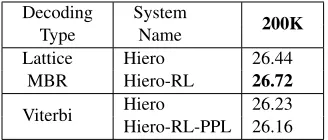
Table 1: Initial Results. Lowercase BLEU results for German-English trained on 200K sentence pairs.4 Top rows display results for our experiments using Moses (Hoang et al., 2007) with Lattice Minimum Bayes-Risk Decoding5 (Tromble et al., 2008) in combination with Batch Mira (Cherry and Foster, 2012) for tuning. Below are results for experiments with Joshua (Ganitkevitch et al., 2012) using Viterbi decoding (i.e. no MBR) and PRO (Hopkins and May, 2011) for tuning.
were done on Joshua (Ganitkevitch et al., 2012), using the Viterbi best derivation. The second set of experiments was done on Moses (Hoang et al., 2007) using Lattice Minimum Bayes-Risk Decod-ing5(Tromble et al., 2008) to sum over derivations.
5.1.1 General Settings
To train our system we use the following settings. We use the standard Hiero grammar extraction constraints (Chiang, 2007) but for our reordering labeled grammars we use them with some modifi-cations. In particular, while for basic Hiero only phrase pairs with source spans up to 10 are allowed, and abstract rules are forbidden, we allow extraction of fully abstract rules, without length constraints. Furthermore we allow their application without length constraints during decoding. Following common practice, we use simple relative frequency estimation to estimate the phrase probabilities, lexical probabilities and generative rule probability respectively.6
5After submission we were told by Moses support that in fact neither normal Minimum Bayes-Risk (MBR) nor Lattice MBR are operational in Moses Chart.
6Personal correspondence with Andreas Zollmann further reinforced the authors appreciation of the importance of this feature introduced in (Zollmann and Venugopal, 2006; Zoll-mann, 2011). Strangely enough this feature seems to be un-available in the standard Moses (Hoang et al., 2007) and Joshua (Ganitkevitch et al., 2012) grammar extractors, that also imple-ment SAMT grammar extraction
5.1.2 Specific choices and settings Joshua Viterbi experiments
Based on experiments reported in (Mylonakis and Sima’an, 2011; Mylonakis, 2012) we opted to not label the (fully lexicalized) phrase pairs, but instead label them with a genericPhrasePairlabel and use a set of switch rules from all other labels to the
PhrasePairlabel to enable transition between Hiero rules and phrase pairs.
We train our systems using PRO (Hopkins and May, 2011) implemented in Joshua by Ganitkevitch et al. (2012). We use the standard tuning, where all features are treated as dense features.We allow up to 30 tuning iterations. We further follow the PRO set-tings introduced in (Ganitkevitch et al., 2012) but use 0.5 for the coefficient Ψ that interpolates the weights learned at the current with those from the previous iteration. We use the final learned weights for decoding with the log-linear model and report Lowercase BLEU scores for the tuned test set.
5.1.3 Specific choices and settings Moses Lattice MBR experiments
As mentioned before we use Moses (Hoang et al., 2007) for our second experiment, in combina-tion with Lattice Minimum Bayes-Risk Decoding5 (Tromble et al., 2008). Furthermore we use Batch Mira (Cherry and Foster, 2012) for tuning with max-imum 10 tuning iterations of the 200K training set, and 30 for the 1000K training set.7
For our Moses experiments we mainly worked with a uniform labeling policy, labeling phrase pairs in the same way with alignment labels as normal rules. This is motivated by the fact that since we are using Minimum Bayes-Risk decoding, the risks of sparsity from labeling are much reduced. And label-ing everythlabel-ing does have the advantage that
ing information can be fully propagated in deriva-tions starting from the lowest (phrase) level. We also ran experiments with the generic phrase pair label-ing, since there were reasons to believe this could decrease sparsity and potentially lead to better re-sults.8
5.2 Initial Results
We report Lowercase BLEU scores for experi-ments with and without Lattice Minimum Bayes-Risk (MBR) decoding (Tromble et al., 2008). Ta-ble 1 bottom shows the results of our first experi-ments with Joshua, using the Viterbi derivation and no MBR decoding to sum over derivations. We display scores for the Hiero baseline (Hiero) and the (partially) alignment labeled system (Hiero-AL-PPL) which uses alignment labels for Hiero rules and PhrasePair to label all phrase pairs. Scores are around 26.25 BLEU for both systems, with only marginal differences. In summary our labeled sys-tems are at best comparable to the Hiero baseline.
Table 1 top shows the results of our second ex-periments with Moses and Lattice MBR5. Here our (fully) alignment labeled system (Hiero-AL) achieves a score of 26.72 BLEU, in comparison to 26.44 BLEU for the Hiero baseline (Hiero). A small improvement of 0.28 BLEU point.
5.3 Advanced experiments
We now report Lowercase BLEU scores for more detailed analysis experiments with and without Lat-tice Minimum Bayes-Risk5(MBR) decoding, where we varied other training and decoding parameters in the Moses environment. Particularly, in this set of experiments we choose the best tuning parameter settings over 30 Batch Mira iterations (as opposed to the weights returned by default – used in the pre-vious experiments). We also explore varieties in tun-ing with a decoder that works with Viterbi/MBR, and final testing with Viterbi/MBR.
In Table 2, the top rows show the results of our ex-periments using MBR decoding. We display scores
8We discovered that the Moses chart decoder does not allow fully abstract unary rules in the current implementation, which makes direct usage of unary (switch) rules not possible. Switch rules and other unaries can still be emulated though, by adapt-ing the grammar, usadapt-ing multiple copies of rules with different labels. This blows up the grammar a bit, but at least works in practice.
Decoding Type
System
Name 200K 1000K
Lattice MBR
Hiero 27.19 28.39
Hiero-AL 26.61 28.32 Hiero-AL-PPL 26.89 28.41
Viterbi Hiero 26.80 28.57
[image:7.612.319.537.44.124.2]Hiero-AL 28.36
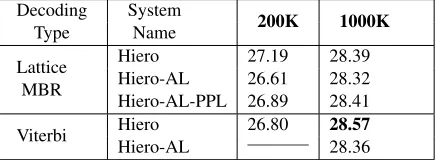
Table 2:Analysis Results. Lowercase BLEU results for German-English trained on 200K and 1000K sentence pairs using Moses (Hoang et al., 2007) in combination with Batch Mira (Cherry and Foster, 2012) for tuning. Top rows display results for our experiments with Lattice Minimum Bayes-Risk Decoding5(Tromble et al., 2008).
Below are results for experiments using Viterbi decoding (i.e. no MBR) for tuning. Results on 200K were run with 10 tuning iterations, results on 1000K with 30 tuning it-erations.
for the Hiero baseline (Hiero) and the fully/partially alignment labeled systems Hiero-AL and Hiero-AL-PPL. In the preceding set of experiments MBR de-coding clearly showed improved performance over Viterbi, particularly for our labelled system.
On the small training set of 200K we observe that the Hiero baseline achieves 27.19 BLEU and thus beats the labeled systems Hiero-AL with 26.61 BLEU and 26.89 BLEU by a good margin. On the bigger dataset of 1000K and with more tuning iter-ations (3), all systems perform better. When using Lattice MBR Hiero achieving 28.39 BLEU, Hiero-AL 28.32 BLEU and finally Hiero-Hiero-AL-PPL achieves 28.41. These are insignificant differences in perfor-mance between the labelled and unlabeled systems.
Table 1 bottom also shows the results of our second set of experiments with Viterbi decoding. Here, the baseline Hiero system for 200K training set achieves a score of 26.80 BLEU on the small training set. We also conducted another set of experiments on the larger training set of 1000K, this time with Viterbi decoding. The Hiero baseline with Viterbi scores 28.57 BLEU while Hiero-AL scores 28.36 BLEU under the same conditions.
labelled system relative to Hiero (in Viterbi) is possi-bly the result of the labelled system being more brit-tle and harder to tune than the Hiero system. This hypothesis needs further exploration.
While a whole set of experimental questions re-mains open, we think that based on this preliminary but nevertheless considerable set of experiments, it seems that our labels do not always improve perfor-mance compared with the Hiero baseline. It is possi-ble that these labels, under a more advanced imple-mentation via soft constraints (as opposed to hard la-beling), could provide the empirical evidence to our theoretical choices. A further concern regarding the labels is that our current choice (5 labels) is heuristic and not optimized for the training data. It remains to be seen in the future if proper learning of these labels as latent variables optimized for the training data or the use of soft constraints can shed more light on the use of alignment labels in hierarchical SMT.
5.4 Analysis
While we did not have time to do a deep compara-tive analysis of the properties of the grammars, a few things can be said based on the results. First of all we have seen that alignment labels do not always im-prove over the Hiero baseline. In earlier experiments we observed some improvement when the labelled grammar was used in combination with Minimum Bayes-Risk Decoding but not without it. In later ex-periments with different tuning settings (Mira), the improvements evaporated and in fact, the Viterbi Hi-ero baseline turned out, surprisingly, the best of all systems.
Our use of MBR is theoretically justified by the importance of aggregating over the derivations of the output translations when labeling Hiero variables: statistically speaking, if the labels split the occur-rences of the phrase pairs, they will lead to multiple derivations per Hiero derivation with fractions of the scores. This is in line with earlier work on the ef-fect of spurious ambiguity, e.g. Variational Decod-ing (Li et al., 2009). Yet, in the case of our model, there is also a conceptual explanation for the need to aggregate over different derivations of the same sen-tence pair. The decomposition of a word alignment into hierarchical decomposition trees has a interest-ing property: the simpler (less reorderinterest-ing) a word alignment, the more (binary) decomposition trees –
and in our model derivations – it will have. Hence, aggregating over the derivations is a way to gather evidence for the complexity of alignment patterns that our model can fit in between a given source-target sentence pair. However, in the current exper-imental setting, where final tuning with Mira is cru-cial, and where the use of MBR within Moses is still not standard, we cannot reap full benefit of our the-oretical analysis concerning the fit of MBR for our models’ alignment labels.
6 Conclusion
We presented a novel method for labeling Hiero variables with nonterminals derived from the hierar-chical patterns found in recursive decompositions of word alignments into tree representations. Our ex-periments based on a first instantiation of this idea with a fixed set of labels, not optimized to the train-ing data, show promistrain-ing performance. Our early experiments suggested that these labels have merit, whereas later experiments with more varied training and decoder settings showed these results to be un-stable.
Empirical results aside, our approach opens up a whole new line of research to improve the state of the art of hierarchical SMT by learning these la-tent alignment labels directly from standard word alignments without special use of syntactic or other parsers. The fact that such labels are in principle complementary with monolingual information is an exciting perspective which we might explore in fu-ture work.
Acknowledgements
References
Alfred V. Aho and Jeffrey D. Ullman. 1969. Syntax directed translations and the pushdown assembler. J. Comput. Syst. Sci., 3(1):37–56.
Hala Almaghout, Jie Jiang, and Andy Way. 2011. Ccg contextual labels in hierarchical phrase-based smt. In
Proceedings of the 15th Annual Conference of the Eu-ropean Association for Machine Translation (EAMT-2011), May.
Stanley F. Chen and Joshua T. Goodman. 1998. An empirical study of smoothing techniques for language modeling. Technical Report TR-10-98, Computer Sci-ence Group, Harvard University.
Colin Cherry and George Foster. 2012. Batch tuning strategies for statistical machine translation. In HLT-NAACL, pages 427–436.
David Chiang. 2005. A hierarchical phrase-based model for statistical machine translation. In Proceedings of the 43rd Annual Meeting of the ACL, pages 263–270, June.
David Chiang. 2006. An introduction to synchronous grammars.
David Chiang. 2007. Hierarchical phrase-based transla-tion. Computational Linguistics, 33(2):201–228. David Chiang. 2010. Learning to translate with source
and target syntax. InProceedings of the 48th Annual Meeting of the Association for Computational Linguis-tics, pages 1443–1452.
Juri Ganitkevitch, Yuan Cao, Jonathan Weese, Matt Post, and Chris Callison-Burch. 2012. Joshua 4.0: Pack-ing, pro, and paraphrases. In Proceedings of the Seventh Workshop on Statistical Machine Translation, pages 283–291, Montr´eal, Canada, June. Association for Computational Linguistics.
Hany Hassan, Khalil Sima’an, and Andy Way. 2007. Su-pertagged phrase-based statistical machine translation. InProceedings of ACL 2007, page 288295.
Hieu Hoang, Alexandra Birch, Chris Callison-burch, Richard Zens, Rwth Aachen, Alexandra Constantin, Marcello Federico, Nicola Bertoldi, Chris Dyer, Brooke Cowan, Wade Shen, Christine Moran, and Ondrej Bojar. 2007. Moses: Open source toolkit for statistical machine translation. In Proceedings of the 41st Annual Meeting on Association for Computa-tional Linguistics - Volume 1, pages 177–180.
Mark Hopkins and Jonathan May. 2011. Tuning as rank-ing. In Proceedings of the Conference on Empiri-cal Methods in Natural Language Processing, pages 1352–1362.
Shankar Kumar and William Byrne. 2004. Minimum bayes-risk decoding for statistical machine translation. InHLT-NAACL, page 16917.
Zhifei Li, Jason Eisner, and Sanjeev Khudanpur. 2009. Variational decoding for statistical machine transla-tion. In Proceedings of the Joint Conference of the 47th Annual Meeting of the ACL and the 4th Interna-tional Joint Conference on Natural Language Process-ing of the AFNLP: Volume 2 - Volume 2, pages 593– 601.
Junhui Li, Zhaopeng Tu, Guodong Zhou, and Josef van Genabith. 2012. Using syntactic head information in hierarchical phrase-based translation. InProceedings of the Seventh Workshop on Statistical Machine Trans-lation, pages 232–242.
Yuval Marton, David Chiang, and Philip Resnik. 2012. Soft syntactic constraints for arabic—english hierar-chical phrase-based translation. Machine Translation, 26(1-2):137–157.
Markos Mylonakis and Khalil Sima’an. 2011. Learning hierarchical translation structure with linguistic anno-tations. In Proceedings of the 49th Annual Meeting of the Association for Computational Linguistics: Hu-man Language Technologies, pages 642–652.
Markos Mylonakis. 2012. Learning the Latent Struc-ture of Translation. Ph.D. thesis, University of Ams-terdam.
Franz Josef Och. 2003. Minimum error rate training in statistical machine translation. In Proceedings of the 41st Annual Meeting on Association for Computa-tional Linguistics - Volume 1, pages 160–167.
Khalil Sima’an and Gideon Maillette de Buy Wenniger. 2011. Hierarchical translation equivalence over word alignments. Technical Report PP-2011-38, Institute for Logic, Language and Computation.
Roy W. Tromble, Shankar Kumar, Franz Och, and Wolf-gang Macherey. 2008. Lattice minimum bayes-risk decoding for statistical machine translation. In Pro-ceedings of the Conference on Empirical Methods in Natural Language Processing, pages 620–629. Ashish Venugopal, Andreas Zollmann, Noah A. Smith,
and Stephan Vogel. 2009. Preference grammars: soft-ening syntactic constraints to improve statistical ma-chine translation. InProceedings of Human Language Technologies: The 2009 Annual Conference of the North American Chapter of the Association for Com-putational Linguistics, pages 236–244.
Dekai Wu. 1997. Stochastic inversion transduction grammars and bilingual parsing of parallel corpora.
Computational Linguistics, 23:377–404.
Hao Zhang, Daniel Gildea, and David Chiang. 2008. Ex-tracting synchronous grammar rules from word-level alignments in linear time. InProceedings of the 22nd International Conference on Computational Linguis-tics - Volume 1, pages 1081–1088.
NAACL 2006 - Workshop on statistical machine trans-lation, June.