D S Sharma, R Sangal and J D Pawar. Proc. of the 11th Intl. Conference on Natural Language Processing, pages 368–377, Goa, India. December 2014. c2014 NLP Association of India (NLPAI)
“
ye word kis lang ka hai bhai?
”
Testing the Limits of Word level Language Identification
Spandana Gella∗
University of Edinburgh Microfost Research Lab, India [email protected]
Kalika Bali, Monojit Choudhury
Microsoft Research Lab, India
{kalikab,monojitc}@microsoft.com
Abstract
Language identification is a necessary pre-requisite for processing any user gener-ated text, where the language is unknown. It becomes even more challenging when the text is code-mixed, i.e., two or more languages are used within the same text. Such data is commonly seen in social me-dia, where further challenges might arise due to contractions and transliterations. The existing language identification sys-tems are not designed to deal with code-mixed text, and as our experiments show, perform poorly on a synthetically created code-mixed dataset for 28 languages.We propose extensions to an existing approach for word level language identification. Our technique not only outperforms the exist-ing methods, but also makes no assump-tion about the language pairs mixed in the text - a common requirement of the ex-isting word level language identification systems.This study shows that word level language identification is most likely to confuse between languages which are lin-guistically related (e.g., Hindi and Gu-jarati, Czech and Slovak), for which spe-cial disambiguation techniques might be required.
1 Introduction
As the World Wide Web is constantly being in-undated by user-generated content in many
lan-guages, automaticLanguage Identification(LI) of
text fragments has become an extremely important ∗
The work was done during authors internship at Mi-crosoft Research Lab India
problem. Since mid 90s, this problem has attracted the attention of researchers (Prager, ), and by 2005 it was thought to be a solved problem (McNamee, 2005). However, there is a renewed interest in LI over last few years (Lui and Baldwin, 2011; Tromp and Pechenizkiy, 2011; Bergsma et al., 2012; Lui and Baldwin, 2012; Goldszmidt et al., 2013; King and Abney, 2013; Carter et al., 2013; Lui et al., 2014) primarily due to a surge in user-generated content in social media, given the rising popularity of Twitter, Facebook and several other online social networking platforms.
Short length, presence of non-standard spelling variations, idiomatic expressions and acronyms are the most commonly cited reasons that make LI for social media content, such as tweets, a challenging problem (Carter et al., 2013; Gold-szmidt et al., 2013). However, there are two other frequently observed phenomena in social media (and also in other forms of user-generated con-tent such as blogs and discussion forums) which
have received very little attention: Code-mixing
andTransliteration.
Code-mixing, loosely speaking, is the process of mixing more than one language in a single con-versation. In the context of social media, code-mixing can be defined as using more than one, usually only two, languages in a single tweet or post. For instance, in the following comment
posted on Facebook, the user hasmixedHindi (in
italics) and English words in a single sentence.
love affection lekar salose
se sunday ke din chali aarahi
divine parampara ko age badhha
rahe ho
has been going on on Sundays for years. This example also illustrates the phenomenon of
transliteration; the Hindi text is not written using the Devanagari script; the user has transliterated it in Roman script. Code-mixing and translitera-tion are not mere challenges for LI, rather these phenomena demand a new definition of LI. It is no longer sufficient to identify the language of a tweet or microblog or even a sentence. One needs
to identify the language of every word.1
Translit-eration adds to the complexity of the problem be-cause there is no notion of correct transliteration
(the same word can be spelled asbadhha, badha,
badhaaand so on), which then can be further con-tracted according to the norms of computer medi-ated communication.
How common are these phenomena? In a
separate study by us (to appear, reference re-moved for anonymity), we found that 50% of the sentences on a Hindi film discussion forum are code-mixed (mainly between Telugu-English and Hindi-English); we also found that 17% of the posts on Facebook public pages of Indian celebri-ties have code-mixing, and more than 90% of the Indian language texts were Romanized. In fact, code-mixing and transliteration are not unique to social media; Gupta et al (2014) have shown that 6% of Bing queries from India has Roman transliterated Hindi words mixed with English terms. Neither is code-mixing unique to Indian languages. In a recently conducted shared task
on LI for codeswitched text2, tens of thousands
of tweets were released that had code-mixing be-tween English and Spanish, English and Nepali, English and Mandarin, and between standard and dialectal Arabic. Thus, LI at word level in the presence of code-mixing and transliteration (wher-ever relevant) is an essential task that needs to be solved before any further analysis of user-generated text in social media.
In this paper, we study the performance of word-level LI for code-mixed text of several state-of-the-art and off-the-shelf LI systems. Since these systems were not designed for tackling code-mixed text, the performance, as expected, is less
1Sometimes, in certain languages, even the same word
can be composed of parts taken from different languages. E.g., the wordhousinalli is composed of an English root houseand Kannada suffixnallimeaning “in the house”. This kind of usage is not uncommon for morphologically rich lan-guages, but is beyond the scope of the current work.
2http://www.emnlp2014.org/workshops/
CodeSwitch/call.html
than satisfactory. We propose extensions to an existing LI technique for language labeling at word level. In the absence of sufficient data across many languages annotated with language labels for words, we created a synthetic dataset by mixing natural language text fragments in 28 languages. Our dataset included three cases of transliterated text, for Hindi, Bengali and Gujarati. The proposed extensions outperform all the exist-ing LI systems evaluated by a significant margin for all 28 languages.
Previous work on LI at word level presumes an
a priori knowledge of the two languages mixed
and the task mostly reduces to a binary classifi-cation problem (Solorio and Liu, 2008a; Nguyen and Dogruoz, 2013; Gella et al., 2013). However, this is not the case in practice. The languages to be identified are usually not known in advance and the set of potential language labels can span all the languages represented on the World Wide Web. The primary contribution of the current work is to highlight the challenges in such a scenario and present a few techniques to deal with these.
The rest of the paper is organized as follows. In Sec. 2 we review related work with special refer-ence to the existing LI systems evaluated in this work. Sec. 3 describes the synthetic dataset cre-ation. In Sec. 4 we propose different extensions and baselines for word level LI, and in the next section, we present the results of the evaluation experiments. Sec 6 discusses the various impli-cations of these results. We conclude with some future directions in Sec 7.
2 Related Work
scripts, processing of the data poses major chal-lenges. Further, many languages that use non-Roman scripts, like Hindi, Bangla, Chinese, Ara-bic etc. are often present in a Romanized form. (Sowmya et al., 2010). Not a lot of work has been done on computational models of code-mixing (Solorio and Liu, 2008a; Solorio and Liu, 2008b; Nguyen and Dogruoz, 2013) , primarily due to the paucity of CM data in conventional text corpora which makes data-intensive methods hard to ap-ply. (Solorio and Liu, 2008a) in their work on English-Spanish CM use models built on smaller datasets to predict valid switching points to syn-thetically generate data from monlingual corpora. While natural language processing like POS tag-ging, normalization, etc remain hard problems to solve, any processing of code-mixed text, first needs to deal with the identification and label-ing of the parts of text which are in different lan-guages.
Monolingual language identification has been worked on intensively in NLP where the task is to assign a language to every document accord-ing to the language it contains. There are existaccord-ing methods which show high accuracies on large (Xia et al., 2009) and short (Tromp and Pechenizkiy, 2011; Lui and Baldwin, 2012) documents when tested against a small set of languages. However, for Code-mixed text, especially those involving transliterations and orthographic variation, this is far from a solved problem. In their work, (King and Abney, 2013) use a weakly supervised n-gram based model trained on monolingual data for la-beling languages in a mixed-language document. In their experiments with language-labels of words in multilingual online discussions using language models and dictionaries, (Nguyen and Dogruoz, 2013) show that spelling variations, similarity be-tween words in the two languages, as well as Named Entities, are the biggest source of errors, though they show some improvement with the in-corporation of context. Gella et al. (2013) built the system with the best performance for the shared task on language identification and back translit-eration for English mixed with Hindi, Bangla and Gujarati in FIRE 2013 (Saha Roy et al., 2013). The system uses a source language with a confi-dence probability for each word similar to (King and Abney, 2013), and incorporates context infor-mation through a code-switching probability. The thing to be noted in all these cases is that the LI
systems have a priori information on the languages that they have to disambiguate,making this essen-tially a binary classification task.
Some of the commonly used as well as state-of-the-art LI techniques used that we evaluate in our work are:
linguini: This was one of the early sys-tems proposed by (Prager, ) to identify multiple languages and their proportions in a single docu-ment. This is based on vector space model, where the languages in a document are determined by the similarity scores of the document vector with the language feature vector.
langid.py: langid.py3 is an off-the-shelf language identification tool trained over naive bayes classifier with a multinomial event model over a mixture of byte 1,2,3,4-grams. It supports 97 languages and has shown high accuracy scores over both long and short documents.
polyglot: This system is designed to detect mul-tilingual documents, their constituent languages and to estimate the portion of each constituent lan-guage. This was achieved with a generative mix-ture model combined with the document represen-tation developed for monolingual language identi-fication. (Lui and Baldwin, 2011).
CLD2: CLD24 is a compact language detection
tool designed to target mono/multi lingual web pages of at least 200 characters. It uses Naive Bayes classifier over unigrams, with quadgrams as features.
3 Synthetic Dataset for Code-Mixed Text In order to conduct a comprehensive evalua-tion of LI systems on code-mixed text, we need a dataset of short text fragments, which we shall
re-fer to asdocument(even though they are no longer
than a sentence), spanning a large number of lan-guages. Ideally, a good proportion of these sen-tences should feature code-mixing between vari-ous language pairs. Most importantly, the words in every sentence must be annotated with the appro-priate language label, so that we can automatically evaluate the performance of various LI systems on this collection.
We are not aware of any such publicly
avail-able dataset. There are monolingual LI
test-benches, but none of these features code-mixing at the word level. The dataset used by (King
3https://github.com/saffsd/langid.py 4https://code.google.com/p/cld2/
and Abney, 2013) has language mixing at inter-sentential level; typically there are stretches of 20 or more words in a single language before switching. However, tweets and social media posts are shorter, and code-mixing in such con-text often means embedding one to three word phrases of one language inside a sentence in an-other language (such as the example cited in Sec. 1). Recently, around 500 code-mixed Web search queries with language labels for words were released as a part of the FIRE shared task on transliterated search (Roy et al., 2013). The dataset contains Bengali-English, Hindi-English and Gujarati-English mixed queries, where all the Indian language words are Romanized. We shall
refer to this dataset as theFIRE-data, which will
be used later for some of our experiments.5
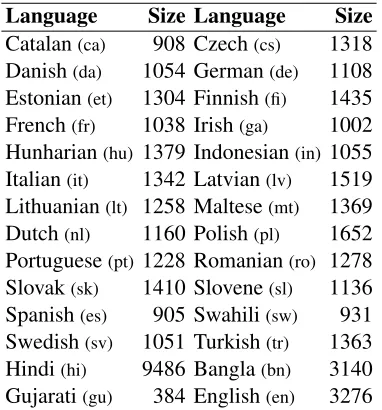
Code-mixed text in only four languages is not sufficient for a realistic evaluation of Web-scale systems. Nevertheless, it is also a very effort inten-sive task to gather and annotate code-mixed text for a large number of language pairs. Hence, we decided to create a synthetic code-mixed dataset spanning 28 languages listed in Table 2.
3.1 Design Principles
Artificially generating code-mixed text from monolingual text data is a non-trivial problem for several reasons. First, code-mixed text is not a random mixture of two languages; rather there are strict syntactic and semantic rules that gov-ern the code-switching points as well as the struc-ture of the sentence. Second, while theoretically one could mix any subset of languages, in practice code-mixing is commonly observed only between certain pairs of languages which have a sizeable bilingual population with active Web presence. Therefore, we came up with the following design principles for creating a synthetic dataset:
1. Every document consists of words from at most two languages. This is based on a practical observation that people rarely mix more than two languages in a single sentence. Whenever they apparently mix more than two languages, words of one of the languages can almost always be
ex-plained away asborrowingrather than mixing.
5As a part of the Code-switching shared task at EMNLP
2014, large datasets for English-Spanish, English-Mandarin, English-Nepali and Dialectal-Standard Arabic have been re-leased recently. But those were not available during this study.
2. All the documents are in a single script, which we chose as the Roman script because of its popularity. If in a code-mixed text, each lan-guage is written in their native script (say Hindi words in Devanagari and English words in Ro-man script), LI becomes a trivial problem. There-fore, we choose languages which either use Ro-man script (like most of the West European lan-guages) or languages which are quite commonly Romanized on the Web such as the Indian lan-guages.
3. Whenever code-mixing happens, one of the languages is always English. This principle is also based on the empirical observation that code-mixing happens mostly between English and other languages (Vyas et al., 2014). However, this is not necessary; there are examples of code-mixing between Turkish and Dutch, Arabic and French, Chinese and Malay, and so on. Since selecting a representative set of language pairs is difficult, and mixing between all pairs would not only lead to impractical cases, but also make it cumbersome to analyze and represent the experimental data, we decided to only experiment with mixing between English and other languages. Note that this choice does not limit the generality of the conclusions of this study as none of the algorithms exploit the fact that one of the languages is English.
4. The length of the documents vary from 4 to 12 words, roughly equivalent to 20-135 charac-ters. This choice is again motivated by the typical length of tweets and social media posts.
of losing some generality.
3.2 Dataset Creation
As a testbench for our experiments, we created a synthetic dataset following the above design prici-ples. The monolingual text samples have been col-lected from the dataset used by (King and Abney, 2013). These are texts from the Wikipedia and var-ious other resources, such as The Universal Decla-ration of Human Rights, Rosetta project and
Jeho-vah’s Witness website6. We selected 25 languages,
including English, from this sample, all of which use Roman script.
We created 954 short documents for each lan-guage in the following manner. First, a real valued
random variable γ is sampled uniformly at
ran-dom from the interval[0,1]. γ defines the
frac-tion of words in the document that are in English.
Another integer valued random variableLis
sam-pled, again uniformly at random from the
inter-val[4,12]. Lis the number of words in the
docu-ment. We define two integer dependent variables
X=round(γL)andY =round((1−γ)L). Here,
round(·) is the rounding-to-nearest-integer
func-tion. A sequence of X words are chosen from
the English monolingual corpus (i.e., anX-gram
is sampled from the corpus following theX-gram
frequency distribution of English). Let us denote
this sequence (potentially null) asZen. Similarly,
a sequence ofY words are sampled, again at
ran-dom from the text corpus of the other language. Let this (again potentially null) sequence be
de-noted byZl∗. Finally, a binary variable sis
sam-pled from {0,1}. If s = 1, we generate the
documentZenZl∗, else we generate the document
Zl∗Zen. Thus, we created 22896 documents
span-ning 25 languages, most of which are code-mixed with English.
For transliterated text in Gujarati, Bengali and Hindi, we used the test and development sets
of the FIRE-data. This dataset has naturally
code-mixed text mostly derived from Web search queries, and we will report the performance of our system directly on this data.
In Table 1 we show few sample test documents.
3.3 Limitations
It is important to understand the limitations of this synthetic dataset, so that we can appropri-ately draw our conclusions on the basis of the
6http://www.watchtower.org
experimental results on this testbench. As we shall see in the next section, none of the LI al-gorithms proposed here explicitly assume that at most two languages are mixed and there is only one codeswitching point. Therefore, we believe that these features of the synthetic dataset are not expected to lead to any misleading conclu-sions. On the other hand, real code-mixed data can have richer distributional patterns, for instance often single words or short phrases are embed-ded, which if appropriately exploited can lead to better performance. This dataset, however, lacks contractions and non-standard spellings because most of the text fragments come from Wikipedia. Therefore, performance of the algorithm on tweets or social media data could be lower than what we observe here, unless the training data is appropri-ately modified.
4 Language Identification Algorithms Following the ideas of (King and Abney, 2013) and (Gella et al., 2013), we first build binary clas-sifiers for each language. The classifier for a
lan-guage ltakes a word as input and returns a score
between 0 and 1, which can be loosely interpreted as some sort of probability that the input word is
of languagel. We combine the outputs of these 28
classifiers and the context of a word to decide the final label of the word. We use character n-gram based classifiers as they are more efficient, robust to noisy data and save us the effort of collecting lexicons.
In this section, first we describe the binary clas-sifier, followed by two simple baselines and one simple disambiguation strategy. We also describe a method to compute the accuracy if we had an optimal disambiguation strategy.
4.1 Binary classifier for Words
For each language l, we built a binary
classi-fier using character n-gram features. We
experi-mented with character n-grams forn= 1to 5, and
two standard classifiers –Naive Bayesand
Logis-tic Regression, for which we used the Mallet tool box (McCallum, 2002) set to the default settings. The positive examples consisted of a random set
of words ofland an equal number of negative
Language L γ Sentence
Spanish 8 0.50 do nicely Switch offefectivos tanto entre los
Turkish 11 0.45 safhalarnda paraszdr lk retim mecburidir Teknikbe delighted to meet them
French 12 0.25 Vasili knew thisune libert plus grande Considrant que les tats Membres
Hindi 5 0.60 to reinvent Michiganchandini badarava
Bangla 9 0.60 swadhinatar sutre smritituku paseisailing in from another room
Latvian 5 0.10 ierobeojumu un apmakstu periodisku atvainjumu
Swahili 11 0.90 ya Magharibi kwenye pwani la Bahari Atlantiki Imepakana na Beninfinger
Table 1: Sample of synthetic test data; the non-English part is in italics
ated content is not available on Wikipedia, for the three Indic languages the training data was
obtained from the development set of the
FIRE-data. Table 2 shows the number of positive
train-ing examples used for each language. An equal number of negative examples were used as well.
We found that for all languages, logistic regres-sion gave the best performance when we use a
combination of n-gram features for alln = 1 to
5. The accuracy on the training set of the best bi-nary classifiers varied from 0.866 for Catalan to 0.992 for Gujarati with an average of 0.941. These findings and numbers are in good agreement with those mentioned in (King and Abney, 2013; Gella et al., 2013).
Language Size Language Size
Catalan(ca) 908 Czech(cs) 1318
Danish(da) 1054 German(de) 1108
Estonian(et) 1304 Finnish(fi) 1435
French(fr) 1038 Irish(ga) 1002
Hunharian(hu) 1379 Indonesian(in)1055
Italian(it) 1342 Latvian(lv) 1519
Lithuanian(lt) 1258 Maltese(mt) 1369
Dutch(nl) 1160 Polish(pl) 1652
Portuguese(pt) 1228 Romanian(ro) 1278
Slovak(sk) 1410 Slovene(sl) 1136
Spanish(es) 905 Swahili(sw) 931
Swedish(sv) 1051 Turkish(tr) 1363
Hindi(hi) 9486 Bangla(bn) 3140
[image:6.612.95.286.404.609.2]Gujarati(gu) 384 English(en) 3276
Table 2: Languages tested and number of unique words in the training samples used for training the binary classifiers for words.
4.2 Baselines
Letd = w1, w2. . . w|d| be a document, where
wi’s are the words. The task of word-level LI
is to assign each wordwi with a language label
λ(wi) chosen from L = {l1, l2...l28}, the set of
all languages. Let us denote the confidence score
of the classifier for language lj on input wi as
conf score(wi, lj).
MaxWeighted: In this method we simply as-sign the label of the language classifier that has the highest confidence score.
λ(wi) = argmaxnj=1conf score(wi, lj)
Thus, this is a completely context agnostic model.
Random: In this model, a randomly chosen la-bel from the possible set of lala-bels is assigned to
thewi, where the possible set of labels is obtained
by setting a threshold value t on the confidence
scores of the classifiers.
λ(wi) =rand{lj :conf score(wi, lj)≥t}
whererand{·}selects a random element from the
set.
4.3 CoverSet Method
The CoverSet method is based on the
as-sumption that code-mixing, whenever it happens, happens only with a few languages, though it as-sumes no hard upper bound on the number of lan-guages that can be mixed in a document. Thus, we
want to choose as few labels from L as possible
so as to label or cover all the words w1 to w|d|,
without compromising on accuracy. Since this in
essence is similar to theminimum set cover
prob-lem, we call this technique theCoverSet.
Like Random, we define a hard threshold t,
such that the only labels that are considered valid
forwiare those for whichconf score(wi, lj)≥t.
Let us define this subset of languages asLi ⊂L.
We define the minimal coversetofdasL∗dif and
only if the following two conditions are satisfied:
1. L∗d∩Li 6=φ ∀1≤i≤28
2. There does not exist a set L0d that satisfies
condition 1, and|L0d|<|L∗d|.
Once theminimal coversetis determined through
iterative search,λwiis assigned the label from the
setL∗d∩Li that has the highest confidence score.
Note that there can be more than oneminimal
co-verset for d, in which case, we do the labeling for all the sets and the one that yields the highest
P
iconf score(wi, λ(wi))is selected as the final
output.
4.4 Optimal Labels
In order to estimate the maximum achievable accuracy in such an extreme LI problem with our language classifiers, we designed the following
optimal method. For each wordwi, we first
com-pute the set of possible labelsLibased on a
thresh-old t. If the actual (gold standard) label of wi,
λ∗(wi)∈Li, then we assignλ(wi) =λ∗(wi), else
any random label is selected forLi. Note that this
is not a practical system because it assumes the knowledge of the gold standard labels; but it will be studied to understand the maximum achievable accuracy of a word label LI system.
5 Experiments and Results
We evaluated the four existing LI systems as well as the four proposed word level LI strategies on the synthetic testbench. Since the existing LI systems output language labels only for the entire document, we evaluated them on document label-ing accuracy, and only on the 25 non-Indic lan-guages because they cannot handle transliterated content. However, the strategies that we proposed were evaluated on both document and word label-ing accuracies for all the languages.
5.1 Document label accuracy
Table 3 we present the document label accu-racies for the 8 systems. For a given document,
Lang1refers to the language which has the higher proportion of words. The other language is
de-noted asLang 2. In other words, if for a
docu-mentγ >0.5,Lang1is English andLang2is the
other language, elseLang1is the other language
andLang2is English.
The 4 existing systems output a single lan-guage as the label for an input document. But
linguini, polyglot and langid.py also
output a second or more languages with some
System Lang1 Lang2 Code Mixing
P R F
linguini 0.589 0.084 0.817 0.846 0.831
polyglot 0.827 0.308 0.990 0.426 0.590
langid.py 0.781 0.058 0.790 1.000 0.885
CLD2 0.817 NA NA NA NA
Random-0.8 0.635 0.235 0.814 0.991 0.894
MaxWeighted 0.832 0.468 0.814 0.993 0.895
CoverSet-0.5 0.888 0.717 0.868 0.991 0.920
Optimal-0.5 0.968 0.882 0.910 0.990 0.953
Table 3: Document label accuracies for the
exist-ing and the proposed LI systems. The value of t
shown after hyphen.
scores whenever the system identifies that the doc-ument could consist of more than one language. Thus, for these systems, we compare their first or
primary output withLang1and the second output,
whenever present, withLang2to compute the
re-spective accuracies. For our approaches, we count the word labels and assign the language with the highest and the second highest number of labels in
the document as Lang1 andLang2respectively.
We tuned the parameter t for three of the
pro-posed systems for maximum word labelling accu-racy. These values are also shown in the Table 3, for which the document labeling accuracies have been reported.
We also report the precision (P), recall (R),
f-score (F) of the systems in identifying
code-mixed documents. While computing these values, we did not consider the language labels, but only whether the output was a single (implying mono-lingual document) or multiple (implying code-mixed document) languages.
System Hindi Gujarati Bangla English
Random-0.8 0.170 0.103 0.180 0.812
MaxWeighted 0.419 0.105 0.399 0.797
CoverSet-0.5 0.569 0.017 0.394 0.814
Optimal-0.5 0.792 0.714 0.719 0.864
Table 4: Language accuracies onFIRE-data
Table 4 presents the document labeling accu-racies for the 3 Indic languages evaluated on the
5.2 Word Labeling Accuracy
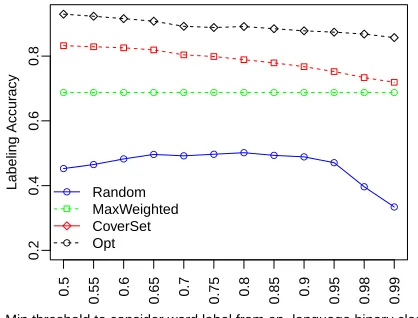
We define the word labeling accuracy as the fraction of words (tokens) in the entire synthetic dataset (including Indic language data) that have been labeled with the correct language. Fig-ure 1 plots the word labeling accuracy of the
four systems for different values of t. Since
MaxWeighteddoes not depend ont, its value is
constant (0.67). As expected,Optimalpresents
an upper-bound on the accuracy, which is close to
0.94, and theRandombaseline provides a
lower-bound on the accuracies, which varies between 0.3
and 0.5. Performance of CoverSet is always
better thanMaxWeighted, and reaches 0.82 for
optimal value oft= 0.5.
L A Top n confused languages
it .815 en(.096) ca(.018) ro(.012) pt(.010) es(.009)
es .733 pt(.071) en(.060) it(.038) ca(.027) ro(.013)
mt .889 en(.039) nl(.007) fr(.005) ro(.004) it(.004)
tr .809 en(.094) hi(.015) bn(.014) da(.011) lv(.007)
fr .681 en(.201) ca(.029) ro(.017) pt(.017) it(.008)
hu .884 en(.024) bn(.011) hi(.009) da(.009) pt(.007)
ca .618 en(.199) es(.040) ro(.025) pt(.025) fr(.023)
sk .690 cs(.164) en(.062) sl(.031) pl(.009) bn(.006)
lt .869 en(.032) lv(.021) bn(.012) id(.007) pt(.006)
de .775 en(.122) nl(.041) da(.016) sv(.007) fr(.006)
ga .811 en(.112) pt(.018) fr(.012) hu(.007) bn(.006)
sl .737 en(.065) sk(.063) cs(.030) bn(.017) hi(.015)
pl .871 en(.043) sk(.013) ro(.010) mt(.009) pt(.006)
ro .740 en(.127) it(.027) fr(.021) ca(.019) es(.010)
nl .730 en(.153) de(.039) da(.032) hu(.007) sv(.007)
pt .800 en(.070) es(.050) it(.023) ca(.015) bn(.007)
sv .803 en(.082) da(.061) de(.008) nl(.007) it(.006)
cs .599 sk(.218) en(.069) sl(.030) hu(.018) mt(.011)
da .702 en(.177) sv(.060) nl(.015) mt(.011) de(.007)
fi .681 et(.169) en(.037) hi(.022) sv(.020) bn(.011)
et .848 en(.050) hi(.024) ro(.009) nl(.009) id(.009)
lv .848 en(.041) lt(.026) pl(.013) sl(.008) id(.006)
sw .714 en(.069) tr(.039) hi(.032) bn(.026) pl(.017)
id .810 hi(.045) en(.040) bn(.016) es(.014) tr(.014)
hi .738 bn(.148) en(.040) id(.014) gu(.006) nl(.006)
bn .878 en(.042) hi(.041) pt(.003) it(.003) id(.003)
gu .712 hi(.146) bn(.087) en(.017) id(.006) mt(.005)
en .897 pt(.008) it(.008) fr(.007) hu(.006) ga(.006)
Table 5: Confusion matrix between languages. L:Language, A: Accuracy
5.3 Error Analysis
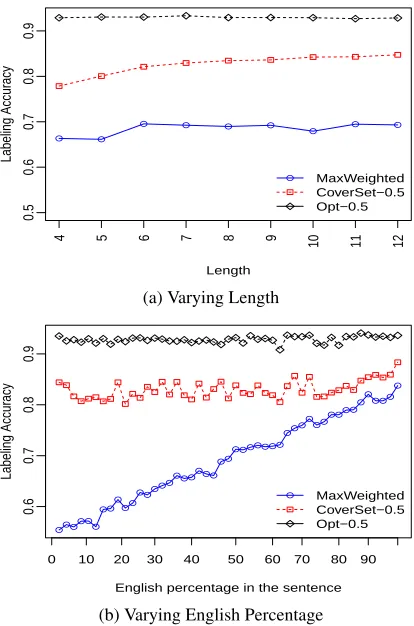
Figures 2a and 2b show the variation of the word labeling accuracy of three of the proposed
systems (results for Random ommited) with the
parameters L (document length) and γ (fraction
● ●
● ● ● ● ● ● ●
●
●
●
● ● ● ● ● ● ● ● ● ● ● ●
0.5
0.55 0.6 0.65 0.7 0.75 0.8 0.85 0.9 0.95 0.98 0.99
Min threshold to consider word label from en−language binary classifier
0.2
0.4
0.6
0.8
Labeling Accur
acy
●
●
Random MaxWeighted CoverSet Opt
Figure 1: Word labeling accuracy vs.t
of words in English). Again, as expected,
perfor-mance ofOptimalis not affected by variation of
these parameters, and that of CoverSetis also
quite robust though we see slight decrease in
per-formance when L drops below 6. Performance
ofMaxWeightedis mostly unaffected byL, but
improves linearly withγ, which implies that there
is a high tendency for this system to label words as English.
We also computed the language label confusion matrix for these strategies. Table 5 shows the five most common confused languages for each of the languages, along with the fraction of tokens so
confused by theCoverSetapproach. From the
table we can infer that English is the least confused language and Czech, Catalan and Finnish are the most confused languages. This table also shows that (Czech, Slovak), (Gujarati, Hindi), (Hindi, Bangla) and (Finnish, Estonian) are some of the most confused language pairs.
6 Discussion
As can be seen from the results presented in the previous section, three of the four extensions pro-posed by us outperform all of the existing LI
sys-tems (Table 3). WhilepolyglotandCLD2are
[image:8.612.316.525.44.203.2]● ●
● ● ● ●
● ● ●
4 5 6 7 8 9 10 11 12
Length
0.5
0.6
0.7
0.8
0.9
Labeling Accur
acy
● MaxWeighted CoverSet−0.5 Opt−0.5
(a) Varying Length
●●● ●●
● ●●
● ●●
●●●●● ●●●●●●
●● ●●●●●●●
●●● ●
●● ●●●●
● ●
●●● ●
0 10 20 30 40 50 60 70 80 90
English percentage in the sentence
0.6
0.7
0.8
0.9
Labeling Accur
acy
● MaxWeighted CoverSet−0.5 Opt−0.5
[image:9.612.84.291.41.354.2](b) Varying English Percentage
Figure 2: Effect ofLandγ on the performance.
bels from a set without taking any context infor-mation into consideration.
All the three extensions are robust to length, i.e., the number of words in a text fragment (Fig. 2a). The Optimalmethod provides an upper-bound on the accuracy that can be achieved using the
cur-rent set of binary classifiers.CoverSetuses
con-text information and achieves higher accuracies for labeling both Lang1 and Lang2 confirming the importance of context in identifying languages in
code-mixed text. Further, CoverSettechnique
is also stable with respect toγ. Thus, from the
results theCoverSettechnique seems the most
promising for identifying and labeling languages in a code-mixed text.
It is interesting to note that the language-pairs that are confused the most (e.g., Hindi-Gujarati, Slovak-Czech etc.) are linguistically related and very close to each other. In fact, the very poor
per-formance of theCoverSetmeythod for Gujarati
as opposed to that ofOptimalin Table 4 is due
to the fact that most of the Gujarati words were also identified as Hindi words. Hence,these are
likely to be confused by the LI systems. It there-fore seems that different techniques and features would be required to disambiguate between these languages.
The fall in accuracies for all the proposed
ex-tensions when tested on FIRE-data could be
at-tributed to the fact that this data is not synthetic and shows all the variations we might expect in real code-mixed data, but more importantly the data is in Roman transliteration. As previous stud-ies have shown (Sowmya et al., 2010; Ahmed et al., 2011) there is a lot of variation in translit-erations of Indian languages due to one-to-many mappings at character level, regional variations and lack of any universally applicable standard conventions. The difficulty for LI systems to dis-ambiguate transliterated Indian languages, thus, increases manifold. It should be noted, however, that the overall trend followed by the proposed ex-tensions remains the same as that on the synthetic data for other languages.
7 Conclusion
In this paper we considered language identifica-tion task for short code-mixed documents contain-ing one or two languages. We analyzed the word-level LI accuracy of some off-the-shelf systems on code-mixed synthetic dataset. We extended these algorithms to identify word-labels across 28 lan-guages. The results show that our extensions out-perform the existing systems significantally. How-ever, most of the methods used consider a binary classification for a language pair.
An important area to work on is the code-mixing of transliterated text where standard tech-niques do not work and lexicons are not avail-able. Our results also show that linguistically close or related languages are more difficult to disam-biguate and further work is required to specifi-cally address this problem.The biggest bottleneck, as always, remains the unavailability of suitable datasets and we will continue to explore new ways to collect, generate and annotate code-mixed data. In conclusion, we would like to mention that lan-guage identification is far from a solved problem; issues like code-mixing, transliteration and non-standard usage not only make it a more difficult problem, but also demands fundamental modifica-tions in the definition of LI. It is an area that is likely to attract a lot more interest from researchers in the near future.
References
U. Ahmed, K. Bali, M. Choudhury, and V. B. Sowmya. 2011. Challenges in designing input method editors for indian languages: The role of word-origin and context. In Proceedings of IJCNLP Workshop on Advances in Text Input Methods.
S. Bergsma, P. McNamee, M. Bagdouri, C. Fink, and T. Wilson. 2012. Language identification for cre-ating language-specific Twitter collections. In Pro-ceedings of the Second Workshop on Language in Social Media, pages 65–74.
MS Cardenas-Claros and N Isharyanti. 2009. Code-switching and code-mixing in internet chatting: Be-tween yes, ya, and si a case study. InThe JALT CALL Journal, 5.
S. Carter, W.Weerkamp, and E. Tsagkias. 2013. Microblog language identification: Overcoming the limitations of short, unedited and idiomatic text. Language Resources and Evaluation Journal, 47:195–215.
Spandana Gella, Jatin Sharma, and Kalika Bali. 2013. Query word labeling and back transliteration for in-dian languages: Shared task system description. In FIRE Working Notes.
Moises Goldszmidt, Marc Najork, and Stelios Papari-zos. 2013. Boot-strapping language identifiers for short colloquial postings. InProc. of ECMLPKDD. Springer Verlag.
J. Gumperz. 1982. Discourse Strategies. Oxford Uni-versity Press.
Parth Gupta, Kalika Bali, Rafael E. Banchs, Monojit Choudhury, and Paolo Rosso. 2014. Query ex-pansion for mixed-script information retrieval. In Proc. of SIGIR, pages 677–686. ACM Association for Computing Machinery.
S. Herring. 2003. Media and Language Change: Spe-cial Issue.
Ben King and Steven Abney. 2013. Labeling the lan-guages of words in mixed-language documents us-ing weakly supervised methods. InProceedings of NAACL-HLT, pages 1110–1119.
Marco Lui and Timothy Baldwin. 2011. Cross-domain feature selection for language identification. InIn Proceedings of 5th International Joint Conference on Natural Language Processing. Citeseer.
Marco Lui and Timothy Baldwin. 2012. langid. py: An off-the-shelf language identification tool. In Proceedings of the ACL 2012 System Demonstra-tions, pages 25–30.
Marco Lui, Jey Han Lau, and Timothy Baldwin. 2014. Automatic detection and language identification of multilingual documents. Transactions of the Asso-ciation for Computational Linguistics, 2:27–40.
Andrew Kachites McCallum. 2002. Mal-let: A machine learning for language toolkit. http://mallet.cs.umass.edu.
P. McNamee. 2005. Language identication: A solved problem suitable for undergraduate instruc-tion. Journal of Computing Sciences in Colleges, 20(3).
C. Myers-Scotton. 1993. Dueling Languages: Gram-matical Structure in Code-Switching. Claredon, Ox-ford.
C. Myers-Scotton. 2002. Contact linguistics: Bilin-gual encounters and grammatical out-comes. Ox-ford University Press, OxOx-ford.
Dong Nguyen and A. Seza Dogruoz. 2013. Word level language identification in online multilingual communication. InProceedings of the 2013 Con-ference on Empirical Methods in Natural Language Processing, pages 857–862.
John C. Paolillo. 2011. “conversational” codeswitch-ing on usenet and internet relay chat. Lan-guage@Internet, 8(3).
John M Prager. Linguini: Language identification for multilingual documents. InSystems Sciences, 1999. HICSS-32. Proceedings of the 32nd Annual Hawaii International Conference on.
Rishiraj Saha Roy, Monojit Choudhury, Prasenjit Ma-jumder, and Komal Agarwal. 2013. Overview and datasets of fire 2013 track on transliterated search. InFIRE Working Notes.
T Solorio and Y. Liu. 2008a. Learning to predict code-switching points. InProceedings of the Empirical Methods in natural Language Processing.
T Solorio and Y. Liu. 2008b. Parts-of-speech tagging for english-spanish code-switched text. In Proceed-ings of the Empirical Methods in natural Language Processing.
V. B. Sowmya, M. Choudhury, K. Dasgupta Bali, T., and A. Basu. 2010. Resource creation for training and testing of transliteration systems for indian lan-guages. InProceedings of the LREC 2010.
Erik Tromp and Mykola Pechenizkiy. 2011. Graph-based n-gram language identification on short texts. InProc. 20th Machine Learning conference of Bel-gium and The Netherlands, pages 27–34.
Yogarshi Vyas, Spandana Gella, Jatin Sharma, Kalika Bali, and Monojit Choudhury. 2014. Pos tagging of english-hindi code-mixed social media content. Proceedings of the First Workshop on Codeswitch-ing, EMNLP.
Fei Xia, William D Lewis, and Hoifung Poon. 2009. Language id in the context of harvesting language data off the web. InProceedings of the 12th EACL, pages 870–878.