Semantic Web based Machine Translation
Bettina Harriehausen-M ¨uhlbauer
University of Applied Sciences Darmstadt, Germany
Timm Heuss
University of Applied Sciences Darmstadt, Germany [email protected]
Abstract
This paper describes the experimental com-bination of traditional Natural Language Processing (NLP) technology with the Se-mantic Web building stack in order to ex-tend the expert knowledge required for a Machine Translation (MT) task. Therefore, we first give a short introduction in the state of the art of MT and the Semantic Web and discuss the problem of disambiguation being one of the common challenges in MT which can only be solved using world knowledge during the disambiguation pro-cess. In the following, we construct a sam-ple sentence which demonstrates the need for world knowledge and design a proto-typical program as a successful solution for the outlined translation problem. We con-clude with a critical view on the developed approach.
1 Introduction
Over the past decades, Machine Translation (MT) has undergone various changes with regard to the underlying technology. Starting in the mid-dle of the last century with rule-based MT, a first logical step was taken towards the end of the century, when statistical methods in Natural Language Processing (NLP) gained overall im-portance, as the growing number of online avai-lable texts could be used as a basis for statistical computations performed on these texts and trans-lations, which resulted in an enhancement of ex-isting rules, statistics and thus results. The new field of Statistical Machine Translation (SMT) was born and MT systems became increasingly better as more and more texts and translations were available. In parallel to the developments in
MT, the Web has significantly grown and gained importance, especially in the recently defined field of the Semantic Web. After having accepted statistical methods as a promising change in MT, we believe that a next logical step will combine MT with Semantic Web technology, resulting in a new focus which can be called Semantic Web Machine Translation (SWMT).
In this paper, we will develop our ideas step by step and will demonstrate on a sample sentence including a lexical ambiguity that our approach does not involve a costly disambiguation pro-cess on the basis of parsing online-dictionaries. Instead, we believe that modern Information Technology (IT) is aligned and committed to in-formation and its markup, as the W3C Semantic Web technology stack1demonstrates, and that we can use the contained knowledge in our disam-biguation process without additional MT rules or statistics being applied.
2 Development and change of focus in MT : from the rule-based past to the web-based future of MT
Traditionally, most MT systems were rule-based systems built on electronic analysis and ge-neration grammars as well as a language-pair-dependent transfer component . These Rule-based Machine Translation (RBMT) systems always in-volved a careful and time-consuming develop-ment of grammatical rules.
More recent development in MT has started to use the vast amount of texts and knowledge that is available online for translations based on statistics
1
http://semanticweb.org/wiki/Main_Page (URL last access 2011-12-18).
and probabilities, leading to a separate focus in MT, namely SMT.
With the growing size of texts available in the web, it is a logical next step to consider using the available knowledge in these texts to enhance NLP applications, including MT, leading to a yet new focus, which we call SWMT.
In this chapter we will develop our idea by starting with a look at how MT has developed over the past decades, how it has made use of the ex-panding Web in recent years and where we see further potential in using existing knowledge for MT technology.
2.1 Statistical Machine Translation
The dream of automatically translating docu-ments from foreign languages into English, or be-tween any two languages, is one of the oldest pur-suits of NLP, being a subfield of artificial intel-ligence research. Traditional MT systems com-puted translations primarily on the basis of ana-lysis and generation phrase-structure-rules, which had to be manually coded in a costly fashion.
One of the leading users of SMT is Google and Google Translate engineer Anton Andryeyev, who explains SMT’s essence as follows:
”SMT generates translations based on patterns found in large amounts of text. [...] Instead of trying to teach the machine all the rules of a lang-uage, SMT effectively lets computers discover the rules for themselves. It works by analysing mil-lions of documents that have already been trans-lated by humans [...].
[...] Key to SMT are the translation dictio-naries, patterns and rules that the program devel-ops. It does this by creating many different pos-sible rules based on the previously translated doc-uments and then ranking them probabilistically. Google admits this approach to translation in-evitably depends on the amount of texts available in particular languages [...].” (Boothroyd 2011)
Therefore, with the change of available re-sources and the growing number of natural lang-uage that is available in machine-readable for-mat as well as the growing number of users in-putting corrections to machine translations man-ually, thus allowing a direct and correct match between source and target texts, we have entered this subfield of MT which focuses on a statistical analysis of texts, in which documents are trans-lated according to a probability distribution p(e|f)
which states that a string e in the target language is the translation of a string f in the source lang-uage.
Philipp Koehn, being among the most popu-lar SMT researchers and developers, also high-lights today’s quality of SMT and the relevance of the vast amounts of texts in the web, which provide the basis for SMT translations, by stating ”Now, armed with vast amounts of example trans-lations and powerful computers, we can witness significant progress toward achieving that dream.” (Koehn et al. 2012)
The research field of statistical machine trans-lation is a rather new field. In his commented bib-liography2Koehn includes statistics about the dis-tribution of publications in the SMT field across the years 1953 until 2008. It is clearly shown that only a few publications appeared before the mil-lennium change and that SMT clearly became an issue of growing interest in the new millennium, with a peak in 2006. Scientists working in the MT field suddenly became aware of the relevance and potential provided by statistics in machine translation and computational linguistics in gen-eral. Still in 2003, Knight & Koehn stated, that ”the currently best performing statistical machine translation systems are still crawling at the bot-tom”, (Knight & Koehn 2004, p. 10), implying that most of the approaches hadn’t gone beyond simple word to word translations yet and hadn’t included more advanced stages of NLP, like syn-tax or even semantics. Among those who made essential contributions to the field of SMT was Kevin Knight who stated in 1999 that ”We want to automatically analyse existing human sentence translations, with an eye toward building general translation rules we will use these rules to trans-late new texts automatically.” (Knight 1999)
The previous statements all point at the vast knowledge included in the just as vast amounts of texts available in digital form in the internet, partly in the form of human sentence translations.
At the same time that MT started clearly mov-ing into usmov-ing the Web to search for machine-readable texts and translations that could be used in the expanding SMT field, Tim Berners-Lee (Berners-Lee & Hendler 2001) defined the know-ledge, that is included in the Web content, to
ex-2
pand the traditional WWW to become a Semantic Web
As we are looking at an expanded view of how to use the Web, and specifically the Semantic Web, for our approach of MT, we would like to draw parallels between what has been said so far about MT and the innovative possibilities that the Semantic Web provides for MT research.
2.2 W3C Semantic Web
The World Wide Web (WWW) was once designed to be as simple, as decentralized and as interop-erable as possible (Berners-Lee 1999, 36f.). The Web evolved and became a huge success, how-ever, information was limited to humans. In or-der to make information available to machines, an extending and complementary set of technolo-gies was introduced in the new millennium by the W3C, the Semantic Web3 (Berners-Lee & Hendler 2001).
The base technology of the Semantic Web is the data format Resource Description Framework (RDF). Aligned to the so called AAA slogan that ”Anyone can say Anything about Any topic” (Allemang & Hendler 2008, p. 35), it defines a structure that is meant to ”be a natural way to describe the vast majority of the data processed by machines” (Berners-Lee & Hendler 2001). In addition to the AAA slogan, a basic construc-tion paradigms of the Semantic Web is the Open World Assumption - the fact that there is always more knowledge than we currently know; new knowledge can always be added later.
RDF expresses meaning by encoding it in sets of triples (Berners-Lee & Hendler 2001), com-posed of subject, predicate and object, which are, in the N3-notation format4, likewise written down as triples:
:subject :predicate :object
We see strong connections between MT and the W3C Semantic Web.
A lot of ideas exist on how to augment the Resource Description Framework (RDF) the base format of the Semantic Web -with natural language. Since the beginning, RDF itself provided capacities for a ”human-readable version of a resource’s name” (Guha
3http://www.w3.org/standards/semantic
web/(URL last access 2012-01-25). 4
http://www.w3.org/DesignIssues/Notati on3.html(URL last access 2012-01-29).
2004), rdfs:label, with an optional lang-uage notation following RFC-30665 (Klyne & Carroll 2004). In addition to that, the Sim-ple Knowledge Organization System (SKOS) ontology features a small selection of uni-code labels for ”creating human-readable rep-resentations of a knowledge organization sys-tem”, skos:prefLabel, skos:altLabel
and skos:hiddenLabel - but also remarks that it ”does not necessarily indicate best practice for the provision of labels with different language tags” (Miles 2008).
Some alternatives developed to the approches above, to address limitations especially of
rdfs:labeland to represent natural language within semantic knowledge in a more sophisti-cated way, like the SKOS eXtension for Labels (SKOS-XL)6, Lemon7and LexInfo8.
And even in the area of wordnets, which might be considered as a more traditional NLP domain, W3C Semantic Web technology plays a role, as approaches were developed to bridge the gap between natural language representations within these wordnets and the design principles of the Semantic Web (Graves & Gutierrez 2005). The conversion of Princeton WordNet9, for example, to RDF/OWL is covered by a W3C Working Draft (van Assem et al. 2006) or the GermaNet wordnet10 equivalent approach (Kunze & L¨ungen 2007), adapting the ideas of the Princeton WordNet conversation.
We decided to give a brief overview of the state-of-the-art of SMT and the Semantic Web, as both areas of research are not only very new developments but they share using information in the Web for their applications and they both offer promising enhancements to traditional, rule-based MT technology. Nevertheless, SMT and Seman-tic Web Technologies have fundamental
differ-5http://www.ietf.org/rfc/rfc3066.txt
(URL last access 2012-01-25).
6http://www.w3.org/TR/skos-reference/
skos-xl.html(URL last access 2012-01-26). 7
http://www.w3.org/International/mult ilingualweb/madrid/slides/declerck.pdf (URL last access 2012-01-31).
8http://lexinfo.net/(URL last access
2012-01-31).
9http://wordnet.princeton.edu/
(URL last access 2012-01-26).
10
ences in that SMT, with systems like Moses11, Ba-bel Fish or Google compute their translations on a pure probability count of n-grams of different length in order to find the best translation by pick-ing the one that gives the highest probability. As these systems have access to a growing text cor-pus, which is, as in the case of Moses, directly en-hanced by collecting manual corrections given by users after the system has computed an inadequate translation, they become better with time. But exactly these statistically based computations are neither possible nor allowed in the Semantic Web because of the Open World Assumption.
3 New idea: Enhancing NLP with Semantic Web technology
With our new approach, we suggest to base MT on a newly defined set of rules, which differ both from rules known from earlier MT approaches but also from any rules that are applied in SMT. Our rules follow Tim Berners-Lees vision, in that knowledge, once defined and formalized, is acces-sible in arbitrary ways. As mentioned earlier, we believe that modern IT follows the commitment of information and it’s markup, and the Semantic Web technology stack is a perfect implementation of that paradigm.
To demonstrate our approach, we selected a common and well known issue: The problem in many areas of NLP is the ambiguity of natural language on various levels, from word level to sentence level. In many cases, strings can only be disambiguated on the basis of world or expert knowledge. How else would a machine decide on whether the prepositional phase is modifying the verb or the preceding noun in ”He eats fish with a fork.” vs. ”He eats fish with bones.”? Especially with translations, it is often crucial to understand the source text correctly, as otherwise ambiguities may result in incomprehensible target language translations, as the examples below will demon-strate.
The state of the art technology of the World Wide Web to express information, facts and re-lations for both humans and machines is RDF. So it is not unlikely that nowadays expert knowledge is encoded in that format, too.
11Moses is a statistical machine translation system
devel-oped by the Statistical MT Research group of University of Edinburgh,http://www.statmt.org/moses/.
Taking care of lacking expert knowledge with Semantic Web technology and thus extending ex-isting MT technology seems to be a promising research area. Instead of just combining RBMT with SMT, we suggest to add the power of the Se-mantic Web to these existing technologies, as the previous approaches were not able to extract and use knowledge from the Web in their translation algorithms and thus leave ambiguities unsolved.
The previously quoted statements made it clear that MT can only be enhanced on the basis of a growing size of text. We claim that the next logical step is to use this growing size of text not only statistically, but in a well-defined way which is offered by Semantic Web technology. The power of our idea is the combination of a strong, proven technology with a popular, open, machine-readable data format.
In order to demonstrate how our approach will enhance existing MT systems, we chose to use a variety of MT systems, some rule-based (e.g. PT12), other statistic-based (e.g. Babel Fish, Google, and Moses) to compare their context-free translation results against our approach. We use those context-free translation results as a starting point for further processing with Semantic Web technology. Traditional MT technology should therefore not be replaced, but enhanced with se-mantics, to benefit from the advantages provided by the Web.
In our sample scenario, the required world knowledge for the sample sentence Pages by Apple is better than Word by MS.
is modelled as RDF instances. We selected a simple file-based storage, with the actual trans-lations being stored as rdfs:labels13 which are localized as defined in Best Common Practice 4714 (BCP47). To take advantage of the power-ful Semantic Web tool set, parts of the world knowledge are not directly defined, but can be inferenced by Web Ontology Language (OWL) capacities. The goal is to produce a semantically good translation for the given sentence.
12
Personal Translator 14 distributed by Linguatec. 13http://www.w3.org/TR/rdf-schema/##ch_
label(URL last access 2011-12-19). 14
3.1 A sample scenario
The first step is the construction of an expres-sive sample scenario where world knowledge is critical for the MT. We looked at the results a number of different translation tools computed for our sample sentence: Google Translator15, Bing Translator16, an online demo of Philipp Koehn’s Moses17, Linguatec Personal Translator PT 1418 (rule-based) and the reference translation in this paper, Yahoo! Babel Fish19.
Research concluded with the following sen-tence, requiring the ”expert knowledge” that a vendor calledAppleproduced a product named
Pages and a vendor called MS (very popu-lar shortform of Microsoft) a product named
Word:
Pages by Apple is better than Word by MS.
One important measure to stress the transla-tion service is to use ”indirect” product names (Pages by Apple and not Apple Pages) to prevent them from deriving product names from possible dictionary entries. Another ”trap” was to abbreviateMicrosoftwithMSto irritate possible n-gram-statistics.
The resulting German translations of the sam-ple sentence were the following:
Google Translator:
Pages von Apple ist besser als Word MS.
Bing Translator:
Seiten von Apple ist besser als MS Word.
Babel Fish:
Seiten durch Apple ist besser als Wort durch Frau.
Moses Machine Translation Demo:
Seiten von Apple ist besser als Word von MS behandelt.
15
http://translate.google.de/(URL last ac-cess 2011-12-18).
16http://www.microsofttranslator.com/
(URL last access 2011-12-18).
17http://demo.statmt.org/index.php (URL
last access 2012-01-29).
18http://www.linguatec.net/products/tr/
pt(URL last access 2012-01-29). 19
http://de.babelfish.yahoo.com/(URL last access 2011-12-18).
Personal Translator PT 14
Paginiert von Apple ist besser als durch MS auszudr¨ucken.
All translations failed, because they did not take semantic relations into consideration. This is a systematic issue in MT, demonstrating the ne-cessity of including world knowledge in the com-putation of the target translation.
4 More examples
As ambiguities are a common MT problem, there are various examples where MT can be enhanced by world knowledge.
Consider, for example, popular persons that have ambiguous last names - like the politicians George W. Bush, Helmut Kohl20, Joschka Fis-cher21 to name a few. MT systems are likely to translate those names if they are not included in dedicated expert dictionaries. But thanks to projects like DBpedia22, we already have the knowledge available in a Semantic Web accessi-ble format and could just use it.
Another area that might benefit from a Seman-tic Web Machine Translation is the internation-alization of technical documents or handbooks, which usual deal with several termini technici. Once modelled in RDF, the required expert know-ledge is universally present and could aid the translation process as well.
5 Analysis
World knowledge is the crucial point for the trans-lation quality of the selected sample sentences. It becomes obvious that in situations like this, with missing expert dictionaries, rule sets or lack-ing statistical toollack-ing like N-grams, the translation quality is relatively low. And this is not an unre-alistic scenario: There will always be uncovered areas in expert dictionaries or missing statistics in a certain domain.
In the given example, if we are looking at the Babel Fish translation, the translation engine was totally mousetrapped as it translated the Apple
product Pages with the obviously context free,
20
The proper name Kohl is also the German word for cab-bage.
21
Fischer means fisherman in German. 22
German translationSeiten. Furthermore, it in-terpreted MSas salutation andWordas the Ger-manWort- all mistakes made caused by lexical ambiguities because of the lack of context know-ledge.
6 Implementation
[image:6.595.332.494.160.245.2]In order to prove our idea, we have developed a prototypical application implementing a Se-mantic Web enhanced SMT. One principal de-sign goal was to keep the program simple, but to apply state-of-the-art Semantic Web technol-ogy like RDF and the query language SPARQL, which are both W3C recommendations.
Figure 1: Architectural overview of the involved com-ponents and exchanged tokens.
And because of the powerful but easy to use Jena Semantic Web Framework23, a prototype im-plementation is written in the Java programming language. The involved MT-components are:
Trivial word dictionary Performs a one-by-one word translation. Entries are designed to re-flect the translation results of Babel Fish.
Semantic Core Reads a file based RDF triple store, executes SPARQL-queries and per-forms reasoning to inference new know-ledge. Resulting text phrases may override certain results derived by dictionary entries.
The following sections give more details about the concrete implementation of those components and the overall execution logic.
23
http://jena.sourceforge.net/ (URL last access 2011-12-19).
6.1 Trivial word dictionary
To fake Babel Fishs translation logic, a very simplified dictionary is defined with the content aligned at its online pendant. As figure 2 shows, the context free translation is reproduced with word-by-word translations.
English German
Apple Apfel
Pages Seiten
Word Wort
better besser
[image:6.595.86.281.263.452.2]... ...
Figure 2: Simplified dictionary to reproduce Babel Fishs simple and context free translation results.
6.2 Semantic Core
The much more interesting part is modelling the world knowledge with Semantic Web technolo-gies. Thereby, a simple file based RDF store is used. The notation format is consistently N324, because of its very good human-readability.
As mentioned in previous sections, world knowledge about Apple and Microsoft is crucial in this translation task. So the first state-ments within the RDF store are about both ven-dors and the products they produce25:
:apple a :vendor, :trigger; rdfs:label "Apple";
:produces :numbers , :pages , :iphone .
In this case, the instance :apple is defined to be of the types :vendor and :trigger. While the former type has no special meaning in this context, the latter is especially impor-tant: :trigger-instances mark significant key-words, indicating that additional world know-ledge should be loaded when they occur in a sentence. So in this example occurrence of the wordApple(rdfs:labelof:apple) in the source text triggers loading and parsing of the
:apple instance and all uses of it within the store.
Furthermore, some products are defined to be produced by:apple.
24http://en.wikipedia.org/wiki/Notation
3(URL last access 2011-12-19).
25For the sake of simplicity, all statements are aligned
The property:producesas well as its oppo-site:producedByare defined as follows:
:produces rdfs:label "produces" @en-US, "produziert"@de-DE .
:producedby rdfs:label "by"@en-US, " von"@de-DE .
Note that both properties have dual-language-labels. This allows the program express the world knowledge :apple :produces :iphonein simple but natural English language as well as in German.
In the next step, both properties are semanti-cally connected asowl:inverseOfeach other:
:produces owl:inverseOf :producedby
This few statements already allow inferenc-ing - reasoning about information that is given implicitly. So it is not only a fact that
:apple :produces :iphone, but also af-ter OWL-inferencing the fact that :iphone :producedBy :apple - without having to state that directly.
Finally, the products get their proper names as-signed:
:numbers rdfs:label "Numbers" . :word rdfs:label "Word" .
:windows rdfs:label "Windows" . :pages rdfs:label "Pages" .
This few lines form the knowledge base which is, thanks to inferencing, sufficient to solve the translation task. The following dictionary entries can directly be read out of the RDF knowledge base:
Microsoft produces Windows MS produces Windows Microsoft produces Word MS produces Word Apple produces Pages Apple produces Numbers
By evaluating the predicates:producesand inferencing the :producedBy statements, the knowledge base in addition contains the inverted entries:
Word by MS
Word by Microsoft Word produced by MS
Word produced by Microsoft Windows by MS
Windows by Microsoft Windows produced by MS
Windows produced by Microsoft
6.3 Wiring it together
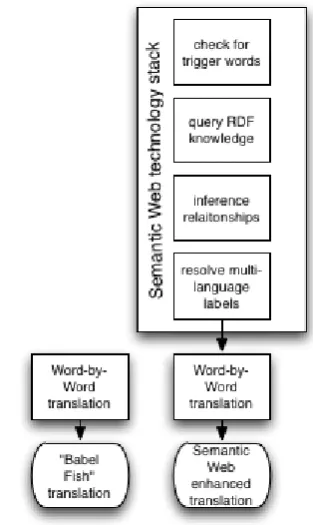
[image:7.595.329.486.286.549.2]As mentioned before, the Semantic World Know-ledge should enhance traditional MT translations. Therefore, the program produces technically two translations of the sentence Pages by Apple is better than Word by MS.: The first translation is done by the trivial dictionary, simply by string-replacing English with German words according to figure 2. The second translation first tries to find a better translation by checking trigger keywords, querying the RDF store for a knowledge, inferencing relationships and resolv-ing labels for the right language, before it contin-ues with the same word-by-word-replacing mech-anism like in the fist translation.
Figure 3: The two translations produced by the pro-gram and their technological foundation.
6.4 Program execution
Our prototype simply executes both described translations and print the result out.
Source sentence:
Pages by Apple is better than Word by MS.
These simple lines, specially the ”Semantic Web enhanced translation”, involve a lot of pro-cessing in the background which is not visible to the user - except for his waiting time. How-ever, a semantically correct translation solution was found.
7 Critical view on the solution
We feel we created something notable here. How-ever, we stand at the very beginning of our re-search and have encountered corresponding is-sues.
Surprisingly, implementation of the program logic - especially the query mechanism - turned out to be quite complicated, even for a simple sce-nario like in this case with a very limited corpus. As a result, the stepwise refinement of a transla-tion (trigger word, query of knowledge, inference relationships and multi-language-label resolution) consists of a lot SPARQL queries. These queries require some processing time and power, which is both already notable in this tiny example. This finally leads to the conclusion that performance might be a major withdraw of our approach, at least for the current implementation.
Another issue was connected to data format: the translation environment, especially the usage of RDF triples consisting of subject, predicate and object, might be regarded to be too much aligned at the very special and constructed problematic of only a number of realtime problems. Sentences have to be somehow split into triples, which is quite an artificial border - not to say a technical limitation - of RDF. Real world NLP surely does not fit into the tripartite simplifications of RDF, and the question is then how often real world problems would benefit from this solution.
Another issue is the Open World Assumption, built into each Semantic Web component: There is no golden standard truth in the Semantic Web and therefore we will never be able to find the ”best” translation for a given sentence within SPARQL-queries or inferencing results. Prob-ably, our approach does not hold for providing complete translation solutions, but for giving very qualified suggestions. Some SMT tools, like Moses, actually do work with suggestions.
However, some of this issues might be solved by applying more sophisticated NLP / MT tech-nology, like n-grams. Besides these issues, the
program works as expected and Semantic Web technology was successfully used to integrate world knowledge into a MT process. Thus, the translation gathered a better quality and it thus can be stated that the experiment was successful.
8 Related work
The project Monnet has, according to its mission statement26, a similar idea to combine MT with Semantic Web technology. However, results are still pending or not publically accessible at this point.
We also acknowledge the work by Elita and Birladeanu (2005), who outlined the combination of the Semantic Web with Example Based Ma-chine Translation (EBMT), which is very much related to our approach. However, there are ma-jor differences: Elita and Birladeanu (2005) only applied their technique on certain phrases of off-ical documents - sequences of words they call ”fields” (Elita & Birladeanu 2005, p. 14). Our idea is however to aid translation of complete sen-tences. Another very important difference is the intensiveness of use of W3C technology. Unlike Elita and Birladeanu (2005), we heavily use RDF, SPARQL and - probably the most promising mat-ter of fact - OWL reasoning and try to follow the Semantic Web standard tooling very strictly.
9 Outlook
At this point in our research, we have not yet com-bined existing MT technology, especially SMT, with SWMT. The combination of approaches has yet to be explored, but existing MT technologies and SWMT are certainly not mutually exclusive and we suspect that a combination of MT ap-proaches will lead to yet even better results, es-pecially in cases where the translation quality is based on world or expert knowledge.
10 Conclusion
In the recent past, MT researchers have already discussed the combination of RBMT and SMT (Hutchins 2009, pp. 13-20). We suggest to add yet another possibility in MT to existing MT approaches, namely a Semantic Web based MT (SWMT).
26http://www.monnet-project.eu/Monnet
In this paper we have taken a next logical step in MT technology by including not only the vast amounts of texts available in the Web to en-hance MT quality applying statistical computa-tions across online texts and translacomputa-tions, but go-ing one step further by lookgo-ing at the power of and knowledge contained in the Semantic Web.
By taking advantage of the knowledge in the Web of the future, our approach of combining Semantic Web technology with MT allows this world knowledge to be made available for ma-chine translations, thus enhancing challenges in MT, such as lexical ambiguities. In our discussed sample sentences, we have shown that a solu-tion for the disambiguasolu-tion would tradisolu-tionally in-volve a costly disambiguation process or would be left unsolved. Using our SWMT approach, the MT quality benefits from world knowledge ex-tracted from the Semantic Web and by its tech-nology.
This combination of MT with Semantic Web technology results in a new focus of MT which we suggest to be called Semantic Web based MT (SWMT).
11 Acknowledgements
We like to thank Rike Bacher from Linguatec and the reviewers of the ESIRMT-HyTra conference 2012 for their valuable hints.
References
Allemang, D. & Hendler, J. (2008), Semantic Web for the Working Ontologist: Effective Modeling in RDFS and OWL, Morgan Kaufmann.
URL: http://ww w.amazon.com/Se
mantic-Web-Working-Ontologist-Effectiv e/dp/0123735564
Berners-Lee, T. (1999),Weaving the Web : The Origi-nal Design and Ultimate Destiny of the World Wide Web by its Inventor, HarperOne.
URL: http://ww w.amazon.com/We
av ing-Web-Original-Ultimate-Inventor/dp/0062515861
Berners-Lee, T. & Hendler, J. (2001), ‘Scientific Amer-ican: The Semantic Web’, Scientific American, USA..
URL: http://scholar.google.com
/scholar?hl=en\&btnG=Search\& q=intitle:Scientific+American: +The+Semantic+Web\#3
Boothroyd, D. (2011), ‘Statistical machine translation to enable universal communication?’.
URL: http://ww w.newelectronics.co.
uk/electronics-technology /statist ical-machine-translation-to-enab le-univ ersal-communication/33008/
Elita, N. & Birladeanu, A. (2005), ‘A first step in inte-grating an EBMT into the Semantic Web’.
URL: ww w.mt-archiv
e.info/MTS-2005-Elita.pdf
Graves, A. & Gutierrez, C. (2005), ‘Data representa-tions for WordNet : A case for RDF’.
URL: http://ww w.dcc.uchile.cl/˜cgu
tierr/papers/w ordnet-rdf.pdf
Guha, R. (2004), ‘RDF Vocabulary Description Lang-uage 1.0: RDF Schema’.
URL: http://moodletest.ncnu.ed
u.tw /file.php/9506/references-2009/RDF\_schema\_1.pdf
Hutchins, J. (2009), ‘Multiple Uses of Machine Transla-tion and Computerised TranslaTransla-tion Tools’,Machine Translationpp. 13–20.
URL: http://ww w.hutchinsweb.me.uk/
Besancon-2009.pdf
Klyne, G. & Carroll, J. (2004), ‘Resource description framework (RDF): Concepts and abstract syntax’, Changes10(February), 1–20.
URL: http://ww w.mendeley .com/res
earch/w3c-gibt-recommendation-fr-resource-description-framew ork-rdf-frei/
Knight, K. (1999), A statistical MT tutorial workbook, in‘Prepared for the 1999 JHU Summer Workshop’.
URL: http://ww w.snlp.de/prescher/t
eaching/2007/StatisticalNLP/bib/ 1999jhu.knight.pdf
Knight, K. & Koehn, P. (2004), ‘What’s New in Statis-tical Machine Translation’, Tutorial, HLT/NAACL pp. 1–89.
URL: http://ww w.auai.org/uai2003/
Knight-UAI-03.pdf
Koehn, P., Osborne, M., Haddow, B., Auli, M., Buck, C., Dugast, L., Guillou, L., Hasler, E., Matthews, D., Williams, P., Wilson, O. & Saint-Amand, H. (2012), ‘Statistical Machine Translation at the Uni-versity of Edinburgh’.
Kunze, C. & L¨ungen, H. (2007), ‘Repr¨asentation und Verkn¨upfung allgemeinsprachlicher und terminolo-gischer Wortnetze in OWL’,Zeitschrift f¨ur Sprach-wissenschaft.
Mark van Assem, V. U. A., Aldo Gangemi, ISTC-CNR, R. & Guus Schreiber, V. U. A. (2006), ‘RDF/OWL Representation of WordNet’.
URL: http://ww
w.w3.org/TR/wordnet-rdf/
Miles, A. (2008), ‘SKOS simple knowledge organiza-tion system reference’,W3C Recommendation.
URL: http://ww w.mendeley .com/r