Event-Centered Information Retrieval Using Kernels on Event Graphs
Goran Glavaˇs and Jan ˇSnajder University of Zagreb
Faculty of Electrical Engineering and Computing Unska 3, 10000 Zagreb, Croatia
{goran.glavas,jan.snajder}@fer.hr
Abstract
Traditional information retrieval models as-sume keyword-based queries and use unstruc-tured document representations. There is an abundance of event-centered texts (e.g., breaking news) and event-oriented informa-tion needs that often involve structure that cannot be expressed using keywords. We present a novel retrieval model that uses a tured event-based representation. We struc-ture queries and documents as graphs of event mentions and employ graph kernels to measure the query-document similarity. Experimental results on two event-oriented test collections show significant improvements over state-of-the-art keyword-based models.
1 Introduction
The purpose of an information retrieval (IR) system is to retrieve the documents relevant to user’s informa-tion need expressed in the form of a query. Many in-formation needs are event-oriented, while at the same time there exists an abundance of event-centered texts (e.g., breaking news, police reports) that could satisfy these needs. Furthermore, event-oriented information needs often involve structure that cannot easily be expressed with keyword-based queries (e.g.,“What are the countries that President Bush has visited and in which has his visit triggered protests?”). Tradi-tional IR models (Salton et al., 1975; Robertson and Jones, 1976; Ponte and Croft, 1998) rely on shal-low unstructured representations of documents and queries, making no use of syntactic, semantic, or discourse level information. On the other hand, mod-els utilizing structured event-based representations have not yet proven useful in IR. However, signifi-cant advances in event extraction have been achieved
in the last decade as the result of standardization ef-forts (Pustejovsky et al., 2003) and shared evaluation tasks (Verhagen et al., 2010), renewing the interest in structured event-based text representations.
In this paper we present a novel retrieval model that relies on structured event-based representation of text and addresses event-centered queries. We define anevent-oriented queryas a query referring to one or more real-world events, possibly includ-ing their participants, the circumstances under which the events occurred, and the temporal relations be-tween the events. We account for such queries by structuring both documents and queries intoevent graphs (Glavaˇs and ˇSnajder, 2013b). The event graphs are built from individual event mentions ex-tracted from text, capturing their protagonists, times, locations, and temporal relations. To measure the query-document similarity, we compare the corre-sponding event graphs using graph kernels (Borg-wardt, 2007). Experimental results on two news story collections show significant improvements over state-of-the-art keyword-based models. We also show that our models are especially suitable for retrieval from collections containing topically similar documents.
2 Related Work
Most IR systems are a variant of the vector space model (Salton et al., 1975), probabilistic model (Robertson and Jones, 1976), or language model (Ponte and Croft, 1998), which do not account for associations between query terms. Recent models in-troduce co-occurrence-based (Park et al., 2011) and syntactic (Shinzato et al., 2012) dependencies. How-ever, these dependencies alone in most cases cannot capture in sufficient detail the semantics of events.
A more comprehensive set of dependencies can be modeled with graph-based representations.
based IR approaches come in two flavors: (1) the entire document collection is represented as a sin-gle graph in which queries are inserted as additional vertices (Mihalcea and Tarau, 2004); (2) each query and each document are represented as graphs of con-cepts, and the relevance of a document for a query is determined by comparing the corresponding graphs (Montes-y G´omez et al., 2000). Our approach fits into the latter group but we represent documents as graphs of events rather than graphs of concepts. In NLP, graph kernels have been used for question type classification (Suzuki, 2005), cross-lingual retrieval (Noh et al., 2009), and recognizing news stories on the same event (Glavaˇs and ˇSnajder, 2013b).
Event-based IR is addressed explicitly by Lin et al. (2007), who compare predicate-argument struc-tures extracted from queries to those extracted from documents. However, queries have to be manually decomposed into semantic roles and can contain only a single predicate. Kawahara et al. (2013) propose a similar approach and demonstrate that ranking based on semantic roles outperforms ranking based on syn-tactic dependencies. Both these approaches target the problem of syntactic alternation but do not consider the queries made of multiple predicates, such as those expressing temporal relations between events.
3 Kernels on Event Graphs
Our approach consists of two steps. First, we con-struct event graphs from both the document and the query. We then use a graph kernel to measure the query-document similarity and rank the documents.
3.1 Event Graphs
An event graph is a mixed graph in which vertices rep-resent the individual event mentions and edges repre-sent temporal relations between them. More formally, an event graph is a tupleG= (V, E, A, m, r), where V is the set of vertices, E is the set of undirected edges,Ais the set of directed edges,m :V → M maps the vertices to event mentions, andr:E →R assigns temporal relations to edges.
We use a generic representation of afactualevent mention, which consists of an event anchor and event arguments of four coarse types (agent,target,time, and location) (Glavaˇs and ˇSnajder, 2013a; Glavaˇs and ˇSnajder, 2013b). We adopt the set of temporal
relations used in TempEval-2 (Verhagen et al., 2010) (before,after, andoverlap), with additional temporal equivalence relation (equal).
To build an event graph, we first extract the event mentions and then extract the temporal relations be-tween them. To extract the event anchors, we use a supervised model based on a rich feature set pro-posed by Glavaˇs and ˇSnajder (2013b), performing at 80% F1-score. We then use a robust rule-based approach from Glavaˇs and ˇSnajder (2013a) to extract event arguments. Finally, we extract the temporal relations using a supervised model with a rich fea-ture set proposed by Glavaˇs and ˇSnajder (2013b). Relation classification performs at 60% F1-score.
To compute the product graph kernels, we must identify event mentions from the query that corefer with mentions from the document. To this end, we employ the model from Glavaˇs and ˇSnajder (2013a), which compares the anchors and four types of argu-ments between a pair of event mentions. The model performs at 67% F-score on the EventCorefBank dataset (Bejan and Harabagiu, 2008).
3.2 Product Graph Kernels
Graph kernels provide an expressive measure of sim-ilarity between graphs (Borgwardt, 2007). In this work, we use product graph kernel (PGK), a type of random walk graph kernel that counts the common walks between two graphs (G¨artner et al., 2003).
Product graph. The graph product of two labeled graphs,GandG0, denotedGP =G×G0, is a graph
with the vertex set
VP =
(v, v0)|v∈VG, v0 ∈VG0, δ(v, v0)
(a) Query graph (b) Document graph (c) Tensor product (d) Conormal product
Figure 1: Examples of event graphs and their products
true overlap between queries and documents. Fig. 1 shows an example of input graphs and their products.
PGK computation. The PGK for input graphsG andG0is computed as
kP G(G, G0) = |VP| X
i,j=1
[(I−λAP)−1]ij
providedλ < 1/d, wheredis the maximum vertex degree in the product graphGP with the adjacency
matrixAP. In experiments, we setλto 1/(d+ 1).
PGK suffers from tottering (Mah´e et al., 2005), a phe-nomenon due to the repetition of edges in a random walk. A walk that totters between neighboring ver-tices produces an unrealistically high similarity score. To prevent tottering between neighboring vertices, Mah´e et al. (2005) transform the input graphs before computing the kernel score on their product: each edge(vi, vj)is converted into a vertexve; the edge
it-self gets replaced with edges(ve, vi)and(ve, vj). We
experiment with Mah´e extension for PGK, account-ing for the increased probability of one-edge-cycle tottering due the small size of query graphs.
4 Experiments
Test Collections and Queries. To the best of our knowledge, there is no standard test collection avail-able for event-centered IR that we could use to evalu-ate our models. Thus, we decided to build two such test collections, with 50 queries each: (1) a general collection of topically diverse news stories and (2) a topic-specific collection of news on Syria crisis. The first collection contains 25,948 news stories obtained from EMM News Brief, an online news clustering service.1 For the topic-specific collection, we se-lected from the general collection 1387 documents that contain the word“Syria”or its derivations.
1http://emm.newsbrief.eu
General collection (news stories)
q1: An ICT giant purchased the phone maker after the government approved the acquisition
q2: The warship tried to detain Chinese fishermen but was obstructed by the Chinese vessels
Topic-specific collection (Syria crisis)
q3: Syrian forces killed civilians, torched houses, and ransacked stores, overrunning a farmer village q4: Rebels murdered many Syrian soldiers and the
gov-ernment troops blasted the town in central Syria
Table 1: Example queries from the test collection
For each collection we asked an annotator to com-pile 50 queries. She was instructed to select at ran-dom a document from the collection, read the docu-ment carefully, and compile at least one query con-sisting of at least two event mentions, in such a way that the selected document is relevant for the query. Example queries are shown in Table 1. For instance, queryq1(whose corresponding event graph is shown in Fig. 1a) was created based on the following docu-ment (whose event graph is shown in Fig. 1b):
Google Inc. won approval from Chinese regula-tors for its$12.5 billion purchase of Motorola Mobility Holdings Inc., clearing a final hurdle for a deal that boosts its patents portfolio. . .
Collection
Model General Specific
Baselines TF-IDF VSM 0.335 0.199 Hiemstra LM 0.300 0.175 In expC2 0.341 0.188 DFR BM25 0.332 0.192
[image:4.612.328.527.54.150.2]Graph-based Tensor 0.502 0.407 Conormal 0.434 0.359 Mah´e Tensor 0.497 0.412 Mah´e Conormal 0.428 0.362
Table 2: Retrieval performance (MAP)
clusters contain less than 50 news stories, we esti-mate that there are at most 50 relevant documents per query. To get an even better estimate of recall, for each query we pooled the union of top 75 documents retrieved by each of the two baseline models.
One annotator made the relevance judgments for all queries. We asked another annotator to provide judgments for two randomly chosen queries and ob-tained perfect agreement, which confirmed our intu-ition that determining relevance for complex event-centered queries is not difficult. The average number of relevant documents per query in the general and topic-specific collection is 12 and 8, respectively.2
Results. Table 2 shows the mean average preci-sion (MAP) on both test collections for four graph kernel-based models (tensor/conormal product and with/without Mah´e extension). We compare our models to baselines from the three traditional IR paradigms: a TF-IDF-weighted cosine VSM, the language model of Hiemstra (2001), and the best-performing models from the probabilistic Divergence from Randomness (DFR) framework (In expC2 and DFR BM25) (Amati, 2003; Ounis et al., 2006). We evaluate these models using the Terrier IR platform.3 Overall, all models perform worse on the topic-specific collection, in which all documents are topi-cally related. Our graph kernel models outperform all baseline models (p<0.01 for tensor models and p<0.05 for conormal models; paired student’s t-test) on both collections, with a wider margin on topic-specific than on the general collection. This result
2
Available athttp://takelab.fer.hr/data
3http://terrier.org
[−1;−0.1](−0.1; 0] (0; 0.1] (0.1; 0.3] (0.3; 1] 0
5 10 15
Figure 2: Histogram of AP differences
suggests that the graph-based models are especially suitable for retrieval over topic-specific collections. There is no significant difference between the ten-sor product and conormal product models, indicating that the conormal product introduces spurious edges more often than it remedies for incorrect extraction of temporal relations. The performance differences due to Mah´e extension are not significant, providing no conclusive evidence on the effect of tottering.
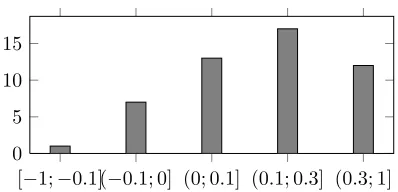
To gain more insights into the performance of our event graph-based model, we analyzed per query differences in average precision between our best-performing model (Tensor) and the best-best-performing baseline (In expC2) on queries from the general col-lection. Fig. 2 shows the histogram of differences. Our graph kernel-based model outperforms the base-line on 42 out of 50 queries. A closer inspection of the eight queries on which our model performs worse than the baseline reveals that this is due to (1) an important event mention not being extracted from the query (2 cases) or a (2) failure in coreference resolution between an event mention from the query and a mention from the document (6 cases).
5 Conclusion and Perspectives
We presented a graph-based model for event-centered information retrieval. The model represents queries and documents as event graphs and ranks the docu-ments based on graph kernel similarity. The experi-ments demonstrate that for event-based queries our graph-based model significantly outperforms state-of-the-art keyword-based retrieval models. Our models are especially suitable for topic-specific collections, on which traditional IR models perform poorly.
[image:4.612.74.297.58.203.2]and structural relations. Another direction concerns the effective integration of event graph-based and keyword-based models. We will also consider ap-plications of event graphs on other natural language processing tasks such as text summarization.
Acknowledgments. This work has been supported by the Ministry of Science, Education and Sports, Republic of Croatia under the Grant 036-1300646-1986. We thank the reviewers for their comments.
References
Giambattista Amati. 2003.Probability models for infor-mation retrieval based on divergence from randomness. Ph.D. thesis, University of Glasgow.
Cosmin Adrian Bejan and Sanda Harabagiu. 2008. A linguistic resource for discovering event structures and resolving event coreference. In Proc. of the LREC 2008.
Karsten Michael Borgwardt. 2007.Graph Kernels. Ph.D. thesis, Ludwig-Maximilians-Universit¨at M¨unchen. Stefan B¨uttcher, Charles LA Clarke, Peter CK Yeung, and
Ian Soboroff. 2007. Reliable information retrieval evaluation with incomplete and biased judgements. In Proc. of the ACM SIGIR, pages 63–70. ACM.
Thomas G¨artner, Peter Flach, and Stefan Wrobel. 2003. On graph kernels: Hardness results and efficient alterna-tives. InLearning Theory and Kernel Machines, pages 129–143. Springer.
Goran Glavaˇs and Jan ˇSnajder. 2013a. Exploring coref-erence uncertainty of generically extracted event men-tions. InProc. of the CICLing 2013, pages 408–422. Springer.
Goran Glavaˇs and Jan ˇSnajder. 2013b. Recognizing iden-tical events with graph kernels. InProc. of the ACL 2013, pages 797–803.
Richard Hammack, Wilfried Imrich, and Sandi Klavˇzar. 2011. Handbook of Product Graphs. Discrete Mathe-matics and Its Applications. CRC Press.
Djoerd Hiemstra. 2001.Using language models for infor-mation retrieval. Taaluitgeverij Neslia Paniculata. Daisuke Kawahara, Keiji Shinzato, Tomohide Shibata, and
Sadao Kurohashi. 2013. Precise information retrieval exploiting predicate-argument structures. InProc. of the IJCNLP 2013. In press.
Chia-Hung Lin, Chia-Wei Yen, Jen-Shin Hong, Samuel Cruz-Lara, et al. 2007. Event-based textual document retrieval by using semantic role labeling and corefer-ence resolution. In IADIS International Conference WWW/Internet 2007.
Pierre Mah´e, Nobuhisa Ueda, Tatsuya Akutsu, Jean-Luc Perret, and Jean-Philippe Vert. 2005. Graph kernels for molecular structure-activity relationship analysis with support vector machines. Journal of Chemical Information and Modeling, 45(4):939–951.
Rada Mihalcea and Paul Tarau. 2004. TextRank: Bring-ing order into texts. In Proc. of the EMNLP 2004, volume 4. Barcelona, Spain.
Manuel Montes-y G´omez, Aurelio L´opez-L´opez, and Alexander Gelbukh. 2000. Information retrieval with conceptual graph matching. InDatabase and Expert Systems Applications, pages 312–321. Springer. Tae-Gil Noh, Seong-Bae Park, Hee-Geun Yoon, Sang-Jo
Lee, and Se-Young Park. 2009. An automatic transla-tion of tags for multimedia contents using folksonomy networks. In Proc. of the ACM SIGIR 2009, pages 492–499. ACM.
Iadh Ounis, Gianni Amati, Vassilis Plachouras, Ben He, Craig Macdonald, and Christina Lioma. 2006. Terrier: A high performance and scalable information retrieval platform. InProceedings of the OSIR Workshop, pages 18–25.
Jae Hyun Park, W Bruce Croft, and David A Smith. 2011. A quasi-synchronous dependence model for informa-tion retrieval. InProc. of the 20th ACM International Conference on Information and Knowledge Manage-ment, pages 17–26. ACM.
Jay Ponte and Bruce Croft. 1998. A language modeling approach to information retrieval. InProc. of the ACM SIGIR, pages 275–281. ACM.
James Pustejovsky, Jos´e Castano, Robert Ingria, Roser Sauri, Robert Gaizauskas, Andrea Setzer, Graham Katz, and Dragomir Radev. 2003. TimeML: Robust specifi-cation of event and temporal expressions in text.New Directions in Question Answering, 3:28–34.
Stephen E Robertson and K Sparck Jones. 1976. Rele-vance weighting of search terms.Journal of the Ameri-can Society for Information science, 27(3):129–146. Gerard Salton, Anita Wong, and Chung-Shu Yang. 1975.
A vector space model for automatic indexing. Commu-nications of the ACM, 18(11):613–620.
Keiji Shinzato, Tomohide Shibata, Daisuke Kawahara, and Sadao Kurohashi. 2012. Tsubaki: An open search engine infrastructure for developing information ac-cess methodology. Journal of Information Processing, 20(1):216–227.
Jun Suzuki. 2005. Kernels for structured data in natural language processing. Doctor Thesis, Nara Institute of Science and Technology.