Shared Decision Making Needs a Communication Record
Bridget Kane
∗†‡∗NSEP, NTNU, Norway
†St. James’s Hospital, Dublin[email protected]
Pieter Toussaint
NSEP, NTNU∗
Trondheim, Norway
[email protected]
Saturnino Luz
‡ ‡Dept of Computer ScienceTrinity College Dublin, Ireland
[email protected]
ABSTRACT
Increasing dependability in collaboration work among health professionals will directly improve patient outcomes, and re-duce healthcare costs. Our research examines the develop-ment of a shared visual display to facilitate data entry and val-idation of an electronic record during multidisciplinary team meeting discussion, where specialists discuss patient symp-toms, test results, and image findings. The problem of gen-erating an electronic record for patient files that will serve as a record of collaboration, communication and a guide for later tasks is addressed through use of the shared visual dis-play. Shortcomings in user-informed designed, structured data-entry screens became evident when in actual use. Time constraints prompt the synopsis of discussion in acronyms, free text, abbreviations, and the use of inferences. We demon-strate how common ground, team cohesiveness and the use of a shared visual display can improve dependability, but these factors can also provide a false sense of security and increase vulnerability in the patient management system.
Author Keywords
Large Shared Display; Data entry; Validation; Record-keeping; Teamwork; Collaboration
ACM Classification Keywords
H.5.3 Group and Organization Interfaces: Computer-supported cooperative work
INTRODUCTION
In this paper we describe a scenario where a multidisciplinary medical team (MDT) of clinical specialists meet to discuss their patient cases. They discuss each patient’s clinical find-ings on examination, and review their radiological imaging and pathology results in the context of those clinical findings. The team agree a definitive diagnosis and a management plan for each patient. If information is incomplete, they will de-cide on further tests that may need to be performed before making their decision, or recommendation to the patient. This
∗Marie Curie (ERCIM) Fellow
Permission to make digital or hard copies of all or part of this work for personal or classroom use is granted without fee provided that copies are not made or distributed for profit or commercial advantage and that copies bear this notice and the full citation on the first page. To copy otherwise, or republish, to post on servers or to redistribute to lists, requires prior specific permission and/or a fee.
CSCW ’13, February 23–27, 2013, San Antonio, Texas, USA. Copyright 2013 ACM 978-1-4503-1331-5/13/02...$15.00.
method of patient management, by an MDT, has become the standard of care for cancer patients in the UK, and in most European countries as well as Canada and Australia. Group decision-making in this clinical setting is considered superior to individual decision-making, because i) synchronous review of the results of independent diagnostic processes improves the diagnostic accuracy and overall reliability of the diagnos-tic process [31], ii) having all of the necessary specialists to-gether is believed to improve the coordination of highly com-plex treatment protocols, and iii) peer review is conducted in this MDT process. The MDTM forum facilitates collabora-tion and knowledge is created through the interaccollabora-tion [17].
Communication failures are acknowledged as a leading root cause of medical error [18]. While effective teamwork is considered one of the ways to improve communication and reduce the number of errors, the majority of communication breakdowns occur in verbal communication when patients are being transferred among clinical staff [27]: a practice recog-nised as a frequent activity at meetings [21], a regular out-come of an MDT discussion, and an acknowledged challenge for researchers in this area [10, 27]. Moreover, inadequate medical record-keeping is known to threaten health care qual-ity especially with respect to coordination and continuqual-ity of care, decision-making capacity and accountability [32].
In the context of an increasingly specialized healthcare sys-tem, and the development of electronic records and ICT tools, there are challenges posed in providing suitable technological support in this setting. CSCW has traditionally investigated the use of interactive tools that support collaboration, and in-teractive table tops and large screen displays are among those tools explored to support cooperative work. However in most of the workplace studies to date, the use of the shared display has been permanent and interactive [2,37] rather than tran-sient and non-interactive as in our setting. Furthermore, the function of the large displays investigated provide for inter-actionwith them by the users. Frequently large displays are seen as tools to support awareness [2] and /or places where people might look for information, interaction is afforded, and people can leave notes for one another, for example. In contrast our study demonstrates the use of a transient, non-interactive, large display, the function of which is intended as an awareness mechanism that adds dependability to the worksystem. The work of building a shared meeting record is made visible, and team members have the opportunity to contribute, indirectly, to the product.
[34], one of the less developed topics in supporting coopera-tive work is the production of records of the interactions, or of the communication and decision-making process. Records from MDT meetings serve to co-ordinate later work tasks, and provide a visible, persistent, account of shared informa-tion. Records also give testimony to collaboration among par-ticular independent specialists, as well as providing a snap-shot in time of a patient’s health status.
The difference between the problems of these teams, and those issues addressed in other CSCW studies can be de-scribed as follows. i) The individual roles involved in these MDTs have a need to interact with one-another directly through talk. Technology is secondary in the setting, or a ‘necessary evil’, which facilitates communication (of radio-logical images, or videoconference, for example). ii) The team need access to a lot of information quickly. Discus-sion is fast-moving because of limited time. The team needs to have all of the information available on the patient that they are discussing, otherwise the patient will be adversely affected [12]. Although having the electronic patient record (EPR) provides reliability, it takes more time to query an elec-tronic medical record than it takes to review a paper chart. iii) Information is generated in the setting that could be useful in several related processes, such as national repositories, or department of health statistics. iv) A subset of information generated at the meeting is required for the patient’s ‘chart’ whether it is a paper or electronic record. v) Tasks are as-signed within the MDT that need to be conducted once the meeting is concluded. vi) The team wants to know (even-tually) that the task assigned was satisfactorily executed. In other words, we are not only concerned with the synchronous support for collaboration. We also need to take account of work tasks and processes before and after the meeting event. It is to these issues, but communication record-keeping in par-ticular, that we address our study and our discussion.
Background
The team meetings that are the focus for this research have been observed over several years. At first, their role in med-ical education was quite prominent and MDTs tended to dis-cuss a small number of ‘interesting cases’. But over the past 10 years in particular, work practices have gradually changed and, like other hospitals, these meetings are now embedded in the routine work of the hospital. Since becoming a nor-mal part of the work in managing patients, issues have arisen for which solutions have been sought. Some of the issues have been brought about by innovations and developments that have taken place independently of this MDT process. The developments that have had most impact, in our experi-ence, are the implementation of an Electronic Patient Record (EPR) System in the hospital, the implementation of a Picture Archive and Communication System (PACS) for managing digital radiological images, and videoconferencing. Changes in recommended practice in radiation oncology, medical on-cology and surgery are also impacting this work system. It is not uncommon for some cancers (depending on tumour type or anatomic location) to be treated though a complex pro-tocol that involves these three specialities (surgery, radiation
and medical oncology). Patients may receive treatments in se-quence, or concurrently, or in some combination of sequences and concurrency. These complex protocols require high lev-els of collaboration and coordination in providing the neces-sary services (including diagnostic tests and monitoring) in a way that maximises the benefit of the improved treatments for the patient. When these systems that require high levels of collaboration and cooperation work well, they also deliver economic efficiencies in addition to patient benefits [15].
Examining how people work in multidisciplinary medical teams (MDTs), and how they address the problems they en-counter, provides insight into collaborative work that can be applied in other non-medical work settings. The MDT forum is a valuable setting for research into problem-solving and decision-making as well as more general CSCW issues. Re-search themes around co-operation and co-ordination; roles and information; time, space and place; knowledge used and technology employed are all relevant to the CSCW commu-nity and can be applied to medical work and meetings [20]. Observing these work teams also gives us improved under-standing of fundamental issues in modes of interpersonal communication, including speech, the use of multimedia and technology-mediated communication. Furthermore, CSCW has a unique contribution to make to medical teamwork. In-deed the grand challenge for CSCW to find ways of integrat-ing the means to support informality into medical systems has already been posed [13]. Supporting collaboration, coor-dination and communication among health professionals will directly impact our health system by making it more depend-able and improve peoples’ lives.
METHODOLOGY
An ethomethodologically-informed ethnographic study was conducted with multidisciplinary medical teams (MDTs), and their meetings in particular, in a large tertiary-referral teach-ing hospital, (and designated cancer centre). The hospital ethics committee approved the study. Undertakings were given that patient privacy is respected and confidentiality is maintained in the data. Since work-processes are the object of our research, no individual patient data is gathered or used in this research. Our approach to this fieldwork conforms to the general position advocated by Randall [33] in that our aim is to achieve a deep understanding of the work, how work-ers communicate and share information in the course of their tasks, and how their role objectives are satisfied.
We have had the benefit of conducting a long-term ethno-graphic study at the teaching hospital for the past eight years. Over this period we have witnessed a number of user initia-tives to address self-identified problems in their work prac-tices, and we have also been able to observe the outcomes of those initiatives. Assessing support requirements has been one of our main objectives, and the problem of enhancing specialist collaboration within the constraints imposed by the busy hospital setting [23]. In our earlier work, record-keeping has been identified as a key concern of MDTs at this hospi-tal [24], and it is in the context of the implementation of a record-keeping initiative that this study is undertaken.
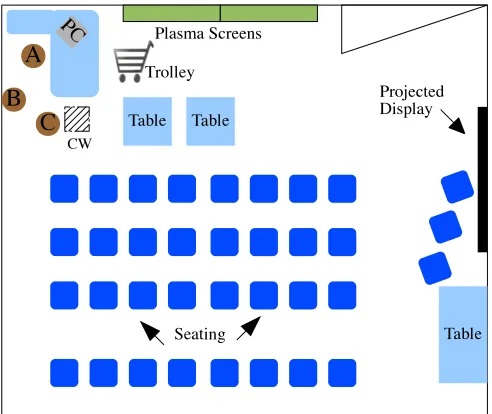
Figure 1. The layout of the meeting room. The Radiologist and Patholo-gist work from positions A and B. The person entering data works from station C.
MDT meetings of several MDTs, recent data for this paper were gathered through approximately 20 hours of focussed observation of the record-entry task at MDT meetings, with a single MDT. The focus is on the implementation of an initia-tive by the MDT to construct and validate a real-time record of the MDT discussion that is available in the patient’s elec-tronic record (EPR). Our ethnographic observations are sup-plemented with a survey and semi-structured recorded inter-views with members from this particular MDT. By supple-menting our ethnographic orientation with mixed data gath-ering methods (survey and interviews), we facilitate triangu-lation of our findings and a more robust analysis.
We confine ourselves in this paper to describing a particular initiative of one MDT, and refer to other teams’ initiatives where relevant.
The MDT under particular study for this paper has approxi-mately 30 members and comprises the following roles: sur-geons, radiologists, pathologists, medical oncologists, ra-diation oncologists, nurses, physiotherapists, data manager, an MDT (clerical) co-ordinator and researchers. The MDT meets weekly to discuss their patients’ management.
The primary objective of the survey we conducted was to help elicit user requirements for a meeting record and was dis-tributed among all of the multidisciplinary teams in the hos-pital. A total of 190 responses were submitted, (of which 29 were returned from the MDT that implemented the meeting record reported here). Analysis of the 190 returns are used in compiling Tables1and2. Additional analysis of the results from the MDT under study for this paper was performed sep-arately. The results from the sample of 29 from this particu-lar MDT followed the same general pattern and there were no significant differences to the overall result.
The semi-structured recorded interviews were conducted in follow-up to the questionnaire, with 11 members of the MDT.
The 11 interviewees are made up of 4 consultant surgeons, one radiologist, two nurses, one data manager, one medical oncologist, one surgical registrar, and one radiation oncolo-gist. Nine of the 11 interviewees from this MDT describe themselves as active vocal participants at meetings. Inter-views lasted between 40 and 60 minutes, and 10 out of 11 were recorded (with participant’s consent). Recordings were reviewed and annotated afterwards for salient findings.
Almost half (13, or 45%) of the MDT members in the MDT described are vocal participants at meetings. Only one-third of the MDT belong to this MDT alone. Most of the members of this MDT belong to at least two other MDTs in addition: two people are members of 5 MDTs. A single MDT is usu-ally concerned with a single organ, biologic system, or set of diseases, for example a Breast MDT, or Lymphoma MDT. Each team will require radiologists, pathologists, medical and radiation oncologists too. These specialities tend to be highly specialised and contribute to several MDTs.
For one MDTM, one of us (BK) undertook to write (copy) simultaneously the written text being entered into the patient record and displayed on screen. The experience of this exer-cise is reported in the section titled ‘The Data Entry Task’.
THE SETTING
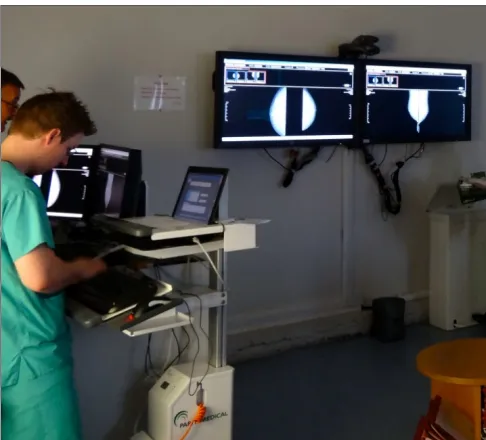
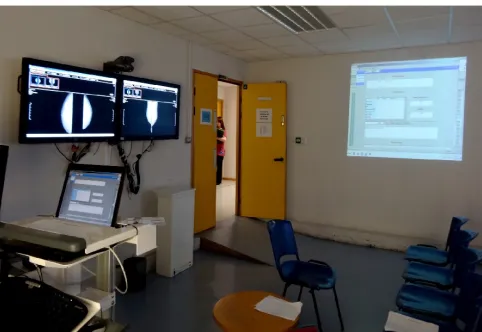
The multidisciplinary team (MDT) has a co-located weekly meeting that normally lasts for approximately 1.75 hours. The room is configured in a theatre-style arrangement with two plasma screen displays in front that are used to display radiological images, and occasional pathology images. The meeting room layout is drawn in Figure 1, and the photo-graph in Figure2was taken from the front left quadrant of the room. The room was originally designed as a radiology seminar room and the workstation with PC, in the front left hand side of the room, is a radiologists workstation with high resolution displays. (See upper left hand corner of the dia-gram in Figure1.) Two plasma screen displays at the front of the room are connected to this fixed workstation. An ad-ditional computer screen, from a computer-on-wheels (CW), is projected onto the right hand side-wall of the room using a ceiling-mounted projector. Figure2shows the radiologist seated at his workstation and the plasma screens with the re-layed image (from workstation). The Specialist Registrar is entering data into the EPR using the mobile workstation. Fig-ure3shows the projected image of the screen of the mobile workstation onto the side wall.
The radiologist normally sits on a stool at A in Figure1and the pathologist sits, or stands, nearby at location B in the Fig-ure. The computer-on-wheels is positioned next to the radi-ologist’s workstation, labelled CW in Figure1, and shown in the photograph in Figure2. Either an experienced nurse specialist, or surgical registrar occupies this position, C, and enters data in real time using the mobile workstation. The computer-on-wheels is connected to a ceiling mounted pro-jector and the data entry screen is projected onto the right hand side wall of the room.
meet-Figure 2. Radiologist talks at his workstation and the Senior Surgical Registrar enters data.
ing. The small tables in front are used to handle the charts, and facilitate consulting and probing the patient’s record, dur-ing the discussion. Consultant surgeons sit nearest the tables and use the charts. The oncologists tend to sit towards the right of the group; pathologists and radiologists tend to sit to the left hand side. While the senior clinical staff tend to sit in the front row, nursing, physiotherapy and research staff sit to-wards the rere of the room according to a role hierarchy. The more senior nursing staff sit in the second row, and so on. The table at the back of the room is used for refreshments, and for display and dissemination of research reports, or articles of interest to the group, as well as the agenda, or list of patients, for the meeting and the sign-in attendance record sheet.
The hospital is undergoing implementation of an electronic patient record system, and currently both paper charts and electronic information are used in patient management. The electronic records contain all laboratory data, radiology im-ages and some clinical notes. However most clinical notes are written into the patient’s paper chart.
Radiological images are accessed through the picture archive and communication system (PACS). Pathology reports can be accessed though the hospital electronic patient record system (EPR) and images from pathology specimens are sometimes brought on memory stick to the meeting, loaded onto the PC at the start of the meeting, and accessed as needed during the discussion on a patient.
THE PROBLEM
Record-keeping at MDT meetings is one of the identified pri-orities for all of the teams surveyed, (reported in [24]), and the affordances of MDT discussion records are discussed in [23]. Here we draw attention to particular items of informa-tion, listed in Table1, that have been requested to be part of the record of an MDT discussion, and illustrate some of the complexity of the problem of record generation.
Priorities for the Specific Information to be Included in a Record of a Patient’s Case Discussion
(In order of frequency expressed importance)
Consensus treatment or management plan agreed Recommendation to patient
Agreed Disease staging Summary of Patient presenting details
Choice of chemotherapy / radiation therapy clearly indicated Lesion type, grade, stage, margin status noted
Background history summarised The underlying basis for decision agreed
The referring consultant Past medical history Patient findings on Examination
[image:4.612.54.297.60.280.2]Cancer molecular diagnostics Family history Investigation dates Accurate smoking history
Table 1. Identified information priorities for inclusion in the record of a patient’s case discussion
The problem that emerged for the MDTs is how to make a record of the discussion, and the form it should take. Prior to formal records, individuals took personal notes. However, concerns were expressed, particularly by those who reported findings to the meeting, that the notes being taken might not truly represent what was being said; that the communication may have been misunderstood, and that there was no way for the person making the utterance to be assured that they would not be misquoted in the future. For example, pathologists and radiologists issue written reports on their findings that are al-ready in written form elsewhere. At the meeting they explain their opinion in talk and illustrate their interpretation with the patient’s images. The words they may use paraphrase, sum-marise, or add emphasis to points made in their report to aid their colleagues’ understanding. However, the written report is the official record and informal notes saying ‘its benign’ have no standing when the official report might say “this le-sion is likely to be benign . . .’. As one radiologist put it: “. . . just because I think its probably benign, doesn’t mean that it is benign . . . the patient needs to be followed up”. An official record of the case discussion would clarify the mean-ing conveyed in the talk, and build a shared understandmean-ing of the patient’s situation in the context of his / her findings that were considered. In any patient case discussion, the in-dividual patient’s test results will be reviewed (including ra-diology, pathology and / or endoscopy findings if any), but it is also important to remember the information, knowledge and experience that the individual experts bring to the discus-sion, (including recent research evidence [9]). Together with the patient information, the expert input forms thecontent of informationin the discussion, a concept used by [36] in his study in the Netherlands.
[image:4.612.325.569.100.275.2]develop-Information ‘Wish list’ for records
Patient Information
Clinical staging
Performance status / Co-morbidity Include Endoscopy (still & video) images
Laboratory results incorporated Up to date staging revision
Decision-making
Basis for decision agreed Was differential diagnosis considered?
What are Pros and Cons of the treatment options considered? What was ruled out?
Communication Process
Print name of person who signs form
Type record and send copy to referring physician and GP Generate a worklist of patients to be seen by a particular person
Automatic information from EPR to PATS (audit database) Have summary distributed to team post-MDTM
Communication Interaction
Who was there?
Names of radiologist and pathologist who contributed Names of all all specialists involved in discussion DidX say anything about the possibility ofZoption?
Other
“Microphones would help us hear”
Table 2. Expressed ‘wish list’ related to information to be gathered for inclusion in a case discussion record
ing a discussion record. All of the specific information items that have been deemed necessary for a record (in Table 1) are clearly made known in discussion, through talk, text and the use of images, and notes are currently taken in written records by most of the MDTs (and scanned in afterwards into the EPR system). But when reviewing notes afterwards, the information sought is not always available, a common feature of medical records and noted in several studies [38,13,19]. There are likely several explanations for missing information, including deliberate withholding of data [38], but noting cor-rect information from conversation between specialists can be a difficult task, and studies have identified problems for individuals when conducting this sort of exercise [22].
The pro forma reports do not purport to address all of the information desired. The teams highlighted a ‘wish list’ of information they would like to be able to record somewhere on the proceedings and process, and Table2lists items of in-formation that are not currently available to which team mem-bers wouldlikeaccess afterwards. At interview, some team members elaborated on items such as ‘clinical staging’. It can be argued that some of the items listed in Table2can be provided through items in Table1, such as ‘Patient findings on examination’, could infer ‘clinical staging’. However, the
point was made that while policy might state that certain in-formation is collected, compliance is often less than desired. “I wish they would fill out the form properly”, said one partic-ipant. In other words, and like others have found [30], there can be a gap between policy and practice, or gaps between the work, the patient, and the information representation which may account for adverse consequences for the patient and in-creased costs for the hospital [38]. This ‘wish list’ will be further considered in the Discussion section. Some of the items requested concern patient information, but most of the suggestions raised concern the communication and decision processes. The ‘Other’ issue listed in Table2, namely ‘mi-crophones’, will be discussed separately.
As well as reducing ambiguity and avoiding potential com-munication misunderstandings, the most immediate and im-portant utility of the record of the MDT discussion is to ex-plicitly document the next steps to be taken in managing the patient, and direct staff who will be interacting with the pa-tient on his/her next visit to their clinic.
The ‘wish list’ is more than about (sometimes) missing infor-mation that is normally available, and there are clear differ-ences in the type of information listed in both Tables. The pro forma reports developed have aimed to captureessential in-formation, and tend to be designed to address the information listed in Table1. The gap between the information that peo-ple see asessentialin Table1, and information they would like to havein Table2points to some of the areas of concern for people in their work.
Examining the items in Table2, we can see that there is a clear information deficit in the current system of record-keeping that is likely impacting patient care. Having an account of the treatment options that were considered, for example, is not information that was formally proposed to capture, yet it is information that many value when considering the manage-ment of their patients. While there are issues concerning the EPR system and the completeness of information gathered, there is also a clearly identified need for ‘decision communi-cation’, or process record of some sort. Zhou argues that a convincing rationale should be recorded for treatment plans, but notes that critical thinking or supporting evidence is often missing from medical records [38]. For example, suppose a surgeon is reviewing records of an MDTM discussion, and sees a particular operation recommended that is not the sur-gical method normally advised in clinical practice guidelines for this clinical situation. In the absence of an explanation, or rationale, for the decision the surgeon cannot be certain if an error was made in the record entry that might account for this unexpected advice. If there are adverse consequences for the patient as a result of the wrong operation being carried out, the damage cannot be undone. Thus it is critically important, in the interest of patient safety and hospital efficiency, that clinicians (e.g. surgeons) are confident in the accuracy of the record.
and examples in Table2. These categories bear some relation to those identified in other MDT meetings studies, such as [36] who noted three categories of communication namely i) grounding communication, ii) making practical arrangements and iii) co-ordinating treatments.
THE SOLUTION
At interview, clinical staff were asked “What if there was a full audio-visual recording of the MDT meeting?” Without exception, team members did not like the idea of having a full audio-visual recording. They felt “. . . it would be a very stifled discussion, having to be careful of every word you said . . .”. Although one team member said “I suppose that’s the way things are going now, but I hope its not[implemented] in my lifetime”. Students when questioned felt it would be a wonderful resource for study if they could access particular types of cases, review the information used in making the di-agnosis and the choice of treatment option made by the MDT in the circumstances. A Swedish oral surgery centre has re-ported such a system, although we note that information in this system is captured asynchronously. It is mainly used for teaching purposes, rather than routine work [6].
The reluctance of staff to consider an audio-visual record of the proceedings - a record that would be easy to make but difficult to process - highlights some of the complexity of this forum. But it is unlikely to be the difficulty in process-ing such a record or concerns for patient privacy, alone, that makes an audio-visual recording so unappealing. Goffman’s metaphor describing ‘frontstage vs. backstage’ [11] is useful to help our understanding of the behaviours we witness, and describe in this paper. The informality observed in the in-teractions ‘backstage’, contrasts with the formality and trans-formation recorded in the formal, ‘front stage’ record entry. Indeed, others have also observed these dual, parallel, inter-action processes in interactive, collaborative, medical work [16,37,5].
Having ruled-out an audio-visual record, a text-based elec-tronic record was investigated that would be available in the patient’s EPR. The particular MDT being studied designed an electronic form, with the help of the Information Services (IS) Department (and independent of our study). Information was identified, focus groups and workshops were held with the team leaders, and prototypes were tested and evaluated by members of the MDT.
The electronic form was designed to capture the key informa-tion items that the MDT agree are essential, and the design and layout of the form was negotiated with the IS department in conjunction with the EPR vendor. The form is designed over four pages and is intended to capture some items through radio-buttons, and check-boxes, and one free-text box is in-cluded for ‘Other’ comments. Gathering structured data elec-tronically will facilitate audit and research later, (and poten-tially decision-support and analysis tools could be applied).
[image:6.612.322.563.60.226.2]A user is first presented with the agenda list of patients for the meeting. Double clicking on a patient row, enters into that individual patient record and a four-tabbed form is presented facilitating structured data entry. The first three tabs provide
Figure 3. Meeting room showing the plasma displays in front with screen from mobile computer projected onto the side-wall of the room. Meeting participants can view the record as its being entered.
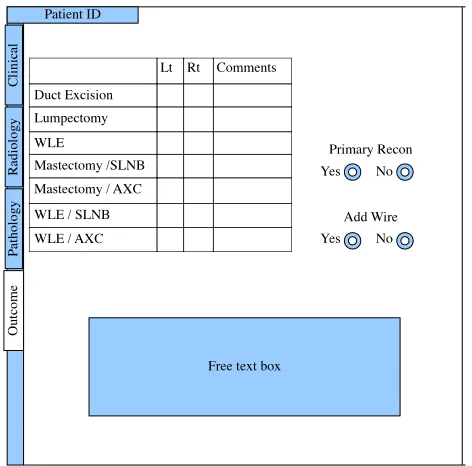
access to separate pages for data related to clinical, radiology, pathology findings respectively. The fourth tab loads the page to record the decision made by the MDT and is depicted in Figure4.
As described earlier, the data entry page to the patient’s EPR is accessed on the computer-on-wheels, and projected onto the side wall of the room. Having the data entry display vis-ible to all of the participants is similar in practice to other centres [29], although the side wall is not reported to be used elsewhere. Some team members expressed a concern that they did not want for their MDT discussion to be trans-formed to a “. . . group form-filling exercise”. Members re-port their satisfaction in meeting their colleagues and sharing opinions. Concerns have been expressed that if people were to“. . . focus only on the next bit of information to be entered . . . it would take from[the quality of]the discussion”.
The side-wall facilitates a very large projected image, several times larger than a plasma screen display in front would al-low (as used for radiology). The plasma screens at the front of the room and the large projected display on the side wall are illustrated in the photograph in Figure3. Another MDT had adopted a practice of using the side-wall of their meeting room to display background information on the patient being discussed, and this had been found useful as an awareness mechanism. The choice of side-wall is likely a matter of con-venience and the knowledge of its satisfactory use by another MDT. Projecting the data entry screen onto the wall means that it is available to all MDT members to view the data be-ing entered, but is not the object of discussion. However, it allows for corrections to be made to understanding, and thus the data is validated at the MDT meeting.
Actual Use
Figure 4. Representation of the data entry screen that is projected onto a side-wall of the meeting room
The check-boxes, intended to indicate the planned procedure, are not used. Neither are the radio-buttons used. At interview, staff who enter data regularly reported that it takes too much time to point the mouse and select an option. It is much faster, and easier, to type free text into the comments box. As one observed:
“. . . by the take your hand from the keyboard to find the mouse, point it and click or whatever, you’ve lost too much time . . . and the discussion has moved on”
Entering data obtained from a fast-paced discussion requires skill and expertise. The person entering the data is either an experienced nurse or an experienced house doctor. Initially, junior doctors in training were assigned the task, but their lack of experience was found to cause them difficulty in keeping pace with the discussion.
Staff who regularly enter data report that it is a highly de-manding task but that they have “. . . got used to it, and don’t mind it at all”. Prior to the data entry screen being projected, the computer-on-wheels was placed at the back of the room; the data were entered in real time and validated afterwards with the lead clinician. There is a greater demand on the per-son entering data to enter as much as possible, now that it is visible, compared to the pressure when the notes were being privately taken.
The physical location of the computer-on-wheels in the meet-ing room has had a great impact for the person entermeet-ing the data. In the words of one of the staff:
“It makes a big difference to us, now that we are up in front beside the radiologist . . . its much easier to lean over and ask something, or check what was said. We were inclined to be forgotten about when we were at the back of the room. Now its easier . . . and they have the
opportunity to point to something missing and maybe say ’don’t forget to say we need to see her after she is finished with the gynae people’1
The Data Entry Task
When one of us (BK) attempted to follow the data entry task by writing down the words that appeared on the large display, the challenge of the task became evident. It was extremely difficult, and not possible at times, to maintain pace with the entries being typed into the free-text box. When asked after-wards about the data entry task, the interviewee explained:
But its difficult for us too . . . but we’re more used to it -and we still sometimes find it difficult too. Sometimes we might have to add in something afterwards from a note that someone has taken. Don’t forget we are using these records afterwards and we know what we want to see. And we know this work, don’t forget . . . we anticipate whats going to be said next. . . . like . . . when someone is talking - we get to know what they’re going to say, and we anticipate what’s coming next - so we’re really thinking through . . . and anticipating . . . we know what they’re saying as we’re writing - we don’t wait until after they’ve said it, if you know what I mean. But it definitely is tiring . . .
This is certainly not a task that anyone can easily perform. The people entering the data are highly qualified and demon-strate an intimate knowledge of their work.
Lessons Learned
There are a few noteworthy behaviours that became evident and from which lessons can be learned for the CSCW com-munity.
Speech: The talk among the MDT specialists is relaxed and informal and when describing their findings they use lan-guage that is distinct from the lanlan-guage used in the medical record. So, for example, a phrase “. . . I didn’t see any sign of cancer in the sample”, is recorded as “Biopsy Lt side is nega-tive”. Or “It didn’t come up on PET” is recorded as “No evi-dence of metastasic disease”. Or “her mother died of cancer” is recorded as “Fhx ca”, meaning that she has a family history of cancer and thus may have a higher risk of developing the disease. Or if the oncologist offers “Send her to me”, the note might say “candidate for neoadjuvant chemo”, meaning that the patient will likely prove suitable for chemotherapy in con-junction with her surgical procedure. In this case the care for the patient will be formally transferred to that clinician, after the MDT meeting. Thus the written record is more formal and it is not a verbatim report of the relatively relaxed talk among MDT members. While it is a record of the discussion it has a more formal and objective appearance, likened by [13] as an ‘act of publication’ with a particular audiences or purposes in mind. It is the intended meaning, as understood in the team, i.e. the communication to be conveyed that is recorded and not the actual spoken words. Action is directed, for after the meeting.
1
Shared Understanding / Common Ground: The core team members work closely together and demonstrate a high re-gard for one another. They appear to be a cohesive group and have a shared understanding of their procedures and policies, so their intentions are not always articulated during discus-sion. When the volume of work increased to a level that elim-inated time for teaching or discussion on research, they self-organised to start 30 minutes earlier and devote this time to their research interests. These once-weekly,voluntary meet-ings of the MDT2are held outside normal working hours at 07:15am and demonstrate the regard and dedication the MDT members have for their meetings. (Many of the members have meetings on the other mornings of the week too, because of their membership of other MDTs.)
When specialists are reporting their findings during the dis-cussion, the information they contribute is assimilated by the team member, and transformed into an action. Examples such as “I’m concerned that we may have missed something . . . and maybe there is something nearby” is recorded as “ re-peat biopsy”. Or “So, we are concordant then, that it is fi-broadenoma - radiology and pathology agree. Is that right?”, becomes “Reassure patient and DC” (DC, stands for ‘dis-charge patient’). Information is generated through interac-tion among the specialists - using speech gestures, and body language. This information becomes synopsised, meaning is interpreted, or inferred, and action is applied. Acronyms and shorthand are frequently used and the MDT appears to have a shared understanding of them. For example, a typical entry into the record might read (for a cancer patient):
“40yrs Presented large tumor Lt breast IDC. Neoadju-vant chemo good clinical response. Proceeded to wire WLE &SNBX. Path IDC G2 2.4mm DCIS. Margins all okay. Closest int @2mm. LVI present and perineural invasion. Nodes 0/3 ER + Pr - Her- MP Grade 3/5. Re-sponse ypT2N0. Plan Med Onc to see and radiation on-cology”.
As one might expect, the report on a non-cancer patient is usually shorter and might read:
“36yrs. Core Rt breast FA 2.5cms. Path FA B2. Concor-dant. Reassure & DC”.
These example reports will have little meaning for most peo-ple. However they provide an important demonstration of how the MDT has developed a shared language that is a com-bination of the different jargons used by the several special-ities in the MDT. The levels of common ground allow for statements such as “So, its a fibroadenoma”, or “. . . she has a lot of family history . . .” to trigger protocols and proce-dures that will be implemented by the individuals on the team whose role it is to carry out the task, such as reassuring pa-tients or arranging genetic counselling.
Common ground and team cohesiveness likely contribute to the development of these local languages. Although it is dif-ficult to measure behaviours in these MDTs, they have been
2
Attendance, both the research seminar and the routine MDTM, is voluntary and outside of normal work hours for most members of the MDT.
the object of studies, as there are concerns that MDTs do not always perform effectively. There are reports that behavioural factors may account for some of the dysfunction observed [35, 7], and, drawing on the research of Clark on common ground [3,4] our concern is how to support this grounding, and avoid breakdown. It can be anticipated that any weaken-ing of common ground in MDT meetweaken-ings will lead to break-down in communication and ultimately affect patient safety.
Validation:
The intention in having the shared display for data entry is to afford team members the opportunity to correct entries, prompt if an omission is observed, or suggest clarification. This record of the MDT discussion has shared ownership, and it is the MDT understanding that what is written into the record will be adhered (unless the patient objects). However, there is no evidence for the MDT to know if this is the case, i.e. that this record isvalidand that tasks are discharged. In fact there is the suggestion that the group cohesiveness may be counter productive and that individuals might not bother to pay any attention to the data being entered, or that they might be reluctant to correct the person entering the data. For the MDTMs observed utilising this method of record-entry, there were no corrections prompted, comments were rare, and any remarks made by other MDT members added emphasis such as“be sure to write that . . . ”. If MDT members fail to check the entry, or feel inhibited about correcting an incorrect en-try, this could potentially lead to a false sense of validity of the discussion record. To compound matters from a hospital perspective there is currently no mechanism to ensure that an instruction in the record, such as“repeat scan in 6/12”, will be carried out. Indeed, some might describe this work system as “an open loop”.
Missed Opportunities:The MDT meeting has a rich content of information available to the MDT, but unfortunately most of this content is unavailable afterwards and its persistence is limited by the quality of the meeting record. Other sections of the hospital, and the healthcare system could benefit from aspects of the information content if they could access it. For example, hospital management has a responsibility to be able to account for the activity of its staff, and to plan services bet-ter. Without access to quality data with regard to the types of work that is being conduced by staff, and a better understand-ing of the services beunderstand-ing delivered, hospital managements are hampered in their organisation, delivery and planning of ser-vices. Indeed, Government budgets are often allocated on the basis of the ‘case-mix’ or other such metric, and hospi-tals employ staff tasked with the responsibility to gather these data, indirectly and labouriously, in patient files. The hospi-tal also has responsibility to national repositories for public health and cancer registries and the MDT meeting is a point in the work processes where these data are available, but not captured. An ideal record from a meeting would satisfy more hospital information needs than is current practice.
com-pare what was being said at the meeting from what was being written. It also gives new insights into interviews that had been conducted at earlier periods in our studies. At all times when individuals were asked about the notes they took during the discussion, the typical answer was “I take note of what-ever is being said”. Being able to monitor the entries and the conversation betrayed the differences.
Microphones: The use of microphones is raised repeatedly in surveys and at interview. Regular, active vocal, partici-pants tend not to want to use them (although some say they would be willing to wear microphones if they were made available). The non-vocal participants on the other hand con-tinually prompt (in surveys and in research interviews) that they cannot always hear what is being said. Yet, at meet-ings it is a very rare event for a non-vocal participant (unusu-ally a junior, or older, member of the team) to ask a speaker to repeat what they said, or to speak louder or more clearly. From time to time senior (and vocal) members of the team have been observed to ask others to “speak up, I can’t hear you”. For junior team members the social structures are in-hibiting. Older team members can also be inhibited (despite their seniority) and one explained “I don’t like to draw atten-tion . . . that I may have an age-related hearing deficit!”.
The fact that an issue such as ‘microphones’ gets raised in questionnaires and interviews interested in ‘record-keeping’, and rarely at MDT meetings, is an indication of the com-plexity of the issues of information, collaboration and record-keeping in healthcare. It is not possible to entirely separate the social and technical aspects of information and its use - they are inter-twined. If utterances cannot be heard, then where, or what, is the information content?
DISCUSSION
It is our responsibility to deliver the promise to provide ICT solutions to make our health systems safer and more depend-able. Evidence that our claims that ICT solutions to sup-port collaboration between health professionals, and between patients and their carers, will transform health services and make safer and more dependable systems is still awaited. Our research identifies a shortcoming in our ability to recognise that support for collaboration, sharing and reuse of informa-tion requires new methods of capturing informainforma-tion and trans-forming it into artifacts that are accessible and ‘fit for pur-pose’, i.e. supports communication records.
We argue that we need a communication record in healthcare that will document information used in decision-making, and support several levels of user skills, knowledge and experi-ence. The argument was made in a participant interview, for instance, that if a record says ‘treat with drugQ for three times a day, for 10 days’, unless that record has the informa-tion that provided the basis for the decision to recommend that treatment, there is potential to introduce new errors into the system. While some staff roles will be satisfied with a straightforward instruction, those in more responsible posi-tions of clinical authority need to have a full understanding of whythat recommendation was made, i.e. the underlying ra-tionale of the decision, and be able to validate or update the decision in the event of new evidence. One clinician said:
“it would all be fine if I only had a few patients to look after . . . then I could remember all the details on each one. But we are getting busier and busier, and we need systems in place that leave no room for error or ambigu-ity.”
It is well recognised that as humans we can expect to make errors and that we need to design systems that make it hard for people to do the wrong thing and easy for people to do the right thing [25]. We also need to guard against precipitating new errors when we introduce electronic information systems in healthcare, and the example above where the basis of the decision is not available is one of those omissions that has al-ready been identified as responsible for some adverse patient events [1,26].
A record from an MDTM is something quite different from an electronic medical record for an individual patient. This research suggests that the communication record need not necessarily be structured, but it should be condensed such that it can be produced and read quickly, processed, compre-hended, and provide the information required. We are not alone in pointing out the need for medical records to be as much about the collaborative work involved and services de-livered as they are about repositories, or ‘silos’ of information strung together over a network. The need for working records that have multiple working views that are both interdependent and independent has been described [8], and [38] argues that an electronic medical record system should be designed to fa-cilitate clinical work process representation, while simultane-ously preparing information in a patient-centered representa-tion for long-term reuse. It has been proposed that electronic patient records should afford organisational knowledge in a similar way to the way paper records allow them to be used as a means of making the activities of an organisation account-able and availaccount-able in various ways [14]. Here, we add that it must be ‘doable’ in the time-constrained setting of an MDT meeting.
Furthermore, given the information-rich setting that the MDTM provides, it is an ideal opportunity to capture knowl-edge that can be used to validate other data, capture non-verbal interaction data for quantitative analysis [28], build case sets for teaching purposes, or to make the overall ‘sys-tem’ of work more effective. For example, by fulfilling the hospital’s responsibility for notification of disease to a na-tional repository, or for building evidence for future review and policy development. While staff regard the newly imple-mented electronic record system as a great improvement over the old method in many respects, they report that the current electronic record does not provide them with all the informa-tion they require and say “we still need to be there . . . to hear, and see for ourselves . . . and take our own notes”.
CONCLUSION
Electronic MDT meeting records, i.e. communication records, should be an important part of the electronic patient record (EPR) system. As well as communicating the deci-sions made, this communication record should provide the basis for the decisions made on a patient: by whom was the decision proposed, who contributed to the discussion, which information was provided, and what was the rationale for the decision? As well as providing a formal account of the col-laborative event, the communication record is an important tool to guide later tasks.
Our study provides insight into how clinicians collaborate at MDT meetings, and argues for a record of the communication and decision-making. When discussing their opinion with one another, clinicians are explaining their motivation and providing context for their opinion (in images, text or other data). The MDT meeting is an opportunity to bridge the dif-ferent clinical specialist perspectives through talk, and one of the few occasions in medical work when different specialities come together to discuss patients. We propose that the ability for an MDT to successfully negotiate this inter-disciplinary bridge and build common ground, may well account for the significant patient, and other, benefits that have been reported to result from MDT collaboration and meetings [35].
The use of large projected transient display as a dependability enhancing mechanism to reduce risk in the MDT worksys-tem is laudable, but its use must not undermine the benefits of co-located discussion. However, if MDT members do not consult the entries, or intervene in discussion, then there is a risk that the large display will undermine its potential ben-efit and give a false sense of reliability. There needs to be a balance between maintaining a fluent discussion, and hav-ing a useful record. We also need to acknowledge the im-portance of MDT cohesiveness in building and maintaining common ground and recognise how these teams can work very efficiently under severe time constraints. Interventions, or events, that threaten team cohesiveness will also threaten patient safety.
Developing a record that will not detract from the syn-chronous face-to-face collaboration between clinicians, that is easily produced, requires little (if any) processing, and pro-vides for the multitude of potential uses is a challenge. We believe that it is a challenge worth the effort. The solution potentially has a very significant role to play in transforming our health services into more dependable, more efficient, and effective system.
ACKNOWLEDGMENTS
A sincere ‘thank you’ is extended to all of the multidisci-plinary teams at St. James’s hospital, Dublin, for their on-going co-operation in this study. Bridget Kane is a Marie Curie (ERCIM) Fellow and at the time of this study was an IRCSET Fellow, funded through the IRCSET Research Council for Science Engineering and Technology (IRCSET) Enterprise Partnership Scheme with St. James’s Hospital Board. The helpful support of Centre for Next Generation Localisation (CNGL, SFI grant 07/CE/1142) in bringing this paper to fruition is also appreciated. We thank our anony-mous reviewers for their helpful comments.
REFERENCES
1. Ash, J. S., Berg, M., and Coiera, E. Some unintended consequences of information technology in health care: The nature of patient care information system-related errors.Journal of the American Medical Informatics Association 11, 2 (2004), 104 – 112.
2. Bardram, J. E., Hansen, T. R., and Soegaard, M. Awaremedia: a shared interactive display supporting social, temporal, and spatial awareness in surgery. In Proceedings of the 2006 20th anniversary conference on Computer supported cooperative work, CSCW ’06, ACM (New York, NY, USA, 2006), 109–118.
3. Clark, H. H.Using Language. Cambridge University Press, Cambridge, 1996.
4. Clark, H. H., and Brennan, S. E. Grounding in communication. InPerspectives on Socially Shared Cognition, L. B. Resnick, J. M. Levine, and S. D. Teasley, Eds. American Psychological Association, Washington, DC, 1991, 127–149.
5. Coiera, E., and Tombs, V. Communication behaviours in a hospital setting: an observational study.BMJ 316, 7132 (2 1998), 673–676.
6. Falkman, G., Gustafsson, M., Torgersson, O., and Jontell, M. The origin, representation, and use of collaboration patterns in a medical community of practice. InEmerging Technologies and Information Systems for the Knowledge Society, M. Lytras et al., Eds., vol. 5288 ofLNCS. Springer, 2008, 403–412.
7. Firth-Cozens, J. Multidisciplinary teamwork: the good, bad, and everything in between.Quality in Health Care 10(2001), 65–66.
8. Fitzpatrick, G. Understanding the paper health record in practice: Implications for EHRs. InHealth Informatics Conference (HIC’2000) Integrating Information for Health Care, Health Informatics Society of Australia (Adelaide, Australia, 2000).
9. Frykholm, O., and Groth, K. References to personal experiences and scientific evidence during medical multi-disciplinary team meetings.Behaviour & Information Technology 30, 4 (2011), 455–466. doi: 10.1080/0144929X.2011.553746.
10. Galliers, J., Wilson, S., Randell, R., and Woodward, P. Safe use of symbols in handover documentation for medical teams.Behaviour & Information Technology 30, 4 (2011), 499–506. doi:
10.1080/0144929X.2011.582147.
11. Goffman, E.The presentation of self in everyday life, reprint ed. Penguin, London, 1990.
13. Hardstone, G., Hartswood, M., Procter, R., Slack, R., and Voss, A. Supporting informality: Team working and integrated care records. InCSCW Chicago 2004, ACM, ACM Press (2004).
14. Hartswood, M., Procter, R., Rouncefield, M., and Slack, R. Making a case in medical work: Implications for the electronic patient record.Computer Supported
Co-operative Work (CSCW) 12(2003), 241 – 266.
15. Hillestad, R., Bigelow, J., Bower, A., Girosi, F., Meili, R., Scoville, R., and Taylor, R. Can electronic medical record systems transform health care? potential health benefits, savings, and costs.Health Affairs 24, 5 (2005), 1103–1117.
16. Ho, D., Xiao, Y., Hu, P. F., Vaidya, V. U., Straumanis, J. P., Cardarelli, M. G., Norcio, A. F., and Gurses, A. P. P. ”front-stage” and ”back-stage” information. InCHI ’08 extended abstracts on Human factors in computing systems, CHI EA ’08, ACM (New York, NY, USA, 2008), 3033–3038.
17. Housley, W. Category work and knowledgeability within multidisciplinary team meetings.Text and Talk 20, 1 (2000), 83–108.
18. Joint Commission for Accreditation of Healthcare Organizations (JCAHO). Root causes of sentinel events. Tech. rep., The Joint Commission, 2010.
19. Jordan, K., Porcheret, M., and Croft, P. Quality of morbidity coding in general practice computerized medical records: a systematic review.Family Practice 21, 4 (2004), 396–412.
20. Kane, B., Groth, K., and Randall, D. Medical team meetings: utilising technology to enhance
communication, collaboration and decision-making. Behaviour & Information Technology 30, 4 (2011), 437–442. doi: 10.1080/0144929X.2011.591576.
21. Kane, B., and Luz, S. ‘referring on’: Passing responsibility for patient care. InWorkshop on ‘Handover: Collaboration for Continuity of Work’, ECSCW, 2007, ACM (Limerick, 2007).
22. Kane, B., and Luz, S. Taking lessons from teleconference to improve same time, same place interaction. InIEEE conference on Computer Based Medical Systems, IEEE (Jyv¨askyl¨a, Finland, 2008).
23. Kane, B., and Luz, S. On record-keeping at multidisciplinary team meetings. In24th IEEE International Symposium on Computer-Based Medical Systems (CBMS), IEEE (Bristol, England, 2011).
24. Kane, B., O’Byrne, K., and Luz, S. Assessing support requirements for multidisciplinary team meetings. In 23rd IEEE International Symposium on
Computer-Based Medical Systems, IEEE (Perth, Australia, 2010), 110 – 115.
25. Kohn, L. T., Corrigan, J. M., and Donaldson, M. S.To Err Is Human: Building a Safer Health System. Institute of Medicine, 2000.
26. Koppel, R., Metlay, J., Cohen, A., Abaluck, B., Localio, A. R., Kimmel, S. E., and Strom, B. L. Role of
computerized physician order entry systems in facilitating medication errors.Journal of the American Medical Association 293, 10 (2005), 1197–1203.
27. Leonard, M., Graham, S., and Bonacum, D. The human factor: the critical importance of effective teamwork and communication in providing safe care.Qual Saf Health Care 13, suppl 1 (2004), i85–90.
28. Luz, S. The non-verbal structure of patient case
discussions in multidisciplinary medical team meetings. ACM Transactions on Information Systems 30, 4 (2012), article 17.
29. Napolitano, G., Ranaghan, E., Middleton, R., Fox, C., and Gavin, A. Real-time multidisciplinary team meeting management systems. a comparison with paper records for staging completeness and waiting times.Behaviour & Information Technology 30, 4 (2011), 473–477.
30. Northcott, D., and Llewellyn, S. Benchmarking in uk health: a gap between policy and practice?
Benchmarking 12, 5 (2005), 419–435.
31. O’Higgins, N. Developing quality care for breast services in Ireland, 2006.
32. Pirkle, C. M., Dumont, A., and Zunzunegui, M.-V. Medical recordkeeping, essential but overlooked aspect of quality of care in resource-limited settings.
International Journal for Quality in Health Care(2012).
33. Randall, D., Harper, R., and Rouncefield, M.Fieldwork for Design. Springer, 2007.
34. Schmidt, K., and Bannon, L. Taking CSCW seriously: Supporting articulation work.Computer Supported Co-operative Work 1, 1/2 (1992), 7–40.
35. Taylor, C., Munro, A. J., Glynne-Jones, R., Griffith, C., Trevatt, P., Richards, M., and Ramirez, A. J.
Multidisciplinary team working in cancer: what is the evidence?British Medical Journal 340(2010), c951.
36. Verhoef, J., Toussaint, P. J., Putter, H.,
Zwetsloot-Schonk, J. H. M., and Vlieland, T. P. M. V. The impact of the implementation of a rehabilitation tool on the contents of the communication during
multidisciplinary team conferences in rheumatology. International Journal of Medical Informatics 76, 1112 (2007), 856–863.
37. Wilson, S., Galliers, J., and Fone, J. Not all sharing is equal: the impact of a large display on small group collaborative work. InProceedings of the 2006 20th anniversary conference on Computer supported cooperative work, CSCW ’06, ACM (New York, NY, USA, 2006), 25–28.