In: R. Levy & D. Reitter (Eds.),Proceedings of the 3rd Workshop on Cognitive Modeling and Computational Linguistics (CMCL 2012), pages 80–89, Montr´eal, Canada, June 7, 2012. c2012 Association for Computational Linguistics
A Computational Model of Memory, Attention, and Word Learning
Aida Nematzadeh, Afsaneh Fazly, and Suzanne Stevenson Department of Computer Science
University of Toronto
{aida,afsaneh,suzanne}@cs.toronto.edu
Abstract
There is considerable evidence that people generally learn items better when the presen-tation of items is distributed over a period of time (the spacing effect). We hypothesize that both forgetting and attention to novelty play a role in the spacing effect in word learning. We build an incremental probabilistic compu-tational model of word learning that incorpo-rates a forgetting and attentional mechanism. Our model accounts for experimental results on children as well as several patterns ob-served in adults.
1 Memory, Attention, and Word Learning
Learning the meaning of words is an important com-ponent of language acquisition, and an extremely challenging task faced by young children (e.g., Carey, 1978; Bloom, 2000). Much psycholinguis-tic research has investigated the mechanisms under-lying early word learning, and the factors that may facilitate or hinder this process (e.g., Quine, 1960; Markman and Wachtel, 1988; Golinkoff et al., 1992; Carpenter et al., 1998). Computational modeling has been critical in this endeavor, by giving precise ac-counts of the possible processes and influences in-volved (e.g., Siskind, 1996; Regier, 2005; Yu, 2005; Fazly et al., 2010). However, computational models of word learning have generally not given sufficient attention to the broader interactions of language ac-quisition with other aspects of cognition and cogni-tive development.
Memory limitations and attentional mechanisms are of particular interest, with recent computational studies reconfirming their important role in aspects
of word learning. For example, Frank et al. (2010) show that memory limitations are key to matching human performance in a model of word segmenta-tion, while Smith et al. (2010) further demonstrate how attention plays a role in word learning by form-ing the basis for abstractform-ing over the input. But much potential remains for computational modeling to contribute to a better understanding of the role of memory and attention in word learning.
One area where there is much experimental evi-dence relevant to these interactions is in the investi-gation of thespacing effectin learning (Ebbinghaus, 1885; Glenberg, 1979; Dempster, 1996; Cepeda et al., 2006). The observation is that people gen-erally show better learning when the presentations of the target items to be learned are “spaced” — i.e., distributed over a period of time — instead of be-ing “massed” — i.e., presented together one after the other. Investigations of the spacing effect often use a word learning task as the target learning event, and such studies have looked at the performance of adults as well as children (Glenberg, 1976; Pavlik and Anderson, 2005; Vlach et al., 2008). While this work involves controlled laboratory conditions, the spacing effect is very robust across domains and tasks (Dempster, 1989), suggesting that the underly-ing cognitive processes likely play a role in natural conditions of word learning as well.
Cuddy and Jacoby, 1982). However, the precise re-lation between forgetting and improved learning has not been made clear. It has also been proposed that subjects attend more to items in the spaced presen-tation because accessing less recent (more novel) items in memory requires more effort or attention (Hintzman, 1974). However, the precise attentional mechanism at work in the spacing experiments is not completely understood.
While such proposals have been discussed for many years, to our knowledge, there is as yet no de-tailed computational model of the precise manner in which forgetting and attention to novelty play a role in the spacing effect. Moreover, while mathemat-ical models of the effect help to clarify its proper-ties (Pavlik and Anderson, 2005), it is very impor-tant to situate these general cognitive mechanisms within a model of word learning in order to under-stand clearly how these various processes might in-teract in the natural word learning setting.
We address this gap by considering memory con-straints and attentional mechanisms in the context of a computational model of word-meaning acquisi-tion. Specifically, we change an existing probabilis-tic incremental model of word learning (Fazly et al., 2010) by integrating two new factors: (i) a forgetting mechanism that causes the learned associations be-tween words and meanings to decay over time; and (ii) a mechanism that simulates the effects of atten-tion to novelty on in-the-moment learning. The re-sult is a more cognitively plausible word learning model that includes a precise formulation of both forgetting and attention to novelty. In simulations using this new model, we show that a possible ex-planation for the spacing effect is the interplay of these two mechanisms, neither of which on its own can account for the effect.
2 The Computational Model
We extend the model of Fazly et al. (2010) — hence-forth referred to as FAS10 — by integrating new functionality to capture forgetting and attention to novelty. The model of FAS10 is an appropriate start-ing point for our study because it is an incremen-tal model of word learning that learns probabilis-tic associations between words and their semanprobabilis-tic properties from naturalistic data. Nonetheless, the
model assumes equal attention to all words and ob-jects present in the input, and, although incremental, it has a perfect memory for the internal represen-tation of each processed input. Hence, as we will show, it is incapable of simulating the spacing ef-fects observed in humans.
2.1 The FAS10 Model
The input to the model is a sequence of utterances (a set of words), each paired with a scene representa-tion (a set of semantic features, representing what is perceived when the words are heard), as in:
Utterance:{she,drinks,milk}
Scene:{ANIMATE,PERSON,FEMALE,CONSUME, DRINK,SUBSTANCE,FOOD,DAIRY-PRODUCT}
For each word, the model of FAS10 learns a proba-bility distribution over all possible features, p(.|w), called themeaning probabilityof the word. Before processing any input, all features are equally likely for a word, and the word’s meaning probability is uniform over all features. At each time stept, an input utterance–scene pair (similar to the above example) is processed. For each wordwand seman-tic feature f in the input pair, an alignment score,
at(w|f), is calculated that specifies how strongly thew–f pair are associated at timet. The alignment score in FAS10 uses the meaning probabilities of all the words in the utterance, which reflect the knowledge of the model of word meanings up to that point, as in:
at(w|f) =
pt−1(f|w)
∑
w0∈U
t
pt−1(f|w0)
(1)
wherept−1(f|w)is the probability of fbeing part of
the meaning of wordwat timet−1.
In the FAS10 model, pt(.|w) is then updated for all the words in the utterance, using the accumulated evidence from all prior and current co-occurrences of w–f pairs. Specifically, an association score is defined between a word and a feature, assoct(w,f), which is a summation of all the alignments for that
wand f up to timet.1 This association score is then normalized using a smoothed version of the
follow-1In FAS10, assoc
t(w,f) =assoct−1(w,f) +at(w|f).
ing to yieldpt(f|w):
pt(f|w) =
assoct(f,w)
∑
f0∈M
assoct(f0,w)
(2)
where
M
is the set of all observed features.There are two observations to make about the FAS10 model in the context of our desire to explore attention and forgetting mechanisms in word learn-ing. First, the calculation of alignmentsat(w|f)in Eqn. (1) treats all words equally, without special at-tention to any particular item(s) in the input. Sec-ond, the assoct(f,w) term in Eqn. (2) encodes per-fect memory of all calculated alignments since it is a simple accumulated sum. These properties motivate the changes to the formulation of the model that we describe next.
2.2 Adding Attention to Novelty to the Model
As noted just above, the FAS10 model lacks any mechanism to focus attention on certain words, as is suggested by theories on the spacing effect (Hintz-man, 1974). One robust observation in studies on attention is that people attend to new items in a learning scenario more than other items, leading to improved learning of the novel items (e.g., Snyder et al., 2008; MacPherson and Moore, 2010; Horst et al., 2011). We thus model the effect of attention to novelty when calculating alignments in our new model: attention to a more novel word increases the strength of its alignment with a feature — and con-sequently the learned word–feature association — compared to the alignment of a less novel word.
We modify the original alignment formulation of FAS10 to incorporate a multiplicative novelty term as follows (cf. Eqn. (1)):
at(w,f) =
pt(f|w)
∑
w0∈U
t
pt(f|w0)
∗noveltyt(w) (3)
where noveltyt(w)specifies the degree of novelty of a word as a simple inverse function of recency. That is, we assume that the more recently a word has been observed by the model, the less novel it appears to the model. Given a word w at timet that was last observed at timetlastw, we calculate noveltyt(w)as:
noveltyt(w) =1−recency(t,tlastw) (4)
where recency(t,tlastw) is inversely proportional
to the difference between t and tlastw. We set
novelty(w)to be 1 for the first exposure of the word.
2.3 Adding a Forgetting Mechanism to the
Model
Given the observation above (see end of Section 2.1) that assoct(w,f) embeds perfect memory in the FAS10 model, we add a forgetting mechanism by re-formulating assoct(w,f)to incorporate a decay over time of the component alignments at(w|f). In or-der to take a cognitively plausible approach to calcu-lating this function, we observe that assoct(w,f)in FAS10 serves a similar function toactivationin the ACT-R model of memory (Anderson and Lebiere, 1998). In ACT-R, activation of an item is the sum of individual memory strengthenings for that item, just as assoct(w,f) is a sum of individual align-ment strengths for the pair (w,f). A crucial dif-ference is that memory strengthenings in ACT-R undergo decay. Specifically, activation of an item
m aftert presentations is calculated as: act(m)t = ln(∑tt0=11/(t−t0)d), wheret0is the time of each
pre-sentation, anddis a constant decay parameter. We adapt this formulation for assoct(w,f) with the following changes: First, in theactformula, the constant 1 in the numerator is the basic strength of each presentation to memory. In our model, this is not a constant but rather the strength of align-ment, at(w|f). Second, we assume that stronger alignments should be more entrenched in memory and thus decay more slowly than weaker alignments. Thus, each alignment undergoes a decay which is dependent on the strength of the alignment rather than a constant decayd. We thus define assoct(w,f) to be:
assoct(f,w) =ln( t
∑
t0=1
at0(w|f)
(t−t0)da t0
) (5)
where the decay for each alignmentdat0 is:
dat0 =
d
at0(w|f) (6)
whered is a constant parameter. Note that thedat0 decreases as at0(w|f)increases.
apple:{FOOD:1,SOLID:.72,PRODUCE:.63, EDIBLE-FRUIT:.32,PLANT-PART:.22, PHYSICAL-ENTITY:.17,WHOLE:.06,· · · }
Figure 1: True meaning features & scores forapple.
3 Input Generation
The input data consists of a set of utterances paired with their corresponding scene representations. The utterances are taken from the child-directed speech (CDS) portion of the Manchester corpus (Theakston et al., 2001), from CHILDES (MacWhinney, 2000), which includes transcripts of conversations with 12 British children, ages 1;8 to 3;0. Every utterance is considered as a bag of lemmatized words. Half of the data is used as the development set, and the other half in the final experiments.
Because no manually-annotated semantic repre-sentation is available for any such large corpus of CDS, we use the approach of Nematzadeh et al. (2012) to generate scene representations. For each utterance a scene representation is generated artifi-cially, by first creating an input-generation lexicon that contains thetrue meaning(t(w)) of all the words (w) in our corpus. The true meaning is a vector of semantic features and their assigned scores (Fig-ure 1). The semantic feat(Fig-ures for a word, depend-ing on its part of speech, are chosen from different sources such as WordNet.2 The score of each feature is calculated automatically to give a higher value to the more specific features (such asFRUITforapple), rather than more general features (like PHYSICAL
-ENTITYforapple).
To generate the scene representation S of an utter-ance U, we probabilistically sample a subset of fea-tures from the feafea-tures int(w)for each wordw∈U. Thus, in each occurrence ofw some of its features are missing from the scene, resulting in an imper-fect sampling. This imperimper-fect sampling allows us to simulate noise and uncertainty in the input, as well as the uncertainty of a child in determining the rele-vant meaning elements in a scene. The scene S is the union of all the features sampled for all the words in the utterance. We note that the input-generation lex-icon is only used in creating input corpora that are naturalistic (based on child-directed speech), and not in the learning of the model.
2http://wordnet.princeton.edu
4 Experiments
First, we examine the overall word learning be-haviour in our new model. Then we look at spacing effects in the learning of novel words. In both these experiments, we compare the behavior of our model with the model of FAS10 to clearly illustrate the ef-fects of forgetting and attention to novelty in the new model. Next we turn to further experiments explor-ing in more detail the interaction of forgettexplor-ing and attention to novelty in producing spacing effects.
4.1 Word Learning over Time
Generally, the model of FAS10 has increasing com-prehension of words as it is exposed to more input over time. In our model, we expect attention to nov-elty to facilitate word learning, by focusing more on newly observed words, whereas forgetting is ex-pected to hinder learning. We need to see if the new model is able to learn words effectively when sub-ject to the combined effects of these two influences. To measure how well a wordwis learned in each model, we compare its learned meaningl(w)(a vec-tor holding the values of the meaning probability
p(.|w)) to its true meaningt(w)(see Section 3):
acq(w) = sim(l(w),t(w)) (7)
where sim is the cosine similarity between the two meaning vectors, t(w) and l(w). The better the model learns the meaning of w, the closer l(w)
would get tot(w), and the higher the value of sim would become. To evaluate the overall behaviour of a model, at each point in time, we average the acq score of all the words that the model has seen.
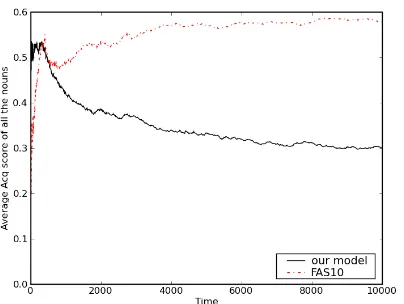
We train each model on 10,000 input utterance– scene pairs and compare their patterns of word learn-ing over time (Figure 2).3 We can see that in the original model, the average acq score is mostly in-creasing over time before leveling off. Our model, starts at a higher average acq score compared to FAS10’s model, since the effect of attention to nov-elty is stronger than the effect of forgetting in early stages of training. There is a sharp decrease in the acq scores after the early training stage, which then levels off. The early decrease in acq scores oc-curs because many of the words the model is
ex-3The constant decay parameterdin Eqn. (6) is set to 0.03 in
this experiment.
Figure 2: Average acq score of the words over time, for our model and FAS10’s model.
posed to early on are not learned very well initially, and so forgetting occurs at a higher rate during that stage. The model subsequently stabilizes, and the acq scores level off although at a lower absolute level than the FAS10 model. Note that when com-paring these two models, we are interested in the pattern of learning; in particular, we need to en-sure that our new word learning model will even-tually stabilize as expected. Our model stabilizes at a lower average acq score since unlike FAS10’s model, it does not implement a perfect memory.
4.2 The Spacing Effect in Novel Word
Learning
Vlach et al. (2008) performed an experiment to in-vestigate the effect of presentation spacing in learn-ing novel word–object pairs in three-year-old chil-dren. Each pair was presented 3 times in each of two settings, either consecutively (massed presenta-tion), or with a short play interval between each pre-sentation (spaced prepre-sentation). Children were then asked to identify the correct object corresponding to the novel word. The number of correct responses was significantly higher when the pairs were in the spaced presentation compared to the massed presen-tation. This result clearly demonstrates the spacing effect in novel word learning in children.
Experiments on the spacing effect in adults have typically examined and compared different amounts of time between the spaced presentations, which we refer to as the spacing interval. Another important parameter in such studies is the time period between the last training trial and the test trial(s), which we
refer to as the retention interval (Glenberg, 1976; Bahrick and Phelps, 1987; Pavlik and Anderson, 2005). Since the experiment of Vlach et al. (2008) was designed for very young children, the proce-dures were kept simple and did not vary these two parameters. We design an experiment similar to that of Vlach et al. (2008) to examine the effect of spac-ing in our model, but extend it to also study the role of various spacing and retention intervals, for com-parison to earlier adult studies.
4.2.1 Experimental Setup
First, the model is trained on 100 utterance–scene pairs to simulate the operation of normal word learn-ing prior to the experiment.4 Then a randomly picked novel word (nw) that did not appear in the training trials is introduced to the model in 3 teach-ing trials, similar to Vlach et al.’s (2008) experiment. For each teaching trial,nwis added to a different ut-terance, and its probabilistically-generated meaning representation (see Section 3) is added to the corre-sponding scene. We add nwto an utterance–scene pair from our corpus to simulate the presentation of the novel word during the natural interaction with the child in the experimental setting.
The spacing interval between each of these 3 teaching trials is varied from 0 to 29 utterances, re-sulting in 30 different simulations for eachnw. For example, when the spacing interval is 5, there are 5 utterances between each presentation of nw. A spacing of 0 utterances yields the massed presenta-tion. We run the experiment for 20 randomly-chosen novel words to ensure that the pattern of the results is not related to the meaning representation of a spe-cific word.
For each spacing interval, we look at the acq score of the novel word at two points in time, to simu-late two retention intervals: One immediately after the last presentation of the novel word (imm condi-tion) and one at a later point in time (latcondition). By looking at these two conditions, we can further observe the effect of forgetting in our model, since the decay in the model’s memory would be more se-vere in thelatcondition, compared to theimm con-dition.5 The results reported here for each spacing
4In the experiments of Section 4.2.2 and Section 4.3, the
constant decay parameterdis equal to 0.04.
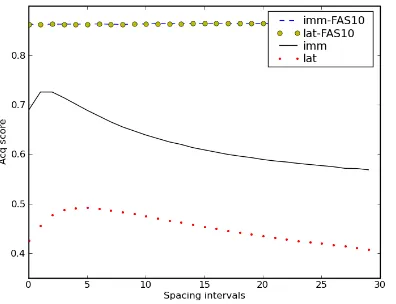
Figure 3: Average acq score of novel words over spacing intervals, in our model and FAS10’s model.
interval average the acq scores of all the novel words at the corresponding points in time.
4.2.2 The Basic Spacing Effect Results
Figure 3 shows the results of the simulations in our model and the FAS10 model. We assume that very small spacing intervals (but greater than 0) correspond to the spaced presentation in the Vlach et al. (2008) experiments, while a spacing of 0 cor-responds to the massed presentation. In the FAS10 model, the average acq score of words does not change with spacing, and there is no difference be-tween the imm and lat conditions, confirming that this model fails to mimic the observed spacing ef-fects. By contrast, in our model the average acq score is greater in the small spacing intervals (1-3) than in the massed presentation, mimicking the Vlach et al. (2008) results on children. This happens because anwappears more novel with larger spacing intervals between each of its presentations resulting in stronger alignments.
We can see two other interesting patterns in our model: First, the average acq score of words for all spacing intervals is greater in theimmcondition than in the lat condition. This occurs because there is more forgetting in the model over the longer reten-tion interval of lat. Second, in both conditions the average acq score initially increases from a massed presentation to the smaller spacing intervals. How-ever, at spacing intervals between about 3 and 5,
processing an input pair. The acq score in theimmcondition is calculated at timet, which is immediately after the last presen-tation ofnw. Thelatcondition corresponds tot+20.
the acq score begins to decrease as spacing intervals grow larger. As explained earlier, the initial increase in acq scores for small spacing intervals results from novelty of the words in a spaced presentation. How-ever, for bigger spacing intervals the effect of nov-elty is swamped by the much greater degree of for-getting after a bigger spacing interval.
Although Vlach et al. (2008) did not vary their spacing and retention intervals, other spacing effect studies on adults have done so. For example, Glen-berg (1976) presented adults with word pairs to learn under varying spacing intervals, and tested them af-ter several different retention inaf-tervals (his experi-ment 1). Our pattern of results in Figure 3 is in line with his results. In particular, he found a nonmono-tonic pattern of spacing similar to the pattern in our model: learning of pairs was improved with increas-ing spacincreas-ing intervals up to a point, but there was a decrease in performance for larger spacing intervals. Also, the proportion of recalled pairs decreased for longer retention intervals, similar to our lower per-formance in thelatcondition.
4.3 The Role of Forgetting and Attention
To fully understand the role as well as the neces-sity of, both forgetting and attention to novelty in our results, we test two other models under the same conditions as the previous spacing experiment: (a) a model with our mechanism for attention to novelty but not forgetting, and (b) a model with our forget-ting mechanism but no attention to novelty; see Fig-ure 4 and FigFig-ure 5, respectively.
In the model that attends to novelty but does not incorporate a memory decay mechanism (Figure 4), the average acq score consistently increases as spac-ing intervals grow bigger. This occurs because the novel words appear more novel following bigger spacing intervals, and thus attract more alignment strength. Since the model does not forget, there is no difference between the immediate (imm) and later (lat) retention intervals. This pattern does not match the spacing effect patterns of people, suggesting that forgetting is a necessary aspect of our model’s abil-ity to do so in the previous section.
Figure 4: Average acq score of the novel words over spac-ing intervals, for the model with novelty but without for-getting.
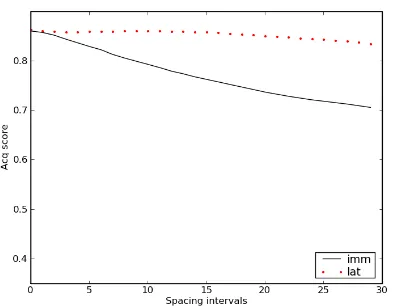
Figure 5: Average acq score of the novel words over spac-ing intervals, for the model with forgettspac-ing but without novelty.
consistently over spacing intervals. This is as ex-pected, because the greater time between presenta-tions means a greater degree of forgetting. Specif-ically, the alignment scores decay more between presentations of the word to be learned, given the greater passage of time in larger spacing intervals. The weaker alignments then lead to lower acq scores in this condition.
Paradoxically, although this effect on learning also holds in the lat condition, another factor is at play, leading to better performance than in theimm
condition at all spacing intervals. Here the greater retention interval — the time between the last learn-ing presentation and the test time — leads to greater forgetting in a manner that instead improves the acq scores. Consider that the meaning representation
for a word includes some probability mass assigned to irrelevant features — i.e., those features that oc-curred in an utterance–scene pair with the word but are not part of its true meaning. Because such fea-tures generally have lower probability than relevant features (which are observed more consistently with a word), a longer retention interval leads to them de-caying more than the relevant features. Thus thelat
condition enables the model to better focus on the features relevant to a word.
In conclusion, neither attention to novelty nor for-getting alone achieves the pattern typical of the spac-ing effects in people that our model shows in the lower two plots in Figure 3. Hence we conclude that both factors are necessary to our account, suggesting that it is an interaction between the two that accounts for people’s behaviour.
4.4 The “Spacing Crossover Interaction”
In our model with attention to novelty and forgetting (see Section 4.2), the average acq score was always better in the imm condition than thelat condition. However, researchers have observed other patterns in spacing experiments. A particularly interesting pattern found in some studies is that the plots of the results for earlier and later retention intervals cross as the spacing intervals are increased. That is, with smaller spacing intervals, a shorter retention inter-val (such as our imm condition) leads to better sults, but with larger spacing intervals, a longer re-tention interval (such as ourlat condition) leads to better results (Bahrick, 1979; Pavlik and Anderson, 2005). This interaction of spacing and retention in-tervals results in a pattern referred to as the spacing crossover interaction (Pavlik and Anderson, 2005). This pattern is different from Glenberg’s (1976) ex-periment and from the pattern of results shown ear-lier for our model (Figure 3).
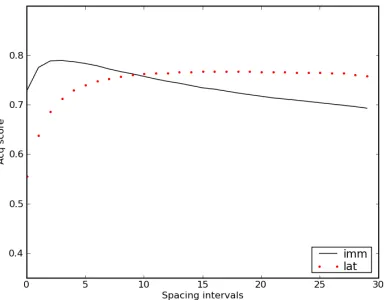
[image:7.612.85.284.295.448.2]Figure 6: Average acq score of the novel words over spac-ing intervals
ods might explain the different spacing patterns in these experiments.
We currently cannot model presentation time di-rectly in our model, since having access to an in-put longer does not change its comin-putation of align-ments between words and features. However, we can indirectly model a difference in presentation time by modifying the amount of memory decay: We assume that when an item is presented longer, it is learned better and therefore subject to less forget-ting. We run the spacing experiment with a smaller forgetting parameter to model the longer presenta-tion period used in Pavlik and Anderson’s (2005) versus Glenberg (1976).6
Our results using the decreased level of forgetting, given in Figure 6, show the expected crossover inter-action between the retention and spacing intervals: for smaller spacing intervals, the acq scores are bet-ter in theimmcondition, whereas for larger spacing intervals, they are better in thelatcondition. Thus, our model suggests an explanation for the observed crossover: in tasks which strengthen the learning of the target item — and thus lessen the effect of forget-ting — we expect to see a benefit of later retention trials in experiments with people.
5 General Discussion and Future Work
The spacing effect (where people learn items better when multiple presentations are spread over time) has been studied extensively and is found to be ro-bust over different types of tasks and domains. Many
6Here, the decay parameter is set to 0.03.
experiments have examined the spacing effect in the context of word learning and other similar tasks. Particularly, in a recent study of Vlach et al. (2008), young children demonstrated a spacing effect in a novel word learning task.
We use computational modeling to show that by changing a probabilistic associative model of word learning to include both a forgetting and attentional mechanism, the new model can account not only for the child data, but for various patterns of spacing ef-fect data in adults. Specifically, our model shows the nonmonotonic pattern of spacing observed in the ex-perimental data, where learning improves in shorter spacing intervals, but worsens in bigger spacing in-tervals. Our model can also replicate the observed cross-over interaction between spacing and retention intervals: for smaller spacing intervals, performance is better when tested after a shorter retention inter-val, whereas for bigger spacing intervals, it is better after longer retention intervals. Finally, our results confirm that by modelling word learning as a stan-dalone development process, we cannot account for the spacing effect. Instead, it is important to con-sider word learning in the context of fundamental cognitive processes of memory and attention.
Much remains to be investigated in our model. For example, most human experiments examine the effect of frequency of presentations of target items. Also, the range of retention intervals that has been studied is greater than what we have considered here. In the future, we plan to study the effect of these two parameters. In addition, with our current model, the amount of time an item is presented to the learner does not play a role. We can also re-formulate our alignment mechanism to incorporate a notion of the amount of time to consider an item to be learned. Another interesting future direction, especially in the context of word learning, is to de-velop a more complete attentional mechanism, that considers different parameters such as social cues and linguistic cues. Finally, we will study the role of forgetting and attention in modelling other rele-vant experimental data (e.g., Kachergis et al., 2009; Vlach and Sandhofer, 2010).
References
John .R. Anderson and Christian Lebiere. 1998.The atomic components of thought. Lawrence Erl-baum Associates.
Harry P. Bahrick. 1979. Maintenance of knowl-edge: Questions about memory we forgot to ask.
Journal of Experimental Psychology: General, 108(3):296–308.
Harry P. Bahrick and Elizabeth Phelps. 1987. Reten-tion of Spanish vocabulary over 8 years. Journal of Experimental Psychology: Learning, Memory, and Cognition, 13(2):344–349.
Paul Bloom. 2000. How Children Learn the Mean-ings of Words. MIT Press.
Susan Carey. 1978. The child as word learner. In M. Halle, J. Bresnan, and G. A. Miller, editors,
Linguistic Theory and Psychological Reality. The MIT Press.
Malinda Carpenter, Katherine Nagell, Michael Tomasello, George Butterworth, and Chris Moore. 1998. Social cognition, joint attention, and communicative competence from 9 to 15 months of age. Monographs of the Society for Research in Child Development, 63(4).
Nicholas J. Cepeda, Harold Pashler, Edward Vul, John T. Wixted, and Doug Rohrer. 2006. Dis-tributed practice in verbal recall tasks: A review and quantitative synthesis. Psychological Bul-letin, 132(3):354 – 380.
Lauren J. Cuddy and Larry L. Jacoby. 1982. When forgetting helps memory: an analysis of repetition effects. Journal of Verbal Learning and Verbal Behavior, 21(4):451 – 467.
Frank Dempster. 1989. Spacing effects and their im-plications for theory and practice. Educational Psychology Review, 1:309–330.
Frank N. Dempster. 1996. Distributing and manag-ing the conditions of encodmanag-ing and practice. Mem-ory, pages 317–344.
Hermann Ebbinghaus. 1885. Memory: A contri-bution to experimental psychology. New York, Teachers College, Columbia University.
Afsaneh Fazly, Afra Alishahi, and Suzanne Steven-son. 2010. A probabilistic computational model
of cross-situational word learning. Cognitive Sci-ence, 34(6):1017–1063.
Michael C. Frank, Sharon Goldwater, Thomas L. Griffiths, and Joshua B. Tenenbaum. 2010. Mod-eling human performance in statistical word seg-menation. Cognition, 117:107–125.
Arthur Glenberg. 1979. Component-levels theory of the effects of spacing of repetitions on recall and recognition. Memory and Cognition, 7:95–112.
Arthur M. Glenberg. 1976. Monotonic and non-monotonic lag effects in paired-associate and recognition memory paradigms. Journal of Ver-bal Learning & VerVer-bal Behavior, 15(1).
Roberta M. Golinkoff, Kathy Hirsh-Pasek, Leslie M. Bailey, and Neil R. Wegner. 1992. Young chil-dren and adults use lexical principles to learn new nouns. Developmental Psychology, 28(1):99– 108.
Douglas L. Hintzman. 1974. Theoretical implica-tions of the spacing effect.
Jessica S. Horst, Larissa K. Samuelson, Sarah C. Kucker, and Bob McMurray. 2011. Whats new? children prefer novelty in referent selection. Cog-nition, 118(2):234 – 244.
Larry L. Jacoby. 1978. On interpreting the effects of repetition: Solving a problem versus remem-bering a solution. Journal of Verbal Learning and Verbal Behavior, 17(6):649 – 667.
George Kachergis, Chen Yu, and Richard Shiffrin. 2009. Temporal contiguity in cross-situational statistical learning.
Amy C. MacPherson and Chris Moore. 2010. Un-derstanding interest in the second year of life. In-fancy, 15(3):324–335.
Brian MacWhinney. 2000. The CHILDES Project: Tools for Analyzing Talk, volume 2: The Database. Erlbaum, 3rd edition.
Ellen M. Markman and Gwyn F. Wachtel. 1988. Children’s use of mutual exclusivity to constrain the meanings of words. Cognitive Psychology, 20:121–157.
Arthur W. Melton. 1967. Repetition and retrieval from memory. Science, 158:532.
Aida Nematzadeh, Afsaneh Fazly, and Suzanne Stevenson. 2012. Interaction of word learning and semantic category formation in late talking. In
Proc. of CogSci’12. To appear.
Philip I. Pavlik and John R. Anderson. 2005. Prac-tice and forgetting effects on vocabulary memory: An activationbased model of the spacing effect.
Cognitive Science, 29:559–586.
W.V.O. Quine. 1960. Word and Object. MIT Press.
Terry Regier. 2005. The emergence of words: At-tentional learning in form and meaning.Cognitive Science, 29:819–865.
Jeffery Mark Siskind. 1996. A computational study of cross-situational techniques for learning word-to-meaning mappings. Cognition, 61:39–91.
Linda B Smith, Eliana Colunga, and Hanako Yoshida. 2010. Knowledge as process: Contextually-cued attention and early word learning. Cogn Sci, 34(7):1287–314.
Kelly A. Snyder, Michael P. BlanK, and chad J. Mar-solek. 2008. What form of memory underlies nov-elty preferences? Psychological Bulletin and Re-view, 15(2):315 – 321.
Anna L. Theakston, Elena V. Lieven, Julian M. Pine, and Caroline F. Rowland. 2001. The role of per-formance limitations in the acquisition of verb– argument structure: An alternative account. J. of Child Language, 28:127–152.
Haley A Vlach and Catherine M Sandhofer. 2010. Desirable difficulties in cross-situational word learning.
Haley A. Vlach, Catherine M. Sandhofer, and Nate Kornell. 2008. The Spacing Effect in Children’s Memory and Category Induction. Cognition, 109(1):163–167, October.
Chen Yu. 2005. The emergence of links between lexical acquisition and object categorization: A computational study. Connection Science, 17(3– 4):381–397.