An Analysis of Bootstrapping for the Recognition of Temporal Expressions
Jordi Poveda
TALP Research Center
Technical University of Catalonia (UPC) Barcelona, Spain
Mihai Surdeanu
NLP Group Stanford University
Stanford, CA
Jordi Turmo
TALP Research Center
Technical University of Catalonia (UPC) Barcelona, Spain
Abstract
We present a semi-supervised (bootstrapping) approach to the extraction of time expression mentions in large unlabelled corpora. Because the only supervision is in the form of seed examples, it becomes necessary to resort to heuristics to rank and filter out spurious pat-terns and candidate time expressions. The application of bootstrapping to time expres-sion recognition is, to the best of our knowl-edge, novel. In this paper, we describe one such architecture for bootstrapping Informa-tion ExtracInforma-tion (IE) patterns —suited to the extraction of entities, as opposed to events or relations— and summarize our experimental findings. These point out to the fact that a pattern set with a good increase in recall with respect to the seeds is achievable within our framework while, on the other side, the de-crease in precision in successive iterations is succesfully controlled through the use of rank-ing and selection heuristics. Experiments are still underway to achieve the best use of these heuristics and other parameters of the boot-strapping algorithm.
1 Introduction
The problem of time expression recognition refers to the identification in free-format natural language text of the occurrences of expressions that denote time. Time-denoting expressions appear in a great diversity of forms, beyond the most obvious ab-solute time or date references (e.g. 11pm, Febru-ary 14th, 2005): time references that anchor on an-other time (three hours after midnight,two weeks be-fore Christmas), expressions denoting durations (a
few months), expressions denoting recurring times (every third month, twice in the hour), context-dependent times (today,last year), vague references (somewhere in the middle of June, the near future) or times that are indicated by an event (the day G. Bush was reelected). This problem is a subpart of a task called TERN (Temporal Expression Recog-nition and Normalization), where temporal expres-sions are first identified in text and then its intended temporal meaning is represented in a canonical for-mat. TERN was first proposed as an independent task in the 2004 edition of the ACE conferences1.
The most widely used standard for the annotation of temporal expressions is TIMEX (Ferro et al., 2005). The most common approach to temporal expres-sion recognition in the past has been the use of hand-made grammars to capture the expressions (see (Wiebe et al., 1998; Filatova and Hovy, 2001; Sa-quete et al., 2004) for examples), which can then be easily expanded with additional attributes for the normalization task, based on computing distance and direction (past or future) with respect to a ref-erence time. This approach achieves an F1-measure of approximately 85% for recognition and normal-ization. The use of machine learning techniques — mainly statistical— for this task is a more recent development, either alongside the traditional hand-grammar approach to learn to distinguish specific difficult cases (Mani and Wilson, 2000), or on its own (Hacioglu et al., 2005). The latter apply SVMs to the recognition task alone, using the output of sev-eral human-made taggers as additional features for the classifier, and report an F1-measure of 87.8%.
1http://www.nist.gov/speech/tests/ace/
Bootstrapping techniques have been used for such diverse NLP problems as: word sense disambigua-tion (Yarowsky, 1995), named entity classificadisambigua-tion (Collins and Singer, 1999), IE pattern acquisition (Riloff, 1996; Yangarber et al., 2000; Yangarber, 2003; Stevenson and Greenwood, 2005), document classification (Surdeanu et al., 2006), fact extraction from the web (Pas¸ca et al., 2006) and hyponymy re-lation extraction (Kozareva et al., 2008).
(Yarowsky, 1995) used bootstrapping to train de-cision list classifiers to disambiguate between two senses of a word, achieving impressive classification accuracy. (Collins and Singer, 1999) applied boot-strapping to extract rules for named entity (NE) clas-sification, seeding the sytem with a few handcrafted rules. Their main innovation was to split training in two alternate stages: during one step, only con-textual rules are sought; during the second step, the new contextual rules are used to tag further NEs and these are used to produce new spelling rules.
Bootstrapping approaches are employed in (Riloff, 1996), (Yangarber et al., 2000), (Yangarber, 2003), and (Stevenson and Greenwood, 2005) in order to find IE patterns for domain-specific event extraction. (Pas¸ca et al., 2006) employ a bootstrapping process to extract general facts from the Web, viewed as two-term relationships (e.g [Donald Knuth, 1938] could be an instance of a “born in year” relationship). (Surdeanu et al., 2006) used bootstrapping co-trained with an EM classifier in order to perform topic classification of documents based on the presence of certain learned syntactic-semantic patterns. In (Kozareva et al., 2008), bootstrapping is applied to finding new members of certain class of objects (i.e. an “is-a” relationship), by providing a member of the required class as seed and using a “such as” type of textual pattern to locate new instances.
The recognition of temporal expressions is cru-cial for many applications in NLP, among them: IE, Question Answering (QA) and Automatic Summa-rization (for the temporal ordering of events). Work on slightly supervised approaches such as bootstrap-ping is justified by the large availability of unla-belled corpora, as opposed to tagged ones, from which to learn models for recognition.
2 Architecture
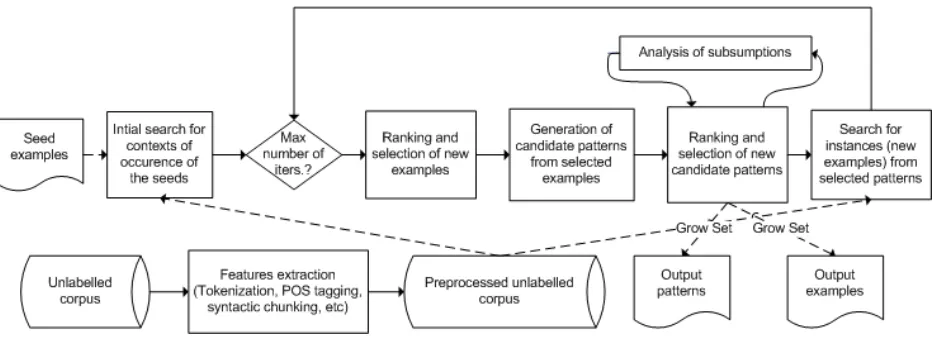
Figure 1 illustrates the building blocks of the algo-rithm and their interactions, along with input and output data.
The inputs to the bootstrapping algorithm are the unlabelled training corpus and a file of seed ex-amples. The unlabelled corpus is a large collec-tion of documents which has been tokenized, POS tagged, lemmatized, and syntactically analyzed for basic syntactic constituents (shallow parsing) and headwords. The second input is a set ofseed exam-ples, consisting of a series of token sequences which we assume to be correct time expressions. The seeds are supplied without additional features, and without context information.
Our bootstrapping algorithm works with two al-ternative views of the same target data (time expres-sions), that is: patterns and examples (i.e. an in-stance of a pattern in the corpus). Apatternis a gen-eralized representation that can match any sequence of tokens meeting the conditions expressed in the pattern (these can be morphological, semantic, syn-tactic and contextual). Anexampleis an actual can-didate occurrence of a time expression. Patterns are generated from examples found in the corpus and, in its turn, new examples are found by searching for matches of new patterns. Both patterns and ex-amples may carry contextual information, that is, a window of tokens left and right of the candidate time expression.
Output examplesandoutput patternsare the out-puts of the bootstrapping process. Both the set of
output examples and the set of output patterns are increased with each new iteration, by adding the new candidate examples (respectively, patterns) that have been “accepted” during the last iteration (i.e. those that have passed the ranking and selection step).
Initially, a single pass through the corpus is per-formed in order to find occurrences of the seeds in the text. Thus, we bootstrap an initial set of exam-ples. From then on, the bootstrapping process con-sists of a succession of iterations with the following steps:
1. Ranking and selection of examples: Each ex-ample produced during any of the previous it-erations, 0 toi−1, is assigned a score (rank-ing). The topnexamples are selected to grow
Figure 1: Block diagram of bootstrapping algorithm
be used for the next step. The details are given in Section 4.2.
2. Generation of candidate patterns: Candidate patterns for the current iteration are generated from the selected examples of the previous step (discussed in Section 3).
3. Ranking and selection of candidate patterns: Each pattern from the current iteration is as-signed a score and the topm patterns are
se-lected to grow the set of output patterns and to be used in the next step (discussed in Section 4.1). This step also involves a process of analy-sis of subsumptions, performed simultaneously with selection, in which the set of selected pat-terns is examined and those that are subsumed by other patterns are discarded.
4. Search for instances of the selected patterns: The training corpus is traversed, in order to search for instances (matches) of the selected patterns, which, together with the accepted ex-amples from all previous iterations, will form the set of candidate examples for iterationi+1.
Also, in order to relax the matching of pat-terns to corpus tokens and of token forms among themselves, the matching of token forms is case-insensitive, and all the digits in a token are gen-eralized to a generic digit marker (for instance, “12-23-2006” is internally rewritten as “@@-@@-@@@@”).
Even though our architecture is built on a tradi-tional boostrapping approach, there are several ele-ments that are novel, at least in the context of tem-poral expression recognition: a) our pattern repre-sentation incorporates full syntax and distributional
semantics in a unified model (see Section 3); b) our pattern ranking/selection approach includes a sub-sumption model to limit redundancy; c) the formu-lae in our example ranking/selection approach are designed to work with variable-length expressions that incorporate a context.
3 Pattern representation
Patterns capture both the sequence of tokens that integrate a potential time expression (i.e. a time expression mention), and information from the left and right context where it occurs (up to a bounded length). Let us callprefixthe part of the pattern that represents the left context,infix the part that repre-sents a potential time expression mention andpostfix
the part that represents the right context.
The EBNF grammar that encodes our pattern rep-resentation is given in Figure 2. Patterns are com-posed of multiplepattern elements(PEs). A pattern element is the minimal unit that is matched against the tokens in the text, and a single pattern element can match to one or several tokens, depending on the pattern element type. A pattern is considered to match a sequence of tokens in the text when: first, all the PEs from the infix are matched (this gives the potential time expression mention) and, second, all the PEs from the prefix and the postfix are matched (this gives the left and right context information for the new candidate example, respectively). There-fore, patterns with a larger context window are more restrictive, because all of the PEs in the prefix and the postfix have to be matched (on top of the infix) for the pattern to yield a match.
pattern ::= prefix SEP infix SEP postfix SEP (modifiers)*
prefix ::= (pattern-elem)* infix ::= (pattern-elem)+ postfix ::= (pattern-elem)*
pattern-elem ::= FORM "(" token-form ")" | SEMCLASS "(" token-form ")" |
POS "(" pos-tag ")" | LEMMA "(" lemma-form ")" | SYN "(" syn-type "," head ")" |
SYN-SEM "(" syn-type "," head ")" modifiers ::= COMPLETE-PHRASE
Figure 2: The EBNF Grammar for Patterns
(i.e. PEs) and chunk-level generalizations. The for-mer have been generated from the features of a sin-gle token and will match to a sinsin-gle token in the text. The latter have been generated from and match to a sequence of tokens in the text (e.g. a basic syntactic chunk). Patterns are built from the following types of PEs (which can be seen in the grammar from Fig-ure 2):
1. Token form PEs: The more restrictive, only match a given token form.
2. Semantic class PEs: Match tokens (sometimes multiwords) that belong to a given semantic similarity class. This concept is defined below. 3. POS tag PEs: Match tokens with a given POS. 4. Lemma PEs: Match tokens with a given
lemma.
5. Syntactic chunk PEs: Match a sequence of to-kens that is a syntactic chunk of a given type (e.g. NP) and whose headword has the same lemma as indicated.
6. Generalized syntactic PEs: Same as the previ-ous, but the lemma of the headword may be any in a given semantic similarity class.
Thesemantic similarity classof a word is defined as the word itself plus a group of other semanti-cally similar words. For computing these, we em-ploy Lin’s corpus of pairwise distributional similari-ties among words (nouns, verbs and adjectives) (Lin, 1998), filtered to include only those words whose similarity value is above both an absolute (highest
n) and relative (to the highest similarity value in the
class) threshold. Even after filtering, Lin’s similari-ties can be “noisy”, since the corpus has been con-structed relying on purely statistical means. There-fore, we are employing in addition a set of manu-ally defined semantic classes (hardcoded lists) sen-sitive to our domain of temporal expressions, such that these lists “override” the Lin’s similarity cor-pus whenever the semantic class of a word present
in them is involved. The manually defined semantic classes include: the written form of cardinals; ordi-nals; days of the week (plus today, tomorrow and
yesterday); months of the year; date trigger words (e.g. day,week); time trigger words (e.g.hour, sec-ond); frequency adverbs (e.g.hourly,monthly); date adjectives (e.g.two- day,@@-week-long); and time adjectives (e.g.three-hour,@@-minute-long).
We use adynamic windowfor the amount of con-text that is encoded into a pattern, that is, we gen-erate all the possible patterns with the same infix, and anything between 0 and the specified length of the context window PEs in the prefix and the postfix, and let the selection step decide which variations get accepted into the next iteration.
The modifiers field in the pattern representa-tion has been devised as an extension mecha-nism. Currently the only implemented mod-ifier is COMPLETE-PHRASE, which when at-tached to a pattern, “rounds” the instance (i.e. candidate time expression) captured by its infix to include the closest complete basic syntactic chunk (e.g. “LEMMA(end) LEMMA(of) SEM-CLASS(January)” would match “the end of De-cember 2009” instead of only “end of DeDe-cember” against the text “. . . By the end of December 2009, . . . ”). This modifier was implemented in view of the fact that most temporal expressions correspond with whole noun phrases or adverbial phrases.
From the above types of PEs, we have built the following types of patterns:
1. All-lemma patterns (including the prefix and postfix).
2. All-semantic class patterns.
3. Combinations of token form with sem. class. 4. Combinations of lemma with sem. class. 5. All-POS tag patterns.
6. Combinations of token form with POS tag. 7. Combinations of lemma with POS tag. 8. All-syntactic chunk patterns.
9. All-generalized syntactic patterns.
4 Ranking and selection of patterns and learning examples
4.1 Patterns
For the purposes of this section, let us define the
Note that, except for the seed examples, this is only
assumed correct, but cannot be guaranteed to be cor-rect (unsupervised). In addition, let us define the in-stance setIp of a candidate patternp as the set of all the instances of the pattern found in a fraction of the unlabelled corpus (only infix of the instance con-sidered). Each candidate patternpatis assigned two partial scores:
1. A frequency-based scorefreq sc(p)that mea-sures the coverage of the pattern in (a section of) the unsupervised corpus:
freq sc(p) = Card(Ip∩ C)
2. A precision scoreprec sc(p)that evaluates the precision of the pattern in (a section of) the un-supervised corpus, measured against the con-trol set:
prec sc(p) = Card(Ip∩C)
Card(Ip)
These two scores are computed only against a fraction of the unlabelled corpus for time effi-ciency. There remains an issue with whether multi-sets(counting each repeated instance several times) ornormal sets(counting them only once) should be used for the instance setsIp. Our experiments indi-cate that the best results are obtained by employing multisets for the frequency-based score and normal sets for the precision score.
Given the two partial scores above, we have tried three different strategies for combining them:
• Multiplicative combination: λ1log(1 +
freq sc(p)) +λ2log(2+ prec sc(p))
• The strategy suggested in (Collins and Singer, 1999): Patterns are first filtered by imposing a threshold on their precision score. Only for those patterns that pass this first filter, their final score is considered to be their frequency-based score.
• The strategy suggested in (Riloff, 1996):
prec sc(p)·log(freq sc(p)) ifprec sc(p)≥thr
0 otherwise
4.1.1 Analysis of subsumptions
Intertwined with the selection step, an analysis of subsumptions is performed among the selected pat-terns, and the patterns found to be subsumed by oth-ers in the set are discarded. This is repeated until ei-ther a maximum ofmpatterns with no subsumptions
among them are selected, or the list of candidate pat-terns is exhausted, whichever happens first. The pur-pose of this analysis of subsumptions is twofold: on the one hand, it results in a cleaner output pattern set by getting rid of redundant patterns; on the other hand, it improves temporal efficiency by reducing the number of patterns being handled in the last step of the algorithm (i.e. searching for new candidate examples).
In our scenario, a patternp1with instance setIp1
is subsumed by a pattern p2 with instance set Ip2
ifIp1 ⊂ Ip2. We make a distinction among
“theo-retical” and “empirical” subsumptions. Theoretical subsumptions are those that can be justified based on theoretical grounds alone, from observing the form of the patterns. Empirical subsumptions are those cases where in fact one pattern subsumes another ac-cording to the former definition, but this could only be detected by having calculated their respective in-stance sets a priori, which beats one of the purposes of the analysis of subsumptions —namely, tempo-ral efficiency—. We are only dealing with theoreti-cal subsumptions here. A patterntheoretically sub-sumes another pattern when either of these condi-tions occur:
• The first pattern is identical to the second, ex-cept that the first has fewer contextual PEs in the prefix and/or the postfix.
• Part or all of the PEs of the first pattern are identical to the corresponding PEs in the sec-ond pattern, except for the fact that they are of amore general type(element-wise); the re-maining PEs are identical. To this end, we have defined a partial order of generality in the PE types (see section 3), as follows:
FORM≺LEMMA≺SEMCLASS; FORM≺POS; SYN≺SYN-SEMC
• Both the above conditions (fewer contextual PEs and of a more general type) happen at the same time.
4.2 Learning Examples
examples, we first assign a score and select a num-bern of distinct infixesand, in a second stage, we
assign a score to each context of appearance of an infix and select (at most)m contexts per infix. Our
scoring system for the infixes is adapted from (Pas¸ca et al., 2006). Each distinct infix receives three par-tial scores and the final score for the infix is a linear combination of these, with theλibeing parameters:
λ1sim sc(ex) +λ2pc sc(ex) +λ3ctxt sc(ex)
1. A similarity-based score (sim sc(ex)), which measures the semantic similarity (as per the Lin’s similarity corpus (Lin, 1998)) of the infix with respect to set of “accepted” output examples from all previous iterations plus the initial seeds. If w1, . . . , wn are the tokens in the infix (excluding stopwords);ej,1, . . . , ej,mj
are the tokens in the j-th example of the set E of seed plus output examples; and sv(x, y)
represents a similarity value, the similarity Sim(wi) of the i-th word of the infix wrt the seeds and output is given by Sim(wi) =
P|E|
j=1max(sv(wi, ej,1), . . . ,sv(wi, ej,mj)),
and the similarity-based score of an in-fix containingPn n words is given by
i=1log(1+Sim(wi))
n .
2. A phrase-completeness score (pc sc(ex)), which measures the likelihood that the infix is a complete time expression and not merely a part of one, over the entire set of candidate example: count(INFIX)
count(∗INFIX∗)
3. A context-based score (ctxt sc(ex)), intended as a measure of the infix’s relevance. For each context (up to a length) where this infix appears in the corpus, the frequency of the word with maximum relative frequency (over the words in all the infix’s contexts) is taken. The sum is then scaled by the relative frequency of this particular infix.
Apart from the score associated with the infix, each example (i.e. infix plus a context) receives two additional frequency scores for the left and right context part of the example respectively. Each of these is given by the relative frequency of the token with maximum frequency of that context, computed over all the tokens that appear in all the contexts of all the candidate examples. For each selected infix, themcontexts with best score are selected.
5 Experiments 5.1 Experimental setup
As unsupervised data for our experiments, we use the NW (newswire) category of LDC’s ACE 2005 Unsupervised Data Pool, containing 456 Mbytes of data in 204K documents for a total of over 82 mil-lion tokens. Simultaneously, we use a much smaller labelled corpus (where the correct time expressions are tagged) to measure the precision, recall and F1-measure of the pattern set learned by the bootstrap-ping process. This is the ACE 2005 corpus, contain-ing 550 documents with 257K tokens and approx. 4650 time expression mentions. The labelled corpus is split in two halves: one half is used to obtain the initial seed examplesfrom among the time expres-sions found therein; the other half is used for eval-uation. We are requiring that a pattern captures the target time expression mentionexactly(no misalign-ment allowed at the boundaries), in order to count it as a precision or recall hit.
We will also be interested in measuring thegain in recall, that is, the difference between the recall in the best iteration and the initial recall given by the seeds. Also important is the number of iter-ations after which the bootstrapping process con-verges. In the case where the same F1- measure mark is achieved in two experimental settings, ear-lier convergence of the algorithm will be prefered. Otherwise, better F1 and gain in recall are the pri-mary goals.
Unless specifically stated otherwise, all the exper-iments presented below share the following default settings:
• Only the first 2.36 Mbytes of the unsupervised corpus are used (10 Mbytes after tokenization and feature extraction), that is 0.5% of the available data. This is to keep the execution time of experiments low, where multiple exper-iments need to be run to optimize a certain pa-rameter.
• We use the Collins and Singer strategy (see section 4.1) with a precision threshold of 0.50 for sub-score combination in pattern selection. This strategy favours patterns with slightly higher precision.
• The maximum length of prefix and postfix is 1 and 0 elements, respectively. This was deter-mined experimentally.
• 100 seed examples are used (out of a maximum of 605 available).
• In the ranking of examples, theλi weights for the three sub- scores for infixes are 0.5 for the “similarity-based score”, 0.25 for “phrase-completeness” and 0.25 for “context-based score”.
• In the selection of examples, the maximum number of new infixes accepted per iteration is 200, with a maximum of 50 different contexts per infix. In the selection of patterns, the max-imum number of new accepted patterns per it-eration is 5000 (although this number is never reached due to the analysis of subsumptions). • In the selection of patterns, multisets are used
for computing the instance set of a pattern for the frequency-based score and normal sets for the precision score (determined experimen-tally).
• The POS tag type of generalization (pattern el-ement) has been deactivated, that is, neither all-POS patterns, nor patterns that are combina-tions of POS PEs with another are generated. After an analysis of errors, it was observed that POS generalizations (because of the fact that they are not lexicalized like, for instance, the syntactic PEs with a given headword) give rise to a considerable number of precision errors. • All patterns are generated with
COMPLETE-PHRASE modifier automatically attached. It was determined experimentally that it was best to use this heuristic in all cases (see section 3).
5.2 Variation of the number of seeds
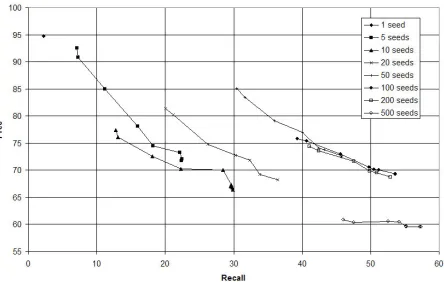
We have performed experiments using 1, 5, 10, 20, 50, 100, 200 and 500 seeds. The general trends ob-served were as follows. The final precision (when the bootstrapping converges) decreases more or less monotonically as the number of seeds increases, al-though there are slight fluctuations; besides, the dif-ference in this respect between using few seeds (20 to 50) or more (100 to 200) is of only around 3%. However, a big leap can be observed in moving from 200 to 500 seeds, where both the initial precision (of the seeds) and final precision (at point of con-vergence) drop by 10% wrt to using 200 seeds. The final recall increases monotonically as the number of seeds increases —since more supervised informa-tion is provided—. The final F1-measure first in-creases and then dein-creases with an increasing num-ber of seeds, with an optimum value being reached somewhere between the 50 and 100 seeds.
[image:7.612.317.539.541.682.2]The largest gain in recall (difference between re-call of the seeds and rere-call at the point of con-vergence) is achieved with 20 seeds, for a gain of 16.38% (initial recall is 20.08% and final is 36.46%). The best mark in F1-measure is achieved with 100 seeds, after 6 iterations: 60.43% (the final precision is 69.29% and the final recall is 53.58%; the drop in precision is 6.5% and the gain in recall is 14.28%). Figure 3 shows a line plot of precision vs recall for these experiments. This experiment sug-gests that the problem of temporal expression recog-nition can be captured with minimal supervised in-formation (100 seeds) and larger amounts of unsu-pervised information.
5.3 Variation of the type of generalizations used in patterns
In these experiments, we have defined four differ-ents sets of generalizations (i.e. types of pattern ele-ments among those specified in section 3) to evalu-ate how semantic and syntactic generalizations con-tribute to performance of the algorithm. These four experiments are labelled as follows: NONE includes only PEs of the LEMMA type; SYN includes PEs of the lemma type and of the not-generalized syn-tactic chunk (SYN) type; SEM includes PEs of the lemma type and of the semantic class (SEMCLASS) type, as well as combinations of lemma with SEM-CLASS PEs; and lastly, SYN+SEM includes every-thing that both SYN and SEM experiments include, plus PEs of the generalized syntactic chunk (SYN-SEMC) type.
[image:8.612.75.298.434.576.2]One can observe than neither type of generaliza-tion, syntactic or semantic, is specially “effective” when used in isolation (only a 3.5% gain in recall in both cases). It is only the combination of both types that gives a good gain in recall (14.28% in the case of this experiment). Figure 4 shows a line plot of this experiment. The figure indicates that the problem of temporal expression recognition, even though appar-ently simple, requires both syntactic and semantic information for efficient modeling.
Figure 4: Effect of using syntactic and/or semantic gen-eralizations
5.4 Variation of the size of unsupervised data used
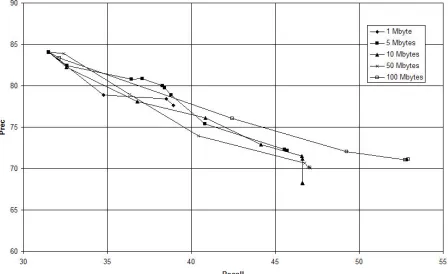
We performed experiments using increasing amounts of unsupervised data for training in the bootstrapping: 1, 5, 10, 50 and 100 Mbytes of preprocessed corpus (tokenized and with feature extraction). The amounts of plain text data are
roughly a fifth part, respectively. The objective of these experiments is to determine whether performance improves as the amount of training data is increased. The number of seeds passed to the bootstrapping is 68. The maximum number of new infixes (the part of an example that contains a candidate time expression) accepted per iteration has been increased from 200 to 1000, because it was observed that larger amounts of unsupervised training data need a greater number of selection “slots” in order to render an improvement (that is, a more “reckless” bootstrapping), otherwise they will fill up all the allowed selection slots.
The observed effect is that both the drop in preci-sion (from the initial iteration to the point of conver-gence) and the gain in recall improve more or less consistently as a larger amount of training data is taken, or otherwise the same recall point is achieved in an earlier iteration. These improvements are nev-ertheless slight, in the order of between 0.5% and 2%. The biggest improvement is observed in the 100 Mbytes experiment, where recall after 5 iterations is 6% better than in the 50 Mbytes experiment after 7 iterations. The drop in precision in the 100 Mbytes experiment is 13.05%, for a gain in recall of 21.36% (final precision is 71.02%, final recall 52.84% and final F1 60.59%). Figure 5 shows a line plot of this experiment. This experiment indicates that increas-ing amounts of unsupervised data can be used to im-prove the performance of our model, but the task is not trivial.
Figure 5: Effect of varying the amount of unsupervised training data
6 Conclusions and future research
[image:8.612.315.539.487.624.2]of time expressions, based on bootstrapping, which introduces a novel representation of patterns suited to this task. Our experiments show that with a rel-atively small amount of supervision (50 to 100 ini-tial correct examples or seeds) and using a combina-tion of syntactic and semantic generalizacombina-tions, it is possible to obtain an improvement of around 15%-20% in recall (with regard to the seeds) and F1-measure over 60% learning exclusively from unla-belled data. Furthermore, using increasing amounts of unlabelled training data (of which there is plenty available) is a workable way to obtain small im-provements in performance, at the expense of train-ing time. Our current focus is on addresstrain-ing specific problems that appear on inspection of the precision errors in test, which can improve both precision and recall to a degree. Future planned lines of research include using WordNet for improving the semantic aspects of the algorithm (semantic classes and simi-larity), and studying forms of combining the patterns obtained in this semi-supervised approach with su-pervised learning.
References
M. Collins and Y. Singer. 1999. Unsupervised mod-els for named entity classification. InProceedings of the Joint SIGDAT Conference on Empirical Methods in Natural Language Processing and Very Large Cor-pora, pages 100–110, College Park, MD. ACL. L. Ferro, L. Gerber, I. Mani, B. Sundheim, and G.
Wil-son. 2005. Tides 2005 standard for the annotation of temporal expressions. Technical report, MITRE Cor-poration.
E. Filatova and E. Hovy. 2001. Assigning time-stamps to event-clauses. InProceedings of the 2001 ACL Work-shop on Temporal and Spatial Information Processing, pages 88–95.
K. Hacioglu, Y. Chen, and B. Douglas. 2005. Automatic time expression labelling for english and chinese text. InProc. of the 6th International Conference on Intel-ligent Text Processing and Computational Linguistics (CICLing), pages 548–559. Springer.
Z. Kozareva, E. Riloff, and E. Hovy. 2008. Seman-tic class learning from the web with hyponym pattern linkage graphs. InProc. of the Association for Com-putational Linguistics 2008 (ACL-2008:HLT), pages 1048–1056.
D. Lin. 1998. Automatic retrieval and clustering of sim-ilar words. In Proceedings of the 17th International Conference on Computational Linguistics and the 36th
Annual Meeting of the Association for Computational Linguistics (COLING-ACL-98), pages 768–774, Mon-treal, Quebec. ACL.
I. Mani and G. Wilson. 2000. Robust temporal process-ing of news. InProceedings of the 38th Annual Meet-ing of the Association for Computational LMeet-inguistics, pages 69–76, Morristown, NJ, USA. ACL.
M. Pas¸ca, D. Lin, J. Bigham, A. Lifchits, and A. Jain. 2006. Names and similarities on the web: Fact extrac-tion in the fast lane. InProceedings of the 21th In-ternational Conference on Computational Linguistics and 44th Annual Meeting of the ACL, pages 809–816. ACL.
E. Riloff. 1996. Automatically generating extraction pat-terns from untagged text. InProceedings of the Thir-teenth National Conference on Artificial Intelligence (AAAI-96), pages 1044–1049. AAAI/MIT Press. E. Saquete, R. Mu˜noz, and P. Mart´ınez-Barco. 2004.
Event ordering using terseo system. In Proc. of the 9th International Conference on Application of Natu-ral Language to Information Systems (NLDB), pages 39–50. Springer.
M. Stevenson and M. Greenwood. 2005. A semantic approach to IE pattern induction. In Proceedings of the 43rd Meeting of the Association for Computational Linguistics, pages 379–386. ACL.
M. Surdeanu, J. Turmo, and A. Ageno. 2006. A hybrid approach for the acquisition of information extraction patterns. InProceedings of the EACL 2006 Workshop on Adaptive Text Extraction and Mining (ATEM 2006). ACL.
J. M. Wiebe, T. P. O’Hara, T. Ohrstrom-Sandgren, and K. J. McKeever. 1998. An empirical approach to tem-poral reference resolution.Journal of Artificial Intelli-gence Research, 9:247–293.
R. Yangarber, R. Grishman, P. Tapanainen, and S. Hutunen. 2000. Automatic acquisition of domain knowledge for information extraction. InProceedings of the 18th International Conference of Computational Linguistics, pages 940–946.
R. Yangarber. 2003. Counter-training in discovery of semantic patterns. InProceedings of the 41st Annual Meeting of the Association for Computational Linguis-tics. ACL.