Entity Centric Opinion Mining from Blogs
Akshat Bakliwal
,
Pi yush Arora
,
Vasudeva Varma
Search and Information Extraction Lab,
LTRC, International Institute of Information Technology, Hyderabad
[email protected], [email protected], [email protected]
A
BSTRACTWith the growth of web 2.0, people are using it as a medium to express their opinion and thoughts. With the explosion of blogs, journal like user-generated content on the web, com-panies, celebrities and politicians are concerned about mining and analyzing the discussions about them or their products. In this paper, we present a method to perform opinion mining and summarize opinions at entity level for English blogs. We first identify various objects (named entities) which are talked about by the blogger, then we identify the modifiers which modify the orientation towards these objects. Finally, we generate object centric opinionated summary from blogs. We perform experiments like named entity identification, entity-modifier relationship extraction and modifier orientation estimation. Experiments and Results presented in this paper are cross verified with the judgment of human annotators.
1 Introduction
A Blog is a web page where an individual or group of users record opinions, information, etc. on a regular basis. Blogs are written on many diverse topics like politics, sports, travel and even products. However, the quality of the text generated from these sources is generally poor and noisy. These texts are informally written and suffer from spelling mistakes, grammatical errors, random/irrational capitalization (Dey and Haque, 2008).
Opinion Mining from blogs aims at identifying the viewpoint of the author about the objects1.
Summarizing these expressed viewpoints can be useful for many business and organizations where they analyze the sentiment of the people on a product, or for an individual(s) who are curious to know opinions of other people. Current approaches on opinion identification divide the larger problem (document) into sub-problems (sentences) and approach each sub-problem separately. These approaches have a drawback that they cannot capture the context flow and opinion towards multiple objects within the blog.
Blog summarization task is considered as normal text summarization, without giving significance to the nature and structure of the blog. Current state of art summarization systems perform candidate sentences selection from the content and generate the summary.
In this paper2, we present a new picture to blog opinion mining, an entity perspective blog
opinion mining and summarization. Here, we identify the objects which the blogger has mentioned in the blog along with his view points on these objects. In this work, named entities are potential objects for opinion mining. We perform opinion mining for each of these objects by linking modifiers to each of these objects and deciding the orientation of these modifiers using a pre-constructed subjective lexicon. And finally, we generate two different concept summaries: an object wise opinionated summary of the document and opinionated summary of the object across the dataset.
2 Related Work
The research we propose here is a combination of Opinion Mining and Summarization. (Pang et al., 2002; Turney, 2002) started the work in the direction of document level sentiment analysis. Major work in phrase level sentiment analysis was initially performed in (Agarwal et al., 2009; Wilson, 2005). (Hu and Liu, 2004; Liu and Hu, 2004; Popescu and Etzioni, 2005) concentrated on feature level product review mining. They extracted features from product reviews and generated a feature wise opinionated summary. Blog sentiment classification is primarily performed at document and sentence level. (Ku et al., 2006) used TREC and NTCIR blogs for opinion extraction. (Chesley, 2006) performed topic and genre independent blog classification, making novel use of linguistic features. (Zhang and et al., 2007) divided the document into sentences and used Pang (Pang et al., 2002) hypothesis to decide opinion features. (He et al., 2008) proposed dictionary based statistical approach which automatically derives the evidence for subjectivity from blogs. (Melville et al., 2009) and (Draya et al., 2009) are among few other works on blog sentiment analysis.
MEAD (Radev et al., 2004) is among the first few and most widely used summarizing systems. (Arora and Ravindran, 2008) perform multi-document summarization. In (Zhou and Hovy, 2005), authors try to summarize technical chats and email discussions.
1In this article, we shall refer to named entity(ies) as object(s).
Figure 1: Algorithmic Flow of the proposed approach
Our work derives its motivation from (Hu and Liu, 2004; Liu and Hu, 2004). They identified product features and generated an opinionated summary from product reviews. In our task, the data is more formal (structured with less grammatical and spelling errors) and we generate opinionated summaries of objects (person, organizations, etc). Our summary differs from a conventional summary because we don’t pick candidate sentences directly from the text, we pick only entities and opinion words towards those entities.
3 Proposed Approach
In this research, we present a new and different approach towards blog opinion analysis. Apart from the traditional approaches of classifying a blog at the sentence and document level, we describe an approach which uses the connectivity and contextual information mined using parsing. The approach proposed here depends on two lexical resources, Stanford CoreNLP3
Tool and SentiWordNet (Baccianella et al., 2010). Stanford CoreNLP tool includes Parser, Part-of-Speech Tagger (PoS), Named Entity Recognizer (NER), Co-reference Resolution System (CRS). Our approach can be viewed as comprising of four major steps.Figure 1represents the architecture of the approach proposed highlighting all the sub-modules and intermediate inputs and outputs.
1. Object Identification: What is an Object? An Object is the entity the blogger is talking and expressing his views about. A blog can have multiple objects which are discussed at varied level of depths. In this step we extract the objects from the input blog. There are various techniques that can be used for performing object identification, using Named Entity Recognizer and Noun Phrase patterns (Hu and Liu, 2004; Liu and Hu, 2004). 2. Modifier Identification: What are object modifiers? An object modifier is usually an
adjective, an adverb or a verb which modifies the object directly or indirectly. In this step we extract the modifiers from the blog and map them to the objects identified in Step 1. In this step, we find all the modifiers and link them to corresponding objects. In the subsequent steps we use only those modifiers which are linked to any object. We focus primarily on adjective modifier (amod), adverb modifier (advmod), nominal subject (nsubj), etc types of dependencies from Stanford parser to link modifiers to their
3http:
Source Telegraph (telegraph.co.uk)
Domain Sports
Number of Blogs 100
Number of Unique Objects 1984
[image:4.420.99.308.70.124.2]Number of Modifiers 4540
Table 1: Summary of Blog Dataset
objects. For ex. ’Ram Lal is a good boy.’, for this example following are the collapsed dependencies: nn(Lal-2,Ram-1); nsubj(boy-6,Lal-2); cop(boy-6,is-3); det(boy-6,a-4); amod(boy-6,good-5). Using the nn tag ’Ram’ and ’Lal’ are combined a single entity[Ram Lal], amod tag maps ’good’ (adjective) to ’boy’ (noun) and nsubj tag maps ’boy’ (noun) to
’Lal’[Ram Lal].
3. Modifier Orientation: What really is Modifier Orientation? Every adjective, adverb and verb have some implicit polarity (positive, negative or neutral) associated with them. With this polarity they modify the orientation of the objects. Once we get the objects being talked about in the blog and also have the modifiers with respect to each of these objects, the next important task is to assign subjectivity scores to these modifiers. We use SentiWordNet(Baccianella et al., 2010) to determine the polarity of each modifier.
4. Summary Generation: We generate an entity wise opinionated summary in the last step. We generate two different kinds of summaries, blog level and entity wise.
At blog level, after assigning orientation to each of the modifier for a particular entity, we generate a tabular summary of the whole blog which has two main parts, different entities and events being talked about and opinion orientation with respect to each entity. Template of the summary is as follows:<Entity, Opinion Words, Opinion Orientation>
In entity wise summary, we collect all the opinions expressed across all the blogs on that entity. After collecting all the opinions we generate a summary for each of the entities. Template of the summary is as follows: <Entity, Opinion Words, Opinion
Orientation,Number of Blogs, List of Blog titles>
4 Dataset
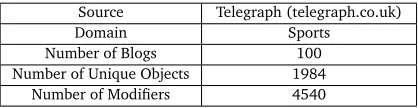
We have collected 100 blogs from Telegraph4in sports domain. These blogs are from various
categories like London Olympics, Cricket, Boxing, etc. While working on this data, we observed that blogs are usually comparison between two or more objects like “X is better than Y under some circumstances”. Hence, we have found many objects in the blog but we find very few opinion words for various entities. ReferTable 1for the dataset used in this research. We decided to go with a more formal dataset because of two reasons. Firstly, there was no dataset available aprior which was annotated in the required format. Secondly, to avoid any form of biasness while collecting the dataset, we simply crawled top 100 blogs from Telegraph sports section. Although this dataset is free from most of the anomalies present in general blog data, but helps us to present the essence of our proposed approach very clearly. A few observations we made while working on blog dataset were: Much of the information present in
the blog(s) were factual, most of the opinions expressed were either in comparison format or negatively orientated.
4.1 Evaluation Setup
In this subsection, we explain the method used for evaluating our approach. We hired three human annotators for this task and calculation of their mutual agreement is done using Cohen’s Kappa measurement5. Validation task was divided into three basic steps
1. Object Identification: Each human annotator was asked to identify all the named entities (person, organizations, location, etc) from the text. This process is similar to step 1 of our proposed approach. Table 2gives the agreement of human annotators for object identification.
Total Unique Objects Identified Total Unique Modifiers Identified
Annotator 1 1984 3690
Annotator 2 1698 3740
Annotator 3 1820 3721
[image:5.420.71.366.197.252.2]AverageκScore 0.856 0.818
Table 2: Manual agreement scores for Object and Modifier Identification
2. Modifier Identification: After step 1, they were asked to mark and decide the orientation (positive or negative) for all the modifier words (adjectives, adverbs and verbs) from the text. This step involved a good understanding of English language and word usage. This corresponds to step 2 of our approach.Table 2gives the agreement of human annotators for modifier identification.
3. Object-Modifier Relation: Here, they were asked to assign/link modifiers to named entities i.e. to determine the opinion of the blogger towards the objects. This step was the most tricky step as it requires a clear understanding of language construct(s). This corresponds to step 3 in our approach where we use dependency processor to handle this. Dependency Processor is a module which reads the typed dependencies retrieved from stanford parser and relates the attributes of these dependency tags with each other.
In the end, for the cases where the annotators failed to achieve an agreement, first and second authors of this paper performed the task of annotation to resolve the disagreement.Table 3 gives the kappa (κ) statistics of human agreement for each of these tasks.
One striking observation we made was that majority of the modifiers were negatively orientated i.e. blogs are frequently written to express negative sentiments (or disagreement) about the object.
5 Experiments and Results
We divide the experiment into four steps as discussed inSection 3(Approach). In this section, we describe the experiment using a small running example6from the corpus. We illustrate the
5http:
//en.wikipedia.org/wiki/Cohen’s_kappa
Figure 2: Image highlights named entities in the piece of text. Words in bold highlight the modifiers and Words coloured using same colour highlight same entities.
Kappa (κ) score between annotator ‘i’ and annotator ‘j’ (κi j)
κ12 0.875
κ13 0.827
κ23 0.842
[image:6.420.217.349.99.163.2]AverageκScore 0.848
Table 3: Kappa Scores for Manual Agree-ment
tools we have used for each step with a small description. We also highlight the task done in each step for snippet example inFigure 2.
• Step 1, we identify the objects using NER (Stanford NER). We use NER over noun phrase patterns because noun phrase patterns tend to introduce more noise. There can be many noun phrases which have no named entities. And also, we have to use some method (like association rule mining) to discard non relevant noun phrases. After performing named entity identification, we then perform co-reference resolution to link all the instances of these entities together, using CRS (Stanford Co-reference Resolution). Stanford NER and Stanford CRS tools were available in Stanford CoreNLP toolkit.
Using Stanford NER, our system discovered a total 1756 unique named entities from 1984 unique named entities tagged by human annotators. In the sample snippet shown inFigure 2, we have 4 named entities “Channel 4”, “Clare Balding”, “Jon Snow” and “Ade Adepitan”.
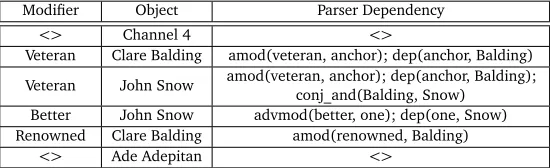
• In Step 2, we identify adjectives, adverbs and verbs which modify the named entities identified in step 1. We link the named entities and modifiers using the dependencies (like amod, advmod, nsubj, etc) given by Stanford parser. We perform dependency association to a level of depth 2. We also discard all the modifiers which are not mapped to any named entity as they are of no use to our system later. Stanford parser and Stanford part-of-speech used in this step is also available in Stanford CoreNLP toolkit.
Using Stanford parser and part-of-speech tagger, our system discovered 3755 correct modifiers (adjectives+adverbs+verbs). This is 82.7% of what human annotators
identified (4540). For the sample snippet inFigure 2mappings (modifier to entity) are shown inTable 4.
Modifier Object Parser Dependency
<> Channel 4 <>
Veteran Clare Balding amod(veteran, anchor); dep(anchor, Balding) Veteran John Snow amod(veteran, anchor); dep(anchor, Balding);
conj_and(Balding, Snow)
Better John Snow advmod(better, one); dep(one, Snow)
Renowned Clare Balding amod(renowned, Balding)
[image:7.420.80.355.71.155.2]<> Ade Adepitan <>
Table 4: Object to Modifier Mapping steps
Object Modifier(s) Orientation
Channel 4 < > Neutral
Clare Balding <veteran, renowned> Positive
Jon Snow <veteran, better> Positive
[image:7.420.99.334.182.238.2]Ade Adepitan <medalist> Positive
Table 5: Blog-Object Summary for the example
•In Step 4, we create a tabular summary of objects and their respective modifiers (Refer Table 5). This summary belongs to type 1 : Blog level summary. Using this kind of summary, we can draw a picture of user’s mind and how he/she thinks about various
[image:7.420.93.342.416.509.2]entities. The second type of summary generated can be used to compare two different entities.
Table 6reports the accordance of our proposed algorithm with human annotators. Opinion orientation agreement is calculated as an aggregate opinion towards an entity.
One plausible reason for decent agreement of our system with manual annotation is that, most of the external tools (Stanford CoreNLP, Parser, PoS tagger) we used in this research are trained on Wall Street Journal News wire data. Our dataset is also taken from a news website, and is written by professional content writers.
Unique objects identified by human annotators 1984 Unique objects identified by our system 1919 Correct Unique objects identified by our system 1756
Object identification coverage 88.5%
Total modifiers tagged by human annotators 4540
Total modifiers tagged by our system 4690
Correct Total modifiers tagged by our system 3755
Modifier identification coverage 82.7%
Opinion orientation agreement (aggregate) 81.4%
6 Discussion
In this section, we discuss some of the challenges we faced while working with the tools used in the above approaches. We try to illustrate the drawbacks of the tools with help of examples, specific for each step.
• In step 1, we proposed the use of NER. We covered∼82.7% of the named entities tagged by human annotators. Stanford NER failed to detect multi word organization names at many places. For example “Great Britain basketball squad” in this example Stanford NER tagged “Great Britain” as a location and didn’t tag basketball squad (tagged as ’Other’). But in actual, this whole should be tagged as an organization. For another example “GB Performance Director Chris Spice”, in this example all the words in this phrase were tagged as an organization but here “Chris Spice” should have been tagged as person.
• In step 2, we use the parser and part-of-speech information derived using Stanford Parser and PoS tagger. These tools also produced some errors, for example in one of the blogs, “match-winning” is tagged as an adjective and in another example, “fine-innings” is tagged as an adjective.
• We use SentiWordNet to decide the polarity of each modifier in step 3. This is a general lexicon built for large purpose sentiment analysis and doesn’t cover various words which are specific to sports domain. Words which are specific to sports domain like “medalist”, “winner” are not present in such lexicons, and thus we need to build a domain specific lexicon.
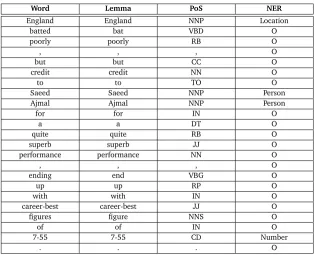
We perform entity centric opinion mining on blogs because blogs are document like big col-lection of text. In blogs, context flows within sentences, across sentences and across multiple paragraphs. It is very hard to perform sentiment analysis at document and sentence level because there are multiple objects being talked about and also at varied level of depths. Calcu-lating the overall opinion is difficult and also it will not present the correct picture. Thus, in this research, we first identify the objects (entities) and perform sentiment analysis and opinion mining across the entities. For example,“England batted poorly, but credit to Saeed Ajmal for a quite superb performance, ending up with career-best figures of 7-55.”in this sentence, there are multiple opinions. We discuss this example in more detail inAppendix A.
Traditional N-Gram based approaches have following limitations: limited training data, diverse topics, context dependency and vocabulary mismatch. Problem of limited training data, context dependency (partial) and vocabulary mismatch are addressed by far using our approach. Our proposed approach is not completely hassle free. Our approach has these limitations: no prior established annotated dataset, determining modifier orientation and poor performance on complex dependency relations.
Conclusion
References
Agarwal, A., Biadsy, F., and Mckeown, K. R. (2009). Contextual phrase-level polarity analysis using lexical affect scoring and syntactic n-grams. InProceedings of the 12th Conference of the European Chapter of the ACL (EACL).
Arora, R. and Ravindran, B. (2008). Latent dirichlet allocation based multi-document summa-rization. InProceedings of the second workshop on Analytics for noisy unstructured text data, AND ’08.
Baccianella, S., Esuli, A., and Sebastiani, F. (2010). Sentiwordnet 3.0: An enhanced lexical resource for sentiment analysis and opinion mining. InProceedings of the Seventh conference on International Language Resources and Evaluation (LREC’10).
Chesley, P. (2006). Using verbs and adjectives to automatically classify blog sentiment. InIn Proceedings of AAAI-CAAW-06, the Spring Symposia on Computational Approaches.
Dey, L. and Haque, S. K. M. (2008). Opinion mining from noisy text data. InProceedings of the second workshop on Analytics for noisy unstructured text data, AND ’08.
Draya, G., Plantié, M., Harb, A., Poncelet, P., Roche, M., and Trousset, F. (2009). Opinion mining from blogs. InInternational Journal of Computer Information Systems and Industrial Management Applications (IJCISIM).
He, B., Macdonald, C., He, J., and Ounis, I. (2008). An effective statistical approach to blog post opinion retrieval. InProceedings of the 17th ACM conference on Information and knowledge management, CIKM ’08.
Hu, M. and Liu, B. (2004). Mining and summarizing customer reviews. InProceedings of the tenth ACM SIGKDD international conference on Knowledge discovery and data mining (KDD’04). Ku, L.-W., Liang, Y.-T., and Chen, H.-H. (2006). Opinion extraction, summarization and tracking in news and blog corpora. InAAAI Spring Symposium: Computational Approaches to Analyzing Weblogs.
Liu, B. and Hu, M. (2004). Mining opinion features in customer reviews. InProceedings of American Associatoin for Artifical Intelligence (AAAI’04).
Melville, P., Gryc, W., and Lawrence, R. D. (2009). Sentiment analysis of blogs by combining lexical knowledge with text classification. InProceedings of the 15th ACM SIGKDD international conference on Knowledge discovery and data mining, KDD ’09.
Pang, B., Lee, L., and Vaithyanathan, S. (2002). Thumbs up? sentiment classification using machine learning techniques. InProceedings of the 2002 Conference on Empirical Methods in Natural Language Processing (EMNLP).
Popescu, A.-M. and Etzioni, O. (2005). Extracting product features and opinions from reviews. InProceedings of the conference on Human Language Technology and Empirical Methods in Natural Language Processing (HLT-EMNLP’05).
Turney, P. D. (2002). Thumbs up or thumbs down?: semantic orientation applied to unsuper-vised classification of reviews. InProceedings of the 40th Annual Meeting on Association for Computational Linguistics.
Wilson, T. (2005). Recognizing contextual polarity in phrase-level sentiment analysis. InIn Proceedings of HLT-EMNLP.
Zhang, W. and et al. (2007). Opinion retrieval from blogs. InIn Proceedings of the sixteenth ACM conference on Conference on information and knowledge management (2007).
Zhou, L. and Hovy, E. (2005). Fine-grained clustering for summarizing chat logs. InProceedings of the Workshop on Beyond Threaded Conversation, held at the Computer-Human Interaction conference (CHI2005).
Appendix A
Word Lemma PoS NER
England England NNP Location
batted bat VBD O
poorly poorly RB O
, , , O
but but CC O
credit credit NN O
to to TO O
Saeed Saeed NNP Person
Ajmal Ajmal NNP Person
for for IN O
a a DT O
quite quite RB O
superb superb JJ O
performance performance NN O
, , , O
ending end VBG O
up up RP O
with with IN O
career-best career-best JJ O
figures figure NNS O
of of IN O
7-55 7-55 CD Number
[image:10.420.46.360.221.476.2]. . . O
Table 7: Results of Stanford CoreNLP on the sample sentence
Figure 3: Figure shows the output of Part-of-speech tagger for the sample sentence
Figure 4: Figure shows the output of Named Entity Recognizer for the sample sentence
named entity recognizer and inFigure 5we show the collapsed dependencies for the sample sentence. We have takenFigure 3, 4, 5from here7. If we consider the sentence as a whole unit,
we cannot predict concretely whether it is positive, negative or neutral sentence but if we look entity wise, we can construct a clear representation for it. We have mainly 2 entities “England” and “Saeed Ajmal” which are referred in this sentence. The entity wise analysis will yield us the following results:
– England: batted poorly. (Negative). Negative sentiment is imparted by adverb “poor”. “poor” is connected with “batted” using an adverb modifier (advmod) tag and “batted” is connected to “England” by nominal subject (nsubj) tag.Figure 5highlight all these connections.
– Saeed Ajmal: quite superb performance. (Positive). Positive adjective (“superb”) is linked to “performance” using adjective modifier (amod) relation and “performance” is linked to “Ajmal” via preposition for (prep_for). In this way, we get the positive sentiment towardsSaeed Ajmal. This entity wise representation provides us with a clear picture of the sentence and overcomes the limitation of sentence level sentiment classification.
In this example, we can also see that “England” is identified incorrectly by Stanford NER. Here “England” should have been identified as an organization (England Cricket Team) rather than
as location.
[image:11.420.66.368.454.510.2]7http://nlp.stanford.edu:8080/corenlp/