A Conditional Random Field-based Traditional Chinese Base-Phrase
Parser for SIGHAN Bake-off 2012 Evaluation
Yih-Ru Wang
National Chaio Tung University
Hsinchu, Taiwan, ROC.
[email protected]
Yuan-Fu Liao
National Taipei University of
Technology, Taipei, Taiwan, ROC
[email protected]
Abstract
This paper describes our system for the sub-task 1 of traditional Chinese Parsing of SIGHAN Bake-off 2012 evaluation. Since this research mainly focuses on speech recognition and synthesis applications, only base phrase chunking was implemented using three Condi-tional Random Field (CRF) modules, includ-ing word segmentation, POS tagginclud-ing and base phrase chunking sub-systems. The official evaluation results show that the system achieved 0.5038 (0.7210/0.387) micro- and 0.5301 (0.7343/0.4147) macro-averaging F1 (precision/recall) rates on full sentence parsing task. However, if only the performance of base phrase chunking was considered, the F-measures may be around 0.70 and is somehow good enough for speech recognition and syn-thesis applications.
1
Introduction
For NLP researches, a semantic parser is used for mapping a natural-language sentence into a for-mal representation of its meaning. It usually first groups the elements in a sentence into words, phrases and clause and then tags each word, phrase and clause with a semantic label.
There are still many challenges in semantic parsing, but the intermediate results of the se-mantic parsing are already quite useful for speech recognition and text-to-speech applica-tions. For example, word sequences information could be used to build the language model in au-tomatic speech recognition (ASR), and the phrase and clause results can be used to further verify the recognition result. In text-to-speech system, boundary information of the words, phrases and clauses can be used to better predict the prosody of synthesis speech.
There are many tasks in the Chinese parser, such as word segmentation, POS tagging, base phrase chunking and full parsing. They are basi-cally sequential learning problems. Thus in the past decade, many statistical methods, such as Support Vector Machine (SVM) (Vapnik, 1995), conditional random field (CRF) (Lafferty et al, 2011), Maximum entropy Markov models (MEMMs) (Berger, etc, 1996), etc. were pro-posed for handling this sequential learning task.
Among them, CRF-based approach has been shown to be especially effective and with very low computational complexity by past studies (Zhan and Huang, 2006). Thus, in this paper, the CRF-based method was adopted to implement our system.
Instead of full parsing, base phrase chunking that identifies non-recursively cores of various types of phrases is possibly just the precursor of full parsing. However, in our text-to-speech and speech recognition applications, the information of base phrase is somehow the most useful cues. Moreover, the complexity of base phrase chunk-ing is much lower than full chunkchunk-ing. Therefore, only base phrase chunking was implemented in our system.
In this paper, a traditional Chinese base phrase chunking system developed for the Bakeoff-2012 evaluation was described in section 2. In section 3, the evaluation result of our system was dis-cussed. Finally, the conclusion was given in sec-tion 4.
2
CRF-based Traditional Chinese
Base-Phrase Chunking System
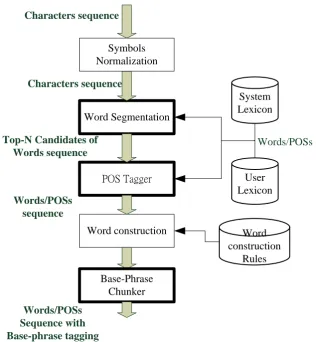
The block diagram of our system is shown in Fig. 1. There are five sub-systems including a text normalization, a word segmentation, a POS tag-ging, a compound word construction and a base-phrase chunking modules.
POS Tagger Word Segmentation
Word construction
System Lexicon
User Lexicon
Base-Phrase Chunker
Characters sequence
Symbols Normalization
Characters sequence
Top-N Candidates of Words sequence
Words/POSs
Words/POSs sequence
Words/POSs Sequence with Base-phrase tagging
Word construction
[image:2.595.136.453.81.424.2]Rules
Fig. 1. The schematic diagram of the proposed system.
First of all, in Chinese, there are lots of canon-ical composition glyphs. The word construction sub-system canonical composition glyphs, or variant characters, were handled in a text-normalization sub-system. The other modules will be briefly described as follows:
2.1 Word Segmentation
The word segmentation sub-system is a CRF-based system. It follows the Zhan’s work (Zhan and Huang, 2006). The 6 tags, named B1, B2, B3, M, E and S, were used to represent the activated function in CRF. The information using in fea-ture template are
Cn : Unicode current character (Unicode plain-0 only).
Bn : radical of current character ("bushu", 部首)
SBn : if Bn==Bn-1
WLn : maximum length word in lexicon match to string including current character,
the 87,000 lexicon from Sinica1 was used as the system internal lexicon, and a user-defined lexicon was allowed to define more words, and in most cases they will be named entities.
WTn : tags of current characters in the maximum word length matched word in lexicon (indicate character position in word using B1, B2, B3, M, E, S).
D/En : whether the current character is a digit.
PMn : whether the current character is a punctuation mark (PM).
The above features and the templates used in our system were commonly used in Chinese word segmentation task. It’s worth to mention that the radical of Chinese character was a useful feature for same OOV words. The top-n se-quences of word segmentation sub-system were sent to the next sub-system.
1
The sub-system was trained by using the Sini-ca corpus, version 4.02. A lot of data was cor-rected in the database by using consistence check.
About more than 1% of data in Sinica Corpus was corrected. The word unigram and unigram of Sinica corpus were first generated, and we find all the word-pairs were also combined into a sin-gle word in the corpus besides the words with POS “Nf” and “Neu”. There are about 10% of the word-pairs can also be segmented into single words. Some word segmentation inconsistency were checked and corrected, like
(1)/民意代表(Na)/ and /民意(Na) 代表(Na)/ both appeared in the corpus,
(2)The word /長途(A) 電話(Na)/ are segmented in all the cases in corpus, but the word /長途 電話(Na)/ was included in the Sinica lexicon. In this case, the lexicon was modified,
(3)Most of the bound morphemes (prefixes, suf-fixes), named entities, compound words, idi-oms, abbreviations.
Some words, especially function words, were segmented into more than one segmentation and POS possibilities, like [就是(T), 就是 (SHI), 就 是(Nc), 就(D) 是(SHI), 就是(D), 就是(Cbb)] and [真是(VG), 真是(D), 真(D) 是(SHI)], while these were not yet checked in our study.
The researchers have set a high standard for their significant works in developing the corpus, yet it is still impossible to ignore the words pro-posed by Andrew Rosenberg (2012): “The cor-pus is an invaluable resource in Spoken and Natural Language Processing. Consistent data sets have allowed for empirical evaluation of competing algorithms. …. However, despite dub-bing these annotations as “gold-standard”, many corpora contain labeling errors and idio-syncrasies. The current view of the corpus as a static resource makes correction of errors and other modifications prohibitively difficult.” Hence, we hope to see the dynamic Chinese lin-guistic resources as soon as possible and the us-ers of corpus could then contribute their error corrections.
Then, 9/10 of the corpus (about 1 million words) was used for training and 1/10 (about 120K words) was used as evaluation data. The F-measure of the word segmentation sub-system is 97.37%. The difference of precision and recall rate was less than 0.1%.
2
http://www.aclclp.org.tw/use_asbc_c.php
2.2 POS tagging
In our system, the top-N output sequences of the word segmentation were sent to the POS tagger. The possible POS types of each word should be the most effective feature for POS tagging. Since a lexicon was used in word segmentation sub-system, the possible POS’s of each lexical word was also store in the lexicon. The information using in feature template are
PMn : Unicode of the first character of cur-rent word when it is PM, or “X” if it is not PM,
WLn : word length of current word.
LPOSn : all possible POSs of current words if the word is in the internal and ex-ternal lexicons, or “X” if it is not in the lexicons, i.e., for word “一”(one) can be “Cbb_Di_D_Neu”
FCn : first character of current word if the word is not in lexicon, or “X” if it is in lexicon.
LCn : last character if the word is not in lexicon, or “X” if it is in lexicon.
There are 47 types of POS in the system those are used in Sinica corpus version 4.0 as well.
The sub-system was also trained by the same corpus used in word segmentation sub-system. The accuracy of the POS tagging sub-system is 94.16%. The recognition of 47 POS types was reasonable except noun type “Nv” due to its am-biguity.
In the basic system, the POS tagger will pro-cess the top-N sequences out from word segmen-tation. The log-likelihood of word segmentation and POS tagging were added and found the best output sequence.
The F-measure of word segmentation and recognition rate of POS tagger were usually used as the performance measures of a parsing system. In our study, we also check the effectiveness of our word segmentation and POS tagger sub-system in the speech recognition application. The above two sub-system was used in building the language model in ASR system. Sinica corpus, CIRB0303 and Taiwan Panorama Magazine4, contain 380 million words totally, were parsed to build the trigram language model for speech rec-ognizer. 60K words were used in the recognition
3
http://www.aclclp.org.tw/use_cir_c.php 4
lexicon. The performance of the Mandarin speech recognizer was evaluated in the TCC-300 speech database5. The out-of-vocabulary rate is 3.1% for 15479 words test data. Word error rate (WER) of the recognizer reduces to 13.4%. About 40% word error rate reduction was achieved comparing to the CRF-based word segmentation and POS tagger system we built from Bakeoff-2005 training database6.
2.3 Compound word construction
The first compound word construction rule
which was implemented in our system is the
Determinative-Measure compound word. In
Sinica Treebank
7, except the 47 POS types,
one more POS tagger DM,
Determinative-Measure compounds, was used. The following DM construction rules, which check the POS of word sequence, were used to construct the DM compound in the word sequence, recur-sively. Neu + Nf + Neu + !(Nf) DM+ !(Nf)
where !(Nf) means that the POS of the next word is not Nf, for example :
一(Neu) 米(Nf) 二(Neu) Neu+ Neqb Neu
(Neu, Nes, Nep, Neqa, Neqb)+Nf DM
DM+(Nf, Neqb) DM (Nep, Nes)+DM DM Neu+(“大”(/da/, big),
“小”(/xian/,small)) +Nf DM
In “Chinese information processing issued by the Central Standards Bureau”8, there are lots of rules for constructing traditional Chinese com-pound words. In our system, some of them were implemented. Those rules are listed in follows,
半A半B, 一A一B, 如A如B,
5
http://www.aclclp.org.tw/use_mat_c.php#tcc300edu 6
http://www.sighan.org/bakeoff2005/ 7
http://www.aclclp.org.tw/use_stb_c.php 8
http://rocling.iis.sinica.edu.tw/CKIP/paper/wordsegment_st andard.pdf
ADAB, D is a character with POS Di, AABB, AB is a lexical word with POS Vx,
where A, B are single character.
2.4 Base-phrase chunking
In the base-phrase chunking sub-system, the POS sequence was the most useful feature in base-phrase chunking. Beside the POS and simplified POS, some character information of the word were also used.
POSn : POS of current word.
SPn : simplified POS of current word.
The types of POS was simplified from 47 to 13 categories, { A, C, D, DE, FW, I, N, P, PM, SHI, T, V }
LWn : word length of current word.
SW1n : set to 1 if word Wn is same as word Wn-1, 0 if otherwise.
SW2n : set to 1 if word Wn is same as word Wn-2, 0 if otherwise.
FCn : first character of current word. ECn : last character of current word.
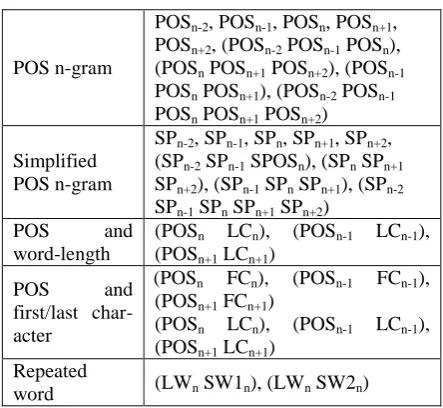
The templates used in the system were shown in Figure 2.
POS n-gram
POSn-2, POSn-1, POSn, POSn+1, POSn+2, (POSn-2 POSn-1 POSn), (POSn POSn+1 POSn+2), (POSn-1 POSn POSn+1), (POSn-2 POSn-1 POSn POSn+1 POSn+2)
Simplified POS n-gram
SPn-2, SPn-1, SPn, SPn+1, SPn+2, (SPn-2 SPn-1 SPOSn), (SPn SPn+1 SPn+2), (SPn-1 SPn SPn+1), (SPn-2 SPn-1 SPn SPn+1 SPn+2)
POS and word-length
(POSn LCn), (POSn-1 LCn-1), (POSn+1 LCn+1)
POS and first/last char-acter
(POSn FCn), (POSn-1 FCn-1), (POSn+1 FCn+1)
(POSn LCn), (POSn-1 LCn-1), (POSn+1 LCn+1)
Repeated
[image:4.595.305.527.451.655.2]word (LWn SW1n), (LWn SW2n)
Fig. 2. List of CRF features for base phrase chunking sub-system.
function of the BP chunking was set to 7 tags, {ADVP, GP, NP, PP, S, VP, XDE(X‧DE)}.
Then, 9/10 of the Bakeoff-2012 Task-4 train-ing corpus was used for traintrain-ing the base-phrase chunking module and 1/10 for was used as self-evaluation data. The result of the base-phrase chunking was shown in Table 1.
The Chinese parsing system as shown in Fig-ure 1 was implemented by using the CRF++ package9. The base phrase tags, ADVP and XDE, were combined into XP as the Bakeoff-2012 re-sult.
BP types Precision Recall F-measure
[image:5.595.76.286.241.374.2]ADVP 90.00% 72.00% 80.00 GP 91.06% 95.54% 93.25 NP 86.61% 87.73% 87.17 PP 88.61% 91.48% 90.03 S 66.43% 57.85% 61.84 VP 79.95% 75.91% 77.88 XDE 86.35% 88.69% 87.51 total 84.61% 84.20% 84.41
Table 1. The performance of base phrase chunking in training and self-evaluation database.
<NP>清晨(Nd) 五點(Nd)</NP> ,(PM) <NP>哈佛(Nb) 大學(Nc)</NP> 的(DE) 宗教 (Na) 藝術史(Na) 教授(Na) 羅伯特.蘭登 (Nb) 在(P) <GP>睡夢(Na) 中(Ng)</GP> 被 (P) 一[Neu]陣[Nf](DM) <XP>急促(VH) 的 (DE)</XP> 電話(Na) 鈴聲(Na) 吵醒(VC) 。 (PM)
<NP>電話(Na) 裡(Ncd)</NP> 的(DE) 人 (Na) 自稱(VG) 是(SHI) <NP>歐洲(Nc) 原子 核(Na)</NP> 研究(VE) 組織(Na) 的(DE) 首 領(Na) ,(PM) <VP>名叫(VG) 馬克西米利 安.科勒(Nb)</VP> ,(PM) 他(Nh) 是 (SHI) 在(P) <NP>互聯網(Na) 上(Ncd)</NP> 找到(VC) <XP>蘭登(Nb) 的(DE)</XP> 電 話(Na) 號碼(Na) 的(T) 。(PM)
Fig. 3. Partial parsing result of “Angels & Demons”, Dan Brown, 2000.
In the speech applications, the accuracy of BP phrase still needs to be improved. Using more training data will be the most effective way to improve the BP chunking.
9
http://crfpp.googlecode.com/svn/trunk/doc/index.html
Since our system is also used as a front end of text-to-speech (TTS) system, usually the input is taken from books and released news. Fig. 3 shows partial parsing result. The context is from “Angels & Demons”, Dan Brown, 2000. The performance is acceptable for TTS application.
3
Evaluation Results on Traditional
Chinese Parsing Sub-task 1
The system use for Bakeoff-2012 Traditional Chinese Parsing sub-task 1 is modified from the basic parser described in last section.
In the Bakeoff-2012 Traditional Chinese Pars-ing sub-task 1, the input sentences were seg-mented with gold standard word sequences. Thus, the basic system was modified to generate the n-best word sequences in POS tagging and com-pound word construction stages for this evalua-tion. The n-best word sequences satisfied with the defined principles, minimum edit-distance and maximum log-likelihood, in the test data set were returned as pre-processing word sequences. Finally, the n-best word sequences with their corresponding POS tags can be sent into phrase chunking module for getting the base-phrase chunking results.
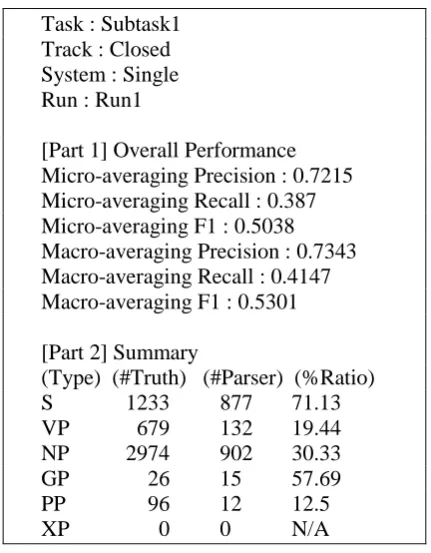
The official evaluation report of our system for Traditional Chinese Parsing sub-Task 1 is shown in Fig. 4.
Task : Subtask1 Track : Closed System : Single Run : Run1
[Part 1] Overall Performance Micro-averaging Precision : 0.7215 Micro-averaging Recall : 0.387 Micro-averaging F1 : 0.5038 Macro-averaging Precision : 0.7343 Macro-averaging Recall : 0.4147 Macro-averaging F1 : 0.5301
[Part 2] Summary
[image:5.595.304.520.454.731.2](Type) (#Truth) (#Parser) (%Ratio) S 1233 877 71.13 VP 679 132 19.44 NP 2974 902 30.33 GP 26 15 57.69 PP 96 12 12.5 XP 0 0 N/A
Basically, the evaluation results show that our system achieved 0.5038 (0.7210/0.387) micro- and 0.5301 (0.7343/0.4147) macro-averaging F1 (precision/recall) on full sentence parsing task.
However, it is believed that the main reason for low recall rate is only base phrases were tagged in our system. Therefore, if only the per-formance of base phrase chunking were consid-ered, the F-measures may be around 0.70. The results are somehow good enough for speech recognition and synthesis applications.
Another possibility of performance degrada-tion is that the number of (X‧DE) phrases in the training corpus is above 13% of total base phrases (In fact, 的(/de/) should be one of the most frequently occurred words in traditional Chinese text). But, there is no (X‧DE) phrase in the evaluation data. It may be the reason why the performance of base phrase chunking was de-generate from 0.84 to 0.70.
4
Conclusions
In this paper, a Tradition Chinese base phrase parser that considered only base phrase chunking was implemented. The official Bake-off 2012 evaluation results on full sentence parsing task show that our system achieved 0.5038 (0.7210/0.387) micro- and 0.5301 (0.7343/ 0.4147) macro-averaging F1 (precision/recall) rates. However, if only the performance of base phrase chunking was considered, the F-measures may be around 0.70. Therefore, the results are somehow good enough for speech recognition and synthesis applications. In the near future, word senses and semantic information in Word-net database will be explored to improve the per-formance of our system.
Acknowledgments
This work was supported by the National Sci-ence Council, Taiwan, ROC, under the project with contract NSC 101-2221-E-009-149-MY2 and 101-2221-E-027-129.
References
Adam L. Berger, Stephen A. Della Pietra, and Vin-cent J. Della Pietra. 1996. A maximum entropy ap-proach to natural language processing. Computa-tional Linguistics, 22(1):39-71.
Andrew Rosenberg. 2012. Rethinking The Corpus: Moving towards Dynamic Linguistic Resources, In Proceedings of INTERSPEECH-2012, Portland, USA.
Hai Zhao, Chang-Ning Huang and Mu Li. 2006. An Improved Chinese Word Segmentation System with Conditional Random Field. In Proceedings of the Fifth SIGHAN Workshop on Chinese Language Processing : 108-117. Sidney, Australia.
Igor Mel’čuk. 1996. Lexical Functions in Lexicogra-phy and Natural Language Processing, chapter
Lexical Functions: A Tool for the Description of Lexical Relations in the Lexicon, Benjamins Pub-lishing Corp.
J. Lafferty, A. McCallum, and F. Pereira. 2001. Con-ditional random fields: Probabilistic models for segmenting and labeling sequence data. In Pro-ceedings of In Intl. Conf. on Machine Learning : 282-289.
L. Shi and R. Mihalcea. 2005. Putting pieces together: Combining FrameNet, VerbNet and WordNet for robust semantic parsing. In Proceedings of Com-putational Linguistics and Intelligent Text Pro-cessing; Sixth International Conference : 100–111, Mexico City, Mexico.
V. Vapnik. 1995. The Nature of Statistical Learning Theory. Springer-Verlag, New York.