An Abstract Schema for Representing Semantic Roles and
Modelling the Syntax-Semantics Interface
Voula Gotsoulia University of Essex
Abstract
This paper presents a novel approach to semantic role annotation implementing an entailment-based view of the concept of semantic role. I propose to represent arguments of predicates with grammatically relevant primitive properties entailed by the semantics of predicates. Such meaning components generalise over a range of semantic relations which humans tend to express systemati-cally through language. In a preliminary study, I show that we can model linguistic knowledge at a general, principled syntax-semantics interface by incorporating a layer of skeletal, entailment-based representation of word meaning in large-scale corpus annotation.
1
Introduction
Large-scale lexical semantic resources that providerelational information about words have recently re-ceived much focus in the field of Natural Language Processing (NLP). In particular, data-driven models for lexical semantics require the creation of broad-coverage, hand-annotated corpora with predicate-argumentinformation, i.e. rich information about words expressing a semantic relation having argument slots filled by the interpretations of their grammatical complements. Corpora combining semantic and syntactic annotations constitute the backbone for the development of probabilistic models that automat-ically identify the semantic relationships, orsemantic roles, conveyed by sentential constituents (Gildea and Jurafsky, 2002). That is, given an input sentence and a targetpredicatorthe system labels constituents with general roles like Agent, Patient, Theme, etc., or more specific roles, as in (1).
(1) [CognizerI]admired[Evalueehim] [Degreegreatly] [Reasonfor his bravery and his cheerfulness].1
The task of automatic semantic role labelling (or shallow semantic parsing) is a first step towards text understanding and has found use in a variety of NLP applications including information extraction (Sur-deanu et al., 2003), machine translation (Boas, 2002), question answering (Narayanan and Harabagiu, 2004), summarisation (Melli et al., 2005), recognition of textual entailment relations (Burchardt and Frank, 2006), etc.
Corpora with semantic role labels additionally lend themselves to extraction of linguistic knowledge at the syntax-semantics interface. The range of semantic and syntactic combinatorial properties ( va-lences) of each word in each of its senses is documented in terms of annotated corpus attestations. For instance, the valence pattern for the use ofadmirein (1) is shown in (2).
(2) Cognizer: Noun Phrase (NP), Subject
Evaluee: Noun Phrase (NP), Object
Degree: Adverbial Dependent
Reason: Prepositional Dependent
1
This data enables the quantitative study of various linguistic phenomena and the investigation of the relationship between the distinct linguistic layers comprised by predicate-argument analysis. Further-more, the formulation ofgeneralisations over predicate-specific annotations can capture how predicates relate in terms of both semantic and syntactic features. Such syntax-semantics mappings (so-called link-ing generalisations) encode regularities concerning the associations of semantic roles with grammatical functions and are essential for alinguistic knowledge basefor NLP applications.
This paper addresses the problem of generalising over the valences of individual predicators and pro-poses an abstract semantic basis for the representation of participant roles. The definition of semantic notions at an appropriate level of abstraction is the prerequisite for the formulation of a general, princi-pled syntax-semantics interface. This is in accordance with a somewhat intuitive conception of semantic roles as classificatory notions encoding semantic similarities across different types of events or situations in the world. In effect, all conceptions of semantic roles as opposed to predicate-specific roles, such as admirer-admired, posit some sort of semantic classification of arguments across predicators while indicating an acknowledgment that the syntax-semantics interface (referred to with the termlinking) is not completely arbitrary. Put differently, semantic roles constitute a level of representation suitable for capturing semantic generalisations which humans tend to expresssystematicallythrough language.
The structure of the paper is organised as follows. Section 2 looks at conceptions of semantic roles in state-of-the-art approaches to semantic annotation indicating problems or complications related to the question of whether or how these roles can support generalisations across predicates. Section 3 calls attention to the theoretical underpinnings of the notion of semantic role and introduces an annotation schema which departs from the traditional view of semantic roles as atomic, undecomposable categories. Following the insight of Dowty’s (1991) theory of Proto-Roles, I will propose analytical representations of verbal arguments based on semantically well-founded, grammatically relevant meaning components entailed by the semantics of predicates (Proto-Role entailments). Finally, section 4 presents a study in which lexical entailments are marked in a corpus in accordance with the proposed schema. General syntax-semantics mappings are extracted from the annotated data and are formalised in abstract classes which readily encode generalisations concerning linking to syntactic form.
2
Corpora with Semantic Roles and Related Work
Semantically annotated corpora currently available for English implement two distinct approaches to the prickly notion of semantic role. The Proposition Bank (PropBank) (Kingsbury et al., 2002) is a one million word corpus in which predicate-argument relations are hand-annotated for every occurrence of every verb in the Wall Street Journal part of the Penn Treebank (Marcus et al., 1994). Verb senses are distinguished informally on the basis of semantic as well as syntactic criteria. The semantic arguments of a verb are numbered sequentially. PropBank uses a common set of role labels (Arg0 up to Arg5) for all predicators, but these labels are defined on a per-verb basis, i.e. they have verb-specific meanings. Example PropBank annotations:
(3) a. [Arg0John]broke[Arg1the window] [Arg2with a rock].
b. [Arg0John]broke[Arg1the window] [Arg3into a million pieces].
c. [Arg1The window]broke[Arg3into a million pieces].
(4) [Arg0Blue-chip consumer stocks]provided[Arg1a lift] [Arg2to the industrial average].
(5) In addition, [Arg0 the bank] has an option tobuy[Arg1 a 30% stake in BIP] [Arg2 from Societe
Generale] [ArgM−T M P after Jan.1, 1990] [Arg3at 1,015 francs a share].
2
As illustrated in (3), argument labels are consistent across alternate syntactic patterns of a given pred-icator in a given sense. However, PropBank refrains from formalising the semantics of the role labels and does not ensure theircoherenceacross verbs. This is particularly clear with higher numbered labels,
2
which correspond to distinct types of participants: Arg2 marks an Instrument forbreak(3), a Benefactive forprovide(4), and a Source forbuy(5). Lower-numbered labels denote various roles as well, but they are less arbitrary across verbs: Arg0 corresponds to traditional Agents, Experiencers, certain types of Theme, etc. which surface as subjects of transitive verbs and a class of intransitives called unergatives; Arg1, on the other hand, is assigned to objects of transitive verbs and subjects of unaccusatives and is the equivalent of traditional Patients, Themes, etc.
While the PropBank corpus enables empirical insight into a variety of linguistic phenomena (e.g. variations in the grammatical expression of arguments) providing useful frequency information for the uses of predicators, it does not lend itself to extraction of a principled linguistic knowledge base with semantic generalisations across predicates. Inasmuch as no consistent mapping is ensured between a label and a semantic role, the argument labels result seriously overloaded across verbs. This explains why role recognition models have particularly poor performance in assigning the labels Arg2-Arg5. In fact, an attempt is currently made to map PropBank argument labels to semantically coherent roles specified by VerbNet (Kipper et al., 2000) (i.e. a broad-coverage verb lexicon based on Levin’s (1993) classification of English verbs according toshared meaning and behaviour). Even though VerbNet specifies a small list of abstract roles (23 in total) which are intended to support generalisations, these roles are not defined as global primitives, but are meaningful only within verb classes. Because mappings of labels to semantic roles with class-specific interpretations would lead to very sparse data, argument labels are subdivided into groupings of VerbNet roles. The latter are created manually on the basis of analysis of argument use.3 The subdivided (more coherent) PropBank labels perform better for semantic role labelling (Loper et al., 2007).
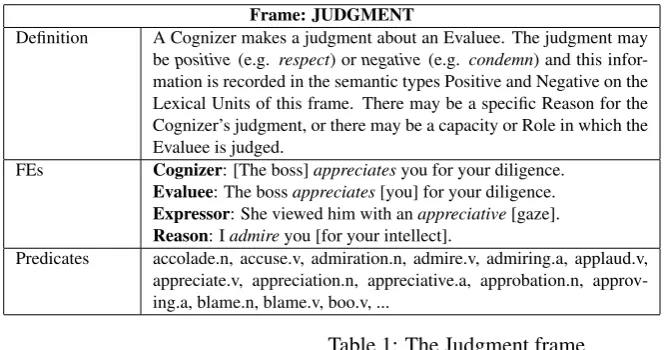
A different paradigm for semantic role annotation is put forth by FrameNet. The Berkeley FrameNet project (Baker et al., 1998) is creating an online lexical database containing semantic descriptions of words based on Fillmore’s (1985) theory of frame semantics. The basic unit of analysis is the semantic frame, i.e. a schematic representation of a stereotypical scene or situation. Each frame is associated with a set of predicates (including verbs, nouns, and adjectives) and a set of semantic roles (calledFrame Elements, FEs) encoding the participants and props in the designated scene. FrameNet includes manually annotated example sentences from the British National Corpus incorporating additional layers of phrase structure and grammatical function annotation. It also includes two small corpora of full-text annotation intended to facilitate statistical analysis of frame-semantic structures. Currently it contains more than 960 frames covering more than 11,600 lexical items exemplified in more than 150,000 annotated sentences. The Judgment frame evoked byadmirein (1) is shown in Table 3.
Frame: JUDGMENT
Definition A Cognizer makes a judgment about an Evaluee. The judgment may bepositive(e.g. respect) ornegative(e.g. condemn) and this infor-mation is recorded in the semantic types Positive and Negative on the Lexical Units of this frame. There may be a specific Reason for the Cognizer’s judgment, or there may be a capacity or Role in which the Evaluee is judged.
FEs Cognizer: [The boss]appreciatesyou for your diligence.
Evaluee: The bossappreciates[you] for your diligence.
Expressor: She viewed him with anappreciative[gaze].
Reason: Iadmireyou [for your intellect].
[image:3.595.69.403.514.689.2]Predicates accolade.n, accuse.v, admiration.n, admire.v, admiring.a, applaud.v, appreciate.v, appreciation.n, appreciative.a, approbation.n, approv-ing.a, blame.n, blame.v, boo.v, ...
Table 1: The Judgment frame
3
FrameNet avoids the difficulties of attempting to pin down a small set of general roles. Instead Frame Elements are definedlocally, i.e. in terms of frames. Frames are situated in semantic space by means of directed (asymmetric) relations. Each frame-to-frame relation associates a less dependent or more general frame (Super frame) with a more dependent or less general one (Sub frame). The hierarchical organisation of frames along with FE identities or analogs across frames are intended to enable the for-mulation of generalisations concerning the combinatorial properties (valences) of predicates. In practice, however, the frame hierarchy turns out to be somewhat complicated. Inheritance (i.e. the strongest se-mantic relation and the most plausible to propagate valence information across frames) is conditioned on complex sets of semantic components underlying frame definitions, ranging from FE membership and relations to other frames to relationships among FEs and Semantic Types on frames and FEs.4This kind of frame dependence based on fine-grained semantic or ontological distinctions is doomed to miss argu-ment structure commonalities in predicates evoking frames that are related at a more abstract, essentially structural semantic level. Section 4 includes a concrete example of the complications in generalising valence information across FrameNet frames.
Researchers working in the FrameNet paradigm have proposed different approaches for abstract-ing over the properties of individual predicators and increasabstract-ing the size of trainabstract-ing data for semantic role labelling systems. Gildea and Jurafsky (2002) attempt to generalise the behaviour of semantically related predicates experimenting with a small set of abstract semantic roles mapped to FrameNet roles. Frank (2004) discusses the potential of applying various generalisation ‘filters’ to corpus-induced syntax-semantics mappings for abstraction of a general linguistic knowledge base. The generalisations proposed by Frank are intended to apply within frames but not across frames. Baldewein et al. (2004) have trained semantic role classifiers re-using training instances of roles that are similar to the target role. As sim-ilarity measures, they use the FrameNet hierarchy, peripheral roles of FrameNet and clusters of roles constructed automatically. Matsubayashi et al. (2009) also explore various machine learning features for generalising semantic roles in FrameNet, namely role hierarchy, human-understandable descriptors of Frame Elements, Semantic Types of filler phrases, and mappings of FrameNet roles to roles of VerbNet. The experimental result of the role classification using these generalisation features shows significant improvements in the system. This is due to the fact that role generalisations can form a remedy for the severe problem ofsparse data which is inherent in lexical semantic corpus annotation. Data sparseness, i.e. the insufficient coverage of the range of predicate senses and constructions within sensible sizes of manually annotated data, is a bottleneck both for acquisition of linguistic knowledge for the semantic lexicon and for automated techniques for semantic role assignment.
3
An Abstract Semantic Basis for the Representation of Participant Roles
From the presentation of different annotation projects it becomes evident that semantic role annotation is a complicated task whose product is deeply influenced by its initial design philosophy and underlying criteria.5 Among these criteria the notion of semantic role itself is central. PropBank uses general role labels that lack semantic coherence. VerbNet and FrameNet, on the other hand, specify coherent roles at a more fine-grained level (i.e. roles with class-specific or frame-specific interpretations). In this section, I consider the linguistic contours of the concept of semantic role proposing an annotation schema based upon theoretically well-founded role concepts which meet the requirements of bothgeneralityand
coherence. This schema is intended at enabling the formulation of a general syntax-semantics interface suitable for modelling the relations of predicates in terms of combinatorial features.
Espousing and extending Dowty’s (1991) Proto-Role hypothesis, I propose to associate arguments of predicates with propertiesentailedby the semantics of predicates.6 Mappings of entailments to syntactic
4
Semantic Types encode information that is not representable in terms of frames and FE hierarchies, e.g. basic typing of fillers of FEs referring to some (external) ontological classification, descriptions of aspects of semantic variation between lexical units such as the Positive and Negative types in the Judgment frame above, etc.
5
This point is discussed in detail by Ellsworth et al., 2004.
constituents can be many-to-one. That is, an argument can be marked with one or more properties
necessarilyentailed by the meaning of the predicator.7 Prepositional complements are also marked with verbal entailments to which prepositions may contribute more specific content. In this paper, I will make no attempt to formalise the content added by prepositions; prepositional semantics is represented solely in terms of the common entailment basis it shares with verbal meaning.
Each Proto-Role entailment indicates a grammatically pervasive concept, i.e. a property having direct effect on the grammatical behaviour of predicates. It is defined in terms of an abstract semanticrelation
underlying the lexical meaning of the predicate. Five such relations are identified in terms of which entailment-based representations are specified: Notion, Causation, Motion, Possession, Conditioning. Note that contrary to mere ontological labels, entailment-based representations encode structural char-acterisations of the semantics of arguments. Consider, for instance, the sentence in (1), repeated here as (6):
(6) [CognizerI]admired[Evalueehim] [Reasonfor his bravery and his cheerfulness].
A structural representation of the meaning of this construction will explicitly encode the relationships between each of the arguments ofadmire, i.e. between the NPI and the NPhim, between the NPhim
and the PPfor his bravery and his cheerfulness, and between the NPI and the PPfor his bravery and his cheerfulness. By contrast, the FrameNet roles shown above do not model the fact that the semantic content of an Evalueerequires a Cognizer, or that a Reasonrequires both a Cognizer and an Evaluee. The view that the semantic properties underlying lexical meaning are relational in nature (i.e. they are not to be conceived entirely independently of one another) has been advocated by several researchers, among others Wechsler (1995), Pinker (1989), Jackendoff (1990), and Davis (2001), on whose work I build.
In the rest of this section, I define a set of recurring entailments which underlie the semantics of a range of verbs displaying various syntactic patterns. Note that this set can be extended on the basis of additional primitive meaning components of the sort described above, covering the semantics of broad verb classes.
(7) [Conceiver The other two]pondered [Conceivedover this morsel] as they tramped along behind
him.8
(8) [Conceiver,IntentionalThey]tested[Conceivedthe software] [Conceived bsoafor similar errors].
(9) [Conceiver,IntentionalThe government] hadreneged[Conceivedon promises to give them land].
(10) [ConceiverHe] likesstereotyping[Conceivedpeople] [Conceived bsoaby appearance].
(11) [ConceiverThe jury] hasfound out[Conceivedthe truth] [Conceived bsoaabout the suspect].
(12) [Conceiver The court] categorised [Conceived,Entity the issue] [Conceived,P roperty as a collateral
question].
situation (in every model) in which the first is true, the second is also true. For linguistic predicates, in particular, an entailment (or lexical entailment) is an analytic implication following from the meaning of the predicate in question.
7
The presence of ‘necessarily’ in this sentence is somewhat redundant, in that its meaning is incorporated by the notion of entailment. I insist, however, on emphasising it to indicate that semantic properties that are accidentally associated with the meaning of a particularuseof a verb will not be annotated. Dowty points out that entailments of thepredicatemust be distinguished from what follows from any one sentence as a whole (e.g. entailments that may arise from NP meanings) (Dowty, 1991:572, footnote 16). For example, in the sentenceMary slapped John, assuming that John is a human entity, it follows from the meaning of the sentence that John will perceive something as a result of the action of slapping. But this ‘entailment’ is not intrinsically tied to the meaning ofslap, because the sentencesMary slapped the tableorMary slapped the corpseare also felicitous. That is, sentience of the direct object is not an essential component of the semantics ofslap, in the way it is for a verb likeawaken. The sentencesMary awakened the tableandMary awakened the corpseare clearly anomalous. True entailments of predicators (which are the ones that will be annotated) must be detectable inevery possible environment in which the predicator is used.
8
(13) [ConceiverOpposition members]accuse[Conceived,Entitythe council] [Conceived,P ropertyof acting
purely ideologically].
The predicates in (7)-(13) are represented in terms of a Notion relation. That is, they involve a Conceiver who is entailed to have a notion or perception of a Conceived participant (while the reverse entailment does not necessarily go through).9 In situation types in which a Conceiver is entailed to have a notion of more than one participant, Conceived arguments are distinguished on the basis of their
saliencein the overall semantics of the predicate. For instance,test(8) intuitively lexicalises a dyadic re-lation between a Conceiver (tester) and a Conceived (tested) entity. A sought entity denoted by afor-PP is represented as part of a secondary Notion relation situated at the background of the primary (testing) relation. Conceived entities that are peripheral to the essential relation lexicalised by the predicate are as-sociated with a more specific property termedConceived background state of affairs(Conceived bsoa). These arguments receive lessfocusin the meaning of the predicate, in a sense that they are not absolutely necessary to understand the predicate’s meaning. The representation oftest(8),stereotype(10), andfind out (11) in terms of two Notion relations, one of which is treated as more salient, reifies the concept ofrelative significance of Proto-Role properties in the verbal semantics. This concept is related to the weighting of entailments in the overall semantics of a verb, which plays a critical role in determining the syntactic patterns in which the verb appears (i.e. the grammatical realisations of its arguments).10
The verbs in (8) and (9) involve an additional entailment of Intentionality. This is used to mark entities characterised by conscious choice, decision, or control over the course of inherently intentional actions. Intentional participants necessarily have a notion/perception of some event participant(s). The annotations in (12) and (13) include the Entity and Property tags which are intended to distinguish Conceived arguments in terms of a predicative relation assigned in the Conceiver’s mental model. The
Propertylabel corresponds to a representation of the formP(x) denoting a propertyPwhich is predicated of some objectx.
The entailments of Notion are not applicable in the semantics of the predicates in (14)-(15) below. These verbs refer to situations with affected participants and are described in terms of an abstract relation of Causation. In the denoted events, a Causer is entailed to affect some entity (the Causee) either phys-ically or mentally. Causally affected participants sometimes undergo radical changes in their (physical or mental) state, which are identified in terms of a readily observable transition from a source to a final (result) state, as shown in (15).
(14) [CauserDiet]influences[Causeedisease].
(15) [Causer The sun] has changed [Causee,Change of state her hair color] [Source state from red]
[End stateto blue].
Verbs as in (16)-(17) are represented in terms of a Motion relation involving a Moving entity (i.e. an object entailed to change location) and Stationary reference frame. Locations at the start, end, or intermediate points of the stationary frame are tagged with the labelsPath source,Path goal, andPath, respectively.
(16) [M ovingThe car]passed[Stationarythe railway station].
(17) [M ovingThe river]flowedsilently [P ath through the forest].
Finally, verbs such asown,possess,acquire,lack, etc. are treated in terms of a Possession relation involving a Possessor and an entity entailed to be Possessed (18).
9The Notion relation, as defined by Wechsler (1995), essentially reconstructs the entailment of
sentience, which was pro-posed by Dowty (1991).
10
(18) [P ossessorThis house]lacks[P ossesseda guest room].
Verbs of caused Motion (19) or caused Possession (20) are represented in terms of both Causation and Motion/Possession, i.e. as meaning ‘cause to move’ (set to motion) or ’cause to possess’. This analysis posits a main (causal) event and a caused sub-event. The entailments associated with the latter are marked in square brackets.
(19) [CauserLucie]threw[Causee,[M oving]him] [[P ath source]from the parapet of a bridge] [[P ath goal]
into deep water].
(20) [CauserHe]handed[[P ossessed]the letter] [[P ossessor]to Weir], who nodded.
Proto-Role entailments are defined in terms of inherently asymmetric semantic relations involving fixed role positions. Each of these relations (with the exception of Motion) can be thought of as instance of a more general relation entailing that properties of an entity β are dependent on an entity α. For example, a conceived entity in a Notion relation depends on the existence of a conceiver (it is taken to be within the scope of the conceiver’s beliefs). An affected or possessed object in a causation or possession relation depends on the existence of some causer or possessor, respectively. I refer to this relation as Conditioning relation and associate it with appropriate Proto-Role properties capturing the semantics of a broad range of verbs for which none of the entailments specified so far seems to hold. These verbs conform to the basic transitivity pattern that motivated Dowty’s Proto-Role hypothesis. Below are some characteristic examples:
(21) [ConditionThis game]demands[Conditionedgreat skill].
(22) [ConditionCode 1425]bans[Conditionedlarge trucks in tunnels].
(23) [ConditionThe adjective ‘beautiful’]denotes[Conditioneda quality which can be found in many
different objects].
(24) [ConditionDiversity]characterises[Conditionedthe sociolinguistics domain].
A Conditioning relation encodes the asymmetries in such predicators in terms of the underlying entailment that the properties of a participant α impose a condition on properties of a participant β. In each of the sentences above we can conclude something about the object participant (e.g. that it is necessary, illegal, or linguistically expressed) on the basis of the subject referent (i.e. the characteristics of the game, the regulations specified by the code, the usage of the adjective ‘beautiful’). By contrast, no property of the subject referent is necessarily conditioned on the object: the semantics of ban, for example, does not allow us to characterise code 1425 as fair/unfair, severe/lax, complete/incomplete, new/old, etc. on the basis of the object NP ‘large trucks in tunnels’; similarly, we cannot infer the precise meaning of the word ‘beautiful’ or whether it is a verb or a noun or an adjective on the basis of the content of the NP ‘a quality which can be found in many different objects’. A more precise definition of the Conditioning relation could state that the intrinsic (i.e. invariable) properties of a participant α
determine or condition some non-intrinsic (i.e. variable or event-dependent) property of a participantβ
while the converse entailment does not go through. In (24), for example, the sociolinguistics domain is associated with a property of being diverse whereas the intrinsic properties of the domain have no significance for the definition of ‘diversity’ or what this notion may characterise.
4
Formulation of a General Syntax-Semantics Interface
on top of FrameNet’s syntactic annotations in accordance with the schema sketched out above. The annotations were produced semi-automatically following a three-stage procedure: (i) mapping Frame Elements (FEs) to entailments at a frame level (ii) automatically adding this information to the data in a new annotation layer, (iii) manually correcting the novel annotations by examining the argument structures of individual predicators for finer semantic distinctions.
From the newly annotated data mappings of entailments to grammatical categories were acquired. The syntactic realisations of Proto-Role properties were found to readily generalise over combinatorial features of verbs pertaining to various FrameNet frames. Valence information can be formally rendered in entailment-based classes calledLexicalisation Types(L-Types) abstracting away from the semantics of predicators. L-Types are defined on the basis of grammatically relevant meaning components and encode linking generalisations cutting across FrameNet frames.
For instance, predicates such asbelieveanddesire(evoking the frames Religious Belief and Desir-ing, respectively) involve arguments that are equivalent in terms of entailments, as illustrated in (25)-(26) below. Hence they are categorised in the Notion L-Type shown in Table 2. Table 2 includes the corre-spondences between combinations of entailments and FrameNet Frame Elements.
Notion L-Type Religious belief Desiring Conceiver Believer Experiencer Conceived, (Entity) Element Focal participant Conceived bsoa, Property Role Role of focal participant
Table 2: Mappings between Notion L-Type and FrameNet frames
(25) If [Conceiver he]believes [Conceived,Entity in Jesus] [Conceived bsoa,P roperty as his Saviour], he
can be baptised.
(26) [ConceiverHe]wanted[Conceived,EntitySmith] [Conceived bsoa,P roperty as the new producer].
In a similar fashion,operate,research, andratifycan be grouped together in a L-Type based on the underlying property of Intentionality. Examples (27)-(28) show that these verbs share common valence patterns despite the differences in the definition of the frames they evoke (Using, Research and Rati-fication): Role and Purpose are core Frame Elements in the Using frame, while Purpose is peripheral in Research and Ratification. Research and Ratification have no Role FE (but this kind of argument is clearly present in the constructions exemplified in (28b-c).
Intentionality L-Type Using Research Ratification Conceiver, Intentional Agent Researcher Ratifier Conceived, (Entity) Instrument Question Proposal Conceived bsoa, Property Role
Conceived bsoa, Intention Purpose Purpose Purpose
Table 3: Mappings between Intentionality L-Type and FrameNet frames
(27) a. [Conceiver,IntentionalWe]operate[Conceiveda menu] [Conceived bsoa,Intention to get the best
out of rations].
b. [Conceiver,Intentional We] research [Conceived this fungus] [Conceived bsoa,Intention to fight
aliments in tobacco and tomato fields].
c. [Conceiver,IntentionalThey] had toratify[Conceivedthe amendments] [Conceived bsoa,Intention
to be readmitted to the Union].
(28) a. There has been a long debate as to whether [Conceived,Entitythe Severn Mill]was operated
[Conceived bsoa,P roperty as a tide mill].
b. [Conceived,EntityThin films]are being researched[Conceived bsoa,P ropertyas a potential medium
c. [Conceived,Entity Such agreements] maybe ratified [Conceived bsoa,P roperty as being in the
public interest].
In the same Intentionality L-Type we also categorise verbs such ascarry out andvisit evoking the frames Intentionally act and Visiting. It is important to note that despite the argument structure sim-ilarities of these predicators, it is not possible to establish an identity link between the Act FE of the Intentionally act frame and the Entity FE of Visiting in terms of the frame hierarchy, because the FEs are associated with different Semantic Types in the corresponding frame definitions, i.e. Act is of type State of affairs whereas Entity is of type Physical object. The examples (29)-(30) illustrate the common use of these verbs in the transitive construction. The (a) sentences show the FE annotation while the (b) sentences show the annotated entailments.
(29) a. [AgentThey] hadcarried out[Act113 uranium conversion experiments].
b. [Conceiver,IntentionalThey] hadcarried out[Conceived113 uranium conversion experiments].
(30) a. [AgentYou] have tovisit[Entity your parents] every once in a while.
b. [Conceiver,IntentionalYou] have tovisit[Conceivedyour parents] every once in a while.
Predicates grouped together in L-Types have some but not necessarily all their grammatical prop-erties in common. This is in accordance with the fact that L-Types are essentially semantically-driven modelling recurring, abstract features in the semantics of predicators while disregarding ephemeral prop-erties as well as lexical idiosyncrasies.11 In addition to the set of entailments discussed in the previous section, L-Types may also incorporate more fine-grained properties that are clearly relevant to linking. For instance, verbs lexicalising a Desiring situation were found with prepositional complements intro-duced by for,after,to, towards,of, orover(e.g. long for, hanker after,aspire to, pine over, etc.), but noton,upon, at, orabout (like other Notion verbs, such as ponder, muse, think, etc.). Inasmuch as a Desiring relation is identified as a recurring concept systematically associated with a particular gram-matical relation (e.g. afor-PP), it can be represented in a separate L-Type inheriting from the Notion L-Type presented previously.12 An initial classification like the one exemplified above captures general
conditions which determine possible associations between the semantics of predicators and grammati-cal relations realising their arguments (e.g. the fact that a conceived entity can only surface in subject position in a passive sentence). It can be extended and refined on the basis of more specific semantic re-lations. Moreover, L-Types can be organised in hierarchical structures. They can form the upper portion of a principled hierarchy of classes encoding successively broader levels of generalisations concerning argument linking.
This study indicated that a small number of Lexicalisation Types abstracts over a wide range of FrameNet frames.13More precisely, in the annotated dataset 48 L-Types were identified based on various combinations of entailments: 9 Notion Types, 7 Intentionality Types, 10 Causation Types, 7 Commu-nication (Caused Notion) Types, 7 Motion (including Caused Motion) Types, 7 Possession (including Caused Possession) Types, and 1 Conditioning Type. These Types readily abstract over associations of semantic properties and grammatical functions attested in over 200 FrameNet frames.14In the FrameNet paradigm, L-Types can be modelled as non-lexicalised frames specifying syntactic mapping constraints.
11
L-Types crucially differ from verb classes in VerbNet, which are based on a rigorous commitment to syntax. This commit-ment yields fine-grained distinctions that very often split semantically coherent classes. In fact, L-Types abstract over VerbNet classes encoding broader levels of linking generalisations.
12
For-PPs are indeed associated with a desiderative sense with a wide range of verbs in various argument positions: ‘He desperately huntedfor a new job’. ‘They searched the groundfor traces’. ‘John ranfor coverwhen it started to rain’.
13
Note that inasmuch as L-Types abstract over both VerbNet classes and FrameNet frames, they can also be useful for combining the two resources.
14
Mappings between FrameNet frames and L-Types can be stated by means of a separate relation in ad-dition to the frame relations currently specified by FrameNet. A relation generalising the combinatorial properties of lexical items across frames would simplify the picture of the frame hierarchy, in that it would essentially decouple purely lexical semantic information (encoded by existing frame-to-frame re-lations) from information pertaining exactly to the interface of syntax and semantics. In future work, our intention is to test whether the proposed semantic role schema and the attested L-Types can be useful for dealing with the sparse data problem and increasing the performance of semantic role labelling systems.
References
[1] Baker, Collin F., Charles J. Fillmore, and John B. Lowe. 1998. The Berkeley FrameNet project. In Proceedings of the COLING-ACL. Montreal, Canada.
[2] Baldewein, Ulrike, Katrin Erk, Sebastian Pad´o, and Detlef Prescher. 2004. Semantic Role Labeling with Similarity-Based Generalisation Using EM-Based Clustering. In Proceedings of Senseval-3, pp. 64-68. Barcelona, Spain.
[3] Boas, Hans C. 2002. Bilingual FrameNet Dictionaries for Machine Translation. In Proceedings of the Third International Conference on Language Resources and Evaluation. Las Palmas, Spain. Vol. IV: pp. 1364-1371.
[4] Burchardt, Aljoscha and Anette Frank. 2006. Approximating Textual Entailment with LFG and FrameNet Frames. In Proceedings of the second PASCAL Recognizing Textual Entailment Workshop. Venice, Italy, pp. 92-97.
[5] Davis, Anthony. 2001. Linking by types in the hierarchical lexicon. CSLI Publications.
[6] Dowty, David. 1991. Thematic Proto-Roles and Argument Selection. Language 67.3, pp. 547-619.
[7] Ellsworth Michael, Katrin Erk, Paul Kingsbury, and Sebastian Pad´o. 2004. PropBank, SALSA, and FrameNet: How Design Determines Product. In Proceedings of the LREC 2004 Workshop on Building Lexical Resources from Semantically Annotated Corpora. Lisbon. [8] Fillmore, Charles J. 1985. Frames and the semantics of understanding. Quaderni di Semantica 6.2, pp. 222-254.
[9] Frank, Anette. 2004. Generalizations over corpus-induced frame assignment rules. In Charles Fillmore, Manfred Pinkal, Collin Baker and Katrin Erk (eds.): Proceedings of the LREC 2004 Workshop on Building Lexical Resources from Semantically Annotated Corpora. Lisbon, Portugal, pp. 31-38.
[10] Gildea, Daniel and Daniel Jurafsky. 2002. Automatic labeling of semantic roles. Computational Linguistics 28 (3), pp. 245-288. [11] Jackendoff, Ray. 1990. Semantic Structures. Cambridge, MA, MIT Press.
[12] Kingsbury, Paul and Martha Palmer. 2002. From Treebank to PropBank. In Proceedings of the LREC, Las Palmas, Canary Islands, Spain. [13] Kipper, Karin, Hoa Trang Dang, and Martha Palmer. 2000. Class-based construction of a verb lexicon. In Proceedings of the Seventh
National Conference on Artificial Intelligence (AAAI-2000), Austin,TX, July-August.
[14] Levin, Beth. 1993. English verb classes and alternations: A preliminary investigation. University of Chicago Press.
[15] Loper, Edward, Szu-ting Yi and Martha Palmer. 2007. Combining Lexical Resources: Mapping Between PropBank and VerbNet. Pro-ceedings of the 7th International Workshop on Computational Semantics. Tilburg, the Netherlands.
[16] Marcus, Mitchell, Grace Kim, Mary Ann Marcinkiewicz, Robert MacIntyre, Ann Bies, Mark Ferguson, Karen Katz, and Britta Schas-berger. 1994. The Penn Treebank: Annotating predicate argument structure. In Proceedings AR-PAHLT Workshop.
[17] Matsubayashi, Yuichiroh, Naoaki Okazaki, and Jun’ichi Tsujii. 2009. A Comparative Study on Generalization of Semantic Roles in FrameNet. In Proceedings of the 47th Annual Meeting of the ACL and the 4th IJCNLP of the AFNLP, pp.19-27. Suntec, Singapore. [18] Melli, Gabor, Yang Wang, Yudong Liu, Mehdi M. Kashani, Zhongmin Shi, Baohua Gu, Anoop Sarkar, and Fred
Popowich. 2005. Description of SQUASH, the SFU question answering summary handler for the DUC-2005 Summariza-tion Task. In Proceedings of the HLT/EMNLP Document Understanding Workshop (DUC). Vancouver, Canada, available at http://duc.nist.gov/pubs/2005papers/simonfraseru.sarkar.pdf.
[19] Narayanan, Srini and Sanda Harabagiu. 2004. Question Answering Based on Semantic Structures. In Proceedings of the 20th International Conference on Computational Linguistics (COLING), pp. 693 - 701. Geneva, Switzerland.
[20] Petukhova, Volha and Harry Bunt. 2008. ‘LIRICS semantic role annotation: design and evaluation of a set of data categories.’ In Pro-ceedings of the Sixth International Conference on Language Resources and Evaluation (LREC 2008), Marrakech, Morocco, May 28-30. [21] Pinker, Steven. 1989. Learnability and Cognition. Cambridge, MA, MIT Press.