Product Information
DuPont Terathane
®Products
e
Recovery of Tetrahydrofuran (THF)
Foreword
Reclamation of solvent from waste air or liquid streams for reuse is often essential to the economic success of an industrial process. This operation is widely known as solvent recovery and is the subject of this publication.
Tetrahydrofuran can be recovered safely and efficiently on an industrial scale by conventional methods from operations such as topcoating, printing, film casting, and chemical processes in which it is used as a reaction medium. It may be recovered alone or in mixtures with other solvents.
Overall recovery efficiencies at plants where THF is being recovered range from 85 to 97%. THF loss during adsorption, drying, and separation varies with the number of solvents involved, but seldom exceeds 3% in a properly designed and operated recovery system. The greatest factor influencing the efficiency of recovery from air streams is the efficiency of vapor collection, which in turn is strongly influenced by the degree of enclosure permitted by the operation.
The physical properties of tetrahydrofuran that are generally of importance in the design of recovery systems are listed in Table 1. Detailed information is given on the recovery of THF from air streams, separation of THF from its water azeotrope, and separation of THF from solvent mixtures.
Recovery of Tetrahydrofuran
from Mixtures with Air
[image:1.612.343.575.231.403.2]Tetrahydrofuran can be recovered safely and efficiently from lean solvent vapor-air mixtures by ordinary solvent recovery procedures such as adsorption and absorption. Adsorption on activated carbon is the most widely used method because of its versatility and efficiency. Absorption is seldom used but can be employed where installation of carbon beds is not feasible. Recovery of THF by condensation is not generally applicable due to the high solvent vapor concentrations required for
Table 1
Physical Properties of Tetrahydrofuran*
Boiling Point at 760 mmHg, °C (°F) 66 (151) Specific Gravity, 20/4°C (68/39°F) 0.888 Weight, lb/gal at 20°C (68°F) 7.4 Refractive Index, n 1.4073 Latent Heat of Vaporization,
cal/g, 66°C (151°F) 95 Flash Point (Tag Closed Cup), °C (°F) –20 (–4) Flammability Limits, vol% in air,
25°C (77°F), Lower 2 Upper 11.8 Miscibility: water; esters, ketones;
alcohols; diethyl ether; aliphatic,
aromatic, and chlorinated hydrocarbons ∞
* These properties are drawn from various DuPont and other sources. DuPont does not make any express or implied warranty that future production will demonstrate or continue to possess these typical properties.
20 D
economical operation. Adsorption and absorption systems for the recovery of THF vapors are out-lined in the following section.
Adsorption
Tetrahydrofuran vapor may be recovered in com-mercially available fixed-bed adsorption units charged with gas-adsorbent grade of activated carbon.1,2 The vapor-air mixture is generally drawn
by a fan through a filter to remove all solid par-ticles, then cooled and blown through a bed of activated carbon that adsorbs the vapor and allows the stripped air to pass through. Typical commer-cial units provide two adsorbers connected in parallel to permit continuous solvent recovery. When one unit becomes saturated with solvent, the vapor-air flow is switched to the other adsorber. Solvent is removed from the saturated unit by passing low pressure steam through the carbon bed countercurrent to the direction of vapor-air flow. The steam revaporizes the solvent and carries it from the adsorber. A flow sheet for the recovery of THF vapor from air by adsorption is shown in
Figure 1. Recovery of Tetrahydrofuran by Carbon Adsorption
The concentration of THF vapor in exhaust air streams from drying ovens is normally maintained below 1% by volume to avoid approaching the explosive range, 2.0 to 11.8% by volume in air. Because of this low concentration and the substan-tial volumes of vapor-air mixture resulting from large-scale operations, three or more adsorbers are frequently required. In such cases, the vapor-air mixture is passed through two adsorbers in parallel while the third is being steamed. Series operation is employed when maximum recovery efficiency is desired but requires a minimum of three and often four adsorption units. To improve efficiency further, adsorption systems are often equipped with automatic sequence controls that operate on a fixed cycle or a cycle that varies to conform with solvent loading. Regardless of the number of units used, they must be large enough to prevent excessive gas velocity and provide adequate dissipation of heat of adsorption.
Tetrahydrofuran recovery efficiencies of 98 to 99% may be expected from activated carbon adsorbers. The adsorptive capacity for THF will vary from one brand of activated carbon to another, but 0.35 lb THF/lb carbon is an approximate average equilib-rium value. Commercial design is often based on half the equilibrium value, because “breakthrough” normally occurs at about that level.
The amount of steam required for regeneration depends on the amount of solvent in the carbon and the physical characteristics of the carbon itself. Under normal conditions, about 3 lb steam/1 lb THF is required, yielding a stripper still feed containing 25% THF. The stripper still removes gross water from the mixture, to give an azeotropic distillate containing 5.3% water. The vapor-liquid equilibrium curve for the THF-water system at atmospheric pressure is presented in Figure 2.
It is apparent from the curve that the azeotrope may be easily obtained in spite of wide variations in feed composition.
VAPOR-LADEN AIR
FILTER & COOLER
BLOWER & MOTOR VENT RETURN
ADSORBER NO. 1
ADSORBER NO. 2
CONDENSERS
EXHAUST AIR
ACTIVATED
CARBON STRIPPER
STILL
THF-WATER AZEOTROPE
EFFLUENT TO WASTE L.P.
STEAM
L.P. STEAM
Absorption
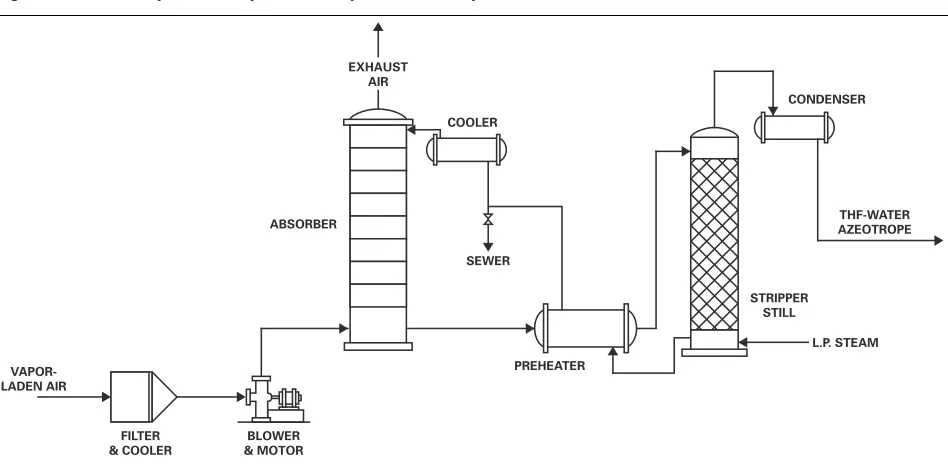
Tetrahydrofuran may be recovered from an air stream by absorption in water where adsorption is impractical. However, economics generally restrict consideration of absorption to large volume recov-ery units, as the THF vapor concentration is very low.
The absorption system depicted in Figure 3 can be used to recover THF from air streams.
Figure 2. Vapor/Liquid Equilibrium
1.0
0.8
0.6
0.4
0.2
0
0 0.2 0.4 0.6 0.8 1.0
Mole Fraction THF in Liquid
Mole Fraction THF in Vapor
Vapor-Liquid Equilibria THF-Water 760 mmHg
Figure 3. Recovery of Tetrahydrofuran by Water Absorption
VAPOR-LADEN AIR
FILTER & COOLER
BLOWER & MOTOR
ABSORBER
EXHAUST AIR
COOLER
SEWER
PREHEATER
STRIPPER STILL
L.P. STEAM CONDENSER
THF-WATER AZEOTROPE
The absorber effluent is then stripped of gross water by distillation to yield the THF-water azeotrope. The water is recycled to the absorber to minimize solvent loss.
Separation of Tetrahydrofuran
from Its Water Azeotrope
Both the adsorption and absorption methods of recovering THF yield an azeotrope containing about 5.3% water, from which THF cannot be separated by simple distillation. Because most operations require dry THF, a number of methods
for separating THF from its water azeotrope have been developed, and several are in commercial use. The operating principles and factors to be consid-ered in design of these systems are discussed individually in the following sections.
Brine Extraction
Tetrahydrofuran, like many other organic solvents, may be dried by extracting the water with a satu-rated calcium chloride brine solution. Figure 4 illustrates the operation of this system.
The THF-water azeotrope is pumped into the bottom of the extraction column where it flows upward, countercurrent to the saturated brine solution. The brine removes most of the water from the azeotrope and flows out of the bottom of the extractor to an evaporator, where it is concentrated for reuse. The water removed by the evaporator contains a small amount of THF and is recycled to the recovery system stripper still.
The water content of the THF stream leaving the top of the extractor is about 1.8% by weight when proper contact between the two streams has been maintained. Final drying is obtained by distilling this stream to yield dry THF and the azeotrope, which is recycled to the extractor. The water content of THF dried by this method can be re-duced below 0.1% when a batch still is used but is more commonly about 0.5%, depending on the efficiency of the still.
[image:3.612.103.577.508.742.2]Figure 4. Brine Extraction
not required. It is useful where moderate to large quantities of THF must be dried and is readily adaptable to batch or continuous operation. Solvent loss should not exceed 1% in the system described, but will be significantly larger if the recycle to the stripper still or evaporator is eliminated. The brine extraction method is particularly useful when mixtures containing several solvents must be dried simultaneously.
Pressure Distillation
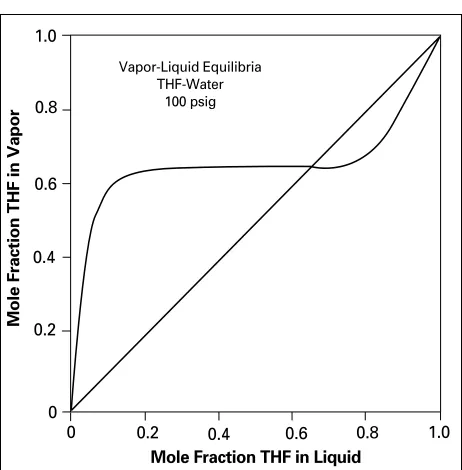
The shift in composition of an azeotrope that occurs when pressure is changed may be used to separate THF from its azeotrope with water.* The water concentration in this azeotrope increases from 5.3% to about 12% as the pressure is increased from atmospheric to 100 psig. This shift is shown
graphically by the vapor-liquid equilibrium diagram in Figure 5.
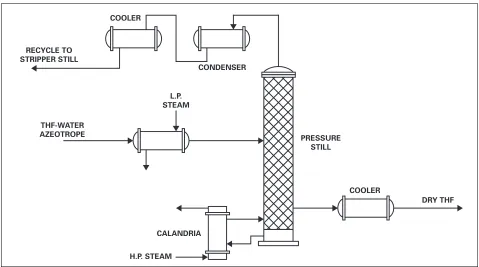
The system shown in Figure 6 employs this principle to dry THF without use of extraneous chemicals or solvents.
THF-water azeotrope from the stripper still of the recovery system is pumped under pressure through a preheater directly to the pressure still. The overhead stream from the pressure still is the THF-water azeotrope at 100 psig, which is recycled to the stripper still. Dry THF containing 0.05% or less
THF-WATER AZEOTROPE
EXTRACTION COLUMN
BRINE EVAPORATOR L.P.
STEAM
L.P. STEAM
BATCH OR CONTINUOUS
STILL
COOLER
DRY THF RECYCLE TO
STRIPPER STILL
CONDENSER
CONDENSER
* Can. Patent 546,591 (1957) assigned to E. I. duPont de Nemours & Co.
Figure 5. Vapor/Liquid Equilibria
1.0
0.8
0.6
0.4
0.2
0
0 0.2 0.4 0.6 0.8 1.0
Mole Fraction THF in Liquid
Mole Fraction THF in Vapor
Vapor-Liquid Equilibria THF-Water
100 psig
water is continuously removed from the base of the pressure still. While pressure distillation is capable of producing drier solvents than the other common drying methods, the degree of dryness obtained is determined by design of the pressure still.
[image:4.612.283.514.501.736.2]Figure 6. Pressure Distillation
RECYCLE TO STRIPPER STILL
COOLER
COOLER
DRY THF
H.P. STEAM CALANDRIA
CONDENSER
L.P. STEAM
PRESSURE STILL THF-WATER
AZEOTROPE
to be dried, other equipment does not exist, or substantial quantities of THF must be dried. These factors usually indicate the desirability of continu-ous operation. Multisolvent mixtures may be dried by this method, but the advantages of simplicity and economy are lost. Solvent loss should be negligible, provided all equipment is tightly sealed and the condenser-cooler combination is efficient.
Solvent Extraction
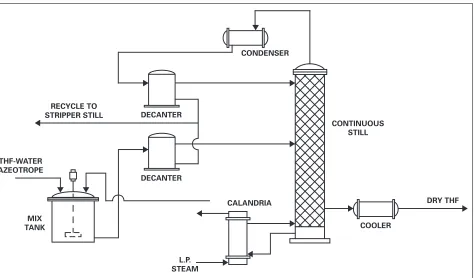
Tetrahydrofuran may be effectively dried by adding certain water-immiscible solvents to the THF-water azeotrope.* Pentane is one of the best solvents for this purpose because of its low price and high efficiency. A THF drying system employing pentane is illustrated in Figure 7.
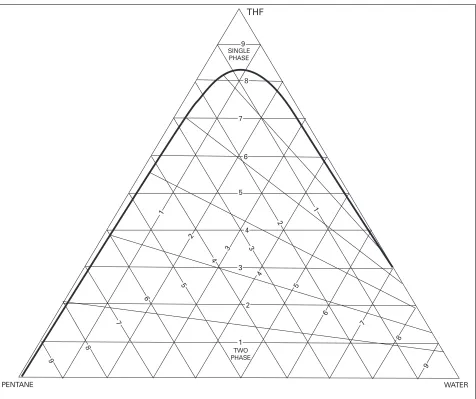
The THF-water azeotrope from the stripper still is continuously mixed in a vessel with an equal volume of pentane. This causes formation of two phases: an organic phase containing pentane, most of the THF, and a small amount of water; and an aqueous phase that contains some THF and traces of pentane. The exact composition of each phase may be predicted from the THF-pentane-water ternary miscibility diagram shown in Figure 8.
The two-phase mixture is pumped to a decanter, where the aqueous layer is separated and recycled to the stripper still for recovery of dissolved THF.
Dry THF is obtained from the organic layer by distilling off pentane and water. This distillation is usually carried out at a pressure of 15 psig to reduce cooling water requirements. The pentane-water condensate forms two layers, which may be separated by decantation and recycled. THF containing less than 0.1% by weight water may be recovered by this system.
With minor modifications, existing solvent recov-ery equipment may often be adapted for THF drying by pentane extraction. However, it must be recognized that pentane is a low-boiling, low-flash solvent that requires careful attention to equipment design and safe handling procedures. The nature of the pentane extraction method generally restricts its use to continuous processing of large volumes of THF. Recycle of minor streams as shown should result in negligible THF loss.
Other Techniques
Several methods that employ solids have been developed for separating THF from its water azeotrope. These are particularly useful if small to moderate quantities of THF must be processed or if a high degree of dryness is required. They include the following:
• Dehydration with caustic soda • Dehydration with calcium chloride • Liquid phase adsorption
Figure 7. Pentane Extraction
Caustic soda can be used effectively to dry the THF-water azeotrope because of its strong affinity for water. The equipment needed includes a liquid-solid contact column with the necessary tanks, pumps, and piping. The azeotrope is pumped upward through a contact column filled with flake caustic. Water extracted from the azeotrope by the caustic forms a concentrated caustic solution that flows downward and is discharged from the bottom of the column. Makeup caustic flake is added as required to the top of the column. The THF flowing from the top of the column may vary in dryness, depending on flow rate and the amount of caustic used. Commercial operation has shown optimum conditions require about 4.5 lb caustic/100 lb azeotrope to yield THF containing approximately 0.5% water. Under these conditions, THF lost with the water brine is about 1% of the THF fed to the dryer. Drier solvent can be obtained where required by recirculation or by processing through a second contact column in series with the first. Trace amounts of caustic and other possible contaminants may be removed from the dry THF if desired by simple distillation. This system conforms readily to either intermittent or continuous operation.
Anhydrous calcium chloride cannot be used di-rectly to dry the THF-water azeotrope, because it reacts with THF to form a solid white complex or etherate. Formation of the etherate is accompanied by considerable evolution of heat and expansion in volume, which may cause plugging if THF is fed
directly into a column of calcium chloride. How-ever, the etherate itself shows an affinity for water and is suitable for drying the azeotrope.*
Equipment for drying with calcium chloride etherate is similar to that for drying with caustic soda. The initial charge of etherate may be prepared by slurrying anhydrous calcium chloride into THF in the contacting column. After the column is charged with etherate, the THF-water azeotrope is pumped upwards through the column, where the water is removed by the etherate (forming a sepa-rate liquid phase of concentsepa-rated brine containing some THF). Dry THF flows from the top of the column and the brine layer is discharged from the bottom. Calcium chloride makeup may be charged as required directly into the top of the column without danger of plugging. Based on laboratory data, operation to produce THF dried to 0.5% water requires about 3 lb calcium chloride/100 lb azeo-trope. At this brine concentration, approximately 0.6% of the THF fed to the dryer will be lost in the waste brine stream.
Liquid-phase adsorption is the method commonly used to obtain very dry solvent when the quantity of THF-water azeotrope does not justify investment in pressure distillation equipment. Type 4A molecular sieves3,4,5 have proved to be particularly useful
adsorbents for water in THF because of their high
* U.S. Patent 2,795,591 (1957), Bente, P. F. (assigned to E. I. du Pont de Nemours & Company)
COOLER
DRY THF CONDENSER
DECANTER
DECANTER
CALANDRIA RECYCLE TO
STRIPPER STILL
L.P. STEAM
CONTINUOUS STILL
THF-WATER AZEOTROPE
THF
SINGLE PHASE
9
8
7
6
5
4
3
2
1
TWO PHASE 2
1
3
4
5
6
7
8
9
1 2
3 4
5 6
7
8 9
[image:7.612.101.577.75.474.2]PENTANE WATER
Figure 8. Ternary Miscibility—THF, Pentane, Water at 25°C (77°F), wt%
adsorption capacity at low water concentrations. Pilot scale tests have indicated that adsorptive capacity may vary from 5 to 12 lb water/100 lb adsorbent, depending on the degree of dryness required. Efficient operation can reduce the water content of THF to a value of 0.002%.
Azeotrope to be dried by liquid phase adsorption is usually semi-dried to a water content of 0.5 to 1.0% by one of the techniques previously described to minimize adsorbent investment and regeneration cost. The semi-dried THF is then pumped upward through a column filled with adsorbent to achieve final drying. Any of several commercially available adsorption units may be used.6 When the adsorber
ceases to provide the dryness required, operation is terminated or switched to a parallel unit to permit regeneration of the saturated adsorbent. Regenera-tion of the adsorbent is accomplished by draining all liquid from the adsorbent bed, heating it to about 400°C (752°F), and cooling to ready it for
reuse. Heat for regeneration may be derived from electricity, steam, or gas. Plant scale installations frequently contain parallel adsorbers controlled by an automatic cycle timer to provide uninterrupted service.
Separation of Tetrahydrofuran
from Solvent Mixtures
solids. In addition, azeotropic combinations between solvents occur frequently. The known binary azeotropes of THF are listed in Table 2.
Separation of THF from specific solvent mixtures may involve one or more addition, decantation, or distillation steps, depending on the identity and number of solvents. DuPont welcomes the opportu-nity to make suggestions on the most efficient, economical system for recovery of THF from particular solvent mixtures. This assistance may be obtained by contacting our Customer Service Center.
Several solvent mixtures containing THF are encountered frequently in industrial operations. These mixtures include the ternary systems THF-toluene-water and THF-methyl ethyl ketone-water. Important factors in the design and operation of processes for the separation of these mixtures are discussed in the following sections.
Reaction solvent mixtures containing THF are frequently used in the chemical and allied indus-tries. A simple new technique for recovering both the reaction product and THF in high yields is also discussed.
Tetrahydrofuran-Toluene-Water
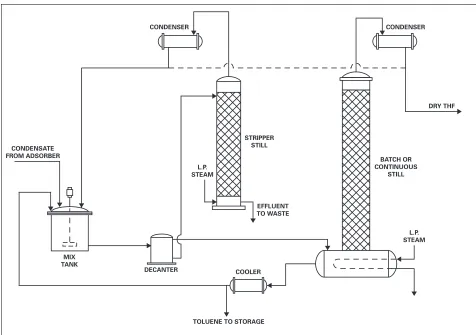
Toluene is used as a diluent for THF in coating operations and is recovered concurrently. Conden-sate from the activated carbon adsorber contains THF, toluene, and water in two ill-defined liquid phases. A system that efficiently separates and dries both THF and toluene is shown schematically in
Figure 9.
Condensate from the adsorber is collected in a mix tank together with several recycle streams. Addi-tional toluene is added, if necessary, to effect adequate phase separation and to extract the optimum amount of THF into the organic phase. The content of the mix tank is then pumped to a decanter where the layers separate. The exact composition of each layer may be predicted from the THF-toluene-water ternary miscibility diagram shown in Figure 10, if the overall composition is known.
The aqueous layer containing dissolved THF and a little toluene is distilled to recover residual solvent that is recycled to the mix tank for extraction. The organic layer consisting of toluene, most of the THF, and a small quantity of dissolved water is charged to a batch still for separation. The first cut removes all water in the form of THF-water azeo-trope that is recycled to the mix tank for extraction. The second cut is essentially pure, water-free THF. The water content of the THF varies, depending on the still efficiency and the care with which the cut is made; however, average conditions should yield THF containing less than 0.3% water. On complete removal of THF, the distillation is terminated and the toluene withdrawn from the boiler and cooled for reuse. Distillation of the organic layer may be adapted for continuous operation, provided the volume involved justifies the additional investment.
Tetrahydrofuran-Methyl Ethyl
Ketone-Water
Tetrahydrofuran is frequently used with methyl ethyl ketone (MEK) in topcoating and other resin solutions to increase solids content and drying rate without increasing viscosity. Solvent vapor recov-ery results in a mixture of THF, MEK, and water, which is usually a single liquid phase. The miscibil-ity characteristics of this ternary system at 25°C (77°F) are shown in Figure 11.
In some cases, THF and MEK are present in the ratio desired for reuse. Under these circumstances, the solvent mixture may be dried by distilling off the water azeotrope of each mixture with brine or caustic soda, depending on the dryness required.
In most cases, it is necessary both to dry and separate the solvents prior to reuse. These opera-tions may generally be carried out in existing recovery systems after minor modification.
[image:8.612.34.512.654.745.2]A typical solvent recovery system that has been modified to separate MEK and THF might operate in the following manner. Condensate from the activated carbon adsorber is stripped of excess
Table 2
Binary Azeotropes of Tetrahydrofuran
Component A: Tetrahydrofuran; b.p., 66°C (150°F)
Component B b.p. B, °C (°F) b.p. Azeotrope, °C (°F) wt% B
Chloroform 61.2 (141) 72.5 (161) 65.5
Cis-dichloroethylene 60.3 (140) 69.9 (157) 46.0
Ethanol 78.4 (172) — 10.0
n-Hexane 68.9 (154) 63.0 (145) 53.5
Methanol 64.7 (147) 60.7 (140) 31.0
Figure 9. Toulene Extraction
water by distillation to yield the water azeotrope of each solvent. The combined azeotropes are fed upward through an extraction column packed with calcium chloride etherate to reduce the overall water concentration to about 0.5%. This mixture is charged to a batch still for separation. The first cut, THF-water azeotrope, is recycled to the extraction column for drying. The second cut is essentially pure, dry THF. Upon complete removal of THF, the distillation is terminated, and the dry MEK remain-ing in the still boiler is cooled for reuse. Based on theoretical considerations, this system is capable of drying solvents to less than 0.1% water. In com-mercial practice, water contents up to 0.5% may be expected.
Reaction Solvent Mixtures
Tetrahydrofuran’s unique solvent power and its ability to direct reactions are leading to wide acceptance by industry as a solvent for Grignard reactions and lithium aluminum hydride reductions. The principal consideration in the use of THF in these applications is its complete water miscibility. This complicates recovery of dry solvent from the reaction mixture.
One simple method for recovering both THF and product in high yield is by addition of a water immiscible co-solvent to reaction mixtures containing THF, water, and the organic product before decanting the organic layer. Pentane, tolu-ene, and xylene are all suitable for this purpose. On addition of the co-solvent, the water content of the organic layer and the THF content of water layer both decrease sharply. The concentration of the reaction product dissolved in the water layer is also lowered significantly.
THF suitable for reuse is recovered from the organic layer decantation by conventional drying and distillation. Molecular sieves3,4,5 have proved
specially useful for drying organic liquid mixtures.
Safety Considerations
Like most organic solvents, tetrahydrofuran is a volatile, flammable liquid that may be hazardous to health if it is improperly handled. These properties suggest that certain precautions be considered in the design and operation of recovery systems.
CONDENSATE FROM ADSORBER
MIX TANK
DECANTER CONDENSER
COOLER
TOLUENE TO STORAGE
CONDENSER
DRY THF
L.P. STEAM L.P.
STEAM
BATCH OR CONTINUOUS
STILL STRIPPER
STILL
THF
SINGLE PHASE
9
8
7
5
4
3
2
1 TWO PHASE 2
1
3
4
5 6
7
9 1
2
3 4
5 6
7
9
TOLUENE WATER
6
[image:10.612.42.514.76.475.2]8 8
Figure 10. Ternary Miscibility—THF, Toluene, Water at 25°C (77°F), wt%
The flash point of THF measured by Tag closed cup is –20°C (–4°F), and its boiling point is 66°C (151°F). This places it in the same fire hazard group as acetone, VM&P naphtha, methyl ethyl ketone, and a number of other commonly used solvents that ignite at room temperature. The precautions normally used to prevent fires when handling such solvents should be used when recovering THF. THF vapor forms explosive mixtures with air between the limits of 2.0% and 11.8% by volume at room temperature. At 100°C (212°F), the limits become 2.1% and 12.0% by volume. The THF vapor concentration in exhaust air from drying ovens should always be maintained well below the lower explosive limits; 50% of the lower explosive limit is a commonly accepted maximum operating level.
The generally accepted threshold limit value for THF is 200 parts per million parts of air. It is unlikely that excessive exposure to THF vapor will
occur during normal operation of properly designed solvent vapor recovery equipment, because proper design usually results in average concentrations well below 100 ppm in the immediate vicinity of coating, printing, or film casting machines. Exces-sive exposure to THF vapor is also unlikely, because the odor is detectable by most people at concentrations of 25 to 50 ppm, a level well below the threshold limit.*
The third factor that must be considered for
safe design of THF recovery systems is the possible presence of tetrahydrofuran hydroperoxide
(THF-peroxide). This material forms in THF exposed to air and can decompose violently when it becomes sufficiently concentrated. A general rule for organic peroxides is that they may be easily handled in concentrations below 5% by weight.
Figure 11. Ternary Miscibility—THF, MEK, Water at 25°C (77°F), wt%
Applied to THF-peroxide, this rule indicates that its concentration in THF should not be permitted to exceed 5%, if distillation is contemplated. Care must always be exercised when distilling THF alone or in mixtures to avoid distilling to dryness, particularly in distillations associated with recov-ery. Distilling to dryness may concentrate the small quantity of THF peroxide normally present in the solvent or its solutions and increases the possibility of violent decomposition.
DuPont THF is stabilized with butylated hydroxy-toluene (BHT) to prevent formation and/or accumu-lation of THF-peroxide during storage. However, the stabilizer is a relatively high boiling compound and is left behind when THF is evaporated. Conse-quently, the THF vapor exhausted from a drying oven is unstabilized and may form a small quantity of THF-peroxide that is adsorbed and decomposed in the activated carbon during recovery operations. Laboratory studies have shown that ordinary
solvent recovery grades of activated carbon,1,2
which contain between 15 ppm and 75 ppm of iron as a natural impurity, decompose THF-peroxide and help prevent its formation.* Industrial experi-ence has confirmed these findings.
Although it is apparent from the above discussion that hazardous amounts of THF-peroxide should not accumulate in recovery systems, periodic checks should be made for possible peroxide content. If recovered THF is to be stored for an extended period, it should be restabilized or blanketed with an inert gas atmosphere. For more details on the properties, uses, storage, and han-dling of THF, please refer to the DuPont THF PUSH bulletin available upon request through our Customer Service Center.
* U.S. Patent 2,790,813 (1957) Bente , P. F. (assigned to E. I. du Pont de Nemours & Company)
THF
SINGLE PHASE
9
8
7
5
4
3
2
1
TWO PHASE 2
1
3
4
5 6
7
9
1
2
3
4
5 6
7
9
MEK WATER
6
8
e
Contact us on the web: http://www.dupont.com/terathane
The information set forth herein is furnished free of charge and is based on technical data that DuPont believes to be reliable. It is intended for use by persons having technical skill and at their own discretion and risk. Because conditions of use are outside of our control, we make no warranties, express or implied, and assume no liability in connection with any use of this information. Nothing herein is to be taken as a license to operate under or a recommendation to infringe any patents.
Equipment
Tetrahydrofuran may be handled in ordinary steel, because it is noncorrosive and does not hydrolyze. Mixtures of THF with other solvents or chemicals may require a material more resistant than steel. Specific recommendations can be offered only when the system is known.
Activated carbon adsorption equipment suitable for THF recovery is available from several manufactur-ers.7,8 Other equipment required for the various
THF recovery systems such as stills, heat exchang-ers, extractors, and tanks is available in standard models or on a custom-made basis from a number of process equipment fabricators. Reference to these firms may be found in the Thomas’ Register
of American Manufacturers, Sweet’s Catalog File,
and similar compilations.
Some equipment fabricators7,8 are able to design
and construct complete solvent recovery systems including adsorbers and all separation equipment. Where recovery equipment does not now exist, this approach offers the advantage of a completely integrated recovery system.
Source of Materials
The DuPont Company does not imply by citation of these manufacturers that only their products will perform satisfactorily. The products of other manufacturers that are not listed may be equally or better suited for the purpose.
Activated Carbon 1
Barneby-Sutcliffe A Division of Waterlink P.O. Box 2526
Columbus, Ohio 43216
Web Site: http://www.bscarbons.com/
2
Calgon Carbon Corp. P.O. Box 1346
Pittsburgh, Pennsylvania 15230
Web Site: http://www.calgoncarbon.com/
Adsorbents and Resins 3
Grace Davison W. R. Grace Co. 7500 Grace Drive Columbia, Maryland
Web Site: http://www.gracedavison.com/
4
Rohm and Haas Co. 5000 Richmond St.
Philadelphia, Pennsylvania 19137 Web Site: http://www.rohmhaas.com/
5
Union Carbide Corporation 39 Old Ridgeway Road Danbury, Connecticut 06817
Web Site: http://www.unioncarbide.com/
Liquid Phase Adsorption Units 6
Lectrodryer Division Ajax Magnethermic Corp. 230 Geri Lane
Richmond, Kentucky 40475
Web Site: http://www.lectrodryer.com/
Solvent Recovery Equipment 7
Koch-Glitsch, Inc. 4111 E. 37th Street North Wichita, Kansas 67220
Web Site: http://www.koch-glitsch.com/
8
Barneby-Sutcliffe A Division of Waterlink P.O. Box 2526
Columbus, Ohio 43216
Web Site: http://www.bscarbons.com/
For additional information or to place an order:
Americas 800-441-3893 fax 302-992-2500
Europe 49-6172-871306 fax 49-6172-871306
Australia 61-2-9923-6111 fax 61-2-9923-6099
P.R. China 86-21-6386-6366 fax 86-21-6386-6333
Japan 81-3-5434-6124 fax 81-3-5434-6189
Korea 82-2-222-5306 fax 82-2-222-5319
Taiwan 886-2-514-4419 fax 886-2-514-4364