Munich Personal RePEc Archive
A Perceptual Measure of Innovation
Performance: Micro Level Evidence from
Turkey
Fındık, Derya and Beyhan, Berna
Trakya University, Bahcesehir University
December 2014
1
A Perceptual Measure of Innovation Performance: Micro level evidence from
Turkey
Derya FINDIK Trakya University
Uzunkopru School of Applied Sciences Dept. of Business Information Management
Uzunkopru, 22300, Edirne E-posta: [email protected]
Berna BEYHAN Bahcesehir University
Faculty of Engineering, Dept. of Engineering Management Besiktas, 34353, Istanbul
E-posta: [email protected]
December, 2014
Abstract
This paper aims to introduce a qualitative indicator to measure innovation performance of Turkish firms by using firm level data collected by Turkish Statistical Institute (TURKSTAT) in 2008 and 2009. We propose a new indicator to measure the innovation performance which is simply based on the perception of firms regarding to the impacts of innovation. In order to create performance indicators we conduct a factor analysis to group the firms’ perceptions on the impacts of innovation. Factor analysis gives us product and process oriented impacts of innovation. There are significant differences among product innovators, process innovators and firms engaged in both product and process innovations with respect to their perceptions on product and process oriented impacts of innovation. Among these three groups, product and process oriented impacts provide a highest value for the firms that perform both product and process innovations. As far as the link between firm characteristics and the impact of innovation is considered, there is a significant difference between small and large firms with respect to their perceptions on product oriented impact of innovation.While product oriented impact are larger for small firms, large firms focus more on process oriented impact. Anova results also indicate that perceptions on process oriented impact significantly differ among exporter firms, domestic market oriented firms and firms being active in internal and external markets. Process oriented impact generate results in favor of exporting firms.
Keywords: innovation impact, product oriented impact, process oriented impact.
2
1. Introduction
This paper deals with an important question for innovation studies: how do innovations
influence the performance of firms? Now, it is accepted by everyone that new technologies
and innovations are vital to the growth of output and productivity (OECD, 2005). Therefore
creating innovative firms, eco-systems and supporting innovation capabilities at the firm
level, regional and national level are important concern for policy makers, managers and
researchers. But it is difficult to understand and measure the impact of innovations on firms.
The aim of this paper is to understand the impact of product and process innovations on firm
performance. Measuring the impact of innovation is one of the most commonly studied topics
in innovation studies. However, in spite of the extensive research on innovation studies we
still do not have a generally accepted indicator or a set of indicators for measuring innovation
performance. Previous studies aiming to measure the impact of innovations have often
focused on financial indicatorsor quantitative outputs; such as increase in productivity,
increase in growth, increase in sales, and the percentage of sales from innovative products
(Evangelista and Vezzani, 2010; Parisi et al. 2006).
Although the indicators used to measure the impact of innovations on firms are valuable
contributions to the literature, we believe that more qualitative measurements are also
necessary to understand the impact of innovations on products, markets and production
processes, or product/service quality. For instance, sometimes the impact of innovations on
performance might not be immediate, or might not be reflected to growth, market sales or
productivity in the same period. In some cases the increase in market share or firm sales might
not be a sole effect of a certain innovation but many other industrial and market changes can
influence it. It might be the case for other financial indicators. Therefore we believe thathow
the impact of innovation is perceived by firms or firm managers is also important to
investigate. Firms which realize that making innovations positively influence their market
presence, products and production capabilities are expected to be more willing to pursue
innovations. However, there is a gap in the literature concerning qualitative indicators to
measure the impact of innovations on firm performance. In this paper, we will fill that gap in
the literature by using a qualitative measurement based on the perception of firms regarding to
the strength of the impact of innovations on products and processes. This is also the main
3
The impact of innovations on firm performance is measured generally by increase in
productivity, increase in sales, increase in the percentage of new products in total sales, or
firm growth (e.g. Beers and Zand, 2014; Evangelista and Vezzani, 2010; Parisi et al., 2006).
Moreover, these studies prove that innovations have a positive impact over these indicators of
firm performance. However, these studies provide no clues about how firms perceive the
impact of these innovations or whether they realize and feel the real impact of these
innovations on their market presence, products or production processes. The impact of
innovations on productivity, growth, employment are not always immediate. Specifically,
perceiving the impact of process innovations on sales, productivity or other financial
indicators might not always very possible in a short term, but firm managers and employees
can evaluate such impacts and provide more information about whether a change in products
or processes is achieved by an innovation or not. Therefore this paper focus on how the
impacts of innovations are perceived by firms/ firm managers and aim to understand how the
perceptions regarding to the impact of innovations on firm performance change regarding to
the type of innovations (product and process innovations) at the firm level. We also control
whether the perceptions regarding to the impact of innovations differ among firms with
different characteristics (i.e. size, foreign ownership, doing R&D, being and exporter or using
intranet).
This study adresseses at least three main contributions. First, we introduce a qualitative
performance indicator to measure impact of innovation. Second, we use firm level datasets in
this study, therefore, it is assumed that firms are heterogeneous in terms of their innovation
behaviours. The last contribution is that this study aims to introduce a novel indicators to
measure impact of innovation in Turkey which is a developing country. The number of
studies elaborating innovation impact in developing countries is rare. This study will fill this
gap in the innovation literature.
In the following section the literature on the impact of innovation on firm performance is
reviewed. The third section provides comprehensive information about data and methodology.
In the fourth section we will discuss the results of the analyses, and section five concludes the
4
2. Literature review
Many people agree on that innovations have a positive impact on firm performance but there
is no agreement on how we can measure the impact of innovations on firm performance.
Moreover, empirical studies provide a positive relationship between innovations and firm
performance (Bigliardi, 2013). The most oftenly used measurement of firm innovation
performance is the share of innovative sales in total (e.g. Beers and Zand, 2014; Frenz and
Letto-Gilles 2009). It is generally measured by the sales comes from radical or new to the
market sales. Evangelista and Vezzani (2010) measure the performance of innovative firms by
the growth in sales. They found that product, process and organizational innovations
possitively associate to the growth of firm turnover.
Hagedoorn and Cloodt (2003), after emphasizing on the variety in performance indicators
identify 3 types of firm performance which are linked to innovations. According to authors
firms have inventive performance which can be measured by the number of patents and patent
citations. Firms also have R&D performance which can be measured by R&D inputs. The
third performance indicators is new product announcements which measure the new product
development performance of the firm. Another measurement used frequently in the literature
is productivity growth at the firm level and national level. Parisi et al. (2006) find out a
positive relationship between process innovations and increase in productivity. Hashi and
Stojcic (2013), based on CIS 4 results compare the impact of innovations for mature market
economies of Western Europe and advanced transition economies of Central and Eastern
Europe. They find out that there is a positive relationship between innovation activities and
productivity. Rocchina-Barrachina et al (2010) based on a survey of Spanish manufacturing
companies find that process innovations bring some extra productivity growth for both large
and small firms.
Another group of indicators used by scholar to measure innovation performance is financial
ratios and indicators. For example, Bigliardi (2013) employs a set of performance indicators
which are related to financial situation of the firm. Among those indicators there are a firm's
return on investment relative to its competitors, a firm's total operating costs relative to its
competitors or a firm's return on assets relative to its competitors. Kostopoulos et al. (2011)
on the other hand aim to understand the linkages between absorptive capacity and innovation
5
performance. The authors measure financial performance by return on assets and return on
sales and found a positive relationship between a firm's innovative performance and financial
performance.
The research model is constructed based on the idea that the perception on innovation impact
can be an alternative indicator to measure innovation performance. The impact of innovation
can be measured by its product and process effects (OECD, 2006). Product variation, product
improvement, new markets and expansion of market share indicate product oriented impact
of innovation. As far as product variation and product improvementsare considered it is
assumed that knowledge and experience gained through innovation process will encourage
firms to develop new products or update the existing ones (Schumpeter, 1934). Remained two
product-oriented impacts of innovations are opening new markets and increasing market
share. A new product should be developed based on the needs of the market (Balachandra,
1997). Firms, therefore, can achieve higher differentiation by innovating products to meet the
needs of the market (Teece and Pisano, 1994; Verona, 1999). Product innovations are
implemented based on the market signals to create new markets. In a similar vein, Damanpour
et al., (2009) have argued that product innovations depend heavily on international markets
and their introduction is expected to generate new markets.Considering the radical
innovations in the fields of nanotechnology, biotechnology, and information and
communication technologies, it is clear that those innovations generate new markets and firms
with higher market shares benefit from those innovations (Blundell et al., 1999). Additionally,
the extant of the benefits is larger for the first mover firms in those technology fields
(Banburry and Mitchell, 1995).
Process innovations, contrary to product innovations, are much more internal to the firm
(Abernathy and Utterback, 1978; Martinez-Ros, 2000; Boer and During, 2001). The drivers of
these innovations are primarily reduction in delivery time, increase in operational flexibility,
and lowering of production costs (Boer and During,2001). Process-oriented effects include,
for instance, quality improvement, increasing flexibility in production processes and in
production capacity, improvements in health and security conditions, and reduction in labour
costs(OECD, 2006; Urgal et al. 2013). These subcomponents of the process-oriented effects
6
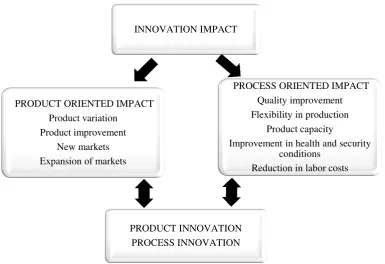
The relation between the type of innovations (product and process)and the impacts of
innovation is presented in Figure (1). The impact of innovation is examined at two levels:
product-oriented impact and process-oriented impact. There is a reciprocal relation between
innovation types and these two levels of innovation impact. The research question is that
whether firms that have engage in product innovations have similar perceptions regarding to
[image:7.595.94.480.230.494.2]the impact of innovations with process innovators or vice versa.
Figure 1. Innovation impact and innovation types
3. Data and methodology
The data for this study is collected from two sources. The first is 2009 ‘Community
Innovation Survey (CIS)’ of 5863 firms encompassing manufacturing and services sectors,
administered by Turkish Statistical Institute (TURKSTAT, 2009). CIS is conducted in order
to determine the innovation capability of firms in the fields of technological innovation, new
product and process improvement, and the use of the new technologies. Additional dataset is
‘ICT Usage in Business Enterprises (2008)’ collected by TURKSTAT. Those statistics are applied to firms having 10 or more employees in the manufacturing and services sectors. This
INNOVATION IMPACT
PROCESS ORIENTED IMPACT Quality improvement Flexibility in production
Product capacity
Improvement in health and security conditions
Reduction in labor costs
PRODUCT INNOVATION PROCESS INNOVATION PRODUCT ORIENTED IMPACT
Product variation Product improvement
7
dataset contains 2700 observations. With these two sources are combined, the final dataset
contains 996 observations. In TURKSTAT(2009), only product innovators, process
innovators, firms that have ongoing and abandoned innovation activities during 2006 to 2008
respond the questions on impact of innovation. Responses are gathered from 504 firms.
Among those, there are four categories which are product innovators (N=91), process
innovators (N=73), firms engaged in both product and process innovations (N=313), and
firms that have ongoing activities (N=27). In this study, we focus on product and process
innovators so our hypotheses do not include firms in the forth category. The final sample is
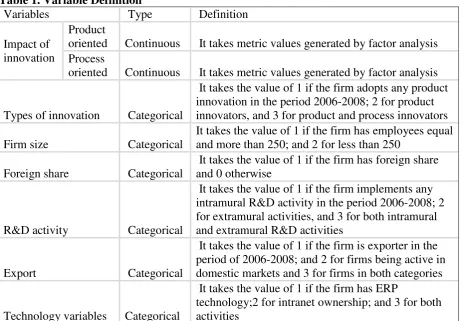
[image:8.595.72.536.285.606.2]composed of 477 observations. Table (1) presents the definition of variables.
Table 1. Variable Definition
Variables Type Definition
Impact of innovation
Product
oriented Continuous It takes metric values generated by factor analysis Process
oriented Continuous It takes metric values generated by factor analysis
Types of innovation Categorical
It takes the value of 1 if the firm adopts any product innovation in the period 2006-2008; 2 for product innovators, and 3 for product and process innovators
Firm size Categorical
It takes the value of 1 if the firm has employees equal and more than 250; and 2 for less than 250
Foreign share Categorical
It takes the value of 1 if the firm has foreign share and 0 otherwise
R&D activity Categorical
It takes the value of 1 if the firm implements any intramural R&D activity in the period 2006-2008; 2 for extramural activities, and 3 for both intramural and extramural R&D activities
Export Categorical
It takes the value of 1 if the firm is exporter in the period of 2006-2008; and 2 for firms being active in domestic markets and 3 for firms in both categories
Technology variables Categorical
It takes the value of 1 if the firm has ERP
technology;2 for intranet ownership; and 3 for both activities
Impact of innovation. In the survey, firms are asked about their perceptions on the impact of
innovations introduced in the period of 2006-2008. These are a) increased range of goods or
services b) improved outdated products/services c) entered new markets d) increased market
share e) improved quality of the products/services f) improved flexibility in the production of
goods and services g) increased capacity of production or services h) improvement in themes
8
each item ranges from 1 to 4. If the observed effect is high, the item takes the value of 4. If
there is no observed effect, the item takes the value of 1. On the basis of work by Urgal
(2013), the impact of innovation is quantified by those 9 indicators in this study.
We applied factor analysis to classify the innovation impact based on the values generated by
polychoric correlation technique1. Based on the kaiser criterion which excludes eigenvalues
equal or less than 1, two factors are determined in the factor analysis. These two factors
account for %70.43 of the total variance. Since varimax rotation procedure is applied these
two factors are not correlated each other. The main reason for using this rotation technique is
to identify variables to create new variables without intercorrelated components. Finally we
had two types of innovation impacts. These are product oriented and process oriented
innovation impacts (OECD, 2006).
Figure 2 demonstrates the factor loadings which indicate two-factor model. The first one is
product oriented impact including the items namely increased range of goods or services
(0.87), improved outdated products/services (0.75), entered new markets (0.80), and increased
markets share (0.82). The second factor is named as process oriented impact, which is
composed of improved quality of the products/services (0.64), improved flexibility in the
production of goods and services (0.72), increased capacity of production or services(0.76),
improvement in themes of health and security (0.83), and reduced labour costs per unit output
[image:9.595.133.498.493.622.2](0.83).
Figure 2. Factor loadings of product oriented impact versus process oriented impact
1
9
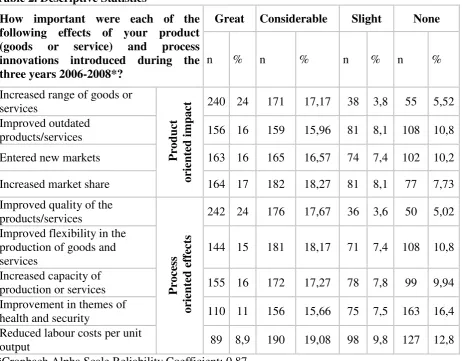
Table 2 shows the number of observations and the share of each responses in total
observations. Each item has adequate number of observations.As far as the product oriented
impact is considered, the proportion of responses reflecting positive perceptions (great
and/considerable) is larger than that of responses assigned to slight or none. Items in process
oriented impact follow the similar pattern. This result validates the two factor model with a
[image:10.595.75.538.218.579.2]high Cronbach Alpha Scale coefficient (0.87) in this study (see, Table 2).
Table 2. Descriptive Statistics
How important were each of the following effects of your product
(goods or service) and process
innovations introduced during the three years 2006-2008*?
Great Considerable Slight None
n % n % n % n %
Increased range of goods or services P rod u ct or iente d impact
240 24 171 17,17 38 3,8 55 5,52
Improved outdated
products/services 156 16 159 15,96 81 8,1 108 10,8
Entered new markets 163 16 165 16,57 74 7,4 102 10,2
Increased market share 164 17 182 18,27 81 8,1 77 7,73
Improved quality of the products/services Pr oc ess or iente d e ff ec ts
242 24 176 17,67 36 3,6 50 5,02
Improved flexibility in the production of goods and services
144 15 181 18,17 71 7,4 108 10,8
Increased capacity of
production or services 155 16 172 17,27 78 7,8 99 9,94 Improvement in themes of
health and security 110 11 156 15,66 75 7,5 163 16,4 Reduced labour costs per unit
output 89 8,9 190 19,08 98 9,8 127 12,8
*Cronbach Alpha Scale Reliability Coefficient: 0.87
Two types of innovation such as product innovation and process innovation are used in order
to detect the relation between innovation impact and innovation types. As introduced in
hypotheses (see, Table 3), it is assumed that product and process innovators differentiate from
each other with regard to their perceptions on the impact of innovation. The impact of
innovation may vary in terms of the firm size, foreign share, intra-mural/extra-mural R&D
10
Product Innovation. Product innovation indicates the adoption of a product that is new to the
organization. It is measured as a binary variable taking the value of 1 if the firm has generated
new products in the period 2006-2008 in Turkey (TURKSTAT, 2009). A vast amount of
studies suggest that the introduction of a new product increases firm performance (Löfsten,
2014; Roberts, 1999; Deeds and DeCarolis, 1999; Cho and Pucik, 2005; Hua and
Wemmerlov, 2006). Product innovations could generate positive effect on firm performance
through increasing range of products. Firms with differentiated products could gain
competitive advantage in the market which turns into increase in firm profits. In addition to
these, new markets could emerge with the introduction of the new products. Damanpour et al.
(2009) has found that product innovations are externally oriented and sensitive to market
signals. The needs of the markets play a crucial role in the implementation of those
innovations. Our hypothesis is constructed based on this rationale indicating that product
innovations generate product oriented impact. Product innovations could also make process
oriented changes for the firm. The features of the new product could enhance capacity of
production or may require flexibility in production processes. To test these assumptions, we
add hypothesis on the link between process oriented impact and product innovations.
Process innovation. Process innovation is defined as the adoption of a process that is new to
the organization. It is measured as a binary variable taking the value of 1 if the firm has
generated new products in the period 2006-2008 in Turkey (TURKSTAT, 2009). Camisón
and López (2014) have found that process innovations positively affect firm performance.
This effect, on the other hand, is mediated by product innovations. Process innovations are
introduced to improve quality of the products, therefore, changes in the product quality will
turn into increase in firm performance (Camisón and López , 2014; Cabagnols and LeBas,
2002). Process innovations reduce the operational costs (Damanpour, 2010). With the
introduction of innovations in business processes, the interaction between interdependent
units increases, therefore firms could allocate less amount of time for the production. In
addition to these, process innovations could enhance health and security conditions of the
work environment. To sustain competitive edge in the markets in the long term, firms
integrate the rules of corporate responsibility (Zadek, 2004). Thus, societal issues are taken
into consideration in process innovations. Firms operating in automobile industry should
consider producing environmentelly friendly cars as much as providing healthy and secure
11
assume that process innovations could generate product oriented impact as much as process
oriented impact which turn into increase in the firm performance.
We use firm size, foreign share, internal and external R&D, export share, the use of ERP, and
intranet ownership as control variables in this study. Firm size is expected to have a positive
effect on both product oriented and process oriented impact of innovation. Large firms
commonly have a higher expectation on profits while investing in R&D activities or deciding
on innovation. Firm size positively affects decision to innovate (Rogers, 2004) and large firms
increase their performance through investing in innovation activities (Camisón and López ,
2014). While some studies emphasize that small firms could benefit from flat type of work
organisation which eases the implementation of innovation (Tether, 1998), large firms due to
the stock of knowledge and human capital, are much prone to innovate. In this study, we
reveal the motivation(s) for the positive relation between firm size and innovation. Do large
firms expect product oriented impact or process effect in decision to innovate? We assume
that large firms due to having strategic resources such as financial assets, human capital,
knowledge and experience tend to produce new products and processes than do their smaller
counterparts (Ettlie and Rubenstein, 1987; Acs and Audretsch, 1988). We include both
product oriented and process oriented impact in terms of firm size in our hypotheses.
As far as the link between foreign share and innovation is considered, foreign firms or firms
having foreign share are more likely to innovate since they access to new knowledge and
technology faster than that of their domestic partners (Almeida, 1996; Almeida and
Fernandes, 2008). Girma et al. (2009) found that the higher levels of foreign share at the firm
increase the innovation activity using firm level panel data for Chinese state-owned
enterprises during the period 1999-2005. In a similar vein, Luong et al. (2014) revealed that
the presence of foreign institutional investors positively affects the firm’s innovation
activities. Three factors are mentioned to explain the success of foreign institutional investors.
These are active monitoring, eliminating innovation failures, and facilitating technology
transfers from innovative countries to non-innovators. Angeli (2014) examining 123 Indian
biopharmaceutical firms between 1999 and 2009, have found that firms with foreign partners
became more successfull at implementing innovation activities. Bertschek (1995) found that
foreign direct investment through technology transfer from foreign investors to domestic
12
Research and development (R&D) activities, as part of innovation activity, are strongly linked
to decision to innovate. R&D activities could be classified as extramural and intramural R&D.
Tsai(2001) have found that organizations investing in their own R&D are much able to
innovate and achieve high performance. The main reason is that internal R&D activities
provide transfer of knowledge from one unit to another and this in turn increase firm’s
performance. Nelson and Chuang (2014) have found that domestic firms’ innovation
performance is positively linked to domestic firms’ R&D activities. As firms focus more on
increasing internal R&D capacity, they exploit external knowledge much easily (Cohen and
Levinthal, 1990).
Product and process oriented impact could differ as regards exporting activities. Firms being
active in international markets are much able to access to knowledge and capabilities required
for innovating new products and processes (Van Biesebroeck, 2005; De Loecker,2007).
Empirical literature on the link between innovation and exporting activites provides some
evidence on the positive effect of exporting activities on innovation (Nieto and Santamaría,
2010; Hsu and Chuang, 2014; Bratti and Felice, 2012) while some others found no significant
effect (Schubert and Simar, 2011; Woerter and Roper, 2010).
Enterprise resource planning (ERP) is a system which integrates different functions of the
firm into a single computer system (Nelson and Somers, 2001). Therefore, with the
contribution of ERP system, firm resources could be managed by using both internal and
external information. Srivardhana and Pawlowski (2007) have found that there is a positive
link between innovation capabilities and the use of ERP systems. ERP system through a
centralised enterprise wide database delivers necessary data in real time and enables
employees to be more innovative and flexible (Davenport et al. 2004). ERP system generates
process oriented impact such as reduction in production costs and improvement in quality of
goods and services for the firms (Shang and Seddon, 2000; Umble et al. 2003; Hong and Kim,
2002). ERP system integrates manufacturing function with all of the functions in an
organization, thus, incompatibility between software and hardware platforms reduces with the
implementation of the ERP system. This results in improvement in production processes and
increase firm performance (Rajagopal, 2002). The success of the ERP system, on the other
hand, heavily depends on compatibility between the system and organizational needs of the
13
Intranet ownership is used as another technology variable in this study. The presence of
intranet within the organization facilitates internal knowledge diffusion (Carr, 1996;Yen and
Chou, 2001). This system works on the basis of confidentiality, i.e. only authorized subjects
are able to connect with each other. Andersen (2001) found positive association between
intranet and innovation. Intranet is a knowledge sharing mechanism within the firm. Swann et
al. (1999) found that firm’s innovation processes are facilitated by intranet which enables knowledge flows within the firm when firms succeed active networking. Accordingly,
knowledge is inherently sticky and requires face to face interaction in most cases (Lin, 2007).
Table 3 demonstrates the set of hypotheses introduced to reveal the relations between firms'
perceptions on the impact of process and product innovations and certain firm characteristics.
The hypotheses are based on the arguments that firm characteristics such as firm size, being
international, conducting intramural R&D activities or receiving external R&D support, being
an exporter, or having certain IT systems would feel the impact of innovations in different
ways and therefore their perceptions about the impact of innovations would be at different
directions (product or process).
Table 3. Hypotheses Product oriented impact
H1 There are differences among product innovators, process innovators and firms engaged in both product and process innovations with respect to their perceptions on product oriented impact of innovation
H2 There are differences between small and large firms with respect to their perceptions on product oriented impact of innovation
H3 There are differences between foreign firms and domestic firms with respect to their perceptions on product oriented impact of innovation
H4 There are differences among firms engaged in intramural,extramural R&D activities and firms engaged in both activities with respect to their perceptions on product oriented impact of innovation
H5 There are differences among exporter firms, domestic markets oriented firms and firms in both categories with respect to their perceptions on product oriented impact of innovation
H6 There are differences between erp users, intranet owners, and firms using both erp and intranet with respect to their perceptions on product oriented impact of innovation
Process oriented impact
14
H8 There are differences between small and large firms with respect to their perceptions on process oriented impact of innovation
H9 There are differences between foreign firms and domestic firms with respect to their perceptions on process oriented impact of innovation
H10 There are differences among firms engaged in intramural, extramural R&D activities and firms engaged in both activities with respect to their perceptions on process oriented impact of innovation
H11 There are differences among exporter firms, domestic markets oriented firms and firms in both categories with respect to their perceptions on process oriented impact of innovation
H12 There are differences between erp users, intranet owners, and firms using both erp and intranet with respect to their perceptions on process oriented impact of innovation
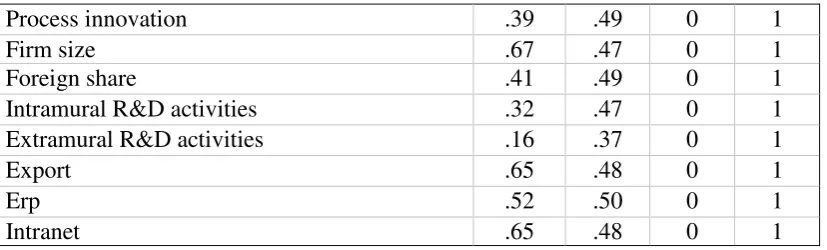
The descriptive statistics of each item that creates factors are demonstrated in Table (4). The
main values of each item are clustered around the value of 1 indicating positive perceptions of
the respondents2. As far as the shares of product and proces innovation are considered, they
are 0.41 and 0.39 respectively. Considering the descriptive statistics of the control variables,
the sample in this study is composed of large firms (67%). 41 percent of the sample has
foreign owned firms. The share of firms engaged in intramural activities (32%) is higher than
that of firms having extramural activities (16%). 65 percent of the sample are active in export
markets. The shares of ERP users and intranet ownership are more than half of the sample
[image:15.595.77.480.519.729.2]which indicates the technological advancement of the firms in the sample.
Table 4. Descriptive statistics
Variables Mean Std.
Dev.
Min Max
Increased range of goods or services 1.61 1.74 0 4 Improved outdated products/services 1.38 1.58 0 4
Entered new markets 1.40 1.60 0 4
Increased market share 1.45 1.60 0 4
Improved quality of the products/services 1.62 1.74 0 4 Improved flexibility in the production of goods
and services
1.37 1.57 0 4
Increased capacity of production or services 1.40 1.58 0 4 Improvement in themes of health and security 1.23 1.46 0 4 Reduced labour costs per unit output 1.25 1.45 0 4
Product innovation .41 .49 0 1
2
15
Process innovation .39 .49 0 1
Firm size .67 .47 0 1
Foreign share .41 .49 0 1
Intramural R&D activities .32 .47 0 1
Extramural R&D activities .16 .37 0 1
Export .65 .48 0 1
Erp .52 .50 0 1
Intranet .65 .48 0 1
4. Estimation results
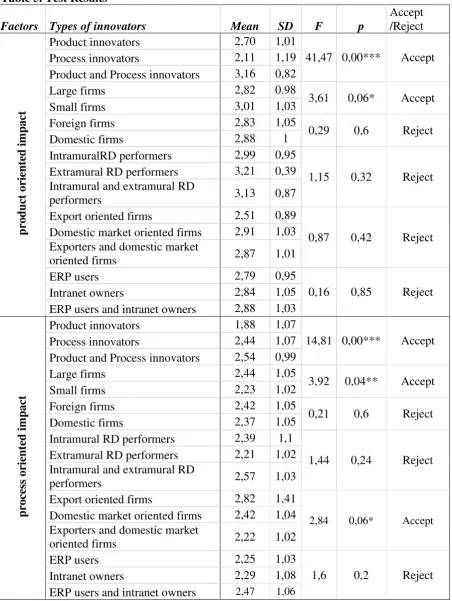
Table 5 demonstrates the test results. Based on the results of anova procedure, there are
significant differences among product, process innovators and firms engaged in both product
and process innovations with respect to their perceptions on product and process oriented
impacts of innovation. We have found that product oriented impact is larger for the third
group including product and process innovators (μ=3,16; F=41,47; p<0,001). Product and
process innovators have the largest mean with respect to process oriented impact of
innovation (μ=2,54;F=14,81;p<0,001). Product innovations create some impact on the
number and variety of firm products provided to customers, increasing firms’ market share,
creating new markets, etc. Their effects on process improvements are perceived significantly
by firms. Process-oriented impacts of innovation, i.e. quality improvement, flexibility in
production, product capacity, health and security improvement and labor costs are observed
directly as the consequences of product innovations. Performing these complementary
activities (product and process innovations) generate both product and process innovation
impacts.
Considering the control variables, it can be argued that there is a significant difference
between small and large firms with respect to their perceptions on product and process
oriented impact. While product oriented impact generate highest mean for small firms
(μ=3,01;F=3,61;p<0,10), large firms acknowledge the process oriented impacts of innovation
more than small firms (μ=2,44;F=3,92; p<0,05). Additionally, anova test provides that there
are differences among exporter firms, firms being active in domestic markets, and firms in
both categories. Accordingly, process oriented impact gives a highest mean for exporter firms
(μ=2,82;F=1,41;p<0,10). With regard to the link between impacts of innovation and remained
variables, there is no significant difference between groups with respect to their perceptions
[image:16.595.68.482.69.194.2]16
Table 5. Test Results
Factors Types of innovators Mean SD F p
Accept /Reject p rod u ct or iente d impact
Product innovators 2,70 1,01
41,47 0,00*** Accept
Process innovators 2,11 1,19
Product and Process innovators 3,16 0,82
Large firms 2,82 0.98
3,61 0,06* Accept
Small firms 3,01 1,03
Foreign firms 2,83 1,05
0,29 0,6 Reject
Domestic firms 2,88 1
IntramuralRD performers 2,99 0,95
1,15 0,32 Reject Extramural RD performers 3,21 0,39
Intramural and extramural RD
performers 3,13 0,87
Export oriented firms 2,51 0,89
0,87 0,42 Reject Domestic market oriented firms 2,91 1,03
Exporters and domestic market
oriented firms 2,87 1,01
ERP users 2,79 0,95
0,16 0,85 Reject
Intranet owners 2,84 1,05
ERP users and intranet owners 2,88 1,03
p roc ess orie n te d impact
Product innovators 1,88 1,07
14,81 0,00*** Accept
Process innovators 2,44 1,07
Product and Process innovators 2,54 0,99
Large firms 2,44 1,05
3,92 0,04** Accept
Small firms 2,23 1,02
Foreign firms 2,42 1,05
0,21 0,6 Reject
Domestic firms 2,37 1,05
Intramural RD performers 2,39 1,1
1,44 0,24 Reject Extramural RD performers 2,21 1,02
Intramural and extramural RD
performers 2,57 1,03
Export oriented firms 2,82 1,41
2,84 0,06* Accept Domestic market oriented firms 2,42 1,04
Exporters and domestic market
oriented firms 2,22 1,02
ERP users 2,25 1,03
1,6 0,2 Reject
Intranet owners 2,29 1,08
17
5. Conclusion
This study presents a novel approach to measure innovation performance of the firms in
Turkey. We introduce two qualitative performance indicators based on the firms’ perceptions
on the impact of innovation. These are product oriented impact and process oriented impact.
Product oriented impact include variation in product range, product improvement, new
markets and expansion of markets. Process oriented impact cover quality improvement,
flexibility in production, improvement in production capacity, improvement in health and
security conditions, and reduction in labor costs.
We observe a significant difference among process innovators, product innovators and firms
that introduce both product and process innovations in terms of their perception on innovation
impact. To measure the effect of process innovation on firm performance is difficult since the
improvements in the business proceses are less tangible. Process innovations, contrary to
product innovations, generate minor changes in the processes at an early stage of production
but its effects on production becomes larger than that of product innovation after a certain
point (Adner and Levinthal, 2001). Process innovations play a dual role in the business world
(Gopalakrishnan et al., 1999). First, process innovations can be used to improve the efficiency
of generating new products and processes. Second, the presence of process innovations
increases the quality and reliability of the production which in turn add value to the
customers. Process innovations, therefore, could facilitate product innovations. The
innovation rate of product innovations at an early stage is much faster(Abernathy and
Utterback, 1978) so it is less probable that product innovations generate process oriented
impact. In this study, product oriented impact as much as process oriented impact are highest
for firms that introduce both product and process innovations. While process innovations
focus on internal organization of the firm (Abernathy and Utterback, 1978; Martinez-Ros,
2000; Boer and During, 2001), product innovations are externally oriented (Damanpour et al.,
2009). This result implies that product and process innovations have complementary functions
that generate results in favor of firms introducing both product and process innovations.
Firm characteristics such as firm size, R&D activities, foreign share, export activities, intranet
ownership and the use of ERP are also included in this study to examine the relation between
18
generate significant differences among firms with respect to firms’ perceptions on product
and process oriented impact.
As for the link between firm size and impacts of innovation, we observe significant difference
between large firms and small firms in terms ther perceptions on product and process
oriented impact. In this study, firms tend to pursue process innovations, when the size of the
firm gets bigger. Large firms due to the availability of financial resources could invest in new
processes which are costly for small firms (Lejjaraga and Martinez-Ros, 2014). Ettlie and
Rubenstein(1987) found that large firms are unlikely to introduce radically new products.
Those firms tend to adopt process innovations to introduce new products. In a similar vein, we
have found that small firms focus more on product oriented impact in this study.
We have found a significant difference between exporter firms and firms in other groups in
terms of their perceptions on innovation impact. In the literature, product innovations are
positively affected by export performance of the firms (Lages et al., 2009). Exporter firms in
contrast to our expectations, do not observe product oriented impact of innovation in this
study. Rather, they focus on process oriented impact. This result indicates that exporting
activities provide external knowledge spillover for firms which in turn generate impacts on
internal organisation of the firm.
5.1. Limitations and further research
This study has some limitations in terms of the time span and the methodology. Due to the
availability of data, we could conduct cross section analysis which provides a snapshot of the
relations between performance indicators and other types of variables in this study. Further
study could be implemented using panel data to observe robustness of the results. As a
methodological point of view, the estimation results are derived from anova procedure. A
future study could be implemented by using other methodologies to examine the qualitative
19
6. References
Abernathy, W. J., and Utterback, J. M. (1978). Patterns of industrial innovation. Technology Review, 64, 254-228.
Acs, Z. J. and Audretsch, D. B. (1988).Innovation in large and small firms: an empirical analysis. The American Economic Review, 678-690.
Adner, R., and Levinthal, D. (2001). Demand heterogeneity and technology evolution: implications for product and process innovation. Management Science, 47, 611-628.
Almeida, P. (1996). Knowledge sourcing by foreign multinationals: patent citation analysis in the US semiconductor industry. Strategic Management Journal, 17, 155-165.
Almeida, R., and Fernandes, A. M. (2008). Openness and technological innovations in developing countries: evidence from firm-level surveys. The Journal of Development Studies,44, 701-727.
Andersen, T. J. (2001). Information technology, strategic decision making approaches and organizational performance in different industrial settings. The Journal of Strategic Information Systems, 10, 101-119.
Angeli, F. (2014).With the help of a foreign ally: biopharmaceutical innovation in India after TRIPS. Health Policy and Planning, 29, 280-291.
Balachandra, R., and Friar, J. H. (1997). Factors for success in R&D projects and new product innovation: a contextual framework. IEEE Transactions on Engineering Management, 44, 276-287.
Banbury, C. M., and Mitchell, W. (1995). The effect of introducing important incremental innovations on market share and business survival. Strategic Management Journal, 16, 161-182.
Beers, C., and Zand, F. (2014). R&D Cooperation, Partner Diversity, and Innovation Performance: An Empirical Analysis. Journal of Product Innovation Management,31, 292-312.
Bertschek, I. (1995). Product and process innovation as a response to increasing imports and foreign direct investment. The Journal of Industrial Economics, 43, 341-357.
20
Blundell, R., Griffith, R., and Windmeijer, F., (1999). Individual effects and dynamics in count data models. (Working paper series no. W99/3), Institute for Fiscal Studies.
Boer, H., and During, W. E. (2001). Innovation, what innovation? A comparison between product, process and organisational innovation. International Journal of Technology Management, 22, 83-107.
Bratti, M., and Felice, G. (2012). Are exporters more likely to introduce product innovations?.
The World Economy, 35, 1559-1598.
Cabagnols, A., and C. LeBas (2002). Differences in the Determinants of Product and Process Innovations: the French Case. In A. Kleinknecht and P. Mohnen (Eds.), Innovation and Firm Performance: Econometric Explorations of Survey Data (pp. 112-149). Palgrave.
Camisón, C., and Villar-López, A. (2014). Organizational innovation as an enabler of technological innovation capabilities and firm performance. Journal of Business Research, 67, 2891-2902.
Carr,J. (1996). Intranet deliver. Business Week, 6, 61-63.
Cassiman, B., and Veugelers, R. (2006). In search of complementarity in innovation strategy: internal R&D and external knowledge acquisition. Management Science, 52, 68-82.
Cho, H. J., and Pucik, V. (2005). Relationship between innovativeness, quality, growth, profitability, and market value. Strategic Management Journal, 26, 555-57.
Cohen, W. M. and Levinthal, D. A. (1990). Absorptive capacity: a new perspective on learning and innovation. Administrative Science Quarterly, 128-152.
Damanpour, F., Walker, R. M., and Avellaneda, C. N. (2009).Combinative effects of innovation types and organizational performance: a longitudinal study of service organizations. Journal of Management Studies, 46, 650-675.
Damanpour, F. (2010). An integration of research findings of effects of firm size and market competition on product and process innovations. British Journal of Management, 21, 996-1010.
Davenport, T. H., Harris, J. G., and Cantrell, S. (2004). Enterprise systems and ongoing process change. Business Process Management Journal, 10, 16-26.
De Loecker, J. (2007). Do exports generate higher productivity? Evidence from Slovenia.
21
Deeds, D. L., and Decarolis, D. M. (1999). The impact of stocks and flows of organizational knowledge on firm performance: an empirical investigation of the biotechnology industry.
Strategic Management Journal, 20, 953-968.
Ettlie, J. E. and Rubenstein, A. H. (1987). Firm size and product innovation. Journal of Product Innovation Management, 4, 89-108.
EU (2006). Community Framework for State Aid for Research and Development and
Innovation. Retrieved 19 December 2014 from
http://eurlex.europa.eu/legalcontent/EN/ALL/?uri=CELEX:52006XC1230%2801%29.
Evangelista, R., and Vezzani, A. (2010). The economic impact of technological and organizational innovations. A firm-level analysis. Research Policy, 39, 1253-1263.
Frenz, M., and Ietto-Gillies, G. (2009). The impact on innovation performance of different sources of knowledge: Evidence from the UK Community Innovation Survey. Research Policy,38, 1125-1135.
Girma, S., Gong, Y., and Görg, H. (2009).What determines innovation activity in Chinese state-owned enterprises? The role of foreign direct investment.World Development, 37, 866-873.
Goldman, R. N., and Preiss, K. (1995). Agile Competitors and Virtual Organisations: Strategies for Enriching the Customer. New York, NY, Van Nostrand Reinhold.
Gopalakrishnan, S., Bierly, P., and Kessler, E. H. (1999). A reexamination of product and process innovations using a knowledge-based view. The Journal of High Technology Management Research, 10, 147-166.
Hagedoorn, J., and Cloodt, M. (2003). Measuring innovative performance: is there an advantage in using multiple indicators?. Research Policy, 32, 1365-1379.
Hammer, M. and Champy, J. (1993). Reengineering the Corporation. Harper Business.
Hashi, I., and Stojčić, N. (2013). The impact of innovation activities on firm performance using a multi-stage model: Evidence from the Community Innovation Survey 4. Research Policy,42, 353-366.
Hong, K. K., and Kim, Y. G. (2002). The critical success factors for ERP implementation: an organizational fit perspective. Information & Management, 40, 25-40.
22
Hua, S. Y., and Wemmerlov, U.(2006). Product change intensity, product advantage, and market performance: An empirical investigation of the PC industry. Journal of Product Innovation Management, 23, 316–329.
Kostopoulos, K., Papalexandris, A., Papachroni, M., and Ioannou, G. (2011). Absorptive capacity, innovation, and financial performance. Journal of Business Research, 64, 1335-1343.
Lages, L. F.,Silva, G., and Styles, C. (2009). Relationship capabilities, quality and innovation as determinants of export performance. Journal of International Marketing, 17, 47-70.
Lejarraga, J., and Martinez-Ros, E. (2014). Size, R&D productivity and Decision Styles.
Small Business Economics, 42, 643-662.
Lin, H. F. (2007). Knowledge sharing and firm innovation capability: an empirical study.
International Journal of Manpower, 28, 315-332.
Löfsten, H. (2014). Product innovation processes and the trade-off between product innovation performance and business performance. European Journal of Innovation Management, 17, 61-84.
Luong, L. H., Moshiran, F., Nguyen, H. G., Tian, X., and Zhang, B. (2014). Do foreign institutional investors enhance firm innovation. (Working paper series no. 2014-04), Kelley School of Business.
Martinez-Ros (2000). Explaining the decision to carry out product and process innovations: The Spanish case. The Journal of High Technology Management Research, 10, 223-242.
Nelson, K. and Somers, M.T. (2001). The impact of critical success factors across the stages of Enterprise Resource Planning Implementations. Article presented at proceedings of the 34th Hawaii International Conference on System Sciences.
Nieto, M. J., and Santamaría, L. (2010). Technological Collaboration: Bridging the
Innovation Gap between Small and Large Firms. Journal of Small Business Management, 48,
44-69.
OECD(2005). Oslo Manual: Guidelines for collecting and interpreteing innovation data.
Retrieved 19 December 2014 from
23
OECD, (2006). Community innovation survey statistics: From today’s community innovation surveys to better surveys tomorrow. Retrieved 19 December 2014 from http://www.oecd.org/science/inno/37489901.pdf.
Parisi, M. L., Schiantarelli, F., and Sembenelli, A. (2006). Productivity, innovation and R&D: Micro evidence for Italy. European Economic Review, 50, 2037-2061.
Rajagopal, P. (2002). An innovation—diffusion view of implementation of enterprise resource planning (ERP) systems and development of a research model. Information & Management, 40, 87-114.
Roberts, P. W. (1999) ‘Product innovation, product-market competition and persistent
profitability in the U.S. pharmaceutical industry’, Strategic Management Journal, 20,655– 670.
Rochina-Barrachina, M. E., Mañez, J. A., and Sanchis-Llopis, J. A. (2010). Process innovations and firm productivity growth. Small Business Economics, 34, 147-166.
Rogers, M. (2004). Networks, firm size and innovation. Small Business Economics, 22, 141-153.
Schubert, T., and Simar, L. (2011). Innovation and export activities in the German mechanical engineering sector: an application of testing restrictions in production analysis. Journal of Productivity Analysis, 36, 55-69.
Schumpeter, J. A. (1934). The theory of economic development: An inquiry into profits, capital, credit, interest, and the business cycle (Vol. 55). Transaction Publishers.
Shang, S., and Seddon, P. B. (2000). A comprehensive framework for classifying the benefits of ERP systems. Article presented at AMCIS 2000 Proceedings, 39.
Srivardhana, T. and Pawlowski,S. D. (2007). ERP systems as an enabler of sustained business process innovation: A knowledge-based view. The Journal of Strategic Information Systems,
16,51-69.
Swan, J., Newell, S., Scarbrough, H. and Hislop, D. (1999). Knowledge Management and Innovation: Networks and Networking. Journal of Knowledge Management,3, 262–75.
Teece, D., and Pisano, G. (1994). The dynamic capabilities of firms: an introduction.
Industrial and Corporate Change, 3, 537-556.
24
Tsai, W. (2001). Knowledge transfer in interorganisational networks: Effects of network position and absorptive capacity on business unit innovation and performance. The Academy of Management Journal, 44, 996-1004.
TURKSTAT (2008). ICT Usage in Business Enterprises Survey, TURKSTAT, Ankara.
TURKSTAT(2009). Community Innovation Survey, TURKSTAT, Ankara.
Umble, E.J., Haft, R.R., and Umble, M.M. (2003). Enterprise resource planning: Implementation procedures and critical success factors. European Journal of Operational Research, 146,241–257.
Urgal, B., Quintás, M. A., and Arévalo-Tomé, R. (2013). Knowledge resources and innovation performance: the mediation of innovation capability moderated by management commitment. Technology Analysis & Strategic Management, 25, 543-565.
Van Biesebroeck, J. (2005). Exporting raises productivity in sub-Saharan African manufacturing firms. Journal of International Economics, 67, 373-391.
Verona, G. (1999). A resource-based view of product development. Academy of Management
Review’, 24, 132-142.
Woerter, M., and Roper, S. (2010). Openness and innovation—Home and export demand effects on manufacturing innovation: Panel data evidence for Ireland and Switzerland,
Research Policy, 39, 155-164.
Womack, J.P., Jones, D.T., Roos, D. and Carpenter, D.S. (1990). The Machine That Changed the World. Macmillan.
Yen, D. C., and Chou, D. C. (2001). Intranets for organizational innovation. Information
Management & Computer Security, 9, 80-87.
Zadek, S. (2004). The path to corporate responsibility. Harvard Business Review, 82,