Collecting Image Annotations Using Amazon’s Mechanical Turk
Cyrus Rashtchian Peter Young Micah Hodosh Julia Hockenmaier Department of Computer Science
University of Illinois at Urbana-Champaign 201 North Goodwin Ave, Urbana, IL 61801-2302
{crashtc2, pyoung2, mhodosh2, juliahmr}@illinois.edu
Abstract
Crowd-sourcing approaches such as Ama-zon’s Mechanical Turk (MTurk) make it pos-sible to annotate or collect large amounts of linguistic data at a relatively low cost and high speed. However, MTurk offers only limited control over who is allowed to particpate in a particular task. This is particularly prob-lematic for tasks requiring free-form text en-try. Unlike multiple-choice tasks there is no correct answer, and therefore control items for which the correct answer is known can-not be used. Furthermore, MTurk has no ef-fective built-in mechanism to guarantee work-ers are proficient English writwork-ers. We de-scribe our experience in creating corpora of images annotated with multiple one-sentence descriptions on MTurk and explore the effec-tiveness of different quality control strategies for collecting linguistic data using Mechani-cal MTurk. We find that the use of a qualifi-cation test provides the highest improvement of quality, whereas refining the annotations through follow-up tasks works rather poorly. Using our best setup, we construct two image corpora, totaling more than 40,000 descriptive captions for 9000 images.
1 Introduction
Although many generic NLP applications can be de-veloped by using existing corpora or text collections as test and training data, there are many areas where NLP could be useful if there was a suitable corpus available. For example, computer vision researchers are becoming interested in developing methods that
can predict not just the presence and location of cer-tain objects in an image, but also the relations be-tween objects, their attributes, or the actions and events they participate in. Such information can neither be obtained from standard computer vision data sets such as the COREL collection nor from the user-provided keyword tag annotations or cap-tions on photo-sharing sites such as Flickr. Simi-larly, although the text near an image on a website may provide cues about the entities depicted in the image, an explicit description of the image content itself is typically only provided if it is not immedi-ately obvious to a human what is depicted (in which case we may not expect a computer vision system to be able to recognize the image content either). We therefore set out to collect a corpus of images annotated with simple full-sentence descriptions of their content. To obtain these descriptions, we used Amazon’s Mechanical Turk (MTurk).1 MTurk is an online framework that allows researchers to post annotation tasks, called HITs (“Human Intelligence Task”), then, for a small fee, be completed by thou-sands of anonymous non-expert users (Turkers). Al-though MTurk has been used for a variety of tasks in NLP, our use of MTurk differs from other research in NLP that uses MTurk mostly for annotation of existing text. Similar to crowdsourcing-based an-notation, quality control is an essential component of crowdsourcing-based data collection efforts, and needs to be factored into the overall costs. For us, the quality of the text produced by the Turkers is particularly important since we are interested in
us-1
All of our experiments on Mechanical Turk were adminis-tered and paid for through the services offered by Dolores Labs.
ing this corpus for future research at the intersection of computer vision and natural language processing. However, MTurk provides limited ways to imple-ment such quality control directly. For example, our initial experiments yielded a data set that contained many sentences that were clearly not written by na-tive speakers. We learned that several steps must be taken to ensure that Turkers both understand the task and produce quality data.
This paper describes our experiences with Turk (based on data collection efforts in spring and sum-mer 2009), comparing two different approaches to quality control. Although we did not set out to run a scientific experiment comparing different strategies of how to collect linguistic data on Turk, our expe-rience points towards certain recommendations for how to collect linguistic data on Turk.
2 The core task: image annotation
The PASCAL Data Set Every year, the Pat-tern Analysis, Statistical Modeling, and Computa-tional Learning (PASCAL) organization hosts the Visual Object Classes Challenge (Everingham et al., 2008). This is a competition similar to the shared tasks familiar to the ACL community, where a com-mon data set of images with classification and de-tection information is released, and computer vision researchers compete to create the best classification, detection, and segmentation systems. We chose to use this collection of images because it is a standard resource for computer vision, and will therefore fa-ciliate further research.
The VOC2008 development and training set con-tains around 6000 images. It is categorized by ob-jects that appear in the image, with some images ap-pearing in multiple categories.2. The images con-tain a wide variety of actions and scenery. Our cor-pus consists of 1000 of these images, fifty randomly chosen from each of the twenty categories.
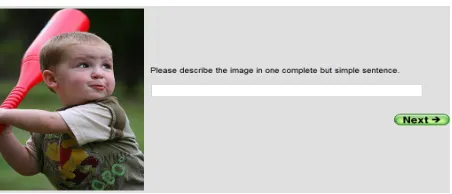
MTurk setup We asked Turkers to write one de-scriptive sentence for each of ten images. An ex-ample annotation screen is shown in Figure 1. We
2The twenty categories include people, various animals,
vehicles and other objects: person, bird, cat, cow, dog, horse, sheep, aeroplane, bicycle, boat, bus, car, motorbike, train, bottle,
[image:2.612.315.541.52.149.2]chair, dining table, potted plant, sofa, tv/monitor
Figure 1: Screenshot of the image annotation task.
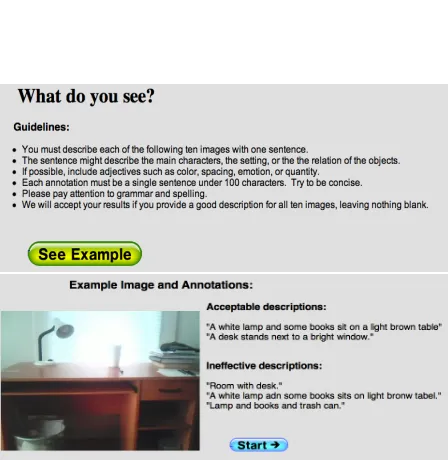
first showed the Turkers a list of instructive guide-lines describing the task (Figure 6). The instruc-tions told them to write ten complete but simple sen-tences, to include adjectives if possible, to describe the main characters, the setting, or the relation of the objects in the image, to pay attention to gram-mar and spelling, and to try to be concise. These instructions were meant to both explain the task and to prepare Turkers to write quality sentences. We then showed each Turker a set of ten images, chosen randomly from the 1000 total images, and displayed one at a time. The Turkers navigated using “Next” buttons through the ten annotation screens, each dis-playing one image and one text-box. We allowed Turkers ten minutes to complete one task.3 We re-stricted the task to Turkers who have previously had at least 95% of their results approved. We paid $0.10 to complete one task. The total cost for all 5000 de-scriptions was $50 (plus Amazon’s 10% fee).
2.1 Results
On average, Turkers wrote the ten sentences in a to-tal of four minutes. The average pay rate was $1.30 per hour, and the whole experiment finished in under two days. Five different people described each im-age, and in the end, most of the Turkers completed the task successfully, although 2.5% of the 5000 sen-tences were empty strings. Turkers varied in the time they took to complete the experiment, in the length of their sentences, and in the level of detail they in-cluded about the image. An example captioned im-age is shown in Figure 2.
Problems with the data The quality of descrip-tions varied greatly. We were hoping to collect sim-ple sentences, written in correct English, describ-ing the entities and actions in the images.
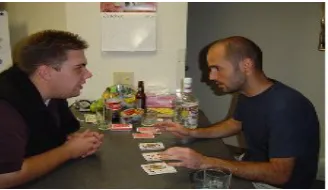
Figure 2: An image along with the five captions that were written by Turkers.
over, these are explicitly the types of descriptions we asked for in the MTurk task instructions. Although we found the descriptions acceptable more than half of the time, a large number of the remaining descrip-tions had at least one of the following two problems:
1. Some descriptions did not mention the salient entities in the image, some were simply noun phrases (or less), and some were humorous or speculative.4 We find all of these to be prob-lems because future computer vision and nat-ural language processing research will require accurate and consistent image captions.
2. A number of Turkers were not sufficiently pro-ficient in English. Many descriptions contained grammar and spelling errors, and some in-cluded very awkward constructions. For exam-ple, the phrase “X giving pose” showed up sev-eral times in descriptions of images containing people (e.g.“The lady and man giving pose.”). Such spelling and grammar errors will pose dif-ficulties for any standard text-processing algo-rithms trained on native English.
Spell checking Due to the large number of mis-spellings in in the initial data set, we first ran the sen-tences first through our spell checker before putting them up on Turk to assess their quality. We tok-enized the captions with OpenNLP, and first checked a manually created list of spelling corrections for each token. These included canonicalizations (cor-recting “surf board” as “surfboard”), words our au-tomatic spell checker did not recognize (“mown”), and the most common misspellings in our data set
4
For example, some Turkers commented on the feelings of animals (e.g.“the dog is not very happy next to the dumpster”), and others made jokes about the content of the image (e.g.“The goat is ready for hair cut”)
(“shepard” to “shepherd”). If the token was not in our manual list, we passed the word to aspell. From aspell’s candidate corrections, we selected the most frequent word that appeared either in other captions of the same image, of images of the same topic, or any caption in our data set.
3 Post-hoc quality control
Because our initial data collection efforts resulted in relatively noisy data, we created a new set of MTurk tasks designed to provide post-hoc quality control. Our aim was to filter out captions containing mis-spellings and incorrect grammar.
MTurk setup Each HIT consisted of fifty differ-ent image descriptions and asked Turkers to decide for each of them whether they contained correct grammar and spelling or not. At the beginning of each HIT, we included a brief training phase, where we showed the Turkers five example descriptions la-beled as “correct” or “incorrect” (Figure 7). In the HIT itself, the fifty descriptions were displayed in blocks of five (albeit not for the same image) , and each description was followed by two radio buttons labeled “correct” and “incorrect”. We did not show the corresponding images. A screenshot is shown in Figure 3. Each block of five captions contained one control item that we use for later assessment of the Turkers’ spell-checking ability. We wrote these con-trol captions ourselves, modeling them after actual image descriptions. We paid $0.08 for one task, and three people completed each task.
3.1 Results
Figure 3: Screenshot from the grammar/spelling checking task. This is a block of five sentences that Turkers had to label as using correct or incorrect grammar and spelling. The first sentence is a control item that we included to monitor the Turkers’ performance, and the other four are captions generated by other Turkers in a previous task.
Data set Quality control % Votes for “correct English”
produced by... performed by... 0 1 2 3
Unqualified writers three Turkers 18.9% 31.2% 26.4% 23.5% Unqualified writers three experts 11.8% 12.7% 15.3% 60.2% Qualified writers three experts 0.5% 2.5% 15.0% 82.0%
Table 1: Quality control by Turkers and Experts. The three experts judged 600 sentences from each data set. 565 sentences produced by unqualified workers were also judged by three Turkers.
in under two days, at a total cost of $28.80 (plus Amazon’s 10% fee). We also selected randomly 600 spell-checked sentences for expert annotation. Three members of our team (all native speakers of English) judged each of these sentences in the same manner as the Turkers. Each sentence could there-fore get between 0 and 3 Turker votes and between 0 and 3 expert votes for good English. The top two rows of Table 1 show the distribution of votes in each of the two groups. We also assess whether the judgments of the Turkers correlate with our own ex-pert judgments. Table 2(a) shows the overall agree-ment between Turkers and expert annotators. The rest of Table 2 shows how performance of the Turk-ers on the control items affected agreement with ex-pert judgments. We define the performance of a Turker in terms of the average the number of con-trol items that they got right in each HIT they took. For each threshold in Tables 2(a)-(d), we considered only those images for which we have three quality judgments by workers whose performance is above the specified threshold.
Our results show that the effectiveness of using Turkers to filter for grammar and spelling issues is limited. Overall, the Turker judgments were overly harsh. The majority Turker vote agrees with the ma-jority vote of the trained annotators on only 65.1%
(a)≥0controls correct: 565 sentences Turk Expert votes
votes 0 1 2 3
0 6.9% 4.4% 3.7% 3.9% 1 3.2% 5.7% 5.0% 17.3% 2 1.8% 2.8% 3.5% 18.2% 3 0.0% 0.4% 2.5% 20.7%
(b)≥5controls correct: 553 sentences Turk Expert votes
votes 0 1 2 3
0 6.9% 4.5% 3.8% 4.0% 1 3.1% 5.4% 5.1% 17.5% 2 1.8% 2.7% 3.6% 18.4% 3 0.0% 0.4% 2.5% 20.3%
(c)≥7controls correct: 331 sentences Turk Expert votes
votes 0 1 2 3
0 6.9% 6.3% 3.9% 5.1% 1 3.0% 4.5% 5.1% 24.5% 2 1.8% 1.8% 2.4% 15.1% 3 0.0% 0.0% 2.1% 17.2%
(d)≥9controls correct: 127 sentences Turk Expert votes
votes 0 1 2 3
[image:5.612.134.478.53.233.2]0 7.9% 6.3% 3.1% 6.3% 1 1.6% 4.7% 6.3% 23.6% 2 0.8% 3.1% 1.6% 15.7% 3 0.0% 0.0% 1.6% 17.3%
Table 2: Quality control: Agreement between Turker and Expert votes, depending on the average number of control items the Turker voters got right.
4 Quality control through pre-screening
Quality control can also be imposed through a pre-screening of the Turkers allowed to take the HIT. We collected another set of five descriptions per image, but restricted participation to Turkers residing in the US5, and created a brief qualification test to check their English. We would like to be able to restrict our tasks to Turkers who are native speakers and com-petent spellers and writers of English, regardless of their country of residence. However, this seems to be difficult to verify within the current MTurk setup.
Qualification Test Design The qualification test consists of forty binary questions: fifteen testing spelling, fifteen testing grammar, and ten testing the ability to identify good image descriptions.
In all three cases, we started the section with a set of instructions displaying examples of positive and negative answers to the tasks. Each spelling question consisted of a single sentence, and Turk-ers were asked to determine if all of the words in the sentence were spelled correctly and if the correct word was being used (“lose” versus “loose”). Each grammar question consisted of a single sentence that was either correct or included a grammatical error. Both spelling and grammar checking questions were based on common mistakes made by foreign English
5As of March 2010, 46.80% of Turkers reside in the U.S
(http://behind-the-enemy-lines.blogspot. com/03/09/2010)
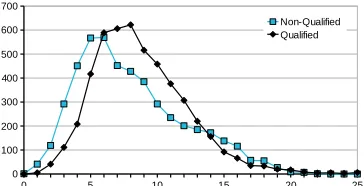
Figure 4: Average caption length (5000 images)
[image:5.612.334.516.290.383.2]MTurk Set-up We use the same MTurk set-up as before, but to encourage Turkers to complete the task even though they first have to pass a qualifica-tion test, we pay them $0.10 to annotate five images.
4.1 Results
We found that the Turkers who passed the qualifica-tion provided much better capqualifica-tions for the images. The average time spent on each image was longer (four minutes per ten images for the non-qualified workers versus five minutes per ten images for the qualified workers). On average, qualified Turk-ers produced slightly longer sentences (avg. 10.7 words) than non-qualified workers (avg. 10.0 words) (Figure 4), and the awkward constructions produced by the unqualified workers were mostly absent. The entire corpus was annotated in 253 hours at a cost of $100.00 (plus Amazon’s 10% fee).
We also looked at the rate of misspellings (ap-proximated by how often our spell-checker indicated a misspelling). Without the qualification test, Out of the 600 sentences produced without the qualifica-tion test, 78 contained misspellings, whereas only 25 sentences out of the 600 produced by the qualified workers contained misspellings. Furthermore, mis-spellings in the no-qualification group include many genuine errors (“the boys are playing in tabel”,
“bycycles“,“eatting”), whereas misspellings in the
qualification group are largely typos (e.g. Ywo for
Two,tableclothe,chariforchair). Furthermore, the
spell checker corrected all 25 misspellings in the qualified data set to the intended word, but 27 out of the 78 misspellings in the data produced by the un-qualified workers got changed to some other word.
The same three members of our team rated again the English of 600 randomly selected sentences writ-ten by Turkers residing in the US who passed our test. We found a significant improvement in quality (Table 1, bottom row), with the majority expert vote accepting over 97% of the sentences. This is also corroborated by qualitative analysis of the data (see Figure 5 for examples). Inspection reveals that sen-tences that are deemed ungrammatical by the experts typically contain some undetected typo, and would be correct if these typos could be fixed. Without a qualification test, there is a significantly greater per-centage of nonsensical responses such as: “Is this a bird squirrel?” and “thecentury”. In addition,
gram-matically correct but useless fragments such as “very dark” and “peace” only appear without a test. After requiring the qualification test, the major reasons for rejection by Turkers are typos such as in “The two dogs blend in with the stuff animals” or missing de-terminers such as in “a train on tracks in town”.
Overall cost effectiveness Using the no qualifica-tion test approach, we first paid $50.00 to get 5000 sentences written by unqualified Turkers (which re-sulted in 4851 non-empty sentences). This rere-sulted in low-quality data which required further verifica-tion. Since this is too time-consuming for expert an-notators, we then paid another $28.80 to get each of these sentences subsequently checked by three Turk-ers for grammaticality, resulting in 2222 sentences which received at least two positive votes for gram-maticality. With the qualification test approach, we paid $100.00 to get 5000 sentences written. Based on our experiments on the set of 600 sentences, ex-perts would judge over 97% of these sentences as correct, thus obviating the immediate need for fur-ther control. That is, it effectively costs more for non-qualified Turkers to produce sentences that are judged to be good than for qualified Turkers. Fur-thermore, their sentences will probably be of lower quality even after they have been judged acceptable.
5 A corpus of captions for Flickr photos
Encouraged by the success of the qualification test approach, we extended our corpus to contain 8000 images collected from Flickr. We again paid the Turkers $0.10 to annotate five images. Our data set consists of 8108 hand-selected images from Flickr, depicting actions and events (rather than images de-picting scenery and mood). These images are more likely to require full sentence descriptions than the PASCAL images. We chose six large Flickr groups6 and downloaded a few thousand images from each, giving us a total of 15,000 candidate images. We re-moved all black and white or sepia images as well as images containing photographer signatures or seals. Next, we manually identified pictures that depicted the actions of people or animals. For example, we kept images of people walking in parks, but not of
6The groups: strangers!, Wild-Child (Kids in Action), Dogs
Without qualification test (1) lady with birds
(2) Some parrots are have speaking skill.
(3) A lady in their dining table with birds on her shoulder and head. (4) Asian woman with two cockatiels, on shoulder
head, room with oak cabinets., (5) The lady loves the parrot With qualification test
(1) A woman has a bird on her shoulder, and another bird on her head (2) A woman with a bird on her head and a bird on her shoulder. (3) A women sitting at a dining table with two small birds sitting on her. (4) A young Asian woman sitting at a kitchen
table with a bird on her head and another on her shoulder. (5) Two birds are perched on a woman sitting in a kitchen. Figure 5: Comparison of captions written by Turkers with and without qualification test
empty parks; we kept several people posing, but not a close-up of a single person.7 Each HIT asked Turkers to describe five images. We required the qualification test and US residency. Average com-pletion time was a little above 3 minutes for 5 sen-tences. The corpus was annotated in 284 hours8, at a total cost of $812.00 (plus Amazon’s 10% fee).
6 Related work and conclusions
Related work MTurk has been used for many dif-ferent NLP and vision tasks (Tietze et al., 2009; Zaidan and Callison-Burch, 2009; Snow et al., 2008; Sorokin and Forsyth, 2008). Due to the noise in-herent in non-expert annotations, many other at-tempts at quality control have been made. Kit-tur et al. (2008) solicit ratings about different as-pects of Wikipedia articles. At first they receive very noisy results, due to Turkers’ not paying at-tention when completing the task or specifically try-ing to cheat the requester. They remade the task, this time starting by asking the Turkers verifiable questions, speculating that the users would produce better quality responses when they suspect their an-swers will be checked. They also added a question that required the Turkers to comprehend the con-tent of the Wikipedia article. With this new set-up, they find that the quality greatly increases and carelessness is reduced. Kaisser and Lowe (2008)
7
Our final data set consists of 1482 pictures from action pho-tography, 1904 from dogs, 776 from flickr-social, 916 from out-door, 1257 from strangers and 1773 from wild-child.
8Note that the annotation process scaled pretty well,
con-sidering that annotating more than eight times the number of images took only 31 hours longer.
collected question and answer pairs by presenting Turkers with a question and telling them to copy and paste from a document of text they know to contain the answer. They achieve a good but far from per-fect interannotator agreement based on the extracted answers. We speculate that the quality would be much worse if the Turkers wrote the sentences them-selves. Callison-Burch (2009) asks Turkers to pro-duce translations when given reference sentences in other languages. Overall, he finds find that Turk-ers produce better translations than machine transla-tion systems. To eliminate translatransla-tions from Turkers who simply put the reference sentence into an online translation website, he performs a follow-up task, where he asks other Turkers to vote on if they believe that sentences were generated using an online trans-lation system. Mihalcea and Strapparava (2009) ask Turkers to produce 4-5 sentence opinion paragraphs about the death penalty, about abortion and describ-ing a friend. They report that aside from a small number of invalid responses, all of the paragraphs were of good quality and followed their instructions. Their success is surprising to us because they do not report using a qualification test, and when we did this our responses contained a large amount of in-correct English spelling and grammar.
to stick with simply using the qualification test be-cause it achieves the desired results already. Fur-thermore, although using TurKit would have proba-bly done away with our few remaining grammar and spelling mistakes, it may have caused the captions for an image to be a little too similar, and we value a diversity in the use of words and points of view.
Our experiences We have described our experi-ences in using Amazon’s Mechanical Turk in the first half of 2009 to create a corpus of images anno-tated with descriptive sentences. We implemented two different approaches to quality control: first, we did not impose any restrictions on who could write image descriptions. This was then followed by a sec-ond set of MTurk tasks where Turkers had to judge the quality of the sentences generated in our initial Turk experiments. This approach to quality control would be cost-effective if the initial data were not too noisy and the subsequent judgments were ac-curate and cheap. However, this was not the case, and quality control on the judgments in the form of control items turned out to result in even lower ac-curacy. We then repeated our data collection effort, but required that Turkers live in the US and take a brief qualification test that we created to test their English. This is cost-effective if English proficiency can be accurately assessed in such a brief qualifica-tion test. We found that the latter approach was in-deed far cheaper, and produced significantly better data. We did not set out to run a scientific experi-ment comparing different strategies of how to col-lect linguistic data on Turk, and therefore there may be multiple explanations for the effects we observe. Nevertheless, our experience indicates strongly that even very simple prescreening measures can provide very effective quality control.
We also extended our corpus to include 8000 im-ages collected from Flickr. We hope to release this data to the public for future natural language pro-cessing and computer vision research.
Recommended practices for using MTurk in NLP
Our experience indicates that with simple prescreen-ing, linguistic data can be elicited fairly cheaply and rapidly from crowd-sourcing services such as Me-chanical Turk. However, many applications may re-quire more control over where the data comes from. Even though NLP data collection differs
fundamen-tally from psycholinguistic experiments that may elicit production data, our community will typically also need to know whether data was produced by na-tive speakers or not. Until MTurk provides a better mechanism to check the native language of its work-ers, linguistic data collection on MTurk will have to rely on potentially very noisy input.
Acknowledgements
This research was funded by NSF grant IIS 08-03603INT2-Medium: Understanding the Meaning
of Images. We are grateful for David Forsyth’s
ad-vice and for Alex Sorokin’s support with MTurk.
References
Chris Callison-Burch. 2009. Fast, cheap, and creative: Evaluating translation quality using Amazon’s Me-chanical Turk. InProceedings of EMNLP 2009. M. Everingham, L. Van Gool, C. K. I. Williams,
J. Winn, and A. Zisserman. 2008. The PASCAL Visual Object Classes Challenge 2008 (VOC2008) Results. http://www.pascal-network.org/challenges/VOC/voc2008/workshop/. Michael Kaisser and John Lowe. 2008. Creating a
re-search collection of question answer sentence pairs with amazons mechanical turk. InLREC 2008. Aniket Kittur, Ed H. Chi, and Bongwon Suh. 2008.
Crowdsourcing user studies with mechanical turk. In Proceedings of SIGCHI 2008.
Greg Little, Lydia B. Chilton, Max Goldman, and Robert C. Miller. 2009. Turkit: tools for iterative tasks on mechanical turk. InHCOMP ’09: Proceedings of the ACM SIGKDD Workshop on Human Computation. Rada Mihalcea and Carlo Strapparava. 2009. The lie detector: Explorations in the automatic recognition of deceptive language. In Proceedings of the ACL-IJCNLP 2009 Conference Short Papers.
Rion Snow, Brendan O’Connor, Daniel Jurafsky, and An-drew Ng. 2008. Cheap and fast – but is it good? evaluating non-expert annotations for natural language tasks. InProceedings of EMNLP 2008.
Alexander Sorokin and David Forsyth. 2008. Utility data annotation with amazon mechanical turk. In Com-puter Vision and Pattern Recognition Workshop. Martin I. Tietze, Andi Winterboer, and Johanna D.
Moore. 2009. The effect of linguistic devices in infor-mation presentation messages on comprehension and recall. InProceedings of ENLG 2009.
Are all of the words correctly spelled and correctly used? Is the sentence grammatically correct? A group of children playing with thier toys (N) A man giving pose to camera. (N) He accepts the crowd’s praise graciously. (Y) The white sheep walks on the grass. (Y) The coffee is kept at a very hot temperture. (N) She is good woman. (N)
A green car is parked in front of a resturant. (N) He should have talk to him. (N) An orange cat sleeping with a dog that is much larger then it. (N) He has many wonderful toy. (N)
I ate a tasty desert after lunch. (N) He sended the children home to their parents. (N) A group of people getting ready for a surprise party. (Y) The passage through the hills was narrow. (Y) A small refrigerator filled with colorful fruits and vegetables. (Y) A sleeping dog. (Y)
Two men fly by in a red plain. (N) The questions on the test was difficult. (N)
A causal picture of a man and a woman. (N) In Finland, we are used to live in a cold climate. (N) Three men are going out for a special occasion. (Y) Three white sheeps graze on the grassy field. (N) Woman eatting lots of food. (N) Between you and me, this is wrong. (Y) Dyning room with chairs. (N) They are living there during six months. (N)
A woman recieving a package. (N) I was given lots of advices about buying new furnitures. (N) This is a relatively uncommon occurance. (Y) A horse being led back to it’s stall. (N)
Table 3: The spelling and grammar portions of the qualification test. The test may be found on MTurk by searching for the qualification entitled “Image Annotation Qualification”.
[image:9.612.73.297.341.571.2]Figure 6: Screenshot of the image annotation instruc-tions: guidelines (top) and examples (bottom).