Aggregating opinions: Explorations into Graphs and Media Content
Analysis
Gabriele Tatzl SORA
Institute for Social Research & Analysis Vienna, Austria
Christoph Waldhauser SORA
Institute for Social Research & Analysis Vienna, Austria
Abstract
Understanding, as opposed to reading is vital for the extraction of opinions out of a text. This is especially true, as an author’s opinion is not always clearly marked. Finding the overall opinion in a text can be challenging to both hu-man readers and computers alike. Me-dia Content Analysis is a popular method of extracting information out of a text, by means of human coders. We describe the difficulties humans have and the process they use to extract opinions and offer a formalization that could help to automate opinion extraction within the Media Con-tent Analysis framework.
1 Introduction
When humans read, they try to not only decode the written language, but also link it with external in-formation. This gives them access to meaning and opinion of a text, that remain hidden from a mere decoder. This process of reading can be organized scientifically within the framework of Media Con-tent Analysis (MCA). Reading, however, is expen-sive in terms of time and money. Yet the volume of textual data that is available for research grows seemingly without bounds. Automating reading, indeed doing MCA – at least to some degree – is a very desirable advance for any practitioner in the field.
The purpose of this short positional paper is to introduce MCA as we use it in our day-to-day lives and discuss challenges and possible solutions for them, with regards to automation.
The remainder of this paper is organized as fol-lows. First we give a brief introduction to Media Content Analysis and it’s applications in the social sciences in general. We will then focus on opin-ion mining as an important task within the general
MCA framework. Special emphasis will be put on the challenges humans (and computers alike) face, when extracting opinions from a document. As a contribution to the effort of overcoming these ob-stacles, we offer a formalized interpretation of the MCA opinion extraction process in section 4. Fi-nally, some concluding remarks and suggestions for an algorithmic implementation are made.
2 Media Content Analysis
Media Content Analysis from a social science per-spective is driven by research questions (e.g.How does the perception of migrant groups vary in dif-ferent media?) and practical questions of private and public clients (e.g.In which context do nega-tive opinions about a corporation occur?) in order to investigate and evaluate the content of commu-nication.
Media Content analysis can be generally de-scribed as “systematic reading of a body of texts, images, and symbolic matter” (Krippendorf, 2004). It “is applied to a wide variety of printed matter, such as textbooks, comic strips, speeches, and print advertising” (Krippendorf, 2004) or more generally to any cultural artifact1. Addi-tionally, Content Analysis is defined as an empir-ical method for (I) systematic and inter-subjective understandable description of textual and formal characteristics and (II) for inquiring into social re-ality that consists of inferring features of a non-manifest context from features of a non-manifest writ-ten text and other meaningful matters (Merwrit-ten, 1995; Krippendorf, 2004; Fr¨uh, 2007).
There is a wide range of methods of research,
“(. . . ) from simple and extensive clas-sifications of types of content for or-ganizational or descriptive purposes to
1MCA is e.g. also used for comparing representations of
groups, issues and events to their real-world occurrences.
deeply interpretative enquiries into spe-cific examples of content, designed to uncover subtle and hidden potential meanings” (McQuail, 2005).
The methodology we use is based upon a broad foundation of recent and widely approved litera-ture (Riffe et al., 1998; Franzosi, 2008; Kaplan, 2004; Merten, 1995; Roberts, 2001; Krippen-dorf, 2004; NeuenKrippen-dorf, 2007; R¨ossler, 2005; Fr¨uh, 2007; Weerakkody, 2009): The analysis typically starts from the formulation of some specific re-search questions, in terms of topics, actors and patterns of interpretation that need to be investi-gated. Based on theoretical foundations and oper-ationalisation, categories (theoretically or empir-ically grounded) and indicators are defined. All categories together make up the codebook, which is the instrument for the manual coding of text. The codebook consists of different characteristics for every variable and of instructions for the man-ual coding. One can compare the codebook to the perhaps more familiar questionnaire used in em-pirical quantitative social science. In this under-standing, the codebook is little more than ques-tions on the text and some hints on how to answer them. For instance, a question might concern a statement’s speaker or subject actor and the way she is arguing her opinion: Is the argumentation of SACT in the statement rational?; possible an-swer codes are 1—the argumentation is consistent and rational, 2—the argumentation is not consis-tent and not well explained, and 3—no valuation possible.
In particular, variables are extracted on different levels of the documents: some address the whole document (article) and its source, some focus on claims to be able to answer all the different re-search questions. A core point in conducting em-pirical research is the demand for validity (exter-nal and inter(exter-nal) and reliability2(pre-tests). These quality checks have to be done carefully (Krippen-dorf, 2004).
The work proceeds with the identification (the manual annotation) of specific variables and indi-cators by turning text into numbers and fill out the codebook’s answer sheet (data entry mask). The turning of text into numbers (coding process) is at the moment a very cumbersome task, as it is
2Reliability in Content Analysis is the amount of
agree-ment or correspondence among two or more coders (Krip-pendorf, 2004; Neuendorf, 2007).
done manually. Humans, so called coders (usually trained junior researchers), have to read each arti-cle and de facto answer questions (the codebook) on the text afterwards. Last but not least, the final data file (cleaned manual codings) is used in statis-tical analysis in order to answer the research ques-tions. The significance of this methodology lies precisely in its capacity to describe the mediated public discourse and various forms and aspects of diversity (i.e. diversity of opinions).
It should be considered that we conduct neither discourse analysis (e.g. Hajer and Versteeg, 2005) nor linguistic analysis (e.g. Livesey, 2001). Our approach is an analysis of mediated public dis-course (see inter alia Gerhards et al., 2007), which implies certain methodological differences. This methodology is especially useful for the analy-sis of web media content and can be combined with other approaches. In the LivingKnowledge project3, the analysis of the mediated public dis-course is combined with Multimodal Genre Anal-ysis (Baldry and Thibault, 2005).
3 Opinion Mining in MCA
Determining the degree to which a whole article (entire content) or a statement in a text (part of content) is positive, negative or neutral is not the only but a very essential reason for conducting Media Content Analysis. Applying the kind of Media Content Analysis mentioned above, we are able to describe the polarity of an opinion and the degree of correlation between the polarity of an opinion and the context of the opinion holder. An opinion holder could be considered as the speaker (person or organization) of a statement in the text. The human coders are instructed by the codebook (rules for coding) how opinions should be detected and ranked (five point-scale4). We are firmly con-vinced that it is not possible to detect opinions across different use cases only by means of polar words or opinion bearing words, because meaning of these words is always dependent on the
con-3
The research leading to these results has received funding from the European Community’s Seventh Frame-work Programme (FP7/2007-2013) under grant agreement n◦231126 Living Knowledge: Living Knowledge – Facts, Opinions and Bias in Time.
4
tent’s context. If you only have a short view on parts of the text, it can result in narrow incomplete interpretations. Besides that, additional informa-tion (which is not in the text) is often required to interpret an opinion and to understand the el-ements of social structure. It must be pointed out that when human coders read an article, there is a process of automatic inference. The proverbial concept of reading vs. understanding captures this notion with surprising accuracy. Correspondingly, sentiment analysis is a rather challenging process for humans as well as for computers.
4 Structuring opinions
In the following we will try to formalize what usu-ally happens inside a human coder, coding an arti-cle. A typical research question in this sense might be: is the opinion of articleX, Θx positive,
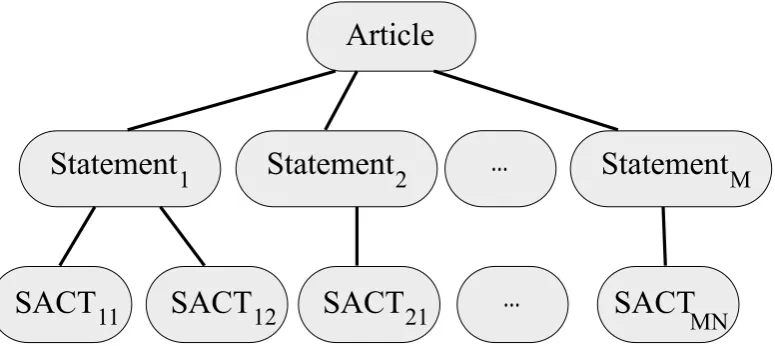
neu-tral, or negative towards a topicY5? The tricky part lies in the fact, that very few articles state their opinions expressis verbis. Rather, articles contain a number of statements on diverse facets of the ar-ticle’s topic. These statements in turn are again composed of reported actions or speech of sub-ject actors6 (SACTs). All these elements can be thought of as nodes in a tree: article being the root node containingM statement nodes andN SACT nodes. Note, that the N SACT nodes need not be uniformly distributed between theM statement nodes. Figure 1 displays the tree structure inherent to Media Content Analysis.
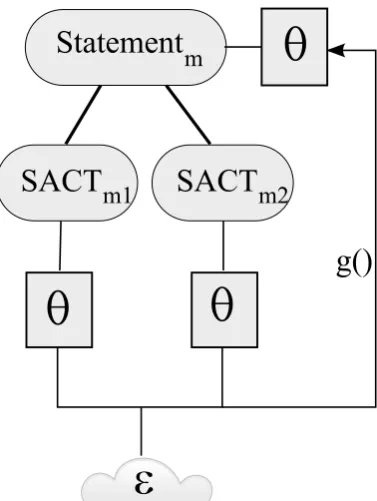
Each node has a number of attributes, variables in the codebook terminology, such as the name of the author or SACT. Next to these obvious at-tributes there are also latent ones, which are only accessible by analyzing all child nodes and ag-gregating the results (possibly with using exter-nal information). Opinions of articles are one ex-ample of latent attributes in Media Content Anal-ysis. The process of aggregating all of a state-ment’s SACTs’ opinions (θmn) into a single state-ment opinion (θm), and further aggregating all of an article’s statement opinions into a single article opinion, lies at the hearth of opinion mining within the Media Content Analysis framework. Figure 2
5Selecting only statements that deal with a certain topicY
is beyond the scope of this paper. However, automating topic selection is rather feasible by including background knowl-edge on the topic itself. Background knowlknowl-edge that is read-ily available at a very early stage of MCA research question formulation.
6A subject actor is the person that effects a claim, e.g. if
the claim is a statement, it is the speaker
Statement
m
SACT
m1
SACT
m2
�
�
�
�
[image:3.595.323.512.59.310.2]g()
Figure 2: Aggregating SACTs’ opinions into a statement opinion within the MCA framework
depicts the aggregating of SACTs’ opinions into a statement opinion as a subtree.
To return to the more formalized notation in-troduced above, Θx = f(g1, g2, . . . , gm), with
gk(θm1, θm2, . . . , θmn, ). A description of these two classes of functions is not trivial. A function (f) that aggregates statement opinions (gk, them-selves aggregates of their SACTs’ opinions) into an overall article opinion (θ) requires to take into account not only the opinion attributes of its state-ment argustate-ments, but also their relationships, an as-sessment of their equal presentation and take hints at the author’s intentions. This function will typ-ically be a weighted mean of the values for the opinion variable for the contained statements:
c
Θx=
PM
k=1wkgk
PM
k=1wk
Article
Statement
1
Statement
2
...
Statement
M
SACT
11
SACT
12
SACT
21
SACT
MN
[image:4.595.108.496.62.235.2]...
Figure 1: Relationship among levels of a document
given statement. In structure, this class of func-tions is also based on the weighted mean concept. However, in estimating the weights, notions of speaker interaction, speaker significance and ef-fectiveness come into play. Many of these con-cepts cannot be sufficiently included by means of analyzing the text. Further, external information is required. This information can be thought of as an ontology or metadata, giving meaning to the actions and speech of a SACT. In a manual cod-ing process, this information has been learned by the human coders through their past experience in reading texts. This is one of the reasons junior re-searchers, and not e.g. unskilled laborers, are used for this task. External knowledge, quite often to a substantial part, is critical in understanding a text.
5 Conclusion
Reading and understanding text is daunting task for humans. It requires years if not decades of training and experience to uncover hidden mean-ings and latent opinions. However, the process of reading is rather simple. We formalized this pro-cess by focusing on the example of extracting and aggregating opinions of an article. By rethinking reading and understanding opinions as a tree, we were able to structure the way humans use au-tomatic inference to weight arguments and form opinions. The aggregating functions are simple themselves, however, estimating the right argu-ments is tricky. It requires the inclusion of mas-sive amounts of external knowledge. In our opin-ion, this knowledge is currently not available in machine accessible form. With the ever increas-ing diffusion of semantic web data and ongoincreas-ing
efforts to create substantial ontologies of external knowledge, the future certainly will show interest-ing developments in this field.
In the meantime, thinking opinion extracting as traversing a tree might help to create software that helps human coders in their work. Also, large training sets of manually coded articles could be used to estimate the weights required to aggregate opinions on higher levels of analysis. However, achieving acceptable performance across diverse topics and usecases seems unlikely at this time.
References
Anthony Baldry and Paul J Thibault. 2005. Multi-modal Transcription and Text Analysis. Equinox, London and Oakville.
Roberto Franzosi. 2008. Content analysis, volume 1 of Sage benchmarks in social research methods. Sage, Los Angeles.
Werner Fr¨uh. 2007. Inhaltanalyse. Theorie und Praxis. UVK, Konstanz, 6. rev. ed. edition.
J¨urgen Gerhards, Anke Offerhaus, and Jochen Roose. 2007. The public attrobution of responsibility. de-veloping an instrument for content analysis. K¨olner Zeitschrift f¨ur Soziologie und Sozialpsychologie, 59:105–125.
Marteen Hajer and Wytske Versteeg. 2005. A decade of discourse analysis of environmental politics: Achievements, challenges, perspectives. Journal of Environmental Policy and Planning, 7(3):175–184.
Klaus Krippendorf. 2004. Content analysis. An in-troduction to its methodology. Sage, London, 2. ed edition.
Sharon M Livesey. 2001. Eco-identity as discursive struggle: Royal dutch/shell, brent spar and nigeria. Journal of Business Communication, 38(1):58–91.
Denis McQuail. 2005. McQuail’s Mass Communica-tion Theory. Sage, London, 5. ed ediCommunica-tion.
Klaus Merten. 1995. Inhaltsanalyse. Einf¨uhrung in Theorie, Methode und Praxis. Westdt. Verlag, Opladen.
Kimberly A Neuendorf. 2007. The content analysis guidebook. Sage, Thousand Oaks.
Daniel Riffe, Stephen Lacy, and Frederick Fico. 1998. Analyzing media messages: using quantitative con-tent analysis in research. Erlbaum, Mahwah.
C W Roberts. 2001. Content analysis. In Smelser and Baltes (Smelser and Baltes, 2001).
Patrick R¨ossler. 2005. Inhaltsanalyse. UVK, Kon-stanz.
Neil J Smelser and Paul B Baltes, editors. 2001. Inter-national Encyclopedia of the Social & Behavioral Science. Elsevier, Amsterdam.