The CMU Submission for the Shared Task on Language Identification in
Code-Switched Data
Chu-Cheng Lin Waleed Ammar Lori Levin Chris Dyer
Language Technologies Institute Carnegie Mellon University Pittsburgh, PA, 15213, USA
{chuchenl,wammar,lsl,cdyer}@cs.cmu.edu
Abstract
We describe the CMU submission for the 2014 shared task on language iden-tification in code-switched data. We participated in all four language pairs: Spanish–English, Mandarin–English, Nepali–English, and Modern Standard Arabic–Arabic dialects. After describing our CRF-based baseline system, we discuss three extensions for learning from unlabeled data: semi-supervised learning, word embeddings, and word lists.
1 Introduction
Code switching (CS) occurs when a multilingual speaker uses more than one language in the same conversation or discourse. Automatic idenefica-tion of the points at which code switching occurs is important for two reasons: (1) to help sociolin-guists analyze the frequency, circumstances and motivations related to code switching (Gumperz, 1982), and (2) to automatically determine which language-specific NLP models to use for analyz-ing segments of text or speech.
CS is pervasive in social media due to its in-formal nature (Lui and Baldwin, 2014). The first workshop on computational approaches to code switching in EMNLP 2014 organized a shared task (Solorio et al., 2014) on identifying code switch-ing, providing training data of multilingual tweets with token-level language-ID annotations. See §2 for a detailed description of the shared task. This short paper documents our submission in the shared task.
We note that constructing a CS data set that is annotated at the token level requires remarkable manual effort. However, collecting raw tweets is easy and fast. We propose leveraging both labeled and unlabeled data in a unified framework; condi-tional random field autoencoders(Ammar et al.,
2014). The CRF autoencoder framework consists of an encoding model and a reconstruction model. The encoding model is a linear-chain conditional random field (CRF) (Lafferty et al., 2001) which generates a sequence of labels, conditional on a token sequence. Importantly, the parameters of the encoding model can be interpreted in the same way a CRF model would. This is in contrary to generative model parameters which explain both the observation sequence and the label sequence. The reconstruction model, on the other hand, inde-pendently generates the tokens conditional on the corresponding labels. Both labeled and unlabeled data can be efficiently used to fit parameters of this model, minimizing regularized log loss. See§4.1 for more details.
After modeling unlabeled token sequences, we explore two other ways of leveraging unlabeled data: word embeddingsandword lists. The word embeddings we use capture monolingual distribu-tional similarities and therefore may be indicative of a language (see§4.2). A word list, on the other hand, is a collection of words which have been manually or automatically constructed and share some property (see§4.3). For example, we extract the set of surface forms in monolingual corpora.
In§5, we describe the experiments and discuss results. According to the results, modeling unla-beled data using CRF autoencoders did not im-prove prediction accuracy. Nevertheless, more ex-periments need to be run before we can conclude this setting. On the positive side, word embed-dings and word lists have been shown to improve CS prediction accuracy, provided they have decent coverage of tokens in the test set.
2 Task Description
The shared task training data consists of code– switched tweets with token-level annotations. The data is organized in four language pairs: English–Spanish Es), English–Nepali
Ne), Mandarin–English (Zh-En) and Modern Standard Arabic–Arabic dialects (MSA-ARZ). Table 1 shows the size of the data sets provided for the shared task in each language pair.
For each tweet in the data set, the user ID, tweet ID, and a list of tokens’ start offset and end offset are provided. Each token is annotated with one of the following labels:lang1,lang2,ne(i.e., named entities),mixed(i.e., mixed parts of lang1 and lang2),ambiguous(i.e., cannot be identified given context), andother.
Two test sets were used to evaluate each sub-mission for the shared task in each language pair. The first test set consists of Tweets, similar to the training set. The second test set consists of token sequences from a surprise genre. Since partici-pants were not given the test sets, we only report results on a Twitter test set (a subset of the data provided for shared task participants). Statistics of our train/test data splits are given in Table 5.
lang. pair split tweets tokens users En–Ne all 9,993 146,053 18
train 7,504 109,040 12
test 2,489 37,013 6
En–Es all 11,400 140,738 9
train 7,399 101,451 6
test 4,001 39,287 3
Zh–En all 994 17,408 995
train 662 11,677 663
test 332 5,731 332
MSA–ARZ all 5,862 119,775 7
train 4,800 95,352 6
test 1,062 24,423 1
Table 1: Total number of tweets, tokens, and Twit-ter user IDs for each language pair. For each lan-guage pair, the first line represents all data pro-vided to shared task participants. The second and third lines represent our train/test data split for the experiments reported in this paper. Since Twit-ter users are allowed to delete their tweets, the number of tweets and tokens reported in the third and fourth columns may be less than the number of tweets and tokens originally annotated by the shared task organizers.
3 Baseline System
We model token-level language ID as a sequence of labels using a linear-chain conditional ran-dom field (CRF) (Lafferty et al., 2001) described
in§3.1 with the features in§3.2.
3.1 Model
A linear-chain CRF models the conditional proba-bility of a label sequenceygiven a token sequence xand given extra contextφ, as follows:
p(y|x,φ) = expλ> P|x|
i=1f(x, yi, yi−1,φ)
P
y0expλ>P|ix=1| f(x, yi0, yi0−1,φ)
where λ is a vector of feature weights, and f is a vector of local feature functions. We useφ to explicitly represent context information necessary to compute the feature functions described below. In a linear-chain structure, yi only depends on
observed variablesx,φand the neighboring labels yi−1 and yi+1. Therefore, we can use dynamic programming to do inference in run time that is quadratic in the number of unique labels and lin-ear in the sequence length. We use L-BFGS to learn the feature weightsλ, maximizing the L2 -regularized log-likelihood of labeled examplesL:
``supervised(λ) =
cL2||λ||22+
X
hx,yi∈L
logp(y|x,φ)
After training the model, we use again use dy-namic programming to find the most likely label sequence, for each token sequence in the test set.
3.2 Features
We use the following features in the baseline sys-tem:
• charactern-grams (loweredcased tri- and quad-grams)
• prefixes and suffixes of lengths1,2,3and4
• unicode page of the first character1
• case (first-character-uppercased vs. all-characters-uppercased vs. all-characters-alphanumeric)
• tweet-level language ID predictions from two off-the-shelf language identifiers: cld22 and
ldig3
encoding
reconstruction
x
yi-1 yi yi+1
xΛi-1 xΛi xΛi+1
[image:3.595.116.247.63.185.2]Φ
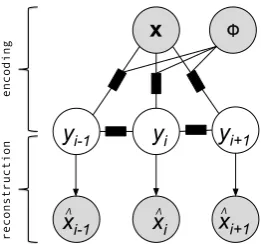
Figure 1: A diagram of the CRF autoencoder
4 Using Unlabeled Data
In§3, we learn the parameters of the CRF model parameters in a standard fully supervised fashion, using labeled examples in the training set. Here, we attempt to use unlabeled examples to improve our system’s performance in three ways: model-ing unlabeled token sequences in the CRF autoen-coder framework, word embeddings, and word lists.
4.1 CRF Autoencoders
A CRF autoencoder (Ammar et al., 2014) consists of an input layer, an output layer, and a hidden layer. Both input and output layer represent the observed token sequence. The hidden layer rep-resents the label sequence. Fig. 1 illustrates the model dependencies for sequence labeling prob-lems with a first-order Markov assumption. Con-ditional on an observation sequencexand side in-formationφ, a traditional linear-chain CRF model is used to generate the label sequence y. The model then generatesˆxwhich represents a recon-struction of the original observation sequence. El-ements of this reconstruction (i.e.,xˆi) are then
in-dependently generated conditional on the corre-sponding label yi using simple categorical
distri-butions.
The parametric form of the model is given by:
p(y,ˆx|x,φ) =
|x|
Y
i=1
θxˆi|yi×
expλ>P|x|
i=1f(x, yi−1, yi, i,φ)
P
y0expλ>P|ix=1| f(x, y0i−1, yi0, i,φ)
whereλis a vector of CRF feature weights,f is a vector of local feature functions (we use the same features described in§3.2), andθxˆi|yi are
categor-ical distribution parameters of the reconstruction model representingp(ˆxi|yi).
We can think of a label sequence as a low-cardinality lossy compression of the correspond-ing token sequence. CRF autoencoders explic-itly model this intuition by creating an information bottleneck where label sequences are required to regenerate the same token sequence despite their limited capacity. Therefore, when only unlabeled examples Uare available, we train CRF autoen-coders by maximizing the regularized likelihood of generating reconstructionsˆx, conditional onx, marginalizing values of label sequencesy:
``unsupervised(λ,θ) =cL2||λ||22+RDirichlet(θ, α)+ X
hx,ˆxi∈U
log X
y:|y|=|x|
p(y,xˆ|x)
where RDirichlet is a regularizer based on a
vari-ational approximation of a symmetric Dirichlet prior with concentration parameter α for the re-construction parametersθ.
Having access to labeled examples, it is easy to modify this objective to learn from both labeled and unlabeled examples as follows:
``semi(λ,θ) =cL2||λ||22+RDirichlet(θ, α)+
cunlabeled× X
hx,ˆxi∈U
log X
y:|y|=|x|
p(y,xˆ|x)+
clabeled× X
hx,yi∈L
logp(y|x)
We use block coordinate descent to optimize this objective. First, we use cem iterations of
the expectation maximization algorithm to opti-mize theθ-block while theλ-block is fixed, then we optimize the λ-block with clbfgs iterations of
L-BFGS (Liu et al., 1989) while the θ-block is fixed.4
4.2 Unsupervised Word Embeddings
For many NLP tasks, using unsupervised word representations as features improves accuracy (Turian et al., 2010). We use word2vec (Mikolov et al., 2013) to train
100–dimensional word embeddings from a large Twitter corpus of about 20 million tweets extracted from the live stream, in multiple lan-guages. We define an additional feature function
4An open source efficient c++
imple-mentation of our method can be found at
in the CRF autoencoder model §4.1 for each of the 100dimensions, conjoined with the label yi.
The feature value is the corresponding dimension forxi. A binary feature indicating the absence of
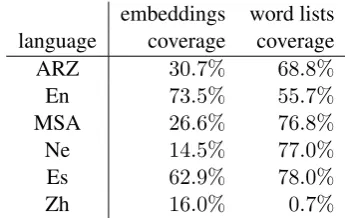
[image:4.595.328.501.62.171.2]word embeddings is fired for out-of-vocabulary words (i.e., words for which we do not have word embeddings). The token-level coverage of the word embeddings for each of the languages or dialects used in the training data is reported in Table 2.
4.3 Word List Features
While some words are ambiguous, many words frequently occur in only one of the two lan-guages being considered. An easy way to iden-tify the label of such unambiguous words is to check whether they belong to the vocabulary of either language. Moreover, named entity recog-nizers typically rely on gazetteers of named enti-ties to improve their performance. We generalize the notion of using monolingual vocabularies and gazetteers of named entities to general word lists. UsingK word lists{l1, . . . , lK}, when a tokenxi
is labeled withyi, we fire a binary feature that
con-joinshyi, δ(xi ∈l1), . . . , δ(xi ∈lK)i, whereδis
an indicator boolean function. We use the follow-ing word lists:
• Hindi and Nepali Wikipedia article titles • multilingual named entities from the JRC
dataset5and CoNLL 2003 shared task
• word types in monolingual corpora in MSA, ARZ, En and Es.
• set difference between the following pairs of word lists: MSA-ARZ, ARZ-MSA, En-Es, Es-En.
Transliteration from Devanagari The Nepali– English tweets in the dataset are romanized. This renders our Nepali word lists, which are based on the Devanagari script, useless. Therefore, we transliterate the Hindi and Nepali named entities lists using a deterministic phonetic mapping. We romanize the Devanagari words using the IAST scheme.6 We then drop all accent marks on the
characters to make them fit into the 7–bit ASCII range.
5http://datahub.io/dataset/jrc-names 6http://en.wikipedia.org/wiki/
International_Alphabet_of_Sanskrit_ Transliteration
embeddings word lists language coverage coverage ARZ 30.7% 68.8%
En 73.5% 55.7%
MSA 26.6% 76.8%
Ne 14.5% 77.0%
Es 62.9% 78.0%
Zh 16.0% 0.7%
Table 2: The type-level coverage of annotated data according to word embeddings (second column) and according to word lists (third column), per lan-guage.
5 Experiments
We compare the performance of five models for each language pair, which correspond to the five lines in Table 3. The first model, “CRF” is the baseline model described in§3. The second “CRF + Utest” and the third “CRF + Uall” are CRF
au-toencoder models (see§4.1) with two sets of un-labeled data: (1)Utestwhich only includes the test
set,7and (2)U
allwhich includes the test set as well
asall tweets by the set of users who contributed any tweets inL. The fourth model “CRF +Uall+
emb.” is a CRF autoencoder which uses word em-bedding features (see§4.2), as well as the features described in§3.2. Finally, the fifth model “CRF +
Uall+ emb. + lists” further adds word list features
(see§4.3). In all but the “CRF” model, we adopt a transductive learning setup.
Since the CRF baseline is used as the encoding part of the CRF autoencoder model, we use the supervisedly-trained CRF parameters to initialize the CRF autoencoder models. The categorical dis-tributions of the reconstruction model are initial-ized with discrete uniforms. We set the weight of the labeled data log-likelihood clabeled = 0.5,
the weight of the unlabeled data log-likelihood cunlabeled = 0.5, the L2 regularization strength
cL2 = 0.3, the concentration parameter of the
Dirichlet priorα = 0.1, the number of L-BFGS iterationscLBFGS= 4, and the number of EM
iter-ationscEM = 4.8 We stop training after50
itera-tions of block coordinate descent.
7U
testis potentially useful when the test set belongs to a
different domain than the labeled examples, which is often referred to as “domain adaptation”. However we were unable to test this hypothesis since all the CS annotations we had access to are from Twitter.
8Hyper-parameters c
L2 and α were tuned using
config En–Ne MSA–ARZ En–Es Zh–En
CRF 95.2% 80.5% 94.6% 94.9%
+Ttest 95.2% 80.6% 94.6% 94.9%
+Tall 95.2% 80.7% 94.6% 94.9%
+emb. 95.3% 81.3% 95.1% 95.0%
[image:5.595.332.503.62.130.2]+lists 97.0% 81.2% 96.7% 95.3%
Table 3: Token level accuracy results for each of the four language pairs.
label predicted predicted
MSA ARZ
true MSA 93.9% 5.3%
[image:5.595.71.298.62.145.2]true ARZ 32.1% 65.2%
Table 4: Confusion between MSA and ARZ in the Baseline configuration.
Results. The CRF baseline results are reported in the first line in Table 3. For three language pairs, the overall token-level accuracy ranges be-tween 94.6%and95.2%. In the fourth language pair, MSA-ARZ, the baseline accuracy is 80.5%
which indicates the relative difficulty of this task. The second and third lines in Table 3 show the results when we use CRF autoencoders with the unlabeled test set (Utest), and with all unlabeled
tweets (Uall), respectively. While semi-supervised
learning did not hurt accuracy on any of the lan-guages, it only resulted in a tiny increase in accu-racy for the Arabic dialects task.
The fourth line in Table 3 extends the CRF au-toencoder model (third line) by adding unsuper-vised word embedding features. This results in an improvement of0.6%for MSA-ARZ,0.5%for En-Es,0.1%for En-Ne and Zh-En.
The fifth line builds on the fourth line by adding word list features. This results in an improvement of1.7%in En-Ne,1.6%in En-Es,0.4%in Zh-En, and degradation of0.1%in MSA-ARZ.
Analysis and Discussion The baseline perfor-mance in the MSA-ARZ task is considerably lower than those of the other tasks. Table 4 illus-trates how the baseline model confuses lang1 and lang2 in the MSA-ARZ task. While the baseline system correctly labels93.9%of MSA tokens, it only correctly labels65.2%of ARZ tokens.
Although the reported semi-supervised results did not significantly improve on the CRF baseline, more work needs to be done in order to conclude these results:
lang. pair |Utest| |Uall| |L|
En–Ne 2489 6230 7504
MSA–ARZ 1062 2520 4800
Zh–En 332 332 663
[image:5.595.101.260.193.247.2]En–Es 4001 7177 7399
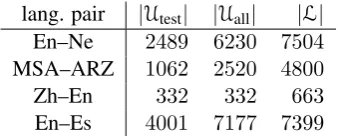
Table 5: Number of tweets inL,UtestandUallused
for semi-supervised learning of CRF autoencoders models.
• Use an out-of-domain test set where some adap-tation to the test set is more promising.
• Vary the number of labeled examples |L| and the number of unlabeled examples|U|. Table 5 gives the number of labeled and unlabeled ex-amples used for training the model. It is pos-sible that semi-supervised learning would have been more useful with a smaller|L|and a larger |U|.
• Tuneclabeledandcunlabeled.
• Split the parametersλinto two subsets:λlabeled
andλunlabeled; whereλlabeledare the parameters which have a non-zero value for any inputxin
Landλunlabeledare the remaining parameters in λwhich only have non-zero values with unla-beled examples but not with the launla-beled exam-ples.
• Use a richer reconstruction model.
• Reconstruct a transformation of the token se-quences instead of their surface forms.
• Train a token-level language ID model trained on a large number of languages, as opposed to disambiguating only two languages at a time.
Word embeddings improve the results for all language pairs, but the largest improvement is in MSA-ARZ and En-Es. Looking into the word em-beddings coverage of those languages (i.e., MSA, ARZ, Es, En in Table 2), we find that they are bet-ter covered than the other languages (Ne, Zh). We conclude that further improvements on En-Ne and Zh-En may be expected if they are better repre-sented in the corpus used to learn word embed-dings.
Config lang1 lang2 ne +lists 84.1% 76.5% 73.7%
[image:6.595.95.268.62.104.2]-lists 84.2% 77.1% 71.5%
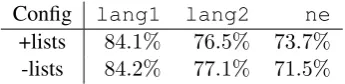
Table 6: F–Measures of two Arabic configura-tions.lang1is MSA.lang2is ARZ.
word lists also have a wide coverage, improving the overall accuracy by 1.6%. The overall accu-racy of the Arabic dialects slightly degrades with the addition of the word lists. Closer inspection in table 6 reveals that it improves the F–Measure of the named entities at the expense of both MSA (lang1) and ARZ (lang2).
6 Related Work
Previous work on identifying languages in a mul-tilingual document includes (Singh and Gorla, 2007; King and Abney, 2013; Lui et al., 2014). Their goal is generally more about identifying the languages that appear in the document than intra– sentential CS points.
Previous work on computational models of code–switching include formalism (Joshi, 1982) and language models that encode syntactic con-straints from theories of code–switching, such as (Li and Fung, 2013; Li and Fung, 2014). These require the existence of a parser for the languages under consideration. Other work on prediction of code–switching points, such as (Elfardy et al., 2013; Nguyen and Dogruoz, 2013) and ours, do not depend upon such NLP infrastructure. Both of the aforementioned use basic character–level fea-tures and dictionaries on sequence models.
7 Conclusion
We have shown that a simple CRF baseline with a handful of feature templates obtains strong re-sults for this task. We discussed three methods to improve over the supervised baseline using un-labeled data: (1) modeling unlabeleld data using CRF autoencoders, (2) using pre-trained word em-beddings, and (3) using word list features.
We show that adding word embedding features and word lists features is useful when they have good coverage of words in a data set. While mod-est improvements are observed due to modeling unlabeled data with CRF autoenocders, we iden-tified possible directions to gain further improve-ments.
While bilingual disambiguation was a good first
step for identifying code switching, we suggest a reformulation of the task such that each label can take on one of many languages.
Acknowledgments
We thank Brendan O’Connor who helped assem-ble the Twitter dataset. We also thank the work-shop organizers for their hard work, and the re-viewers for their comments. This work was sponsored by the U.S. Army Research Labora-tory and the U.S. Army Research Office under contract/grant number W911NF-10-1-0533. The statements made herein are solely the responsibil-ity of the authors.
References
Waleed Ammar, Chris Dyer, and Noah A. Smith. 2014. Conditional random field autoencoders for unsuper-vised structured prediction. InProc. of NIPS. Heba Elfardy, Mohamed Al-Badrashiny, and Mona
Diab. 2013. Code switch point detection in ara-bic. InNatural Language Processing and Informa-tion Systems, pages 412–416. Springer.
John J. Gumperz. 1982. Discourse Strategies. Studies in Interactional Sociolinguistics. Cambridge Univer-sity Press.
Aravind K. Joshi. 1982. Processing of sentences with intra-sentential code-switching. In Proceedings of the 9th Conference on Computational Linguistics -Volume 1, COLING ’82, pages 145–150, Czechoslo-vakia. Academia Praha.
Ben King and Steven Abney. 2013. Labeling the lan-guages of words in mixed-language documents us-ing weakly supervised methods. Proceedus-ings of the 2013 Conference of the North American Chapter of the Association for Computational Linguistics: Hu-man Language Technologies, pages 1110–1119. As-sociation for Computational Linguistics.
John Lafferty, Andrew McCallum, and Fernando Pereira. 2001. Conditional random fields: Prob-abilistic models for segmenting and labeling se-quence data. InProc. of ICML.
Ying Li and Pascale Fung. 2013. Improved mixed lan-guage speech recognition using asymmetric acous-tic model and language model with code-switch in-version constraints. In Acoustics, Speech and Sig-nal Processing (ICASSP), 2013 IEEE InternatioSig-nal Conference on, pages 7368–7372, May.
Ying Li and Pascale Fung. 2014. Code switch lan-guage modeling with functional head constraint. In
D. C. Liu, J. Nocedal, and C. Dong. 1989. On the lim-ited memory bfgs method for large scale optimiza-tion. Mathematical Programming.
Marco Lui and Timothy Baldwin. 2014. Accurate language identification of twitter messages. In Pro-ceedings of the 5th Workshop on Language Analysis for Social Media (LASM), pages 17–25, Gothenburg, Sweden, April. Association for Computational Lin-guistics.
Marco Lui, Han Jey Lau, and Timothy Baldwin. 2014. Automatic detection and language identification of multilingual documents. Transactions of the Asso-ciation of Computational Linguistics, 2:27–40. Tomas Mikolov, Kai Chen, Greg Corrado, and Jeffrey
Dean. 2013. Efficient estimation of word represen-tations in vector space. InProc. of ICLR.
Dong Nguyen and Seza A. Dogruoz. 2013. Word level language identification in online multilingual com-munication. Proceedings of the 2013 Conference on Empirical Methods in Natural Language Processing, pages 857–862. Association for Computational Lin-guistics.
Anil Kumar Singh and Jagadeesh Gorla. 2007. Identi-fication of languages and encodings in a multilingual document. InBuilding and Exploring Web Corpora (WAC3-2007): Proceedings of the 3rd Web as Cor-pus Workshop, Incorporating Cleaneval, volume 4, page 95.
Thamar Solorio, Elizabeth Blair, Suraj Maharjan, Steve Bethard, Mona Diab, Mahmoud Gonheim, Abdelati Hawwari, Fahad AlGhamdi, Julia Hirshberg, Alison Chang, and Pascale Fung. 2014. Overview for the first shared task on language identification in code-switched data. InProceedings of the First Workshop on Computational Approaches to Code-Switching. Joseph Turian, Lev Ratinov, and Yoshua Bengio. 2010.