Metaphor Detection in Discourse
Hyeju Jang, Seunghwan Moon, Yohan Jo, and Carolyn Penstein Ros´e Language Technologies Institute
Carnegie Mellon University Pittsburgh, PA 15213, USA
{hyejuj, seungwhm, yohanj, cprose}@cs.cmu.edu
Abstract
Understanding contextual information is key to detecting metaphors in discourse. Most current work aims at detecting metaphors given a single sentence, thus focusing mostly onlocal contextual cues within a short text. In this paper, we present a novel approach that explicitly leveragesglobal contextof a discourse to detect metaphors. In addition, we show that syntactic information such as depen-dency structures can help better describe local contextual information, thus improv-ing detection results when combined. We apply our methods on a newly annotated online discussion forum, and show that our approach outperforms the state-of-the-art baselines in previous literature.
1 Introduction
Detecting metaphors in text is an active line of research which has attracted attention in recent years. To date, most of the previous literature has looked at lexical semantic features such as selectional restriction violations (Martin, 1996; Shutova and Teufel, 2010; Shutova et al., 2010; Shutova et al., 2013; Huang, 2014) or contrast in lexical concreteness and abstractness (Turney et al., 2011; Broadwell et al., 2013; Tsvetkov et al., 2013). While these approaches have been shown to be successful in detecting metaphors given a single sentence, metaphor detection in discourse brings a new dimension to the task. Consider the following excerpt from an online Breast Cancer discussion forum as an example:
welcome, glad for the company .... just sad to see that there are so many of us. Here is a thought that I have been thinking since I was diagnosed. This disease should be called the “Hurry up
and Wait” illness. Since the day I heard the dreaded words “you need to have a biopsy”, I feel like I am on a speed-ing train. It rushes into every station where you have to make instant deci-sions, while this ominous clock is tick-ing. Wait for test results, wait for ap-pointments, wait for healing.
In the example above, it is difficult to identify “rushes into every station”as a metaphorical ex-pression using the previous approaches, because it does not violate selectional restrictions or have any notable contrast in lexical concreteness and abstractness. The reason for this is clear: the ac-tion of rushing into stations itself makes perfect sense literally when it is viewedlocallyas an iso-lated phrase, while the contextual cues for this metaphor are embedded globally throughout the discourse (e.g. diagonsed,disease,biopsyare se-mantically contrasted withtrain, rushes, and sta-tion). This clearly demonstrates the need for a new set of computational tools to represent con-text beyond a single sentence, in order to better de-tect metaphorical expressions that have contextual connections outside the sentence in which they are used.
Context for metaphor detection. Metaphor is a semantic phenomenon that describes objects often with a view borrowed from a different do-main. As such, it is natural that metaphors in-herently break the lexical coherence of a sentence or a discourse. Klebanov et al. (2009), for exam-ple, showed in their study that words related to the topic of discussion are less likely to be metaphori-cal than other words in text, implying that contex-tual incoherence might serve as a cue for detect-ing metaphors. Based on this observation, the idea of leveraging textual context to detect metaphors has been recently proposed by some researchers (Broadwell et al., 2013; Sporleder and Li, 2009).
Our contributions. We extend the previous approaches for detecting metaphors by explicitly addressing the global discourse context, as well as by representing the local context of a sen-tence in a more robust way. Our contribution is thus twofold: first, we propose several tex-tual descriptors that can capture global contex-tual shifts among a discourse, such as semantic word category distribution obtained from a frame-semantic parser, homogeneity in topic distribu-tions, and lexical chains. Second, we show that global and local contextual information are com-plimentary in detecting metaphors, and that lever-aging syntactic features is crucial in better describ-ing lexico-semantic information in a local con-text. Our method achieves higher performance on a metaphor disambiguation task than state-of-the-art systems from prior work (Klebanov et al., 2014; Tsvetkov et al., 2013) on our newly created dataset from an online discussion forum.
The rest of the paper is organized as follows. Section 2 relates our work to prior work. Section 3 explains our method in detail, specifically in re-gards to how we use global context and local con-text for metaphor detection. Section 4 describes theBreast Cancer dataset annotated and used for our experiment. In Section 5, we present our ex-perimental results and show the effectiveness of our method with the task of metaphor disambigua-tion. Section 6 analyzes the results and identifies potential areas of improvement, and we give our concluding remarks in Section 7.
2 Relation to Prior Work
The main approaches to computationally detect-ing metaphors can be categorized into work that considers the following three classes of features: selectional preferences, abstractness and concrete-ness, and lexical cohesion.
Selectional preferences relate to how seman-tically compatible predicates are with particular arguments. For example, the verb drink prefers beeras an object overcomputer. The idea behind using selectional preferences for metaphor detec-tion is that metaphorical words tend to break se-lectional preferences. In the case of “the clouds sailed across the sky”, for instance,sailedis deter-mined to be metaphorically used because clouds as a subject violates its selectional restriction. The idea of using violation of selectional preferences as a cue for metaphors has been well studied in a
variety of previous work (Martin, 1996; Shutova and Teufel, 2010; Shutova et al., 2010; Shutova et al., 2013; Huang, 2014) In general, this work can be further categorized into work that uses lexical resources and the work that uses corpus-based ap-proaches to obtain selectional preferences
From the observations that metaphorical words (source domain) tend to use more concrete and imagination rich words than the target domain of metaphors, theabstractness/concreteness ap-proaches computationally measure the degree of abstractness of words to detect metaphors. Take the following two phrases as examples that demonstrate this concept: green idea (metaphori-cal expression) andgreen frog(literal expression.) The former has a concrete word (green) modify-ing an abstract concept (idea), thus bemodify-ing more likely to be metaphorical. The idea of leveraging abstractness/concreteness in detecting metaphors has been proposed and studied by several groups of researchers (Turney et al., 2011; Broadwell et al., 2013; Tsvetkov et al., 2013; Assaf et al., 2013; Neuman et al., 2013). Note that most of this work uses datasets that comprise grammati-cally restricted sentences (e.g. ones with S+V+O or A+N structures) for their experiments, in order to test their hypothesis in a controlled way.
Another line of work considers lexical coher-ence of text as a cue for metaphor. The lexi-cal coherence approach is motivated by the ob-servation that metaphorical words are often se-mantically incoherent with context words. There have been several approaches proposed to com-pute lexical coherence. Broadwell et al. (2013), for instance, employed topic chaining to catego-rize metaphors, whereas Sporleder and Li (2009) have proposed to use lexical chains and semantic cohesion graphs to detect metaphors. Shutova and Sun (2013) and Shutova et al. (2013) have formu-lated the metaphor detection problem similar to outlier detection or anomaly detection tasks, and proposed to use topic signatures as lexical coher-ence features. Schulder and Hovy (2014) used TF-IDF to obtain domain term relevance, and applied this feature to detect metaphors.
discourse to detect metaphors and that we lever-age the syntactic structures to better represent lo-cal contextual information.
3 Our Method
In this section, we describe our method to measure nonliteralness of an expression in context. Specif-ically, we describe how we use contextual infor-mation as features for metaphor classification in discourse.
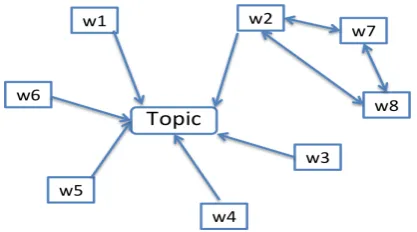
[image:3.595.77.286.347.463.2]We first define lexical cohesion before we in-troduce our motivation and method for utilizing global contexts as features for detecting metaphor. A text is said to be lexically cohesive when the words in the text describe a single coherent topic. Specifically, lexical cohesion occurs when words are semantically related directly to a common topic or indirectly to the topic via another word. Figure 1 illustrates the lexical cohesion among words shown as a graph.
Figure 1: Graph representation depicting lexical cohesion among words in a given text. Edges rep-resent lexical relatedness between a topic and a word or between words. For example, w1 is di-rectly related to the topic of discussion, whereas
w7 is only indirectly related to the topic through
w2.
The intuition for our main idea is that metaphorically-used words would often break lex-ical cohesion of text, while literal expressions would maintain a single connected graph of top-ically or semanttop-ically related words. Therefore, we identify that these incohesive words may serve as cues for nonliteral expressions. The follow-ing two examples illustrate the described phe-nomenon, both of which contain the same phrase “break the ice”.
... Meanwhile in Germany, the cold penetrated the vast interior of Cologne cathedral, where worshippers had to
break the ice on holy water in the font. The death toll from the cold also in-creased ...
... “Some of us may have have acted as critics at one point or another, but for the most part its just as film-goers,” he said. And, breaking the ice at a press conference, he praised his vice-president, French actress Cather-ine Deneuve ...
The phrase“break the ice”in the first example is used with words such ascoldandwaterwhich are semantically coherent with its literal meaning, whereas in the second example, the phrase is used withpress conference,praised, andvice-president, which are far from the literal meaning ofbreakand ice.
Note that this contextual information lies in dif-ferent parts of a discourse, sometimes locally in the same sentence as the target word or globally throughout multiple surrounding sentences in a discourse. Given this observation, we categorize contextual information into two kinds depending on the scope of the context in text: globaland lo-cal. Global contexts range over the whole doc-ument, whereas local contexts are limited to the sentence that contains the expression of interest. Section 3.1 explains how we represent global con-texts. Section 3.2 describes the features we use for local contexts, and how we leverage syntactic information to make a more robust use of the se-mantic features in local context.
3.1 Global Contextual Features
We use the following features to represent global contexts of a given text.
and the surrounding contexts. Formally, we define the value of theglobal word category featureas
P
w∈d1(cw=ctw)
Nd ,
wherecwis the category of wordw,ctwis the cat-egory of the target word, andNdis the number of words in documentd.1(.)is an indicator function that equals 1 when the expression inside is true and 0 otherwise.
We have also used WordNet1’s 44 lexnames in our preliminary experiment to obtain word cat-egories. However, we have found that its coarse categorization of words (44 categories as opposed toFrameNet’s 1204) led to poorer performance, thus we have usedFrameNethere instead.
Topic Distribution: Our intuition for using topic distributions is that non-literal words tend to have a considerably different topic distribution from that of the surrounding document (global context). To implement this idea, we run a topic model to obtain a word-topic distribution (=
P(topic|word)) and document-topic distribution (= P(topic|document)). We use Latent Dirichlet Allocation (LDA) (Blei et al., 2003) to find 100 topics from the entire corpus, and calculate the topic distribution per document and the topic dis-tribution per word from the trained topic model. Specifically, we begin by training our model for 2,000 iterations on a large data set. Then, for the estimation on test documents we apply this model to our test data set for 100 iterations of Gibbs sam-pling.
The original LDA computes P(word|topic) in-stead of P(topic|word). In order to compute
P(topic|word), the first 20 iterations out of 100 are used as a burn-in phase, and then we collect sam-ple topic assignments for each word in every other iteration. This process results in a total of 40 topic assignments for a word in a document, and we use these topic assignments to estimate the topic dis-tributions per word as in (Remus and Biemann, 2013). We used theGibbsC++toolkit (Phan and Nguyen, 2007) with default parameters to train the model.
Finally, we use the cosine similarity between
P(topic|document) andP(topic|word) as features that represent the global alignment of topics be-tween the target word and the document.
Lexical Chain: We use lexical chains(Morris and Hirst, 1991) to obtain multiple sequences of
1https://wordnet.princeton.edu/man/lexnames.5WN.html
semantically related words in a text. From the in-tuition that metaphorical words would not belong to dominant lexical chains of the given text, we use the lexical chain membership of a target word as a cue for its non-literalness. Because each dis-course instance of our dataset tends to be short and thus does not produce many lexical chains, we use a binary feature of whether a target word belongs to the longest chain of the given text. In our imple-mentation, we use theELKBtoolkit (Jarmasz and Szpakowicz, 2003) to detect lexical chains in text which is built on Roget’s thesaurus (Ro-get, 1911). Note that a similar approach has been used by Sporleder and Li (2009) to grasp topical words in a text.
Context Tokens: In addition, we use unigram features to represent the global context. Specifi-cally, we use binary features to indicate whether the context words appeared anywhere in a given discourse.
3.2 Local Contextual Features
The local contextual information within a sentence is limited because it often contains fewer words, but the information could be more direct and richer because it reflects the immediate context of an ex-pression of interest. We represent local contex-tual information using the semantic features listed below, combined with grammatical dependencies to induce relational connections between a target word and its contextual information.
target word.
Semantic Relatedness: If the semantic related-ness between a target word and the context words is low, the target word is likely to be metaphori-cally used. From the observation that the words that are in grammatical relation to the target word are more informative than other words, we use the dependency relations of a target word to pick out the words to compute semantic relatedness with. To represent the semantic relatedness between two words, we compute the cosine similarity of their topic distributions.
We use the semantic relatedness information in two different ways. One way is to compute aver-age semantic relatedness over the words that have dependency relations with a target word, and use it as a feature (AvgSR). The other is to use semantic relatedness of the words in grammatical relations to the target word as multiple features (DepSR).
We use the same techniques as in Section 3.1 to compute topic distribution using an LDA topic model.
Lexical Abstractness/Concreteness: People often use metaphors to convey a complex or ab-stract thought by borrowing a word or phrase hav-ing a concrete concept that is easy to grasp. With this intuition, Turney et al. (2011) showed that the word abstractness/concreteness measure is a use-ful clue for detecting metaphors.
To represent the concreteness of a word, we used Brysbaert’s database of concreteness ratings for about 40,000 English words (Brysbaert et al., 2014). We use the mean ratings in the database as a numerical feature for the target word. In ad-dition, we also use the concreteness ratings of the words in grammatical relations to the target word as local context features.
Grammatical Dependencies: We use the
stanford-corenlp toolkit (Manning et al., 2014) to parse dependency relations of our data and apply grammatical dependencies as described above for each semantic feature. We use gram-matical dependencies only between content words (e.g. words with syntactic categories of noun, verb, adjective, and adverb).
4 Data
We conduct experiments on data acquired from discussion forums for an online breast cancer sup-port group. The data contains all the public posts, users, and profiles on the discussion boards from
October 2001 to January 2011. The dataset con-sists of 1,562,459 messages and 90,242 registered members. 31,307 users have at least one post, and the average number of posts per user is 24.
We built an annotated dataset for our experi-ments as follows. We first picked seven metaphor candidates that appear either metaphorically or lit-erally in the Breast Cancer corpus: boat, can-dle, light, ride, road, spice, and train. We then retrieved all the posts in the corpus that contain these candidate words, and annotated each post as to whether the candidate word in the post is used metaphorically. When the candidate word occurs more than once in a single post, all occurrences within a post were assumed to have the same us-age (either metaphorical or literal).
Note that our annotation scheme is differ-ent from the VU Amsterdam metaphor-annotated dataset (Steen et al., 2010) or the essay data used in (Klebanov et al., 2014), where every word in the corpus is individually labeled as a metaphor or a literal word. Our approach of pre-defining a set of metaphor candidate words and annotating each post as opposed to every word has several prac-tical and fundamental benefits. First, metaphors often have a wide spectrum of “literalness” de-pending on how frequently they are used in ev-eryday text, and there is a continuing debate as to how to operationalize metaphor in a binary deci-sion (Jang et al., 2014). In our work, we can cir-cumvent this metaphor decision issue by annotat-ing a set of metaphor candidate words that have a clear distinction between metaphorical and literal usages. Second, our annotation only for ambigu-ous words ensures to focus on how well a model distinguishes between metaphorical and literal us-age of the same word.
candidate N # L N % L
[image:6.595.81.282.61.202.2]boat* 54 281 16.12 83.88 candle* 4 18 18.18 81.82 light 503 179 73.75 26.25 ride 234 185 55.85 44.15 road 924 129 87.75 12.25 spice* 3 21 12.50 87.50 train 94 41 69.63 30.37 all 1816 854 68.01 31.99
Table 1: Metaphor use statistics of data used for MTurk (* indicates metaphor candidates for which the literal usage is more common than the non-literal one,N: nonliteral useL: literal use).
annotation quality control, we requested that all workers have a United States location and have 98% or more successful submissions. We ex-cluded annotations for which the first task of copy and paste failed. 18 out of 13,348 annotations were filtered out in this way.
To evaluate the reliability of the annotations by MTurkers, we calculated Fleiss’s kappa (Fleiss, 1971), which is widely used to evaluate inter-annotators reliability. Using a value of 1 if the MTurker coded a word as a metaphorical use, and a value of 0 otherwise, we find kappa value of 0.81, suggesting strong inter-annotator agreement. We split the data randomly into two subsets, one as a development set for observation and anal-ysis, and the other as a cross-validation set for classification. The development set contains 800 instances, and the cross-validation set contains 1,870 instances. Table 1 shows the metaphor use statistics of the annotated data.
5 Evaluation
We evaluate our method on a metaphor disam-biguation task detailed in Section 5.1. Section 5.2 lists the metrics we used for the evaluation on this test set. Section 5.3 describes the baselines we compare our method against on these metrics. We detail our classification settings in Section 5.4 and report our results in Section 5.5.
5.1 Task
The task for our experiment is metaphor disam-biguation: given a candidate word, decide whether the word is used as a metaphor or as a literal word in a post. For example,boat in (1) is used
metaphorically, whereasboat in (2) is used liter-ally. The task is thus to classify each of the seven candidate metaphors defined in Section 4 into ei-ther a metaphor or a literal word.
(1) Just diagnosed late November. Stage I and with good prognosis. ... Now I am having to consider a hysterectomy and am really scared and don’t know what to do. I have no children and don’t really think I want to. I really want to do what is best for me but it is so hard to know. Anyone else been in the same boat with the endometriosis?
(2) Good Morn Girls, It is 52 this morn. WOW! there is a bad storm rolling in at this time and tornado watches but those are pretty com-mon. ... Hubby started his truck driving school today. We use to have ski boats so he and I could both drive a semi. Backing is the hardest part cause the trailer goes opposite of the direction you turn but once you get use to it, it’s not hard. ...
5.2 Evaluation Metrics
We report four evaluation metrics: accuracy, pre-cision, recall, and F-score.
Accuracy: Accuracy is the percentage of cor-rectly classified instances among all instances.
Precision: Precision is the percentage of cor-rectly classified instances among instances as-signed to a particular class (metaphor or literal) by the model.
Recall: Recall is the percentage of correctly classified instances among all nonliteral or literal instances. Precision and recall are recorded for both metaphorical and literal labels.
F-score: F-score is the harmonic mean of pre-cision and recall.
5.3 Baselines
We compare our method to a context unigram model as well as two other baselines from re-cent work on metaphor detection: Klebanov et al. (2014), and Tsvetkov et al. (2013).
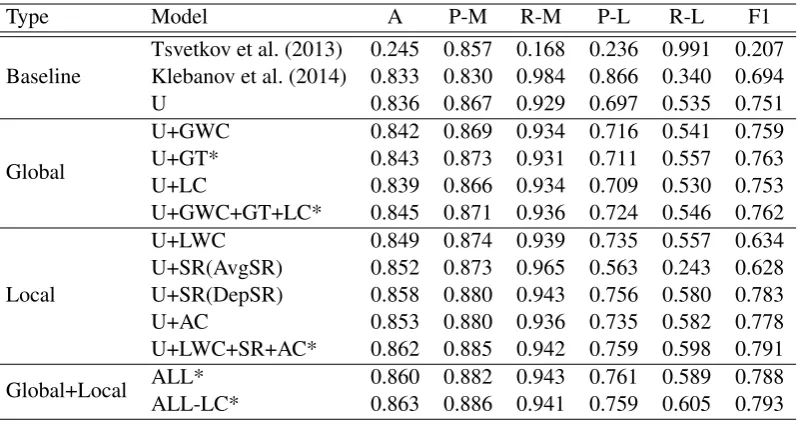
Type Model A P-M R-M P-L R-L F1
Baseline Tsvetkov et al. (2013) 0.245 0.857 0.168 0.236 0.991 0.207Klebanov et al. (2014) 0.833 0.830 0.984 0.866 0.340 0.694
U 0.836 0.867 0.929 0.697 0.535 0.751
Global
U+GWC 0.842 0.869 0.934 0.716 0.541 0.759 U+GT* 0.843 0.873 0.931 0.711 0.557 0.763 U+LC 0.839 0.866 0.934 0.709 0.530 0.753 U+GWC+GT+LC* 0.845 0.871 0.936 0.724 0.546 0.762
Local
[image:7.595.101.500.61.272.2]U+LWC 0.849 0.874 0.939 0.735 0.557 0.634 U+SR(AvgSR) 0.852 0.873 0.965 0.563 0.243 0.628 U+SR(DepSR) 0.858 0.880 0.943 0.756 0.580 0.783 U+AC 0.853 0.880 0.936 0.735 0.582 0.778 U+LWC+SR+AC* 0.862 0.885 0.942 0.759 0.598 0.791 Global+Local ALL*ALL-LC* 0.860 0.882 0.943 0.761 0.589 0.7880.863 0.886 0.941 0.759 0.605 0.793
Table 2: Performance on metaphor disambiguation evaluation. (Models) U: context unigram, GWC: global word category, GT: global topic dist., LC: lexical chain, LWC: local word category, SR: semantic relatedness, AC: abstractness/concreteness. (Metrics) A: accuracy, P-M: precision on metaphors, R-M: recall on metaphors, P-L: precision on literal words, R-L: recall on literal words, F1: Average F1 score over M/L., *: statistically significant improvement over baselines
Tsvetkov et al. (2013) use local contextual features (such as abstractness and imageability, supersenses, and vector space word representa-tions), and targets for two syntactic construc-tions: subject-verb-object (SVO) and adjective-noun (AN) tuples. Note that the output of this system is a sentence level label rather than a word (e.g. they output a binary label that in-dicates whether the target sentence contains any metaphorical phrase). Thus, we take the output of their sentence level label on the sentence that con-tains our target word, and treat their output as a label for our target word disambiguation task. Al-though it is therefore not a fair comparison, we included this system as a baseline because this is a state-of-the-art system for metaphor detection tasks. In addition, we can make this compari-son to contextualize results with regards to how a state-of-the-art non-discourse model (i.e. not us-ing global context) will perform in more general discourse contexts.
Klebanov et al. (2014) use target word lexi-cal features such as part-of-speech tags, concrete-ness rating, and topic score. Their approach does not use any contextual information as our method does. As a result, the same words are most likely to obtain the same features. Note that Klebanov et al. (2014) evaluated their approach for each con-tent word in a given text, but in our paper we
evaluate how their method performs on ambigu-ous words in particular.
5.4 Classification
We used theLightSIDE toolkit (Mayfield and Ros´e, 2010) for extracting features and performing classification. For the machine learning algorithm, we used the logistic regression classifier provided byLightSIDEwithL1regularization. We used basic unigram features extracted byLightSIDE, and performed 10-fold cross validation for the fol-lowing experiments. Instances for each fold were randomly chosen.
5.5 Results
The classification results on the Breast Cancer corpus are shown in Tables 2 and in 3.
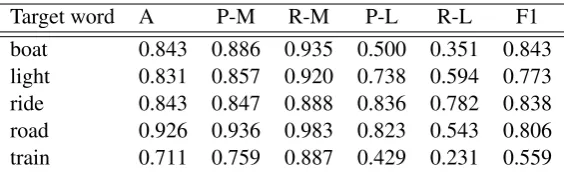
Target word A P-M R-M P-L R-L F1 boat 0.843 0.886 0.935 0.500 0.351 0.843 light 0.831 0.857 0.920 0.738 0.594 0.773 ride 0.843 0.847 0.888 0.836 0.782 0.838 road 0.926 0.936 0.983 0.823 0.543 0.806 train 0.711 0.759 0.887 0.429 0.231 0.559
Table 3: Performance on metaphor disambiguation task per target word with the best setting ALL-LC. Note that the performance results on target wordscandleandspiceare not reported because of their small number of instances.
Klebanov et al. (2014) performs poorly at recall on literal words. We conclude that our methods significantly outperform the baselines in detecting metaphors in discourse.
6 Discussion
The results of our methods on the metaphor dis-ambiguation task are promising, indicating that both global features and local features can serve as strong indicators of metaphor.
Note that the combined global+local features did not show significant improvement over the lo-cal features on this task in Table 2. We had be-lieved that local and global features (aside from unigram features) would provide synergistic pre-dictions, however we found that the local features provided stronger predictions and drowned out the effect of the global features.
We identify the following possible sources of errors of our method: first of all, the low perfor-mance of lexican chain (LC) features is notice-able. This might be due to errors originating from the output of theELKB toolkit which we employ to obtain lexical chains. More specifically,ELKB
builds lexical chains using a standard thesaurus, which is extremely vulnerable to noisy text such as our online discussion forum (which contains ty-pos, abbreviations, medical terms, etc.).
Secondly, the semantic relatedness scores ob-tained from LDA gives high scores to frequently co-occurring words, thus inevitably reducing ef-fectiveness in disambiguating frequently used metaphors. While this is an issue inherent in any distributional semantics approach, we find that our LDA-based features do improve overall perfor-mance.
7 Conclusion
We summarize our contributions as follows: we identified that both global and local contextual
fea-tures can serve as powerful indicators of metaphor, and proposed several methods to represent contex-tual features in discourse. We also extended previ-ous literature that considers local contextual infor-mation by explicitly incorporating the syntactic in-formation, such as dependency relations, into local contextual features, resulting in an improved per-formance. The performance was evaluated on our newly builtBreast Cancerdataset, which provides examples of metaphors in a discourse setting. We showed that our method significantly outperforms the systems from recent literature on a metaphor disambiguation task in discourse. Our method can be easily applied to disambiguate all the content words in text once we have correspondingly la-beled data.
Acknowledgments
This research was supported in part by NSF Grant IIS-1302522.
References
Dan Assaf, Yair Neuman, Yohai Cohen, Shlomo Arg-amon, Newton Howard, Mark Last, Ophir Frieder, and Moshe Koppel. 2013. Why dark thoughts aren’t really dark: A novel algorithm for metaphor
identi-fication. In Computational Intelligence, Cognitive
Algorithms, Mind, and Brain (CCMB), 2013 IEEE Symposium on, pages 60–65. IEEE.
Collin F Baker, Charles J Fillmore, and John B Lowe.
1998. The berkeley framenet project. In
Proceed-ings of the 17th international conference on Compu-tational linguistics-Volume 1, pages 86–90. Associ-ation for ComputAssoci-ational Linguistics.
David M. Blei, Andrew Y. Ng, and Michael I. Jordan.
2003. Latent dirichlet allocation. J. Mach. Learn.
Res., 3:993–1022, March.
2013. Using imageability and topic chaining to lo-cate metaphors in linguistic corpora. InSocial Com-puting, Behavioral-Cultural Modeling and Predic-tion, pages 102–110. Springer.
Marc Brysbaert, Amy Beth Warriner, and Victor Ku-perman. 2014. Concreteness ratings for 40
thou-sand generally known english word lemmas.
Behav-ior research methods, 46(3):904–911.
Dipanjan Das, Desai Chen, Andr´e FT Martins, Nathan Schneider, and Noah A Smith. 2014.
Frame-semantic parsing. Computational Linguistics,
40(1):9–56.
Joseph L Fleiss. 1971. Measuring nominal scale
agreement among many raters. Psychological
bul-letin, 76(5):378–382.
Ting-Hao Kenneth Huang. 2014. Social metaphor de-tection via topical analysis. In Sixth International Joint Conference on Natural Language Processing, page 14.
Hyeju Jang, Mario Piergallini, Miaomiao Wen, and
Carolyn Penstein Ros´e. 2014. Conversational
metaphors in use: Exploring the contrast between
technical and everyday notions of metaphor. ACL
2014, page 1.
Mario Jarmasz and Stan Szpakowicz. 2003. Not as easy as it seems: Automating the construction of
lexical chains using rogets thesaurus. InAdvances
in Artificial Intelligence, pages 544–549. Springer.
Beata Beigman Klebanov, Eyal Beigman, and Daniel Diermeier. 2009. Discourse topics and metaphors. In Proceedings of the Workshop on Computational Approaches to Linguistic Creativity, pages 1–8. As-sociation for Computational Linguistics.
Beata Beigman Klebanov, Chee Wee Leong, Michael Heilman, and Michael Flor. 2014. Different texts,
same metaphors: Unigrams and beyond. ACL 2014,
page 11.
Christopher D. Manning, Mihai Surdeanu, John Bauer, Jenny Finkel, Steven J. Bethard, and David Mc-Closky. 2014. The Stanford CoreNLP natural
lan-guage processing toolkit. In Proceedings of 52nd
Annual Meeting of the Association for Computa-tional Linguistics: System Demonstrations, pages 55–60.
James H Martin. 1996. Computational approaches
to figurative language. Metaphor and Symbol,
11(1):85–100.
Elijah Mayfield and Carolyn Ros´e. 2010. An in-teractive tool for supporting error analysis for text
mining. In Proceedings of the NAACL HLT 2010
Demonstration Session, pages 25–28. Association for Computational Linguistics.
Jane Morris and Graeme Hirst. 1991. Lexical cohesion computed by thesaural relations as an indicator of the structure of text. Comput. Linguist., 17(1):21– 48, March.
Yair Neuman, Dan Assaf, Yohai Cohen, Mark Last, Shlomo Argamon, Newton Howard, and Ophir Frieder. 2013. Metaphor identification in large texts corpora. PloS one, 8(4):e62343.
Xuan-Hieu Phan and Cam-Tu Nguyen. 2007. Gibb-slda++: Ac/c++ implementation of latent dirichlet allocation (lda).
Steffen Remus and Chris Biemann. 2013. Three knowledge-free methods for automatic lexical chain
extraction. InHLT-NAACL, pages 989–999.
Peter Mark Roget. 1911.Roget’s Thesaurus of English
Words and Phrases... TY Crowell Company. Marc Schulder and Eduard Hovy. 2014. Metaphor
de-tection through term relevance. ACL 2014, page 18. Ekaterina Shutova and Lin Sun. 2013. Unsupervised metaphor identification using hierarchical graph
fac-torization clustering. In HLT-NAACL, pages 978–
988.
Ekaterina Shutova and Simone Teufel. 2010.
Metaphor corpus annotated for source-target domain
mappings. InLREC.
Ekaterina Shutova, Lin Sun, and Anna Korhonen. 2010. Metaphor identification using verb and noun clustering. InProceedings of the 23rd International Conference on Computational Linguistics, pages 1002–1010. Association for Computational Linguis-tics.
Ekaterina Shutova, Simone Teufel, and Anna
Korho-nen. 2013. Statistical metaphor processing.
Com-putational Linguistics, 39(2):301–353.
Caroline Sporleder and Linlin Li. 2009. Unsupervised recognition of literal and non-literal use of idiomatic
expressions. InProceedings of the 12th Conference
of the European Chapter of the Association for Com-putational Linguistics, pages 754–762. Association for Computational Linguistics.
Gerard J Steen, Aletta G Dorst, J Berenike Herrmann, Anna Kaal, Tina Krennmayr, and Trijntje Pasma.
2010. A method for linguistic metaphor
identifica-tion: From MIP to MIPVU, volume 14. John Ben-jamins Publishing.
Yulia Tsvetkov, Elena Mukomel, and Anatole Gersh-man. 2013. Cross-lingual metaphor detection using common semantic features.
Peter D Turney, Yair Neuman, Dan Assaf, and Yohai Cohen. 2011. Literal and metaphorical sense iden-tification through concrete and abstract context. In