Influence of preprocessing on dependency syntax annotation: speed and
agreement
Arne Skjærholt
Department of Informatics, University of Oslo
Abstract
When creating a new resource, prepro-cessing the source texts before annotation is both ubiquitous and obvious. How the preprocessing affects the annotation effort for various tasks is for the most part an open question, however. In this paper, we study the effects of preprocessing on the annotation of dependency corpora and how annotation speed varies as a function of the quality of three different parsers and compare with the speed obtained when starting from a least-processed baseline.
We also present preliminary results con-cerning the effects on agreement based on a small subset of sentences that have been doubly-annotated.1
1 Introduction
It is commonly accepted wisdom in treebanking that it is preferable to preprocess data before PoS and syntax annotation, rather than having annota-tors work from raw text. However, the impact of preprocessing is not well studied and factors such as the lower bound on performance for preprocess-ing to be useful and the return on investment of increased performance are largely unknown.
Corpora and applications based on dependency syntax have become increasingly popular in recent years, and many new corpora are being created. In this work we investigate the task of syntactic anno-tation based on dependency grammar, and how an-notation speed and inter-annotator agreement are influenced by parser performance. Our study is performed in the context of the annotation effort currently under way at the national library of Nor-way, tasked with creating a freely available syn-tactically annotated corpus of Norwegian. It is the first widely available such corpus.
1Code and data used to obtain these results is available at https://github.com/arnsholt/law7-annotation
1.1 Related work
The Penn Treebank project (Marcus et al., 1993) had annotators correct automatically parsed and PoS-tagged data, and they report that correcting rather than annotating from scratch is massively helpful in the PoS annotation task (from scratch took twice as long and increased error rate and dis-agreement by 50%), but unfortunately there is no such comparison for the syntactic bracketing task. The task of PoS annotation has been studied fur-ther by Fort and Sagot (2010), who establish the lower bound on tagger accuracy to be in the range of 60–80% for the preprocessing to be useful.
For the task of syntactic bracketing, Chiou et al. (2001) investigated some facets of the prob-lem while developing the Penn Chinese treebank and found that when using a parser with a labelled
F1=76.04, the time spent correcting is 58% of the
time spent on unassisted annotation, and a further improved parser (F1=82.14) reduces the time to
50% of that used by unassisted annotation.
2 Experimental protocol
In this section we outline the key methodological choices made for our experiments. First we dis-cuss what timing data we collect and the texts an-notated, before describing the preprocessors used.
Environment For our experiments, four differ-ent texts were chosen for annotation: two from theAftenposten (AP 06 & AP 08), and two from
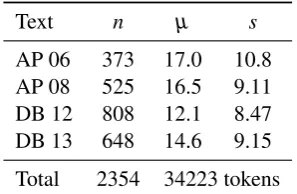
Dagbladet (DB 12 & DB 13), both daily news-papers. Key statistics for the four texts are given in Table 1. The annotation effort uses the TRED
tool2, originally created for the Prague Depen-dency Treebank project. It is easily extended, and thus we used these facilities to collect the timing data. To minimise interference with the annota-tors, we simply recorded the time a sentence was shown on screen and accounted for outliers caused by breaks and interruptions in the analysis.
The annotation work is done by two annotators, Odin and Thor. Both are trained linguists, and
2http://ufal.mff.cuni.cz/tred/
Text n µ s
AP 06 373 17.0 10.8 AP 08 525 16.5 9.11 DB 12 808 12.1 8.47 DB 13 648 14.6 9.15
[image:2.595.107.256.62.159.2]Total 2354 34223 tokens
Table 1: Statistics of the annotated texts. n num-ber of sentences,µmean length,slength standard deviation.
are full-time employees of the National Library tasked with annotating the corpus. The only ad-ditional instruction given to the annotators in con-junction with the experiment was that they try to close the TREDprogram when they know that they were going away for a long time, in order to min-imise the number of outliers. The actual annota-tion proceeded as normal according to the anno-tation guidelines3. Thor annotated AP 08 and DB 13, while Odin annotated AP 06 and DB 12 as well as the first 400 sentences of DB 13 for the purposes of measuring annotator agreement.
Preprocessing In our experiments, we consider three different statistical parsers as preprocessors and compare these to a minimally preprocessed baseline. Unfortunately, it was impossible to get timing data for completely unannotated data, as TRED requires its input to be a dependency tree. For this reason our minimal preprocessing, we call it the caterpillar strategy, is attaching each word to the previous word, labelled with the most frequent dependency relation.
Of the three statistical parsers, one is trained directly on already annotated Norwegian data re-leased by the treebank project (version 0.2) and the other two are cross-lingual parsers trained on converted Swedish and Danish data using the tech-niques described in Skjærholt and Øvrelid (2012). In brief, this technique involves mapping the PoS and dependency relation tagsets of the source cor-pora into the corresponding tagsets of the target representation, and applying structural transfor-mations to bring the syntactic analyses into as close a correspondence as possible with the tar-get analyses. It was also shown that for lan-guages as closely related as Norwegian, Danish and Swedish, not delexicalising, contrary to the
3Distributed with the corpus at:
http://www.nb.no/Tilbud/Forske/Spraakbanken/ Tilgjengelege-ressursar/Tekstressursar
Parser UAS LAS
[image:2.595.345.488.63.142.2]Baseline 30.8% 3.86% Danish 69.9% 46.7% Swedish 77.7% 68.1% Norwegian 86.6% 83.5%
Table 2: Parser performance. Labelled (LAS) and unlabelled (UAS) attachment scores.
standard procedure in cross-lingual parsing (Sø-gaard, 2011; Zeman and Resnik, 2008), yields a non-negligible boost in performance.
All three parsers are trained using MaltParser (Nivre et al., 2007) using the liblinear learner and the nivreeager parsing algorithm with default set-tings. The Norwegian parser is trained on the first 90% of the version 0.2 release of the Norwegian dependency treebank with the remaining 10% held out for evaluation, while the cross-lingual parsers are trained on the training sets of Talbanken05 (Nivre et al., 2006) and the Danish Dependency Treebank (Kromann, 2003) as distributed for the CoNLL-X shared task. The parser trained on Swedish data is lexicalised, while the one trained on Danish used a delexicalised corpus.
The performance of the four different prepro-cessing strategies is summarised in Table 2. The numbers are mostly in line with those reported in Skjærholt and Øvrelid (2012), with a drop of a few percentage points in both LAS and UAS for all parsers, except for a gain of more than 5 points LAS for the Danish parser, due to the fixed relation labels. There are three reasons for the differences: First of all, the test corpus is differ-ent; Skjærholt and Øvrelid (2012) used the ver-sion 0.1 release of the Norwegian corpus, while we use version 0.2. Secondly, TREDrequires that
its input trees only have a single child of the root node, while MaltParser will attach unconnected subgraphs to the root node if the graph produced after consuming the whole input isn’t connected. Finally, TRED validates dependency relation la-bels strictly, which revealed a few bugs in the conversion script for the Danish data. A post-processing script corrects the invalid relations and attaches multiple children of the root node to the most appropriate child of the root.
0 50 100 150 200 250
2 4 6 8 10 12 14 16 18 20
Median
time
(s)
Sentence length Caterpillar
[image:3.595.291.515.68.257.2]Danish Norwegian Swedish
Figure 1: Median annotation time, Odin.
to a parser, in such a way that 5 chunks were parsed with the baseline strategy and the remain-ing chunks were evenly distributed between the remaining three parsers. This strategy ensures as even a distribution between parsers as possi-ble, while keeping the annotators blind to parser assignments. We avoid the annotators knowing which parser was used, as this could subcon-ciously bias their behaviour.
3 Results
Speed To compare the different parsers as pre-processors for annotation, we need to apply a sum-mary statistic across the times for each annotator, binned by sentence length. We use the median, which is highly resistant to outliers and concep-tually simpler than strategies for outlier elimina-tion4. Furthermore, to ensure large enough bins, we only consider sentences of length 20 or less.
Figure 1 shows the evolution of annotation time as a function of sentence length for Odin for all four parsers, and Figure 2 the corresponding graphs for Thor. It is clear that, although Odin consistently uses less time to annotate sentences than Thor, the different parsers are ranked identi-cally, and the relative speed-up of the higher qual-ity parsers is similar for both annotators.
Agreement To measure agreement we study the LAS and UAS we get from comparing Odin and Thor’s annotations. Artstein and Poesio (2008) ar-gue strongly in favour of using a chance-corrected
4Nor does it assume normality, which would be
inappro-priate for timing data, unlike most outlier detection methods. 0 100 200 300 400 500 600 700
2 4 6 8 10 12 14 16 18 20
Median
time
(s)
Sentence length Caterpillar
[image:3.595.51.275.68.257.2]Danish Norwegian Swedish
Figure 2: Median annotation time, Thor.
Parser n UAS LAS
[image:3.595.330.501.301.381.2]Baseline 10 99.1% 99.1% Danish 130 96.3% 94.0% Swedish 110 96.1% 94.4% Norwegian 150 96.8% 95.3%
Table 3: Annotator agreement. nsentences, unla-belled (UAS) and launla-belled (LAS) attachment.
measure of agreement, but the measures they present are applicable to categorical data, not structured data such as syntactic data. Thus, sim-ple agreement measures are the standard measures in syntax (Hajiˇc, 2004; Miltsakaki et al., 2004; Maamouri et al., 2008). As mentioned in Sec-tion 2, only 400 sentences were doubly annotated. Ideally, we would have liked to have all the texts doubly annotated, but external constraints on the annotation effort limited us to the set at hand.
of parser performance, and labelled agreement is somewhat lower again, indicating some level of disagreement over dependency relations.
4 Analysis
Our results are clearest for the question of how time used to annotate is affected by preprocess-ing quality. The Danish parser halves the time re-quired to annotate sentences compared to the base-line; already an important gain. The Norwegian parser cuts the time in half again, with the Swedish parser between the two. Based on the learning curves in Skjærholt and Øvrelid (2012), a parser with performance equivalent to the Danish parser (70% UAS) can be obtained with about 50 anno-tated sentences, and the 80% UAS of the Swedish parser is reachable with about 200 sentences.
Given the limited amount of data available for our study of agreement, it is hard to make solid conclusions, but it does appear that head selec-tion is virtually unchanged by parser performance, while there may be some increase in agreement on dependency relation labels, from 96.0% with the Danish parser, to 96.5% and 97.1% with the Swedish and Norwegian parsers. Agreement is ex-tremely high for both heads and labels on the data preprocessed with the baseline parser, but based on 10 sentences, it is impossible to say whether this is a fluke or a reasonable approximation of the value we would get with a larger sample.
The unchanged agreement score suggests that the annotators are not unduly influenced by a bet-ter parser. An increase in agreement would not be an unambiguously positive result though; a pos-itive interpretation would be that the annotators’ work is closer to the Platonic ideal of a correct analysis of the corpus, but a less charitable inter-pretation is that the annotators are more biased by the parser. Furthermore, the very high agreement for the baseline parser is potentially worrying if the result remains unchanged by a larger sample. This would indicate that in order to get the best quality annotation, it is necessary to start from a virtually unprocessed corpus, which would re-quire four times as much time as using a 90% UAS parser for preprocessing, based on our data.
5 Conclusions
Given the time-consuming nature of linguistic an-notation, higher annotation speed is an obvious good for any annotation project as long as the
annotation quality doesn’t degrade unacceptably. Based on the results obtained in our study, it is clear that the speed-up to be had from a good de-pendency parser is important, to the extent that when annotating it is a very bad idea to not use one. Further, based on the learning curves pre-sented in Skjærholt and Øvrelid (2012), it seems that parser adaptation with a view to preprocess-ing for annotation is primarily useful in the ear-liest stages of an annotation effort as the learn-ing curves show that once 100 sentences are anno-tated, a parser trained on that data will already be competitive with a cross-lingual parser for Norwe-gian. Other languages may require more data, but the amount required is most likely on the same or-der of magnitude. If same-language data are avail-able, a parser trained on that may last longer.
As regards annotator agreement, our results show that head selection as measured by unla-belled accuracy is unchanged by parser accuracy. Agreement as measured by labelled accuracy in-creases somewhat with increased parser perfor-mance, which indicates that agreement on labels increases with parser performance. The agreement results for our baseline parser are extremely high, but given that we only have ten sentences to com-pare, it is impossible to say if this is a real differ-ence between the baseline and the other parsers.
5.1 Future work
There are a number of things, particularly relat-ing to annotator agreement we would like to in-vestigate further. Chief of these is the lack of a chance corrected agreement measure for depen-dency syntax. As mentioned previously, no such measure has been formulated as most agreement measures are most naturally expressed in terms of categorical assignments, which is a bad fit for syn-tax. However, it should be possible to create an agreement measure suitable for syntax.
References
Ron Artstein and Massimo Poesio. 2008. Inter-Coder Agreement for Computational Linguistics. Compu-tational Linguistics, 34(4):555–596.
Fu-Dong Chiou, David Chiang, and Martha Palmer. 2001. Facilitating Treebank Annotation Using a Sta-tistical Parser. In Proceedings of the first interna-tional conference on Human language technology research, pages 1–4.
Karën Fort and Benoît Sagot. 2010. Influence of Pre-annotation on POS-tagged Corpus Development. In Nianwen Xue and Massimo Poesio, editors, Pro-ceedings of the fourth linguistic annotation work-shop, pages 56–63, Stroudsburg. Association for Computational Linguistics.
Jan Hajiˇc. 2004. Complex Corpus Annotation: The Prague Dependency Treebank. Jazykovedný ústav L’. Štúra, SAV.
Matthias Trautner Kromann. 2003. The Danish De-pendency Treebank and the DTAG Treebank Tool. In Proceedings of the 2nd Workshop on Treebanks and Linguistic Theories, pages 217–220. Växjö Uni-versity Press.
Mohamed Maamouri, Ann Bies, and Seth Kulick. 2008. Enhancing the Arabic Treebank : A Collabo-rative Effort toward New Annotation Guidelines. In
Proceedings of the 6th International Conference on Language Resources and Evaluation, pages 3192– 3196. European Language Resources Association.
Mitchell P. Marcus, Beatrice Santorini, and Mary Ann Marcinkiewicz. 1993. Building a large annotated corpus of English: The Penn Treebank. Computa-tional Linguistics, 19(2):313–330.
Eleni Miltsakaki, Rashmi Prasad, Aravind Joshi, and Bonnie Webber. 2004. The Penn Discourse Tree-bank. InProceedings of the 4th International Con-ference on Language Resources and Evaluation, pages 2237–2240. European Language Resources Association.
Joakim Nivre, Jens Nilsson, and Johan Hall. 2006. Tal-banken05 : A Swedish Treebank with Phrase Struc-ture and Dependency Annotation. InProceedings of the fifth international conference on Language Re-sources and Evaluation.
Joakim Nivre, Jens Nilsson, Johan Hall, Atanas Chanev, Gül¸sen Eryi˘git, Sandra Kübler, Svetoslav Marinov, and Erwin Marsi. 2007. MaltParser: A language-independent system for data-driven de-pendency parsing. Natural Language Engineering, 13(2):95–135.
Arne Skjærholt and Lilja Øvrelid. 2012. Impact of treebank characteristics on cross-lingual parser adaptation. In Iris Hendrickx, Sandra Kübler, and Kiril Simov, editors,Proceedings of the 11th inter-national workshop on treebanks and linguistic theo-ries, pages 187–198, Lisbon. Edições Colibri.
Anders Søgaard. 2011. Data point selection for cross-language adaptation of dependency parsers. In Pro-ceedings of the 49th Annual Meeting of the Associa-tion for ComputaAssocia-tional Linguistics, pages 682–686.