Instrumentation. Chromatography: Liquid: Partition Chromatography (Liquid+Liquid). III/Chiral Separations: Countercurrent Chromatography; Liquid Chromatography.
Foam Countercurrent Chromatography. Ion Analysis:
Liquid Chromatography; High-Speed Countercurrent Chromatography. Liquid Chromatography. Medicinal
Herb Compounds: High-Speed Countercurrent Chrom-atography. Natural Products: High-Speed
Counter-current Chromatography; Liquid Chromatography. Peptides
and Proteins: Liquid Chromatography. Proteins:
High-Speed Countercurrent Chromatography.
Further Reading
Conway WD (1990)Countercurrent Chromatography: Ap-paratus,Theory and Applications. New York: VCH. Conway WD and Petroski RJ (eds) (1995)ACS Symposium
Series Monograph on Modern Countercurrent Chromato-graphy. Washington, DC: American Chemical Society.
Ito Y (1981) Countercurrent chromatography (minireview). Journal of Biochemical and Biophysical Methods 5: 105}129.
Ito Y (1986) High-speed countercurrent chromatography. CRC Critical Reviews in Analytical Chemistry 17: 65}143.
Ito Y (1991) Countercurrent chromatography in Chrom-atography V, part A, chap. 2, pp. A69}A107. Amster-dam: Elsevier.
Ito Y (1996) Countercurrent chromatography. In: Encyclo-pedia of Analytical Science, pp. 910}916. London: Academic Press.
Ito Y (1996) pH-zone-reRning countercurrent chromatog-raphy.Journal of Chromatography A753: 1}30. Ito Y and Conway WD (eds) (1996)High-Speed
Counter-current Chromatography. New York: Wiley-Intersci-ence.
Mandava NB and Ito Y (1988)Countercurrent Chromatog-raphy:Theory and Practice. New York: Marcel Dekker.
Derivatization
I. S. Krull, Northeastern University, Boston, MA, USA R. Strong, Repligen Corporation, Needham, MA, USA
Copyright^ 2000 Academic Press
Introduction
Derivatization involves changing in some way the basic chemical or physical structure of a compound, usually to a single product, which may be more useful for the analysis of the original analyte in liquid chromatography (LC). Derivatization can be used for analytical or preparative scale LC. In the analytical mode, it can be used to improve the identiRcation and quantitation of the analyte of interest. It may also be used to improve throughput and recovery in prepara-tive scale LC puriRcations of large amounts of mater-ial. Changes in the basic structure of the analyte can also lead to improved peak shape, elution times, peak symmetry, efRciency, plate count, and other indi-cators of chromatographic performance. That is, elu-tion times and retenelu-tion factors, as well as resoluelu-tion, separation factors, reduced plate heights, and other LC parameters of performance, can all be varied and improved by suitable, selective derivatization of the starting analyte.
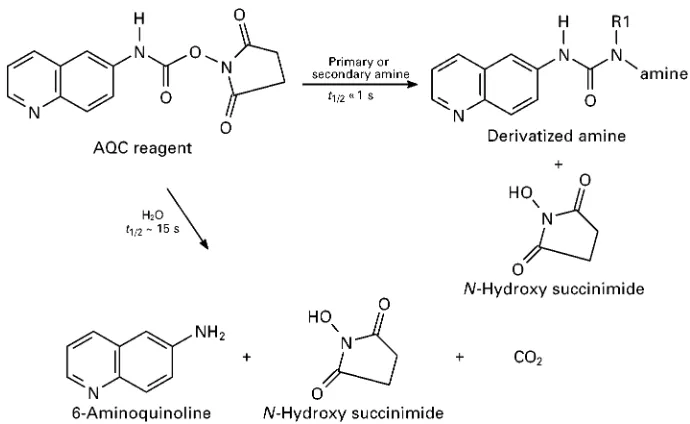
The most general type of derivatization involves modifying the chemical structure of the starting com-pound by tagging or adding another reagent to it via a suitable functional group alteration (Figure 1). Thus, most simple derivatizations involve a
derivatiz-ing reagent, the substrate or analyte of interest, the desired derivative of the analyte, remaining excess reagent, and undesirable by-products coming from the excess derivatizing reagent reacting with solvent, water or thermally degrading (Figure 1). Ideally, only the desired derivative would remain at the end of the reaction period, without any remaining starting analyte, derivatizing reagent or by-products. How-ever, this idealized situation is rarely observed and it is often necessary to separate prior to or during the LC analysis the desired derivative from all other pos-sible compounds coming from the derivatization re-action and/or sample components and their possible derivatization products.
Though most derivatizations usually occur in a ho-mogeneous solution between the analyte of interest and the reagent itself, it is possible to perform derivat-izations on the analyte in solution with an immobi-lized or solid-phase reagent. Figure 2 illustrates a typical immobilized or solid-phase reagent that has been described in the literature for use with LC. It is also feasible toRrst immobilize the analyte on a solid support, such as silica gel, Immobilon2+membrane, poly(styrene-divinylbenzene), C18 packing material,
Figure 1 Chemical derivatization of an analyte using 6-aminoquinoyl-N-hydroxysuccinimidyl carbamate (6-AQC) reagent. This is a homogeneous reaction that occurs in solution. The 6-AQC degrades with water to form 6-aminoquinoline andN-hydroxysuccinimide, with the release of carbon dioxide.
Figure 2 Typical immobilized or solid-phase reagent. The 6-AQ-tagged polymeric reagent reacts with amines (703C, 10 min), producing a derivative free in solution, now 6-AQ derived. (6-AQ, 6-aminoquinoline; PSt, polystyrene.)
analyte or by-products of the reagent, in a state suit-able for direct LC injection.
Other approaches to derivatization involve the use of photochemical reactions, usually performed on-line after the separation occurs, which convert the starting analyte into one or more derivatives with improved detection properties (ultraviolet (UV),
Suorescent (FL), electrochemical (EC), etc). This does not introduce excess derivatizing reagent, reagent by-products or hydrolysis by-products, since the reagent itself is light rather than a chemical. Such approaches have become popular in LC applications. It is also possible to utilize electrochemistry to perform
de-rivatizations in LC, as well as microwave digestion, immobilized enzyme reactors, pH alteration of the mobile phase after the separation, etc.Table 1 sum-marizes the most commonly utilized derivatization techniques described in LC other than simple, chem-ical reactions.
General Approaches to Derivatization
in Liquid Chromatography
[image:2.568.133.434.508.684.2]Table 1 Summary of common derivatization approaches, other than chemical reactions, used in LC
1. Photochemical conversions, photohydrolysis reactions, photocleavage or photoextrusion reactions, photobleaching, etc.
2. Electrochemical conversions (amperometric or coulometric), oxidative or reductive reactions to convert an electrochemi-cally inactive analyte into an electrochemielectrochemi-cally active deriva-tive.
3. Enzymatic conversions, enzyme}substrate reaction detec-tion, used to detect enzymes post-column via their reaction with substrate and formation of the conversion product, which may then be UV, FL, EC and/or MS active. This is detection of enzymes first separated by LC.
4. Microwave digestion reactions, post-column, used to digest proteins/peptides, nucleic acids and other biopolymers, leading to monomeric species that are more easily detected (EC) and/or derivatized before final detection (e.g. pro-teinsPamino acids#OPAPtagged amino acids; UV, FL, or EC active).
5. Immunodetection (ID), post-column in LC, used to tag an antigenic species with a FL or enzyme-tagged antibody, leading to indirect detection of the untagged antigen via its complex formation in a sandwich format. A primary antibody must be immobilized on the solid ID support to initially cap-ture the antigen after separation by LC.
6. Enzymatic conversion of a substrate, post-column, to form the turnover product with improved UV, FL or EC detection properties. This is detection of enzyme substrates, first sep-arated by LC, then detected post-column by addition of enzyme in solution or via an immobilized enzyme reactor column, pre-detection.
reagent to substrate, separation of derivative from sample components and reaction by-products, de-tector optimization for derivatives, chromatographic optimization of derivative peak shape, generation of standard derivative and structure conRrmation, pro-duction of derivative calibration plot for quantita-tion, etc. The purity of the derivative peak in a sample must also be demonstrated by online photodiode ar-ray (PDA) or mass spectrometric (MS) methods. The derivatization reagent must be well characterized with regard to structure and its purity demonstrated. The reaction conditions need to be optimized to min-imize reagent consumption, maxmin-imize derivative yield, and eliminate the formation or presence of reaction and reagent by-products that might interfere in the Rnal separation and detection steps. It may even be necessary or desirable initially (pre-LC) to separate the excess reagent from the derivative and then introduce just the sample and the now-formed derivative into the analytical LC column.
Sometimes the reagents used have different de-tector properties from the Rnal derivatives. The ex-cess reagent at the end of the derivatization reaction
may then be transparent under the optimized detec-tion condidetec-tions for the derivative. It may even coelute together with the derivative peak, yet not be observed under such detection conditions. This reduces the need for initial separation of excess, unreacted reagent from the derivative and sample, and/or optimization of LC conditions so that the derivative peak appears completely resolved from all the other peaks.
Large versus Small Analyte Molecules and Their Derivatizations
It is generally easier to derivatize small molecules than large ones, since the rates of chemical reactions of very large biomolecules are usually orders of magnitude slower than those of smaller species. This is a function of effective chemical collisions, the num-ber of chemical collisions per unit time between react-ive sites, conformational preferences of large biomolecules, and the number of active sites available in a biomolecule. That is not to say that biomolecules cannot be successfully derivatized } they often are and can be}but the efRciency of derivatization (per-cent derivatization per unit time) versus smaller react-ive species is usually much less. Also, the energy of activation needed to derivatize a primary amino group in a large molecule is often much larger than that for a very small molecule having the same functionality. This is, of course, a function of the neighbouring groups, conformational preferences, conformations available, hydrogen bonding within the biomolecule, and other factors. A considerable danger with derivatizing large molecules (typically biopolymers) stems from the fact that, in most cases, such a polymer possesses a number of reactive groups, for reasons just speciRed, which may differ in their reactivity. The result may be the formation of a number of products bearing the same tag in differ-ent mole per mole ratios. Although in enzymatic ampliRcation techniques the formation of multiple products helps identiRcation, in the situation just de-scribed the formation of multiple derivatization prod-ucts should be avoided. The separation of such mixtures is often difRcult, usually resulting in broad peaks and low plate counts. Moreover, it may be difRcult to trace back which derivative was derived from which solute present in the original sample.
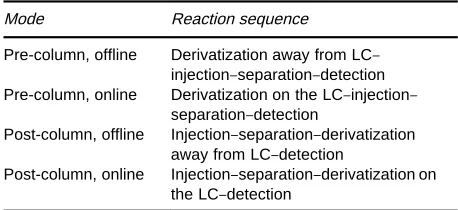
Table 2 Derivatization placement in LC
Mode Reaction sequence
Pre-column, offline Derivatization away from LC} injection}separation}detection Pre-column, online Derivatization on the LC}injection}
separation}detection
Post-column, offline Injection}separation}derivatization away from LC}detection
Post-column, online Injection}separation}derivatization on the LC}detection
will be improved detector response, but perhaps much smaller chromatographic changes than with small molecules if the derivatization is carried out pre-column. Derivatizations are therefore often per-formed post-column. An ideal derivatization scheme would generate many derivatives from the original biomolecule, such as via enzyme ampliRcation. This is already used to detect intact enzymes, but is used much less to detect proteins, peptides, nucleic acids, etc. Thus, the scheme described using post-column, microwave digestion of proteins, followed by a second post-column solution reaction with a FL derivatizing reagent (e.g.o-phthaldialdehyde, OPA), leads to many amino acids now detectable by FL methods. This is, perhaps, an ideal example of a general approach that greatly improves detectability of large molecules, such as via enzyme ampliRcation for enzymes.
Of]ine versus Online Arrangements
It is also necessary to differentiate between ofSine and online arrangements (Table 2). In the ofSine mode the reactions occur away from the high performance liquid chromatography (HPLC) system, although there may be some examples that could be deRned as either ofSine or online (e.g. in a sample vial in a ca-rousel as part of an automated derivatization} injec-tion system in LC). In the online mode the reacinjec-tion chemistry occurs as part of the HPLC system, integ-rated into the instrumentation and analysis, and is time constrained and controlled. Thus there are four different and distinct types of derivatization ap-proaches, or modes, for LC: (1) online, pre-column; (2) online, post-column; (3) ofSine, pre-column; and (4) ofSine, post-column (Table 2).
Pre-column versus Post-column Arrangements
The derivatization can be carried out in the pre-col-umn or post-colpre-col-umn mode, i.e. before or after the separation has taken place. In the post-column ap-proach the derivatization reaction does not have to yield a single, stable product, provided that the reac-tions are reproducible. There are several serious dis-advantages associated with this technique: (1) excess
derivatization reagent must not interfere in the detec-tion process; (2) reacdetec-tion kinetics need to be rapid to allow real-time detection; (3) additional pumps are needed for a nonpulsating supply of derivatization reagent; (4) reaction solvents must be miscible with the separation mobile phase; and (5) an efRcient mix-ing of derivatization reagent with the column efSuent is required.
Pre-column derivatization is an alternative ap-proach to post-column derivatization. One of its ad-vantages is that derivatization is independent of the mobile phase and the reaction kinetics are not lim-ited. Apart from an increase in detectability, pre-col-umn derivatization can also improve the selectivity and chromatographic resolution of the overall method. Excess reagent present in the reaction mix-ture must be chromatographically resolved from the analyte derivative peaks, and/or be physically or chemically removed from the sample solution prior to injection. If several analytes yield the same deriva-tive(s), then these would not be separable, and it would be impossible to determine which analyte was originally present in the sample. For example, the use of a substrate that could react with several enzymes, pre-column, would then lead to exactly the same product(s), preventing absolute identiRcation of the enzyme actually present in the sample reaction mix-ture. More derivatizations have been performed on-line, post-column, as opposed to onon-line, pre-column, or even ofSine, pre-column, for the above reasons, at least in LC areas. It is also possible to perform de-rivatizationsin situ, or within the mobile phase. In this case derivatization reagent is placed in the sol-vents used for the LC separation. After separation has occurred, the eluent from the LC column can be heated to cause the reaction to occur, prior to theRnal detection stage. Unlike the online, post-column mode of operation, this does not require the addition of a mixing tee, heating coil, reagent pump, or ancillary tubing after the LC column.
Of]ine, Pre-column Derivatization
OfSine, pre-column derivatizations have no ex-tracolumn loss of efRciency and no solvent or kinetic limitations. Derivatization can be conducted under
nonautomated ofSine pcolumn derivatizations re-quire operator attendance and manual manipulations.
Online, Pre-column Derivatization
Online, pre-column derivatization is accomplished by incorporation of a derivatization reagent into the
Sow scheme of the LC. Since all of the derivatized products are injected into the LC, this mode of de-rivatization does not have the solvent dilution prob-lem observed in ofSine derivatization. There are sev-eral requirements for the conduction of online pre-column derivatization: (1) good chemical and/or pressure stability of derivatization reagents in organic solvent; (2) good solubility of derivatized products in the mobile phase; (3) no precipitate or gas generated in the derivatization; (4) compatibility of derivatiz-ation solvent with mobile phase; and (5) minimum volume of derivatization solvent or well packed solid-phase derivatization column. In online pre-column derivatization, the extraction and clean-up of com-plex samples often becomes part of the chromato-graphic operation, which can be automatically (computer/microprocessor interface) performed via switching of valves. Preliminary sample handling is minimized and automated derivatization procedures tend to provide better reproducibility.
Of]ine, Post-column Derivatization
This is perhaps the most unwieldy derivatization ap-proach of all (Table 2). It involves separating the analyte of interest from the LC eluent prior to detec-tion, performing a solution or solid-phase derivatiz-ation away from the instrumentderivatiz-ation, manually or automatically, and then detecting theRnal derivatized solution. Automation is difRcult, reproducibility is less than ideal, and even accuracy and precision falter, at times, because of a lack of total automatability. Thus, this mode receives the least emphasis in the literature and the lowest recommendation of application.
Online, Post-column Derivatization
In this approach (Table 2) injection}separation steps are followed by online derivatization, using auto-mated, fully online instrumentation and methods. This technique utilizes post-column reactors (low dead volume mixing tees, knitted open-tubular reac-tors, low dead volume reaction coils, etc.) in which the chemical regents are introduced to the LC eluent. A delay time is needed (reaction dependent) to con-vert the analyte to product(s), and the entire solution, along with excess reagent(s), is introduced into the detector. This approach also allows for online liquid}liquid extraction, ion suppression (dual col-umn ion chromatography), pH adjustment, organic
solvent addition, basic hydrolysis reactions, addi-tional chemical reactions modifying the solutes prior to the derivatization step (e.g. oxidation of imidazole ring in proline and hydroxyproline for their assay by the OPA reaction), enzyme addition, and the use of post-column, immobilized reagents or enzymes. There are many chemical reactions that have been employed post-column online: sequential reactions, solid-phase/catalytic enhanced reactions (e.g. carba-mate detection), microwave digestion of proteins, photochemical reactions, etc. However, there are se-vere constraints or requirements on the nature of the reagent solvent and solution that can be mixed with the LC efSuent, detector transparency of such sol-vents, prevention of analyte derivative precipitation before detection, mixing of reagents with analyte, lack of mixing noise, need for additional instrumenta-tion, mixing tees, connecting joints, and extra tubing connections. Nevertheless, at least in LC areas, this particular mode has been the most widely employed and applied.
Speci
\
c Recommendations for
Successful Application of
Derivatization in Liquid
Chromatography
It is clear that there are numerous approaches to successful derivatization possible in various modes of LC, including reversed-phase, ion exchange, normal phase and hydrophobic interaction. There are per-haps too many choices as to which speciRc reagent will prove applicable for a new analyte, or how to best optimize and apply any given reagent, much less what might prove the optimal LC conditions for the
Rnal derivatives. A rational approach to derivatiz-ation for all LC is called for. Such rderivatiz-ational designs for method development, optimization and validation in HPLC are available from the literature. A rational approach to developing, optimizing and then validat-ing a derivatization method for LC is described below.
1. Know the structure of the analyte(s), what func-tional groups are present for tagging, and what types of reactions might be employed. A good knowledge of organic chemistry is needed and available at this stage. Some of the existing texts on derivatizations for HPLC should be utilized. 2. What are the requirements of theRnal
3. What is known in the literature about the LC of the analyte of interest, as a standard pure com-pound (without regard to sample matrices yet)? Are conditions reported for underivatized analy-sis, and what conditions have been already de-scribed and optimized? Could these be eventually utilized for simple derivatives of the original analyte? What modiRcations might be needed to resolve the analyte derivatives? Are any tagging methods already reported for GC or thin-layer chromatography (TLC) that might prove applic-able in LC? What types of reagents have been described? What were the speciRc reaction condi-tions already optimized for this derivatization scheme?
4. Perform simple, test tube reactions on a standard of the analyte ofSine, away from the LC instru-ment, to optimize reaction conditions and to demonstrate the nature of the products formed, their number, derivatization yield, ease of prod-uct work-up prior to LC, etc. Utilize TLC, gas chromatography (GC), LC, and whatever other analytical tools are available to determine which reagents will tag the analyte, the nature of the products formed. Follow the optimization steps described below.
5. Optimize the derivatization conditions in terms of the usual reaction parameters: time, solvent, pH, temperature, catalysts. This can be per-formed univariately or multivariately, even using computer algorithms (simplex/multiple routines) to realize surface maps of conditions leading to optimal formation of the desired derivative. Whatever the optimization routine used, theRnal conditions need to be compatible with pre- or post-column LC reaction requirements (instru-mental, solvents, mixing). Optimize reaction conditions and demonstrate formation of the de-sired derivativebeforeintroduction into the LC instrument.
6. Demonstrate the formation of derivative, nature of the derivative (structure), purity of standard derivative, per cent derivatization (yield), etc., using standard organic chemistry methods (elemental analysis, mass spectrometry, Fourier transform infrared (FTIR) and nuclear magnetic resonance (NMR) spectroscopy). What is the na-ture of the derivative obtained from the analyte? What is its exact structure, solubility, stability to various LC solvents, detection properties (UV, FL, EC), etc.?
7. How does the Rnal derivatization approach change the possible ionization states of the orig-inal analyte? What modiRcations to the separ-ation conditions of the original, untagged analyte
must now be made to accommodate the nature of the derivatized species (e.g. ion exchange chrom-atography (IEC) changes)? Will the new tag(s) induce additional charges on the original analyte that will then affect LC mobility, migration times, resolutions, etc.? Will the tags induce un-wanted hydrophobic properties to the tagged species affecting solubility, migration tendencies, resolution, efRciency and peak shape? How do we then accommodate such structural and phys-ical/chemical property changes, how do we know what those changes really are before any LC methods development is pursued? Will the newly tagged species still permit host}guest complexa-tion, such as with cyclodextrins, crown ethers and other complexation additives to the LC buffer?
8. Now utilize the standard derivative to optimize the LC conditions, again consulting the literature to determine if this derivative or an analogous structure has already been described along with speciRc LC operating conditions. Utilize those conditions or slight variations to realize optimized LC conditions for your standard deriv-ative. This may require optimization by univari-ate or multivariunivari-ate methods, perhaps using com-puter algorithms, varying one parameter at a time to generate a surface map demonstrating optimized conditions. This is similar to resolu-tion maps in LC via DryLab from LC Resources. There are other computer programs in the litera-ture that might prove useful in this area of LC separation optimization for the standard derivative.
9. Demonstrate analytical Rgures of merit with standard derivative, based in part on original method/assay requirements, such as linearity of calibration plots possible (UV, FL, EC), detection limits, limit of quantitation, accuracy and pre-cision of quantitations possible, robustness of the LC conditions to small operational changes (pH, temperature, solvent, ionic strength, voltage applied, sample introduction, etc.), time per anal-ysis, cost per analanal-ysis, instrument/method prep-aration, etc. This is still all derived for standards of the derivative, and not yet with actual analyte or samples.
10. Demonstrate analytical Rgures of merit with standard analyte, exactly as above, but now in-troducing the actual derivatization steps required to convert the original standard analyte into the derivative.
quan-titation (LOQ), limit of detection (LOD), linearity of calibration plots, ruggedness, robust-ness, reproducibility, repeatability, accuracy/ precision of quantitations, time per analysis, cost per analysis and sample preparation require-ments.
12. Validate Rnal, optimized method with known samples containing known levels of analyte using double-blind spiking, standard reference mater-ials (if available), comparison with currently ac-cepted method on split, spiked samples (known levels), and Rnally interlaboratory collaborative studies. Assemble all Rnal data in terms of accuracy and precision, reproducibility from la-boratory to lala-boratory, repeatability within one laboratory, ruggedness from laboratory to labor-atory, robustness within any given laborlabor-atory, all in terms of qualitative identiRcation of analyte present, and thenRnal quantitative information in terms of accuracy and precision of such measurements.
13. Write upRnal procedure and protocols for per-forming the Rnal, overall derivatization-LC method, including the necessary sample prepara-tion steps, isolaprepara-tion of analyte from matrix (if required) before derivatization, possible derivat-ization of analyte in sample matrix followed by isolation of derivative, or derivatization of analyte in sample matrix with direct injection of crude mixture into LC with minimal (if any) sample preparation (dilute/shoot). Include all possible procedures and reagents, chemicals, sol-vents and instrumentation needed for another laboratory to reproduce, repeat, and obtain valid results using the newer method in their hands/ laboratories.
14. Distribute theRnal protocols and procedures to all those laboratories that participated in the interlaboratory collaborative studies, so that they can validate and demonstrate reproducibility of the overall optimized methods involving derivat-ization-LC operations and conditions.
Problems and Pitfalls in Using
Derivatization in Liquid
Chromatography
There are some potential problems and pitfalls in the routine use of derivatizations in LC. Major amongst these is the need to remove the excess reagent and/or its hydrolysis and thermal degradation products from the Rnal derivatization solution prior to detection. This can be accomplished by an initial sample clean-up ofSine, and/or by addition of a large amount of
another reactive compound to consume all of the excess reagent to form a single known derivative easily separated from the analyte’s derivative. Sometimes the LC conditions themselves may resolve the excess reagent and any of its hydrolysis/ by-products from the desired derivative. Other ap-proaches utilize a derivatizing reagent that, together with its hydrolysis/by-products, does not appear in theRnal chromatogram because it has very different detector properties from those of the analyte’s derivative.
Another possible problem in utilizing derivatiz-ation involves a low per cent conversion to the de-sired derivative. This can be improved by forcing the reaction conditions, working at elevated temper-atures for longer periods of time, invoking a suitable catalyst and by increasing the concentrations of analyte and reagent. Sometimes isolating the analyte from the sample on a solid support, followed by reaction with the usual derivatization solution, can lead to a much faster and more efRcient reaction and conversion. In general the higher the per cent conver-sion, the easier it is to detect trace levels of analyte in complex matrices, such as bioSuids.
Another problematic area has to do with reactions from other components in the sample mixture, be-sides that of the desired analyte, leading to a complex mixture of derivatives difRcult to resolve by LC and/or detection methods. This can be improved by selectively isolating the analyte of interest from the sample matrix prior to derivatization, followed by the desired reaction conditions and introduction of the derivative into the LC system. This can more easily be accomplished by combining afRnity LC with another LC mode, such as reversed-phase, so that the afRnity step isolates the analyte of interest. This is then followed by a derivatization on the afRnity sup-port with the analyte immobilized, or initial elution of the analyte from this support, solution reaction, and then introduction into the second LC system. A simple, solid-phase afRnity extraction column can be used to isolate the desired analyte from the com-plex sample, and prepare it for the desired, homo-geneous (solution) or heterohomo-geneous (solid-phase) de-rivatization reaction.
leading to a single product, or by preventing some of the sites from reacting by using suitable reaction conditions or protecting groups that will then leave only a single site left to react. In the case of protein or biopolymer derivatizations, multiple products are usually formed, leading to several LC peaks that then raise detection limits and make identiRcation of the original protein and quantitation more difRcult, espe-cially at trace levels. In general, homogeneous (uni-form) tagging of biopolymers is always problematic, though conditions are currently being developed that may eliminate such difRculties.
It is possible that the reaction conditions required for derivatization may cause the analyte itself to de-grade, even as it reacts with the reagents. The degra-dation products can also react with the very same tagging reagent. This leads to a multiplicity of prod-ucts, rather than a single homogeneous derivative, again making quantitation at trace levels and
identi-Rcation of the original analyte more difRcult. How-ever, this complex mixture of products can be forced to elute as a single, sharp peak by using suitable LC conditions. This can then function as a suitable peak for quantitation and identiRcation of the analyte of interest.
Finally, there are the issues of reagent stability, purity, uniformity and shelf-life, all important areas when using a reagent over a long period of time for numerous analyses. Conditions must be found that provide a pure reagent with good shelf-life, long-term stability during the course of the reaction and storage, available from several commercial vendors at reason-able cost and amounts, and availreason-able in high purity and consistency. In most cases, such commercial re-agents are indeed available for many LC applications today.
Conclusions and Summary
This article has provided an overview of derivatiz-ation for LC. It is clear that this approach has undergone signiRcant developments over the past few decades, to the point where it is now a mature area of LC science. Numerous books and reviews have ap-peared in recent years, and the literature continues to grow. Several excellent primers are available on the use of derivatization in LC and other separation areas, such as capillary electrophoresis (CE). Derivat-ization serves several useful functions in LC, but can especially improve chromatographic performance and peak shape for the original analyte, improve detector response to permit trace determinations, and improve quantitation for the original analyte by improving signal-to-noise ratios in complex sample matrices.
Derivatization can also stabilize an otherwise re-active analyte by the formation of a more stable derivative. The formation of multiple derivatives, using either solution or solid-phase (mixed-bed) approaches, has enabled improved qualitative
identi-Rcation of an analyte, as well as conRrmation of quantitation by providing two to three different peaks for such purposes, all from the same sample undergoing one or a series of tagging reactions. Auto-mation of derivatization, both pre- and post-column and online or ofSine, has developed such that it has become virtually a routine part of LC analysis. It is quite common to perform derivatization of amino acids pre-column, ofSine or online, in order to im-prove the identiRcation and quantitation of these species, for example in a protein hydrolysate or intra-venous solution. Derivatization for trace level detec-tion of many analytes has also become commonplace, particularly when combined with preconcentration as part of the sample preparation}derivatization}LC steps. These tagging approaches permit the trace analysis of many analytes in complex sample matrices that other-wise would not be detectable by direct LC analysis.
Derivatization has thus become very commonplace in much of LC analytical work and applications. A wide variety of suitable reagents are commercially available, providing enhanced detection in several modes (UV, FL, EC and MS). Derivatization ap-proaches are being developed for proteins and pep-tides that would lead to directed fragmentation and/or improved ionization for lowered detection limits in various forms of mass spectrometry or LC-MS. These efforts to develop improved derivatiz-ation reagents for further LC-detector applicderivatiz-ations will undoubtedly continue for many years to come.
See also: II/Chromatography: Liquid: Detectors: Ultra-violet and Visible Detection. III/Peptides and Proteins: Liquid Chromatography.
Further Reading
Blau K and Halket J (eds) (1993)Handbook of Derivatives for Chromatography, 2nd edn. New York: John Wiley &Sons.
Frei RW and Zech K (eds) (1988, 1989)Selective Sample Handling and Detection in High Performance Liquid Chromatography, Parts A and B. Amsterdam: Elsevier. Knapp DR (1979)Handbook of Analytical Derivatization
Reactions. New York: John Wiley&Sons.
Krull IS (ed.) (1986) Reaction Detection in Liquid Chromatography. New York: Marcel Dekker.
Krull IS, Zhou F-X, Bourque AJ, Szulc M, Yu J and Strong R (1994) Solid-phase derivatization reactions for biomedical liquid chromatography. Journal of Chromatography B659: 19}50.
Krull IS, Mazzeo J, Szulc M, Stults J and Mhatre R (1996) Detection and identiRcation in biochromatography. In: Katz E (ed.) High Performance Liquid Chromatogra-phy: Principles and Methods in Biotechnology, pp. 163}232. New York: John Wiley&Sons.
Krull IS, Szulc ME and Dai J (1997) Derivatizations in HPCE.A Primer. Thermo Bioanalysis Corporation, San Jose, CA.
Lawrence JF (1981) Organic Trace Analysis by Liquid Chromatography. New York: Academic Press.
Lingeman H and Underberg WJM (eds) (1990) Detection-Oriented Derivatization Techniques in Liquid Chrom-atography. New York: Marcel Dekker.
Detectors: Electron Spin Resonance
K. Osterloh, Magnettech GmbH, Berlin, and Institute
of Physiology, Freie Universita(t Berlin, Berlin, Germany
H.-H. Borchert, Institute of Pharmacy,
Humboldt Universita(t zu Berlin, Berlin, Germany
C. Kroll, Hexal-Pharma GmbH, Magdeburg, Germany
Copyright^ 2000 Academic Press
Introduction
The role of radicals in (bio-)chemical reactions is currently becoming increasingly signiRcant. Free rad-icals may be generated by any kind of irradiation and contribute essentially to many aging processes in many materials, particularly in the presence of oxy-gen. They are even able to cause manifold organic damages as in lipid peroxidation or in inSammatory diseases. Organic reperfusion injuries after ischaemia are currently the subject of intensive research activ-ities. On the other hand, stable free radicals are used practically in a number of applications in manyRelds, e.g. as additives in industrial processes such as polym-erization or as analytical tools in research on mem-brane, emulsion and surface properties of materials or formulations. The utilization of such substances as protective additives, e.g. for process control or as research tools, has stimulated interest in the synthesis of new compounds of this class. The increasing search for radicals is paralleled with a rising demand for methods to detect, identify and quantify them. In the context of separation techniques, this means having a technique at hand to trace them in eluted fractions.
High chemical reactivity combined with low
speci-Rcity is typical of the majority of radicals. As a conse-quence, solutions containing such substances are like-ly to alter their composition within a short time owing to the decreasing content of reactive compo-nents and to the accumulation of reaction products. This kind of change can easily be monitored by chromatographic methods. Having separated all the constituents at a given time, it may become necessary
to identify original or intermediate radicals to evalu-ate the particular stage of an ongoing reactive pro-cess. However, the detectors routinely used in HPLC cannot indicate directly any radical present in the separated fractions. The most advanced method suit-able for this purpose is electron spin resonance spec-troscopy (ESR), but most ESR spectrometers are currently installed as large and heavy instruments, not at all suitable as detectors for chromatographic methods. It will be shown here that this kind of spectroscopic method can be realized with devices of table-top size that can easily be integrated into any chromatographic separation line.
Electron spin resonance (or electron paramagnetic resonance, EPR) spectroscopy is the only direct method to measure radicals since it is based on the existence of unpaired electrons. Likewise, paramag-netic metal complexes are also sensitive to this spec-troscopic method. A substantial advantage for the study of radical reactions would be the rapid analysis of a fraction directly upon separation to avoid cha-nges caused by putative consecutive reactions. This can only be achievable by direct coupling of the separator (HPLC) with the speciRc detector (ESR) in the shortest possible way without any unnecessary dead volume (long tubing lines or valves). An abso-lute prerequisite for such an instrumental set-up is a spectrometer of a size that allows installation at the site of the sample separation, and not necessarily vice versa. The other problem is synchronization of sample separation and recording of a spectrum which requires a deRnite period of time. Both problems have been solved in the on-line coupling of HPLC and ESR spectroscopy described here.