FM 3-90
Field Manual
No. 3-90 Department of the ArmyHeadquarters
Washington, DC , 4 July 2001
FM 3-90
TACTICS
Table of Contents
FIGURES
TABLES
PREFACE
PART ONE
TACTICAL FUNDAMENTALS
Chapter 1 THE ART OF TACTICS
The Tactical Level of War
The Science and Art of Tactics
Hasty Versus Deliberate Operations
Solving Tactical Problems
Chapter 2 COMMON TACTICAL CONCEPTS AND GRAPHIC CONTROL
MEASURES
Doctrinal Hierarchy
The Operational Framework
Principles of War
Tenets of Army Operations
The Factors of METT-TC
Elements of Operational Design
Battlefield Operating Systems
Basic Tactical Concepts
Basic Tactical Graphic Control Measures
PART TWO OFFENSIVE OPERATIONS
Chapter 3 THE BASICS OF THE OFFENSE
Characteristics of Offensive Operations
Historical Example
Types of Offensive Operations
Common Offensive Control Measures
Forms of Maneuver
Common Offensive Planning Considerations
Transition
Chapter 4 MOVEMENT TO CONTACT
Organization of Forces
Control Measures
Planning a Movement to Contact
Executing a Movement to Contact
Search and Attack
Chapter 5 ATTACK
Organization of Forces
Control Measures
Planning an Attack
Preparing an Attack
Executing an Attack
Special Purpose Attacks
Chapter 6 EXPLOITATION
Organization of Forces
Control Measures
Planning an Exploitation
Executing an Exploitation
Chapter 7 PURSUIT
Organization of Forces
Control Measures
Planning a Pursuit
PART
THREE
DEFENSIVE OPERATIONS
Chapter 8 BASICS OF DEFENSIVE OPERATIONS
Historical Example
Types of Defensive Operations
Common Defensive Control Measures
Common Defensive Planning Considerations
Common Defensive Scenarios
Transition
Chapter 9 THE AREA DEFENSE
Organization of Forces
Control Measures
Planning an Area Defense
Preparing an Area Defense
Executing an Area Defense
Chapter 10 THE MOBILE DEFENSE
Historical Example
Organization of Forces
Control Measures
Planning a Mobile Defense
Preparing a Mobile Defense
Execution of a Mobile Defense
Chapter 11 THE RETROGRADE
Delay
Withdrawal
Retirement
Combat Service Support
Unique Retrograde Situations
PART
FOUR
TACTICAL ENABLING OPERATIONS
Chapter 12 SECURITY OPERATIONS
Fundamentals of Security Operations
Historical Example
General Considerations for Security Operations
Screen
Guard
Cover
Area Security
Local Security
Combat Outposts
Chapter 13 RECONNAISSANCE OPERATIONS
Reconnaissance Objective
Reconnaissance Fundamentals
Historical Example
Characteristics of Reconnaissance Assets
Forms of Reconnaissance
Planning a Reconnaissance
Recuperation and Reconstitution of Reconnaissance Assets
Chapter 14 TROOP MOVEMENT
Methods of Troop Movement
Administrative Movement
Tactical Road March
Approach March
Movement Techniques
Planning a Troop Movement
Preparing a Troop Movement
Executing a Troop Movement
Movement Control
Chapter 15 RELIEF IN PLACE
Organization of Forces
Control Measures
Planning a Relief in Place
Preparing a Relief in Place
Executing a Relief in Place
Chapter 16 PASSAGE OF LINES
Organization of Forces
Control Measures
Planning a Passage of Lines
Forward Passage of Lines
Appendix A ARMY BRANCHES AND TACTICAL ECHELONS
Combat Arms
Combat Support
Combat Service Support
Tactical Echelons
Appendix B TACTICAL MISSION TASKS
Actions by Friendly Force
Effects on Enemy Force
Appendix C AIRBORNE AND AIR ASSAULT OPERATIONS
Common Factors
Airborne Operations
Air Assault Operations
Appendix D ENCIRCLEMENT OPERATIONS
Offensive Encirclement Operations
Defending Encircled
Breakout from an Encirclement
Exfiltration
Attacking Deeper into Enemy Territory
Linkup
Appendix E REAR AREA AND BASE SECURITY
Command Responsibilities
Control Exercised by US Area Commanders
Route Security
Convoy Security
SOURCE NOTES
GLOSSARY
BIBLIOGRAPHY
Figures
Figure
1-1. Initial Situation
1-2. British Moves
1-3. Final Battle Stage
1-4. Risk Reduction Factors
2-1. Doctrinal Hierarchy of Operations
2-2. Flanks of a Stationary Unit
2-3. Flanks of an Armor-Heavy Team Moving in an Echelon Right Formation
2-4. Generic Air Corridor
2-5. Corps with Contiguous Areas of Operations
2-6. Corps with Noncontiguous Areas of Operations
2-7. Assembly Areas
2-8. Checkpoint 13
2-9. Contact Point 8
2-10. Engagement Areas
2-12. Target Reference Point
2-13. Trigger Lines
2-14. Deep, Close, and Rear Areas
2-15. Coordinated Fire Line
2-16. Fire Support Coordination Line
2-17. Free-Fire Area
2-18. A Formal Airspace Coordination Measure
2-19. No-Fire Area
2-20. Restrictive Fire Area
2-21. Restrictive Fire Line
2-22. Targets
2-23. Forward Line of Own Troops
2-24. Line of Contact
2-25. Named Area of Interest
2-26. Obstacle Control Measure Graphics
2-27. Phase Lines Used with Other Control Measures
2-28. Position Area for Artillery
2-29. Routes
2-30. Targeted Area of Interest
3-1. Initial Objectives
3-2. Attack-by-Fire Position BRANDON
3-4. Axis of Advance
3-5. Direction of Attack JOAN
3-6. Final Coordination Line (FCL) ROBERT Used in Conjunction with Other Offensive Control Measures
3-7. Limit of Advance Used with Other Common Control Measures
3-8. PL DON as a LD
3-9. Objective STEVE
3-10. Point of Departure 7
3-11. Probable Line of Deployment ROBERT Used with Other Control Measures
3-12. Rally Point 14
3-13. Support-by-Fire Position SCOTT
3-14. Single Envelopment
3-15. Double Envelopment
3-16. Control Measures for Conducting an Envelopment
3-17. Turning Movement—Turning Force Conducting the Decisive Operation
3-18. Control Measures for a Turning Movement
3-19. Infiltration Lane
3-20. Linkup Point 8
3-21. Penetration: Relative Combat Power
3-22. Penetration Graphic Control Measures
3-24. Expanding the Penetration
3-25. Frontal Attack
3-26. Column Formation
3-27. Line Formation
3-28. Echelon Left Formation
3-29. Echelon Right Formation
3-30. Box Formation
3-31. Diamond Formation
3-32. Wedge Formation
3-33. Vee Formation
4-1. Soviet Moves
4-2. Force Organized for a Movement to Contact
4-3. Movement to Contact Control Measures
4-4. A Column Advance Guard Attacking to Destroy a Contained Enemy Force
4-5. Search and Attack Control Measures
5-1. Minimum Attack Control Measures
5-2. Movement from AA to LD
5-3. PLD and Assault Positions
5-4. Attack of an Objective: The Breach
5-5. Attack of an Objective: The Assault
5-6. Ambush Tactical Mission Graphic
5-8. L-Shaped Ambush
5-9. Area Ambush
5-10. Major Counterattack
5-11. Spoiling Attack
6-1. Exploitation Control Measures in a Contiguous AO
6-2. Brigade Exploitation: Battalions in Column Formation
6-3. Division Exploitation: Brigades Abreast, No Reserve
6-4. Brigade Exploitation: Two Battalions Forward, One in Reserve
7-1. Frontal Pursuit
7-2. Combination Pursuit
7-3. Pursuit Control Measures
8-1. Movements of an Area Defense
8-2. Use of a BHL in a Rearward Passage of Lines
8-3. Forward Edge of the Battle Area
8-4. Task Force Battle Position
8-5. AO and Battle Position Control Measures Used in Combination
8-6. Five Kinds of Battle Positions
8-7. Strong Point Defense
8-8. Final Protective Fire
8-9. Direct Fire Control Measures
8-11. All Company Teams on the Perimeter
8-12. Three Battalion TFs on Perimeter, Co/Teams Positioned in Depth
8-13. Two Battalion TFs on the Perimeter, One in Reserve
8-14. Perimeter Defense Control Measures
8-15. A Hill in Cross-Section
8-16. Oblique Defilade
9-1. Typical Control Measures for an Area Defense
9-2. Organization of Forces for an Area Defense— Contiguous Area of Operations
9-3. Organization of Forces for an Area Defense— Noncontiguous Area of Operations
9-4. Division Conducting a Defense in Depth with
Subordinate Brigades Deployed in Noncontiguous Areas of Operations with Enemy Avenues of Approach Depicted
9-5. Brigade Conducting a Forward Defense in a Contiguous Area of Operations
9-6. Division Counterattack
9-7. Area Defense Using Static and Dynamic Elements
9-8. Battle Handover Line
10-1. Donbas Movements
10-2. Mobile Defense
10-3. Organization of Forces for a Mobile Defense
10-4. Mobile Defense Control Measures
10-5. Mobile Defense Before Commitment of Striking Force
11-1. Withdrawal from Resaca
11-2. Delay Tactical Mission Graphic
11-3. Control Measures for a Delay
11-4. Delay Forward of a Specified Line for a Specified Time
11-5. Delay from Alternate Positions
11-6. Delay from Subsequent Positions
11-7. Detachment Left in Contact
11-8. Withdrawal Control Measures
11-9. Types of Withdrawals
11-10. Retirement Tactical Mission Graphic
11-11. Organization of Forces for a Retirement Operation
11-12. Stay-Behind Force
12-1. Common Security Control Measures
12-2. Security Force Crossing the LD Separately from the Main Body to Establish a Flank Screen
12-3. Security Force Continuing to Cross the LD Separately from the Main Body to Establish a Flank Screen
12-4. Second Technique Used by a Moving Flank Security Force to Establish a Moving Flank Screen
12-5. Third Technique Used by a Moving Flank Security Force to Establish a Flank Guard or Cover
12-6. Control Measures Used in a Screen Mission
12-7. Moving Flank Screen
12-9. More Displacement Methods for a Flank Screen
12-10. Guard Locations
12-11. Advance Guard for a Division Shaping Attack
12-12. Multiple Security Forces
12-13. Stationary Flank Guard
12-14. Moving Flank Guard Control Measures
12-15. Attack Using a Covering Force
12-16. Generic Depiction of a Defensive Cover
12-17. Combat Outposts
13-1. Mongol Army Route
13-2. Mongol Army Pursuit
13-3. Route Reconnaissance Control Measures
13-4. Zone Reconnaissance Control Measures
13-5. Area Reconnaissance Control Measures
14-1. Tactical Road March
14-2. Route Control Measures
14-3. Start Point
14-4. Release Point
14-5. Light Line
14-6. Approach March
14-7. Movement Techniques
14-9. Traveling Overwatch
14-10. Bounding Overwatch—Alternate Bounds
14-11. Bounding Overwatch—Successive Bounds
14-12. Corps Movement Control
15-1. Overlay of a Brigade Relief in Place
16-1. Control Measures Associated with a Forward Passage of Lines
16-2. Passage Point 8
16-3. Lane
16-4. Gap
16-5. Forward Passage of Lines
16-6. Rearward Passage of Lines
A-1. Combat Arms Capabilities
A-2. Combat Support Capabilities
A-3. Combat Service Support Capabilities
A-4. Airborne Battalion-Size Task Force
A-5. Heavy Brigade Combat Team
A-6. IBCT Organization
A-7. Heavy Division
A-8. Representative Corps Organizational Diagram
B-1. Tactical Mission Tasks
B-2. Attack-by-Fire Tactical Mission Graphic
B-4. Bypass Tactical Mission Graphic
B-5. Task Force Conducting a Fix and a Bypass
B-6. Clear Tactical Mission Graphic
B-7. Follow and Assume Tactical Mission Graphic
B-8. Follow and Support Tactical Mission Graphic
B-9. Occupy Tactical Mission Graphic
B-10. Retain Tactical Mission Graphic
B-11. Secure Tactical Mission Graphic
B-12. Seize Tactical Mission Graphic
B-13. Support-by-Fire Position Tactical Mission Graphic
B-14. Block Tactical Mission Graphic
B-15. Block Obstacle Effect Graphic
B-16. Canalize Tactical Mission Graphic
B-17. Canalizing Terrain Enhanced by Obstacles Used with an Engagement Area
B-18. Contain Tactical Mission Graphic
B-19. Destroy Tactical Mission Graphic
B-20. Disrupt Tactical Mission Graphic
B-21. Disrupt Obstacle Effect Graphic
B-22. Fix Tactical Mission Graphic
B-23. Fix Obstacle Intent Graphic
B-25. Isolate Tactical Mission Graphic
B-26. Neutralize Tactical Mission Graphic
B-27. Turn Tactical Mission Graphic
B-28. Turn Obstacle Effect
C-1. Assault Objectives
C-2. Airhead Line
C-3. Boundaries and Fire Support Coordinating Measures for an Airhead
C-4. Flight Routes Depicted on an Overlay
D-1. Inner and Outer Arms of an Encirclement
D-2. Encirclement Control Measures
D-3. Squeeze Technique
D-4. Hammer and Anvil Technique
D-5. Wedge Technique
D-6. Encircled Armor Division’s Perimeter Defense
D-7. Organization of Forces for a Breakout Operation
D-8. Breakout by an Encircled Mechanized Division
D-9. Continued Breakout by an Encircled Mechanized Division
D-10. Linkup of a Moving Force and a Stationary Force
D-11. Linkup of Two Moving Forces
E-1. OPCON versus TACON in Rear Area and Base Security
E-3. Typical Base Defense Organization
E-4. Security Platoon
E-5. Base Cluster Harrington
E-6. Convoy Security Organization
Tables
Table
5-1. Advantages and Disadvantages of Limited-Visibility Attacks
11-1. Advantages and Disadvantages of Delay Techniques
12-1. Typical Size of Security Forces for a Given Mission and Echelon
12-2. Screen Movement Methods
13-1. Typical ISR Assets Available
Preface
Doctrine provides a military organization with a common philosophy, a language, a purpose, and unity of effort. Tactics is the art and science of employing all available means to win battles and engagements. Specifically, it comprises the
actions taken by a commander to arrange units and activities in relation to each other and the enemy.
PURPOSE
FM 3-90 introduces the basic concepts and control measures associated with the art of tactics. It cannot be read in
isolation. To understand FM 3-90, the reader must understand the operational art, principles of war, and links between the operational and tactical levels of war described in FM 3-0,
Operations. He should understand how the activities described in FM 3-07, Stability Operations and Support Operations, carry over and affect offensive and defensive operations and vice versa. He should understand the operations (plan,
prepare, execute, and assess) process described in FM 6-0,
Command and Control, and how that process relates to the military decision making process and troop-leading
procedures described in FM 5-0, Army Planning and Orders Production. FM 3-90 also refers to joint publications (JPs). Reviewing referenced JPs will also aid in understanding FM 3-90.
FM 3-90 focuses on the tactics used to employ available means to win in combat. Those tactics require judgment in application. The ability to seize and secure terrain, with its populations and productive capacity, distinguishes land forces conducting decisive offensive and defensive operations. FM 3-90 provides a common discussion of how commanders from the battalion task force level through the corps echelon conduct tactical offensive and defensive operations and their supporting tactical enabling operations. It is not prescriptive, but authoritative.
new piece of equipment. However, the integration of new equipment and organizations usually requires changes in related techniques and procedures. FM 3-90 provides guidance in the form of combat-tested concepts and ideas modified to exploit emerging Army and joint capabilities.
SCOPE
FM 3-90 focuses on the organization of forces, minimum essential control measures, and general planning,
preparation, and execution considerations for each type and form of combat operation. It is the common reference for all students of the tactical art, both in the field and the Army school system. A family of subordinate manuals address the techniques and procedures used by tactical combat forces at each echelon. Assessment concepts described in FM 6-0 and
FM 6-22, Army Leadership, also apply. All operations process considerations are modified as necessary to account for the specific factors of METT-TC existing during each operation.
Tactical enabling operations and special environments
discussed in other manuals are not repeated in FM 3-90. That is why FM 3-90 does not discuss why information operations (FM 3-13), river-crossing operations (FM 3-97.13), and combined arms breaching operations (FM 3-34.2).
ADMINISTRATIVE INFORMATION
Readers of FM 3-90 should be aware that the rules regarding the use of land mines are evolving. A commander should seek legal guidance concerning currently applicable rules and
policies regarding land mines before directing their
employment. The rules of engagement he provides to his subordinates should reflect those guidelines.
The historical examples used in FM 3-90 were deliberately chosen to illustrate the fact that American tacticians should widen their areas of study of the military profession to include other armies and other times.
In FM 3-90, the term heavy applies to armored, aviation, cavalry, mechanized infantry and their associated combined arms elements. The term light applies to airborne, air assault, and light infantry and their associated combined arms
elements. The term special operations forces applies to rangers, special forces, special operations aviation, civil affairs, and psychological operations elements. The initial brigade combat teams (IBCTs) are the prototypes of a
In FM 3-90, the term battalion applies to a battalion, battalion task force, or a cavalry squadron unless differences in
capabilities requires that a specific organization be named. The term company refers to a company, company team, battery, or troop size organization.
FM 3-90 uses planning process to indicate both the military decision making process and troop leading procedures. Battalion-sized and larger units use the military decision making process. Company-sized and smaller units follow troop leading procedures.
Unless otherwise stated, whenever FM 3-90 uses the singular form of decisive operation or shaping operation; both the singular and plural forms are included.
The glossary lists most terms used in FM 3-90 that have joint or Army definitions. Terms for which FM 3-90 is the proponent manual (the authority) are indicated with an asterisk.
Definitions for which FM 3-90 is the proponent manual are printed in boldface in the text. For other definitions the term is italicized and the number of the proponent manual follows the definition.
Cross-references use the new field manual numbering
system. The bibliography lists field manuals by new number followed by old number.
Unless stated otherwise, masculine nouns or pronouns do not refer exclusively to men.
Headquarters, US Army Training and Doctrine Command is the proponent for this publication. Send comments and
recommended changes and the rational for those changes to: Commander, US Army Combined Arms Center and Fort
PART ONE
Tactical Fundamentals
Chapter 1
The Art of Tactics
War is, above all things, an art, employing science in all its branches as its servant, but depending first and chiefly upon the skill of the artisan. It has its own rules, but not one of them is rigid and invariable. As new implements are devised new methods result in its mechanical
execution; but over and above all its mechanical appliances, it rests upon the complex factors of human nature, which cannot be reduced to formulas and rules. The proper use of these thinking and animate parts of the great machine can be divined only by the genius and instinct of the commanders. No books can teach this, and no rules define it.
Captain Francis V. Greene, 1883
Tactics is the employment of units in combat. It includes the ordered arrangement and maneuver of units in relation to each other, the terrain and the enemy to translate potential combat power into victorious battles and engagements (FM 3-0).
CONTENTS
The Tactical Level of War The Science and Art of Tactics
The Science
The Art
Historical Example
Hasty Versus Deliberate Operations
Choices and Tradeoffs
Risk Reduction
Solving Tactical Problems 1-1. This is the capstone
manual for offensive and defensive operations at the tactical level. This is a manual for professionals and requires dedication and study to master. It is
authoritative and provides guidance in the form of combat-tested concepts and ideas modified to take
Tactics is the employment of units in combat.
Techniques are the general and
detailed methods used by troops and commanders to perform assigned missions and functions, specifically the methods of using equipment and personnel.
Procedures are standard and detailed courses of action that describe how to perform tasks.
in nature but require judgment in application.
1-2. The tactics and supporting techniques and procedures described in this manual are only starting points for the tactician, who must understand the
difference between tactics and techniques and
procedures. Tactics always require judgment and adaptation to the unique circumstances of a specific situation. Techniques and procedures are established
patterns that can be applied repeatedly with little or no judgment in a variety of circumstances. Tactics, techniques, and procedures (TTP) provide the tactician with a set of tools to use in developing the solution to a tactical
problem. The solution to any specific problem is a unique combination of these TTP or the creation of new ones based on a critical evaluation of the situation. The tactician determines his solution by a thorough mastery of doctrine and existing TTP, tempered and honed by experience gained through training and operations. He uses his creativity to develop solutions for which the enemy is neither prepared, nor able to cope.
THE TACTICAL LEVEL OF WAR
1-3. The levels of war are doctrinal perspectives that clarify the links between strategic objectives and tactical actions. Although there are no finite limits or boundaries between them, the three levels are strategic, operational, and tactical. They apply to all types of military operations.
1-4. The tactical level of war is the level of war at which battles and engagements are planned and executed to accomplish military objectives assigned to tactical units or task forces. Activities at this level focus on the ordered arrangement and maneuver of combat elements in relation to each other and to the enemy to achieve combat objectives (JP 1-02). It is important to understand tactics within the context of the levels of war. The strategic and operational levels provide the context for tactical operations. Without this context, tactical operations are reduced to a series of disconnected and
unfocused actions. Engagements are linked to battles. One or more battles are linked to winning major operations and campaigns, leading to operational success, which can lead to strategic success. (FM 3-0 discusses major operations and campaigns.)
1-6. An engagement is a small, tactical conflict between opposing maneuver forces, usually conducted at brigade level and below (FM 3-0). An engagement normally lasts only a short time—minutes, hours, or a day. It can result from one side’s deliberate offensive movement against an opponent or from a
chance encounter between two opponents, such as a meeting engagement. An engagement can be a stand-alone event or one of several related engagements comprising a battle.
1-7. Levels of command, size of units, types of equipment, or types of forces or components are not associated with a particular level of war. National
assets, such as intelligence and communications satellites, previously considered principally in a strategic context, are an important adjunct to
tactical operations. Actions are strategic, operational, or tactical based on their effect or contribution to achieving strategic, operational, or tactical objectives. Many times the accuracy of these labels can only be determined during
historical studies.
1-8. Advances in technology, information-age media reporting, and the compression of time-space relationships contribute to the growing
interrelationships between the levels of war. The levels of war help
commanders visualize a logical flow of operations, allocate resources, and assign tasks to the appropriate command. However, commanders at every level must be aware that in a world of constant, immediate communications, any single event may cut across the three levels (see FM 3-0).
THE SCIENCE AND ART OF TACTICS
1-9. The tactician must understand and master the science and the art of tactics, two distinctly different yet inseparable concepts. A tactician is an individual devoted to mastering the science and art of tactics.
Commanders and leaders at all echelons and supporting commissioned, warrant, and noncommissioned staff officers must be tacticians to lead their soldiers in the conduct of full spectrum operations.
THE SCIENCE
1-10. The science of tactics encompasses the understanding of those military aspects of tactics—capabilities, techniques, and procedures— that can be measured and codified. The science of tactics includes the physical capabilities of friendly and enemy organizations and systems, such as determining how long it takes a division to move a certain distance. It also includes techniques and procedures used to accomplish specific tasks, such as the tactical terms and control graphics that comprise the language of tactics. While not easy, the science of tactics is fairly straightforward. Much of what is contained in this manual is the science of tactics—techniques and procedures for employing the various elements of the combined arms team to achieve greater effects.
1-11. Mastery of the science of tactics is necessary for the tactician to
realization necessitates the study of the art of tactics.
THE ART
1-12. The art of tactics consists of three interrelated aspects: the creative and flexible array of means to accomplish assigned missions, decision making under conditions of uncertainty when faced with an intelligent enemy, and understanding the human dimension—the effects of combat on soldiers. An art, as opposed to a science, requires exercising intuitive faculties that cannot be learned solely by study. The tactician must temper his study and evolve his skill through a variety of relevant, practical experiences. The more experience the tactician gains from practice under a variety of circumstances, the greater his mastery of the art of tactics.
1-13. The tactician invokes the art of tactics to solve tactical problems within his commander’s intent by choosing from interrelated options, including—
● Types and forms of operations, forms of maneuver, and tactical
mission tasks.
● Task organization of available forces, to include allocating scarce
resources.
● Arrangement and choice of control measures.
● Tempo of the operation.
● Risks the commander is willing to take.
1-14. These options represent a starting point for the tactician to create a unique solution to a specific tactical problem. Each decision represents a choice among a range of options; each balances competing demands requiring
judgment at every turn. While there may be checklists for techniques and procedures, there are no checklists for solving tactical problems. The
commander must not look for a checklist approach to tactics; instead, he must use his experience and creativity to outthink his enemy.
1-16. The second aspect of the art of tactics is decision making under
conditions of uncertainty in a time-constrained environment and demonstrated by the clash of opposing wills—a violent struggle between two hostile, thinking, and independent opposing commanders with irreconcilable goals. Each
commander wants to impose his will on his opponent, defeat his opponent’s plans, and destroy his opponent’s forces. Combat consists of the interplay between these two opposing commanders, with each commander seeking to accomplish his mission while preventing the other from doing the same. Every commander needs a high degree of creativity and clarity of thought to outwit a willing and able opponent. He must quickly apply his judgment to a less than omniscient common operational picture provided by his command and control (C2) system to understand the implications and opportunities afforded him by the situation. The commander always uses the most current intelligence in order to facilitate his visualization of the enemy and environment. That same C2 system transmits the decisions resulting from his situational understanding to those individuals and units required to engage and destroy the enemy force.
1-17. The third and final aspect of the art of tactics is understanding the human dimension—what differentiates actual combat from the problems encountered during training and in a classroom. Combat is one of the most complex human activities, characterized by violent death, friction, uncertainty, and chance. Success depends at least as much on this human aspect as it does on any numerical and technological superiority.
The Human Dimension—Combat at Han-sur-Nied
When only [300] yards from the bridge, the [1-317th IN] skirmish line was hit by high explosive shells from a detachment of sixteen 40-mm. antiaircraft guns…. The armored infantry froze in their places or tried to reach the shelter of the ditches alongside the road…, while projectiles…, fired with almost sniperlike accuracy, swept…their ranks. The 231st Armored [FA BN] turned its howitzers on the
enemy…, but as the German gunners were blasted—arms and legs flying into the air —others ran forward to serve the weapons.
…[1LT Vernon L.] Edwards' [platoon of the 68th Tank BN] started across the bridge. The first tank crossed successfully. The second stalled on the bridge when the platoon commander was hit; for a brief while the tank stood there, [1LT] Edwards' body dangling from the open turret. The third received a direct hit and burst into flame, but was backed off the wooden bridge by its commander after he had ordered his crew to leave the blazing tank. During this effort…[1LT] Daniel Nutter and [CPL] Charles Cunningham, B Company 25th Armored [EN BN], ran forward to cut the wires leading to the demolition charges. [1LT] Nutter, at the enemy end of the bridge, was killed just as he completed his task. [CPL]
Cunningham, who had cut the wires at the western end…raced across the bridge, and returned with the body of his commander.
1-18. The tactician cannot ignore the human aspect. He seeks to recognize and exploit indicators of fear and weakness in his enemy, and to defeat the enemy’s will, since soldiers remain key to generating combat power. More than any other human activity, continuous combat operations against an intelligent enemy takes a toll on soldiers, severely straining their physical and mental stamina. This creates in soldiers the tangible and intangible effects of courage, fear, combat experience, exhaustion, isolation, confidence, thirst, and anger. If left unchecked these effects can result in decreased vigilance, slowed
perception, inability to concentrate, communication difficulties, and an inability to accomplish manual tasks.
1-19. Leaders must be alert to indicators of fatigue, fear, lapses in discipline standards, and reduced morale in friendly and enemy soldiers. They must work to counteract the effects on the friendly force while taking measures to
enhance these effects on the enemy. When the friendly force has the initiative, it can force the enemy to conduct continuous operations to react to friendly actions and then exploit the effects of continuous operations on the enemy. These conditions can have a cumulative effect on units that can lead to
collapse. The tactician must understand how they affect human endurance and factor them into his plans. He must understand the limits of human endurance in combat. This is the subtle difference between pushing soldiers beyond their limits to exploit success versus resting them to prevent the collapse of unit cohesion. (FM 6-22.5 discusses the effects of continuous combat operations.)
HISTORICAL EXAMPLE
1-20. The following vignette discusses the Battle of Cowpens fought during the American Revolution. It illustrates the need for the tactician to combine the effects of the science of tactics with his application of the tactical art.
Cowpens, 17 January 1781
On 17 January 1781, American BG Daniel Morgan defeated British LTC Tarleton at the Cowpens in South Carolina in a battle that captures the essence of the art of tactics— the use of intuitive faculties that cannot be learned solely by study. Although
outnumbered, Morgan’s troops fought and won against a previously unbeaten opponent. The battle achieved decisive results with strategic significance.
In December 1780, Morgan was sent with 600 men into the South Carolina highlands under orders to protect Americans, forage, and threaten British control of the
highlands. Tarleton’s British Legion—numbering nearly 1,000 men and consisting of a combined cavalry-infantry force reinforced with additional infantry and two, three-pounder guns—was sent to pursue Morgan. By 16 January 1781, Tarleton had closed to within six miles of Morgan’s force.
Having known of Tarleton’s mission since 14 January, Morgan obtained information on Tarleton’s tactical style while he began to retreat. With Tarleton so close on 16
muskets, and the terrain allowed him to mask his reserves from view. Morgan deployed his forces on the battlefield, confident that Tarleton would not attempt to flank his position. Rather, Morgan believed that Tarleton would initially attack him with part of his cavalry supported by infantry, wait for confusion, and then exploit those vulnerabilities with his cavalry reserve. This had been his pattern of operations in previous engagements with the Americans.
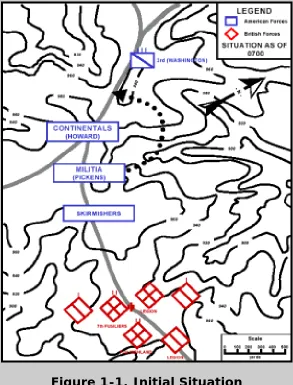
Figure 1-1. Initial Situation In the main line of battle, Morgan
placed his Continentals and Virginia militia, who were former Continentals, on the military crest of the rise under COL Howard’s command. They
numbered 450. About 150 meters downhill, toward the expected reaction of the enemy, he stationed the bulk of his militia under the command of COL Pickens. Another 150 meters down the hill, he positioned a skirmisher line of 150 militia riflemen. Behind the hill, he placed LTC Washington’s 120-strong cavalry force in reserve. Each line was within rifle range but out of musket range of the line behind it. As
explained the night before, skirmishers only needed to fire one or two shots and then retire to the second line. In turn, the militia in the second line only needed to fire two volleys. Then they could retire to their left around to the rear of the hill and, protected by the cavalry, reform. The cavalry would counterattack British cavalry as the situation allowed, guard the militia horses, or cover a retreat if necessary. (See Figure 1-1.)
Tarleton deployed his forces from their march formation into a line, with three light infantry companies on the right, the Legion infantry in the center, and one regular British battalion on the left of this main line. He stationed one troop of cavalry on each flank of the main line and one three-pounder gun on either side of the Legion infantry. He kept the other regular British battalion and the remainder of his Legion cavalry in reserve. The British immediately came under fire from the skirmishers. Tarleton sent a troop of dragoons to disperse them while his main forces deployed. The dragoons lost 15 of 50 men. The skirmishers retired to the American second line.
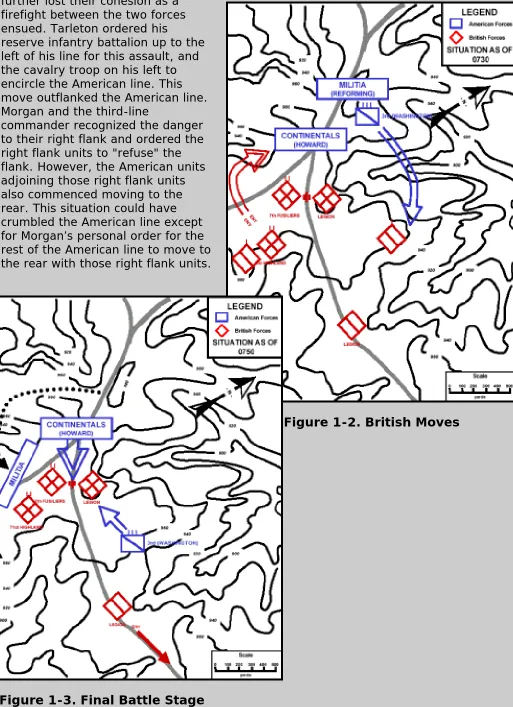
Tarleton then assaulted the second line. His artillery opened fire, but apparently on the third line. The American rifle fire disrupted his formation. When his forces closed to within 50 meters of the second line, they received a volley from the militia that staggered and further disrupted them. The militia’s expected second volley was more ragged as it began to withdraw. Seeing this movement, Tarleton ordered his right-hand troop of dragoons to charge the militia as it withdrew. The American cavalry charged this troop and
overwhelmed it, driving the dragoons off the field in accordance with Morgan’s plan. (See Figure 1-2.)
Figure 1-2. British Moves further lost their cohesion as a
firefight between the two forces ensued. Tarleton ordered his
reserve infantry battalion up to the left of his line for this assault, and the cavalry troop on his left to encircle the American line. This move outflanked the American line. Morgan and the third-line
commander recognized the danger to their right flank and ordered the right flank units to "refuse" the flank. However, the American units adjoining those right flank units also commenced moving to the rear. This situation could have crumbled the American line except for Morgan’s personal order for the rest of the American line to move to the rear with those right flank units.
Figure 1-3. Final Battle Stage
British left flank units. (See Figure 1-3.) The battle was over within an hour of Tarleton’s first assault. The British losses were 110 killed, 200 wounded, and 700 prisoners, although Tarleton personally escaped with about 140 of his cavalry. The British could not replace the mobile forces that Tarleton lost at the Cowpens. Without a mobile force, the British no longer had an effective counter to American partisans and light forces. The British later won at Guilford Court House, but suffered such heavy losses that they had to abandon their operations in the interior of the Carolinas.
Morgan combined the science of tactics with his application of the tactical art to defeat superior numbers of British forces under Tarleton. Morgan arrived at a unique and creative solution to his tactical problems. Trusted information about Tarleton’s style was a crucial part of his deployment plan. Morgan understood the diverse military and social elements of his force (untried militia, Continentals, and
volunteers). He asked no more of any element than it could deliver and used the strengths of each to the fullest. Daniel Morgan used tactical art to convert his
understanding of American troops, knowledge of human nature, and rapport with his soldiers into the vital components of a brilliant tactical victory.
HASTY VERSUS DELIBERATE OPERATIONS
1-21. A hasty operation is an operation in which a commander directs his immediately available forces, using fragmentary orders (FRAGOs), to perform activities with minimal preparation, trading planning and preparation time for speed of execution. A deliberate operation is an operation in which a commander’s detailed intelligence concerning the situation allows him to develop and coordinate detailed plans,
including multiple branches and sequels. He task organizes his forces specifically for the operation to provide a fully synchronized combined arms team. He conducts extensive rehearsals while conducting shaping operations to set the conditions for the conduct of his decisive
operation.
1-22. Most operations lie somewhere along a continuum between these two extremes. The 9th Armored Division’s seizure of the bridge at Remagen in March 1945 illustrates one end, a hasty operation conducted with the forces immediately available. At the other end of the continuum is a deliberate operation, such as the 1st Infantry Division’s breach operation during the opening hours of Operation Desert Storm. Ongoing improvements in
information and C2 systems continue to assist in the development of a common operational picture of friendly and enemy forces while facilitating decision
making and communicating decisions to friendly forces. These improvements can help diminish the distinction between hasty and deliberate operations; they cannot make that distinction irrelevant.
CHOICES AND TRADEOFFS
plan and prepare for the operation or bring additional forces to bear on the problem. The commander makes that choice in an environment of uncertainty, which always entails some risk.
1-24. The commander may have to act based only on his available combat information in a time-constrained environment. Combat information is
unevaluated data gathered by or provided to a commander that, due to its highly perishable nature or the critical nature of the tactical situation, cannot be processed into tactical intelligence or other staff products in time to meet the commander’s information requirements (FM 6-0). The commander must understand the inherent risk of acting only on combat information since it is vulnerable to enemy deception operations and can be misinterpreted at any stage up through reporting channels. The unit intelligence staff helps the commander assign a level of confidence to combat information he uses in decision making.
1-25. Uncertainty and risk are inherent in tactical operations and cannot be eliminated. A commander cannot be successful without the capability of acting under conditions of uncertainty while balancing various risks and taking
advantage of opportunities. Although the commander strives to maximize his knowledge about his forces, the terrain and weather, civil considerations, and the enemy, he cannot let a lack of information paralyze him. The more
intelligence on the enemy, the better able the commander is to make his
assessment. Less information means that the commander has a greater risk of making a poor decision for the specific situation. A commander never has perfect intelligence, but knowing when he has enough information to make a decision within the higher commander’s intent and constraints is part of the art of tactics and is a critical skill for a commander.
1-26. The commander should take the minimum time necessary in planning and preparing to ensure a reasonable chance of success. Reduced coordination at the start of the operation results in less than optimum combat power
brought to bear on the enemy, but often allows for increased speed and momentum while possibly achieving surprise. The commander must balance the effects of reduced coordination against the risk that the effects of increased coordination will not match the enemy’s improved posture over time. The more time the commander takes to prepare for the operation, including improving his situational understanding, the more time the enemy has to prepare and move additional units within supporting range or distance. Additionally, it reduces the time his subordinates have to conduct their own planning and preparations. If the enemy can improve his disposition faster than the friendly force can, the delays in execution decrease the commander’s chances of success.
1-27. It is better to err on the side of speed, audacity, and momentum than on the side of caution when conducting military operations, all else being equal. Bold decisions give the best promise of success; however, one must
differentiate between calculated risks and a military gamble. A calculated risk is an operation in which success is not a certainty but which, in case of failure, leaves sufficient forces to cope with whatever situations arise (FM 6-0). The willingness to take calculated risks requires military judgment to reduce risk by foresight and careful planning and to determine whether the risk is worth
destruction of one’s force (FM 6-0). Rare situations can arise where even a gamble may be justified; for example, when defeat is merely a matter of time and the only chance lies in an operation of great risk. LTC Chamberlain’s decision to conduct a bayonet charge with what was left of the 20th Maine on the second day of the Battle of Gettysburg is an example of a military gamble.
1-28. The commander can be less deliberate in planning and preparing for an operation when facing a clearly less-capable and less-prepared enemy force. In these circumstances, the commander can forego detailed planning, extensive rehearsals, and significant changes in task organization. For example, an attacking battalion task force encountering enemy security outposts just
moving into position will conduct actions on contact to immediately destroy the outposts without the loss of momentum. It then follows that against a larger and more prepared enemy, the commander needs more preparation time and a larger force to succeed. If the commander determines that he cannot defeat the enemy with the forces immediately at hand, he must determine what additional measures he must take to be successful. The measures can include any or all of the factors along the continuum.
1-29. This does not imply that a commander conducting a hasty operation foregoes the advantages provided by his combined arms team. A commander who chooses to conduct hasty operations synchronizes the employment of his forces in his head as he issues FRAGOs. He uses tangible and intangible
factors, such as the training level and experience of his subordinates, his own experience, perception of how the enemy will react, understanding of time-distance factors, and knowledge of the strengths of each subordinate and supporting unit to achieve the required degree of synchronization.
RISK REDUCTION
1-30. An important factor in reducing a commander’s risk is how much intelligence he has about the enemy. As intelligence becomes available, the commander determines where along the continuum of hasty versus deliberate operations he will operate to accomplish his mission. There is no set of rules to determine this point—any choice entails risk. If the commander decides to execute a hasty operation based on limited intelligence, he risks an
uncoordinated operation against an enemy about which he knows little.
Moreover his forces may not be strong enough to accomplish their mission with minimum casualties. This could lead to piecemeal commitment and potential defeat in detail. He must balance this option against the risk of waiting to attack, which allows the enemy time to reinforce or conduct additional preparation.
1-31. When higher headquarters determines the time to start an operation, or in a defense when the enemy initiates the operation, the commander has little flexibility regarding where to operate along the continuum of hasty versus deliberate operations. In these situations he must use all the time available to conduct planning and preparation. While the military decision making process tasks used in a time-constrained environment are the same as in the full process, many are done mentally by the commander or with less staff involvement. Each commander decides how to shorten the process. A commander may use the complete process to develop the plan, while a
1-32. The commander can reduce the risk associated with any situation by increasing his knowledge of the terrain and friendly, neutral, and enemy forces. He has a greater risk of making a poor decision if his situational understanding is incomplete or faulty. If the commander lacks sufficient information to make an informed choice, his first priority must be to gain the required information to support his decision making while at the same time taking precautions to
protect his force from surprise. During an unexpected encounter with the enemy, often an acceptable way to gain that intelligence is to conduct a hasty attack to determine the size and disposition of the enemy force. The
commander adapts his reconnaissance and intelligence efforts to the existing situation and picks the appropriate tools to answer his critical information requirements. For example, the commander can retask his reconnaissance assets or increase the size of his reconnaissance effort.
1-33. A commander—supported by a digital C2 system that can access accurate, real-time information—takes advantage of a different operational environment than that facing a commander with an analog C2 system. Greatly improved knowledge of the enemy and friendly situations facilitates his
employment of precision fires, his conduct of decisive maneuver at extended ranges, and his provision of responsive and flexible support of his forces. The integration of advanced information technologies, highly capable leaders, and agile organizational systems reduces risk and facilitates the conduct of full spectrum operations.
1-34. Risk reduction does not always mean increasing knowledge of the enemy at the expense of time. A commander can partially compensate for a lack of intelligence by being flexible in his troop dispositions through an increase in the depth of the security area, size and number of security units, and size of the reserve. The commander’s choices of combat and movement formations provide the versatility to allow for initial enemy contact with the smallest possible friendly force. This allows the greatest flexibility in meeting unforeseen enemy dispositions. Another way to compensate for increased risk is to allow time and resources for subordinate elements to develop the situation.
1-35. Because uncertainty exists in all military operations, every military decision contains risk. The commander exercises tactical art when he decides how much risk to accept. As shown in Figure 1-4, the commander has several techniques available to reduce the risk associated in a specific operation. Some of these techniques for reducing risk take resources from the decisive
Figure 1-4. Risk Reduction Factors
1-36. The commander has the option to redirect the efforts of forces
previously used to reduce his risk toward strengthening his decisive operation as more information becomes available. In any operation, the relationship
between information, uncertainty, risk, size of reserves and security forces, and the disposition of the main body may change frequently. The commander must continually weigh this balance and make adjustments as needed.
1-37. These adjustments can create problems. Too many changes or changes made too rapidly in task organization, mission, and priorities can have negative effects on the operations process. For example, if a commander changes the task organization of his force too frequently, the force fails to develop the flexibility provided by teamwork. On the other hand, if he fails to change the task organization when dictated by circumstances, the force lacks flexibility to adapt to those changing circumstances. It is then unable to react effectively to enemy moves or act with the concentration of effects that lead to mission success.
SOLVING TACTICAL PROBLEMS
1-38. Success in tactical problem solving results from the aggressive,
intelligent, and decisive use of combat power in an environment of uncertainty, disorder, violence, and danger. A commander wins by being on the offense, initiating combat on his own terms—at a time and place of his choosing. He never surrenders the initiative once he gains it. He builds momentum quickly to win decisively through the rapid application of available combat power,
operating inside the enemy’s decision making cycle, and mastering the
transitions between the defense to the offensive and vice versa. These rules of thumb allow the commander to maximize friendly and minimize enemy combat power by preventing the enemy from fighting as a combined arms force.
1-39. Offensive action is key to achieving decisive results. Tactical
produce the theater-level effects required by the operational commander. Circumstances may require defending; however, tactical success normally requires shifting to the offense as soon as possible. The offense ends when the forces conducting it accomplish their missions, reach their limits of advance, or approach culmination. Those forces then consolidate, resume the attack, or prepare for other operations.
1-40. A commander wants to initiate combat on his own terms to give himself important advantages. This allows him to mass the effects of his combat power against selected inferior and isolated enemy units in vulnerable locations.
Possession of the initiative allows a commander to continually seek vulnerable spots and shift his decisive operation when opportunities occur. A commander seizes, retains, and exploits the initiative by—
● Maneuvering more rapidly than the enemy to gain positional
advantage (the place where the effects of fires are most destructive) over the enemy.
● Employing firepower to facilitate and exploit positional advantage.
● Sustaining his forces before, during, and after the engagement with
the enemy.
● Achieving and maintaining information superiority.
● Planning beyond the initial operation and anticipating possible events.
A commander never surrenders the initiative once he gains it. He presses the fight tenaciously and aggressively. He accepts risk while leading soldiers and pushing systems to their limits.
1-41. The tactician, notwithstanding his status as a commander or a staff officer, seeks ways to build momentum quickly by seizing the initiative and executing shaping, sustaining, and decisive operations at a high tempo. Momentum helps to retain and complements the initiative. Concentrating the effects of combat power at the decisive place and time overwhelms an enemy and gains control of the situation. Rapid maneuver to place the enemy in a disadvantageous position also builds momentum. Momentum allows the tactician to create opportunities to engage the enemy from unexpected directions with unanticipated capabilities. Having seized the initiative, the tactician continues to control the relative momentum by taking action to
maintain focus and pressure, controlling the tempo of operations, and creating and exploiting opportunities, while always assessing the situation and taking calculated risks.
1-42. The commander’s C2 system assists the rapid building of momentum by allowing him to see and understand the situation so quickly that his forces can act before the enemy forces can react to the initial situation. His operations process focuses on executing rather than planning. Modern information
degree, gain an accruing advantage that becomes significant over time; making decisions quickly—even with incomplete information—is crucial.
1-43. The tactician chooses from a number of tactical options to create the solution to the tactical problem facing him. (Chapter 2 lists these options as the types and forms of military operations and forms of maneuver.) Although he solves the specific tactical problem facing him by following the general
principles outlined in this manual, there is no single, doctrinally correct, procedurally derived solution to any problem. The tactician who employs the more appropriate tactics given the existing situation has a distinct advantage over his opponent, even if their forces have equal combat power.
1-44. The tactician uses his mastery of the art and science of tactics, his understanding of the situation, and his judgment to create unique solutions appropriate to the mission and the other specific factors of METT-TC. There are usually several solutions that might work, although some will be more
effective. He seeks a solution that defeats the enemy in the time available at the least cost in men and materiel. It should be a decisive solution that
postures the unit for future missions and provides for the greatest flexibility to account for unexpected enemy actions or reactions. The solution must be in accordance with the higher commander’s intent. A thorough understanding of the enemy greatly assists the commander in his development of workable solutions. Commander’s visualization is the doctrinal term for this process. (FM 6-0 describes commander’s visualization.)
1-45. The tactician learns to cut to the heart of a situation, recognize its important elements, and base his decisions on those important elements as he masters his profession. The ability to do this cannot be acquired overnight. A tactician develops this capability after years of schooling, self-study, and practical training experiences, which eventually develop the intuitive faculties required to solve tactical problems. He rarely gets the opportunity to practice the science and art of tactics under actual combat conditions.
1-46. Doctrine requires human judgment when applied to a specific situation. In choosing a solution to a tactical problem, applicable laws and regulations, the mission, the laws of physics, human behavior, and logistic realities
constrain the tactician, not standardized techniques and procedures. The true test of the tactician’s solution is not whether it uses the specific techniques or procedures contained in this manual, but whether the techniques and
procedures used were appropriate to the situation. Tactical proficiency is not defined by mastery of written doctrine, but by the ability to employ available means to win battles and engagements. A solution may not match any previous doctrinal example; however, the language used to communicate that concept must be technically precise and doctrinally consistent, using commonly
understood and accepted doctrinal terms and concepts.
1-47. Transitions between the types and forms of operations are difficult and, during execution, may create unexpected opportunities for Army or enemy forces. The tactician must quickly recognize such opportunities. He develops transitions as branches during the planning process and acts on them
immediately as they occur. Transition between one type or form of an operation to another is a complex operational consideration.
prevent the friendly force from accomplishing its mission. That is the end goal of all military operations. Decisive tactical victory occurs when the enemy no longer has the means to oppose the friendly force. It also occurs when the enemy admits defeat and agrees to a negotiated end of hostilities. Historically, a rapid tactical victory results in fewer friendly casualties and reduced resource expenditures. However, the tactician avoids gambling his forces and losing his combined arms synchronization in search of rapid victory.
Chapter 2
Common Tactical Concepts and Graphic Control Measures
In war, obscurity and confusion are normal. Late, exaggerated or misleading information, surprise situations, and counterorders are to be expected.
Infantry in Battle, 1939
The tactician must understand the common tactical concepts and definitions used by the military profession in the conduct of offensive and defensive operations. This chapter introduces the doctrinal hierarchy that forms the framework by which this manual is organized. The concepts and terms in this chapter are common to most operations. This manual discusses those concepts and terms specific to a type or form of operations in the corresponding chapter. For example, Chapter 4 discusses the
objective as a control measure.
CONTENTS
Doctrinal Hierarchy
The Operational Framework Principles of War
Tenets of Army Operations The Factors of METT-TC
Elements of Operational Design Battlefield Operating Systems Basic Tactical Concepts
Combined Arms Decisively Engaged Defeat in Detail Flanks Maneuver Mutual Support Operation Piecemeal Commitment Reconstitution
Rules of Engagement Supporting Distance Supporting Range Tactical Mobility
Basic Tactical Graphic Control Measures Air Corridor
Area of Operations and Boundaries Assembly Areas
Checkpoint Contact Point
Critical Friendly Zone
Direct Fire Control Measures Deep, Close, and Rear Areas
Fire Support Coordination Measures Fire Support Targets
Forward Line of Own Troops Line of Contact
Names Area of Interest Obstacle Control Measures Phase Line
Position Area of Artillery Route
Targeted Area of Interest
DOCTRINAL HIERARCHY
rapidly shifts from one type or form of operation to another to continually keep the enemy off balance while positioning his forces for maximum effectiveness. Flexibility in
transitioning contributes to a successful operation. A good tactician chooses the right combinations of combined arms to place the enemy at the maximum disadvantage.
Figure 2-1. Doctrinal Hierarchy of Operations
2-2. The commander conducts tactical enabling operations to assist the planning, preparation, and execution of any of the four types of military operations (offense,
defense, stability, and support). Tactical enabling operations are never decisive operations in the context of offensive and defensive operations; they are either shaping or sustaining operations. Part IV of this manual discusses tactical enabling operations that are not the subject of a separate field manual. The commander uses tactical enabling operations to help him conduct military actions with minimal risk.
2-3. This hierarchy does not describe discrete, mutually exclusive operations. All tactical missions can contain elements of several different types and subordinate forms. For example, an attacking commander may have one subordinate conducting an
envelopment, with another subordinate conducting a frontal attack to fix the enemy. The enveloping force usually attacks once the direct-pressure force makes a movement to contact while repeatedly attacking to keep pressure on the fleeing enemy. The encircling force uses an envelopment to conduct a series of attacks to destroy or clear enemy forces in its path on the way to its blocking position. Once it occupies the blocking position, the unit may transition to a defense as it blocks the retreat of the fleeing enemy force.
THE OPERATIONAL FRAMEWORK
2-4. The operational framework consists of the arrangement of friendly forces and resources in time, space, and purpose with respect to each other and the enemy or situation. It consists of the area of operations, battlespace, and the battlefield
responsibility for commanders and provides a way for them to visualize how they will employ forces against the enemy. Army commanders design an operational framework to accomplish their mission by defining and arranging its three components. The commander uses the operational framework to focus combat power. Combat power is the total means of destructive and/or disruptive force which a military unit/formation can apply against the opponent at a given time (JP 1-02).
2-5. As part of the military decision making process, the commander visualizes his battlespace and determines how to arrange his forces. The battlefield organization is the allocation of forces in the area of operations by purpose. It consists of three
all-encompassing categories of operations: decisive, shaping, and sustaining (FM 3-0).
Purpose unifies all elements of the battlefield organization by providing the common focus for all actions. The commander organizes his forces according to purpose by determining whether each unit’s operation will be decisive, shaping, or sustaining. Those decisions form the basis of his concept of operations. He describes the area of operations (AO) in terms of deep, close, and rear areas when the factors of METT-TC require the use of a spatial reference. FM 3-0 explains the operational framework and battlefield organization.
Principles of War
● Objective
● Offensive
● Mass
● Economy of force
● Maneuver
● Unity of command
● Security
● Surprise
● Simplicity
Tenets of Army Operations
● Initiative
● Agility
● Depth
● Synchronization
● Versatility
Factors of METT-TC
● Mission
● Enemy
● Terrain and weather
● Troops and support
available
● Time available
● Civil considerations
PRINCIPLES OF WAR
2-6. The nine principles of war defined in FM 3-0 provide general guidance for conducting war and military
operations other than war at the strategic, operational, and tactical levels. They are fundamental truths governing combat operations. The principles are the enduring
bedrock of Army doctrine. First published in 1923 as general principles in Field Service Regulations United States Army, they have stood the tests of analysis, experimentation, and practice. They are not a checklist and their degree of application varies with the situation. Blind adherence to these principles does not guarantee success, but each deviation may increase the risk of failure. The principles of war lend rigor and focus to the purely creative aspects of tactics and provide a crucial link between pure theory and actual application.
TENETS OF ARMY OPERATIONS
2-7. The tenets of Army operations—initiative, agility, depth, synchronization, and versatility—build on the principles of war. They further describe the characteristics of successful operations. While they do not guarantee success, their absence risks failure. FM 3-0 defines the tenets.
THE FACTORS OF METT-TC
Elements of Operational Design
● End state and military
conditions
● Center of gravity
● Decisive points and
objectives
● Lines of operation
● Culminating point
● Operational reach,
approach, and pauses
● Simultaneous and
sequential operations
● Linear and nonlinear
operations
● Tempo
Battlefield Operating Systems
● Intelligence
● Maneuver
● Fire support
● Air defense
● Mobility/
countermobility/ survivability
● Combat service support
● Command and control
For example, terrain and weather effects on movement rates and fuel consumption are quantifiable and, therefore, part of the science of war. Terrain and weather effects on soldier morale are not totally quantifiable and are part of the art of war. FM 6-0 provides a detailed discussion of the factors of METT-TC.
ELEMENTS OF OPERATIONAL DESIGN
2-9. A major operation begins with a design—an idea that guides the conduct (plan, prepare, execute, and assess) of the operation. The operational design provides a conceptual linkage of ends, ways, and means. The
elements of operational design are tools to aid the commander in visualizing major operations and shaping his intent. They help the commander clarify and refine his vision by providing a framework for him to describe the operation in terms of task and purpose. FM 3-0 defines each of these elements. Their utility diminishes with each succeeding tactical echelon. What is envisioned as a decisive point by the land component commander
becomes a clearly delineated objective for a battalion task force.
BATTLEFIELD OPERATING SYSTEMS
2-10. There are seven battlefield operating systems (BOS). The seven BOS definitions from FM 7-15 are—
● The intelligence system is the activity to
generate knowledge of and products portraying the enemy and the environmental features required by a command planning, preparing, and executing operations.
● The maneuver system is the movement of forces to achieve a position of
advantage with respect to enemy forces. This system includes the employment of forces on the battlefield in combination with direct fire or fire potential. This system also includes the conduct of tactical tasks associated with force
projection.
● The fire support system encompasses the collective and coordinated use of
target-acquisition data, indirect-fire weapons, fixed-wing aircraft, offensive information operations, and other lethal and nonlethal means against targets located throughout an AO.
● The air defense system is the employment of all active measures designed to
nullify or reduce the effectiveness of attack by hostile aircraft and missiles after they are airborne.
● The mobility, countermobility, and survivability system.
■ Mobility operations preserve the freedom of maneuver of friendly forces.
■ Countermobility operations deny mobility to enemy forces.
■ Survivability operations protect friendly forces from the effects of
● The combat service supp