Supported by the National Council of Technological and Scientific Development (CNPq), Brazil (Project No. 445322/2014-4).
Gender and Age Effects on the Expression of Genes
Related to Lipid Metabolism in Broiler’s Liver
Angélica de Souza Khatlab
1, Ana Paula Del Vesco
2, Eliane Gasparino
1*,
Adhemar Rodrigues de Oliveira Neto
31Department of Animal Science, State University of Maringá, Maringá, Brazil
2Department of Animal Science, Federal University of Sergipe, São Cristóvão, Brazil
3EVONIK of Brazil, São Paulo, Brazil
*Corresponding author: [email protected]
ABSTRACT
de Souza Khatlab A., Del Vesco A.P., Gasparino E., de Oliveira Neto A.R. (2018): Gender and age effects on
the expression of genes related to lipid metabolism in broiler’s liver. Czech J. Anim. Sci., 63, 103–109.
Two experiments were conducted to assess gender (Experiment 1) and age (Experiment 2) effects on the expression of genes related to lipid metabolism in broiler chickens. The expression of fatty acid synthase (FAS), apolipoprotein A-I (APOA-I), apolipoprotein B (APOB), adiponectin (ADIPOQ), liver kinase B1 (LKB1), and AMP-activated protein kinase α-1 (AMPKα-1) genes was evaluated by qRT-PCR. In Experiment 1, we observed a gender effect on feed intake, as male broilers presented greater feed intake than females. Female broilers pre-sented greater gene expression of FAS, and lower expression of ADIPOQ and AMPKα-1, than males. A gender effect was not observed for the gene expression of APOA-I, APOB, or LKB1. In Experiment 2, there was a significant age effect on feed intake and weight gain. Broilers 42 days of age presented greater feed intake and weight gain than 21-day-old birds. 21-day-old broilers showed greater expression of APOA-I, ADIPOQ, LKB1,
and AMPKα-1, and lower APOB gene expression in the liver than 42-day-old broilers. Age had no effect on
FAS gene expression. Our results show that the gender and age could act on the expression of genes related to lipid synthesis, such as FAS and APOB, and also on genes related to lipid oxidation, such as ADIPOQ, LKB1,
and AMPK.
Keywords: apolipoprotein; lipogenesis; lipolysis
High body fat content in chickens has been the subject of numerous studies because it is related to reduced feed efficiency, reduced carcass yield, and lower customer acceptance of the final product (Wu et al. 2006). The accumulation of body fat is a result of absorption, synthesis, and oxidation of lipids (Smink et al. 2010) which are determined by the balance between lipogenesis, which occurs mostly in the liver of birds, and by lipolysis (β-oxidation) in mitochondria (Nelson and Cox 2011).
According to Saadoun and Leclercq (1987), the synthesis of lipids in adipose tissue is limited, and thus, lipid deposition in this tissue depends on the availability of lipid substrates derived from blood plasma. Lipids in the plasma originate from the diet and the hepatic lipogenesis process (Hermier 1997). Thus, lipid deposition and β-oxidation mechanisms depend on the transport of lipids. In the plasma, lipids are transported with lipo-proteins, which contain apolipolipo-proteins, such as apolipoprotein A-I (apoA-I) and apolipoprotein B (apoB) (Ginsberg 2002).
Male and female broilers present some differences in the body fat deposition process, and females have a higher rate of fat deposition than males (Silva 2012). Studies suggest that this is possibly due to metabolic and hormonal differences (Tumova and Teimouri 2010). Similar to gender, the age of the chickens can also influence the fat synthesis rate, since greater fat content is observed in carcasses of older chickens (Zerehdaran et al. 2005).
Thus, the present study was developed under the hypothesis that the differences in fat deposition among chickens of different genders and ages may occur as a function of differences in the expression of genes related to lipid synthesis and oxidation. Therefore, our objective was to evaluate animal performance and the gene expression of fatty acid synthase (FAS), apolipoprotein A-I (APOA-I), apolipoprotein B (APOB), adiponectin (ADIPOQ), liver kinase B1 (LKB1), and AMP-activated pro-tein kinase α-1 (AMPKα-1) in the liver of male and female 42-day-old broilers (Experiment 1), and in the liver of females 21 and 42 days of age (Experiment 2).
MATERIAL AND METHODS
This work was conducted in accordance with the specifications of the Ethics Committee of the State University of Maringá.
Experimental design
Experiment 1. This study was conducted to evalu-ate the effect of broiler chicken (Cobb 500, Gallus gallus) gender on performance and on the expres-sion of genes related to lipid metabolism. For the experiment, 60 females and 60 males (21-day-old) were used. The animals were separated in collec-tive cages (at a density of 10 birds/m2); each cage with 10 birds was considered as one experimental
unit for performance parameters (n = 6). The birds were raised in an acclimatized room at comfortable temperature according to Cobb-Vantress (2016): temperature was maintained at 25°C with 60% relative humidity and then decreased gradually to 18°C and 60% relative humidity until day 42. Throughout the experimental period, the animals had free access to water and a balanced diet to meet their nutritional demands (Rostagno et al. 2011), consisting of a corn and soy-based feed with 19.7% crude protein and 3170 kcal/kg. A 24-h light schedule was used.
Weight gain was calculated as: (broiler weight at 42 days of age – weight at 21 days of age). Feed intake was calculated as the difference between the amount of feed offered in the experimental period and the feed residue at day 42. The feed intake and weight gain were corrected for mortality.
Experiment 2. This study was conducted to evaluate the effect of age of female broilers on performance and on the expression of genes re-lated to lipid metabolism. For the experiment, one hundred one-day-old female broilers were used. The animals were separated in collective cages (at a density of 10 birds/m2), and each cage with 10 birds was considered as one experimental unit for performance parameters (n = 10). The birds were raised in an acclimatized room at thermoneutral according to Cobb-Vantress (2016) as described above. Throughout the experimental period, the animals had free access to water and a balanced diet to meet their nutritional demands (Rostagno et al. 2011), consisting of a corn and soy-based feed with 21.6% crude protein and 3052 kcal/kg in the starter period (1–21 days), and 19.7% crude protein and 3170 kcal/kg in the grower period (22–42 days). A 24-h light schedule was used.
Feed intake was calculated as the difference between the amount of feed offered through the experimental period and the feed residue at day 21 for the first experimental period (days 1–21), and between the amount of feed offered through the experimental period and the feed residue at day 42 for the second experimental period (days 22–42). To calculate the weight gain, all birds were weighed at days 1, 21, and 42. The feed intake and weight gain were corrected for mortality.
Gene expression. Gene expression in Experi-ments 1 and 2 was evaluated in the liver. For gene expression analysis birds were considered as experi-mental units (n = 6). Total RNA was individually extracted from six birds of each treatment using TRIzol® reagent (Invitrogen, USA) according to the manufacturer’s instructions (1 ml/100 mg tis-sue). All of the materials used had been previously treated with the RNase inhibitor RNase AWAY® (Invitrogen). The total RNA concentration was measured using a spectrophotometer at a wave-length of 260 nm. The RNA integrity was analyzed using 1% agarose gel stained with 10% ethidium bromide and visualized under ultraviolet light. The RNA samples were treated with DNase I (Invitro-gen) according to the manufacturer’s instructions to remove potential genomic DNA contamina-tion. A SuperScript™ III First-Strand Synthesis Super Mix kit (Invitrogen) was used for cDNA synthesis from 1 μg of DNase-treated total RNA, according to the manufacturer’s instructions. The cDNA concentration was measured using a spectrophotometer at a wavelength of 260 nm. The cDNA samples were diluted to 40 ng/μl and stored at –20°C until further use as a template in the amplification reaction.
Real-time PCR was performed using the fluores-cent dye SYBR Green (SYBR® Green PCR Master Mix, Applied Biosystems, USA). The amplification reaction consisted of 5 μl of diluted cDNA, 0.5 μl
of each primer (forward and reverse) at 10 μM (final concentration in the reaction of 200 nM), 12.5 μl of SYBR® Green PCR Master Mix, and water up to a total volume of 25 μl. To measure each gene reaction efficiency, a series of 25 μl re-actions was performed similar to that above using as a template 5 μl of the cDNA pool derived from a serial dilution. Thermal cycling parameters for all genes were the following: hot-start, 95°C for 10 min, followed by 40 cycles of denaturation and annealing/extension, 95°C for 15 s, 60°C for 1 min, and then, melting curve, 65–95°C.
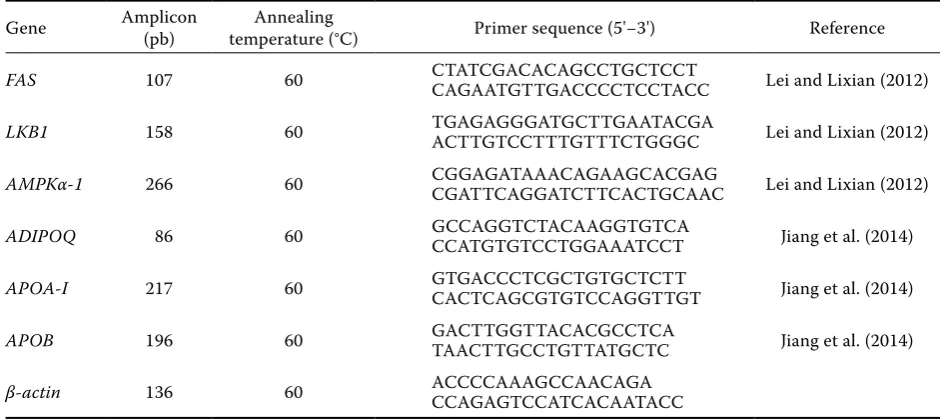
The primers used for gene amplification reac-tions were designed according to Lei and Lixian (2012) and Jiang et al. (2014) (Table 1). Two endo-genous controls, β-actin and GAPDH, were tested, and β-actin (Accession No. L08165) was selected because its amplification efficiency was higher and similar to the amplification efficiency of the target genes. All of the analyses were performed in duplicate, each in a volume of 25 µl.
[image:3.595.61.534.519.729.2]Gallus gallus specific primers were used in the amplification of all genes. The amplification effi-ciencies were similar for the genes of interest, with 90–110% efficiency. The analyses of the dissocia-tion curves did not reveal any non-specific PCR products, such as the formation of primer dimers, which demonstrated the reliability of the data in the estimated mRNA expressions of the evalu-ated genes. The β-actin used as the endogenous
Table 1. Primer sequences used for quantitative real-time polymerase chain reactions
Gene Amplicon (pb) temperature (°C)Annealing Primer sequence (5'−3') Reference
FAS 107 60 CTATCGACACAGCCTGCTCCT CAGAATGTTGACCCCTCCTACC Lei and Lixian (2012)
LKB1 158 60 TGAGAGGGATGCTTGAATACGA ACTTGTCCTTTGTTTCTGGGC Lei and Lixian (2012)
AMPKα-1 266 60 CGGAGATAAACAGAAGCACGAG CGATTCAGGATCTTCACTGCAAC Lei and Lixian (2012)
ADIPOQ 86 60 GCCAGGTCTACAAGGTGTCA CCATGTGTCCTGGAAATCCT Jiang et al. (2014)
APOA-I 217 60 GTGACCCTCGCTGTGCTCTT CACTCAGCGTGTCCAGGTTGT Jiang et al. (2014)
APOB 196 60 GACTTGGTTACACGCCTCA TAACTTGCCTGTTATGCTC Jiang et al. (2014)
β-actin 136 60 ACCCCAAAGCCAACAGA CCAGAGTCCATCACAATACC
control did not show any statistically significant differences among the treatments, which verified the efficiency of β-actin as an endogenous control.
Statistical analysis. The 2–∆Ct method (Livak
and Schmittgent 2001) was used to analyze relative expression. The results are expressed as the means and standard deviations. The Shapiro–Wilk test was applied to evaluate the normality of the data. The experiments were conducted in a completely randomized design: Experiment 1 evaluated the gender effect (male and female), and Experiment 2 evaluated the effect of two ages (21 and 42 days of age). The results were submitted to ANOVA, and when the effect was significant, the averages were compared using Tukey’s test (P < 0.05) by the SAS software (Statistical Analysis System, Version 9.0, 2002).
RESULTS
Experiment 1. Gender effects on performance
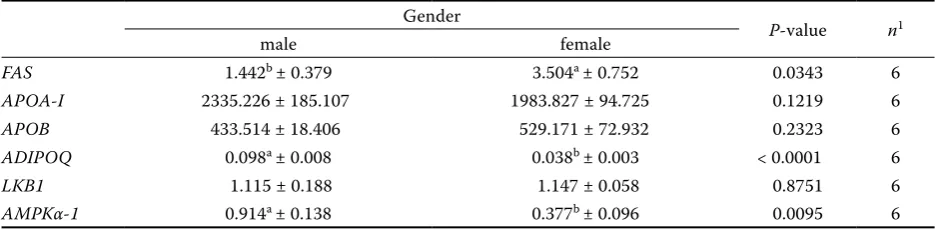
and gene expression are presented in Table 2 and Table 3, respectively. A significant gender effect
on feed intake was found (P = 0.0421), as male broilers had greater feed intake than females. There was no difference between weight gain of male and female broilers.
Regarding gene expression, females presented greater expression of FAS than males (3.504 vs 1.442 arbitrary units (AU)). Females also had lower expression of ADIPOQ (0.038 vs 0.098 AU) and
AMPKα-1 (0.377 vs0.914 AU) than male broilers. There was no significant gender effect on APOA-I,
APOB or LKB1 gene expression (Table 3).
Experiment 2. Age had a significant effect on feed
intake (P = 0.0003) and weight gain (P < 0.0001) (Table 4). At 42 days of age broilers had greater feed intake and weight gain than 21 day-old birds.
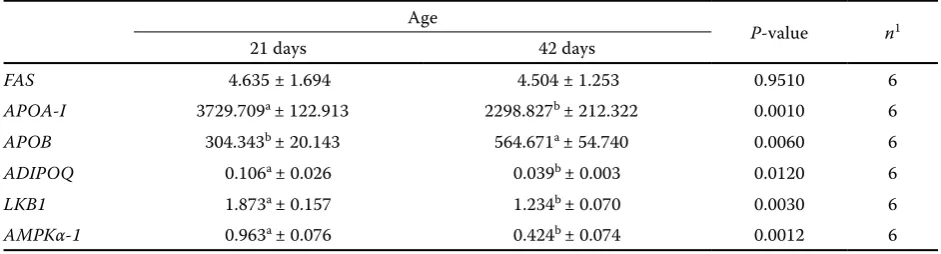
We observed an age effect on APOA-I (P = 0.0010),
APOB (P = 0.0060), ADIPOQ (P = 0.0120), LKB1 (P = 0.0030), and AMPKα-1 (P = 0.0012) gene expres-sion (Table 5). Broilers at day 21 presented greater expression of APOA-I (3729.709 AU), ADIPOQ
(0.106 AU), LKB1 (1.873 AU), and AMPKα-1
[image:4.595.63.290.125.185.2](0.963AU), and lower APOB gene expression, than broilers at 42 days of age. There was no age effect on FAS gene expression.
Table 2. Feed intake and weight gain of male and female broilers (in kg)
Gender
P-value n1
male female
Feed intake 2.54a ± 0.24 1.71b ± 0.15 0.0421 6 Weight gain 1.72 ± 0.16 1.25 ± 0.17 0.1178 6 a,bmeans within a row with different superscripts significantly
differ by Tukey’s test (P < 0.05); results are means ± SE 1collective cages (10 birds/cage) were considered as
experi-mental units
Table 3. FAS, APOA-I, APOB, ADIPOQ, LKB1, and AMPKα-1 gene expressionin the liver of male and female broilers
Gender
P-value n1
male female
FAS 1.442b ± 0.379 3.504a ± 0.752 0.0343 6
APOA-I 2335.226 ± 185.107 1983.827 ± 94.725 0.1219 6
APOB 433.514 ± 18.406 529.171 ± 72.932 0.2323 6
ADIPOQ 0.098a ± 0.008 0.038b ± 0.003 < 0.0001 6
LKB1 1.115 ± 0.188 1.147 ± 0.058 0.8751 6
AMPKα-1 0.914a ± 0.138 0.377b ± 0.096 0.0095 6
FAS = fatty acid synthase, APOA-I = apolipoprotein A-I, APOB = apolipoprotein B, ADIPOQ = adiponectin, LKB1 = liver kinase B1, AMPKα-1 = AMP-activated protein kinase α-1 (expressed as arbitrary units (AU))
1birds were considered as experimental units
[image:4.595.304.531.125.185.2]a,bmeans within a row with different superscripts significantly differ by Tukey’s test (P < 0.05); results are means ± SE
Table 4. Feed intake and weight gain of broilers at 21 and 42 days of age (in kg)
Age
P-value n1 21 days 42 days
Feed intake 0.76b ± 0.01 1.84a ± 0.09 0.0003 10 Weight gain 0.64b ± 0.01 1.42a ± 0.01 < 0.0001 10 a,bmeans within a row with different superscripts significantly
differ by Tukey’s test (P < 0.05); results are means ± SE 1collective cages (10 birds/cage) were considered as
[image:4.595.63.531.594.709.2]DISCUSSION
Feed intake and weight gain are determined by genetic potential, environment, nutrition, and other factors such as gender and age. In line with the results from literature, in our study males presented greater feed intake than females, and older broilers had greater feed intake and weight gain than younger broilers (Musundire et al. 2017).
Nowadays, besides the best performance pro-vided by the animal breeding, broilers also have in-creased body fat deposition (Tumova and Teimouri 2010). Fat is one of the main problems that occurs in the poultry industry and may represent a sig-nificant source of loss in carcass yield. Increased fat content can also reduce acceptance by consum-ers (Gaya et al. 2006). Body fat deposition is the result of absorption, synthesis, and oxidation of lipids (Smink et al. 2010) which are determined by the balance between lipogenesis and lipolysis (β-oxidation) (Nelson and Cox 2011). These reac-tions are dependent on the transport of lipids in the plasma.
Lipid molecules are transported by lipoproteins, which contain apolipoproteins such as apolipo-protein A-I (apoA-I) and apolipoapolipo-protein B (apoB). Apolipoprotein A-I is the major constituent of the protein fraction of high density lipoprotein (HDL), and thus, apoA-I acts in the reverse trans-port process of cholesterol, from extrahepatic peripheral cells to the liver where it is metabolized (Spady 1999). According to Zhuo et al. (2015), a decreased APOA-I gene expression may affect the
formation of HDL, thereby impairing the process of cholesterol reverse transport. This suggests that decreased APOA-I expression could result in increased accumulation of body fat.
Apolipoprotein B (apoB) is required for the syn-thesis and secretion of chylomicrons and very low density lipoproteins (VLDL) (Ginsberg 2002). Amongst other functions, it has a role in the ab-sorption and secretion of lipids (Cruz et al. 2015). Moreover, apoB is the major protein component of low density lipoprotein (LDL), which transports lipids from the liver to the body’s cells (Novak and Bydlowski 1996). Although the detailed mechanism governing the deposition of fat in the carcass is not fully understood, studies show that abdominal fat accumulation has been associated with a higher content of lipoprotein particles containing apoB-48 and apoB-100, as well as increased APOB gene expression (Zhang et al. 2006). We observed lower
APOA-I and greater APOB gene expression in broilers of 42 days of age, which may help explain, at the level of transcription, the greater body fat observed in older birds (Zerehdaran et al. 2005).
[image:5.595.62.533.125.252.2]Regarding the differences between male and female broilers, we observed that females had higher FAS gene expression than males. FAS is a gene related to lipids synthesis. The synthesis of lipids starts by the action of the multifunctional enzyme complex ACC. After ACC action, lipids synthesis occurs by a sequence of repetitive reac-tions mediated by the action of multienzyme system FAS (Nelson and Cox 2011). Studies have shown that FAS gene expression is positively correlated Table 5. Expression of FAS, APOA-I, APOB, ADIPOQ, LKB1 and AMPKα-1 genes in the liver of 21- and 42-day-old broilers
Age
P-value n1
21 days 42 days
FAS 4.635 ± 1.694 4.504 ± 1.253 0.9510 6
APOA-I 3729.709a ± 122.913 2298.827b ± 212.322 0.0010 6
APOB 304.343b ± 20.143 564.671a ± 54.740 0.0060 6
ADIPOQ 0.106a ± 0.026 0.039b ± 0.003 0.0120 6
LKB1 1.873a ± 0.157 1.234b ± 0.070 0.0030 6
AMPKα-1 0.963a ± 0.076 0.424b ± 0.074 0.0012 6
FAS = fatty acid synthase, APOA-I = apolipoprotein A-I, APOB = apolipoprotein B, ADIPOQ = adiponectin, LKB1 = liver kinase B1, AMPKα-1 = AMP-activated protein kinase α-1 (expressed as arbitrary units (AU))
to the body fat content in animals (Mildner and Clarke 1991). Also, according to Nogalska and Swierczynski (2001), the maximum lipid synthesis capability in body tissues is determined by the level of FAS gene synthesis.
We also evaluated the expression of genes related to lipid oxidation, including the adiponectin gene (ADIPOQ). After ligation of adiponectin to its receptor, the phosphorylation of AMPK occurs (Yamauchi et al. 2003), which in turn phosphoryl-ates and inactivphosphoryl-ates the ACC enzyme. This mecha-nism stimulates lipid oxidation, with a consequent reduction in lipid synthesis, since it regulates the expression of genes involved in lipogenesis such as ACC and FAS (Wang et al. 2009). The reduced
ADIPOQ expression observed in birds at 42 days of age and in female broilers may indicate that the higher body fat content usually observed in females (Silva 2012) and older birds (Zerehdaran et al. 2005) may be related to the lower ADIPOQ
gene expression observed in these animals, since adiponectin is inversely related to fat in the carcass (Whitehead et al. 2005).
Another gene related to oxidation of lipids evalu-ated in this study is AMP-activevalu-ated protein kinase α-1 (AMPKα-1), which has been recognized as an important protein able to regulate lipid me-tabolism due to its action on lipogenic enzymes, such as ACC and FAS (Zhou et al. 2001). The action of AMPK reduces the lipogenesis process and increases lipid oxidation (Winder and Har-die 1999). Activation of AMPK occurs when the level of organic energy (ATP) is reduced, and its activation may occur due to the phosphorylation of the 172 threonine residue present in the alpha catalytic subunit of AMPK (Hawley et al. 2003). Liver kinase B1 (LKB1) is considered the major route of AMPK activation, since an LKB1 deficiency results in an almost complete loss of AMPK activ-ity (Shaw et al. 2005). Our results show that male broilers had higher AMPKα-1 gene expression than females, and 21-day-old broilers had greater LKB1
and AMPKα-1 gene expression than older broilers. The increased expression of these genes may be related to the increased ADIPOQ expression also observed in those birds, since adiponectin activates AMPKα by the LKB1 pathway, thereby promoting an increase in lipid oxidation rate and reduction in lipid synthesis. These results may contribute to the lower fat deposition in the carcass of males and of 21-day-old broilers.
CONCLUSION
The results obtained in this study provide an-other possible explanation at the molecular level for the differences usually observed in body fat content of broilers of different genders and ages; they may occur due to an increased expression of genes related to lipid deposition, such as FAS
and APOB, to a lower APOA-I gene expression and to a lower expression of genes related to lipid oxidation such as ADIPOQ, LKB1, and AMPKα-1.
REFERENCES
Berg J.M., Tymoczko J.L., Stryer L. (eds) (2012): Biochem-istry. Guanabara Koogan, Rio de Janeiro, Brazil. (in Por-tuguese)
Cobb-Vantress (2016): COBB Breeder Management Guide. Available at http://www.cobb-vantress.com/docs/default- source/management-guides/cobb-breeder-management-guide---english.pdf (accessed Feb 1, 2017)
Cruz V.A.R., Schenkel F.S., Savegnago R.P., Grupioni N.V., Stafuzza N.B., Sargolzaei M., Ibelli A.M.G., Peixoto J.O., Ledur M.C., Munari D.P. (2015): Association of apolipo-protein B and adiponectin receptor 1 genes with carcass, bone integrity and performance traits in a paternal broiler line. PLoS ONE, 10, e0136824.
Gaya L.G., Mourao G.B., Ferraz J.B.S. (2006): Genetic-quan-titative aspects of performance, carcass and body com-position traits in broilers. Ciência Rural, 36, S709–S716. (in Portuguese)
Ginsberg H.N. (2002): New perspectives on atherogenesis. Role of abnormal triglyceride-rich lipoprotein metabo-lism. Circulation, 106, 2137–2142.
Hawley S.A., Boudeau J., Reid J.L., Mustard K.J., Udd L., Makela T.P., Alessi D.R., Hardie D.G. (2003): Complexes between the LKB1 tumor suppressor, STRADα/β and MO25α/β are upstream kinases in the AMP-activated protein kinase cascade. Journal of Biology, 2, 28. Hermier D. (1997): Lipoprotein metabolism and fattening
in poultry. The Journal of Nutrition, 127, 805S–808S. Jiang R.R., Zhao G.P., Zhao J.P., Chen J.L., Zheng M.Q.,
Liu R.R., Wen J. (2014): Influence of dietary nicotinic acid supplementation on lipid metabolism and related gene expression in two distinct broiler breeds of female chickens. Journal of Animal Physiology and Animal Nu-trition, 98, 822–829.
broiler chicks. Asian-Australasian Journal of Animal Sciences, 25, 1300–1308.
Livak K.J., Schmittgent T.D. (2001): Analysis of relative gene expression data using real-time quantitative PCR and the 2–∆∆Ct method. Methods: A Companion to Methods in Enzymology, 25, 402–408.
Mildner A.M., Clarke S.D. (1991): Porcine fatty acid syn-thase: cloning of a complementary DNA, tissue distri-bution of its mRNA and suppression of expression by somatotropin and dietary protein. The Journal of Nutri-tion, 121, 900–907.
Musundire M.T., Halimani T.E., Chimonyo M. (2017): Physi-cal and chemiPhysi-cal properties of meat from scavenging chickens and helmeted guinea fowls in response to age and sex. British Poultry Science, 31, 1–7.
Nelson D.L., Cox M.M. (eds) (2011): Lehninger Principles of Biochemistry. Worth Publishers, New York, USA. Nogalska A., Swierczynski J. (2001): The age-related
differ-ences in obese and fatty acid synthase gene expression in white adipose tissue of rat. Biochimica et Biophysica Acta, 1533, 73–80.
Novak E.M., Bydlowski S.P. (1996): Molecular biology of dyslipidemias. Genetic variation of apolipoproteins. Arquivos Brasileiros de Cardiologia, 67, 411–417. (in Portuguese)
Rostagno H.S., Albino L.F.T., Donzele J.L., Gomes P.C., Oliveira R.F., Lopes D.C., Ferreira A.S., Barreto S.L.T., Euclides R.F. (eds) (2011): Brazilian Tables for Birds and Pigs: Composition of Foods and Nutritional Require-ments. Federal University of Viçosa, Viçosa, Brazil. Saadoun A., Leclercq B. (1987): In vivo lipogenesis of
ge-netically lean and fat chickens: effects of nutritional state and dietary fat. The Journal of Nutrition, 117, 428–435. Shaw R.J., Lamia K.A., Vasquez D., Koo S.-H., Bardeesy N.,
Depinho R.A., Montminy M., Cantley L.C. (2005): The kinase LKB1 mediates glucose homeostasis in liver and therapeutic effects of metformin. Science, 310, 1642–1646. Silva C.R. (2012): Performance and deposition of nutrients
of broiler chickens fed with different lysine levels. Ph.D. Thesis. Minas Gerais, Brasil: Federal University of Viçosa. (in Portuguese)
Smink W., Gerrits W.J., Hovenier R., Geelen M.J., Verstegen M.W., Beynen A.C. (2010): Effect of dietary fat sources on fatty acid deposition and lipid metabolism in broiler chickens. Poultry Science, 89, 2432–2440.
Spady D.K. (1999): Reverse cholesterol transport and ath-erosclerosis regression. Circulation, 100, 576–578.
Tumova E., Teimouri A. (2010): Fat deposition in the broiler chicken: a review. Scientia Agriculturae Bohemica, 41, 121–128.
Wang Y., Zhou M., Lam K.S.L., Xu A. (2009): Protective roles of adiponectin in obesity-related fatty liver dis-eases: mechanisms and therapeutic implications. Ar-quivos Brasileiros de Endocrinologia e Metabologia, 53, 201–212.
Whitehead J.P., Richards A.A., Hickman I.J., Macdonald G.A., Prins J.B. (2005): Adiponectin – a key adipokine in the metabolic syndrome. Diabetes, Obesity and Me-tabolism, 8, 264–280.
Winder W.W., Hardie D.G. (1999): AMP-activated pro-tein kinase, a metabolic master switch: possible roles in type 2 diabetes. The American Journal of Physiology, 277, E1–E10.
Wu G.Q., Deng X.M., Li J.Y., Li N., Yang N. (2006): A po-tential molecular marker for selection against abdominal fatness in chickens. Poultry Science, 85, 1896–1899. Yamauchi T., Kamon J., Ito Y., Tsuchida A., Yokomizok T.,
Kita S., Sugiyama T., Miyagishi M., Hara K., Tsunoda M., Murakami K., Ohteki T., Uchida S., Takekawa S., Waki H., Tsuno N.H., Shibata Y., Terauchi Y., Froguel P., Tobe K., Koyasu S., Taira K., Kitamura T., Shimizu T., Nagai R., Kadowaki T. (2003): Cloning of adiponectin receptors that mediate antidiabetic metabolic effects. Nature, 423, 762–769.
Zerehdaran S., Vereijken A.L., van Arendonk J.A., van der Waaij E.H. (2005): Effect of age and housing system on genetic parameters for broiler carcass traits. Poultry Sci-ence, 84, 833–838.
Zhang S., Li H., Shi H. (2006): Single marker and haplotype analysis of the chicken apolipoprotein b gene T123G and D9500D9– polymorphism reveals association with body growth and obesity. Poultry Science, 85, 178–184. Zhou G., Myers R., Li Y., Chen Y., Shen X., Fenyk-Melody J.,
Wu M., Ventre J., Doebber T., Fujii N., Musi N., Hirshman M.F., Goodyear L.J., Moller D.E. (2001): Role of AMP-ac-tivated protein kinase in mechanism of metformin action. The Journal of Clinical Investigation, 108, 1167–1174. Zhuo Z., Lamont S.J., Lee W.R., Abasht B. (2015): RNA-seq
analysis of abdominal fat reveals differences between modern commercial broiler chickens with high and low feed efficiencies. PLoS ONE, 10, e0135810.