Bayesian Modelling and Analysis of
Utility-based Maintenance for
Repairable Systems
A thesis submitted to the University of Dublin, Trinity College
in partial fulfillment of the requirements for the degree of
Doctor of Philosophy
Department of Statistics, Trinity College Dublin
September 2016
Declaration
I declare that this thesis has not been submitted as an exercise for a degree at this
or any other university and it is entirely my own work.
I agree to deposit this thesis in the University’s open access institutional repository
or allow the Library to do so on my behalf, subject to Irish Copyright Legislation and
Trinity College Library conditions of use and acknowledgement.
The copyright remains solely with the author, Shuaiwei Zhou.
Shuaiwei Zhou
Abstract
This thesis focuses on modelling and inference for maintenance systems for the
pur-pose of utility optimisation. Providing standardised notation throughout, we first
demonstrate the motivation for investigating the problem of modelling and inference
for maintenance systems and briefly state the problems which are to be explored. The
definitions and terminology, which are also used within the general domains of science
and engineering, have been presented in terms of statistical representation.
We propose a Bayesian method to optimise the utility of a two phase maintenance
system sequentially by dynamic programming method. In particular, the parameters
of the failure distribution for the system of interest are analysed within the Bayesian
framework. Utility-based maintenance is modelled in several modified models,
in-cluding imperfect preventive maintenance, time value of money effect in maintenance,
maintenance for systems with discrete failure time distributions, maintenance for
par-allel redundant systems, of which all follow numerical examples. A hybrid approach
combining myopic and dynamic programming method is proposed to solve multi-phase
maintenance systems.
The Bayesian dynamic programming is carried out through the gridding approach
to solve the issue arising from nested series of maximisations and integrations over
a highly non-linear space. The core of gridding method, the increment is studied
extensively. We also utilise and modify the approach proposed by Baker (2006) to
analyse the effect of risk aversion on the variability of system in cash flows.
The potential generalisation of the current models has been discussed and the future
work concerning complicated models and efficient computation methods have also been
Acknowledgements
I would like to express my utmost and sincere gratitude to my two wonderful
super-visors, Professor Simon P. Wilson and Professor Brett Houlding, for their invaluable
guidance and constant devotion to me during my PhD research. No matter how stupid
the questions I asked or how na¨ıve I was, they were always extremely patient to explain
and explore potential ideas with me.
Within the discipline of statistics, I would like acknowledge the kind help and
interesting discussions with the professors in our department and beyond, in particular
Myra O’Regan, John Hasslet, Eamonn Mullins and Elizabeth Heron. My memorable
PhD journey has been thankfully shared with fellow researchers who are Jason Wyse,
Louis Aslett, Susanne Schimitz, Arnab Bhattacharya, Tiep Mai, Arthur White, Gernot
Roetzer and Angela McCourt. I have been fortunate to have wonderful friendships
with Sean O’Riordain, Cristina De Persis, Thinh Doan, Donnacha Bolger and Shane
O’Meachair. My appreciation also goes to Charles McLaughlin and Michael Kelly with
their generous help during my PhD life in Ireland.
I am also indebted to my parents, and my brother and his wife, for their incredible
encouragement and support. Xiaoyao and Xiaonan, who burst onto the scene during
my undergraduate and postgraduate time, makes me proud of being a happy uncle.
The generous support of a four-year scholarship by the China Scholarship Council
and a three-year studentship by the University of Dublin made it all feasible.
Shuaiwei Zhou
Trinity College, Dublin
Abbreviations
ARA Absolute Risk Aversion
CARA Constant Absolute Risk Aversion
CBM Condition-based Maintenance
CDF Cumulative Distribution Function
CE Certainty Equivalent
CHF Cumulative Hazard Function
CM Corrective Maintenance
CR Cost Rate
CRRA Constant Relative Risk Aversion
DARA Decreasing Absolute Risk Aversion
DP Dynamic Programming
DRRA Decreasing Relative Risk Aversion
GA Genetic Algorithm
H-M-DP Hybrid Myopic Dynamic Programming
IARA Increasing Absolute Risk Aversion
IID Independent and Identically Distributed
IPM Imperfect Preventive Maintenance
IRRA Increasing Relative Risk Aversion
PDF Probability Density Function
PM Preventive Maintenance
PMF Probability Mass Function
PPM Perfect Preventive Maintenance
RRA Relative Risk Aversion
Contents
Abstract vii
Acknowledgements ix
Abbreviations xi
List of Tables xvii
List of Figures xxi
Chapter 1 Introduction 1
1.1 Background and Motivation . . . 1
1.2 Structure and Main Contributions . . . 3
Chapter 2 Repairable Systems and Maintenance 5 2.1 Repairable Systems . . . 5
2.1.1 Basic Terminology and Examples . . . 5
2.1.2 Reliability Measures . . . 6
2.1.3 Classical Failure Distributions . . . 9
2.2 Maintenance Modelling . . . 13
2.2.1 Maintenance Policies . . . 14
2.2.2 Maintenance Effectiveness . . . 16
2.2.3 Sequential Maintenance . . . 19
2.3 Maintenance Optimisation . . . 20
2.3.1 Optimisation Approaches . . . 20
Chapter 3 Statistical Methodology and Utility 25
3.1 Bayesian Modelling . . . 25
3.1.1 Likelihood function . . . 27
3.1.2 Prior distribution . . . 28
3.1.3 Posterior analysis . . . 30
3.1.4 Hierarchical Bayesian models . . . 31
3.1.5 Bayesian method in maintenance . . . 33
3.2 Dynamic Programming . . . 35
3.2.1 An Elementary Example . . . 35
3.2.2 Characteristics . . . 40
3.2.3 Formalisation under Uncertainty . . . 42
3.3 Utility Theory . . . 43
3.3.1 Utility Functions and Probabilities . . . 44
3.3.2 Expected Utility . . . 46
3.3.3 Risk Aversion . . . 48
3.3.4 Utility in Maintenance . . . 50
Chapter 4 Sequential Preventive Maintenance 53 4.1 The Problem Setting . . . 54
4.2 Utility Functions . . . 57
4.3 Modelling Maintenance . . . 59
4.3.1 Myopic Modelling . . . 59
4.3.2 Stochastic Dynamic Programming . . . 61
4.3.3 Bayesian Weibull Modelling . . . 62
4.3.3.1 One-Phase System . . . 68
4.3.3.2 Two-Phase System . . . 68
4.3.4 Gridding Approach . . . 72
4.3.5 Pseudocode . . . 82
4.4 Numerical Examples . . . 84
4.4.1 PPM for Two-Phase System . . . 84
Chapter 5 Sequential Maintenance Extension 93
5.1 Imperfect Maintenance . . . 93
5.2 Time Value of Money . . . 98
5.3 Maintenance in Discrete Time . . . 100
5.4 Maintenance for Parallel Systems . . . 103
5.5 PPM under failure time distribution assumptions . . . 105
5.6 Hybrid Myopic-Dynamic Programming . . . 108
5.7 Sensitivity Analysis . . . 117
5.7.1 Gridding Increments . . . 117
5.7.2 Cost Structure . . . 121
5.7.3 Prior Sensitivity . . . 122
5.7.4 Utility Function Forms . . . 123
5.8 Parallel Computing . . . 125
Chapter 6 Risk Aversion in Maintenance 127 6.1 Utility Functions . . . 127
6.2 Risk-averse Maintenance Modelling . . . 129
6.3 Numerical Examples . . . 131
6.4 Discussions . . . 132
Chapter 7 Conclusions and Future Work 133 7.1 Conclusions . . . 133
7.2 Applications . . . 134
7.3 Outlook . . . 135
Appendix A Glossary 137 Appendix B Mathematical Proofs 139 B.1 Iso-elastic Utility Functions . . . 139
B.2 Negative Exponential Utility Functions . . . 140
B.3 Certainty Equivalent . . . 140
B.4 Risk Aversion . . . 141
List of Tables
2.1 State Assumptions after Maintenance . . . 17
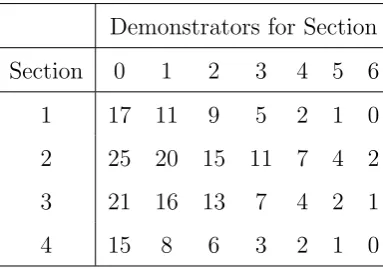
3.1 Number of failed students for a course with 4 sessions and 6 available demonstrators. . . 36
3.2 Dynamic Programming Example: Stage 4. . . 37
3.3 Dynamic Programming Example: Stage 3. . . 38
3.4 Dynamic Programming Example: Stage 2. . . 38
3.5 Dynamic Programming Example: Stage 1. . . 39
3.6 Properties of Utility Functions . . . 49
4.1 Optimal corrective maintenance (CM) time and corresponding expected cost for each chance node based on dynamic programming and myopic methods. Bracketed figures are failure timeTf1 with respect toT ∗ m1 and Tm∗2, numbers in brackets representing corresponding failure times. . . . 86
4.2 Optimum Perfect Preventive Maintenance (PPM) time through different optimisation objectives,i.e., expected cost and expected utility for each chance node based on dynamic programming method. Bracketed figures are failure time Tf1 with respect to Tm1 and Tm2, numbers in brackets representing corresponding failure times. . . 87
4.3 Optimal perfect preventive maintenance (PPM) time and corresponding expected utility for chance node CN1 by dynamic programming condi-tioning on various risk aversion parameter η of an exponential utility function. . . 88
5.1 Optimal Imperfect Preventive Maintenance (IPM) time and
correspond-ing expected cost for chance nodesCN1 andCN22 conditioning on
vari-ous PM power parameterβ based on dynamic programming and myopic
methods. . . 97
5.2 Optimal Perfect Preventive Maintenance (PPM) time and corresponding
expected cost rate for chance node CN1 conditioning on various time
effect parameter r based on dynamic programming. . indicates the
cost rate comparison to its previous one. . . 99
5.3 Optimal perfect preventive maintenance (PPM) time and corresponding
expected cost for chance nodeCN1 by dynamic programming
condition-ing on various parameterp of a discrete Weibull failure distribution. . . 102
5.4 Optimal perfect preventive maintenance (PPM) time and corresponding
expected cost rate for each chance node by dynamic programming for
one-unit systems and two-unit redundant parallel systems. Bracketed
figures are failure time Tf1 with respect to Tm1 and Tm2, numbers in
brackets representing corresponding failure times. . . 104
5.5 Optimal Perfect Preventive Maintenance (PPM) time and corresponding
expected cost rate for each chance node by dynamic programming based
on Weibull and gamma failure time assumptions. Bracketed figures are
failure time Tf1 with respect to Tm1 and Tm2, numbers in brackets
rep-resenting corresponding failure times. . . 107
5.6 Optimal Perfect Preventive Maintenance (PPM) time and
correspond-ing expected cost rate of chance nodes CN21 and CN22 for three-phase
maintenance systems based on Hybrid Myopic-Dynamic Programming
and myopic methods. . . 115
5.7 Comparison of optimal perfect preventive maintenance (PPM) time and
corresponding expected cost for each chance node based on different
in-crement parameterδ. Bracketed figures are failure timeTf1 with respect
toTm1 and Tm2, numbers in brackets representing corresponding failure
5.8 Optimal perfect preventive maintenance (PPM) time and corresponding
expected cost for chance node CN1 conditioning on various increment
parameterδ based on dynamic programming. . . 119
5.9 Optimal perfect preventive maintenance (PPM) time and
correspond-ing expected cost for chance node CN1 conditioning on cost difference
between failure and maintenance based on dynamic programming. . . . 121
5.10 Optimal perfect preventive maintenance (PPM) time and corresponding
expected cost for chance nodeCN1 conditioning on various prior mean
of parameterθ based on dynamic programming. . . 122
5.11 Optimal perfect preventive maintenance (PPM) time and
correspond-ing expected cost for chance node CN1 conditioning on various prior
standard deviation of parameterθ based on dynamic programming. . . 123
5.12 Optimal perfect preventive maintenance (PPM) time and corresponding
expected cost for each chance node by dynamic programming based on
non-Log and Log utility functions. Bracketed figures are failure time
Tf1 with respect toTm1 and Tm2, numbers in brackets representing
List of Figures
2.1 Comparison of Weibull Distributions with Different Shape Parameters
η: Probability Density Functions (top-left), Cumulative Distribution
Functions (top-right), Survival Functions (bottom-left), Hazard
Func-tions (bottom-right). . . 11
2.2 Comparison of Gamma Distributions with Different Shape Parameters
η: Probability Density Functions (top-left), Cumulative Distribution
Functions (top-right), Survival Functions (bottom-left), Hazard
Func-tions (bottom-right). . . 13
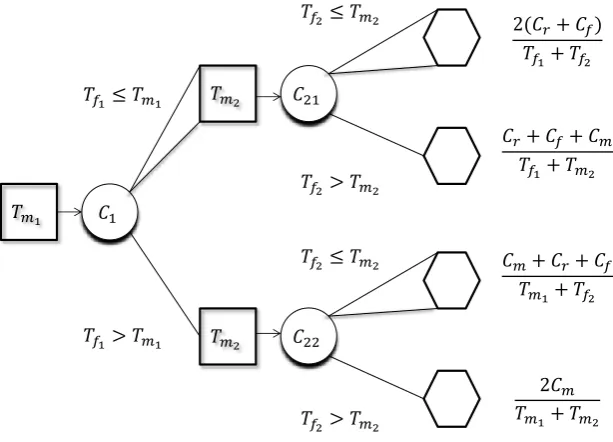
4.1 Decision Tree for Two-Phase System . . . 56
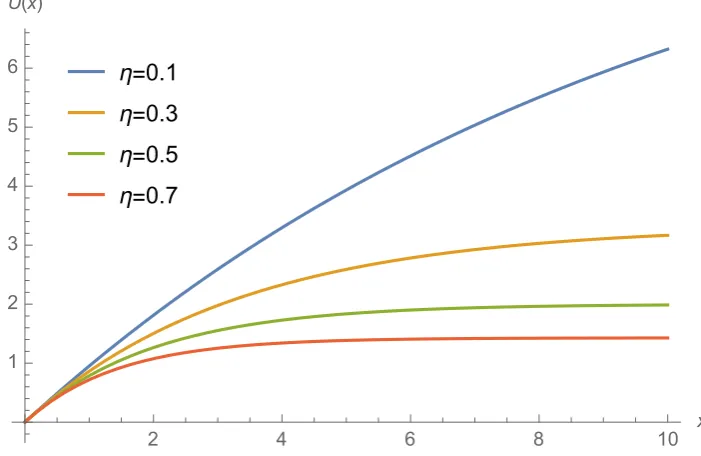
4.2 Exponential utility functions with various risk-aversion parameter η. . . 59
4.3 Comparison of truncated normals with various mean (left) and
truncat-ing points (right). . . 64
4.4 Expectation ofTf (left) and variance of Tf (right) given θ and κ= 1. . 66
4.5 Prior distribution ofθ: truncated normal distributionN(2, 1) truncated
at 1. . . 66
4.6 Expectation ofθ (left) and variance of θ (right) given a and b=∞. . . 67
4.7 Marginal density of Tf1: fTf1(tf1) =
R
f(tf1|θ)f(θ)dθ. . . 68
4.8 Maintenance Time Optimisation Simplification. . . 72
4.9 Prior distribution of θ (left) and marginal distribution of Tf1 (right) by
the gridding method. . . 74
4.10 Probability of Tf2 conditioning on tf1, i.e., pTf2(tf2|tf1 =i), where i=
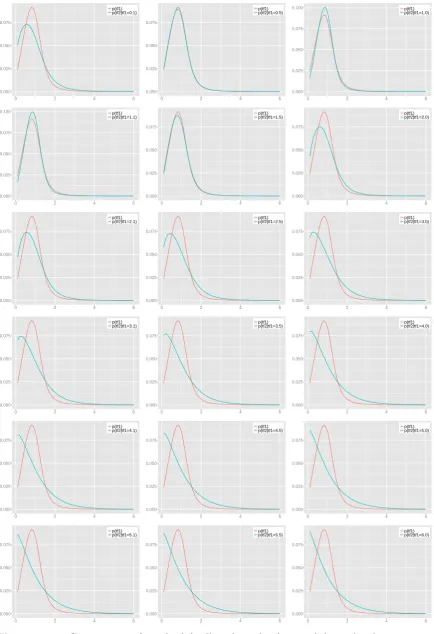
0.1, . . . ,6, by the gridding method. . . 75
4.11 Comparison ofpTf1(tf1) (red) andpTf2(tf2|tf1 =i) (green), wherei= 0.1,
4.12 3D scatter plot for maximal probability of Tf2 conditioning on tf1, i.e.,
maxpTf2(tf2|tf1), with vertical lines for each point. . . 77
4.13 Maximal probability of Tf2 conditioning on tf1, i.e., maxpTf2(tf2|tf1). . 77
4.14 Tf2 that has maximal probability conditioning ontf1,i.e., arg maxpTf2(tf2|tf1);
corresponding probabilities (rounded to 2 decimals) shown alongside
dots that represent Tf2 which maximise the probabilities given a
spe-cific tf1. . . 78
4.15 Maximal probability ofTf2 and the corresponding Tf2; correspondingtf1
shown alongside dots. . . 79
4.16 Probability of Tf2 conditioning on tf1 > Tm1, i.e., pTf2(tf2|tf1 > Tm1),
whereTm1 = 0.1, . . . ,6, by the gridding method. . . 80
4.17 Comparison of pTf1(tf1) (red) and pTf2(tf2|tf1 > Tm1) (green), where
Tm1 = 0.1, 0.5, 1.0, 1.1, 1.5, 2.0, 2.1, 2.5, 3.0, 3.1, 3.5, 4.0, 4.1, 4.5, 5.0,
5.1, 5.5, 5.9. . . 81
4.18 Expected utilities for two-phase systems at chance nodes CN21, CN22
and CN1 under the dynamic programming method. . . 85
4.19 Expected costs for two-phase systems at chance nodes CN21,CN22 and
CN1 under the dynamic programming method. . . 87
4.20 Risk aversion parameter η on utility. . . 88
4.21 Optimal Maintenance Decision Tree for Two-Phase Systems. . . 89
4.22 Posterior probability density of θ conditioning on Tf1(≤0.5) and Tf1 >
0.5 compared with prior probability density of θ. . . 90
5.1 Comparison of probabilities ofTf2 conditioning on optimalTm1 obtained
through PPM and IPM. . . 95
5.2 Comparison of probabilities of Tf2 conditioning on observed Tf1 and
implemented imperfect preventive maintenance atTm1. . . 96
5.3 Discrete Weibull Probability Mass Functions (top-left: p = 0.01, θ = 2;
top-right: p = 0.1, θ = 2; bottom-left: p = 0.5, θ = 2; bottom-right:
p= 0.9, θ= 2). . . 101
5.4 Marginal Weibull and gamma probabilities of Tf1, pW(tf1) and pG(tf1)
5.5 Decision tree for three-phase system with sequential problem with
shad-ing indicatshad-ing a range of possible outcomes for the precedshad-ing chance
node; Box DP-1 and DP-2 show the break into two period problems. . 109
5.6 Comparison of probabilities of Tf2 conditioning on varying Tf1 and
op-timalTm1. . . 111
5.7 Posterior probability density of θ conditioning on Tf1 ≤ Tm1(0.5) and
Tf1 > Tm1(0.5) compared with prior probability density ofθ. . . 113
5.8 Expected cost rates at chance node CN21 conditioning on tf1 ≤ Tm1
(top-left: tf1 = 0.1, top-right: tf1 = 0.2, middle-left: tf1 = 0.3,
middle-right: tf1 = 0.4 and bottom-left: tf1 = 0.5; and expected cost rates at
chance node CN22 conditioning on tf1 > Tm1 (bottom-right) under the
H-DP-M method. . . 114
5.9 Optimal Maintenance Decision Tree for Three-Phase Systems . . . 116
5.10 Sensitivity analysis concerning gridding intervals: Compiling time
(top-left); Optimal Maintenance Time (top-right); Expected Cost Rate
(bottom-left); Expected Cost Rate per Compiling Time Unit (bottom-right). . . 120
5.11 Parallel Computing for p(tf2, tf1) . . . 125
6.1 Certainty-Equivalent with the risk-aversion parameterηunder different
Chapter 1
Introduction
1.1
Background and Motivation
In the current climate of globalisation, competition as well as varying demands from
stakeholders, increasing pressure on manufacturing performance has been one of the
main driving forces in the growth of manufacturing industries (Tsang, 2002). From this
point of view maintenance is a significant activity in industrial practice, resulting in the
importance of maintenance optimisation. Maintenance aims to combat the inevitable
degradation of systems over their operational lifetime and keep them in working order.
Therefore, maintenance plays an important role in sustaining and improving systems
availability, which in turn affects the productivity of the system of interest.
Recently, more attention has been directed towards improving and optimising
main-tenance in manufacturing systems as inappropriate mainmain-tenance could result in huge
cost and risk (Holmberg et al., 2010). Maintenance costs can reach anywhere between
15% and 70% of production costs (Wang et al., 2008), which also indicates that there
is still a large potential for increasing the productivity in current maintenance
prac-tices. In some industries, a slight improvement in throughput could result in significant
economic impact.
In modern times, the complexity of maintenance systems has increased drastically,
see Duffuaa et al. (2001). This is partly due to modern manufacturing systems which
involve numerous interactions and dependencies between components. It is evident
that analytical and mathematical approaches are limited in solving such complex
analysis is applied to use accumulating evidence to make advantageous early decisions.
In the context of system engineering, this could help save cost and even improve
sys-tem performance. The Bayesian method of sequential analysis is to make decisions that
minimise the expected value of some loss function which can be viewed as a function
of corresponding inputs and outputs, see DeGroot (1970) and Brockwell and Kadane
(2003). In this thesis, we focus the study on Bayesian sequential analysis applied to
maintenance optimisation of repairable systems.
The study of system maintenance has attracted increasing attention in recent years
because of a need from industry for increasing the reliability and availability of systems
whilst decreasing the associated costs. Percy and Kobbacy (1996) pioneered work in
preventive maintenance modelling from a Bayesian perspective. Damien et al. (2007)
analysed a single item maintenance in a Bayesian semi-parametric setting, which solves
the drawbacks of other models failing to capture the true underlying relationships in
the data. However, their analysis is based on a pre-defined finite time horizon, for
example, see Baker (2010); in other words, the maintenance time phases are pre-defined
which is not practical in reality; in our work, on the contrary, the maintenance time
phases are also pre-defined depending on a particular system but random and flexible,
which meets the maintenance scheduling programme. Nonparametric methods have
also been investigated in system maintenance. Gilardoniet al. (2013) use a
power-law-process parametric method by incorporating the nonparametric maximum likelihood
estimate of an intensity function to estimate the optimal preventive maintenance policy.
However, all these approaches fail to consider sequential maintenance which requires
more complicated modelling and longer computation time.
Maintenance based on prognostics is a prior event analysis and action. By means
of incorporating prognostics into the maintenance decision making process, one could
carry out a maintenance forecast based on known characteristics as well as the
evalua-tion of the significant parameters of the item. With regard to maintenance objectives,
as in most of the literature cost-based optimisation framework is taken (Van Horenbeek
et al., 2010). However, focus should not only be on costs as risk preference is simply
ignored if only cost-oriented objective is taken into account. Utility functions used
to measure risk preferences are ubiquitous in economic research. The little published
Rao (1993); Keren and Pliskin (2006). In fact, the field of maintenance and reliability
is a suitable area to apply risk-averse policies because there are numerous cash flows
occurring stochastically. A drawback of taking cost per unit time as a criterion of
optimality is that two policies might then be equally attractive, even if for one of them
the annual maintenance spend were much more variable than that for the other. What
might be seen by some as over-maintenance, in the sense that mean cost per unit time is
not minimised, could be optimal as a risk-averse policy, in which the large unscheduled
losses from failure have such a dis-utility that very frequent maintenance is carried out.
Clearly, a policy that minimised cost per unit time would be unsatisfactory for a
main-tenance engineer who could not convince management that periods of high loss were
an unavoidable part of an optimal long-term policy or for an enterprise that could not
survive because of short-term cash flow problems. Thus, extra maintenance activity is
an insurance policy against large losses occurring over a period.
Models and methodologies proposed in this thesis are primarily suited for large
in-dustrial purposes, for example, an automatic manufacturing system, a robotic process,
or a computer server for the non-life essential services, in which cases failure is neither
rare or frequent, maintenance itself is not cheap or trivial, but failure is a considerable
expense, though not exorbitantly so. Hence, this approach is not suitable to apply to
maintenance of systems with very high risk aversion properties, e.g., a nuclear power
facility, an off-shore oil field, or a life support system. It is also not worthwhile applying
to trivial systems where the computational cost of performing this analysis outweighs
any savings.
1.2
Structure and Main Contributions
The overall research goal of this thesis is to develop a utility-based prognostic
mainte-nance optimisation methodology within a Bayesian statistical framework, which uses
historical information and predictions in remaning lifetime of repairable systems.
The following is an overview of the structure of this thesis along with the main
research contributions.
• Chapter 1 introduces the research background and motivation, and briefly
• Although research background and motivation is given in Chapter 1, Chapter
2 gives a detailed review on maintenance modelling and analyses as well as the
fundamental concepts in systems maintenance, from reliability measures to
clas-sical failure time distributions. We highlight the essential publications which are
highly related to the research questions in this thesis.
• For those beyond the statistical research community, Chapter 3 briefly presents
the Bayesian perspective on modelling, and continues to introduce the
founda-tional concepts of the dynamic programming method as well as utility theory,
which are the maintenance optimisation methodologies in this research.
• Chapter 4 solves the sequential maintenance problem under the policy of perfect
preventive maintenance by a dynamic programming method utilising the idea
proposed by Brockwell and Kadane (2003), whereby a grid is constructed in the
maintenance and failure time space, over which the utility functions of expected
cost per unit time are evaluated. This method has a computation time which is
linear in the number of phases in the sequential problem.
• Chapter 5 extends the previous sequential preventive models to imperfect
preven-tive maintenance, taking account of the time value of money, modelling prevenpreven-tive
maintenance in discrete time setting as well as maintenance for parallel systems,
analysing the effect of failure time distribution assumptions on preventive
mainte-nance time and proposing an adaptive approach to solving multi-phase systems’
maintenance. Sensitivity analysis via the parameters of sequential preventive
maintenance models will also be carried out in the chapter.
• Chapter 6 utilises and modifies the approach proposed by Baker (2006) to
inves-tigate and analyse the effect of risk aversion on the variability of system in cash
flows from a certainty-equivalent point of view.
• Chapter 7 states the major conclusions and contributions of this research and
Chapter 2
Repairable Systems and
Maintenance
In this chapter we introduce the difference between non-repairable systems and
re-pairable systems, and classify the maintenance policies and review related modelling
methods.
2.1
Repairable Systems
2.1.1
Basic Terminology and Examples
A repairable system is a system that can be restored to an operating condition by some
repair process instead of replacement of the entire system. For example, an automobile
is a repairable system because most failures, such as the inability to start because of
a bad starter, can be fixed without replacing the entire automobile. Repair does not
have to involve replacement of any parts. For instance, the automobile may fail to start
because of a bad connection with the battery. In this case cleaning the cables and their
connectors with the battery may solve the problem. On the other hand, a light socket
is not considered as a repairable system. The only way to repair a burned-out light is
to replace the bulb; in other words, replace the entire system.
A non-repairable system is one which is discarded after failure. A light bulb is a
non-repairable system for example. Today, with automated production processes being
discarded when they fail. Consider for example a small desk-top fan which can be
purchased for less than 10 euro at a discount shop. When such a unit fails, we would
probably discard it and buy another, because the cost of fixing it is greater than that
of purchasing a new one. Many electrical systems are now non-repairable, or they are
more expensive to repair than to replace.
A few definitions used in repairable systems are given below.
Definition 2.1 Global time Failure of a repairable system is measured in global time if the failure times are recorded as time since the initial start-up of the system.
Failures in global time will be denoted by X1 < X2 <· · ·.
Definition 2.2 Local time Failure times of a repairable system are measured in local time if the failure times are recorded as time since the previous failure. Failures
in local time will be denoted by T1, T2, . . ..
Local time is mainly used in the following work, unless explicitly stated.
Definition 2.3 Deterioration and Improvement We say that a repairable sys-tem is deteriorating if the times between failure tend to get shorter with ageing. If the
times between failure tend to increase, then we will say that the system is improving.
2.1.2
Reliability Measures
There are similarities and differences between repairable and non-repairable systems.
A few issues are clarified to understand repairable system behaviour as follows.
For a non-repairable system the lifetime of the system is a random variable. As
there is no repair, the system would be discarded after its one and only failure, and if it
does not have an impact on the performance of a similar system located elsewhere, then
the assumption that different systems have lifetimes that are independent is reasonable.
Also, if many copies of the system were produced by the same manufacturing process,
then it is also reasonable to assume that the system lifetimes have the same distribution.
These two assumptions can be combined into one statement that says the lifetimes are
independent and identically distributed (IID) from some distribution having cumulative
Definition 2.4 Cumulative Distribution Function The cumulative distribution function (CDF) of a random variable X is defined to be the function
F(x) = P(X ≤x).
Since the lifetime must be nonnegative the probability distribution must have
pos-itive probability on the pospos-itive axis only. In other words, F(x) = 0 for x <0.
Definition 2.5 Survival Function The survival function S(x), also called the re-liability function, is the probability that a system will carry out its mission through time
x.
The survival function evaluated at x is just the probability that the failure time is
beyond timex. Thus the survival function is related to the CDF in the following way:
S(x) =P(X > x) = 1−P(X ≤x) = 1−F(x). (2.1)
Definition 2.6 Probability Density Function The probability density function (PDF) is defined to be the derivative of the CDF, provided that the derivative exists.
That is,
f(x) = d
dxF(x) = − d dxS(x).
Another way to express the PDF is through the limit
f(x) = lim
∆→0
F(x+ ∆x)−F(x)
∆x = lim∆→0
P(x < X ≤x+ ∆x)
∆x . (2.2)
Another important function related to, but distinct from the PDF, is the hazard
function.
Definition 2.7 Hazard Function The hazard function is
h(x) = lim
∆x→0
P(x < X ≤x+ ∆x|X > x)
∆x . (2.3)
This is the limit of the probability per unit time that a unit fails (for the first and only
time) in a small interval given that it has survived to the beginning of the interval.
given in (2.2). These are nearly the same, except one is a conditional probability and
the other is not.
One property of a PDF is that it must integrate to 1; that is, since we are dealing
with random variables that have all the probability on the nonnegative axis,
Z ∞
0
f(x)dx= 1.
The hazard is defined as the limit of a conditional probability, but it is not a conditional
probability density function. The hazard function does not need to integrate to 1, and
in fact, for most distributions we study, the hazard will not integrate to 1 but infinity
(see Cumulative Hazard Function). For a system whose hazard function is increasing,
this means that (in the limit) the probability of failure in a small interval divided by
the length of the interval is increasing with time. Thus if we take a small fixed length
of time, such as one hour, an increasing hazard would mean that the probability of
failing in this one hour, given that the system survived past the start of that hour,
increases with the age of the system. In this case we say that the system is wearing
out. Compare this definition with that of deterioration for a repairable system. We
say that a repairable system deteriorates when the times between failures tend to get
smaller, and we say that a non-repairable system is wearing out if the hazard function
is increasing. A non-repairable system with a decreasing hazard function is said to
experience burn-in. The term “deteriorate” will be reserved for repairable systems
and the term “wear out” will be reserved for non-repairable systems. Similarly, the
terms “improvement” and “burn-in” will be reserved for repairable and non-repairable
systems, respectively. Also note, for a continuous random variable the hazard function
can be defined as
h(x) = f(x) S(x).
Knowing any one of the pdf f(x), the cdf F(x), the survival function S(x), or the
hazard function h(x) is enough to find all of the others.
Definition 2.8 Cumulative Hazard Function The quantity
H(x) =
Z t
0
h(x)dx
Asttends to infinity,i.e.,S(x) tends to 0, the cumulative hazard function increases
without bound, which implies thath(x) must not decrease too quickly, otherwise,H(x)
will converge.
2.1.3
Classical Failure Distributions
The next section covers some of the commonly used distributions for lifetime, including
the exponential, the Weibull, and the gamma.
Exponential Distribution
The simplest model for lifetimes is the exponential distribution.
Definition 2.9 Exponential distribution The exponential distribution is a con-tinuous distribution having pdf
f(x) =λexp(−λx), x >0
and cdf
F(x) =P(X ≤x) =
Z x
0
λexp(−λt)dt = 1−exp(−λx), x >0. (2.4)
We write X ∼EXP(λ), where λ is often referred to as a rate parameter, to indicate
that the random variable X has an exponential distribution with a CDF given by (2.4).
The mean and variance of the exponential distribution are λ1 and λ12, respectively. The
most distinctive feature of the exponential distribution is that it is the only continuous
distribution with the memoryless property.
Definition 2.10 Memoryless property A distribution has the memoryless prop-erty if
P(X > t+x|X > t) =P(X > x).
In other words, if the distribution has the memoryless property, then for instance, the
probability that an old unit survives one more day will equal the probability that a
brand new unit will survive one day. The memoryless property imposes some strong
assumptions about the way units age.
Another unique feature of the exponential distribution is that it is the only
Weibull Distribution
We discuss here the Weibull distribution for several reasons. First, it is probably the
most widely used distribution for lifetimes. Second, if repairs bring a system back
to a good-as-new state and the times between failures X1, X2, . . . are independent,
then the assumption that the times between failures are iid Weibull random variables
may be reasonable because Weibull is a versatile distribution that can take on the
characteristics of other types of distributions.
Definition 2.11 The Weibull distribution has survival function
S(x) = expn−x α
ηo
, x >0. (2.5)
IfXis a random variable with this survival function, then we will writeX ∼W EI(η, α),
where η and α are the shape and scale parameters, respectively.
The cdf, pdf and hazard functions are therefore given as follows:
F(x) = 1−S(x) = 1−expn−x α
ηo
, x >0 (2.6)
f(x) = F0(x) = η α
x
α
η−1
expn−x α
ηo
, x >0 (2.7)
h(x) = f(x) S(x) =
η α
x α
η−1
exp− x α
η
exp− x α
η =
η α
x
α
η−1
, x >0. (2.8)
The hazard function h is increasing when η > 1 and decreasing when η < 1. When
η= 1, the hazard function is the constant function h(x) = 1/α. Thus, the exponential
η=1.8
η=1
η=0.6
1 2 3 4 5 x
0.2 0.4 0.6 0.8 1.0 PDF η=1.8 η=1 η=0.6
1 2 3 4 5 x
0.2 0.4 0.6 0.8 1.0 CDF η=1.8 η=1 η=0.6
1 2 3 4 5 x
0.2 0.4 0.6 0.8 1.0 Survival η=1.8 η=1 η=0.6
1 2 3 4 5 x
[image:35.595.98.539.54.346.2]2 4 6 8 Hazard
Figure 2.1: Comparison of Weibull Distributions with Different Shape Parameters
η: Probability Density Functions left), Cumulative Distribution Functions
(top-right), Survival Functions (bottom-left), Hazard Functions (bottom-right).
When the scale parameter α = 1, Figure 2.1 shows a number of Weibull
proba-bility density functions, cumulative distribution functions and corresponding hazard
functions, respectively.
The mean and variance of the Weibull can be expressed in terms of the gamma
function which is defined below.
Definition 2.12 Gamma Function For a > 0 the gamma function is defined to be
Γ(a) =
Z ∞
0
xa−1e−xdx.
The next theorem gives the mean and variance of the Weibull distribution in terms of
the gamma function.
Proposition 2.1 If X ∼W EI(η, α), then
E(X) = αΓ
1 + 1 η
and
V(X) = α2
"
Γ
1 + 2 η − Γ
1 + 1 η
2#
(2.10)
See Rigdon and Basu (2000) for proofs.
Gamma Distribution
The gamma distribution is another useful model for the lifetime of systems.
Definition 2.13 The pdf for the gamma distribution can be written as
f(x) = x
η−1
θηΓ(η)exp(−x/θ), x >0.
We will write X ∼ GAM(η, θ) if the random variable X has this pdf, where η and θ
are the shape and scale parameters, respectively. Another useful form for the gamma
pdf is obtained by substituting 1/λ for θ; this gives
f(x) = λ
ηxη−1
Γ(η) exp(−λx), x >0. (2.11)
The cdf and the survival function, and hence also the hazard function, cannot be
written in closed form. We can write the cdf as
F(x) =
Z x
0
ληωη−1
Γ(η) exp(−λω)dω.
If we make the transformation y=λω, then this becomes
F(x) =
Z λx
0
λη(y/λ)η−1
Γ(η) e
−y1
λdy
= λ
η
λη−1Γ(η)
1 λ
Z λx
0
yη−1e−ydy
= 1
Γ(η)
Z λx
0
yη−1e−ydy.
The hazard function is therefore
h(x) = f(x)
1−F(x)
=
ληxη−1
Γ(η) exp(−λx)
1− 1 Γ(η)
Rλx
0 y
η−1e−ydy.
This hazard function is increasing when η > 1, decreasing when η < 1, and constant
η=1.8
η=1
η=0.6
1 2 3 4 5 x
0.2 0.4 0.6 0.8 PDF
η=1.8
η=1
η=0.6
1 2 3 4 5 x
0.2 0.4 0.6 0.8 1.0 CDF
η=1.8
η=1
η=0.6
1 2 3 4 5 x
0.2 0.4 0.6 0.8 1.0 Survival
η=1.8
η=1
η=0.6
1 2 3 4 5 x
[image:37.595.99.539.53.347.2]0.5 1.0 1.5 Hazard
Figure 2.2: Comparison of Gamma Distributions with Different Shape Parameters
η: Probability Density Functions left), Cumulative Distribution Functions
(top-right), Survival Functions (bottom-left), Hazard Functions (bottom-right).
When the scale parameter θ = 1, Figure 2.2 shows a number of gamma
proba-bility density functions, cumulative distribution functions and corresponding hazard
functions, respectively.
2.2
Maintenance Modelling
Traditional repairable systems assume a whole range of performance levels, varying
from perfect functioning to complete failure, and assuming the repair is perfect.
How-ever, many manufacturing systems suffer increasing wear with usage, age or
deteri-oration, that is, perfect functioning is not always satisfied. Therefore, maintenance
management, as an important policy for a repairable system, is widely used to keep
systems in good condition, to decrease failures, and increase system availability. Based
on the European standard (EN 13306:2010), a definition of maintenance management
Definition 2.14 Maintenance Management depicts all activities of the manag-ment that determine the maintenance objectives, strategies and responsibilities, and
implementation of them by such means as maintenance planning, maintenance control,
and the improvement of maintenance activities and economics.
According to the definition above, the major steps to maintenance modelling can
be summarised as:
1. Determine the maintenance objective(s).
2. Define or select maintenance policies according to measures of system
perfor-mance.
3. Plan, control and improve maintenance.
2.2.1
Maintenance Policies
The availability and usability play a crucial part in a system’s performance because
any breakdowns and holdups can seriously impede its performance. At the same time,
idle systems negatively affect the ratio between fixed cost to output. The reduced
output induced by system breakdowns would result in less production as well as less
profitability which can be regarded as an inefficiency for the system. Moreover, complex
systems usually require a significant startup time after an interruption occurs. Possibly
during this period of time, goods that do not meet acceptable levels,e.g., scrap or goods
of minor quality are produced, as a result, one cannot obtain her or his expected profit
since these products cannot be sold or have to be sold at reduced prices. Thus, efficient
operation of a system requires well-scheduled maintenance to avoid interruptions as
much as possible and to recover from breakdowns quickly.
For a manufacturing system, wear-out, ageing and deteriorating will have a negative
impact on the function of the system, which results in the consequence that the system
cannot fulfil its capability. Maintenance is introduced to counteract those negative
ef-fects from an economic point of view. Therefore, maintenance actions plays an essential
role in sustaining and possibly improving a system’s availability, which in return will
improve the productivity of the system considered. In general, maintenance policies
and strategies are commonly categorised into three domains: Corrective Maintenance
Corrective maintenance is initiated when the system sees a breakdown which results
in a stop for a system working and induces considerable cost. Corrective maintenance
is usually named repair, restoration or replacement of failed components. This
mainte-nance policy is often applied to systems of which failure is not costly and do not result
in disastrous situations, for components with constant failure rate,e.g., if a failure time
of components is assumed to follow an exponential distribution.
Preventive maintenance is implemented for the purpose of minimising the
nega-tive impact of an unexpected breakdown. Generally speaking, prevennega-tive maintenance
usually involves less resource consumption compared to that of corrective maintenance
and it can be designed in the production plans of the system of interest. PM
in-cludes all partial or complete overhauls, such as filter cleaning, oil charging, etc. in
order to prevent a critical failure that is costly before it actually occurs. It can be
seen that preventive maintenance makes sense in the situation when the failure rate
of a unit or component is increasing in time. Unlike CM that is unexpected,
preven-tive maintenance can usually be properly planned and prepared. Although prevenpreven-tive
maintenance is incorporated to prevent critical failures in system designing, sometimes
failure may still be seen. As a result, it is usually suggested to combine both corrective
maintenance and preventive maintenance tasks.
However, when the operation schedules and environmental variables change in
prac-tice, exhaustive or unnecessary use of preventive maintenance can occur. To make
sure that preventive maintenance is taken only when it is required, condition based
maintenance was introduced by incorporating inspections of the system of interest in
pre-determined intervals to determine the system’s operation condition. Depending on
the outcome of an inspection, relevant maintenance tasks can be implemented. It is
worthwhile noting that CBM is sometimes analysed in the field of PM (Manziniet al.,
2010).
The preventive maintenance policies include time based PM (Roux et al., 2008) in
which PM is conducted every t units of time and age based PM (Chen et al., 2006)
where PM is carried out every t units of operating time. There are other alternatives
of preventive maintenance, e.g., for non-repairable systems, group block replacements
where units or components would be replaced if it failed whereas the other working
Condition based maintenance has received less attention probably because it is
rel-atively new compared to CM and PM. However, thanks to the fact that the inspection
is less costly, one is encouraged to implement CBM (Xiang et al., 2012). If a system
is designed to serve for a long period, one inspection monitor can be installed if it is
relatively cheaper. Van Horenbeek and Pintelon (2013) proposed a prognostic
mainte-nance by combining CBM with the prediction about the states of components to see
if a threshold is expected to be reached before the following scheduled inspection. If it
does, the component is replaced immediately. Although it can be seen that there is an
increasing application of CBM in practice (Wang et al., 2008), it is less studied in the
literature.
In reviewing the literature, we find limited effort was taken to compare
differ-ent maintenance policies. Xiang et al. (2012) investigated a repairable system
un-der preventive maintenance and condition based maintenance policies and found that
condition-based maintenance is superior to scheduled maintenance paradigm via
simu-lation. Van Horenbeek and Pintelon (2013) studied five different maintenance policies
(i.e., CM, block PM, age based PM, CBM with inspection and CBM under continuous
monitoring) on one machine and their noted effects.
2.2.2
Maintenance Effectiveness
Preventive maintenance comprises all maintenance activities which are not triggered
by a system failure. Not only the mode of maintenance task (preventive maintenance
or corrective maintenance) and its associated maintenance interval impact the failure
rate, but also its level of quality (effectiveness of maintenance task). The state after a
maintenance action is performed on a component is assumed to be: perfect, imperfect,
Maintenance Policy System State Failure Rate
Preventive maintenance The system state is
re-stored to be “as good
as new”
Decreasing of the failure rate
Imperfect maintenance A maintenance action
that restores the
system to a state
somewhere between
“as good as new” and
“as bad as old”
Decreasing of the failure rate
Minimal Maintenance The system state is
“as bad as old”
No effect on the failure rate
Worse Maintenance System is in
operat-ing state worse than
just prior to the
main-tenance action
Increasing of the failure rate
Worst maintenance System breaks down
right after
mainte-nance action
Increasing of the failure rate
Table 2.1: State assumptions after maintenance
Imperfect, worse or worst maintenance can be caused by repairing parts of a system
mistakenly. In addition to one of the best known models proposed by Brown and
Proschan (1983), Pham and Wang (2006) reviewed other approaches to model imperfect
maintenance, such as (p, q) rule, (p(t), q(t)) rule, improvement factor, and virtual age
approach, etc. Briefly, with probability p, the item is restored to the as good as new
state or otherwise to the as bad as old state with probability q = 1− p. A novel
approach to modelling imperfect preventive mainteannce will be propsed in Chapter 5.
Quality levels of worse and worst maintenance are related to maintenance and repair
induced failures. Preventive maintenance actions, as cleaning or greasing, mitigate the
deterioration effect of some failure mechanics and restore components to a “as good
mechanisms will remain unaffected. Hence, Lin et al. (2001) introduced the concept
of two categories of failure mechanisms, maintainable failure mechanisms and
non-maintainable failure mechanisms. Preventive maintenance will affect maintainable
fail-ure mechanisms exclusively, whereas non-maintainable mechanisms remain unaltered.
Zequeira and Berenguer (2005) stated that the maintainable and non-maintainable
failure rates are dependent and restored the system of interest to a condition between
as good as new and as bad as old via their proposed preventive maintenance actions.
In the literature, three approaches for modelling the impact of preventive
mainte-nance on the failure rate have been studied extensively; a failure rate model by Lie
and Chun (1986) and Nakagawa (1986), Nakagawa (1988), an age reduction model by
Canfield (1986) and Malik (1979) and a hybrid model by Lin et al. (2001).
In maintenance modelling, most researchers model a system as a whole unit,
with-out considering the effect of deterioration and failure on the subsystems. On the other
hand, machines were modelled as subsystems by some researchers. Van Horenbeek
and Pintelon (2013) modelled a simplified version only considering one subsystem in
a few machines and analysed the structural and stochastic dependencies. Roux et al.
(2008) evaluated the impact of three maintenance policies under an assumption that a
system has only two independent components. One of the assumptions in maintenance
modelling is assuming all the units or components of a system are identical and
inde-pendent. There are other less rigorous assumptions and we will include some of them
in our research:
• Perfect maintenance: preventive maintenance is assumed to be done perfectly
and it is often referred to as ‘systems are are good as new’ after preventive
maintenance is conducted. In this thesis, perfect preventive maintenance (PPM)
is equivalent to corrective maintenance (CM) in the sense that they have the
same consequence with regard to the state of the system after maintenance.
• Time of implementing maintenance is assumed to be constant and often is even
reduced to be negligible implying that maintenance is carried out instantaneously.
• Costs of all relevant maintenance tasks are assumed to be known as constant and
the cost of CM is always more than that of PM.
conduct maintenance.
• System failures are assumed to be detected immediately.
2.2.3
Sequential Maintenance
Under sequential maintenance, systems may be maintained at unequal time intervals,
in contrast to periodic maintenance in which the maintenance interval is fixed and
unique.
Barlow and Proshan (1965) design a sequential maintenance policy for a finite time
span. Under this maintenance policy, the time for which maintenance is scheduled
depends on the time remaining rather than the pre-determined and identical
mainte-nance time. In addition, the next maintemainte-nance interval is determined by minimising
the average cost per unit time during the remaining time. Therefore, this policy does
not determine systems’ future maintenance intervals at the initial time of system
per-formance, which adds flexibility and reduces systems costs.
Nguyen and Murthy (1981) model preventive maintenance under a sequential policy
in which a failure needed to be corrected has not occurred by a reference timeti, whereti
is the maximum time that a system should be fully replaced without extra maintenance
after the (i−1)th repair; in other words, the system is replaced after (k−1) repairs.
The system is repaired (or replaced at the kth repair) at the time of failure or at time ti, whichever occurs first.
Nakagawa (1986) propose and compare periodic and sequential preventive
nance policies for the system with minimal repair at failure and compute the
mainte-nance intervals in a Weibull distribution case, indicating that a sequential preventive
maintenance policy is superior to a periodic one. Schutzet al. (2011) extend previous
research by considering a system performing a wide range of missions over a finite
plan-ning horizon and a dynamic system failure law is taken into account to modelling the
different missions with various characteristics depending on the operational conditions.
Linet al. (2000) propose general sequential imperfect preventive maintenance models,
in which the effective remaining time of the system would be reduced whilst the hazard
rate would be adjusted after each preventive maintenance. We refer it to as a hybrid
hazard adjustment on systems.
There are also studies by Dieulle et al. (2003) calculating the long-time expected
cost per unit of time via considering if system’s state is above or below a threshold and
assuming deterioration as a gamma process; and Schutzet al. (2011) investigating the
periodic and sequential preventive maintenance policies over a finite planning horizon.
However, due to the highly mathematical formalisation of their modelling, it is not
staightforward to be applied in practice.
2.3
Maintenance Optimisation
2.3.1
Optimisation Approaches
As the complexity of maintenance systems increases, maintenance optimisation
meth-ods have also developed from classical methmeth-ods to modern or non-traditional methmeth-ods.
Classical optimisation methods (Rao, 2009) are analytical and use differential
cal-culus to find the optimal value. For example, scatter search (Chenet al., 2006),
Nelder-Mead method (Roux et al., 2008, 2013), cyclic coordinate method (Xiang et al., 2012),
the modified Powell method (Marquez et al., 2003), Fibonacci algorithms (Asadzadeh
and Azadeh, 2014) and local search (Gupta and Lawsirirat, 2006; Triki et al., 2013),
have been applied to simple manufacturing systems. However, it has been criticised
that optimising maintenance through classical methods lacks the analysis of objective
functions and solution space. Thus it poses difficulty in justification of the optimisation
methods.
In order to deal with the complexity increase of maintenance systems, modern
or non-traditional methods have been utilised (Deb, 2005; Rao, 2009). Two modern
optimisation methods are mainly applied, which are Genetic Algorithms (GA) and
Simulated Annealing (SA). In fact the use of SA is only reported in a few articles. In
this sense, exploration of other modern optimisation methods to systems maintenance
problems could be another research branch.
The most reported modern optimisation method in maintenance, GA, is based upon
the process of natural selection in biology and has been applied to various optimisation
problems (Rao, 2009). SA originates from the idea of the annealing process in
beginning and then cooled gradually under a fully controlled environment to obtain
desirable shapes or properties. This method has been used to solve a wide variety of
problems, such as the ones with continuous, discrete and mixed-integer variables (Rao,
2009).
Dynamic programming (DP), see Bellman (1954), is a method of solving a
com-plex problem by breaking it down into series of simpler subproblems (different parts
of the original problem) and then combining the solutions to the subproblems to
ob-tain an overall solution to the original problem. There are two advantages using this
formulation. First, dynamic programming enables computing the optimal solution in
some cases which usually only applies to smaller problems. Due to the curse of
di-mensionality, computing the optimal solution to larger problems cannot be done in
a reasonable and feasible amount of time (Powell, 2007). Second, dynamic
program-ming can produce optimal theoretical results which could indicate the behaviour of the
optimal policy in the proposed models, for example, see Ding et al. (2002).
In a general assumption about state, action and parameter spaces, Rieder (1975)
consider a non-stationary Bayesian dynamic decision model which can be reduced to
a non-Markovian decision model with known transition probabilities. As a
pioneer-ing work in Bayesian dynamic programmpioneer-ing, his work provides criteria of optimality
and the existence of Bayes policies. Nicolato and Runggaldier (1999) combine
burn-in, which is used to cope with the problem of “infant mortality” in system running
periods, with identical multi-component systems, and propose a Bayesian dynamic
programming method to make decisions on the optimal maintenance interval and best
burn-in time.
In other words, dynamic programming is an optimisation approach that transforms
a complex problem into a sequence of simpler problems; its essential characteristic is the
multistage nature of the optimisation procedure, which provides a general framework
employed to solve particular aspects of a more general formulation. In the decision
tree problem, we often call it “Roll-Back”, see Ross (1995). As in the problem we
will discuss in the next chapter, we divide the system’s running procedure into a few
stages and based on the information we learn from running the system, we model the
functional form of the system utility and then attempt to maximise it.
problem. We consider the system running from a global perspective, which means we
assume the whole running procedure of the system, and make a decision based on the
optimal utility of the system. On the contrary, myopic decision making means that
we can do local utility optimisation based on the information we previously obtained.
Although we would not obtain the optimal utility for the system, optimisation problems
can be simplified and are also easier to implement in practice, and we can simply regard
it as a “roll-forward” method.
2.3.2
Optimisation Objectives
Cost minimisation is one of the most reported optimisation objectives in maintenance
studies, for example, minimising total cost or expected cost per unit time. Increasing
preventive maintenance cost could result in over-maintenance for systems while
increas-ing hazard rate and its consequences would end up with under-maintenance. Note that
usually corrective maintenance cost is fixed and higher than preventive maintenance
cost (Gupta and Lawsirirat, 2006; Rouxet al., 2008; Xianget al., 2012). However, it is
not sufficient to simply only consider maintenance cost as maintenance is part of
sys-tems and various costs are associated with syssys-tems processing. Thus some researchers
have incorporated other costs, in addition to maintenance cost, into maintenance
ob-jectives. For instance, a penalty per unit time for systems unavailability (Alrabghi and
Tiwari, 2013), or the cost resulting from unsatisfactory products (Oyarbide-Zubillaga
et al., 2008).
On the contrast to maintenance cost, Roux et al. (2013) propose maximising
sys-tems availability as the optimisation objective. They argue that it is more justified as
production costs are more dominant in the total cost of systems running. However,
such interpretation would ignore the fact that maintenance costs can be higher than
production costs (Wang et al., 2008).
However, it is suggested to design the objective as maximising production
through-put because maximum system availability does not necessarily guarantee maximum
production throughput (Lei et al., 2010) because a system would not be in a working
state due to various reasons such as lack of raw materials or supporting tools.
On the requirements of different engineering problems, optimising several
average cost per unit time and maximising systems availability. There are mainly
three ways to realise this aim: firstly, put several objectives into one objective
func-tion, however, this method requires transformation in a universal unit among different
objectives; secondly, assign weights to different objectives based on decision maker’s
preference. Although transformation is not required in this method, the decision maker
has to trade-off among objectives; thirdly, simply solve several objectives
simultane-ously using multi-objective optimisation algorithms, e.g., Oyarbide-Zubillaga et al.
(2008) implement a Non-dominated Sorting Genetic Algorithm to minimise costs as
well as maximise system production profits.
The objective proposed in this thesis is utility-based maintenance. From the
main-tenance engineer’s point of view, by incorporating risk preferences into mainmain-tenance
modelling, management of systems could avoid short-term problems such as short-term
cash flow problems by considering optimal long-term policy such as systems
availabil-ity. For example, there are two policies that are equally preferred based on minimising
average cost per unit time, however, it is likely that one of them has more variable
Chapter 3
Statistical Methodology and Utility
In operational research and management science we face uncertainty frequently, whether
in the form of uncertain demand for production, uncertain performing time in systems,
or uncertainty about parameters calibrating a simulation model,etc. Despite the fact
that we are facing uncertainty, we usually are able to collect some related information
which could reduce the effects of such uncertainty. This would have two impacts: on
one hand, gathering information helps us make better decisions which could produce
better outcomes; on the other hand, the costs induced by collecting information, such
as time and money spent, or even opportunity cost due to collecting one piece of
infor-mation whereas we could have had another, could increase. How to find the optimal
balance between these benefits and costs is what we are attempting to explore. Two
methods for formulating such problems are Bayesian methods and Dynamic
Program-ming, respectively.
3.1
Bayesian Modelling
In the twentieth century, the so called ‘frequentism’ has dominated the statistical
phi-losophy. Under the framework of the frequentist approach, the hypothetical long term
proportion of the time that an event of interest occurs is expressed via probability and
the parameters of probability models are regarded to be unknown but fixed
numeri-cal quantities. Pearson studied the problems of the frequentist style extensively in the
early twentieth century. One can find most of the foundations for frequentist modelling
Bayesian modelling arises earlier than the frequentist methodology actually. It is
being dated back to a thought experiment conducted by Bayes (1763) who threw balls
onto a square table, and to the ‘inverse probability’ found by Laplace (1774) and later
replaced as ‘Bayesian’ in the 1950s by Fisher (Fienberg, 2006). Both Bayes and Fisher
took the uniform prior distribution: it was a outcome of the ball throwing experiment
in Bayes’ case, while it was considered as an intuitive axiom which is a ‘principle of
insufficient reason’ by Fisher. Yet, Bayesian modelling and inference has not drawn
much attention until it reappeared and was recognised in the modern form thanks to
Jeffreys (1939) and Savage (1954), among other researchers.
Briefly the Bayesian concept combines both objective probability that has a similar
interpretation compared to the probabilities in frequentism and subjective probability
that is taken to express a degree of belief from a personalistic point of view. The
treatment of regarding the parameters of probability models as realisations of a random
variable or not differentiate Bayesian modelling from frequentist methodology, and
enable one to put direct statements of probability for these parameters.
Let us consider a sequence of observations x = {x1, . . . , xn} and a corresponding
probability model that is believed to be the generating model for the data, with a
probability density function fX(x|ψ) in which the parameter(s) ψ is made explicitly
to model the dependence. It is worthwhile noting thatψ may be a vector of parameter
in general. ψ is considered as the unknown realisation of a random variable in the
Bayesian modelling, as a result we can consider the joint density function of the random
variables X and Ψ:
fX,Ψ(x, ψ) =fX|Ψ(x|ψ)fΨ(ψ) (3.1)
where fX|Ψ(x|ψ) :=fX(x|ψ) for simplicity.
As a result, given data x, one can apply Bayes’ Theorem to directly derive the
uncertainty expression for ψ as:
fΨ|X(ψ|x) =
fX(x;ψ)fΨ(ψ)
R
ΩfX(x;ψ)fΨdψ
(3.2)
∝fX(x;ψ)fΨ(ψ)
where Ω is the sample space of Ψ. Notice that the denominator is independent of ψ
(3.2) is referred to as the posterior distribution of parameter(s) ψ and encapsulates all
knowledge and information concerning the unknown parameters.
However, in practice the integral in the denominator of (3.2) which is the
normal-ising constant, does not often have an analytically tractable form. Due to this fact,
it hindered the learning and application of Bayesian modelling for quite a long period
of time. With the rapid development of computing techniques such as Markov chain
Monte Carlo in modern time, Bayesian modelling has become easier to implement since
the 1990s.
3.1.1
Likelihood function
In (3.2), the first term in the numerator is usually written as L(ψ;x) := fX(x|ψ) to
indicate the fact that the observed data xare fixed and ψ is in fact stochastic. Fisher
(1922) terms this the likelihood, arguing that it was all necessary to do inference
through simply maximisingL(ψ;x) with regard toψ and one can obtain the maximum
likelihood estimate (MLE), ˆψ. However, due to the fact that RΩL(ψ;x)dψ 6= 1, we can not take the likelihood as a probability distribution function for ψ, which makes
expressing the uncertainty about the point estimate ˆψ somewhat more ambiguous than
the expression in the form of posterior distribution in Bayesian modelling.
In favour of the ‘fiducial probability’ of ψ, Fisher (1930) defined ∂ψ∂ FX(x;ψ) as a
way to connect ψ to a direct probability uncertainty. However, after extensive
criti-cism, e.g.(Lindley, 1958), almost nobody refers to this idea in the modern literature.
Therefore, based on asymptotic analysis, the expression of uncertainty for ˆψ is limited
to be required to state the upper/lower confidence bound for non-standard models,
which is argued to contain the ‘true’ ψ in terms of a specified hypothetical long run
proportion.
Still only in the way of the likelihood can the data enter the posterior distribution
to be utilised. And as the amount of data collected increases, the likelihood part
dominates the posterior distribution more, resulting in approximate agreement between
maximum likelihood estimate for frequentists and highest a posteriori density values
for Bayesians, which is the mode of the posterior distribution. In Bayesian modelling,
any two models with the same likelihood L(ψ;x) are believed to result in the same
called the ‘likelihood principle’.
3.1.2
Prior distribution
The prior distribution is the termfΨ(ψ) in numerator from (3.2). Because the
param-eters are treated as random variables in Bayesian modelling, a Bayesian is required to
specify corresponding distributions for the random variables which are independent of
the dataxin (3.1). The prior distribution is taken to represent the information that a
decision maker has known prior to observing any possible data and is usually regarded
as the most controversial part in Bayesian methodology.
The controversy arises owing to the fact that the choice of a prior distribution
is always a subjective decision. However, it is argued that the implementation of a
prior distribution adds flexibility of modelling. For example, we can choose a ‘sceptical
prior’ which is suggested to assign a lower probability to some favourable outcomes.
Thus, the probability weighs in favour of that outcome becomes even more compelling.
However, we can think that the chosen model that is believed to be where the data are
generated, fX(·;ψ) is also a somewhat subjective choice.
Common prior choices
In Bayesian modelling and inference, the prior is often chosen from some parametric
family o