Multi-Stage Multi-User Detection Assisted Asynchronous Fast-FH/MFSK
Kiyoshi Hamaguchi
1and Lajos Hanzo
21
Communications Research Laboratory, Yokosuka, 239-0847, Japan
2Dept. of ECS, University of Southampton, SO17 1BJ, U.K.
E-mail:
1[email protected],
2[email protected]
Abstract- A multi-stage Multi-User Detection (MUD) scheme designed for asynchronous fast Frequency-Hopping/Multilevel Frequency-Shift-Keying (fast-FH/MFSK) systems is proposed, in which each signal detection interval is divided into sub-intervals and the MUD is applied to each sub-interval. In our scheme the MUD exploits the explicit knowledge of the hopping addresses assigned to users. The received signal level is attenuated by a constant scaling factor, when it is deemed to be overwhelmed by multi-user interference. For the sake of preventing erroneous detection events, when communicating over frequency-selective fading channels, the scheme advocated also invokes a space diversity technique. In the investigated scenario the achievable Bit Error Rate (BER) of the proposed scheme was reduced by as much as an order of magnitude in comparison to that of a conventional MUD scheme, when transmitting over an AWGN channel. For transmission over a channel exhibiting uncorrelated frequency-domain fading, selection diversity was used for the sake of achieving a reduced BER.
I. Introduction
Eliminating multi-user interference is of vital importance in wireless communication systems for the sake of improving the achievable transmission quality and system capacity within a limited bandwidth. In particular, Multi-User Detection (MUD) schemes [1]-[4] employed in synchronous fast Frequency-Hopping (FH) Multilevel Frequency-Shift-Keying (MFSK) systems [5] are attracting considerable attention owing to their attractive performance and low computational complexity. In this paper, we consider an efficient MUD scheme designed for asynchronous FH/MFSK multi-user systems.
An efficient MUD scheme has been proposed in [2] for improving the achievable Bit Error Rate (BER) performance of synchronous MFSK/FH-SSMA based wireless communication systems. In this scheme, all legitimate transmitted signals are generated by the receiver and then compared to the received signal. This Maximum-Likelihood (ML) detection approach results in a high interference rejection capability, which is achieved at the cost of a potentially excessive computational complexity, particularly when the number of users is high. An efficient Multi-Stage (MS) MUD scheme has been developed in [3] for reducing the complexity imposed in such cases. This scheme successively eliminates the interfering signals by exploiting the explicit knowledge of the users’ MUD addresses. A further improved MS-MUD scheme was proposed in [4], where the contribution of the estimated interfering signal is cancelled from the received composite signal by exploiting both the knowledge of all users’ MUD addresses as well as that of their received signal powers. In other words, the MS-MUD of [4] is capable of successfully mitigating the effects of interference, as long as all users’ received signal powers are known. In practice, however, the received signal is typically contaminated by Multi-User Interference (MUI) and hence it may be an arduous task to accurately determine the individual users’ received signal powers. In [6] a modified scheme
has been proposed, where a constant weighting factor is invoked for mitigating the effects of the interferers, as it will be detailed hereafter. Specifically, in the system described in [6] two matrices are constructed, which host the desired signal and the estimated interference respectively, in a manner similar to that used in the MS-MUD described in [4], with the important exception that we eliminate the requirement of knowing the received signal powers. For the sake of preventing erroneous detection events, when communicating over frequency-selective fading channels, the scheme advocated in [6] invoked both space diversity and a variable detection threshold.
Practical systems are, however, asynchronous in the uplink. In this paper, we propose an asynchronous FH system using the appropriately modified MUD scheme of [6], in which each chip interval is divided into M number of sub-intervals using an approach similar to that employed in fractionally spaced channel equalizers [7]. We commence our discourse by describing the asynchronous FH system model in Section II. In Section III, we briefly introduce the MUD scheme proposed for asynchronous FH as an extended version of the conventional MUD [6]. In Section IV, the bit-error-rate (BER) of the proposed MUD is studied in comparison to both that of the single-user detector (SUD) and the conventional MUD operating on a chip-by-chip basis, when communicating over the Additive White Gaussian Noise (AWGN) channel and a channel exhibiting uncorrelated frequency-domain fading. In order to mitigate the associated fading effects, the proposed MUD scheme is also combined with space diversity. Finally, we present our conclusions in Section V.
II. Fast-FH/MFSK System
Let us consider a time-frequency coded system [5], where K
number of users are supported and the transmitted signal of each user is constituted by a sequence of L chips, selected from a set of
Q legitimate frequencies. Moreover, we assume that the L-chip
sequences of all the users arrive at the receiver’s input at a different instant, i.e. that we employ an asynchronous system. A matrix having Q rows and L columns, representing the legitimate frequencies and time slots, respectively, contains the received signals of the system.
We assume that xk(j)={0, 1, 2,…, Q-1} represents a data symbol of the k-th user transmitted at the time instant of
( ) ( )
k j =x jk ⋅ + k
y 1 a , (1)
where we have 1=(1,1,…,1), representing a unit-vector, while ‘+’
indicates addition over the Galois Field GF(Q). We define a
transmitted signal matrix Sk(j)={sq,l(k)}, in which sq,l(k)=Ak cos(2πfqt+ϕk), when yk,l(m)=q, while sq,l(k)=0 otherwise, where Ak and ϕk are the magnitude as well as the initial phase offset of the
k-th user, respectively, while fq is the signaling frequency of q
∈
Q. In the conventional MUD scheme described in [6], the receiver processes the received signal for the sake of constructing the (Q×
L)-element received signal matrix of R(j)={rq,l(j)}, in which each matrix element stores the corresponding received signal components associated with a legitimate frequency and time slot, each having a different detected power level, where we have 1≤ ≤q Qand1
≤ ≤
l
L
. Here, we assume that rq,l(j) is expressed as:( 1) 2
, ( 1) ( 1) , ,
1
( ) c c { ( , , ) ( ) ( ) }
c c
K L j T lT
q l t L j T l T q l k q l
k
r j = −− ++ −
γ
q k t s kδ
t n dt ==
∫
∑
+ ,(2)where γ(q,k,j), nq,l, andδk(t) are the fading envelope of the k-th user at frequency q and time slot j, the receiver’s thermal noise, and a binary function having a value of unity for
L(j−1)Tc+(l−1)Tc+t0,k
≤
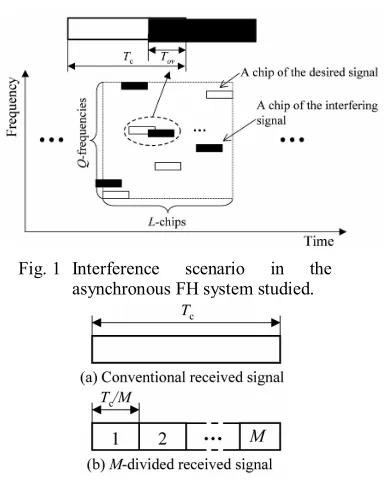
t<L(j−1)Tc+lTc+t0,k and zero otherwise, with t0,k being the received signal's time offset for user k, respectively. Eq. (2) shows that rq,l(j) is contaminated by the effects of MUI, depending on the duration of the asynchronous overlap of the desired signal and the interfering signal characterized by t0,k.Fig.1 shows the schematic of the asynchronous FH system. Let Tov denote the duration of overlap of the desired signal
with the interfering signal. When we define ∆=Tov/Tc as the
relative overlap, then ∆=±1/2 is expected to impose the highest interference and hence to inflict the highest BER. In order to improve the BER performance of asynchronous FH, it is important to mitigate the effects of the interference imposed by this overlap. For the sake of achieving this goal, we divide the chip duration into fractionally-spaced chip intervals. Fig. 2 shows (a) the chip-spaced signal of the conventional MUD, and (b) the fractionally-spaced signal of the proposed MUD at the receiver, where M is referred to as the number of chip-fractions per chip interval. Although the received desired-signal power of
Ek={(1/2Μ)AdTc}2 decreases upon increasing M, the reduction of
the desired-signal power may be less than that of the interference power, where Ad is the magnitude of the desired signal.
III. Asynchronous MUD Scheme
A. Synchronous MUD for AWGN channels
First of all, we consider the Gaussian scenario, where γq,l is
constant, since there is no fading. Fig. 3 in conjunction with m=1 illustrates the block diagram of the proposed MUD scheme. In order to simplify our discourse, we omit the transmitted symbol index j. The elements of the received signal matrix, ( ) ( )
,
{ i}
i q l
r
=
R ,
where the matrix is valid for detection stage i, are compared to a
constant-valued positive threshold δ, so as to generate
( ) ( )
,
ˆ i {ˆ i}
q l
r =
R , where we have ˆ,( ) 1
i q l
r = for rq l, >δ, and zero
otherwise. Next, Rˆ( )i is used for generating the data of user k by
subtracting ak from Rˆ( )i on a chip-by-chip basis over GF(Q), producing the decoded data matrix ( ) {ˆ( k l,),( )}
i i
k = rq a− l
D ,as seen in
[image:2.595.341.533.58.300.2]Fig. 3. If the received signal does not suffer from any noise or other channel impairments,Dk(i) contains a complete row of binary one values at the received signal matrix positions corresponding to
Fig. 1 Interference scenario in the asynchronous FH system studied.
Fig. 3 Block diagram of the fractionally-spaced MUD scheme.
Fig. 2 (a) Received signal in the conventional MUD,
and (b) the signal divided into M fractional
[image:2.595.49.548.567.723.2]the desired user’s symbolxk(m).In practice, however, the received signals do suffer from MUI imposed by undesired users, as well as from AWGN and other channel impairments. Hence the received signal matrix may contain incomplete rows, as well as multiple non-zero rows, which render the detection process prone to detection errors. By contrast, in a perfect reception scenario one and only one complete row having non-zero values exists, which allows us to unambiguously estimate the data symbol,
x
ˆ
v( )i , for1≤ ≤v K v k, ≠ .
In the next detection step we construct the estimated
interference matrix, ( ) ( )
,
{ }
i i
k = cq l
C of user k, where we have
( ) , ( )
ˆ i ,
v v l
i
x a l
c
+=
1, and zero otherwise. Using this matrix, weproceed by assuming that if the (q, l)-th element of the matrix containing the interference, namely Ck(i), is non-zero, then this particular element of the received signal matrix, R(i), will be
corrupted by MUI with a high probability. Thus, we propose that the (q, l)-th, and only the (q, l)-th element ofR(i)be updated by
using the following relationship:
( 1) ( )
, ,
i i
q l q l
r + = ⋅ρ r , (3)
whereρis a positive real-valued constant constrained to the range of 0<ρ<1. Intuitively, a small value of ρ may necessitate the employment of a high number of detection stages, but this has the benefit of ensuring that low signal contributions are not inadvertently cancelled. By contrast, a high value of ρmay result in the desired signal being cancelled. It is worth noting that in the
MUD described in [4] ,( 1) 0
i q l
r + = was used when the condition of
( ) ( )
, ,
( ) ( )
ˆ , ˆ ,
|
i i|
l l
i i
x a l x a l
c
ν +ν−
r
ν +ν<
ε
ν was satisfied, where( ) ,
( )
ˆ i ,
v v l i
x a l
c
+=
E
ν. The variables Eν as well as εν, respectively,were defined as the received signal power and the detection threshold related to user ν,1
≤
ν≤
K,ν≠k.The next detection stage invokes the above procedure again. When we curtail this iterative detection process at the (i+1)-th stage, the received signal hosted byR(i)is decoded again.
The final detection step is constituted by finding the specific row
of ( 1) ( 1)
,
{ i }
i q l
r + + =
R , which exhibits the maximum decoded power
that is expressed as:
,
( 1) ( 1)
( ),
1
max k l
L
i i
k n n a l
l
x + r− +
=
′ =
∑
. (4)
B. The Proposed Asynchronous MUD Scheme
The received signal corresponding to the j-th detection stage can be described by the received signal matrix R(i)=[R(i)(1) R(i)(2)
…R(i)(M)], where R(i)(m)={r
q,l(m)} has Q rows and L columns, representing the legitimate frequencies and time slots of Fig. 2(b), respectively. For R(i)(m) the conventional MUD of [6] is applied in
our scheme. Fig. 3 also illustrates the block diagram of the
proposed MUD which corresponds to having m>1. The basic
philosophy of the scheme is to eliminate the effects of interference by dividing the chip-interval into sub-intervals, when the desired signal is deemed to be partially overwhelmed by multi-user interference. The difference with respect to the conventional MUD manifests itself during the final detection stage denoted as
‘Decode User k’ in Fig. 3. When we terminate this iterative
detection process at the (i+1)-th stage, the received signal
contained by the matrix R(i+1)(m) is decoded again. The final
detection step is constituted by finding that specific row of R(i+1),
which exhibits the maximum decoded power expressed as:
,
( 1) ( 1)
( ),
1 1
'i max L M k l ( )i
k n n a l
l m
x + r m +
− = = =
∑∑
. (5)C. Signal Detection Threshold
Let us commence by defining a false alarm as the event, when the presence of a certain signalling frequency is detected falsely, as a consequence of the excessive interference plus noise exceeding the threshold parameter, δ. The associated design trade-off is that if δ is increased, the false alarm probability is decreased at the cost of potentially missing the detection of the wanted signal, and vice versa. When a typical square-law detector is used, each received
signal is squared, summed and compared to δ. The probability
density function (pdf) of the received signal, x, at the detector thus obeys the χ2−distribution having a degree of freedom of M, which
is expressed as:
/ 2 1 / 2
/ 2
( ) , 0
2 ( / 2)
M x
M M
x e
f x x
M
− −
= ≥
Γ , (6)
where Γ(.) is the gamma-function [8]. The corresponding
cumulative distribution function (cdf) is defined by the integral of the pdf, and the associated false alarm probability is determined by the appropriate percentage point of the cdf.
D. MUD for fading channels
When we use MUD in fading channels, the received signal strength recorded at each receivedfrequency and in each time-slot varies as the function of the channel conditions. Let us consider the interference cancellation mechanism of the MUD. The power of the interfering signal decreases in successive MUD stages, since the interfering signals can be detected by comparing them to the
constant threshold δ and subtracting them from the received
multi-user signal. For the sake of preventing false interference-detection in our MUD, the presence of an interfering signal is deemed to be recognized, when all L chips constituting a symbol can be detected. In other words, when the condition:
(1) ,
(1) ˆv v l, i
x a l
r
δ ρ≤ ⋅ + , (7)
is satisfied at the i-th stage for all values of the timeslot index l, the interference imposed on user νdecreases by a factor of ρ, as we have seen in Equation (3). By contrast, when
(1) ,
(1) ˆv v l, i
x a l
r
ρ ⋅ + <δ is satisfied for at least one timeslot, say that at
index l, the interfering signal of user ν does not decrease.
As a powerful anti-fading technique, spatial diversity has been often used for mitigating the fading-induced signal-level fluctuation in wireless communications [9]. When using this technique, the condition stipulated in Equation (7) may be relaxed and the BER performance may be substantially improved. When selection-combining is used, we detect the signal of that specific diversity branch, which has the highest received signal magnitude.
IV. Results and Discussions
Hence we used computer simulations for evaluating its BER performance. This section characterizes the BER performance of a fast-FH/MFSK system employing the proposed MUD scheme, as well as a Single-User Detection (SUD) scheme [4] and the MS-MUD arrangement of [4] as benchmarker schemes, where the
SUD scheme simply finds the specific row of Dk containing the
highest number of non-zero elements.
In this section we first consider the proposed MUD scheme in the context of synchronous FH in order to find optimum number of stages. Then, using the optimum number of stages, we evaluate the MUD’s performance in an asynchronous FH scenario. As usual, here we use the terminology of ‘flat fading’ for a non-dispersive correlated time-domain fading channel, where all frequencies fade together. By contrast, we refer to the channel exhibiting uncorrelated Rayleigh fading in the frequency-domain simply as an ‘uncorrelated frequency-domain (FD) fading’ channel.
A. Performance for an AWGN channel in synchronous FH
Fig. 4 shows theBER versus the scaling factor ρperformance of
the proposed system, where we have Q=16, L=5, where
Einarsson’s multi-user addressing scheme [10] was used for minimizing the chip collisions. An AWGN channel was used, where C/N was 16 dB and the number of users was 12. The
threshold parameter δwas defined in the same manner as in [4],
where the false alarm threshold introduced for detecting the presence of noise rather than a useful signal was set to 1 %. The power of the desired signal and that of each interfering signal was the same in both cases. In this environment, we can see that when
we setρto 0.3, the achievable BER is lower, despite invoking a
lower number of detection stages.
Fig. 5 shows the BER results obtained under the same conditions as those shown in Fig. 4. In this figureρwas set to 0.3. Since the SUD is the least intelligent detection scheme, its BER is the highest among the detection schemes we studied, particularly when the number of users is relatively low and hence the MUDs perform well. The MS-MUD scheme described in [4] performs better than the SUD scheme, because with the advent of MS-MUD the effects of interference are efficiently cancelled. However, as it can be seen in Fig. 5, the achievable BER is slightly degraded, when the number of detection stages is increased. This is because the MS-MUD scheme tends to set certain elements of the received signal matrix to zero during the first detection stage and hence the achievable BER does not improve during the successive detection stages. The proposed MUD achieves substantial BER improvements in comparison to the MS-MUD of [4], which improves as the number of detection stages is increased from 1 to 4. This is particularly true, when the number of users supported is in excess of 13.
B. Performance in asynchronous FH
When we use the proposed MUD scheme, we can see that the achievable BER performance depends on the number of MUD
stages, as shown in Fig. 5. As an example, here we employ two
MUD stages, when considering the trade-offs between the achievable performance and the computational complexity. Fig. 6 characterizes the BER performance of the asynchronous fast-FH/MFSK system employing the proposed MUD, as well as that of a SUD [2] and that of the conventional MUD [3] used as benchmark schemes. An AWGN channel was used and the C/N
ratio was 16 dB. In order to make a fair BER comparisons between the proposed and the conventional MUD, as well as the SUD, the signal format shown in Fig. 2 (b) was used and the
threshold δ was adjusted for maintaining a 1 % false alarm
probability, when the received signal obeyed the pdf of Eq. (6). We set M=2 and ∆max=±1/2. The power of the desired signal and that
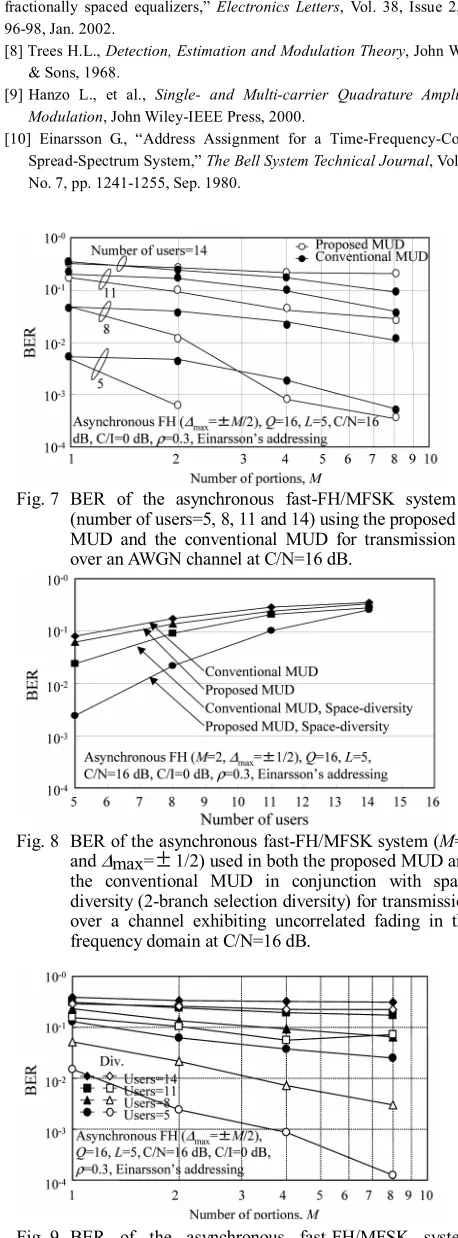
of the superimposed interfering signals was the same, resulting in a Carrier-to-Interference power ratio (C/I) of 0 dB, while the coefficient ρ was set to 0.3. Since the SUD is the simplest of the detection schemes considered, its BER is the highest. The proposed MUD performs better than the conventional MUD, because the effects of interference are efficiently eliminated. Fig. 7 also shows the achievable BER performance, when employing the proposed MUD as well as the conventional MUD in conjunction with M=1,2,4, and 8. As expected, when a higher value of M is used, the performance improves at the cost of an increased computational complexity. Although the desired signal’s power of
Ekdecreases, the interference power decreases more dramatically with the advent of the fractionally spaced MUD.
C. Performance of combined MUD and space diversity over Rayleigh-fading channels
In order to demonstrate the beneficial effect of space diversity in the context of the proposed MUD scheme in Figs. 8 and 9, we characterize the achievable BER performance, when combining the proposed MUD scheme with 2-branch space diversity. We assumed that the two frequency-domain diversity channels faded independently. From Figs. 8 and 9, it can be seen that when we used diversity, the performance improved. This seems to indicate that the space diversity assisted schemes result in both reduced noise effects, and in reduced false signal detection.
V. Conclusions
A multi-stage MUD scheme was proposed for employment in
asynchronous fast-FH/MFSK systems. In the proposed scheme
each signal detection interval is divided into sub-intervals and the MUD is applied to each sub-interval in order to reduce the effects of MUI. The MUD scheme was combined with space-diversity for the sake of improving the achievable performance in fading environments. In the investigated scenario the achievable BER of the proposed MUD is reduced by as much as an order of magnitude in comparison to the conventional MUD. Alternatively, the number of users supported may be increased by about 13 % at
BER=10-2, when using M=2 with the advent of the proposed
scheme.
Acknowledgment
This work was partly supported by a grant of the JSPS overseas research fellowship of Japan.
References
[1] Timor U., “Improved Decoding Scheme for Frequency-Hopped Multilevel FSK System,” The Bell System Technical Journal, Vol. 59, No. 10, pp. 1839-1855, Dec. 1980.
[2] Mabuchi T., Kohno R., and Imai H., “Multi-User Detection Scheme based on Canceling Co-Channel Interference for MFSK/FH-SSMA System,” IEEE Journal on Selected Areas in Communications, Vol. JSAC-12, No. 4, pp. 593-604, May 1994.
Systems,” IEE Proceedings on Communications, Vol. 143, No. 6, pp. 380-388, Dec. 1996.
[4] Halford K.W. and Brandt-Pearce M., “Multi-Stage Multi-User Detection for FHMA,” IEEE Transactions on Communications, Vol. 48, No. 9, pp. 1550-1562, Sep. 2000.
[5] Goodman D.J., Henry P.S., and Prabhu V.K., “Frequency Hopped Multilevel FSK for Mobile Radio,” The Bell System Technical Journal, Vol. 59, No. 7, pp. 1257-1275, Sep. 1980.
[6] Hamaguchi K., Yang L.L., and Hanzo L., “Multi-stage multi-user detection assisted fast-FH/MFSK,” Proceedings of IEEE Vehicular
Technology Conference 2003 Spring, Apr. 2003.
[7] Mohamad H., Weiss S., Rupp M., and Hanzo L.,”Fast adaptation of
fractionally spaced equalizers,”Electronics Letters, Vol. 38, Issue 2, pp. 96-98, Jan. 2002.
[8] Trees H.L., Detection, Estimation and Modulation Theory, John Wiley & Sons, 1968.
[9] Hanzo L., et al., Single- and Multi-carrier Quadrature Amplitude
Modulation, John Wiley-IEEE Press, 2000.
[10] Einarsson G., “Address Assignment for a Time-Frequency-Coded, Spread-Spectrum System,” The Bell System Technical Journal, Vol. 59, No. 7, pp. 1241-1255, Sep. 1980.
[image:5.595.306.535.58.677.2]Fig. 7 BER of the asynchronous fast-FH/MFSK system (number of users=5, 8, 11 and 14) using the proposed MUD and the conventional MUD for transmission over an AWGN channel at C/N=16 dB.
Fig. 8 BER of the asynchronous fast-FH/MFSK system (M=2
and∆max=
±
1/2) used in both the proposed MUD andthe conventional MUD in conjunction with space diversity (2-branch selection diversity) for transmission over a channel exhibiting uncorrelated fading in the frequency domain at C/N=16 dB.
[image:5.595.312.531.162.484.2]Fig. 9 BER of the asynchronous fast-FH/MFSK system (number of users=5, 8, 11 and 14) used in the proposed MUD in conjunction with space diversity (2-branch selection diversity) for transmission over a channel exhibiting uncorrelated fading in the frequency domain at C/N=16 dB.
Fig. 4 BER versus the scaling factorρ for the proposed MUD
scheme invoked in the fast-FH/MFSK system for transmission over an AWGN channel at C/N=16 dB, while supporting 12 users.
Fig. 5 BER versus the number of users in the fast-FH/MFSK system used in the proposed MUD scheme, as well as in the MS-MUD scheme of [4] and in the SUD of [4] for transmission over an AWGN channel at C/N=16 dB.
Fig. 6 BER of the asynchronous fast-FH/MFSK system (M=2
and ∆max=