Original Article
The effects of continuous home nursing
visits on patients with chronic renal
failure and peritoneal dialysis
Fei Li1, Wenyi Han2, Wen Chen1
1Department of Nephrology, The Second Affiliated Hospital of Hainan Medical University, Haikou, Hainan Province, China; 2International School of Nursing, Hainan Medical University, Haikou, Hainan Province, China
Received September 18, 2019; Accepted January 3, 2020; Epub February 15, 2020; Published February 28, 2020
Abstract: Objective: To explore the effect of continuous home nursing visits on patients with chronic renal failure and peritoneal dialysis. Methods: Seventy-two patients with chronic renal failure and peritoneal dialysis were se-lected. According to a random number table, they were divided into an observation group and a control group, with 36 cases in each group. The patients in the control group received telephone follow-up, and the patients in the observation group underwent continuous home nursing visits. The dialysis adequacy, mental states of anxiety and depression, quality of life, nutritional status, and complications were compared between the two groups. Re-sults: The serum creatinine (SCr) and blood urea nitrogen (BUN) levels in the observation group were lower than
those of control group after nursing (both P<0.05). The residual glomerular filtration rate (rGFR) in the observation group showed no statistical significance before and after nursing (P<0.05). The anxiety and depression scores in
the observation group were lower than those of control group after the nursing (P<0.001). The physical function, emotional function, role function, cognitive function, social function, and overall quality of life scores increased in the observation group after the nursing, and they were higher than those of the control group (all P<0.001). The prealbumin (PA), hemoglobin (Hb), and albumin (ALB) levels increased in the observation group after the nursing (P<0.05), but the corresponding values in the control group showed no obvious changes (P<0.05). The nutritional indexes in the observation group were higher than those of the control group (P<0.01). The overall complication rate in the observation group (16.67%) was lower than it was in the control group (38.89%) (P<0.05). Conclusion: The application of continuous home nursing visits for patients with chronic renal failure and peritoneal dialysis can improve the dialysis adequacy, the patient’s psychological state, quality of life and nutritional status, and reduce complications. It is worthy of clinical promotion.
Keywords: Continuous home nursing visits, chronic renal failure, peritoneal dialysis, dialysis adequacy, nutritional status
Introduction
Peritoneal dialysis is an important renal re- placement therapy for chronic renal failure. It has the advantages of home dialysis and ease of operation which is gradually spread and applied. It was reported that peritoneal dialysis currently accounts for 15% of all renal replace-ment therapy for acute and chronic renal injury in the world [1, 2]. Peritoneal dialysis can delay the progression of chronic renal failure, protect residual renal function and prolong patients’ survival times [3]. However, due to the lack of supervision and guidance from medical staff and the long clinical course of the disease,
[7]. This nursing mode is conducive to the smooth treatment of the patients [8]. With the increasing prevalence of chronic renal failure and the further promotion of home peritoneal dialysis, patients have an urgent requirement for continuous home nursing visits. Currently, there are few published studies on continuous home nursing visits for patients with chronic renal failure and peritoneal dialysis. Therefore, this study discussed the effect of continuous home nursing visits on peritoneal dialysis patients with chronic renal failure, and it is reported as follows.
Materials and methods
General information
Seventy-two patients with chronic renal failure and peritoneal dialysis who were admitted to the Second Affiliated Hospital of Hainan Medical University from January 2018 to January 2019 were enrolled in this study. Inclusion criteria: Patients met the diagnostic criteria for renal failure established by the American National Kidney Foundation Kidney Disease Outcome Quality Initiative (K/DOQI) [9]. Patients were between 30-80 years old, underwent peritoneal dialysis for over 3 mon- ths, underwent peritoneal dialysis at home, had a clear awareness to cooperate with treat-ment and nursing positively, volunteered to participate in the study, and signed the informed consent form. Exclusion criteria: Patients who underwent bedridden peritoneal dialysis. Patients who had heart failure, hepa- tic or pulmonary insufficiency, diseases of the immune system, gastrointestinal ulcers and gastrointestinal bleeding, combined peritonitis, historical or a recent history of kidney trans-plantation, a malignant tumor, systemic inflam -mation or acute and chronic infection, severe malnutrition, a serious disease in the hospital, a previous history of mental illnesses, or com-munication disorders. This study was approved by the Medical Ethics Committee of the Second Affiliated Hospital of Hainan Medical University. The patients were randomized into the obser-vation group or the control group according to a random number table, with 36 cases in each group.
Methods
The two groups were treated with the Tianjin Baxter dual system and peritoneal dialysate.
amount of protein intake each day, and guide them in cooking food correctly. Maintain a light diet and control salt intake. (6) Guide the family members to participate in the nursing: provide guidance and education to the family mem-bers, help patients to obtain financial and psy -chological support from their family members, and enable the patients to feel at ease. Provide
[image:3.612.90.386.88.311.2]tomated Biochemistry Analyzer from Japan. (3) Psychological states: before and after nursing, the anxiety and depression in both groups we- re evaluated using Zung’s Self-Rating De- pression Scale (SDS) and the Self Rating Anxiety Scale [10]. Both are 20 item Likert scales. The lower the score, the lighter the anxi-ety and depression.
Table 1. General information (_x± sd, n)
Group Observation group Control group χ2/t P
n 36 36
Gender 0.056 0.813
Male 20 19
Female 16 17
Average age (year) 55.8±6.2 56.4±6.3 0.407 0.685 Primary disease 0.787 0.853 Diabetic nephropathy 15 13
Chronic glomerulonephritis 17 19 Hypertensive nephropathy 3 2 Polycystic kidney 1 2
Duration of dialysis (month) 22.68±10.25 23.42±11.37 0.290 0.773
Education 0.261 0.878
Elementary school 6 7 Middle school 14 12 College degree and above 16 17
health education to the family members, explain the cautions about the patient’s diet, encourage the family members to cooperate and provide patients with a healthy diet. Teach family mem-bers about the peritoneal dialysis operation. Help the patient if necessary, to make the treatment pro-cess smooth. The nurs- ing effect was evaluated after 6 months in both groups.
Outcome measures
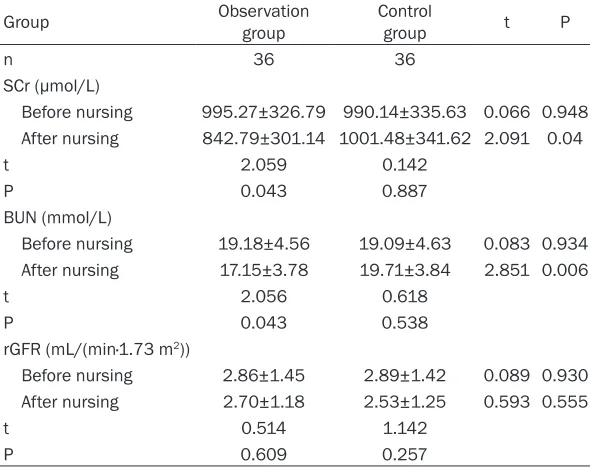
Primary outcome measu- res: (1) Dialysis adequacy: 3 mL of fasting venous blood was collected in the morning to measure the SCr and BUN. The urine was collected to measure the creatinine and BUN. 24-hour urine volume was recorded. rGFR = (renal urea clearance + creati-nine clearance)/2, of which creatinine clearance = (uri -nary creatinine/SCr) × 24- hour urine volume/1440. BUN clearance = (urine urea nitrogen/serum urea nitrogen) × 24-hour urine volume/1440. The correc-tion value was applied to calculate rGFR, calculation formula = calculation result × body surface area/1.73 m2. (2) Nutritional status:
peripheral venous blood was collected. The PA, Hb and ALB levels were mea-sured using a Hitachi Au- Table 2. Comparation of the dialysis adequacy (_x± sd)
Group Observation group Control group t P
n 36 36
SCr (μmol/L)
Before nursing 995.27±326.79 990.14±335.63 0.066 0.948 After nursing 842.79±301.14 1001.48±341.62 2.091 0.04
t 2.059 0.142
P 0.043 0.887
BUN (mmol/L)
Before nursing 19.18±4.56 19.09±4.63 0.083 0.934 After nursing 17.15±3.78 19.71±3.84 2.851 0.006
t 2.056 0.618
P 0.043 0.538
rGFR (mL/(min·1.73 m2))
Before nursing 2.86±1.45 2.89±1.42 0.089 0.930 After nursing 2.70±1.18 2.53±1.25 0.593 0.555
t 0.514 1.142
P 0.609 0.257
[image:3.612.91.386.351.585.2]Secondary outcome measures: (1) Quality of life: the patient’s overall quality of life, physical function, emotional function, role function, cog-nitive function, and social function before and after nursing were evaluated using the quality of life questionnaire (QLQ-30). The total score was between 0-100. The higher the score, the better the quality of life. (2) Observation of the complications in the two groups.
Statistical methods
All statistical data were analyzed using SPSS 19.0 statistical software. The measurement data were expressed as the mean ± standard
After nursing, the BUN and SCr levels in the observation group were significantly lower than the levels before nursing. The BUN and SCr lev-els in the observation group were significantly lower than the levels in the control group (P<0.05). There was no statistical significance in the rGFR in the observation group before and after nursing, and there was no significant dif -ference compared with the rGFR of the control group (P>0.05). See Table 2 and Figure 1.
Comparison of the psychological states
[image:4.612.95.316.75.303.2]After nursing, the anxiety and depression scores in both groups were significantly lower Figure 1. Comparation of the dialysis adequacy. A. Serum creatinine; B. Blood urea nitrogen; C. Residual
[image:4.612.90.328.354.525.2]glomerular filtration rate. Compared with before nurs -ing, *P<0.05. Compared with the observation group, #P<0.05, ##P<0.01. SCr, serum creatinine; BUN, blood urea nitrogen; rGFR, residual glomerular filtration rate.
Table 3. Comparison of the psychological states (_x± sd)
Group Observation group Control group t P
n 36 36
Anxiety score
Before nursing 62.42±5.73 63.28±6.04 0.620 0.537 After nursing 31.65±3.79 48.16±4.81 16.176 0.000 t 26.873 11.749
P 0.000 0.000
Depression score
Before nursing 63.34±6.28 64.27±6.11 0.637 0.526 After nursing 36.48±5.06 48.80±5.27 10.118 0.000 t 19.983 11.504
P 0.000 0.000
deviation (_x ± sd) and independent sam-ples t-test were applied. A paired t-test was used for the intra-group compari-sons before and after nursing. All count data were expressed as a % and a chi-squared (χ2) test was applied. P<0.05
was considered statistically significant. Results
Comparation of the general information
There were no significant differences between the two groups in terms of gen-der composition including age, primary disease, duration of the dialysis or educa-tion (P>0.05). See Table 1 for details.
than they were before the nursing (P<0.001), and the scores in the observation group were significantly lower than those of the control group (P<0.001). See Table 3 and Figure 2.
Comparison of the quality of life
After nursing, the physical function, emotional function, role function, cognitive function, social function, and overall quality of life scores in both groups were significantly higher than they were before the nursing (P<0.001), and the scores in the observation group were sig-nificantly higher than those of the control group (P<0.001). See Figure 3.
Comparison of the nutritional status
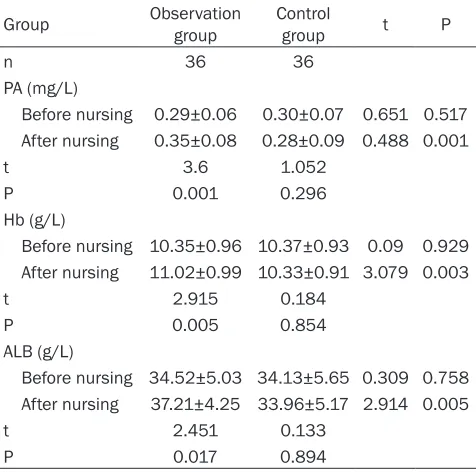
After nursing, the PA, Hb and ALB levels in the observation group were significantly higher than they were before the nursing (P<0.05). There was no significant change in the control group. The nutritional indexes in the observa-tion group were significantly higher than those of the control group (P<0.01). See Table 4 and Figure 4.
Comparison of complications
The overall incidence of complications in the observation group was 16.67%, which was
[image:5.612.92.522.76.199.2]sig-Figure 2. Comparison of the psychological states. A. Anxiety score; B. Depression score. Compared with the scores before nursing, ***P<0.001. Compared with the observation group, ###P<0.001.
[image:5.612.92.525.248.480.2]nificantly lower than the incidence in the con -trol group (38.89%) (P<0.05). See Table 5. Discussion
Chronic renal failure is the result of the devel-opment of various chronic renal diseases advancing to a certain stage rather than an independent disease [10]. Studies have indi-cated that the prevalence of stages 3-5 chro- nic renal disease in China was up to 11% and the incidence was increased by about 3% ev- ery year, which seriously endangers the resi-dents’ physical and mental health [11]. Chronic renal failure can lead to renal parenchymal damage, resulting in varying degrees of renal atrophy and impaired renal function. Fur- thermore, it can lead to water-electrolyte im- balance, acid-base imbalance, metabolite re- tention and other syndromes [12, 13]. There is no cure for chronic renal failure. Renal replace-ment therapy is the chief method of delaying the deterioration of the disease [14]. Periton- eal dialysis is a renal replacement therapy. Peritoneal dialysis utilizes the peritoneum as a semi-permeable membrane to clear metabo-lites and toxicants accumulated in the body, to promote the water-electrolyte and acid-base balances, thereby improving the conditions of patients with chronic renal failure [15]. Peritoneal dialysis can be performed at home,
cal changes, but they can also understand their family environment, structure, family members, and the health status of the family members’, etc. And then, they can carry out nursing activi-ties and provide effective assistance according to the actual demand and available resources [18, 19]. During the progress of continuous home nursing visits, the medical staff not only check the patient’s health status, but they also learn about their living environment, psycho-logical state, etc., and provide assistance and guidance to the patient. Meanwhile, the pa- tient’s family members are instructed to partici-pate in the patient’s nursing progress to miti-gate their burden.
[image:6.612.91.329.89.325.2]This study showed that after nursing, both the BUN and SCr levels in the observation group were lower than they were before nursing. The BUN and SCr levels in the observation group were lower than those of the control group. There was no statistical significance in the rGFR in the observation group before and after nursing, and there was no significant difference compared with the rGFR of the control group. The results are consistent with previous stud-ies [20]. It was indicated that the BUN and SCr levels in the observation group could be better cleared than they could in the control group, which showed better dialysis adequacy in the observation group. Although the descent of Table 4. Comparison of the nutritional status (_x± sd)
Group Observation group Control group t P
n 36 36
PA (mg/L)
Before nursing 0.29±0.06 0.30±0.07 0.651 0.517 After nursing 0.35±0.08 0.28±0.09 0.488 0.001
t 3.6 1.052
P 0.001 0.296
Hb (g/L)
Before nursing 10.35±0.96 10.37±0.93 0.09 0.929 After nursing 11.02±0.99 10.33±0.91 3.079 0.003
t 2.915 0.184
P 0.005 0.854
ALB (g/L)
Before nursing 34.52±5.03 34.13±5.65 0.309 0.758 After nursing 37.21±4.25 33.96±5.17 2.914 0.005
t 2.451 0.133
P 0.017 0.894
which is conducive to the treatment and recuperation of patients and can miti- gate the patients’ burdens. It is being accepted by more and more patients [16]. However, home treatment for perito-neal dialysis patients requires self-opera-tion and self-care. It has some effects on patient compliance due to the lack of supervision and timely guidance from medical staff.
psychologi-rGFR was inevitable, the descent can be delayed and the residual renal function can be protected. This study also suggested that after the nursing, the improvement of anxiety and depression in the observation group was better than it was in the control group, and the quality of life was higher than it was in the control group, which is basically consistent with previ-ous studies [21, 22]. It showed that continuprevi-ous home nursing visits could improve the psycho-logical state and quality of life of peritoneal dialysis patients with chronic renal failure. At the same time, this study showed that after nursing, the nutritional indexes, namely the PA and Hb and ALB levels, in the observation gr- oup were increased, but the control group showed no significant change. The overall inci -dence of complications in the observation group was 16.67%, which was significantly lower than of the incidence in the control group. It is basically consistent with previous studies
eficial to finding and solving problems for peri -toneal dialysis patients; medical staff can com-municate with patients directly and build a good relationship with them. Patients are more likely to confide when they have any difficulties or problems with peritoneal dialysis. Nursing services provided by medical staff were much more targeted, which is conducive to promoting the smooth treatment of patients; medical staff could learn about the patient’s family directly through continuous home nursing visits, then make full use of the family resources to main-tain the patient’s health. The patient’s family members could better participate in the prog-ress of nursing through guidance and commu-nication; the patient’s psychological state, treatment and nursing compliance, and perito-neal dialysis progress could be effectively improved through various nursing services. Consequently, the dialysis adequacy and quali-ty of life could be improved and the
complica-Figure 4. Comparison of the nutritional status. A. Prealbumin; B. Hemoglobin; C. Albumin. Compared with the results before nursing, *P<0.05, **P<0.01.
Compared with the control group, ##P<0.01. PA,
[image:7.612.89.523.72.318.2]prealbumin; Hb, hemoglobin; ALB, albumi.
Table 5. Comparison of the complications (n, %) Group Observation group Control group χ2 P
n 36 36
Hypotension 1 (2.78) 3 (8.33) 1.059 0.303 Cardiovascular events 2 (5.56) 3 (8.33) 0.215 0.643 Infections 3 (8.33) 7 (19.44) 1.858 0.173 Bleeding 0 (0.00) 1 (2.78) 1.014 0.314 Overall incidence 6 (16.67) 14 (38.89) 4.431 0.035
[image:7.612.90.332.349.453.2]ben-tions of peritoneal dialysis could be reduced. However, due to the short observation time of this preliminary study, the long-term prognosis effect of continuous home nursing visits on patients with chronic renal failure and perito-neal dialysis was not discussed. It will be fur-ther explored in a future study.
In summary, the application of continuous home nursing visits for patients with chronic renal failure and peritoneal dialysis can improve the dialysis adequacy, the patient’s psychologi-cal state, quality of life and nutritional status, and reduce complications. It is worthy of clini-cal promotion.
Disclosure of conflict of interest
None.
Address correspondence to: Wen Chen, Depart-
ment of Nephrology, The Second Affiliated Hospital
of Hainan Medical University, No. 48 Baishuitang Road, Longhua District, Haikou 570311, Hainan Province, China. Tel: +86-0898-66809030; Fax: +86-0898-66809030; E-mail: chenwen2yui2@163. com
References
[1] Liakopoulos V, Nikitidou O, Kalathas T, Roum-eliotis S, Salmas M and Eleftheriadis T. Perito-neal dialysis-related infections recommenda-tions: 2016 update. What is new? Int Urol Nephrol 2017; 49: 2177-2184.
[2] Tejera D, Varela F, Acosta D, Figueroa S, Be-nencio S, Verdaguer C, Bertullo M, Verga F and Cancela M. Epidemiology of acute kidney inju-ry and chronic kidney disease in the intensive care unit. Rev Bras Ter Intensiva 2017; 29: 444-452.
[3] Rigoni M, Torri E, Nollo G, Zarantonello D, Laudon A, Sottini L, Guarrera GM and Brunori G. Survival and time-to-transplantation of peri -toneal dialysis versus hemodialysis for end-stage renal disease patients: competing-risks regression model in a single Italian center ex-perience. J Nephrol 2017; 30: 441-447. [4] Li JW, Wong JHS, Chak WL and Chau KF. Effect
of incident nocturnal home hemodialysis ver-sus incident continuous ambulatory peritoneal dialysis on employment rate, clinical, and labo-ratory outcomes: a 1-year retrospective obser-vation study. Hemodial Int 2018; 22: 308-317. [5] Chen M, Zhou R, Du C, Meng F, Wang Y, Wu L,
Wang F, Xu Y and Yang X. The carbon footprints of home and in-center peritoneal dialysis in China. Int Urol Nephrol 2017; 49: 337-343.
[6] Kuo IC, Huang JC, Wu PY, Chen SC, Chang JM and Chen HC. A low geriatric nutrition risk in-dex is associated with progression to dialysis in patients with chronic kidney disease. Nutri-ents 2017; 9.
[7] Kinjo K, Sairenji T, Koga H, Osugi Y, Yoshida S, Ichinose H, Nagai Y, Imura H, South-Paul JE, Meyer M and Honda Y. Cost of physician-led home visit care (zaitaku care) compared with hospital care at the end of life in Japan. BMC Health Serv Res 2017; 17: 40.
[8] Salehi Tali S, Mehralian H, Imani R, Khaledi A and Hatami Pour K. Effect of continuous caring and educational intervention (home visit) on quality of life in the congestive heart failure pa-tients. Can J Civ Eng 2008; 36: 926216-926218.
[9] National Kidney Foundation. K/DOQI clinical practice guidelines for bone metabolism and disease in chronic kidney disease. Am J Kidney Dis 2003; 42 Suppl 3: S1-201.
[10] Vadakedath S and Kandi V. Dialysis: a review of the mechanisms underlying complications in the management of chronic renal failure. Cureus 2017; 9: e1603.
[11] Sun K, Lin D, Li F, Qi Y, Feng W, Yan L, Chen C, Ren M and Liu D. Fatty liver index, albuminuria and the association with chronic kidney dis-ease: a population-based study in China. BMJ Open 2018; 8: e019097.
[12] Chen H, Chen L, Liu D, Chen DQ, Vaziri ND, Yu XY, Zhang L, Su W, Bai X and Zhao YY. Com-bined clinical phenotype and lipidomic analy-sis reveals the impact of chronic kidney dis-ease on lipid metabolism. J Proteome Res 2017; 16: 1566-1578.
[13] Lundstrom UH, Gasparini A, Bellocco R,
Qureshi AR, Carrero JJ and Evans M. Low renal replacement therapy incidence among slowly progressing elderly chronic kidney disease pa-tients referred to nephrology care: an observa-tional study. BMC Nephrol 2017; 18: 59. [14] Subramanian L, Quinn M, Zhao J, Lachance L,
Zee J and Tentori F. Coping with kidney
dis-ease-qualitative findings from the empowering
patients on choices for renal replacement ther-apy (EPOCH-RRT) study. BMC Nephrol 2017; 18: 119.
[15] Li WY, Wang YC, Hwang SJ, Lin SH, Wu KD and Chen YM. Comparison of outcomes between emergent-start and planned-start peritoneal dialysis in incident ESRD patients: a prospec-tive observational study. BMC Nephrol 2017; 18: 359.
[16] Li PK, Ng JK and McIntyre CW. Inflammation
and peritoneal dialysis. Semin Nephrol 2017; 37: 54-65.
decision-mak-ing regarddecision-mak-ing visit intensity planndecision-mak-ing for newly admitted patients: a qualitative descriptive study. Home Health Care Serv Q 2018; 37: 211-231.
[18] Tan CE, Jaffar A, Tohit N, Hamzah Z and Hashim SM. Exploring patients’ reasons for participa-tion in a medical educaparticipa-tion home visit pro-gram: a qualitative study in Malaysia. Perspect Med Educ 2017; 6: 182-188.
[19] Wu MP, Huang CM, Sun WJ, Shih CY, Hsu SH and Huang SJ. The promotion of resources in-tegration in long-term care service: the experi-ence of taipei city hospital. Hu Li Za Zhi 2018; 65: 24-32.
[20] Jeffs L, Jain AK, Man RH, Onabajo N, Desveaux L, Shaw J, Hensel J, Agarwal P, Saragosa M, Jamieson T, Wong I, Maione M and Bhatia RS. Exploring the utility and scalability of a tele-homecare intervention for patients with chron-ic kidney disease undergoing peritoneal dialy-sis-a study protocol. BMC Nephrol 2017; 18: 155.
[21] Hemmelgarn BR, Smekal MD, Weaver RG,
Thomas C, Benterud E, Tam K, Manns BJ, Tonelli M, Finlay J, Donald M, Tam-Tham H, Bello A, Tangri N and Quinn RR. Implementa-tion and evaluaImplementa-tion of a risk-based appro- ach to guide chronic kidney disease care: protocol for a multiphase mixed-methods study. Can J Kidney Health Dis 2018; 5: 2054358117753618.
[22] Thilly N, Chanliau J, Frimat L, Combe C, Mer-ville P, Chauveau P, Bataille P, Azar R, Laplaud D, Noel C and Kessler M. Cost-effectiveness of home telemonitoring in chronic kidney disease patients at different stages by a pragmatic ran-domized controlled trial (eNephro): rationale and study design. BMC Nephrol 2017; 18: 126.