b8GlGl/b8Gl'1
flSSEr:1BlER
V1.4
USER'S MANUAL
SOFTWARE DYNAMICS
2111 W. Crescent. SuiteG,. Anaheim, CA 92801
REFERENCE MANUAL
7th Printing
This manual describes Software Dynamics' ASM version 1.4 family of 680x assemblers. Software Dynamics has carefully checked the information given in this manual, and" i t is believed to be entirely reliable. However, no responsibility is assumed for inaccuracies.
Software Dynamics reserves the right to change specifications without notice.
**********************************************************************
**
This manual describes software which is a proprietary product**
**
of Software Dynamics (SO). SO software is licensed for use on a**
**
single copy per computer basis, and is covered by u.S copyright**
**
laws. Unless a written exception is obtained from SO, the soft-**
**
ware must be used only on the single computer whose unique, SD-**
**
assigned serial number matches that for which the software was**
**
purchased. Copying the software for any purpose other than**
**
archival storage, or use of the software on other than the as-**
**
signed serial numbered CPU is strictly prohibited. SO assumes**
**
no liability regarding the use of the software.**
**
Certain software programs and datafiles are delivered for use**
**
in an encrypted format. The content of such programs and data**
**
are considered to be a trade secret of SO. Attempts to break**
**
the encryption method, publishing, copying or storage of such**
**
a program or file in clean text form will be treated as theft of**
**
a trade secr~t, and prosecuted as such.**
**
POSSESSION OR USE OF THIS MANUAL OR THE SOFTWARE IT DESCRIBES**
**
CONSTITUTES AGREEMENT BY THE USER TO THESE TERMS.**
**********************************************************************
TABLE OF CONTENTS
INTRODUCTION . . • . . . • • • . . . • . • . • • 1
ASM -- A SMART ASSEMBLER ON A LITTLE MACHINE • . . . 1
NOTATION DEFINITION . • • . • . . . 2
GENERAL DISCUSSION . • • . . . • . • • . . • • • 3
SOURCE FILE FORMAT . . . • . . . • . • • • . · 4
LINE FORMAT . . . • • . . • • . • • • • 5
LABEL FIELD (OR LF) . • . . . • . • . . • • • • 6
COMMAND FIELD (OR CF) • • . . • • • . · 6 ARGUMENT FIELD (OR AF) • . • . . . • . · 6
COMMENT FIELD . . • . • • . . . · 6
SOURCE LINE NUMBERS . • . . . . . . . . • . • • 7
EXPRESSIONS . . . 9
VALUES . . . . . . . . • . . . • . • 9
MANIFEST VALUES . . . • . . . 10
DECIMAL NUMBERS • • . . . . • 10
BINARY NUMBERS . . . . . . 11
OCTAL NUMBERS . • . . . 11
HEXADECIMAL NUMBERS . • . . . • . . . . 12
CHARACTER VALUES . . . . . . . • . 13
IMPLICIT VALUES . . . • . . . . • . 14
THE "*" VALUE . . . . . . . • • 14
THE II
*
I . . VALUE . . • . . . • • . • 14SYMBOLS . . . • • • . • . 15
RESERVED SYMBOLS . . . • • . . . • . . 16
PRE-DEFINED SYMBOLS . . . . . • 16
FORWARD REFERENCES . . . • . . . . 16
COMPUTATION. . . • . • • • • 17
MONADIC OPERATORS . . • . . . • . 17
DYADIC OPERATORS . . . . . • . 18
COMPLEX EXPRESSIONS • • • . • • . . . . . 23
OPERATOR HEIRARCHY . . . • • • . 23
PARENTHESES . . . . • . . • • . . • . 24
LINE PROCESSING . . . · . . . 25
6800/6801 MACHINE INSTRUCTION LINES . . . • • . • . 26
INHERENT MODE OPCODES . . . • • . . . . • • . . 28
REGISTER-REGISTER MODE . . . • . 28
DIRECT MODE . . . • . . • . . . . • • • 29
EXTENDED MODE . . . • • • . • . • 30
EXTENDED INDIRECT MODE . • . . . • . 30
INDEXED MODE . . . • . . • • 31
ZERO OFFSET INDEXED MODE . • • • . • . . . 31
8-BIT CONSTANT OFFSET INDEXED MODE . . . • . . . 32
AUTO INCREMENT/DECREMENT INDEXED MODE . . . 33
RELAT IVE MODE . . . • . • . . . . : . . 34
IMMEDIATE MODE . . • . . • • . . . . . . . . 34
OPCODE MNEMONICS RECOGNIZED . • . . . • . 35
6809 MACHINE INSTRUCTION LINES • • . • • •. • INHERENT MODE . . • • •
• • • • • 41 • • • • • 43 REGISTER-REGISTER MODE • • • • • • •
DIRECT MODE • • • • • • EXTENDED MODE • . • . • • • EXTENDED INDIRECT MODE . . • •
• • 43 44 • • • • • 45 • 45 INDEXED MODE • • • • • • • • • • • • • • • • . • 46 ZERO OFFSET INDEXED MODE • • • • •
5-, 8-, AND 16-BIT CONSTANT • 46 OFFSET INDEXED MODE . . • • • . • . . . • • 47
PROGRAM COUNTER RELATIVE (INDEXED) MODE . • . . 48 ACCUMULATOR OFFSET INDEXED MODE • • • • • • • • 49 AUTO INCREMENT/DECREMENT INDEXED MODE . • • . . 49 RELATIVE MODE • . . • • • • • • • . • . . . 50 IMMEDIATE MODE . . . . • • • • . • • . 50 STACK MODE . • . • • . . • . . . 51 OPCODE MNEMONICS RECOGNIZED . • • . • . . • • . 52
DIRECTIVES
SYMBOL DEFINITION DIRECTIVES . • • , EQUATE (EQU) • . • • . . • • . • . IMPLICIT EQUATE (EQU) • . • • • .
SET • • • • • • • ~ • • • • • • • • •
DATA GENERATION DIRECTIVES FORM CONSTANT BYTE . . . RESERVE MEMORY BYTES . .
FORM DOUBLE BYTE CONSTANT . . . FORM CONSTANT CHARACTERS . • FORM FLOATING POINT NUMBERS IMPLICIT DATA STATEMENT SET LOCATION COUNTER . . SET DATA PAGE REGISTER .
• • . . 58
• • • . 59 . • . 59 • 59 • • 61
. . • 63
· . . . . 63
· • • • • 64
· . . . . 65
• • • • • • 66
· 68 69 • • • • • 71 · 71
CONDITIONAL ASSEMBLY DIRECTIVES • . . • • . . . . • 72 SIMPLE CONDITIONAL ASSEMBLY • • • • 73 · . . . . 73 · . . . . 73 • • • • • • • 74 ALTERNATIVE ASSEMBLY • . . • • • • . •
NESTED CONDITIONAL ASSEMBLY . • • • . MORE COMPLICATED CONDITIONAL ASSEMBLY MULTI-CASE CONDITIONAL ASSEMBLY . . . CONDTIONAL ASSEMBLY ON UNDEFINED SYMBOLS CONDITIONAL ASSEMBLY ON DEFINED SYMBOLS
• • . • . 75
• • • • 76 • • • • 76
FULL DESCRIPTION OF CONDITIONAL ASSEMBLY COMMANDS . . . 77 THE "IF" DIRECTIVE . • • • • . • • . 79 CLOSE CONDITIONAL ASSEMBLY BLOCK . • • • . • • • • • 79 CONDITIONAL ASSEMBLY WITH CHECK . . . . . • . . 79 IF SYMBOL NOT DEF INED • • . . . . . . . . . • . 80 IF SYMBOL DEFINED . . • • . . . . • . 80 THE ELSE DIRECTIVE • • • • . . . . . . • 81 CONDITIONAL ELSE . . . • . . . • . . . • 81 CASE CONDITIONAL ASSEMBLY . . . . . . • . • 82
SINGLE LINE ITERATIVE ASSEMBLY • 83
ASSEMBLY CONTROL DIRECTIVES . . . • • • • • • • • 84 • • • • • • 84
· . . . 85
TERMINATE SOURCE FILE . • . SELECT ASSEMBLY OPTIONS • • • • THE OPT STATEMENT . • .
THE INCLUDE STATEMENT . . • . . . •
· . . . 88 · . . . 88
LISTING CONTROL AND FORMATTING · . . . 90 PAGE HEADING FORMAT • . . • • .
LINE LISTING FORMAT . . . • . . . . PRINT CONTROL CARDS . . . . . . . . TURN LISTING ON/OFF . . • • • . SET TITLE AND EJECT PAGE . . . • . SET SUBTITLE AND EJECT PAGE . . . .
. . 91 • • • • 92
· . . . 93
• • • • 93
• • • • 94 • • • • 95
SET NAME . . . . . . . . • . . . . . 95
SPACE LISTING N LINES . . . • SET LISTING TABS • . . . . . . PRINT SKIPPED RECORDS . . .
PRINT GENERATED DATA . . . . PRINT CONDITIONAL ASSEMBLY COMMANDS
• • • 96 · . . . 96 · . . . . 97 • • • • • • • • 97 . . . 98
OPERATING ASM . . . • . . 99 STARTING ASM • • • • . . • • . . . . . . . 99 OPERATOR INPUT LINES . . • • . . . • . • • • • . 100 ERROR MESSAGES . . . . . . . • . 103 SYMBOL TABLE DUMP FORMAT . . • . . . . 105 ERROR LINE SUMMARY FORMAT • . . . • . . . . 106 MEMORY USAGE . . . • . . . . . • . • . . • 106
APPENDICES
APPENDIX A -- ASM DIRECTIVES
WHICH DISALLOW FORWARD REFERENCES • 107
APPENDIX B ASCII CHARACTER SET . · 108
APPENDIX C I/O ERROR MESSAGES · 109
APPENDIX D 680C COMPATIBILITY
INSTRUCTION SET . . • . . . • • . • . . • • . • • • 110
SECTION I: INTRODUCTION
SOFTWARE DYNAMICS
ASM -- 6800/6809 MICROPROCESSOR ASSEMBLY LANGUAGE
INTRODUCTION
ASM A SMART ASSEMBLER ON A LITTLE MACHINE
ASM is a sophisticated family of assemblers for 6800, 6801 and 6809 microprocessors, and is intended for operation under the SDOS operating system.
There are four such assemblers:
ASM6800.680, assembling 6800/6801 code and executing on a 6800 system
ASM6800.689, assembling 6800/6801 code and executing on a 6809 system
ASM6809.680, assembling 6809 code and executing on a 6800 system
ASM6809.689, assembling 6809 code and executing on a 6809 system
These assemblers are powerful, highly flexible tools. They are fast. Most important, they are professionals with the professional user in-mind.
development designed by
Significant features include:
--Multi-level conditional assembly. unrivalled in the industry.
--Multi-level INCLUDE files.
--Extensive listing format control.
ASM's facilities are
--Big-assembler computational power due to extensive operator set.
--Big-assembler performance due lookup.
to hash-coded symbol table
--Symbol table dumps sorted by name and by value; unused symbols are flagged.
--Big-assembler error diagnosis. Readable error messages are produced on the listing; error lines are always listed; and a
special summary at the end of the assembly tells you which lines had errors.
--680C coding style allows code to work on 6800, 6801 or 6809 by simply reassembling.
NOTATION DEFINITION
When introducing a construct or command, the following notation will be used to describe its allowable syntax.
--Graphic characters (e.g., +, /, -) and symbols printed in upper case denote strings of characters which must be present exactly as written in the manual. Example:
,X
denotes the string ",X".
--Symbols written in angle brackets denote a class of possible inputs. For example,
<NUMBER>
denotes any string whioh conforms to ASM's definition of a number. Hence, the string
345
would qualify.
--Curly brackets are used to denote that a certain item is optional.
{, xl
indicates that the string ",X" may occur, but need not.
Ranges of possibilities of which one must be chosen are denoted by listing the alternatives vertically.
X ,X
<EXP'>, X
indicates that either ",X" must be present. written as
or
X
{<EXP>},X
{ {< EXP >
1 , }
X"X",",X", Note that
or an expression followed by this could also have been
--Finally, ellipsis (" ••• ") are used to indicate the possibility of indefinite repetition when embedded in text. For example,
<EXP> { , <EXP> .•. }
iQdicates that a series of one or more expressions separated by commas is acceptable. Ellipsis on a line by itself represents some indefinite sequence of source lines. For example:
line I
line n
indicates that some sequence of lines exists between line 1 and line n.
SECTION I: INTRODUCTION
GENERAL DISCUSSION
All assemblers in the ASM family have all the properties described in this manual, unless specifically indicated. For the most part, differences between the assemblers are limited to the instruction set intended for assembly by ASM.
This manual assumes that the reader knows the M6800/M6801 and/or the M6809 machine instruction set. It is a manual on the use of the assembler. It is not, nor is i t intended to be, a tutorial on the instruction set for these microprocessors.
To use ASM, the programmer first prepares a "source" dis.k file. This can be done by using EDIT or SEDIT under SDOS. Then ASM is invoked, and given the name of the source file to be assembled, and names of listing and binary object files to be produced.
ASM is a two-pass assembler. That is, the entire source file is read twice. On the first pass through the source file, all assembly errors are suppressed, and certain operations (like producing a listing or binary) are not performed. This pass is performed primarily to assign symbols their values.
At the end of the first pass, all symbols should be defined; ASM rewinds the source file, and processes i t again. This time i t produces a listing file and a binary file, according to the userls directions.
SOURCE FILE FORMAT
ASM places very few restrictions on the format of the source file. Its only requirements are:
1) Source lines must be terminated with carriage returns.
2) Nulls may not be significant characters in the file; they will always be ignored.
3) If the file is divided up into "forms" using characters, the form-feeds must immediately carriage-return.
form-feed follow a
All other ASCII characters are legal and will be printed in the listing without complaint. Control characters (with the exception of tab) will always be printed as 11"11 followed by an appropriate letter. For example, control-A will be listed as
I I " A" •
The tab character is treated somewhat differently. If i t appears as part of a character string, -it will be listed as ""1"; otherwise i t will cause one or more blanks to be output, until the print carriage is positioned at a tab stop or is past the last tab stop. Tabs may be adjusted by the user via the TABS directive.
A form-feed character that does not follow a carriage return will always be treated like any other ASCII control character.
SECTION II: SOURCE FILE FORMAT
LINE FORMAT
ASM has a free-format line syntax. Fields may begin in any column and are separated from one another (or "de.limited") by blanks or tabs. Each field may be broken into subfields, each subfie1d being separated from the next by commas.
Some consequences of ASM's line syntax are:
--Blank lines may be freely inserted to format the listirg as desired.
--Comment lines may be specified column 1 or with a series of comment. Examples:
either blanks,
with a star ("*II) in a semicolon and the
* THIS IS A COMMENT LINE. THE "*11 IS IN COLUMN 1. THIS IS ALSO A COMMENT LINE.
THIS IS A COMMENT LINE, TOO.
; ANY NUMBER OF BLANKS CAN PRECEDE 11;".
--Blank or tab characters not embedded in a string ALWAYS terminate a field. In particular, this means that a comma should not usually be followed by a blank, as one would ordinarily do when typing. Also, this means that blanks may not be inserted in the middle of an expression.
--Consecutive blanks or tabs are treated as a single blank.
A line consists of the following parts, any of which may absent. The scanning of a line is always stopped by a
(semi-colon) character encountered outside a text string.
be
...
I1) LABEL FIELD (or LF). The label field, if non-null, must begin in the first column of the line. (see "Line Numbers", below for exception). This field is generally used to
specify symbols whose values are to be changed or determined by the command given on the same line. If the label field begins with an asterisk, the entire line is treated as a comment. It will be listed but otherwise ignored.
2) COMMAND FIELD (or CF). The command field is the second field of the line. This field is examined by ASM in order to determine how to process the line. If the command field is absent, ASM will treat the line as an implicit EQU
*
if a label is present, otherwise the line will be treated as a comment.3) ARGUMENT FIELD (or AF). The argument field is the third field of the line. It contains all arguments needed by the command. For an argument field to be present, there must also be a command field. Example:
LDAA AF
I
I
I
> ARGUMENT FIELD> COMMAND FIELD
4) COMMENT FIELD. Any portion of the line which is not scanned for a given command, or which is separated from the rest of the line by a semicolon, is treated as commentary. It is listed but otherwise ignored (but note that this, is not the case when the semicolon is part of or delimits a string. See discussions of FCC, TITLE directives.)
SECTION II: SOURCE FILE FORMAT
SOURCE LINE NUMBERS
ASM can accept files containing line numbers at each line, as long as the user alerts ASM directive.
the beginning of via the "WITH"
If line modified fashion.
numbers are present in the file, the line format is somewhat. Line numbers are handled in the following
1) Any string of zero or more digits or periods which starts a line will be listed but otherwise ignored.
2) If the next character is a blank or a tab, i t will also be ignored.
3) The next character in the file will be the first significant character of the line.
4) No error checking is done with respect to line numbers.
Examples: (Note that <TAB> represents the ASCII tab character. Assume that ASM has been directed to expect line numbers.)
409.17 <TAB> LABEL <TAB> LDAA <TAB> FROG
\---/
\---/
\--/
\--/
LINE # LF CF AF
409.l7LABEL <TAB> LDAA <TAB> FROG
\----/\---/
\--/
\--/
LN # LF CF AF
Because of the definition of the line number format, rather unexpected things can happen:
409.17 <TAB> LDAA <TAB> FROG
\---/
\--/
\--/
LINE # LF CF
In the above ~xample, the LDAA is erroneously treated as a label. The prpper way to enter the line is:
409.17 <TAB> <TAB> LDAA <TAB> FROG
\---/
I
\--/
\--/
LINE #
I
CF AF(NO LF)
Note that the line number can be absent:
<TAB> LABEL <TAB> LDAA <TAB> FROG
\---/ \---/
\--/
\--/
LN # LF CF AF
The moral is, be careful with line numbers.
SECTION III: EXPRESSIONS
EXPRESSIONS
ASM provides the user with the computations at assembly represents a significant step Motorola-standard assemblers. as well as parenthetical subexpressions.
ability time. beyond Many and
to perform sophisticated ASM expression handling the capabilities provided by more operators are handled, heirarchical grouping of
These extensions do not represent a burned bridge between ASM and Motorola standard assemblers; in fact, ASM can be directed via the "WITH" command to supress heirarchical considerations and evaluate operators from left to right; thus sources currently in development using Motorola-standard assemblers can be shifted to ASM without difficulty.
VALUES
Numeric values can be specified in expressions in two ways: manifestly and implicitly. All values share certain attributes:
--They are all sixteen-bit quantities.
--They are usually considered as two's complement signed numbers, where the most-significant bit is the sign of the number: positive if reset, negative if set.
--Certain operators treat the values as 16-bit unsigned quantities, in particular the multiply and divide group.
l~ANIFEST VALUES
IIManifest values" are those values which are entirely self-defining; that is, the text of the manifest value completely specifies the value to be used. This section describes the various manifest constants and their variations.
DECIMAL NUMBERS
The simplest manifest value represented by a string of notation.
<DIGIT> { <DIGIT> ••• }
is a decimal
decimal number. The value is digits, in ordinary base-10
If the value specified exceeds 65535, IIOverflow" is reported. If a letter is detected in the middle of a number, "Illegal Digit" is reported.
Examples:
346 000443 00000001 10000000 l139A4
Copyright (C) 1977
(Many Leading Zeroes is OK)
(But this is too big "Overflow" is reported) (Also illegal -- bad digit)
SECTION III: EXPRESSIONS
BINARY NUMBERS
Numbers may be specified in bases other than base ten. Binary (base two) numbers are represented as follows:
% <B-DIGIT> { <B-DIGIT> ... } <B-DIGIT> { <B-DIGIT> ... } B
<B-DIGIT> must be either 10 1 or Ill. If a digit outside this range is seen, "Illega1 Digit" is reported. If the assembled value exceeds 65535, "Overf10w" is reported.
Examples:
%10110 10110B
%111000111000111000 0102l0B
(Binary repesentation of 22 base 10) (Same thing using suffixed form) (Too big -- causes "overflow")
(Illegal -- "2" is not a binary digit)
Lower case qualifiers are also accepted:
%10llb (Same as %10llB)
OCTAL NUMBERS
Numbers may be specified in base eight, "octal notation." Such numbers have the form:
@ <O-DIGIT> { <a-DIGIT> ... }
<a-DIGIT> { <a-DIGIT> } 0 (The letter "oh") <a-DIGIT> { <O-DIGIT> •.. } Q
<a-DIGIT> may be any of the digits "0" through "7"; if "8" or "9" are seen, II Illegal Digit" is reported. If the yalue exceeds
65535, "Overflow" is reported.
Examples:
@26 260 26Q @759 @3777777
(Octal representation of 22, base ten) (The same, using suffix form)
(Alternate suffix form)
(Illegal -- 19 1 is not an octal digit) (Too big -- loverf10w" is reported)
Note that lower case qualifiers are also accepted:
026q 730
HEXADECIMAL NUMBERS
Numbers may be specified in base 16, so-called "hexadecimal notation." Each digit represents a number from 0 to 15; the digits 10 through 15 are represented by the letters "A" through
"F". There are two forms:
$ <HEXDIGIT> { <HEXDIGIT> .•. } <DIGIT> { <HEXDIGIT> •.. } H
A suffix-form hexadecimal value MAY NOT begin with one of the hex digits "A" through "F". Numbers whose first significant digit is
"A" through "F" must have a leading zero (see examples).
If a letter that is not between "A" and Digit" is reported. If the value exceeds reported.
"F" is seen, "Illegal $FFFF, "Overflow" is
Examples:
$16 16H 0AEH AEH $EG $FFFE3
(Hex representation of 22, base 10) (Suffix form of same number)
(Suffix form of $AE)
(Invalid this is a symbol)
(Invalid "G" is not a hex digit)
(Invalid too big for 16 bits. Overflow reported)
Lower case digits and qualifiers are accepted:
0aeh $f7f
SECTION III: EXPRESSIONS
CHARACTER VALUES
A value may be specified in terms of the ASCII code of an input character. Such values have the following form:
, <CHARACTER>
The "'" is a single quote character, ASCII $27. <CHARACTER> may be any character except carriage-return (subject to the restrictions mentioned in the section on "Source File Format"). If the character is a tab, i t will be listed as 11 .... 1" for improved
readability; hence the only time one will see "'" followed by a blank in a listing is when the quoted character actually is a blank.
The value used will be the 7-bit with zeroes extended to fill the 9 value.
ASCII value of the character, most-significant bits of the
Examples:
'A
' .... 1 '<CR>
Copyright (C) 1977
(Specifies the value 65, base 10)
(Specifies the value 32, i.e. quoted blank) (Specifies the value 9)
(Invalid -- "illegal string" is reported)
IMPLICIT VALUES
Obviously, manifest values would not be very themselves. An important feature of any assembler is to represent values symbolically. The user thus gains to manipulate values without having to know what values are.
THE "*" VALUE
useful by the ability the ability the actual
ASM provides a special kind of implicit value -- the address that the next byte stored into memory will occupy. This value is called the LOCATION COUNTER. Whenever a star ("*") takes the place of a value in an expression, ASM substitutes the current value of the location counter. This value can be used like any other valuei i t is never a forward reference. At the beginning of each pass, "*" has the value zero.
"*" does not neccessarily remain the same throughout the processing of a statement (for example, see FDB directive). But on most statements, particularly all machine language instructions, i t remains constant until all expressions on that line have been evaluated.
THE 1'1
*
1 II VALUEASM for 6809 provides a second type of instruction counter, the location of the start of the next instruction. Whenever the star-apostrophe appears ("*1") within an instruction operand, i t will yield the value of the following instruction's opcode byte. If the star-apostrophe appears in a non-instruction line, its value is identical with star ("*").
Examples:
A
FOB #*' SET
*'
*1iSame as
*
:Same as*
iSame as
*
The reason for this special implicit value is i t represents the PC (program counter) value that is used in PC relative addressing modes.
Example:
LOA QQQ_*
I,
PC :Relative reference to loc QQQSECTION III: EXPRESSIONS
SYMBOLS
Symbols in ASM consist of a letter, a colon (":") or a period (".II), followed by a string of letters, digits, colons, periods, dollar signs ("$"), percent signs ("%") or at signs ("@"). A symbol may be of any length; however only the first thirty-two are used to distinguish one symbol from another.
Lower-case letters which appear in symbols are considered by ASM to be the same character as their upper-case equivalent. They will appear in lower case on the listing, but will match upper-case versions of the same letters.
The following are symbols:
QRS
qrs (The same as QRS -- lower-case matches upper-case) L34
A
.BEGIN.WITH.DOT.LONGER.THAN.THIRTY .BEGIN.WITH. DOT. LONGER. THAN. THIRTY. TWO
(ASM treats the last two as the same symbol) .BEGIN.WITH. DOT. LONGER. THAN. FIFTEEN
(This symbol is different from both the above)
The following are NOT symbols:
$DOLLAR (Does not begin with letter, colon or period)
RESERVED SYMBOLS
ASM has no "reserved symbols", however, some symbols have special interpretation in certain contexts. For 6800/6801 ASM, these symbols are nAil, "B", "D", "S", and "X". For 6809 ASM the symbols "A", "B", liD", "X", "Y", "S", "U", "CC", "DP", "PC" and "PCR" can have special interpretations. (See "Machine Instruction Lines" for details.)
PRE-DEFINED SYMBOLS
ASM has three pre-defined symbols:
M6800 M6801 M6809
The purpose of these symbols is to support the 680C "concept", permitting conditional assembly dependent on the target CPU. For more information, see "Appendix D".
For the ASM6800 with 6801 option disabled (no use of WITH M680l directive), the symbol M6800 has the value 1, and M680l and M6809 have the value 0. For ASM6800 with 6801 option enabled (WITH M680l directive used), the symbol M680l has the value 1 and M6800 and M6809 have the value 0. ASM6809 has M6809 equal to 1 with M6800 and M680l equal to 0.
FORWARD REFERENCES
A symbol may with some restrictions ,be used before i t is defined. Such a use is called a FORWARD REFERENCE. In general, a forward reference may be used in any context that will allow ASM to allocate the same number of bytes at the same locations in pass one and pass two.
See Appendix A for a list of ASM directives which do not allow forward references.
SECTION III: EXPRESSIONS
COMPUTATION
Manifest and implicit values can be combined and operated upon at assembly time to produce new values. This is done by means of operators. ASM provides an extensive range of computational functions. These functions are divided into two categories: Monadic operators, which operate on one value to produce a result; and Dyadic Operators, which combine two values to produce a third.
MONADIC OPERATORS
+<A>
Monadic plus does nothing. Its usual use is for clarity. +1 ==> 1
+0 ==> 0
-<A>
Monadic minus computes the two's complement of its argument. -1 ==> $FFFF
-0 ==> 0
+\<A>
Monadic backslash computes the one's complement of its argument. \1 ==> $FFFE
\0 ==> $FFFF
&<A>
Monadic ampersand computes the logical ASM considers any zero or negative value any positive non-zero value is "true".
&1 ==> 0 &0 ==> 1 &17 ==> 0 &(-1) ==> 1
Copyright (C) 1977 17
inverse of its argument. to be logically ttfalse";
DYADIC OPERATORS
<A>+<B>
Dyadic plus computes the arithmetic sum of its two arguments. No check is made for overflow.
3+2 ==> 5
$FA00+$100 ==> $FB00
$105+$FFFF ==> $104 {No overflow is reported}
<A>-<B>
Dyadic minus computes the two's complement arithmetic difference of its arguments. No overflow check is made.
3-2 ==> 1
$FA00-$100 ==> $F900 $105-$FFFF ==> $106
<A>*<B>
Dyadic star multiplies its arguments together as sixteen-bit unsigned quantities. If the result cannot be represented as a sixteen bit unsigned number, "Overflow" is reported.
3*2 ==> 6
$7000*2 ==> $E000 {No overflow} {Overflow} $FE00*2 ==> $FC00
<A>/<B>
Slash computes the quotient are treated as sixteen-bit,
"Overflow" is reported, and
3/2 ==>
307/5 ==>
$FE00/$100 ==> $170C/0 ==>
Copyright {C} 1977
of <A> divided by <B>. The arguments unsigned quantities. If <B> is zero, the result is zero.
1 {Integer division} 61
$FE
o
{Overflow}SECTION III: EXPRESSIONS
<A>//<B>
Doubleslash computes the Covered Quotient of <A> and <B>. Covered Quotient is defined as «A>+<B>-l)/<B>. This operator is useful in computing the number of <B>-byte units needed to hold <A> bytes. For example, if PROGSIZE is the number of bytes in a program, and SECTSIZE is the number of bytes in a disk sector, PROGSIZE//SECTSIZE is the number of disk sectors required to store that program.
3//2 307//5 $FE00//$100 $170C//0 $FF03//$100 <A>\<B> ==> ==> ==> ==> ==>
Dyadic backs lash computes
3\2 ==>
307\5 ==>
$FE00\$100 ==> $170C\0 ==> $FF03\$l00 ==>
<A>##<B> 2 62 $FE
o
$100 (Overflow)(Note that this works even though $FF03+$100-l exceeds 16 bits)
the remainder of <A> divided by <B>. 1
2
o
o
(Overflow) 3Doublehash performs a logical-shift operation. If <B> is positive, the result is <A> shifted left <B> bit places, with zeroes shifted into the least-significant bits. If <B> is negative, the result is <A> shifted right <B> bit places, with zeroes shifted into the most-significant bits. If <B> is zero, the result is <A>.
Bang 3##2 $FE##8 $FE00##-8 12345##16 <A>1<B>
computes the 211 ==> 014 ==> 712 ==>
Copyright (C) 1977
==> ==> ==> ==> bitwise 3 4 7 $C $FE00 $FE
o
logical-inclusive-or of its arguments.
<A>&<B>
Dyadic ampersand arguments.
2&1 ==> 0&4 ==> 7&2 ==>
<A>ll<B>
computes
o
o
2
the -bitwise logical-and of its
Doublebang computes the arguments. It is defined
bitwise logical-exclusive-or as «A>&\<B»I{<B>&\<A».
of its
2111 ==> 3 0114 ==> 4 7112 ==> 5
<A>=<B>
Equal compares its arguments and returns 1 if they are equal, 0 otherwise.
3=3 ==> 1 3=4 ==> 0
<A>#<B>
Hash compares its arguments and returns 0 if they are equal, 1 otherwise.
3#3 ==> 0 3#4 ==> 1
SECTION III: EXPRESSIONS
<A> > <B> Greater compares left argument is
its arguments as signed numbers; returns 1 if greater than the right argument, 0 otherwise. 3>3 ==>
3>4 ==> 4>3 ==> $FFFE>0 ==> 0>$FFFE ==> (Note that $FFFE
<A> >= <B> <A> => <B>
o
o
1
o
1
is interpreted here as -2.)
Greater-equal is like Greater, but returns 1 if <A> is greater than or equal to <B>.
3>=3 ==> 1 3>=4 ==> 0 4>=3 ==> 1 $FFFE>=0 ==> 0 0>=$FFFE ==> 1 ($FFFE is interpreted here as -2.)
<A> < <B>
Less is like Greater, but returns 1 if <A> is less than <B>, 0 otherwise.
3<3 ==> 3<4 ==> 4<3 ==> $FFFE<0 ==> 0<$FFFE ==> ($FFFE is interpreted here
<A> <= <B> <A> =< <B>
o
1o
1o
as -2.)Less-equal is like Greater, but returns 1 i f <A> is less than or equal to <B>, 0 otherwise.
3<=3 ==> 1 3<=4 ==> 1 4<=3 ==> 0 $FFFE<=0 ==> 1 0<=$FFFE ==> 0 ($FFFE is interpreted here as -2.)
<A> » <B>
Logical-greater compares its arguments as UNSIGNED returns I if <A> is greater than <B>, otherwise 0.
3»3 ==> 0
3»4 ==> 0
4»3 ==> I
$FFFE»0 ==> I 0»$FFFE ==> 0
($FFFE is interpreted here as 65534.)
<A> >/ <B>
numbers; i t
Logical-greater-equal is like Logical-greater, but returns I if <A> is greater than or equal to <B>, 0 otherwise.
3>/3 ==> I 3>/4 ==> 0 4>/3 ==> I $FFFE>/0 ==> I 0>/$FFFE ==> 0
($FFFE is interpreted here as 65534.)
<A> « <B>
Logical-less is like Logical-greater, but returns I if <A> is less than <B>, otherwise 0.
3«3 ==> 0
3«4 ==> I
4«3 ==> 0
$FFFE«0 ==> 0 0«$FFFE ==> 1
($FFFE is interpreted here as 65534.)
<A> \< <B>
Logical-Iess-equal is like Logical-greater, but returns I if <A> is less than or equal to <B>, otherwise 0.
3\<3 ==> I 3\<4 ==> I 4\<3 ==> 0 $FFFE\<0 ==> 0 0\<$FFFE ==> I
($FFFE is interpreted here as 65534.)
SECTION III: EXPRESSIONS
COMPLEX EXPRESSIONS
ASM allows the user to create complex expressions involving many operators. In such expressions, the problem arises of order of computation. ASM provides two methods of specifying this order.
OPERATOR HIERARCHY
Unless otherwise instructed (via the "WITH" directive or the use of parentheses), ASM evaluates expressions using an operator-precedence algorithm; the order of evaluation, though generally left-to-right, can be modified according to which operators are used. In order to determine whether an operator gets to be evaluated, ASM looks at the operators which follow that operator in the expression. If the next operator gets to go first, ASM performs that operator and uses the result as the right argument to this operator -- but not before checking the operator-after-next, and so on. The ordering decision is made as follows:
1) The first operators performed will be monadic operators, from right to left.
--SYM <==> -(-SYM) -\4 <==> -(\4).
2) The next operator performed will be double-hash (shift). A##-3 <==> A##(-3)
3) The next operators performed will be *,
/,
//
and\,
going from left to right across the expression.A*B/5 <==> (A*B)/5 A/5##4 <==> A/(5##4) A/B*2 <==> (A/B)*2
4) The next operators performed will be dyadic + and again from left to right.
A+3-B <==> (A+3)-B A-3+B <==> (A-3)+B A-B-C <==> (A-B)-C A-B*4 <==> A-(B*4)
5) The next operators evaluated will be the relational operators: = , # , <, < = , = < , >, > = , = >, < <, \ <, > >, and > / •
3*A<B <==> (3*A) <B
4##2«5/A+2 <==> (4##2)«({5/A)+2) B>3*A <==> B>(3*A)
A<B<C <==> (A<B)<C
6) Last come the logical operators: 1, &, and 11. A<B&C=D+2 <==> (A<B)&{C={D+2»
A>B1C#D11D<0 <==> ({A>B)1{C#D»1J(D<0)
PARENTHESES
As implied in the above descriptions, parentheses can be used to specify explicitly the order of evaluation of a given expression. Parentheses must always be matched; that is, for every left parenthesis there must be one and only one corresspondng right parenthesis. A failure here will result in a "Syntax Error" for the line containing the expression.
Parentheses may be nested to any level.
They may be used even if WITH MCM has been specified.
SECTION IV: LINE PROCESSING
LINE PROCESSING
ASM follows these rules when processing a line:
1) If the first character of the Label field is a star ("*"), the line is treated as a comment. It is listed but otherwise ignored.
*
*
This is a comment Ignore me.
2) If the command field consists of a single symbol i t is looked up in the list of opcodes (see sections on "Machine Instruction Lines" for lists of opcodes accepted). If found, the line is treated as a machine instruction line.
LOX 3 TSX
CLV PUL A
All of these
are machine instruction lines by rule (2).
3) If the command field is not an opcode symbol, then the symbol is checked in the list of ASM directives. If found, the line is treated as a directive line.
J EQU 17 This is a directive by rule (4)
PAGE So is this
ORG $47 As is this
4) Any line which does not qualify under rules (2), or (3) is processed as an implicit data statement (see below).
LDAC #34 This is an implicit data statement 3,4*17 So is this
(TSX) So is this
6800/6801 MACHINE INSTRUCTION LINES
The major function of an assembler is the translation of symbolically specified machine instructions into a form directly understandable by the target computer. This section describes instructions translated by ASM6800, and presumes knowledge of the 6800/6801 instruction set, which can be found in the Motorola MC6801 Programming Manual. ASM is fully, compatible with 'the Motorola 6800 standard assembler syntax, with several useful extensions.
--6801 opcodes are assembled if enabled by use of a WITH M680l directive. 6800 equivalent instructions are assembled for 6801 instructions if a WITH M680l directive is not given.
--Many 6809 assembly mnemonics and address modes are supported. This considerably simplifies construction of programs that will run on either processor, depending on which assembler is used. See section on M680C.
--Special set of opcodes to allow coding to work on 6800, 6801 and 6809. These opcodes are called 680C opcodes (See Appendix D). Many "convenience" instructions are included in 680C, which act as logical extensions to the '00/'09 instruction set, such as double register shifts, 16 bit memory increments, and decrements, etc.
--Automatic long branching. Short branches that are out-of-range will be assembled as a branch on complementary conditions around a JMP to the destination if the destination expression contains no forward references.
--Multiple labels are allowed, separated by commas. All labels present on an opcode line will be equated to the location counter, "*", before the rest of the line is processed.
--Two new inherent-addressing mode opcodes are defined, SKI and SK2 (Skip 1 and Skip 2). These opcodes can be used to cause the CPU to skip one or two bytes before executing the next instruction, changing only the condition code flags. These opcodes will work on all standard 6800/6801 CPUSi they are really the opcode bytes of Bit A, Immediate and Compare X, Immediate instructions. Note that use of these instructions is NOT generally portable from 6800 to 6809 and vice versa.
--A, B, D, S, and X may be used as ordinary symbols as long as they are distinguishable from their use as register designators.
SECTION V: 6800/6801 MACHINE INSTRUCTION LINES
ASM processes each machine instruction line as follows: all labels are first equated to the location counter, '*'i then the opcode specified is inspected tq determine which operand addressing modes are legal. Finally, the operand field is scanned for an appropriate addressing mode specification. The opcode is combined with the specified addressing mode to generate the object code corresponding to the desired instruction.
Many opcodes (LOA, STAA STX, SUBD, etc.) include a register specification (A, B, 0, X, or S) as the last letter of the opcode mnemonic.
There are several operand modes for 6800/6801 instructions. A given instruction that is recognized by ASM will have one or more modes as legal forms (some opcodes require no operand specification whatsoever). The syntax of each of these modes is discussed in the following pages. A few examples of each mode will be given. A table of instruction mnemonics and their modes can be found at the end of this section.
Throughout this section, the notation " <expr> "means any expression, "EA=" means Effective Address, and "(" <expr> ")" to the right of "EA=" means lithe contents of <expr>".
INHERENT MODE
Inherent Mode opcodes need no argument field is ignored. For be left blank.
operand specifications. The portability purposes, i t should
Syntax:
Examples:
<opcode>
RTI DES CLRA PSHD
REGISTER-REGISTER MODE
:Return from Interrupt :S:=S-l
:A-Reg:;::0
:Pushes A and B
Register-Register Mode addresses source and destination registers. This mode is used only for TFR A,B and TFR B,A 6809 equivalent instructions. See M680C description.
Syntax:
<opcode> <reg>, <reg>
Examples:
TFR A,B Tfr b,a
SECTION V: 6800/6801 MACHINE INSTRUCTION LINES
DIRECT MODE
Direct Mode is used to address a location in the range $0000 through $00FF. The 8 bits of operand embedded in the instruction form the lower 8-bits of the 16-bit memory reference address while the upper 8-bits of the address are implicitly zero. If an instruction operand address evaluates within the range $0000 to $00FF, ASM automatically generates Direct Mode memory reference if appropriate for that instruction.
Direct references may be forced with a n<" prefix. Use of this prefix prevents any default to the Extended Mode addressing. An error is generated if the effective address does not map into the range $0000 to $00FF. Use of the n<" prefix is illegal with opcodes that only allow extended mode addressing.
Syntax:
Example:
A
B
Copyright (C) 1977
<opcode>
EQU EQU
SUBB INC ADDB LDA ROR
$10 $123
A B
<A <B <A
{<prefix>}<exp>
iGenerated:
iDirect reference to loc $10 iExtended reference to loc $123 iDirect reference to loc $10
iDirect ref to loc $123 WITH ERROR iExtended reference WITH ERROR
EXTENDED MODE
Extended mode addresses memory with a l6-bit address embedded in the instruction. Any location in the memory space can be referenced with this mode. Extended mode may be forced by use of the ">" prefix. Certain 6800/6801 instructions can only use Extended modes to directly reference memory. Instructions whose operand evaluates to an address in the range $0100 to $FFFF, or which are extended-mode only instructions are assembled with an
extended address mode.
Syntax:
Example:
AA
BB
<opcode>
EQU EQU LDAA
STA ROR
EXTENDED INDIRECT MODE
$10 $1234
>AA
BB
AA
{<prefix>}<exp>
i">" was required to produce iextended mode addressing iExtended addressing
iAlways generates extended mode
Extended Indirect Mode addresses memory embedded in the instruction to retrieve address. This mode is indicated by "[" operand field.
using the
"]"
a l6-bit address effective l6-bit surrounding the
Syntax:
<opcode> [<exp>]
Whenever indirect mode is encountered, ASM6800 substitutes the following:
LDX
<opcode>
<exp> 0,X
Note that use of indirect addressing destroys the contents of the X register. This is an extension of M6800 assembly code and is supported for M680C.
Example:
LDD [PNTR] iLoad $1234 from loc QQ
PNTR FDB QQ
QQ $1234
SECTION V: 6800/6801 MACHINE INSTRUCTION LINES
INDEXED MODE
Indexed mode addressing forms an effective address equal to the sum of an offset value and the contents of an index register.
There are several types of indexing that may be specified to ASM:
Zero offset 8-bit offset Pre-decrement Post-increment
All the above permit indirect addressing, specified by enclosing the operand field in "[" "J"S •
Indexed Mode always involves one of the following inde~ register notations:
General syntax: <opcode>
,X ,S
Index register X System stack pointer
([}{{--}{<expr>},<indexreg>{++}(J}
Whenever indirect mode is encountered, ASM6800 substitutes the following:
LDX
<opcode>
<expr> 0,X
Note that use of indirect addressing destroys the contents of the X register. If the index register specified is S, then a TSX instruction is inserted, and the instruction treated as though ,X had been written instead.
ZERO OFFSET INDEXED MODE
This mode is also known as a register indirect addressing. The effective address is equal to the contents of the specified index register. This form generates a zero offset byte for a conventional 8 bit constant offset indexed mode.
Index Registers: X, S
Syntax:
Examples:
~opyright (C) 1977
<opcode> <opcode>
LDA LDB
,X [,SJ
,<reg> [,<reg>J
iEA
=
(X)i(register indirect)
i(indirect register indirect)
i EA. = (( S + 1 ) )
8-BIT CONSTANT OFFSET INDEXED MODE
Constant offset indexing forms an effective address equal to a constant plus the contents of an index register. The constant is embedded in the instruction. The constant must be in the range 0 to 255.
Index Registers: X, S
Syntax:
Examples:
)pyright (C) 1977
<opcode> <opcode>
SUBA DEC ADDD
2,X [61,5J [CAT,XJ
<expr>,<reg> [<expr>,<reg>J
;EA =
iEA = ;EA =
32
;constant offset
;indirect constant offset
(X)+5
«5)+1+61) ( (X)+CAT)
SECTION V: 6800/6801 MACHINE INSTRUCTION LINES
AUTO INCREMENT/DECREMENT INDEXED MODE
Index registers on the M6809 may be automatically stepped by +1, +2, -1 and -2 bytes. ASM6800 simulates this for M680C. Increments are done AFTER the memory reference and hence annotated FOLLOWING the index register (i.e., X++); the effective address is the original contents of the index register. Decrements are done PRIOR to the memory reference and hence annotated PRECEEDING the index register {i.e., --Y)i the effective address is the contents of the index register after i t is decremented. Indirection is permitted, but only with the double stepped forms C++, --).
Index Registers: X, S
Syntax: <opcode> <opcode> <opcode> <opcode> <opcode> <opcode> ,<reg>+ , <reg>++ ,-<reg> ,--<reg> [,<reg>++] [,--<reg>]
ASM6800 substitutes for each of the above:
<opcode> IN<reg> <opcode> IN<reg> IN<reg> DE<reg> <opcode> DE<reg> DE<reg> <opcode>
, <reg> i <reg>+
,<reg> <reg>++
,<reg> i-<reg>
i--<reg>
,<reg>
Indirect mode is treated as described previously.
Examples:
Copyright (C) 1977
LDA STA LDD STX LDX ,X+ , -S ,X++
, -y
[,S++]
iEA={X) \ X=X+l iY=Y-l \ EA={Y) iEA=(X) \ X=X+2 iY=Y-2 \ EA={Y) iEA=«Y)+2) \ Y=Y+2
RELATIVE MODE
The branch (Bxx and LBxx) class of instructions use this mode. There are two offset sizes used in relative mode, 8 and 16 bits. The 8 bit form is invoked with instruction mnemonics of the form "BxX" and the 16 bit with ILBxx". The effective address is equal to the address of the next instruction plus the value of the (sign-extended) constant offset embedded in the instruction. The "LBxx" form generates 2 M6800 instructions: a conditional branch on the opposite condition around a JMP extended to the destination.
Syntax:
Bxx LBxx
Examples:
<expr> <expr>
BRA LBCC
BLIMP ZEPPELIN
NOTE: If the 8-bit form (IBxX") is requested and the <expr> expression is evaluable on Pass 1 to a destination that is out of range, ASM will substitute the l6-bit
(IILBxX") form.
IMMEDIATE MODE
Many 6800 instructions use a constant embedded in the instruction rather than an operand in a memory location separate from the instruction. This is designated "immediate" mode. The size of an immediate operand is determined by the instruction, not the operand; some instructions use 16 bit immediate operands while others use 8 bit immediate operands. The notation "#<expr>" is used to specify an immediate operand; if only 8 bits are required by the instruction, the expression value must be in the range -128 to 255 or an error will result.
Syntax:
Examples:
Copyright (C) 1977
<opcode>
ADDA
SUBD LDS
SUBB SBCA
#<expr>
#1 #$4071 #BUFFER+2
#BUFFER\256 #BUFFER/256
34
; adds 1 to A register
same general effect as SUBD #BUFFER
SECTION V: 6800/6801 MACHINE INSTRUCTION LINES
OPCODE MNEMONICS RECOGNIZED BY ASM6800
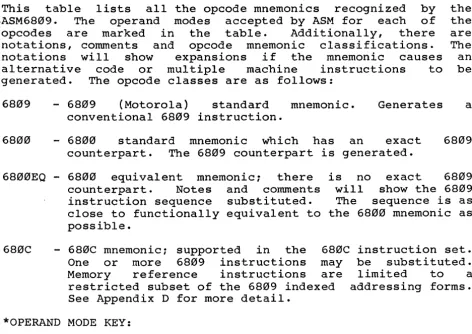
This table lists all the opcode mnemonics recognized by ASM6800. The operand modes accepted by ASM for each of the opcodes are marked in the table. Additionally, there are notations, comments and opcode mnemonic classifications. The notations will show expansions if the mnemonic causes alternative code or multiple machine instructions to be generated. The opcode classes are as
follows:
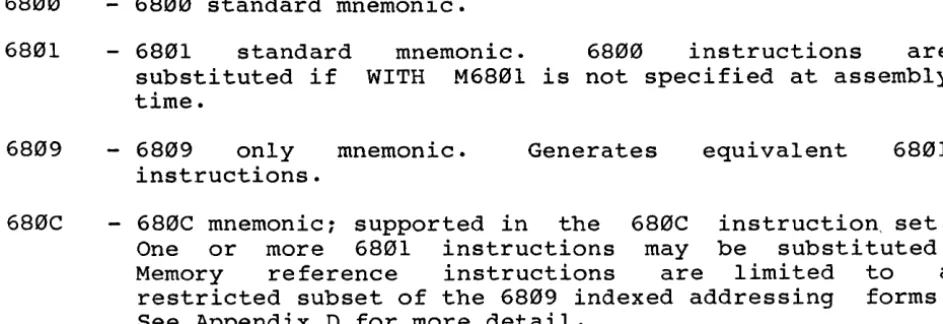
6800
6801
6809
680C
6800 standard mnemonic.
- 6801 standard substituted if time.
mnemonic. 6800 instructions are WITH M6801 is not specified at assembly
6809 only mnemonic. instructions.
Generates equivalent 6801
- 680C mnemonic; supported in the 680C instruction, set. One or more 6801 instructions may be substituted. Memory reference instructions are limited to a restricted subset of the 6809 indexed addressing forms. See Appendix D for more detail.
*OPERAND MODE KEY:
IDX=INDEXED INH=INHERENT
Copyright (C) 1977
EXT=EXTENDED BRA=BRANCH
DIR=DIRECT PSH=PUSH/PULL
35
IMM=IMMEDIATE R/R=REG/REG
[image:43.621.67.539.201.363.2]OPCODE
OPCODE OPERAND MODE* CLASS NOTES AND COMMENTS
I E D I I B P R D X I M N R S
/
X T R M H A H RABA
·
·
X·
6800ABX
·
· ·
·
X·
6801 See Footnote #1ADCA X X X X 6800
ADCB X X X X
· · · ·
6800ADCD X X X X
·
·
·
·
680C ADCB arg+1\
ADCA arg ADDA X X X X·
·
· ·
6800ADDB X X X X 6800
ADDD X X X X 6801 ADDB arg+1
\
ADCA argANDA X X X X
·
· ·
·
6800 ANDB X X X X·
· ·
·
6800ANDD X X X X 6800 ANDB arg+1
\
ANDA argASL X X
· · · ·
6800ASLA
· · · ·
X·
6800ASLB
·
· ·
·
X·
6800ASLD
· ·
·
·
X·
6801 ASLB \ ASLAASR X X 6800
ASRA
·
·
· ·
X·
6800ASRB
·
· · ·
X·
6800ASRD
·
·
X·
680C ASRA \ RORBBCC
·
X 6800BCS
·
·
·
·
·
X 6800BEQ
·
X· ·
6800BEQD
·
· ·
X 680C BNExxx \
TSTA \xxx
BEQ arg BGE·
,.
·
X·
·
6800BGT
·
X 6800BHI
·
· · ·
·
X·
·
6800BHS
· · ·
X· ·
6800BITA X X X X
· · ·
·
6800BITB X X X X 6800
BLE
·
X 6800BLO
·
·
· · ·
X 6800BLS
·
·
· · ·
X 6800BLT
· ·
·
· ·
X 6800BMI
·
· · ·
·
X 6800BNE
·
· · · ·
X 6800BNED
· ·
· ·
·
X 680C BEQxxx \
TSTA \xxx
BNE argBPL
· · ·
X 6800BRA
·
·
·
X· ·
6800BRN
·
· · · ·
X 6801 NOP \ NOPBSR
· · · · ·
X 6800BVC
· ·
·
X· ·
6800BVS
·
· ·
X·
·
6800ASM REFERENCE MANUAL 6/01/83
SECTION V: 6800/6801 MACHINE INSTRUCTION LINES
OPCODE
OPCODE OPERAND MODE* CLASS NOTES AND COMMENTS
I E D I I B P R D X I M N R S
/
X T R M H A H RCBA
·
· · ·
X·
6800CLC
· ·
· ·
X·
6800 CLI·
·
· ·
X·
·
·
6800 CLR X X·
· · ·
·
·
6800 CLRA· · · ·
X·
·
·
6800 CLRB·
· · ·
X·
6800 CLV·
·
· ·
X·
6800 CMPA X X X X·
· · ·
6800 CMPB X X X X· ·
·
·
6800CMPD X X X X
·
· · ·
680C See Footnote 2CMPX X X X X
·
6809 CPXCOM X X
·
· · ·
6800COMA X
·
6800COMB X
·
6800COMD
·
·
·
·
X·
680C COMB \ COMA CPX X X X X·
·
·
·
6800DAA
·
·
X·
6800DEC X X 6800
DECA
· · · ·
X·
6800DECB X
· ·
·
6800DECD X X X
·
680C See Footnote 3DES
· ·
X·
6800DEX X
·
6800EORA X X X X
·
· · ·
6800EORB X X X X 6800
EORD X X X X
·
·
·
·
680C EORB arg+1 \ EORA arg ERRORRTS·
·
·
·
X·
680C SEC \ RTSINC X X
·
6800INCA
· · · ·
X·
6800INCB
·
·
X·
6800INCD X X X
·
680C See Footnote 4INS
·
·
X·
6800INX
· · ·
·
X·
6800OPCODE
OPCODE OPERAND MODE* CLASS NOTES AND COMMENTS
I E D I I B P R D X I M N R S
/
X T R M H A H RJMP X X. 6800
JSR X X X. 6800
LBCC
·
X.
·
680C BCSxxx
\
JMP arg\
xxx
LBes
·
·
· · ·
X.
·
680C Bcexxx
\
JMP arg\
xxx
LBEQ
·
· · · ·
X 680C BNExxx
\
JMP arg\
xxx
LBGE
·
X·
·
680C BLTxxx
\
JMP arg\
xxx
LBGT
·
· · · ·
X 680C BLGxxx
\
JMP arg\
xxx
LBHI
· · · · ·
X 680e BLSxxx
\
JMP arg\
xxx
LBHS
·
· ·
·
·
X 680C BLOxxx
\
JMP arg\
xxx
LBLE • X 680C BGT
xxx
\
JMP arg\
xxx
LBLO
· · · · ·
X 680e BHSxxx
\
JMP arg\
xxx
LBLS
· · ·
X 680C BHIxxx
\
JMP arg\
xxx
...
LBLT
· · ·
·
·
X 680C BGExxx
\
JMP arg\
xxx
LBMI
· · ·
·
·
X 680C BPLxxx
\
JMP arg\
xxx
LBNE
· · ·
·
·
X 680C BEQxxx
\
JMP arg\
xxx
LBRA
·
X·
·
680C JMPxxx
LBVC
·
X·
·
680C BVSxxx
\
JMP arg\
xxx
LBVS • X
· ·
680C BVSxxx
\
JMP arg\
xxx
LDA X X X X
· · · ·
6800 LDAA argLDAA X X X X 6800
LDAB X X X X 6800
LDB X X X X
·
· · ·
6800 LDAB argLDD X X X X
·
·
· ·
6801 LDAB arg+1 \ LDAA arg LDS X X X X·
· · ·
6800LDX X X X X
· ·
6800LEAS X
· ·
· · ·
680e RPT arg\
INS LEAX X·
· · ·
·
6800 RPT arg\
INXLSL X X
·
6800 ASL argLSLA
·
· · ·
X . 6800 ASLALSLB
· · · ·
X·
6800 ASLBLSLD
·
·
·
·
X·
·
·
680e ASLB \ ROLA LSR X X·
·
·
·
·
·
6800LSRA
·
· · ·
X . 6800LSRB
·
·
·
·
X • 6800LSRD
·
· · ·
X . 680C LSRA \ RORBSECTION V: 6800/6801 MACHINE INSTRUCTION LINES
OPCODE
OPCODE OPERAND MODE* CLASS NOTES AND COMMENTS
I E D I I B P R D X I M N R S
/
X T R M H A H RMUL
· · · ·
X·
6801 JSR MUL6809NEG X X
· · ·
6800NEGA
·
· · ·
X·
6800NEGB
·
· · ·
X·
6800NEGD
· ·
·
·
X·
·
·
680C NEGA \ NEGB\
SBCA #0 NOP·
·
·
·
X·
6800OKRTS
· ·
X·
680C CLC \ RTSORA X X X X 6800 ORA
ORAA X X X X
·
6800ORAB X X X X
· ·
·
·
6800ORB X X X X
· · · ·
6800 ORBORD X X X X
·
· ·
·
680C ORB arg+1\
ORA arg PSHA·
·
·
·
X·
X·
6800PSHB
· · ·
·
X·
X·
6800PSHD
· · · ·
X·
X·
680C PSHB \ PSHA PSHX· · · ·
X·
X·
6801 See Footnote 5PULA
·
· · ·
X·
X·
6800 PULB·
·
·
·
X·
X·
6800PULD
· ·
·
·
X·
X·
680C PULA \ PULBPULX
·
· · ·
X·
X·
6801 TSX \ LDX 0,X\
INS \ INSROL X X
·
·
·
6800ROLA
·
·
X·
6800ROLB
·
·
X·
6800ROLD
·
· · ·
X·
680C ROLB \ ROLAROR X X
·
·
·
·
6800RORA
· ·
· ·
X·
6800 RORB· · · ·
X·
6800RORD
· ·
X·
680C RORA \ RORBRTI
· ·
·
·
X·
6800RTS
· ·
· ·
X·
6800SBA
· · · ·
X·
6800SBCA X X X X
·
· · ·
6800SBCB X X X X 6800
SBCD X X X X
· ·
· ·
680C SBCB arg+1\
SBCA argSEC
· ·
X·
6800OPCODE
OPCODE OPRAND MODE* CLASS NOTES AND COMMENTS
I E D I I B P R D X I M N R S
/
X T R M H A H RSEI X
·
6800SEV X
·
6800STA X X X . 6800 STAA arg
STAA X X X
·
6800STAB X X X
·
6800STB X X X . 6800 STAB arg
STD X X X . 6801 STAB arg+1 \ STAA arg
STS X X X
·
6800STX X X X
· · · · ·
6800 SUBA X X X X·
·
6800 SUBB X X X X·
· ·
·
6800SUBD X X X X •
· · ·
6801 SUBB arg+1 \ SBCA argSWI
· · · ·
X·
6800TAB X
·
6800TAP X
·
· ·
6800TBA X
· · ·
6800TDS
· ·
· ·
X·
680C STD TEMPX \ LDS TEMPXTDX
·
·
X·
680C TFR D,XTFR
· · ·
·
·
X 680C TAB or TBATPA X
·
6800TSD X
·
680C TSX \ TXDTST X X
·
·
· ·
6800TSTA
· ·
X·
6800TSTB
·
·
· ·
X·
· ·
6800TSTD
· · ·
·
X. 680C SUBD #$0000TSX X
·
6800TXD
·
· · ·
X·
680C STX TEMPX \ LDD TEMPXTXS
· · · ·
X. 6800WAI
· · · ·
X·
6800Footnote 1: STAB TEMPX+1\ADDB TEMPX+1\STAB TEMPX+1\ LDAB TEMPX \ ADCB #0\STAB TEMPX\LDX TEMPX
Footnote 2: CMPB arg+1 \ BNE xxx \ CMPA arg \ xxx ...
Footnote 3: TST arg+1 \ BNE xxx \ DEC arg \ xxx DEC arg+1
Footnote 4: INC arg+1 \ BNE xxx \ INC arg \ xxx
Footnote 5: STX TEMPX \ LDAB TEMP+1 \ PSHB \ LDAB TEMPX \ PSHB
SECTION VI: 6809 MACHINE INSTRUCTION LINES
6809 MACHINE INSTRUCTION LINES
The major function of an assembler is the translation of symbolically specified machine instructions into a form directly understandable by the target computer. This section presumes knowledge of the 6809 instruction set, which can be found in the Motorola MC6809 Programming Manual. ASM is fully compatible with the Motorola 6809 standard assembler syntax, with several useful extensions.
--All M6800/M6801 Opcodes are accepted and generate equivalent 6809 code.