With 8 text-figures Printed in Great Britain
STEPPING PATTERNS IN TARANTULA SPIDERS
BY DONALD M. WILSON*
Department of Molecular Biology, University of California, Berkeley
(Received 6 March 1967)
INTRODUCTION
The limb movements of many multilegged animals occur in metachronal sequences, often sequences running from posterior to anterior. Such sequences are not so con-spicuous in animals with few legs. However, for the walking of certain insects with variable gaits it has been possible to produce a descriptive model based on meta-chronal rhythms with stepping pattern varying with frequency (Wilson, 1966 a). This same model can be extended to animals with four (or more) pairs of legs. For simplicity one can assume that legs on opposite sides of the animal always alternate and then make the following formulation for legs of one side. Number the legs 1, 2, 3, and 4, from front to back. Then the basic stepping sequence in the model is 4321. Again for simplicity, hold the interval between 4 and 3, 3 and 2, and 2 and 1 constant. Vary the repetition rate of the whole set. At low repetition rates the stepping pattern is
(a) 4 3 2 1 4 3 2 1.
The wavelength, or number of segments between legs having the same posture, is greater than three segments and no two legs step at the same time. If the cycle interval is decreased a state is reached in which legs 1 and 4 step synchronously.
(6) 4 3 2 1
4 3 3 2 (14) 3 2 (14) 3
The length of the metachronal wave is three segments. Greater reduction of the cycle interval produces further overlap of the basic sequences.
(c) 4 3 2 1
4 3 2 i
4 3 2
3 2 4 1 3 2 4 1 3 2
T h e n e x t stage of overlap p r o d u c e s
(«*) 4 3 2 1
4 3 2 i
4 3 2 1
(24) (13) (24) (13)
in which the wavelength is two segments and even-numbered legs alternate exactly with odd-numbered legs. If legs on the other side are just in antiphase then the animal
134 DONALD M . W I L S O N
moves on alternating tetrapodal diagonal sets of legs (see later). Further compression of the sequences gives a new pattern:
(e) 4 3 2 i
4 3 ? I 4 2 31 4 2 3 1
and yet others:
(/) 4 3 2 1
2 3 (14) 2 3 (14) 2 3
(g) 4 3 2 1
2 3 4 1 2 3 4 1 2 3 4 1 2 3
and finally the absurd pattern of one wavelength one segment is achieved:
(A) 4 3 2 1
(1234) ( " 3 4 )
A gait may be denned for one side as any pattern arising from the repetitive or cyclic use of legs in which each leg is used exactly once per cycle. Then if one excludes cases with synchronous leg movements, the six possible gaits for four legs are
1 4 1 2 3 2 4 3 1 2
3 4 1 3 2 4 4 2 1 3 5 4 2 3 1 6 4 3 2 1
These gaits are in use the majority of the time the animal is walking. The several more posterior legs normally step at almost exactly the same frequency. For example, in one sample the number of steps by the right legs 4, 3, 2, 1, and pedipalp (P) were respectively 165,164,165,152, and 134. When stepping at the same average frequency, it is very unlikely that one leg will step twice in the stepping interval of another.
Walking patterns in spiders have been described previously most extensively by Bethe (1930) and Jacobi-Kleeman (1953). They make the generalization that the normal gait is the one in which odd legs of one side work together with even ones on the other side according to the pattern
1 ..
which is equivalent to our gait (d). If one allows that Bethe might have subsumed under this pattern those patterns in which leg phases deviate somewhat from exact synchrony and antiphase then gaits (c), (d) and (e) all fit approximately to his ' normal' pattern. Jacobi-Kleemann points out that in fact there is much deviation from exact alternation and synchrony. This pattern and its near variations may be described as that one in which adjacent legs are held in a phase relationship of approximately 1800 (or 0-5) and diagonally opposite legs are nearly synchronous. Even-numbered pairs or odd-numbered pairs of one side also have a phase relationship of approximately o. The reader can convince himself that another similar set of patterns can be generated in the same manner beginning with the opposite sequence 1234. However, the two sets can be told apart by comparing sequence pattern to frequency. For example, the sequence 4321 occurs at very low relative frequency in the set of patterns generated from the posterior to anterior metachronicity, but at high relative frequency in the case of waves running anterior to posterior. Several such differences occur between the two sets of patterns. The different patterns are correlated with phase relationship changes between different legs when frequency changes. The model has been con-structed from the ideal condition that the interval (or latency) between successive legs in the metachronal sequence is a constant so that changes in frequency result in large changes in phase and hence pattern.* In the insects examined carefully in this regard (walking sticks, Wendler, 1964a; and cockroaches, Wilson 1966a) latency is not in fact constant, but its variation is quite insufficient to maintain phase constancy and therefore walking patterns do vary systematically with frequency. The variation in walking patterns in these insects is consistent with the model based on forward running metachronicity. Whether this model holds for most other insects is not known. It seems likely that some kinds of insects, such as beetles, tend to be more phase
136 DONALD M. WILSON
constant and use the higher-speed types of pattern over most of their frequency range (unpublished observations).
The present work on spiders was undertaken in the light of these considerations. Before presenting that work I would like to make a comparison with work on one other animal which walks with eight legs. Dwain Parrack (1964) has made a study of walking in crayfishes. His thesis is not published, but the following abstract will give the salient relevant features.
Parrack analysed films of walking crayfishes. The animals stopped or turned often, so statistical analysis was needed in order to sort out common patterns. He found that the dominant gait contained the unilateral sequence 4231. He found that diagonally opposite legs tended to move at the same time. Waves of stepping appeared to move along the body and more than one wave could be present at one time on one side; that is, the wavelength was less than three legs. The opposite legs of one segment tended to move in alternation. (This cannot always be the case, since List (1895) and Bethe (1897) reported that the legs on the two sides of Astacus may follow different sequences.) Parrack found that the anterior leg pairs have a strong tendency to be used alternately, but the posterior pairs do not. In his sample of records the various gaits occurred with the relative frequencies shown in Table 1.
Table 1. Summary of data on stepping orders for the legs of one side
in a crayfish {from Parrack, 1964)
Current Gait no. Order model
1 4 1 2 3 (g) Very rare 2 4 3 1 2 — Rare 3 4 1 3 2 (c) Common 4 4 2 1 3 — Rare 5 4 2 3 1 («) Dominant 6 4 3 2 1 (a) Uncommon
Thus the common gaits of the crayfish are those predicted by the model and are the ones nearest to the pattern of wavelength 2. One cannot tell from Parrack's paper whether there is any correlation of pattern with frequency.
MATERIALS AND METHODS
Ten tarantulas, probably of the species Dugesiella hentzi (Girard), were used. Nine were obtained from Texas via a biological supply house. The tenth was a borrowed pet collected in central California. The latter animal was filmed both in 1962 and 1966. The more extensive statistical analyses come from this individual. The animals were allowed, or stimulated, to walk in a graduated arena and filmed with a Bolex cine" camera at 24 or 32 frames/sec, for most records, or at 64 frames/sec, for a few fast startle reactions. The films were analysed with a stop-motion projector with a frame counter. Charts showing the stepping times were prepared. These charts resembled Fig. 1 b. For the statistical analysis the times of beginning of protractions were punched on I.B.M. cards and computations carried out on a digital computer.
the body so they could not move noticeably. When several legs were so tied the animal's balance was quite badly affected. This effect seemed to be a direct mechanical one, although some proprioceptive component from the tied legs may also have been operative. Tying up the legs interfered with the leg reflexes in unknown ways, but the
_ • / . ! _ /
-- 10
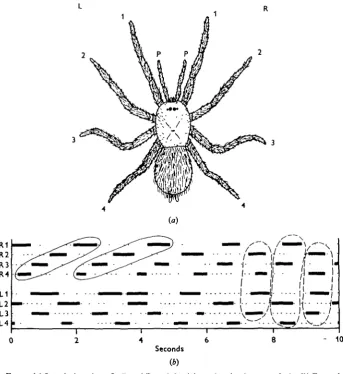
Fig. 1. (a) Leg designations. L, R and P are left, right and pedipalp respectively, (ft) Example of stepping record from a tarantula. The bars indicate time leg is up and protracting. The solid enclosures outline hind-to-front metachronal sequences on the right side. The left side does not exhibit the same pattern. The dashed enclosures emphasize a few steps in the ' alternating tetrapods' mode.
damage was not permanent. A strong effect of tying up several legs was that the animals often would not try to walk unless violently stimulated. As soon as released from their bonds, however, they seemed normally active.
[image:5.451.51.395.128.503.2]138 DONALD M . W I L S O N
The other three died in a few hours, but not before each had performed before the camera at some length.
RESULTS*
The stepping sequences of these spiders are in fact fairly similar to those of most insects. Aside from the difference in number of legs, however, there is another signifi-cant difference. The legs do not necessarily step at exactly the same frequency so there are sometimes phase drifts between given legs even during steady locomotion. At first sight the majority of the observations do appear to fit the model, but with rather a lot of random variation. Therefore, it was necessary to examine the records by more quantitative methods than had been necessary for cockroaches. The main results were obtained in two series.
First series
The normal animal. The single specimen used for this rather extensive set of films showed a high degree of variability in its walking patterns. Inspection of Fig. ib indicates some of the variety. In the first 4 sec. of this record the two sides of the animal exhibit different patterns. The left side steps in the well-known pattern in which
Table 2. Relative frequencies of different stepping orders in a tarantula
(The gait types, according to the model presented in the introduction, are listed.) Gait Relative
type Order frequency
(a) 4 3 2 1 5 2
(<0 4 1 3 2 3 3 2
(«) 4 2 3 1 157
(g) 4 1 2 3 2 4 3 1 2 2 2 4
4 2 1 3 31
even-numbered legs alternate with odd-numbered ones (wavelength 2). On the right side the hind-to-front metachronal sequence is more obvious (wavelength 3). Corre-lated with the difference in sequences on the two sides are unusual phase-relationships between the legs of a single segment; for example, the legs of segment 3 step syn-chronously. There is a transition in the middle of the record to the typical' alternating tetrapods' or ' diagonal rhythm' gait which is the eight-legged analogue of the insects' tripod gait.
With such variation in the records a means of tabulation of large sets of data was needed in order to gain an overall view of the walking behaviour. I chose first to use Parrack's method. This consisted of writing down in a list the order of the legs in stepping, considering one side of the body at a time, and using as the marker for each leg cycle the time at which the foot leaves the substrate. (Similar but not identical results are obtained if one chooses another point in the stepping cycle.) From this list all sequential sets of four entries which contained exactly one step by each leg were identified. The numbers of sets in each of the possible sequential orderings were counted. Each set was considered a cycle so that the sequence 4321 would be identical with 3214, 2143 and 1432. Table 2 presents the results of this count.
Are these results consistent with the descriptive model presented in the introduction ? That model predicts the sequences 4321,4132, 4231,4123 and cases in which some legs are synchronous, e.g. (42) (3 1). In the total record these sequences do account for two-thirds of all the sets. However, two-thirds of all the possible patterns are predicted by the model. The second most common sequence, 4312, does not even fit the metachronal wave model.
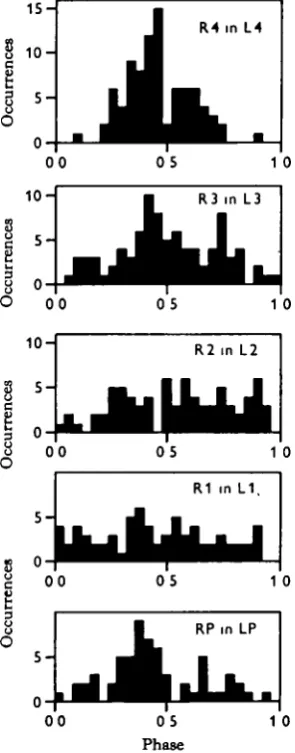
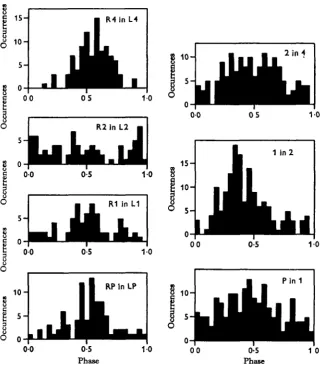
Another way to view the data is to examine the phase relationships between certain leg pairs rather than to look at ordering between several legs. Fig. 2 shows the phase relationships between the two legs of each segment. The hind legs show a strong tendency to alternate, but there is wide scatter about the modal value. More anterior pairs of legs show weaker and weaker antagonistic relationships. The pedipalps, which often move like legs, show a moderately strong tendency to alternate.
R4 in L4
0 5 1 0
R1 in L 1 ,
0 0 0 5 1 0
[image:7.451.147.295.228.605.2]Phase
140 DONALD M. WILSON
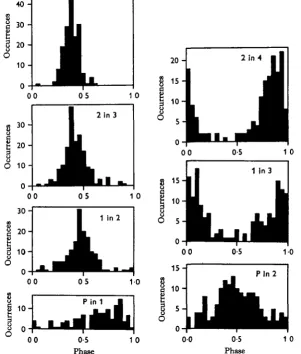
Adjacent legs on one side show more regular phase-relationships than do lateral homologues (Fig. 3). They also tend to be out of phase, but the modal value is not necessarily 0-5. In other words, there is not a strict antagonism. Since adjacent legs approximately alternate, legs two segments apart tend to be synchronised. Although the pedipalps move like legs their phase-relationships with respect to the legs are not
50
[image:8.451.75.377.161.515.2]-1 0
Fig. 3. Phase relationships between legs on the same side. Segmentally adjacent legs tend to alternate, but are not exactly out-of-phase, although unilateral phase relationships are less variable than bilateral ones. Legs two segments apart work approximately in-phase (except for the pedipalps).
about. Notice that legs 1 and 3 step at about the same time. From the phase histogram of Fig. 3 one can tell that 3 precedes 1 almost as often as 1 precedes 3. When the former occurs, perhaps as the result only of random variation, the stepping pattern is 43 12. This is the second most common entry of Table 1. It is a gait not predicted by the model, but it can occur if there is only a minor perturbation away from the commonest predicted gait. The other most commonly observed pattern may represent only a small phase variation also. Thus if one allows the addition of random variation the model is still tenable, but it is nearly worthless because it is unrestrictive.
Are the different patterns correlated with frequency differences? They are not clearly correlated. The same pattern may be used over the whole observed frequency range, and at one frequency several patterns may be found even in this one individual animal. A more precise measure of pattern-w.-frequency relationship may be obtained by calculating the correlation between the stepping interval of one leg and the phase
(P)
1
2
3
4
- I - -
I I
1-I
I 1
Fig. 4. Stepping sequence reconstruction from model values from the phase histograms. The vertical lines represent the start of each stepping cycle. Reconstructed average gait = 413a. Phases: 3 in 4 = 0-4; 2 in 3 = 0-43; l i n i ° 0-45 (P in 1 = O'7).
of the next anterior leg's step in that interval. The correlation coefficient of phase with interval will be zero or insignificant if the legs maintain approximately constant phase-relationships, it will be negative if there is a tendency toward constant posterior-to-anterior latency, and positive in the case of maintained posterior-to-anterior-to-posterior latency. Of the eight possible unilateral comparisons, including those between pedipalps and first legs, only four showed significantly negative correlations between phase and interval, and these correlations do not account for much of the phase variation. None of the correlations was significantly positive. The strongest correlations were between the pedipalps and first legs. For the legs proper, only two of the six comparisons were significant, and these only weakly so.
For this animal it appears that the model is of little value. Although there are wide variations in phase relationships between the legs these are not strongly correlated with frequency as they are in some insects. The diverse patterns may arise through irregular variation away from an average pattern. The average pattern is one in which segmentally adjacent and laterally opposite legs more or less alternate, but the exact classical alternating tetrapod gait is not of common occurrence.
142 DONALD M . W I L S O N
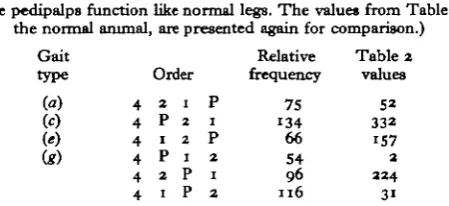
The animal made much more regular use of the pedipalps as walking appendages. The sequential patterns are entered in Table 3. If the model is applied to the remaining three legs and one pedipalp, and if leg four is thought of as adjacent to the second leg, then the commonest pattern is still (c).
Table 3. Relative frequencies of different stepping orders in a tarantula
with the third legs incapacitated.
(The pedipalps function like normal legs. The values from Table 2, the normal animal, are presented again for comparison.)
[image:10.451.116.341.165.268.2]Gait type (a) (c) («) Or) 4 4 4 4 4 4 Order 2 P I P 2 I I 2 2 I P P P I P 2 I 2 Relative frequency 75 134 66 54 96 116 Table 2 values 52 332 157 2 2 2 4 31
The only sharp difference between Table 3 and Table 2 is that the second most common pattern in this case is the other gait not predicted by the model. This is the one which would result from the pattern of Fig. 4 if legs 4 and 2 changed order because of a small phase shift. On the average it appears that removing the third pair of legs results in an adaptive change in the behaviour of the remaining legs such that the old gaits are accomplished by new leg combinations.
The phase-relationships between some legs of the animal with third legs tied are given in Fig. 5. The most obvious difference from Figs. 2 and 3 is that leg 2 alternates poorly with leg 4 rather than stepping at the same time. These legs are now functionally adjacent and might be expected to alternate. Legs 1 and 2 alternate as before. The pedipalps tend to alternate with legs 1 much better than before. Within segments there are also interesting effects. Legs 4 alternate, as before. Legs 2 appear confused. This histogram is apparently random (Kolmogorov-Smirnov test) even though the histograms for more anterior pairs are not. Alternation between the contralateral legs is stronger in legs 1 and the pedipalps than in legs 2. Viewed from the point of view of phase-relationships, tying legs 3 has had a pronounced effect, but not one which is simply explained by renumbering the legs and saying the old pattern persists.
Phase Phase
Fig. 5. Phase relationships between the moving legs of a tarantula with the third legs immobilized by tying them over the back. The first and fourth pairs are about normal. The second pair is disturbed. Relationships between second and fourth legs are nearly opposite those of the intact animal. The pedipalps behave more like ordinary legs.
Second series
Normal animals. Nine more animals were filmed. Their performance even in total was relatively more uniform than that of the single individual of the first series. Perhaps this was because they were given a much larger area over which to move so that stops and turns were not induced by the walls of the container. The tabulation of gaits is given in Table 4.
144 DONALD M. WILSON
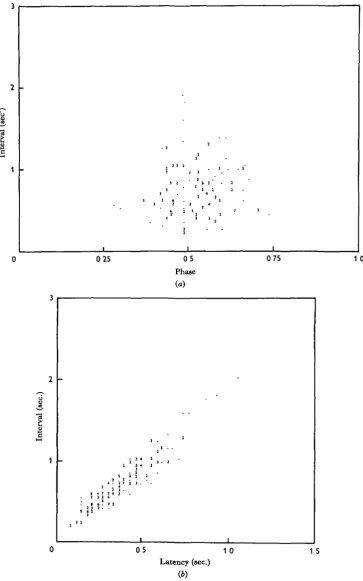
[image:12.451.78.377.203.369.2]Phase-relationships between the third and fourth legs only were studied. The phases of the third leg steps in the interval of the fourth leg steps for a wide frequency range are presented in Fig. ya. There is not an obvious dependence of phase on interval. The correlation coefficient of — 0-090 is not significant at the 5 % level for this sample size. On the other hand the fourth to third leg latency is highly correlated with stepping interval. The correlation coefficient for the data in Fig. 76 is +0-942. Essentially, the relationship between the legs is a constant phase-relationship. However, for the longest intervals in Fig. 7 b there seems to be an increase in slope, suggesting that in the slowest walking there may be a tendency toward constant latency between hind leg and next anterior leg. RP R1 R2 R4 LP L1 L2 L4 Seconds
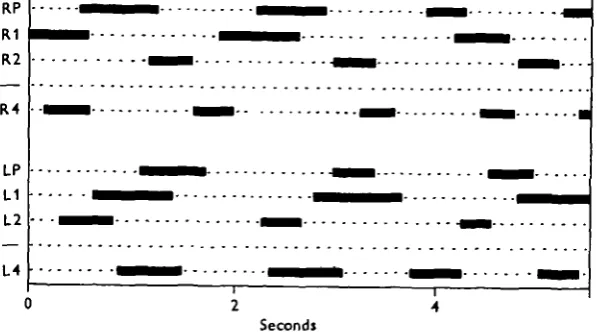
Fig. 6. Walking record from an animal with the third legs tied up. The bind legs step at higher frequency and are not well correlated in phase with the others.
Table 4. Relative frequencies of different stepping orders for the second
series of animals
(There is a general similarity to Table 2, but with a different detailed order of prevalence of gait types.)
[image:12.451.123.333.438.534.2]Gait type (a) W («)
te)
4 4 4 4 4 4 Order 3 2 i 3 2 3 I 2 3 I 2 I I 2 I 3 2 3 Relative frequency 3 2 135 1235 87 154 52 Table 2 values 52 3 3 2 157 2 2 2 4 3 i•a
$.
i I t .
0 25 05
Phase
0 75 1 0
•3
t
Latency (sec.)
(b)
Fig. 7. (a) Scattergram of fourth leg interval o. phase of third leg in that interval from variable records from several animals. There is no clear relationship. The correlation coefficient is — 0-090. (6) Scattergram of fourth leg interval v. latency of the next third leg step for the same sample. There is a strong correlation (r = + 0-942). The relationship does not appear to be linear, but to deviate in the direction of non-increasing latency at the longest intervals.
[image:13.451.44.408.31.613.2]146 DONALD M. WILSON
interesting result is not qualitatively different in the absence of third leg feedback or in the presence of unusual third leg feedback.
The overall stepping pattern in these third-leg amputees was quite often a rather good tripod gait (ignoring the pedipalps) involving nearly synchronous stepping of legs R i , L2, R4 alternating with L i , R2, L4.
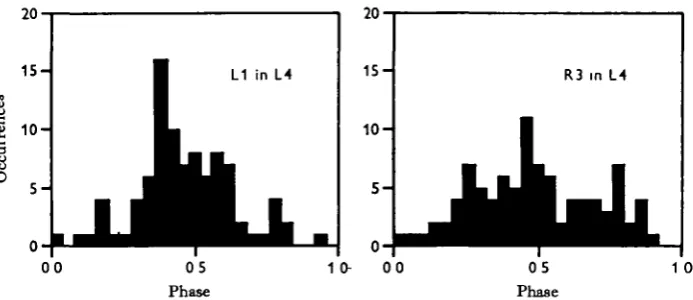
Other leg interference. In order to place a normally synchronous pair of legs under a maximal mechanical load which could be expected to produce alternation, a fourth leg and the contralateral third leg were either cut off or tied. In addition the second pair of legs was similarly incapacitated. Movements of the remaining legs (Ri, L i , R3, and L4) were observed. The animals with four legs tied up were reluctant to walk at all, but amputees were quite mobile. There were no consistent differences in the average frequencies of the several legs, but there were differences between the legs from run to run and from animal to animal. Although there was much scatter a rough pattern could be discerned. The diagonal legs stepped more or less together while legs on one side alternated (Fig. 8). The false hind-leg pair (R3, L4) alternated about as well as the third leg pair does in a normal animal and it showed none of the tendency toward synchrony of the normal diagonal pair. The new phase settings were independent of frequency. Over a fourfold frequency range the correlation coefficient between phase and frequency was + 0-022 (P > 5 %) while the correlation coefficient for latency and frequency was + 0-639 (P < o-i %) for a sample of about 100 steps.
Another interesting amputation combination is removal of a first leg and the contra-lateral hind leg. If the animal were to follow the rules that legs of the same segment alternate and adjacent legs alternate, the resulting pattern would be
in which only two legs support weight part of the time. On the other hand a diagonal rhythm of alternating tripods
147
[image:15.451.56.403.74.224.2]0 0
Fig. 8. Phase histograms for animals lacking the second leg pair and one third leg and the contralateral fourth leg. The remaining legs 3 and 4, which normally are synergistic, tend to alternate as do the combinations of legs 1 and 3 of the same side.
DISCUSSION
These results on tarantulas are mostly similar to those of Jacobi-Kleeman (1953) on the web-spinning spider Aranea. She found an approximate 'diagonal rhythm', but one with systematic deviations from exact alternation and synchrony. She neither expresses these deviations as a function of frequency nor gives primary data from which one can make a direct comparison in this respect with the present work. She does find that the ' diagonal rhythm' tends to be maintained after amputation or autonomy of one or two legs. She also describes some rather different patterns which may be special adaptations to walking on the web fibres.
Several differences appear between these results on tarantulas and the better-known studies on insect walking.
(1) The tarantula leg oscillations are more loosely coupled to each other. The two sides may maintain different rhythms. The pedipalps and even first legs may be slower than the rest. In other spiders the front legs may be held up during fast walking (Manton, 1953). Even the main segments involved in walking may differ in frequency. For example, after ablation of the third leg pair, the fourth pair may be considerably faster than the rest. Jacobi-Kleemann (1953) found that in Aranea the hind pairs are normally faster than the front pairs and that sometimes the third pair steps at double the fre-quency of the others. Even when all of the spider's legs move at the same frefre-quency there is a relatively loose phase-coupling. The phase histograms all have rather broad peaks, even over narrow frequency ranges. Similar sorts of looseness of coupling can be found in some insect preparations (Wendler, 1964a, b), but more fixed patterns seem to be the rule for adult insects.
148 DONALD M. WILSON
walking legs have strong bilaterally synchronous motions. If there is an influence across the abdominal thoracic boundary, it could upset the alternation of the more posterior pairs of walking legs.
(3) The data on tarantulas does not fit the introductory model. It can be seen that this model predicts some of the tarantula gaits, but it fails to predict one of the commonest ones. There is apparently very little dependence of pattern (or phase-relationships) on frequency. The average gait is near to the ' alternating tetrapods' pattern and devia-tions away from the average seem to be unsystematic. In addition to generally irregular behaviour, which could mask pattern-frequency correlations, it is true that common gaits may be observed over wide frequency ranges.
If the model developed from insects is not useful, how may the gaits of the tarantulas be described? The problem may be similar for crayfishes. Parrack and several other authors (Voelkel, 1922; Herter, 1932; List, 1895; Bethe, 1897; Baldi, 1936) have reported a wide diversity of patterns in these animals too. Perhaps it is useful to return to something like the earlier idea of Bethe (1930) and von Hoist (1935) offunctional groups of legs. Bethe and Hoist thought of the functional group as consisting of a diagonal pair of legs which worked in near synchrony. As has been pointed out by Hughes (1952) this relationship does not hold in cockroaches. I suggest that even for the tarantulas and crayfish von Hoist's alternative formulation that adjacent legs tend to alternate is preferable. If the two sides of a segment alternate and sequential seg-ments alternate, then naturally diagonal legs are synergistic. This formulation leads directly to another model mechanism.
A possible mechanism. Each leg and the control mechanism of its half-ganglion comprise some kind of oscillator. The two sides are negatively coupled, either intra-centrally or via reflexes akin to the mammalian crossed extension reflex. Let us suppose that the segments are also negatively coupled either centrally or reflexly. Equal reciprocal inhibitory coupling between matched simple neural oscillators can give rise to simple alternation at 1800 phase over fairly wide frequency ranges if each oscillator responds similarly to changes in input excitation. (Wilson, 19666). This simple relationship could give rise to the basic 'alternating tetrapods' gait of spiders or the ' alternating tripods' gait of insects. All that is required is that each half-ganglion oscillator be most strongly negatively coupled to its nearest neighbours. If random variation is added to this relationship small phase shifts between legs that are nearly synchronous will give rise to a wide variety of stepping sequences. From the point of view of stepping order small deviations in phase may look significant, but clearly they may make little or no difference in the overall pattern of support and movement. If the postulated inhibitory relationships between two of the oscillators were not equal, or if one oscillator tended to be faster than the other, then the phase relationship would not be 1800. Metachronal sequences with a definite direction of wave propogation could then be exhibited. If two segmental oscillators had very different inherent frequencies, or if the coupling were too weak, then the legs could work at different frequencies, but still with a tendency to certain preferred phase relationships.
correct. Unidirectional inhibition tends to give rise to more or less fixed latency relationships and sometimes to near synchrony due to the 'paradoxical driving' phenomenon (Perkel et al. 1963). One-way excitation tends to give rather fixed short latency or synchronous relationships also. Cross-excitation tends to produce synergism, except when loose coupling allows some phase difference between oscillators with inherently different frequencies. In the latter case phase usually varies systematically with frequency. Such a relationship was the basis for my previous model for insect walking (Wilson 1966,1967). These comments are not intended as rigorous generalities. However, they are the outcome of fairly extensive experimentation with analogues.
The above considerations are consistent with the hypothesis of a set of inhibitorily coupled oscillators, each controlling one leg. The coupling could be intracentral or reflex, and in the latter case could be due either to intersegmental reflexes or could be confined to mechanical effects and myotatic reflexes in the single member. If the in-hibitory coupling is strongest for nearest neighbours, then next-nearest neighbours will tend to exhibit in-phase behaviour. If the coupling is principally reflex or if the moving leg is necessary merely to keep a central oscillator running (see Wendler, 1966) then the effects of amputation follow naturally.
Could this new model hold for the insects too? If the excitation of a pair of reciproc-ally inhibiting neural analogues is reduced to very low values so that the period is long, the phase constancy fails. When the average period for the two oscillators lasts much longer than the inhibitory effect then they still are prevented from working together, but there is no influence working to keep them at 1800. If the two oscillators are not quite equal one may then inhibitorily drive the other at more or less constant latency. Thus from the same kind of simple neuron network one may have phase-constancy at higher frequencies or frequency related phase variation at lower frequencies. In other words, this same model could work for both cockroaches and tarantulas.
What is the nature of the segmental oscillators? The analogues I have used are highly non-linear relaxation oscillators intended mainly as neurone analogues. The walking-control oscillators might be more nearly sinusoidal, but are probably not exactly so. Hughes (1952) discusses variation in protraction and retraction times which divide the stepping cycle unequally in cockroaches. The oscillations could be of either purely intraganglionic origin or be reflex in nature. Myotatic, crossed extension, step, or intersegmental leg reflexes all exist in insects. Wendler (1966) provides some new arguments regarding the roles of reflexes or central oscillators in insect walking and provides evidence that reflexes operating within the single limb cannot be the sole basis for coupling between the limbs.
150 DONALD M . W I L S O N
or peripheral reflex origin of locomotory rhythms has been, or should be, resolved by synthesis. That is, that both central and peripheral influences operate in harmonious interpenetration. I am much inclined to agree with this. However, it is still true that an endogenous c.N.s. oscillator for arthropod walking has not been demonstrated. If centrally endogenous oscillators for the control of the spider legs exist, then in some of the amputation experiments reported here either the reflexes are able unharmoniously to override the central oscillators, or each oscillator only runs when its leg is present and free to move, or the central oscillators have more than one preferred state of coupling. The latter possibility is not too remote. Some kinds of hypothetical networks of only two neurons can exhibit tendencies toward both in-phase and out-of-phase behaviour. This double relationship is most easily achieved if there is both excitation and inhibition between the members. Both in-phase and out-of-phase relationships have been found between motor output activities in pairs of insect legs during rhythmic input to one of them (Wilson, 1965). Both synergistic and antagonistic relationships occur between small groups of motor neurons in flying or shivering lepidoptera (Kammer, Ph.D. thesis) and in flying or stridulating grasshoppers (Eisner, personal communication).
It will probably not be possible to prove the non-existence of central oscillators in systems controlling rhythmic behaviour nor often to prove their necessity. Nor is it likely to be possible to demonstrate the separate sufficiency of reflexes, since they must operate through more or less intact ganglia. It has been possible in some cases to demonstrate the sufficiency of central oscillators and the necessity for reflex modula-tion of them. For those systems in which positive demonstramodula-tions can be made, two obvious questions should be approached next. How are the individual oscillators constructed? How are the segments coupled?
SUMMARY
1. A descriptive model for the walking patterns of eight-legged animals similar to one applicable to some insects is presented. Data from films of walking tarantulas are compared to the gaits predicted by the model.
2. The model is found to be inapplicable to the tarantula data in two important respects. Some of the common walking patterns of the tarantulas are not predicted by the model, and the several patterns found are not correlated with frequency differences. 3. The tarantula gaits are best described in terms of the phase-relationships between leg pairs. Bilaterally opposite legs and segmentally adjacent legs tend to be used in antiphase. There is much phase variation, giving different stepping sequences, but this variation is by and large not correlated with speed.
4. Incapacitation of some of the spider's legs results in adaptive changes in phase-coupling between the other legs.
5. A mechanistic model which could explain both insect and spider data is tentatively suggested. It is based on negative coupling between the oscillators controlling each leg.
REFERENCES
BALDI, E. (1936). Richerche sulla fisiologia del sistema nervoso negli artropodi. I. La meccanica de ambulatoria nonnale de gamero. Arch. zool. ital. 23, 47-80.
BETHE, A. (1897). Vergleichende Untersuchungen tiber die Funktion des Zentralnervensystem der Arthropoden. Pflilg. Arch. ges. Pkytiol. 68, 449-545.
BETHE, A. (1930). Studien Uber die Plastizitlt des Nervensystems. I. Aranoideen und Crustaceen.
Pflilg. Arch. ges. Phytiol. 224, 793-820.
HERTER, K. (1932). Beitrfige zur Zentrenfunktion zehnfussiger Krebse. Z. vergl. Pkytiol. 17, 209—26. HOLST, E. VON (1935). Die Koordination der Bewegung bei den Arthropoden in Abhangigkeit von
zentralen und peripheren Bedingungen. Biol. Rev. 10, 234-61.
HUGHES, G. M. (1952). The co-ordination of insect movements. I. The walking movements of insects.
J. Exp. Bwl. 29, 267-84.
JACOBI-KLEEMAN, M. (1953). Uber die Locomotion der Kreuzspinne Aranea diadema beim Netzbau (nach Filmanalysen). Z. vergL pkytiol. 34, 606—54.
KENNEDY, J. S. (1966). Some outstanding problems in insect behaviour. In Insect Behaviour (ed. P. T . Haskell), pp. 97-112. Surrey, England: Bartholomew Press.
LIST, T. (1895). Morphologisch-biologische Studien uber den Bewegungsapparat der Arthropoden. I. Theil: Astacus fluvtatilis. Gegenbaurs morph. Jb. 22, 380-440.
MANTON, S. M. (1953). Locomotory habits and the evolution of the larger arthropoden groups. Symp.
Soc. exp. Biol. 7, 339-276.
PABRACK, D. W. (1964). Stepping sequences in the crayfish. Ph.D. thesis, University of Illinois.
PERKEL, D. H., SCHULMAN, J. H., BULLOCK, T. H., MOORE, G. P. & SEGUNDO, J. P. (1964). Pacemaker
neurons: effects of regularly spaced synaptic input. Science, N.Y. 145, 61-3.
VOELKEL, H. (1922). Die Fortbewegungsarten des Flusskrebse. Arch. ges. Pkysiol. 194, 224-9.
WENDLER, G. (1964a). Laufen und stehen der Stabheuschrecke Carausius morosus: Sinnesborsten felder in den Beingelenken als Glieder von Regelkreisen. vergl. Pkysiol. 48, 283-94.
WENDLER, G. (19646). Uber die Fortbewegung der Larven von Cantharis fusca. Z. vergl. Pkysiol. 48, 283-94.
WENDLER, G. (1966). The coordination of walking movements in arthropods. Symp. Soc. exp. Biol. 20,
229-50.
WrLSON, D. M. (1965). Proprioceptive leg reflexes in cockroaches. J. exp. Biol. 43, 397-409. WILSON, D. M. (1966a). Insect walking. Ann. Rev. Ent. 11, 103-22.
WILSON, D. M. (19666). Central nervous mechanisms for the generation of rhythmic behaviour in arthropods. Symp. Soc. exp. Biol. 20, 199-228.
WILSON, D. M. (1967). An approach to the study of rhythmic behavior. In Invertebrate nervous