THE EFFECT OF TEMPERATURE ON THE BURST
SWIMMING PERFORMANCE OF FISH LARVAE
BY R. S. BATTY AND J. H. S. BLAXTER
Dunstaffnage Marine Laboratory, PO Box 3, Oban, Argyll, PA34 4AD, Scotland
Accepted 27 May 1992
Summary
Newly hatched herring and plaice larvae were stimulated by probes to make C-start escape responses at temperatures between 5 and 15 °C. The responses and the subsequent burst-speed swimming were recorded and analysed using high-speed video at 400 frames s~'. The muscle contraction time of the initial C-start was temperature-dependent, ranging from 22-33 ms at 5°C to 17-21 ms at 15°C. Immediately following the C-start, tail-beat frequency ranged from 18s"1 at 5°C to 35 s~' at 15°C. Tail-beat amplitude, equivalent to 0.4-0.6 of a body length (L), and stride length, about 0.5 L, were not temperature-dependent. The escape speed ranged from 8 L s ~ ' at 5°C to 15 L s "1 at 15 °C. These results and those of other workers can be described by the equation:
where/is tail-beat frequency, t is temperature and L is length.
Introduction
Most species of marine fishes have a very high fecundity, producing thousands and even millions of eggs per year. Their newly hatched larvae are usually small (2-9 mm long) and vulnerable, for they undergo mortality rates of 5-30 % per day as a result of starvation, predation, disease, pollution and other causes. It is now accepted by many workers that predation is the main source of mortality. Investigations of the ability of larvae to evade predators by escape behaviour are thus helpful in understanding the mechanisms controlling survival and contribute to our understanding of the processes underlying the recruitment of larvae to the juvenile and adult fish stocks.
Batty, 1984). The few measurements of burst swimming speed were made at different temperatures, however, so that comparisons of performance among species is impossible. The effect of temperature on the mechanism of escape from predators is particularly relevant given the current interest in long-term climate change.
The use of a high-speed video system recording at 400 frames s"1 has allowed a detailed study of the effects of temperature on escape responses and burst swimming of the early larvae of two species, herring Clupea harengus L. and plaice Pleuronectes platessa L., as they made rapid responses to tactile stimulation by a probe. These two species were studied because of their different body shapes: the herring has an eel-like larva about 9 mm long at hatching; plaice larvae at hatching are about 6 mm long and deeper in the body.
Materials and methods
Herring gonads were dissected from spawning fish caught in the Firth of Clyde in March 1990. The eggs were fertilized at an ambient temperature of about 7°C. After about 30 min, they were transferred to tanks for incubation and hatching at a nominal temperature of 10°C (see Table 1 for actual temperatures). The larvae were studied at hatching and at the end of the yolk-sac stage [about 80 day-degrees (dd) post-hatch, where day-degrees is the sum of the mean daily temperatures using — 1°C as the 'biological zero', the theoretical temperature at which development takes infinite time].
Plaice eggs and sperm were obtained by stripping broodstock caught in the Firth of Clyde and held in the aquarium. After fertilization at ambient temperature, the eggs were incubated and hatched at a nominal temperature of 8°C (Table 1). The larvae were studied at hatching and at the end of the yolk-sac stage at about 94 dd.
To record escape responses, batches of 30 larvae just after hatching, or at the end of the yolk-sac stage, were transferred from the stock tanks to several Table 1. Temperatures during rearing (mean±s.D.) and during experiments (mean
only)
Temperature (°C)
Fertilization Experiments Fertilization Experiments Species to hatching at hatching to 80/94 dd at 80/94 dd
Herring
10.0±0.1
Plaice
7.9±0.4
dd, day-degrees since hatch (80 herring, 94 plaice). 4.8 10.0 15.0
5.1 8.2 12.5
10.0±0.1
8.1±0.6
4.9 \ 10.0
[ 14.5
experimental dishes using a wide-bore pipette. The dishes, made of clear Perspex, were 11.5 cm in diameter with a water depth of 2.0 cm. The larvae were viewed in silhouette by a N AC HSV-400 high-speed video system recording at 400 frames s"1 using transmitted light from a stroboscope. This was supplied by a flexible light guide with one end positioned under the Perspex dish and pointing upwards into the camera lens, and the other end positioned at the output of a stroboscopic source giving 400 flashes s~ . A convex Fresnel lens immediately under the dish focused the light onto the camera lens.
A hand-held fine glass probe was used to induce C-start or 'fast-startle' responses (Eaton and DiDomenico, 1986). These take the form of rapid and extreme contractions of the body, usually on the side away from the point of stimulation, followed by a brief period of burst-speed swimming. In a series of trials, individual larvae in a dish were approached by the probe at an angle roughly normal to the body axis. If the larva responded with a C-start, the trial was considered to be successful. Individual larvae were stimulated until 15 successful trials had been completed before the dish was changed. Although individual larvae could not be identified it was possible to avoid using the same larvae over a number of consecutive trials by noting their position (using two observers) after a response. Using 30 larvae in each dish with a response rate of about 25 % (Yin and Blaxter, 1987), some larvae would have been stimulated twice and others three or even more times during each set of trials within one dish. A dish was not re-used for at least 20 min after a set of trials. A total of sixty successful trials was recorded for each developmental stage and each test temperature.
A frame-by-frame replay of the video tapes allowed an analysis to be made of the C-start and subsequent burst of swimming at 2.5 ms intervals. Coordinates of different parts of the body were recorded and analysed by a computer using MOVIAS (NAC-Corp. Japan) software. Three points were recorded from each frame: (1) the tip of the snout, (2) a point on the body at the posterior limit of the yolk-sac (or of the head in 80-94dd larvae), and (3) the tip of the tail (in these young larvae this was the posterior limit of the primordial fin fold, see Fig. 1). Since the software only scaled x:y coordinates or angles in relation to the horizontal axis of the video frame rather than the axis of motion of the larva, a new coordinate system based on the mean path (axis) of motion of the fish was calculated. This used a geometric regression on the coordinates of the points recorded on all the frames of any particular swimming sequence to give a new coordinate system with the x-axis running along the fitted regression line.
Latency
C-start (minimal distance x)
Yaw(0)
Tail-beat frequency (1/7)
Stride length (x)
Fig. 1. Diagrams showing measurements made and terms used when analysing larval responses. For further explanation see text.
distance (x) covered by the larva along the axis of motion during one tail-beat cycle. (7) Burst swimming speed - the average speed during one tail-beat period.
The effects of temperature on these parameters were investigated by two types of experiment. In some trials the larvae were transferred from the rearing temperature (10°C herring; 8°C plaice) to the same trial temperature. In other trials temperature effects were investigated, after an acclimation period of about 2h, by transferring the larvae from the rearing temperature to different nominal temperatures (herring from 10°C to 5°C or 15°C; plaice from 8°C to 5°C or 12°C). The actual temperatures used are shown in Table 1. A short acclimation period was used because the larvae develop so quickly. This protocol can be justified by our own unpublished experiments which showed that there were no differences in locomotor performance of larvae reared at a particular temperature compared with larvae transferred to that temperature from another temperature with a 2-h acclimation period. Furthermore, Wardle (1980) showed that the contraction time of plaice muscle depended on the ambient temperature and not on the adaptation temperature.
Results Latency
Some larvae made 'distant responses', initiating the C-start before they were touched. The distances between the probe and the larvae at the initiation of the response were very variable but rarely more than half a body length (3-4mm). Other larvae responded after part of the body had been slightly displaced by the probe (Fig. 1). For this type of response, latencies could be calculated (Fig. 2); they are very variable and show little consistent trend with temperature.
40
30
u 20
3
10
o Herring hat a Herring 80 dd • Plaice hat A Plaice 94 dd
10
Temperature (CC)
[image:5.451.93.356.426.594.2]15
40
u I 30
§ 20
O
10
°*
O Herring hat A Herring 80 dd • Plaice hat * Plaice 94 dd
10
Temperature (°C)
[image:6.451.92.353.79.255.2]15
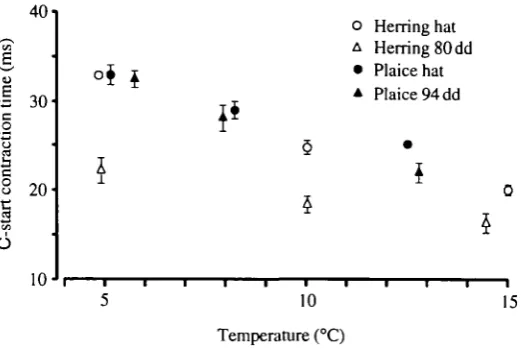
Fig. 3. C-start contraction time of herring and plaice larvae at different temperatures after stimulation with a probe, hat, at hatching; dd, day-degrees since hatching.
Contraction time
In contrast to latency, the C-start contraction times were very consistent for each species, stage and temperature (Fig. 3) and there were strong effects of temperature. At 5°C the contraction time was half as long again as at 12-15°C. In herring, the contraction times were significantly longer at hatching than at the end of the yolk-sac stage at all temperatures; in plaice, this effect was only seen at about 12 °C.
Yaw and tail-beat amplitude
The initial C-start resulted in a massive yaw of the head of 50-60° from the body axis. Many larvae only swam for a few tail beats with the yaw declining rapidly (Fig. 4). Most of the data on tail-beat frequency and amplitude, stride length and swimming speed were analysed from the plots of yaw since they gave an objective estimate of the extreme limits of the tail-beat cycle.
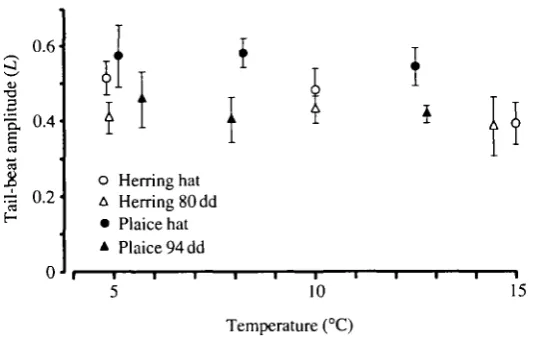
Tail-beat amplitudes (the average of the distances moved by the tip of the tail during the two sweeps between the arrows in Fig. 4) are large, between 0.4 and 0.6 of a body length (L), with no obvious effects of either species or temperature (Fig. 5).
Tail-beat frequencies
temperature on muscle mechanics. The plaice generally had lower tail-beat frequencies than the herring, in agreement with their longer C-start contraction times (Fig. 3).
200
150
c
I
I 50
a
25 50 75
Time (ms)
[image:7.451.82.389.131.314.2]100 125
Fig. 4. Plot obtained by MOV1AS software of the yaw of the head ( A ) of a herring larva on either side of its axis of motion during an escape burst of swimming from a probe (see Fig. 1 for further explanation). The two arrows show the start and finish of one tail-beat cycle from which other parameters such as tail-beat frequency were measured. The lower plot (O) shows the swimming speed at different times during the tail-beat cycle as measured by the forward progression of the snout along the axis of motion.
0.6
•a
U 0.4
n= 0.2 o Herring hatA Herring 80dd
• Plaice hat A Plaice 94 dd
10
Temperature (°C)
15
[image:7.451.88.355.423.593.2]Stride length
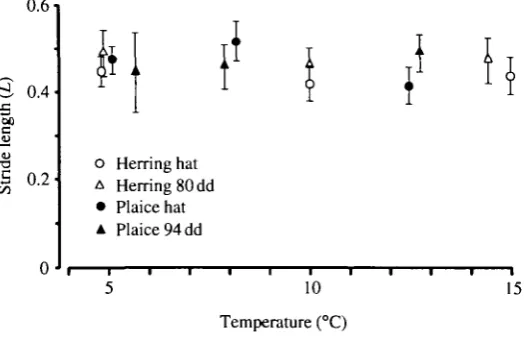
The distance covered as a proportion of the body length, during one tail-beat cycle delimited by the arrows in Fig. 4, is shown in Fig. 7. Stride lengths were of the order of half a body length with no influence of temperature, with the exception of newly hatched plaice at a test temperature of 12.5 °C where the stride length was significantly reduced.
40
35
30
g" 25
20
15
10
o Herring hat A Herring 80 dd • Plaice hat A Plaice 94 dd
10
Temperature (°C)
[image:8.451.85.345.177.351.2]15
Fig. 6. Tail-beat frequencies of herring and plaice larvae at different temperatures, hat, at hatching; dd, day-degrees since hatching. The frequency was measured from the tail-beat period between the two arrows in plots similar to that shown in Fig. 4.
0.6
0.4 •S
'S 0.2 o Herring hatA Herring 80 dd
• Plaice hat A Plaice 94 dd
10
Temperature (°C)
15
[image:8.451.80.343.423.591.2]CO
20
15
10
5Jr
o — Herring hat A — Herring 80 dd • - - Plaice hat A - - Plaice94dd
10
Temperature (°C)
[image:9.451.92.352.86.254.2]15
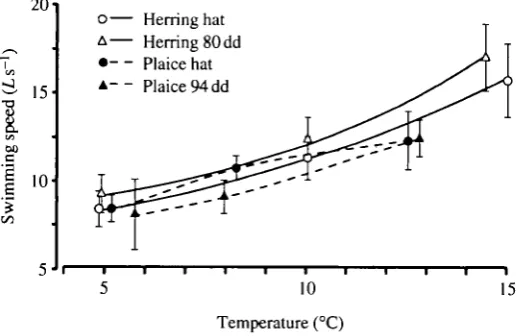
Fig. 8. Swimming speed in body lengths per second (Ls ') for herring and plaice larvae at different temperatures, hat, at hatching; dd, day-degrees since hatching. The swimming speed was measured during the tail-beat cycle shown between the two arrows in plots similar to that shown in Fig. 4.
Swimming speed
Swimming speed, again measured over the tail-beat cycle shown in Fig. 4, was strongly temperature-dependent, as might be expected from its relationship with tail-beat frequency (but not with stride length which was temperature-indepen-dent). The newly hatched herring larvae swam at 80-150 mm s"1 and the older herring at 100-160 mm s~J depending on temperature. The newly hatched larvae of plaice swam at 55-80 mm s"1 with an unexpected plateau of swimming speed between 8 and 12°C which is explained by their reduced stride length. The older plaice swam at 55-86 mm s~l depending on temperature.
If swimming speed (obtained as shown in Fig. 4) is expressed as scale speed, i.e. in units of body length (L), the specific differences and anomalies tend to disappear (Fig. 8). Both species and stages swim at about 8 L s- 1 at 5°C, rising to 15 L s "1 at 15 °C. The herring slightly out-perform the plaice at the higher temperatures.
Discussion
factors involved in latencies where the onset of the stimulus may be perceived by a number of different sense organs. Latent responses may also have included some very close distant responses in which, although the stimulus was detected at a distance, the response occurred after the larvae had been touched.
The escape behaviour of the larvae is driven by the initial C-start muscle contraction, which is highly temperature-dependent. The low variance of the contraction times suggests that the C-start behaviour of herring and plaice larvae is very consistent. Eaton and Emberley (1991) found that the initial angle turned by goldfish in a C-start depended on the position of the stimulus. In our experiments, the stimulus was given in a consistent manner and no attempt was made to vary the positioning of the probe. Following the C-start, the high-speed escape burst is usually short and the larva comes to rest within a second. This behaviour is not found when the larva experiences a more harmful stimulus such as the nematocyst of the medusa Aurelia; then the escape response continues at high speed for longer (Blaxter and Batty, 1985).
Fuiman (1991) has shown that high temperature increases the response (escape) speeds of older herring larvae preyed on by yearling herring. We have now shown strong effects of temperature on C-start contraction time (Fig. 3) of very young herring and plaice larvae, ranging from 22-33 ms at 5°C to 17-21 ms at 15°C. The burst speeds measured in our experiments of about 8-16 L s"1 (Fig. 8) between 5 and 15°C depend on the stride length, which is 0.4-0.5 times the body length regardless of temperature.
While tail-beat frequency depends on temperature (Fig. 6), as might be expected from its close relationship with the speed of muscle contraction, neither tail-beat amplitude (Fig. 5) nor stride length (Fig. 7) are temperature-dependent. Swimming speed is the product of tail-beat frequency and stride length (Wardle, 1980), which is a function of wavelength and of forward velocity (u) divided by wave velocity (v). Although stride length is not itself a causal factor determining swimming speed, the fact that it does not vary indicates that the effect of temperature on swimming speed depends solely on the tail-beat frequency.
Previous work involved the measurement of twitch contraction times of isolated pieces of white muscle from much older fish. Wardle (1980) found times of 70-80 ms at 5°C and 30-40 ms at 15°Cfor a number of species. These longer times may, in part, be accounted for by a size factor. Archer et al. (1990), for example, found that twitch contraction times of cod muscle scaled in proportion to L0 2 9, where L was the total body length.
It is possible to predict burst speeds and compare them with the present data and those in the literature. Using our results (Fig. 8) and data from Wardle (1977, 1980) we can show that at a fixed temperature:
/ = constant X L" ,
where / i s tail-beat frequency and L is total body length. Also, for a fixed total body length:
where t is the ambient temperature and to the 'biological zero'. The complete model fitted by SAS Nlin procedure is:
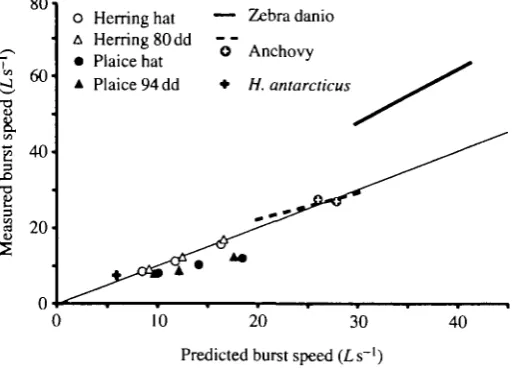
/=100e-"/ ('+ 2 9-5>L-°-2 6 6. (1) This model can be used to predict tail-beat frequency for a given size of fish at a particular temperature. Swimming speed can then be predicted as the product of tail-beat frequency and stride length. Using equation 1 with estimated stride lengths, measured and predicted burst speeds are compared in Fig. 9. Our data are plotted together with those for three species of larvae (not included in the model) already studied: zebra danio (Fuiman, 1986), anchovy (Hunter, 1972; Webb and Corolla, 1981) and Harpagifer antarcticus (Johnston etal. 1991). There is a good agreement between measured and predicted maximum swimming speeds, with the exception of the zebra danio which has an exceptionally good performance. Plaice have a poor swimming performance compared with both the clupeids, which perform equally well (allowing for temperature and size effects) and Harpagifer antarcticus. This poor performance of plaice larvae results from a lower than expected tail-beat frequency for this size of larva rather than from a relatively short stride length.
Escape responses from a standing start should be most effective when inertial forces are operating. Although the larvae have no caudal fin to give good lateral resistance to the water at this early stage of development, the lateral surface area of the body is increased by the presence of a primordial fin fold running along both the dorsal and ventral surfaces of the body. In a viscous regime, frictional forces dominate and the increased drag on the body surface of small organisms reduces
80
60
e 40
1
1 20
o Herring hat — Zebra danio A Herring 80dd
-„, . f O • Plaice hat
A Plaice 94 dd • H. antarcticus
O Anchovy
J
10 20 30
Predicted burst speed (Ls~')
[image:11.451.94.351.407.591.2]40
u/v and, if wavelength does not vary, also the stride length. Stride length depends on the number of body waves within one body length during swimming, a larger number of body waves reducing the stride length. Larger organisms, with the notable exception of species like the eel, tend to be stiffer with few body waves. This allows for a longer stride length and a higher swimming speed for a given tail-beat frequency. It is clear from visual examination of our video recordings that the propulsive wavelength employed by both herring and plaice larvae is close to one body length. The reduced stride length of larval fish swimming at burst speeds is not explained either by operating in the viscous flow regime or by reduced wavelength and must be due to some other factor. Temperature increases raise the swimming speed but in large fish the lower maximum tail-beat frequencies mean that their swimming performance, measured as L s"1, is poorer than that of small fish (Wardle, 1977).
35-
30-25'
20'
I 15'
o
n
tim
e (
o
A
15 °C
5°C
10°C
35
? 30 o
25
20
15
10
5°C
o Herring hat A Herring 80dd • Plaice hat A Plaice 94 dd
10 15 20 25 30
Half tail-beat period (ms)
35
The considerable decrease in C-start contraction time of herring between hatching and 80 dd post-hatch (Fig. 3) is not reflected in similar changes in the tail-beat frequency (Fig. 6) which, for the herring, remains almost constant during this period of development. C-start contraction times are compared with half the tail-beat period in Fig. 10. In general, C-start contraction times are longer than half the tail-beat period. This could be explained by overlapping contractions of the muscle on either side of the body during swimming leading to stiffening of the posterior part of the body in order to facilitate force transmission. The timing of the second contraction of the escape response, relative to the first, changes during herring development so the first contraction is partly overlapped by the second contraction.
The interest of larval forms is in the scale effects that take place as they grow. Fish larvae may be as small as 2-3 mm at hatching and metamorphose into the adult form at lengths of 10-35 mm depending on species. During development, the body usually becomes deeper, the primordial fin fold is lost, to be replaced by flexion of the notochord and the appearance of the caudal fin; other median fins develop and buccal respiration and opercular function appear. In addition, surface:volume ratios change, with the attendant effects on friction and streamlin-ing. During this time the Reynolds numbers can change by several orders of magnitude, making studies on the hydrodynamics of fish in relation to growth and body form especially worthwhile.
u
I
l.O-i
0.8-
0.6-°-
41
0.2-Herring and plaice larvae burst speed Plaice larvae cruising speed Herring larvae cruising speed Dace, 52 mm
Dendrodoa glossularia
10° 101 102 103
Reynold's number
104 105
For example, swimming speed depends on tail-beat frequency and stride length. Stride length is, however, subject to a scale effect, that of smaller aquatic organisms being less than that of larger organisms. The 'tadpole' larva of the ascidian Dendrodoa grossularia has a stride length of about 0.2 (Batty et al. 1991) whereas adult fish have stride lengths of 0.7-0.8 (Bainbridge, 1958; Wardle, 1977). The stride length is related to the Reynolds number, RE (Fig. 11), but does not reach the asymptote found in adult fish over the size and temperature ranges used. Small organisms moving relatively slowly, such as Dendrodoa grossularia, will be moving in a viscous regime (RE<20). Larger fish larvae at cruising speed (Blaxter, 1986) will be in an intermediate (20<./?£<200) or inertial (/?£>200) regime. Burst-swimming fish larvae are likely to be in an inertial regime during the burst but operate at lower Reynolds numbers as they decelerate.
This work was part of the Inter-University Marine Research Initiative (IMRI) between the Dunstaffnage Marine Laboratory and the Universities of Dundee, St Andrews and Stirling and funded by the Natural Environment Research Council. We are grateful to Professor I. A. Johnston and Dr R. N. Gibson for reading the manuscript in draft, to Ms K. Fretwell for her assistance with the analysis of the video recordings and to our colleagues Dr R. N. Gibson, Mrs L. Robb and Mr C. Comely for their help with larval rearing. J.H.S.B. is an Honorary Research Fellow of the Scottish Marine Biological Association.
References
ARCHER, S. D . , ALTRINGHAM, J. D . AND JOHNSTON, I. A. (1990). Scaling effects on the
neuromuscular system, twitch kinetics and morphometrics of cod Gadus morhua. Mar. Behav. Physiol. 17, 137-146.
BAILEY, K. M. AND BATTY, R. S. (1984). Laboratory studies of predation by Aurelia aurila on larvae of cod, flounder, plaice and herring: development and vulnerability to capture. Mar. Biol. 83, 287-291.
BAINBRIDGE, R. (1958). The speed of swimming of fish as related to size and to the frequency and amplitude of tail beat. J. exp. Biol. 35,109-133.
BATTY, R. S., BLAXTER, J. H. S. AND BONE, Q. (1991). The effect of temperature on the
swimming of a teleost (Clupea harengus) and an ascidian larva {Dendrodoa grossularia). Comp. Biochem. Physiol. 100A, 297-300.
BLAXTER, J. H. S. (198(5). Development of the sense organs and behavior of teleost larvae with special reference to feeding and predator avoidance. Trans. Am. Fish. Soc. 115, 98-114. BLAXTER, J. H. S. AND BATTY, R. S. (1985). The development of startle responses in herring
larvae. J. mar. biol. Ass. U.K. 65, 737-750.
BLAXTER, J. H. S. AND FUIMAN, L. A. (1990). The role of the sensory organs of herring larvae in evading predatory fishes. J. mar. biol. Ass. U.K. 70, 413-427.
EATON, R. C. AND DIDOMENICO, R. (1986). Role of the teleost escape response during development. Trans. Am. Fish. Soc. 115, 128-142.
EATON, R. C. AND EMBERLEY, D. S. (1991). How stimulus direction determines the trajectory of the Mauthner-initiated escape response in teleost fish. J. exp. Biol. 161, 469—487.
FUIMAN, L. A. (1986). Burst swimming performance of larval zebra danios and effects of diel temperature fluctuations. Trans. Am. Fish. Soc. 115, 143-148.
FUIMAN, L. A. (1991). Influence of temperature on evasive responses of Atlantic herring larvae attacked by yearling herring, Clupea harengus L. J. Fish Biol. 39, 93-102.
JOHNSTON, I. A., JOHNSON, T. P. AND BATTRAM, J. C. (1991). Low temperature limits burst
swimming performance in Antarctic fish. Jn Biology of Antarctic Fishes (ed. G. di Prisco, B. Maresca and B. Tota), pp. 179-190. Heidelberg: Springer-Verlag.
WARDLE, C. S. (1977). Effects of size on the swimming speeds offish. In Scale Effects in Animal Locomotion (ed. T. J. Pedley), pp. 299-313. New York, London: Academic Press.
WARDLE, C. S. (1980). Effects of temperature on the maximum swimming speeds of fish. In Environmental Physiology of Fishes (ed. M. A. AH), pp. 519-531. New York: Plenum Publishing Corp.
WEBB, P. W. AND COROLLA, R. T. (1981). Burst swimming performance of northern anchovy Engraulis mordax larvae. Fishery Bull. U.S. 79, 143-150.
WEBB, P. W. AND WEIHS, D. (1986). Functional locomotor morphology of early life history stages of fish. Trans. Am. Fish. Soc. 115, 115-127.