MASTER THESIS
Revising the TAM in hedonic information systems: The influence of
the TAM, perceived enjoyment, innovativeness and extraversion on
the use of location-based social networks.
Mariëlle E. Bouwman s0220256
University of Twente
Faculty of Behavioural Sciences
Department of Media, Communication & Organisation
Date:
31 December 2011
Supervisors:
Page 2/30 ABSTRACT
As a hedonic information system, a location-based social network (LBSN) is often seen as a promising innovative mobile service in recent years. However, research on LBSNs is still limited. Little is known about the factors influencing the intention to use LBSNs and the actual use of LBSNs. Our study aims to explain the critical factors underlying the use of a LBSN, by developing a conceptual framework based on the Technology Acceptance Model, the theory of diffusion of innovations and the Five-Factor Model. To examine our proposed research model, we conducted an online survey among users of a Dutch LBSN (Feest.je). We applied structural equation modelling to test our research model. Our results demontrate that perceived usefulness, perceived ease of use, perceived enjoyment and innovativeness seems to be significantly predicting the intention to use and the actual use of LBSNs, and hedonic information systems in general. We found no effect of the influence of extraversion. In practical, our results suggest that developers of LBSNs should especially make their service pleasant and fun to use. Whether a service is seen as enjoyable, will in fact have a significant impact on the intention to use a service, and on the usefulness and ease of use of a service.
Page 3/30 INTRODUCTION
A significant shift in social media the last few years, is the transition from PC’s to mobile devices, such as smartphones and tablet computers. Increasing technological possibilities of mobile phones facilitated a rapid growth of innovative mobile applications and services. Together with the increasing need of users for information to be available “all the time, everywhere, from all devices” (Zheng & Li, 2006, p. 23), this led to a shift in social media. One of these growing innovative mobile services, are location-based social networks (LBSNs), such as Foursquare, Facebook Places and Feest.je (the Dutch equivalent). These location-based services (LBS) are seen as one of the most promising applications in the next years: “location-based services can present powerful opportunities for brands to connect with people, based on where they are and what they are doing, offering a high degree of tailored messaging” (TNS, 2011).
In the literature, a LBSN is defined in various wording: such as commercial location-based online social network (Li & Chen, 2010), mobile social networks (Humphreys, 2010), mobile-device-based social networking service (Counts & Fisher, 2010) and SpotAFriendNow application (van den Berg & Pekarek, 2010). It is essential therefore, to first establish a clear definition of a LBSN. Here, a LBSN is defined as a hedonic (pleasure-oriented) information system, that: enables users to search for locations (geo-tagged information) with their mobile device (e.g., smartphone, tablet PC), allows users to check-in on that location, share their location (with users within the service, or with their entire social network) and offer the possibility to meet other users near that location (Fusco, Michael, & Michael, 2010a; Li & Chen, 2009). First started in 2000 as a simple mobile text-service with few users (Dodgeball), LBSNs grew the last decade into advanced location-based services, for example Foursquare (10 million users worldwide) and Facebook Places (approximately 40/50 million users worldwide).
Page 4/30
in why they use LBSNs. In their research on the future face of social media, Universal McCann stated: “A deeper knowledge of consumer needs and motivations is the key to unlocking our understanding of social media” (p. 49). The contribution of this study is that it will give scientific insights into the critical factors affecting the use of hedonic information systems, and LBSNs in particular. Furthermore, results from this study can help developers of LBSNs (e.g., Foursquare or Feest.je) to understand the underlying mechanisms of the use of their services and can potentially help them to approach their current and potential users more effectively.
This study aims to explain the factors underlying the use of a LBSN, by developing a conceptual framework based on the Technology Acceptance Model (TAM), the theory of diffusion of innovations and the Five-Factor Model (FFM). Specifically, this paper will study the influence of perceived usefulness, perceived ease of use and perceived enjoyment (adapted from the TAM), innovativeness (adapted from the theory of diffusion of innovations) and extraversion (adapted from the FFM), on the intention to use and the actual use of LBSNs. The triangulation of these three theories will give a more thorough insight into explaining the use of LBSNs. In the study of Kim (2010) on mobile data services, the Theory of Planned Behaviour was combined with the Expectation-Confirmation Model. According to Kim (2010), an integrated model provides a more better understanding of their results than either theory considered alone.
Therefore, the research question central to this study is as follows: “To what extent does
the TAM, with the additional constructs perceived enjoyment, extraversion and
innovativeness, contribute to explaining the intention to use and the actual use of LBSNs?”
Page 5/30 2. THEORETICAL BACKGROUND
In the literature, several models can be found that try to explain the adoption and use of hedonic information systems. In their study on use patterns of location-based services, Lehrer, Constantiou & Hess (2010) use a model of perceptual and intuitive cognitive systems. Within the background context (experience, knowledge and expertise of the individual) and the context of use, the actual use of a location-based service is determined by the referencing processes (perceptual) and reason-based processes (intuitive). Furthermore, in another study, the model of Triandis is being used to explain the motives and barriers affecting the use of mobile data services (Bina, Karaiskos, & Giaglis, 2007). The model of Triandis presumes that use behaviour consists of three elements: intention, habit and facilitating conditions. Also, the motivation theory and network externalities are used by Lin & Lu (2011), to explain why people use social networking. According to Lin & Lu (2011), the intention to use is determined by internal (perceived benefit) and external motivations (number of members, number of peers and perceived complementarity). However, most models that examine the adoption and use of hedonic information systems, are based on the Technology Acceptance Model (TAM).
Page 6/30
According to the TAM, the actual use of a system is directly determined by the behavioural intention to use and indirectly by the perceived usefulness, perceived ease of use and external variables. These variables will be explained in the following sections.
2.1 Behavioural intention
The behavioural intention can be defined as the likelihood an individual intents to use a LBSN. However, the use of a LBSN is a rather general understanding. To date, no categorization has yet been made; therefore, we will try to distinguish between the various types of uses of a LBSN.
There are several kinds of LBSNs with different functionalities, some emphasize location-sharing and location-recommending (e.g., Brightkite, Where, Facebook Places), while others focus on the game-element (e.g., Foursquare, SCVNGR, Feest.je). For this study, Feest.je will be used to examine the use of a LBSN. Subsequently, the functionalities of Feest.je will be used to define the “actual use” of a LBSN. When looking at Feest.je, three functionalities can be distinguished, namely spots, parties and friends. Spots are the so-called locations, whereby the users of Feest.je are able to: search for spots, check-in on spots, create spots and give awards to spots. Furthermore, parties are a central element on Feest.je (feestje is Dutch for “party”), users of Feest.je can: search for parties, add parties and check-in on parties. Finally, friends play an important role on Feest.je; users of Feest.je are able to: search for friends, add friends, respond to check-in of friends and share their activity on Feest.je with friends. In sum, the actual use of a LBSN consists of three elements: spots, parties and friends.
Page 7/30
the actual use of a technology. However, in our opinion, it is also important to actual examine the relation between the intention to use a service and the actual use. Based on our assumptions, we argue that the behavioural intention to use a LBSN will have a positive influence on the actual use of a LBSN. We propose the following hypotheses:
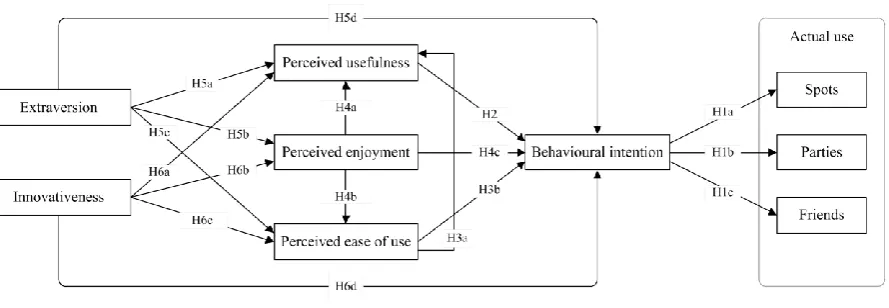
H1a: Behavioural intention has a positive influence on the actual use of spots. H1b: Behavioural intention has a positive influence on the actual use of parties. H1c: Behavioural intention has a positive influence on the actual use of friends.
2.2. Perceived usefulness
Perceived usefulness can be defined as the degree to which an individual believes that using a LBSN will enhance their performance (adapted from Davis (1989)). According to the TAM, perceived usefulness will have a positive influence on the behavioural intention. This assumption is supported by various studies on services related to LBSNs (e.g., Agarwal & Karahanna, 2000; Bina, et al., 2007; Chang, 2007; van der Heijden, 2004; Lin & Lu, 2011; Lu, Yao, & Yu, 2005; Qi, Li, Li, & Shu, 2009). For example, in his study on hedonic information systems Chesney (2006) shows that perceived usefulness has a significant influence on the intention to use. Furthermore, in their comparison of mobile services (text-messaging, contact, payment and gaming), Nysveen, Pedersen & Thorbjørnsen (2005) found out that perceived usefulness, as a antecedent, had a significant influence on the intention to use a mobile service. Also, Parveen & Sulaiman (2008) showed that perceived usefulness plays a significant positive influence on the intention to use wireless internet applications on a mobile device. Lastly, a study by Verkasalo, López-Nicolás, Molina-Castillo & Bouwman (2010), showed a strong significant influence of perceived usefulness on the intention to use smartphone applications. Based on these findings, we argue that the perceived usefulness of a LBSN will have a positive influence on the behavioural intention to use a LBSN. Therefore, we propose the following hypothesis:
H2: Perceived usefulness has a positive influence on the behavioural intention.
2.3 Perceived ease of use
Page 8/30
have a positive influence on the perceived usefulness. These assumptions are supported by various studies on services related to LBSNs (e.g., Agarwal & Karahanna, 2000; Bina, et al., 2007; Chang, 2007; Chen & Chen, 2011; Nysveen, et al., 2005; Qi, et al., 2009). For example, in their study on the adoption of wireless internet applications on a mobile device, Lu et al. (2005), found out that perceived ease of use played a significant positive influence in the intention to adopt the applications. Furthermore, in the studies of Lu et al. (2005) and Venkatesh (2000), a strong positive influence of perceived ease of use on the perceived usefulness was found. Moreover, van der Heijden (2004) showed in his study on hedonic information systems, that perceived ease of use had a significant positive influence on the behavioural intention as well as on the perceived usefulness. Based on these findings, we argue that the perceived ease of use of a LBSN will have a positive influence on the behavioural intention to use a LBSN. Furthermore, we argue that the perceived ease of use of a LBSN will have a positive influence on the perceived usefulness of a LBSN. Therefore, we propose the following hypotheses:
H3a: Perceived ease of use has a positive influence on the perceived usefulness. H3b: Perceived ease of use has a positive influence on the behavioural intention.
2.4 Perceived enjoyment
Page 9/30
teachers, Teo & Noyes (2011) showed a significant positive influence of perceived enjoyment on the intention to use technology. Moreover, they found a significant positive influence of perceived enjoyment on perceived usefulness and perceived ease of use (Teo & Noyes, 2011). Also, in their study on mobile hedonic applications, Liu & Li (2011) found a significant positive influence of perceived enjoyment on perceived usefulness. Venkatesh (2000) shows, in his study into the determinants of perceived ease of use, that perceived enjoyment has a significant positive influence on perceived ease of use. Based on these findings, we believe that perceived enjoyment will play an important role in the use of a pleasure-oriented information system, like a LBSN. Therefore, perceived enjoyment will be added as an antecedent in the TAM. We argue that the perceived enjoyment of a LBSN will have a positive influence on the behavioural intention to use a LBSN. Furthermore, we argue that the perceived of a LBSN will have a positive influence on the perceived usefulness and the perceived ease of use of a LBSN. Therefore, we propose the following hypotheses:
H4a: Perceived enjoyment has a positive influence on perceived usefulness H4b: Perceived enjoyment has a positive influence on perceived ease of use H4c: Perceived enjoyment has a positive influence on the behavioural intention
Page 10/30
positive relation between personality and the perceived enjoyment when using an information system. Based on these findings, we argue that the personality traits of the FFM will have a significant influence on the constructs of the TAM. In the next section, we will explain the FFM and we will relate this theory to the constructs of the TAM.
2.5 Extraversion
As a commonly used approach in research on personality, the FFM divides personality into five different dimensions, namely: extraversion, agreeableness, conscientiousness, neuroticism and openness to experience (McCrae & John, 1992). The first trait, extraversion, reflects a person’s tendency to exhibit social behaviour and to experience positive emotions (Ross et al., 2009). Secondly, agreeableness reflects the tendency of a person to be trustworthy, compliant, sympathetic and cooperative (Ross, et al., 2009). The third dimension, conscientiousness, reflects the extent to which a person is organized, dedicated and conscientious (Ross, et al., 2009). As four trait, neuroticism, reflects the tendency of a person to experience psychological distress and to be extremely sensitive to threats (Ross, et al., 2009). Lastly, openness to experience, represents a person’s willingness to consider alternatives, be curious and to enjoy artistic activities (Ross, et al., 2009).
In the case of LBSNs, the trait of extraversion seems to be of particular interest. After all, a LBSN facilitates social behaviour, in the form of searching for other users, sharing activity with other users and if desired, meet with other users. Social behaviour is central to the trait of extraversion. A highly extraverted individual will be sociable, will seek activity and excitement, will be assertive and will seek the company of others. We believe that these needs of an extraverted individual can be gratified when using a LBSN.
Page 11/30
Furthermore, we argue that extraversion will have a positive influence on the perceived usefulness, perceived enjoyment and the perceived ease of use of a LBSN. Therefore, we propose the following hypotheses:
H5a: Extraversion has a positive influence on perceived usefulness H5b: Extraversion has a positive influence on perceived enjoyment H5c: Extraversion has a positive influence on perceived ease of use H5d: Extraversion has a positive influence on the behavioural intention
Besides extraversion, another antecedent could potentially affect the degree of acceptance and use of LBSNs, namely the degree of innovativeness of a person. Especially when studying new technologies such as LBSNs, we believe that this variable could be an influential construct. This assumption is supported by several studies on the influence of innovativeness on the intention to use services that are related to LBSNS. Also, Agarwal & Prasad (1998) claim that the degree of innovativeness will give valuable insights in the reasons why some individuals adopt the new technologies, while others reject them. Therefore, the inclusion of innovativeness as a construct to the model seems appropriate. A theory that is often used, when assessing the degree of innovativeness, is the theory of diffusion of innovations. This theory can help explain the adoption and acceptance of new technologies (Rogers, 1995). However, in our opinion, using this theory alone would be insufficient to explain the use of LBSNs. Therefore, we argue that when integrating this theory with the TAM, a better explanation can be given of the intention to use LBSNs and the actual use. In the next section, we will explain the theory of diffusion of innovations and we will relate this theory to the constructs of the TAM.
2.6 Innovativeness
Page 12/30
information technology. Furthermore, individuals with a high score on innovativeness are expected to develop more positive attitudes towards new technologies (in this study LBSNs).
When looking at the literature, several studies show a strong significant influence of the degree of innovativeness on the use of services that are related to LBSNs (e.g., Agarwal & Karahanna, 2000; Kuo & Yen, 2009; Parveen & Sulaiman, 2008). For example, in his study on the adoption of mobile commerce, Yang (2005) shows that innovativeness has a significant influence on the TAM constructs of perceived usefulness and perceived ease of use. This is also confirmed by a study of Lu et al. (2005) on the adoption of wireless internet services via mobile technology. They found out that innovativeness had a significant positive relation on the perceived usefulness and perceived ease of use (Lu, et al., 2005). Furthermore, studies of Kwon, Choi & Kim (2006) and Tang & Chiang (2009) on mobile services, show that innovativeness is a significant predictor of perceived usefulness. Finally, Qi et al. (2009) claim that innovativeness has a positive influence on the behavioural intention to use mobile data services. Based on these findings, innovativeness will be added as an antecedent in the TAM. We argue that innovativeness will have a positive influence on the behavioural intention to use a LBSN. Furthermore, we argue that innovativeness will have a positive influence on the perceived usefulness, perceived enjoyment and the perceived ease of use of a LBSN. Therefore, we propose the following hypotheses:
[image:12.595.79.524.593.747.2]H6a: Innovativeness has a positive influence on perceived usefulness H6b: Innovativeness has a positive influence on perceived enjoyment H6c: Innovativeness has a positive influence on perceived ease of use H6d: Innovativeness has a positive influence on the behavioural intention
Page 13/30
Based on the previous assumptions on the hypothesized influences between the actual use, behavioural intention, perceived usefulness, perceived ease of use, perceived enjoyment, extraversion and innovativeness, we propose our research model (see Figure 1).
To test the research model, two studies are conducted among users of Feest.je. First, a preliminary study was conducted to shed light on the hypothesized constructs and other not-hypothesized constructs that could influence the use of Feest.je. By first examining the use of Feest.je with a qualitative study, evidence could be found supporting other variables than the hypothesized constructs. Subsequently, the main study was conducted to examine the
proposed research model. The next section will discuss the methods used in these studies.
3. METHOD
3.1 Preliminary study 3.1.1 Sample and procedure
To examine whether the proposed constructs were relevant to the use of Feest.je, a short preliminary study was conducted. In July 2011, a total of 67 Feest.je users were asked to participate in a short online survey. The sample comprised seven males, one female and three unknown (M = 31.50, SD = 8.16). Participants were recruited through searching on Twitter for tweets relating to the usage of Feest.je. We assume that Feest.je users, who share their activity on Twitter, are able to give valuable input for a preliminary qualitative study. The degree of Feest.je usage varied across the participants – 72.7% of the Feest.je users reported to be occasional users, followed by 18.2% regular users and 9.1% rare users.
3.1.2 Measures
Page 14/30
comes to mind when you use Feest.je and describe in what kind of situations you use Feest.je).
3.2 Study
3.2.1 Sample and procedure
To examine the relationship between the proposed constructs, an online survey was conducted among Feest.je members in September 2011. A total of 13858 Feest.je users randomly received an e-mail invitation from Feest.je. In this e-mail, they were asked to participate in the online survey. Furthermore, this invitation provided a short introduction to the survey, a time estimate to complete the survey and information about the incentive the Feest.je users would receive when they completed the survey (a Feest.je badge). A first invitation was sent between September 8, 2011 and September 19, 2011. Subsequently, the reminder was sent on September 26, 2011.
A total of 236 e-mail addresses turned out to be invalid, which leaves 13622 valid email addresses. A subset of 210 Feestje.je users (158 male, 46 female and 6 unknown) participated in the study, whereby 200 participants completed the entire survey and 10 participants did not filled in the demographic questions. Participants ranged in age from 15 to 69 (M = 33.65, SD = 10.63). The degree of Feest.je usage varied across the participants – 36.2% of the Feest.je users reported to be rare users, followed by 31.4% occasional users, 27.1% non-users and 5.2% regular users (M = 2.15, SD = .88).
3.2.2 Measures
Usage. As is evident from the theoretical background section, the actual use of Feest.je consists of three basic functionalities, namely spots, parties and friends. Using these functionalities, we developed a scale to measure the degree of actual use of Feest.je. On a five-point Likert scale (1 = “often”, 5 = “never”), participants filled in the extent to which they used spots (such as checking-in at locations and searching for locations), parties (e.g., checking-in at parties and add parties to Feest.je) and friends (for example, searching for friends on Feest.je and sharing activity with other social networks) (see Appendix A). The scale was proven to be reliable (α = .94), when tested in the preliminary study and the pre-test (N = 48). The obtained Cronbach’s alpha reliability estimate was .93.
Page 15/30
used. On a five-point Likert scale (1 = “strongly disagree, 5 = “strongly agree), participants were asked to rate their agreement on the 12-items of the Extraversion subscale (see Appendix A). A higher score on this scale, indicates a higher level of extraversion as a personality trait. The obtained Cronbach’s alpha reliability estimate was .73 (see Table 1).
Innovativeness. To measure the degree of innovativeness of the participants, a four-item scale was adapted from Agarwal & Prasad (1998) (see Appendix A). This scale is proven to be reliable when assessing the degree of personal innovativeness in the context of IT (Agarwal & Karahanna, 2000; Agarwal & Prasad, 1998), context-aware services (Kwon, et al., 2006) and mobile data services (Lu, et al., 2005). On a five-point Likert scale (1 = “strongly disagree, 5 = “strongly agree), participants were asked to rate their agreement with the items. Slight modifications were made to the items when translating them into Dutch. A higher score on this scale, indicates a higher degree of innovativeness as a personality trait. The obtained Cronbach’s alpha reliability estimate was .77 (see Table 1).
Perceived usefulness, perceived ease of use, behavioural intention and perceived
enjoyment. To measure the constructs of perceived usefulness, perceived ease of use and behavioural intention, items from the TAM (Davis, 1989) were used. These items are well-validated and are a commonly used method to assess the mentioned constructs. To determine the degree of enjoyment, adapted items from Venkatesh (2000) and Verkasalo et al. (2010) were used. Participants were asked to rate their agreement with the items on a five-point Likert scale (1 = “strongly disagree, 5 = “strongly agree). The items were translated into Dutch and adapted to this study (see Appendix A). The obtained Cronbach’s alpha reliability estimate for the four constructs was .79 (also see Table 1).
4. RESULTS
4.1 Preliminary study
Page 16/30
Open-ended questions about the reasons participants used Feest.je, indicated that there are several reasons why Feest.je is being used. Most important is the reason that the participants “liked” to use Feest.je (16.1%). Also, participants were asked to indicate in what kind of situation they used Feest.je the most. Feest.je was particularly used when checking-in to pleasure-oriented occasions, for example going to a restaurant, a club or a party (28.6%).
Results of the preliminary study indicate that, besides the commonly-used constructs of the TAM (perceived ease of use and perceived usefulness), other constructs also play a role in the use of Feest.je. It was proposed that the degree of innovativeness, extraversion (social behaviour) and enjoyment would play a significant role in the use of Feest.je. The preliminary study confirms this assumption. Furthermore, we found no evidence for supporting other variables than the hypothesized constructs.
4.2 Study
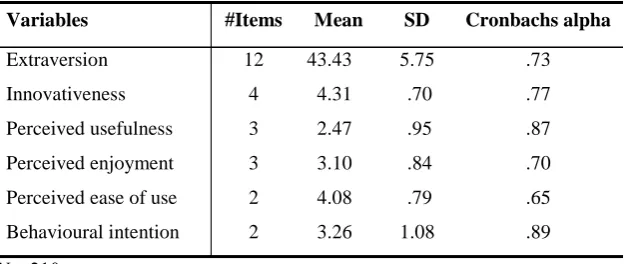
The means, standard deviations and Cronbach’s alpha reliability estimates were calculated for the two predictor variables and four criterion variables (see Table 1). Also, the mean and the standard deviation of extraversion were compared to norm scores of the NEO-FFI (Hoekstra, et al., 2003). This comparison indicates that the average score on extraversion was significantly higher than the published norm in the NEO-FFI (M = 40.1, p < .001).
4.2.1 Structural equation modelling
[image:16.595.88.405.622.754.2]To test the proposed research model (see Figure 1), structural equation modelling using Amos 18.0 (Arbuckle, 2009) was applied. Structural equation modelling is a statistical methodology that takes a confirmatory (i.e., hypothesis-testing) approach to the analysis of a structural theory bearing on some phenomenon (Byrne, 2001). Typically, this theory represents causal processes that generate observations on multiple variables (Bentler, 1989).
Table 1.
Descriptive statistics and reliability.
Variables #Items Mean SD Cronbachs alpha
Extraversion 12 43.43 5.75 .73
Innovativeness 4 4.31 .70 .77
Perceived usefulness 3 2.47 .95 .87
Perceived enjoyment 3 3.10 .84 .70
Perceived ease of use 2 4.08 .79 .65
Behavioural intention 2 3.26 1.08 .89
Page 17/30
Synonyms for structural equation modelling are covariance structure analysis, covariance structure modelling, and analysis of covariance structures. According to Byrne (2001), the term structural equation modelling conveys two important aspects of the procedure: (1) that the causal processes under study are represented by a series of structural (i.e., regression) equations, and (2) that these structural relations can be modelled pictorially to enable a clearer conceptualization of the theory under study. The hypothesized model can then be tested statistically in a simultaneous analysis of the entire system of variables to determine the extent to which it is consistent with the data. Byrne (2001) poses that if the goodness of fit is adequate, the model argues for the plausibility of postulated relations among variables; if it is inadequate, the tenability of such relations is rejected.
To assess if the sample size was adequate for structural equation modelling, Hoelter’s critical N was computed. At the .05 level of significance, the model in Figure 1 resulted in a Hoelter’s N of 415. Furthermore, at the .01 level of significance, the model of Figure 1 resulted in a Hoelter’s N of 732. Because the sample size is sufficient (Hoelter’s N > 200), we can apply structural equation modelling.
4.2.2 Path analyses
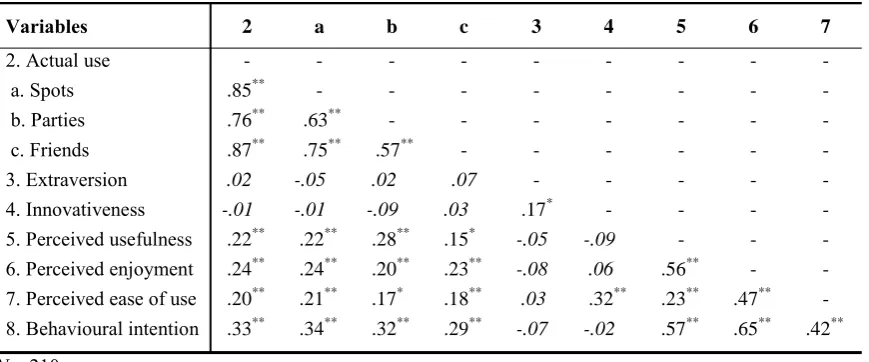
[image:17.595.77.512.527.708.2]Before examining the paths of our research model, the correlation matrix of the variables is computed (see Table 2). First of all, as hypothesized, there seems to be a strong significant positive relation between the perceived ease of use and perceived usefulness.
Table 2.
Correlation matrix.
Variables 2 a b c 3 4 5 6 7
2. Actual use - - - -
a. Spots .85** - - - -
b. Parties .76** .63** - - - -
c. Friends .87** .75** .57** - - - -
3. Extraversion .02 -.05 .02 .07 - - - - -
4. Innovativeness -.01 -.01 -.09 .03 .17* - - - -
5. Perceived usefulness .22** .22** .28** .15* -.05 -.09 - - -
6. Perceived enjoyment .24** .24** .20** .23** -.08 .06 .56** - -
7. Perceived ease of use .20** .21** .17* .18** .03 .32** .23** .47** -
8. Behavioural intention .33** .34** .32** .29** -.07 -.02 .57** .65** .42**
N = 210.
*p < .05 (2-tailed). **p < .01 (2-tailed).
Page 18/30
However, when linking these two variables in the structural equation modelling, this connection would lead to a not-fitted model.
Secondly, it was hypothesized that innovativeness had a direct influence on the behavioural intention. However, examination of the structural model, shows that this connection would not lead to a fitted model (χ² (36) = 17.998, χ² /df = .986, SRMR = .027, TLI = 1.001, RMSEA = .000 (90% confidence interval [CI]: .000, .06), AIC = 93.800, ECVI = .449 (CI: .450, .511)).
Furthermore, there seems to be a strong positive relation between actual use and perceived usefulness, perceived enjoyment, perceived ease of use and behavioural intention. However, when including actual use as a variable in the research model, this does not lead to a fitted model (χ² (21) = 16.338, χ² /df = .819, SRMR = .016, TLI = 1.012, RMSEA = .000 (90% confidence interval [CI]: .000, .108), AIC = 66.456, ECVI = .318 (CI: .321, .356)). Actual use, therefore, will not be included in the path analysis.
As stated before, the actual use consists of three variables: spots, parties and friends. As evidenced in the correlation matrix, there are significant positive relations between these three variables of actual use (2a, 2b and 2c) and the perceived usefulness, perceived enjoyment, perceived ease of use and behavioural intention. When adding the variables of actual use separately to the research model, this leads to a fitted model. However, the model only shows a good fit when these variables are only associated with the behavioural intention (χ² (36) = 17.998, χ² /df = 1.047, SRMR = .030, TLI = .997, RMSEA = .015 (90% confidence interval
[image:18.595.80.525.576.713.2][CI]: .000, .068), AIC = 93.698, ECVI = .448 (CI: .445, .514)). This is in accordance with previous research, where behavioural intention directly determines the actual use (Chang, 2007; Kim, et al., 2010).
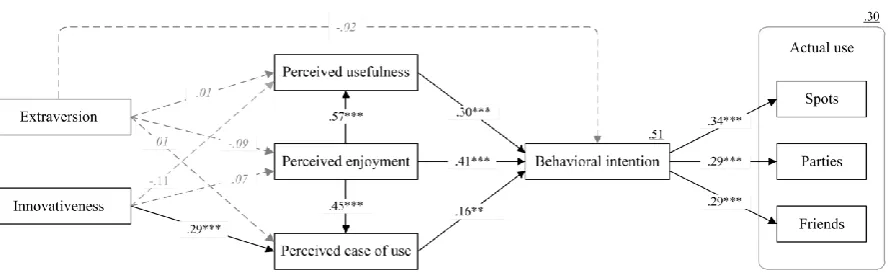
Figure 2. Standardized path coefficients of the research model.
Note.*p < .05, **p < .01, ***p < .001.
Page 19/30 4.2.3 Path model & hypotheses
Based on the path analyses, a fitted model is computed (see Figure 2) (χ² (36) = 17.998,
χ² /df = 1.047, SRMR = .030, TLI = .997, RMSEA = .015 (90% confidence interval [CI]:
.000, .068), AIC = 93.698, ECVI = .448 (CI: .445, .514)). This model shows the standardized path coefficients and variance accounted for by the complete set of variables (consisting of the factor loading (β) and the squared multiple correlations (R2).
The variance accounted by for the complete set of variables is expressed in the squared multiple correlations. Perceived usefulness, perceived enjoyment, perceived ease of use and innovativeness explained 51% of the variance in the behavioural intention. Furthermore, the actual use was accounted by the research model for 30%.
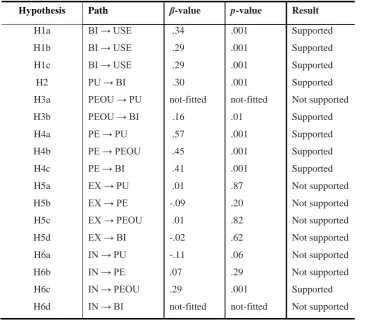
[image:19.595.78.446.442.762.2]Based on the preceding path model, an overview of the hypotheses has been made (see Table 3). The findings of this study indicate that the behavioural intention (H1a, H1b, H1c), has a significant positive influence on the actual use of a LBSN. Furthermore, the perceived usefulness (H2), perceived ease of use (H3b, H3c) and perceived enjoyment (H4a, H4b, H4c) have a significant direct positive influence on the behavioural intention to use a LBSN. Subsequently, these hypotheses are supported. Moreover, we can reject H3a, because the
Table 3. Path coefficients
Hypothesis Path β-value p-value Result
H1a BI → USE .34 .001 Supported
H1b BI → USE .29 .001 Supported
H1c BI → USE .29 .001 Supported
H2 PU → BI .30 .001 Supported
H3a PEOU → PU not-fitted not-fitted Not supported
H3b PEOU → BI .16 .01 Supported
H4a PE → PU .57 .001 Supported
H4b PE → PEOU .45 .001 Supported
H4c PE → BI .41 .001 Supported
H5a EX → PU .01 .87 Not supported
H5b EX → PE -.09 .20 Not supported
H5c EX → PEOU .01 .82 Not supported
H5d EX → BI -.02 .62 Not supported
H6a IN → PU -.11 .06 Not supported
H6b IN → PE .07 .29 Not supported
H6c IN → PEOU .29 .001 Supported
Page 20/30
influence of perceived ease of use on perceived usefulness was not evident in our fitted model. Also, the study showed that extraversion did not have a significant influence on the behavioural intention, perceived usefulness, perceived enjoyment and perceived ease of use. Therefore, H5a, H5b, H5c and H5d are rejected. Furthermore, the findings of this study indicate that innovativeness had a significant influence on perceived ease of use (supporting H6c), but not on perceived usefulness, perceived enjoyment and the behavioural intention (rejecting H6a, H6b and H6d).
5. DISCUSSION
5.1 Main findings
The present study contributes to the literature on the use of hedonic information services, by developing an integrated model to examine the use of a LBSN. We used a combination of three theories, the TAM, the FFM and the theory of diffusion of innovations, to examine the critical factors underlying the intention to use and the actual use of LBSNs. Specifically, by adding additional constructs to the TAM (i.e., perceived enjoyment, extraversion and innovativeness), we sought to explain the use of Feest.je.
The results of the present study indicate that the actual use of a LBSN can be significantly predicted by the intention to use a LBSN. Furthermore, the perceived usefulness, perceived enjoyment and perceived ease of use are significant predictors of the intention to use a LBSN. Also, perceived enjoyment is a significant predictor of perceived usefulness and perceived ease of use. Perceived enjoyment is regarded as the key influencer of the research model. Lastly, we found that innovativeness is a significant predictor of perceived ease of use.
Page 21/30
relation between the perceived ease of use and behavioural intention is proven to be significant (e.g., Chen & Chen, 2011; van der Heijden, 2004; Lu, et al., 2005; Qi, et al., 2009). In accordance with previous studies, we found that innovativeness has a positive influence on the perceived ease of use (e.g., Kuo & Yen, 2009; Kwon, et al., 2006; Lu, et al., 2005; Parveen & Sulaiman, 2008; Tang & Chiang, 2009). Our findings imply that a higher score on the degree of innovativeness, leads to an increasing perception of the ease of use of a LBSN. That is, a LBSN is seen as easier to use by individuals high on innovativeness, than individuals low on innovativeness. A possible explanation lies in the fact that individuals high on innovativeness are more experienced with new information technologies, than individuals low on innovativeness. Subsequently, this familiarity leads to an increasing ease of use of a LBSN.
Also, our study reveals that extraversion has no significant influence on the perceived usefulness, perceived enjoyment, perceived ease of use and behavioural intention. This finding is contrary to existing work which found extraversion to be significantly related to the TAM (e.g., Devaraj, et al., 2008; Rosen & Kluemper, 2008; Wang, 2010; Wang, et al., 2010). Although the participants in our study significantly scored higher than the average norm score of the NEO-FFI (Hoekstra, et al., 2003), we found no significant effect of extraversion on one of the constructs of our research model.
Lastly, our results show that perceived enjoyment is the key influencer in our research model. Corresponding to previous work, we found that perceived enjoyment is a significant predictor of perceived usefulness (Liu & Li, 2011; Teo & Noyes, 2011), perceived ease of use (Teo & Noyes, 2011; Venkatesh, 2000) and behavioural intention (Chen & Chen, 2011; van der Heijden, 2004; Verkasalo, et al., 2010). This means that the more pleasure and fun an individual experiences when using a LBSN, the more this LBSN is seen as useful and easy to use. Moreover, the intention to use a LBSN will be higher, when an individual experiences pleasure, enjoyment and fun during the use.
Page 22/30
der Heijden (2004) support our assumption, by claiming that perceived enjoyment should be seen as a key determinant in the use of hedonic information systems. When looking at several studies that have incorporated perceived enjoyment into the TAM, it is remarkable though, that they only examine the influence of perceived enjoyment on one or two core concepts of the TAM (e.g., Chen & Chen, 2011; Lin & Lu, 2011; Liu & Li, 2011). To our knowledge, only van der Heijden (2004), Chesney (2006) and Lin & Lu (2011) examined the incorporation of perceived enjoyment as a key influencer into their research model. However, these three studies were limited to the field of hedonic websites, pleasure-oriented software and social networks. Our study contributes to the literature by examining the influence of perceived enjoyment on the core concepts of the TAM in the context of mobile hedonic information services, namely LBSNs.
5.2 Limitations and future research
This study has several limitations that should be taken into account. First of all, we measured the degree of usage of Feest.je among our sample. As evidenced in the method section, approximately 67,6% of the participants reported to be rare or occasional users. We believe that our research model could have been influenced by this low degree of usage. For example, we hypothesized that individuals who are sociable and extravert, would tend to use a LBSN more. It is possible that we found no effect, due to the fact that most of the participants indicated to be rare or occasional users. Future research should use more active and frequent users, to examine whether extraversion indeed has no influence on the perceived usefulness, perceived enjoyment, perceived ease of use and behavioural intention to use a LBSN.
Page 23/30
Concerning our sample, several limitations can be pointed out. First of all, our sample was not evenly distributed, with only 21,9% female (n = 46). When looking at the differences between men and women, it is remarkable to find out that, for women, innovativeness has a significant positive influence on perceived enjoyment as well as on perceived ease of use. This would indicate that women who are highly innovative, would perceive a LBSN as more enjoyable and easy to use, than women low on the degree of innovativeness. For men, innovativeness only has a significant influence on the perceived ease of use. For a better generalizability, we recommend on one hand, that future research should strive for an even distribution of the sample. On the other hand, future research should also look deeper into the differences between men and women. Also, we studied the users of Feest.je, a Dutch LBSN. With approximately 20.000 users, one might wonder to what degree the users of this Dutch LBSN will be representative for users of a worldwide LBSN such as Foursquare with 10 million users. To examine the feasibility of our results, future research should study other LBSNs.
Moreover, we claimed in our theoretical background section that we limited ourselves to investigating extraversion, because it is the one trait that reflects social behaviour the most and would therefore be most interesting to examine in the context of LBSNs. Our study, however, shows no influence of extraversion on the proposed constructs. Therefore, it is not inconceivable that other personality traits, such as neuroticism or openness to experience, could influence the intention to use a LBSN. Previous studies of Devaraj et al. (2008) and Rosen & Kluemper (2008) confirm this assumption by demonstrating a positive influence of agreeableness and a negative influence of neuroticism on the constructs of the TAM. Further research needs to be done to examine the role of the other personality traits on the intention to use and the actual use of LBSNs and hedonic information systems in general.
Page 24/30
could have an influence on our research model, namely perceived involvement, social influence and use context.
First of all, perceived involvement reflects the degree of involvement that people experience when using an information technology (Agarwal & Karahanna, 2000; Rosen & Kluemper, 2008). According to Agarwal & Karahanna (2000) and Rosen & Kluemper (2008), a deep state of involvement can be strongly positively associated with perceived usefulness and perceived ease of use when using an information technology in general, or a social network service in particular. It is plausible that perceived involvement will serve as a significant determinant in our research model. Furthermore, we also believe that the social influence could play an important role in our research model. Social influence can be defined as the degree to which an individual believes significant others put pressure on him/her to make a particular decision, such as using a LBSN (Lu, et al., 2005; Verkasalo, et al., 2010). According to Lu et al. (2005) and Verkasalo et al. (2010), there is a strong positive relation between social influence and the constructs of the TAM. Therefore, we believe that when an individual is positively influenced by an important other, he/she will be more inclined to use a LBSN, will perceive a LBSN to be more useful, will experience more enjoyment when using a LBSN and will perceive the LBSN to be easier to use. Lastly, we expect that the context in which a LBSN is used, will have a significant influence on the perceived usefulness, perceived ease of use, perceived enjoyment and behavioural intention. According to several studies on mobile hedonic services, it is important to have a fit between the context and the information technology used (Bina, et al., 2007; Liu & Li, 2011). We assume that when a LBSN is used in an appropriate context, this will lead to an increase in the perceived usefulness, perceived ease of use, perceived enjoyment and will eventually lead to an increase in the intention to use the LBSN. To better understand the intention to use and the actual use of hedonic information systems, we suggest that further research needs to be done to examine the above antecedents and other determinants of the behavioural intention, perceived usefulness, perceived ease of use and perceived enjoyment.
5.3 Conclusion
Page 25/30
Page 26/30 REFERENCES
Agarwal, R., & Karahanna, E. (2000). Time flies when you're having fun: Cognitive absorption and belief's about information technology usage. . MIS Quarterly, 24(4), 665-694.
Agarwal, R., & Prasad, J. (1998). A conceptual and operational definition of personal innovativeness in the domain of information technology. Information Systems Research, 9(2), 204-215.
Arbuckle, J.L. (2009). Amos (Version 18.0.0). Crawfordville, FL.: AMOS Development Corporation.
Bentler, P.M. (1989). Theory and implication of EQS: A structural equations program. Los Angeles: BMDP Statistical Software.
Berg, B. van den, & Pekarek, M. (2010). SpotAFriendNow: social interaction through location-based social networks. In R. Meersman, T. Dillon & P. Herrero (Eds.), On the move to meaningful internet systems: OTM 2010 workshops (pp. 329-338). Heidelberg/Berlin: Springer-Verlag.
Bina, M., Karaiskos, D., & Giaglis, G.M. (2007). Motives and barriers affecting the use of mobile data services. Paper presented at the International Conference on the Management of Mobile Business, Toronto, ON.
Butt, S., & Phililps, J.G. (2008). Personality and self-reported mobile phone use. Computers in Human Behavior, 24, 346-360.
Byrne, B.M. (2001). Structural equation modeling with AMOS: Basic concepts, applications and programming. Mahwah, NJ: Erlbaum.
Chang, P.C. (2007). Understanding consumers’ behaviour when using a mobile phone as a converged device. Paper presented at the 18th Australasian Conference on Information Systems, Toowoomba, Australia.
Chen, C.F., & Chen, P.C. (2011). Applying the TAM to travelers’ usage intentions of GPS devices. Expert Systems with Applications, 38, 6217-6221.
Chesney, T. (2006). An acceptance model for useful and fun information systems. Human Technology, 2(2), 225-235.
Counts, S., & Fisher, K.E. (2010). Mobile social networking as information ground: A case study. Library & Information Science Research, 32, 98-115.
Davis, F.D. (1989). Perceived usefulness, perceived ease of use, and user acceptance of information technology. MIS Quarterly, 13(3), 319-340.
Davis, F.D., Bagozzi, R.P., & Warshaw, P.R. (1989). User acceptance of computer technology: A comparison of two theoretical models. Management Science, 35(8), 982-1003.
Davis, F.D., Bagozzi, R.P., & Warshaw, P.R. (1992). Extrinsic and intrinsic motivation to use computers in the workplace. Journal of Applied Social Psychology, 22(14), 1111-1132.
Devaraj, S., Easley, R.F., & Crant, M. (2008). How does personality matter? Relating the five-factor model to technology. Information Systems Research, 19(1), 93-105.
Fusco, S.J., Michael, K., & Michael, M.G. . (2010a). Using a social informatics framework to study the effects of location-based social networking on relationships between people: a review of literature. Paper presented at the IEEE International Symposium on Technology and Society (ISTAS), Wollongong, NSW.
Page 27/30 He, W., Liu, X., & Ren, M. (2011). Location cheating: A security challenge to location-based
social network. Paper presented at the 31st International Conference on Distributed Computing Systems,, Minneapolis, Minnesota.
Heijden, H. van der. (2004). User acceptance of hedonic information systems. MIS Quarterly, 28(4), 695-704.
Hoekstra, H.A., Ormel, J., & De Fruyt, F. (2003). Handleiding NEO FFI, Big Five Persoonlijkheidsvragenlijst. Lisse: Swets & Zeitlinger.
Humphreys, L. (2010). Mobile social networks and urban public space. New Media & Society, 12(5), 763-778.
Inyang, I., Benke, G., Dimitriadis, C., Simpson, P., McKenzie, R., & Abramson, M. (2010). Predictors of mobile telephone use and exposure analysis in Australian adolescents. Journal of Paediatrics and Child Health, 46, 226-233.
Kiesler, S., Kraut, R., Cummings, J., Boneva, B., Helgeson, V. , & Crawford, A. (2002). Internet evolution and social impact. IT & Society,, 1(1), 120-134.
Kim, B. (2010). An empirical investigation of mobile data service continuance: Incorporating the theory of planned behavior into the expectation–confirmation model. Expert Systems with Applications, 37, 7033–7039.
Kim, K.K., Shin, H.K., & Kim, B. (2010). The role of psychological traits and social factors in using new mobile communication services. Electronic Commerce Research and Applications. doi: 10.1016/j.elerap.2010.11.004
Kuo, Y.F., & Yen, S.N. (2009). Towards an understanding of the behavioral intention to use 3G mobile value-added services. Computers in Human Behavior, 25, 103-110.
Kwon, O., Choi, K., & Kim, M. (2006). User acceptance of context-aware services: Self-efficacy, user innovativeness and perceived sensitivity on contextual pressure. Behaviour & Information Technology, 26(6), 483-498.
Lehrer, C., Constantiou, I., & Hess, T. (2010). Exploring use patterns and perceived value of location-based services. Paper presented at the Ninth International Conference on Mobile Business / Ninth Global Mobility Roundtable, Athens.
Li, N., & Chen, G. (2009). Analysis of a location-based social network. Paper presented at the International Conference on Computational Science and Engineering, Vancouver, BC. Li, N., & Chen, G. (2010). Sharing location in online social networks. IEEE Network, 24(5),
20-25.
Lin, K.Y., & Lu, H.P. (2011). Why people use social networking sites: An empirical study integrating network externalities and motivation theory. Computers in Human Behavior, 27, 1152–1161.
Liu, Y., & Li, H. (2011). Exploring the impact of use context on mobile hedonic services adoption: An empirical study on mobile gaming in China. Computers in Human Behavior, 27, 890-898.
Lu, J., Yao, J.E., & Yu, C.S. (2005). Personal innovativeness, social influences and adoption of wireless Internet services via mobile technology. Journal of Strategic Information Systems, 14, 245-268.
McCrae, R.R., & John, O.P. (1992). An introduction to the five-factor model and its applications. Journal of Personality, 60, 175-215.
Nysveen, H., Pedersen, P.E., & Thorbjørnsen, H. (2005). Intentions to use mobile services: antecedents and cross-service comparisons. Journal of the Academy of Marketing Science, 33, 330-346.
Page 28/30 Qi, J., Li, L., Li, Y., & Shu, H. (2009). An extension of technology acceptance model:
analysis of the adoption of mobile data services in China. Systems Research and Behavioral Science, 26, 391-407.
Rogers, E.M. (1995). Diffusion of innovations (fourth edition). New York: The Free Press. Rosen, P.A., & Kluemper, D.H. (2008). The impact of the big five personality traits on the
acceptance of social networking website. Paper presented at the Americas Conference on Information Systems (AMCIS), Toronto, ON.
Ross, C., Orr, E.S., Sisic, M., Arseneault, J.M., Simmering, M.G., & Orr, R.R. (2009). Personality and motivations associated with Facebook use. Computers in Human Behavior, 25, 578-586.
Shirani-Mehr, H., Banaei-Kashani, F., & Shahabi, C. (2010). Using location based social networks for quality-aware participatory data transfer. Paper presented at the 2nd ACM SIGSPATIAL International Workshop on Location Based Social Networks, San Jose, CA.
Tang, J.E., & Chiang, C. (2009). Perceived innovativeness, perceived convenience and TAM: Effects on mobile knowledge management. Paper presented at the Third International Conference on Multimedia and Ubiquitous Engineering, Qingdao, China.
Teo, T., & Noyes, J. (2011). An assessment of the influence of perceived enjoyment and attitude on the intention to use technology among pre-service teachers: A structural equation modeling approach. Computers & Education, 57, 1645-1653.
Thorbjørnsen, H., Pedersen, P.E., & Nysveen, H. (2007). “This is who I am”: identity expressiveness and the theory of planned behavior. Psychology & Marketing, 24(9), 763-785.
TNS. (2011). Today's top trends vs. tomorrow's Retrieved 15 november, 2011, from
http://www.tnsdigitallife.com/view/future-trends
Universal-McCann. (2010). Wave 5 – the socialisation of brands Retrieved 8 november, 2010, from http://www.umww.com/global/knowledge/view?Id=128
Venkatesh, V. (2000). Determinants of perceived ease of use: integrating control, intrinsic motivation, and emotion into the technology acceptance model. Information Systems Research, 11(4), 342-365.
Venkatesh, V., Morris, M.G., Davis, G.B., & Davis, F.D. (2003). User acceptance of information technology: Toward a unified View. MIS Quarterly, 27(3), 425-478. Verkasalo, H., López-Nicolás, C., Molina-Castillo, F.J., & Bouwman, H. (2010). Analysis of
users and non-users of smartphone applications. Telematics and Informatics, 27, 242-255.
Wang, W. (2010). How personality affects continuance intention: An empirical investigation of instant messaging. Paper presented at the Pacific Asia Conference on Information Systems, Taipei, Taiwan.
Wang, Y.S., Lin, H.H., & Liao, Y.W. (2010). Investigating the individual difference antecedents of perceived enjoyment in students’ use of blogging. British Journal of Educational Technology, 42, 1-14. doi: 10.1111/j.1467-8535.2010.01151.x
Yang, K.C.C. (2005). Exploring factors affecting the adoption of mobile commerce in Singapore. Telematics and Informatics, 22, 257-277.
Page 29/30 APPENDIX A. MEASURING THE VARIABLES
A.1. Actual use
- Spots:
- Search for spots
- Check-in at spots
- Add spots
- To give awards to spots
- Parties:
- View parties
- Check-in at parties
- Add parties
- Friends:
- Search for friends
- Add friends
- React on check-ins of friends
- Share spots with social networks.
A.2. Behavioural intention
- I plan to use Feest.je in the future.
- I expect to use Feest.je in the future.
A.3. Perceived usefulness
- I think it is useful to use Feest.je
- Using Feest.je improves my efficiency.
- Using Feest.je saves time.
A.4. Perceived ease of use
- I find it easy to check-in with Feest.je
- Using Feest.je is easy for me to understand.
A.5. Perceived enjoyment
- I think it is fun to use Feest.je
Page 30/30 - I use Feest.je to kill time.
A.6. Extraversion (adapted from Hoekstra et al. (2003), translated into English)
- I like to have a lot of people around me
- I laugh easily
- I don’t see myself as a happy and cheerful person - I really enjoy talking to people
- I like to be at places where something is going on
- I am not a cheerful optimist
- I am a very active person
- I would usually prefer to do thing alone
- I often feel like I am bursting of energy
- I would rather go my own way than I would give guidance to others
- I live a hectic life
- I am a cheerful and lively person
A.7. Innovativeness
- If I hear about a new information technology, I look for ways to experiment with it.
- In general, I am hesitant to try out new information technologies.
- Among my peers, I am usually the first to try out new information technologies.