Original citation:
Enki, Doyo G., Garthwaite, Paul H., Farrington, C. Paddy, Noufaily, Angela, Andrews, Nick J. and Charlett, Andre. (2016) Comparison of statistical algorithms for the detection of infectious disease outbreaks in large multiple surveillance systems. PLoS One, 11 (8). e0160759.
Permanent WRAP URL:
http://wrap.warwick.ac.uk/90307
Copyright and reuse:
The Warwick Research Archive Portal (WRAP) makes this work of researchers of the University of Warwick available open access under the following conditions.
This article is made available under the Creative Commons Attribution 4.0 International license (CC BY 4.0) and may be reused according to the conditions of the license. For more details see: http://creativecommons.org/licenses/by/4.0/
A note on versions:
The version presented in WRAP is the published version, or, version of record, and may be cited as it appears here.
Comparison of Statistical Algorithms for the
Detection of Infectious Disease Outbreaks in
Large Multiple Surveillance Systems
Doyo G. Enki1☯*, Paul H. Garthwaite2☯, C. Paddy Farrington2‡, Angela Noufaily3‡, Nick
J. Andrews4‡, Andre Charlett4‡
1Medical Statistics Group, Plymouth University Peninsula Schools of Medicine and Dentistry, Plymouth, United Kingdom,2Department of Mathematics and Statistics, The Open University, Milton Keynes, United Kingdom,3Warwick Medical School, Warwick University, Coventry, United Kingdom,4Public Health England, London, United Kingdom
☯These authors contributed equally to this work. ‡These authors are co-first authors on this work. *[email protected]
Abstract
A large-scale multiple surveillance system for infectious disease outbreaks has been in operation in England and Wales since the early 1990s. Changes to the statistical algorithm at the heart of the system were proposed and the purpose of this paper is to compare two new algorithms with the original algorithm. Test data to evaluate performance are created from weekly counts of the number of cases of each of more than 2000 diseases over a twenty-year period. The time series of each disease is separated into one series giving the baseline (background) disease incidence and a second series giving disease outbreaks. One series is shifted forward by twelve months and the two are then recombined, giving a realistic series in which it is known where outbreaks have been added. The metrics used to evaluate performance include a scoring rule that appropriately balances sensitivity against specificity and is sensitive to variation in probabilities near 1. In the context of disease sur-veillance, a scoring rule can be adapted to reflect the size of outbreaks and this was done. Results indicate that the two new algorithms are comparable to each other and better than the algorithm they were designed to replace.
1 Introduction
Many public health bodies tasked with surveillance of infectious diseases use statistical surveil-lance systems to process large quantities of data in order to detect emerging outbreaks and, if appropriate, implement control measures. For England and Wales, a laboratory-based report-ing system has been the mechanism for national and regional surveillance of infectious dis-eases, with laboratory reports collated at the centre in London. The centre was called the Health Protection Agency (HPA) until 2013, when it became part of Public Health England (PHE). For more than twenty years the HPA/PHE used an algorithm reported in [1] to analyse
a11111
OPEN ACCESS
Citation:Enki DG, Garthwaite PH, Farrington CP, Noufaily A, Andrews NJ, Charlett A (2016) Comparison of Statistical Algorithms for the Detection of Infectious Disease Outbreaks in Large Multiple Surveillance Systems. PLoS ONE 11(8): e0160759. doi:10.1371/journal.pone.0160759
Editor:Dena L. Schanzer, Public Health Agency of Canada, CANADA
Received:January 27, 2016
Accepted:July 25, 2016
Published:August 11, 2016
Copyright:© 2016 Enki et al. This is an open access
article distributed under the terms of theCreative
Commons Attribution License, which permits unrestricted use, distribution, and reproduction in any medium, provided the original author and source are credited.
Data Availability Statement:The data for this study were obtained under contract from Public Health England (PHE), and disclosure of the data to third parties is not permitted under the confidentiality clauses contained this contract. The data may be made available to researchers on a case by case basis by PHE. To this end, please contact Dr André Charlett Head, Statistics, Modelling and Economics Dept. National Infection Service Public Health
England [email protected].
these data and identify outbreaks, but work to improve the algorithm was recently undertaken and several modifications proposed [2].
The purpose of this paper is to compare the performances of two new forms of the algo-rithm with that of the original algoalgo-rithm. Key features for an effective comparison are:
1. test data that reflects reality;
2. appropriate metrics for evaluating performance.
The primary novel features of this paper are the method of constructing test data and a scor-ing rule that is tailored to the task of comparscor-ing outbreak surveillance systems. The methods may be used in the evaluation of a wide variety of surveillance methods when long time series of disease counts are available.
To compare the algorithms, we are fortunate in having extensive data from PHE: weekly counts of the number of cases of each of more than 2000 infectious diseases over a twenty-year period, from 1991-2011. However, exploiting these data is not straightforward. With large out-breaks it may not be clear in which week an outbreak started or exactly when it ended. With minor abberations, it will not be known whether a slightly high value was an outbreak or whether it simply resulted from random variation. To emphasize this latter point, suppose there is a small spike in the number of cases of a disease in one particular week. One surveil-lance method, Method A, flags an outbreak for this week while another method, Method B, does not. Does this result suggest that Method A is better than Method B, or vice-versa? We cannot answer the question unless we know whether an outbreak really occurred in that week. Moreover, differentiating between the performances of the methodswillinvolve situations where it is tricky to decide whether an outbreak occurred, as that is when methods are most likely to disagree and hence be separable. Similar problems arise when methods disagree as to when an outbreak started or ended.
Nevertheless, basing test data on real data is clearly desirable, especially as the time series for the occurrences of real diseases take extremely diverse patterns, as examples given later will illustrate. Simulated data that is generated solely from a mathematical model will not fully rep-licate the variety of time series that can occur, some of which have bizarre patterns or features. The approach we adopt is to take the time series of real data for each disease and separate it into two series, one giving the baseline (background) disease incidence and the other the dis-ease outbreaks. The separation will not be perfect, but each should be a reasonable reflection of reality for the disease. We then shift one series forward by twelve months so as to destroy the close dependence between the two series at each time point, while respecting seasonal effects. The two series are then added together to form a realistic series in which we know where out-breaks have been added.
This method of constructing test time series of infectious disease data has not been proposed before. The closest related work is that of [3], [4] and [5], who each inject artificial outbreaks into time series of real surveillance data. Their aim is to evaluate surveillance methods for the fast detection of large disease outbreaks caused by bio-terrorism, which is a different context to the one we consider. In particular, outbreaks caused by bio-terrorism are rare, so past data can be equated to baseline (outbreak-free) data and, from lack of real data, the outbreaks they injected into time series had to be predominantly artificial.
A number of criteria have been proposed for evaluating the performance of outbreak detec-tion systems; reviews may be found in [6] and [7]. It is commonly recommended that a variety of evaluation criteria should be examined to see if a surveillance method is fit for purpose [8]. Here the criteria we shall examine reflect specificity, sensitivity, time before an outbreak is detected, and the number of cases before detection. As specificity can easily be improved at the
G0900560, and The Royal Society Wolfson Research Merit Award (https://royalsociety.org/grants-schemes-awards/grants/wolfson-research-merit/), number WM110005. The funders had no role in study design, data collection and analysis, decision to publish, or preparation of the manuscript.
cost of poorer sensitivity, or vice-versa, combined measures that balance specificity against sen-sitivity are needed. ROC curves and related curves have been used for this purpose, but a sepa-rate curve would be needed for each infectious disease being monitored, and here there are a large number of diseases.
Instead, we propose the use of a scoring rule that is based on the probabilities that a surveil-lance method gives for‘outbreak’and‘no outbreak’each week. A novel feature of the scoring rule is that it reflects the number of cases that have been observed, giving greater weight to higher counts, regardless of whether or not there was an outbreak that week. In practice, this means that missing a large outbreak is generally penalised more than missing a small outbreak. This seems appropriate, as missing a large outbreak tends to have more adverse consequences. Also, a surveil-lance algorithm must sometimes miss very small outbreaks if it is to have reasonable specificity.
An important question is how to strike a balance between specificity and sensitivity. One way of partially answering this question is to consider the situation where the time series of dis-ease occurrences is generated from a mathematical model. Then, given the data for the current week and preceding weeks, we could know, in principle, the true probability each week of‘ out-break’and‘no outbreak’. A surveillance system that consistently matches these probabilities should expect to get a better score than a system that does not match these probabilities. By definition this will be the case if, and only if, the scoring rule isstrictly proper. The scoring rule we use is strictly proper, so the expected score is maximised by giving probabilities that mirror reality. The purpose of the surveillance algorithms is to monitor a large number of diseases to detect which of them, if any, display signs of an outbreak. From this perspective, the only results of interest are those that suggest an outbreak is likely or highly likely to have arisen. Our chosen scoring rule reflects this purpose; it is asymmetric and discriminates far more between probabilities in the range 0.95–1 than in the range 0–0.9. To our knowledge, this is the first use of a proper scoring rule that is targeted to a small section of the probability range.
In Section 2 we briefly describe the outlier detection algorithms examined in this paper. In Section 3 we describe the test data used for evaluation and the procedure for deriving it from the historical time series. The motivation for the procedure and its benefits are discussed. The evaluation criteria used to compare the performance of algorithms are given in Section 4. These include the novel scoring rule. Results from the comparison of algorithms are presented in Section 5 and some concluding comments are made in Section 6.
2 The outbreak detection algorithms
We shall refer to the original algorithm proposed by [1] as theHPA algorithmbecause of its long-term use by the HPA. [2] examined the effects of their proposed modifications using sim-ulated data generated from a mathematical model. Based on the results, two modified algo-rithms were proposed and applied to real data. These are the two other algoalgo-rithms that we examine here. Following Noufaily et al., we refer to these as thequasi-Poisson algorithmand
thenegative binomial algorithm.
The purpose of each algorithm is to provide an exceedance score (X) for each disease, where this is defined as
X¼y0mb0
Umb0: ð1Þ
In this equation,y0is the number of cases of the disease in the current week,mb0is its
expected value, andUis a threshold value such that Pr(y0>U) approximately equals some
investigation and a list is produced that ranks theflagged diseases in the order given by their exceedance scores. For each disease, the algorithms also produce ap-value from a hypothesis test that there is no outbreak of the disease in the current week.
The algorithms all fit a weighted quasi-Poisson model to a time series of counts of disease cases over the preceding five years, allow the expected count to follow a linear trend over time with seasonal variation, and down-weight counts that are unusually high as the aim is to model the underlying baseline (outbreak-free) time series. Some details are given in Appendix A and further detail may be found in [1] and [2].
The only difference between the negative-binomial algorithm and the quasi-Poisson algo-rithm is that the former uses a negative binomial distribution to calculate the thresholdUwhile the latter (and also the HPA algorithm) use a normal approximation. The differences between the HPA algorithm and these other two algorithms are greater. The HPA algorithm only includes a linear time trend if there is evidence that there is a trend and uses different criteria for down-weighting past values that are high. Also, to handle seasonality it restricts the data it uses from any year to a seven-week window centred on the current week, while the other algo-rithms use the full data and model seasonality using a 10-level factor. From its original design, the HPA algorithm does not flag a disease as a potential outbreak unless the total count in the past four weeks exceeds 4. Noufaily et al. considered forms of negative-binomial and the quasi-Poisson algorithms that adopted this policy and those are the forms used here, as small isolated counts of a very rare disease should not, in general, be flagged as aberrant. (Although any case of certain dangerous diseases always requires investigation.)
3 The test data
From the simulation study that they conducted, Noufaily et al. concluded that the false-positive rate given by the HPA algorithm is too high, primarily due to excessive down-weighting of high baseline values and reliance of too few baseline weeks. They applied the algorithms of interest here to real data from PHE for the year 2011 and found that the two modified algo-rithms flagged high values at a much lower rate than the HPA algorithm. However, the speci-ficity and sensitivity of algorithms could not be determined because of the limitations of using real data: the precise occurrences and sizes of outbreaks are not known. Here we start with his-torical time series of real disease counts and from them construct realistic time series in which the details of outbreaks are known.
The data are from PHE for the years 1991-2011 and relate to 3,303 distinct types of infec-tious organism whose occurrence frequencies range across six orders of magnitude. These data have been analysed by [9], who examine its characteristics and note a diversity of seasonal pat-terns, trends, artifacts and extra-Poisson variation. Following [9], data from the last 26 weeks of 2011 will not be used so as to mitigate the effects of delays in data processing at the end of the series. (Reporting delays are an issue with laboratory data of the form available to us. Meth-ods to incorporate the effects of reporting delays in statistical surveillance systems have been the subject of separate research [10]). Some organisms that were identified towards the end of the study period would not have been identified by the tests that were performed a decade or so earlier. In line with Enki et al., all leading sequences of zeros are recoded as missing values and, to reduce the selection bias this introduces, the first non-zero count is reduced by one. There are 999 diseases for which there are less than eight years data and these are omitted from our analysis, reducing the number we examine to 2304.
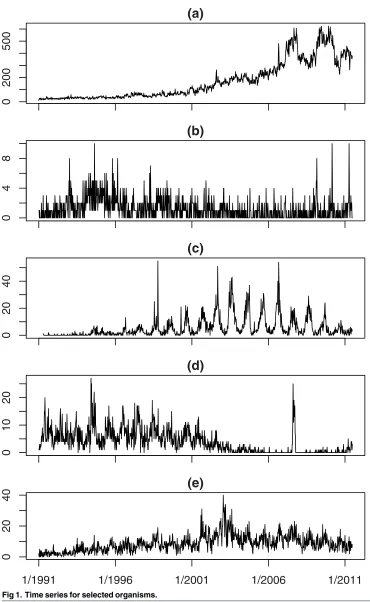
Fig 1. Time series for selected organisms.
exceed 600, while the counts in plot (b) (Schistosoma haematobium) never exceed 10. Shapes also vary. Plot (a) shows a clear trend, plot (b) is flat with a number of one-week spikes, plot (c)
(Salmonella enteritidis PT21) shows marked seasonality and plot (d) (Campylobacter coli) and
plot (e) (Acinetobacter SP) show both seasonality and trend.
The following steps were followed for each organism to separate its time series of weekly counts into one time series of baseline data (seriesA) and another of outbreaks (seriesB). The procedure is iterative and starts withAequated to the observed time series, {yi,i= 1, 2,. . .},
whereyiis the count in weektifor the organism of current interest.
Step 1. As noted in Section 2, none of the three algorithms will flag a disease as a potential
outbreak unless at least five cases of the disease have been reported in the past four weeks. In line with this, the time series is examined to see whether it includes at least one sequence of four weeks in which there were five or more cases of the disease. If not, then the series will not help differentiate between the algorithms, so it is omitted from all analyses and no further steps are performed for it.
Step 2. A generalised linear model (GLM) or generalised additive model (GAM) is fitted to
Ausing the mgcv package inR. In either case, a quasi-Poisson model with a log link function is used and a seasonal covariate factor is included if there is evidence (at the 5% significance level) that its inclusion improves model-fit. The seasonal factor has 12 levels, one for each month. A GLM is fitted if there is no evidence (at the 5% significance level) of a linear trend over time; otherwise a GAM with a smoothed time trend is fitted. Output from the GLM or GAM includes fitted values giving the weekly expected disease counts and an estimate of the dispersion parameter,ϕ, that is constrained tob1. The time series inAis long (weekly counts over at least an 8-year period) and the models are not complex, so the risk of overfitting is small and any overfitting would have little effect.
Step 3. We next determine whether any weekly counts inAshould be classified as extreme.
Letyi denote the value inAfor weekti. [Unless the original value inAfor weektihas been
replaced (c.f. step 4),yi ¼yi.] The underlying base rate for that week is taken as the expected
count,bmi, and if there is no outbreak, an estimate of the variance of the count isbbmi. Any weekly count of two or less is classified as‘not extreme’. For other weeks:
1. We first classifyyi as extreme if it exceedsbmiþ2ðbbmiÞ1=2.
2. For each of the weeks whose counts are‘extreme’, we check if the counts of the adjacent weeks are also extreme, but use less stringent criteria because outbreaks commonly last more than a week. We classifyyi as extreme if its value exceedsmbiþ1:5ðbbmiÞ1=2and it is next to a value that is extreme.
Although extreme values may arise from a number of reasons, we refer to them collectively as‘outbreaks’because they should all be flagged by outbreak detection algorithms, whose aim is to detect cases of a disease that are not part of the baseline series.
Step 4. We note the weeks in which values have been classified as extreme. They are then
dropped fromAand replaced. Ifyi is dropped, it is replaced with a random value from a nega-tive binomial distribution with meanbmiand variancebmbi, under the constraint that the new value must be less thanmbiþ1:5ðbbmiÞ1=2.
Step 5. We then return to step 2 and repeatedly cycle through steps 2–4 until step 3 identifies
none of the values inAas extreme.
Step 6. When this step is reached, seriesAcontains the final estimate of the baseline data.
An R program used in the implementation of the above steps is provided as supporting information [S1 R.Codes].
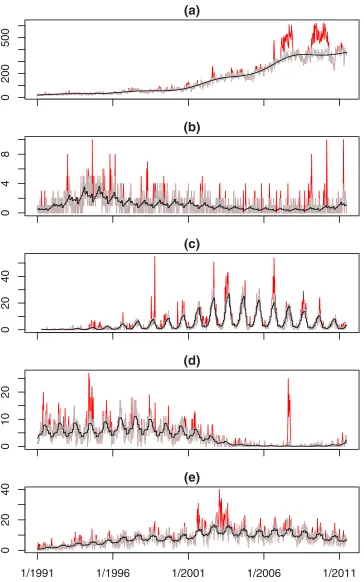
Fig 2takes the time series shown inFig 1and separates each of them into seriesAand series B. The lighter (grey) line in each plot isAand the non-zero values inBare shown by the darker (red) lines. The black line shows the baseline expected counts when there is no outbreak. The baseline is meant to follow any trend or seasonality in seriesAand in the plots it appears to do this well.
We want time series in which we know where outbreaks have occurred. One approach is to simulate outbreaks from a mathematical model and add them to seriesA, so that the baseline incidence mirrors reality. Another approach is to add seriesBto baseline data simulated from a mathematical model, so that the outbreak data mirrors reality. With both these approaches, the outbreaks and baseline data are independent so it is clear that outbreaks have been injected into a baseline. Also, we know when outbreaks have been injected and their sizes.
In contrast, the following criticisms are valid if we simply addAtoBto form the test time series.
1. Independent outbreak data have not been injected into baseline data. Rather, the original data series has simply been reconstructed.
2. The method of identifying extreme counts (so as to formB) uses only slightly more infor-mation than the outbreak detection algorithms being tested. (They only differ as to whether future data are used to decide if the count in the week of current interest is extreme.) Conse-quently, when this method and, say, the HPA algorithm disagree as to whether a count in a particular week is extreme, it is not clear which should be taken as correct. That is, we do not know when outbreaks have occurred with sufficient certainty.
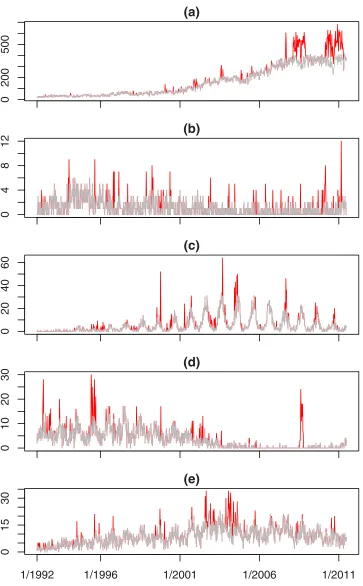
Nevertheless, usingAto model baseline incidence andBto model outbreaks is attractive, as this makes full use of the data. The solution that we adopt is to shiftBforward by one year, giv-ing a new series (seriesCsay) that has the same annual timing of any seasonal pattern that was present inB. We then create the series of test data by addingAtoCfor the 19.5 years where these two time series overlap. The relationship between contemporaneous elements ofCandA is weak (the element inCis from the previous year), so it is reasonable to treat the addition of CtoAas the injection of outbreaks into unrelated baseline data. Weeks in whichCis non-zero are classified as the weeks in which outbreaks occur. As long asAis a realistic representation of a baseline weekly disease count andBis a realistic sequence of outbreaks of the disease, then A+Cshould be a realistic time series on which to test outbreak detection algorithms. More-over, we have more information about the occurrence of outbreaks than is available to the algo-rithms under test. In particular, we can be certain that outbreaks have been injected in those weeks where the count in the test data is higher than in the real data. This covers the great majority of classified outbreaks: the count is higher in the test data in 94% of the weeks for which seriesCis non-zero.
Fig 2. Time-series separated into baseline (grey line) and outbreaks (darker/red lines) for selected organisms; continuous black line shows the baseline expected counts when there is no outbreak.
0
200
500
(a)
048
1
2
(b)
02
0
4
0
6
0
(c)
01
0
2
0
3
0
(d)
01
5
3
0
(e)
[image:10.612.201.564.73.659.2]1/1992 1/1996 1/2001 1/2006 1/2011
Fig 3. The test series for selected organisms showing the baseline (grey line) and injected outbreaks (darker/red lines).
4 Evaluation measures
4.1
Standard Metrics
Algorithms were applied to the test data of each organism and they classified the count in each week as extreme/not extreme, which we equate to outbreak/no outbreak. The following metrics will be used to evaluate an algorithm’s performance. They relate to specificity, sensitivity and timeliness.
False positive rate(FPR). This is the proportion of weeks in which a count was flagged as
extreme but, in fact, there was no outbreak. A low FPR corresponds to good specificity.
Probability of detection(POD). Each sequence of weeks in which seriesChas non-zero
val-ues defines the timing of one outbreak. An outbreak is deemed to be detected if the algorithm flags a count as extreme at least once during the outbreak’s duration. POD is the proportion of outbreaks that are detected; a high POD corresponds to good sensitivity.
Scaled probability of detection(ScPOD). From a practical viewpoint, missing large outbreaks
matters more than missing small outbreaks. This metric reflects the proportion of outbreaks detected and their sizes. Letnjdenote the number of cases in thejth outbreak (obtained from C). Suppose there areNoutbreaks and that the algorithm detected thejth outbreak ifj2J, whereJis a set of positive integers. We define the scaled probability of detection as
ScPOD ¼ Pj2Jnj= PN
j¼1nj: ð2Þ
Average time before detection(ATBD). For a specified set ofNoutbreaks, this is the average
number of weeks between an outbreak starting and its detection (excluding the week of detec-tion). The set of outbreaks will consist of outbreaks of specified sizes but will exclude outbreaks that were not detected. Letmj denote the number of weeks before an outbreak’s detection, wherej2Jifmj relates to an outbreak in the set. Then
ATBD ¼ Pj2Jmj=N: ð3Þ
The overall ATBD is the ATBD for the set of all outbreaks that were detected. A good algo-rithm will not only detect a large proportion of outbreaks (which POD and ScPOD measure), but will also detect them quickly, which this metric measures.
Relative size before detection(RSBD). The timeliness of a surveillance system also depends
on the number of outbreak cases that occur before an outbreak is detected. To obtain a measure that is not dominated by common diseases, we relate this number to baseline values. Letvj
denote the number of cases in thejth outbreak during the weeks before its detection (given by seriesC) and letujdenote the number of baseline cases during those weeks (given by seriesA).
Ifujequates to an average of less than two cases per week, we increase it so that it equals two
cases per week, so that uncommon diseases do not have a disproportionate affect. We define the relative size before detection as
RSBD ¼ Pj2Jðvj=ujÞ=N: ð4Þ
4.2
A Tailored Scoring Rule
expectation of his score by reporting his true beliefs and it is said to bestrictlyproper if a person canonlymaximize his expectation of his score by reporting his true beliefs.
A scoring rule should be proper if it is to play a role in evaluating surveillance methods for disease outbreaks. To illustrate this, we consider a scoring rule that is not proper, though at first sight it seems a sensible rule. Specifically, suppose that, when a surveillance method esti-matespias the probability of an outbreak in weekti, then its score is given by:
score¼
pi if an outbreak has occurred
1pi if no outbreak has occurred:
ð5Þ
(
This is called the linear scoring rule. It seems a reasonable rule as it assigns a score equal to the estimated probability of the event that occurred.
Now suppose we are comparing two surveillance methods that calculate each week the probability that an outbreak has occurred. Supposepi is a realistic estimate of this probability
in weekti. (In a simulation study we could calculatepi, as the mechanism for generating the
number of cases in a week is known.) Suppose further that one surveillance method always esti-matespi accurately while the second method is biased and gives probabilities that are too extreme: whenpi >0:5the probability it gives is greater thanpi while, whenpi <0:5, the probability it gives is less thanpi. Clearly a decent scoring rule should give a better long-term average score to the accurate surveillance method, rather than the biased method. However, if a surveillance method givespias the probability of an outbreak in weekti, then the expected
score that it receives from the linear scoring rule, E(Si) say, is
EðSiÞ ¼pipiþ ð1piÞð1piÞ: ð6Þ
AsdEðSiÞ=dpi ¼2p
i 1, it follows that the biased surveillance method has a higher
expected score than the accurate method, both whenpi >0:5and whenp
i <0:5. This is
clearly inappropriate and is the type of error that cannot arise with a proper scoring rule: with a proper scoring rule, by definition, the expected score is maximized by settingpiequal topi, as
that is the realistic (honest) estimate of the probability of an outbreak.
Strictly proper scoring rules provide a natural balance between sensitivity and specificity. When there is an outbreak in weekti, a large value ofpicorresponds to good sensitivity and
yields a good score. When no outbreak has occurred, a low value ofpicorresponds to good
specificity and this also yields a good score. If it is strictly proper, the scoring rule ensures that the expected score is maximised by giving a realistic value topiat each time point, thus
balanc-ing the contrastbalanc-ing needs for good sensitivity (setpihigh) and good specificity (setpilow).
The most common scoring rules are the logarithmic, quadratic and spherical rules. These are not well-suited to the present context because we require a scoring rule that is insensitive to values ofpiin the range 0 to 0.9, and very sensitive to variation inpiin the range 0.95 to 1—
when a disease has a value ofpiin the former range (below 0.9), no action will be taken to
investigate whether there is an outbreak of the disease (unless the seriousness of a disease means that all occurrences are investigated), while the impetus to investigate increases substan-tially aspiincreases from 0.95 to 1. A flexible choice of scoring rules is based on the family of
beta distributions [11]:
score¼
giF1ðpiÞ if an outbreak occurred in week ti
gif1F2ðpiÞg if no outbreak occurred in week ti;
ð7Þ
(
whereF1andF2are the cumulative distribution functions of beta(a,b+ 1) and beta(a+ 1,b)
asymmetric ifa6¼band strictly proper for anya,b>−1 [12]. Here we seta= 40 andb= 0.5.
Table 1lists the scores that this rule gives for a variety of values ofpiwhengi= 1. It can be
seen that all values ofpi2(0, 0.9) give similar scores, while scores change substantially aspi
increases from 0.95 to 1.0. The occurrence of an outbreak (rather than no occurrence) only gives the higher score whenpexceeds 0.985. If an alarm should be sounded when an outbreak has likely occurred, then sounding it for values ofpabove 0.985 might make a suitable thresh-old, as the alarm should only be raised when there is clear evidence that an outbreak has occurred.
In judging the performance of algorithms, the most important weeks are those when the count of an organism is noticeably higher than usual for the time of year. Those are the weeks in which an algorithm might incorrectly flag an outbreak when one has not occurred, or when one algorithm might correctly flag an outbreak while another algorithm does not. Also, if a large outbreak has occurred, we would like it to be flagged very clearly. In contrast, missing very small outbreaks (perhaps of just two or three cases) seems inevitable if the false discovery rate is to be kept low, so missing large outbreaks should be penalised more. Thus, inEq (7)we wantgito reflect the size of an outbreak while
1. gishould not equal 0 when there is no outbreak—weeks with no outbreak are less important
but not unimportant.
2. The value ofgishould give no information about outbreaks that is not readily available to
the outbreak detection algorithm. This is necessary for the validity of the scoring rule— oth-erwise it might be possible to improve an algorithm (when judged by expected score) by exploiting the value ofgi.
To illustrate the relevance of (b), note that the scoring rule would be proper ifgitook a
ran-domly generated value, even if that value varied from week to week. The scoring rule would still be proper ifgiwere set equal toyi, the number of cases in the current week, as that
informa-tion is available to the outbreak detecinforma-tion algorithms (and used by them). However, some choices ofgicould change an algorithm’s optimal approach to estimatingpi. As an extreme
example, ifgiwere set equal to the size of the outbreak in the current week, equalling 0 when
there is no outbreak, then settingpiequal to 1 for allimaximises the expected score.
The approach we advocate is to setgiequal to max[0, (yi−ηi)1/2], whereηiis a low estimate
of the baseline count for weeki. In implementing the scoring rule, we take the corresponding week in each of the previous five years and setηiequal to the smallest number of cases in any
one of those weeks. (For example, if weektiis the first week of August 2011, thenηiis taken as
the smallest number of cases in the first week of August in the years 2006 to 2010). Thusgiis
proportional to the square-root of a high estimate of the outbreak size. This gives greater importance to large outbreaks, whilegiwill usually also be non-zero in weeks without outbreak. Table 1. Scores given to the probability of outbreak (p) using beta(40, 1.5) and beta(41, 0.5) distributions forF1andF2.
Outbreak No outbreak Outbreak No outbreak
p F1(p) 1−F2(p) p F1(p) 1−F2(p)
0.0 0.0 1.0 0.99 0.847 0.635
0.9 0.037 0.997 0.995 0.940 0.477
0.95 0.248 0.959 0.999 0.994 0.225
0.97 0.484 0.885 0.9995 0.998 0.160
0.98 0.653 0.801 1.0 1.0 0.0
We use max[0, (yi−ηi)1/2], rather than max[0,yi−ηi], so that a few common diseases do not
dominate the overall scores of algorithms.
While the above form of scoring rule is useful for evaluating surveillance methods, it cannot be applied to weather forecasting because of intrinsic differences between the two contexts. With surveillance methods a quantity is observed that relates to the magnitude of an outbreak if an outbreak has occurred, but the question of whether an outbreak has occurred is still of interest. In weather forecasting this does not happen when, say, the forecast is giving the proba-bility of rain: if the quantity of rain that has fallen in a day is known, then we know whether it has rained. Consequently, in weather forecasting other approaches have been proposed to take the quantity of rainfall into account in evaluating rainfall forecasts [13,14]. However, the methods do not give proper scoring rules.
To apply the scoring rule to an algorithm, the algorithm’s value forpimust be calculated for
each week. If there were four or fewer cases of disease in the last four weeks then, by assump-tion, there is no outbreak in the current week andpiis set equal to 0. Similarly, we setpiequal
to 0 in weeks where the observed count is less than the number the algorithm expects when there is no outbreak. For other weeks, letBidenote the event that there is an ongoing outbreak
of the disease under consideration at timetiand letBcidenote the (complementary) event that
there is no outbreak at timeti. To obtainpi, we calculate (i)PðyijBic;HiÞ, (ii)P(Bi|Hi), and (iii) P(yi|Bi,Hi), whereHidenotes the historical data available at timeti. Thenpiis given by Bayes
theorem,
pi¼PðBijyi;HiÞ ¼
PðyijBi;HiÞ PðBijHiÞ
PðyijBi;HiÞ PðBijHiÞ þPðyijBci;HiÞ PðBctjHiÞ
: ð8Þ
The outbreak detection algorithms were designed to evaluate the probability that the countYiis greater than a threshold value,U, when there is no outbreak. Hence we can obtain PðY yijBci;HiÞandPðYyiþ1jBci;HiÞfrom the algorithm under consideration and, for
(i), equatePðyijBci;HiÞto their difference. For (ii), we equateP(Bi|Hi) to the proportion of
weeks in the series that are classified as‘extreme’by the algorithm. It seems prudent to antici-pate an outbreak in at least one week in twenty years, so we setP(Bi|Hi) equal to 0.001 if it is
less than that value.
Quantity (iii),P(yi|Bi,Hi), is trickier to determine. For each organism, we first identify the
weeks for which the algorithm flags an abberation or outbreak (hence called outbreak-weeks). If there were more than five outbreak weeks then:
1. For both outbreak and non-outbreak weeks we calculate the standardised count,
SCðyijHiÞ ¼
y2i=3mb2i=3 fvarðy2i=3bm2i=3Þg
1=2; ð9Þ
whereyiis the observed count that week andmbiis the (baseline) count predicted by the
algorithm. Bothmbiand varðyi2=3mb2i=3Þare used in calculating exceedance scores, so they are readily available from each algorithm.
2. We select the outbreak weeks and fit a log-normal distribution to the standardised counts of those weeks.
3. For all weeks (except whenpihas not been set to 0), we equateP(yi|Bi,Hi) to the difference
betweenP{ξSCi(yi)} andP{ξSCi(yi+ 1)}, whereξis a variable that has the log-normal
If there were five or fewer outbreak weeks then:
4. Taking just the outbreak weeks, a Poisson distribution is fitted to the counts above base-line,yibmi, with the Poisson parameter equated to a constant (λ) multiplied by the stan-dard deviation of the baseline count atti, (ϕμi)1/2. The maximum likelihood estimate ofλ
isbl¼PiðyimbiÞ=PiðbbmiÞ1=2, where the summations cover the outbreak weeks.
5. For all weeks (except whenpi= 0),P(yi|Bi,Hi) is equated to the probability ofyimbi
under a Poisson distribution with meanblðbmbiÞ1=2.
5 Results
There are 2304 diseases for which we have eight years or more of continuous data. Of these eases, 1345 showed no sequence of four weeks in which there were five or more cases of the dis-ease and so have no count that is classified as an outbreak by any of the algorithms. Those diseases are not considered further in our analyses.
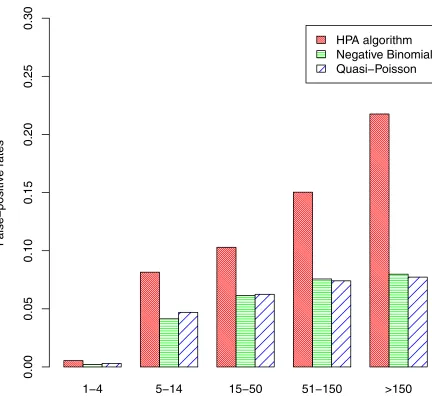
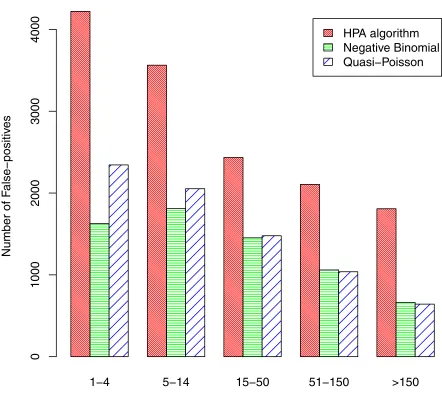
The false positive rates for the other 959 diseases are shown inFig 4. The rates vary greatly according to the baseline disease count (the values in seriesA) and were calculated for five groups: counts of 1–4, 5–14, 15–50, 51–150, and over 150.Fig 4shows that the false-positive rate increases substantially as the baseline count increases—clearly large baseline counts make the identification of outbreaks more problematic, as might be expected. Although the first group has very low false-positive rates, the rates in this group are important because it is much the largest group and, in terms of actual numbers rather than rates, there are more false posi-tives in this group than any other. The number of false-posiposi-tives in each group are shown in
Fig 5. Comparing algorithms, the false-positive rates (and the number of false-positives) are typically about twice as high for the HPA algorithm as for the negative binomial and quasi-Poisson algorithms. The false positive rates for these latter two algorithms are fairly similar, although the negative-binomial performed a little better than the quasi-Poisson when the baseline count was small. When groups are combined, the overall false-positive rate was 1.63% for the HPA algorithm, 0.76% for the negative binomial algorithm and 0.87% for the quasi-Poisson.
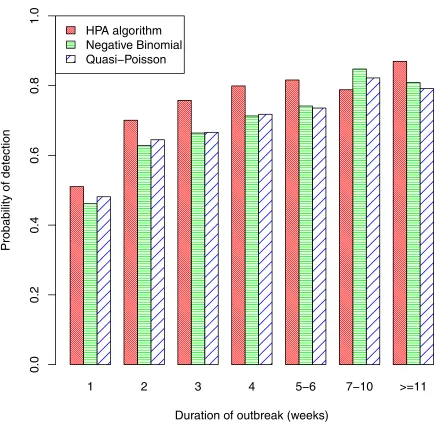
Turning to sensitivity, long outbreaks are easier to detect than short outbreaks, so sensitivity will vary with outbreak duration.Fig 6shows the proportion of outbreaks that were detected by each algorithm, classified by outbreak duration. This proportion is only about 50% for out-breaks that lasted only one week, increases substantially for those lasting two weeks (the pro-portion was 70% for the HPA algorithm), and generally continued to increase as the duration of the outbreak increased. The overall probability of detection was 57% for the HPA algorithm, 51% for the negative binomial and 53% for the quasi-Poisson. There were 233 outbreaks of 7 or more weeks duration and, for these, the probability of detection was 83%, 83% and 81% for the HPA, negative-binomial and quasi-Poisson algorithms, respectively.
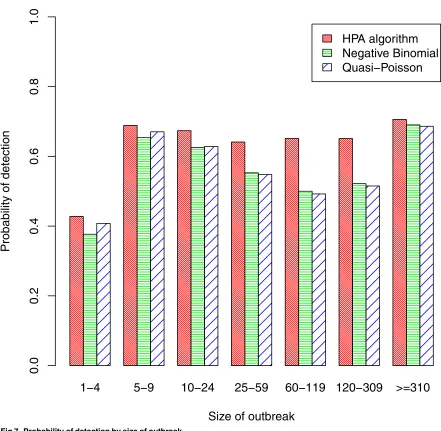
an overall measure of sensitivity that gave greater importance to larger outbreaks. Its value was 70.7% for the HPA algorithm, somewhat better than the values of 67.3% and 67.4% for the quasi-Poisson and negative-binomial algorithms.
Rather than simply detecting outbreaks, it is important to detect them in a timely fashion.
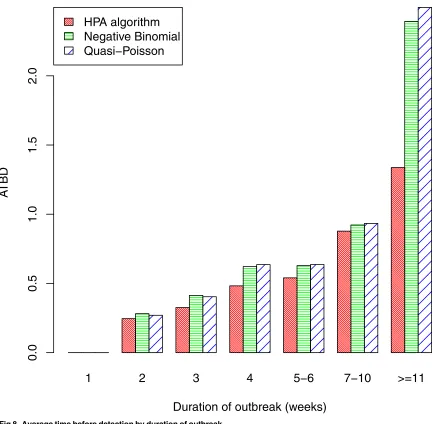
Fig 8indicates the weeks that elapsed before an outbreak was detected. We only consider out-breaks that were at some stage detected, as sensitivity has already been examined (Figs6and
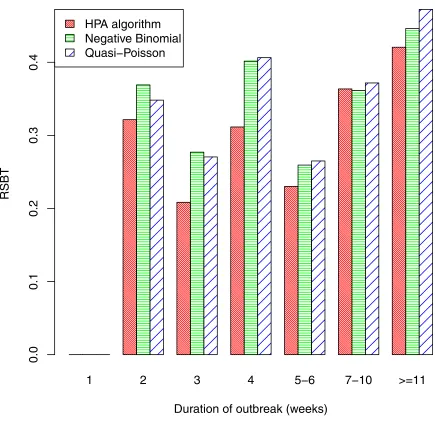
[image:16.612.141.573.71.479.2]7). Indeed, we only consider those outbreaks that were detected by all three algorithms, so that comparison of the algorithms is fair. The figure shows that outbreaks of less than 10 weeks duration were detected quickly (assuming they were detected); the delay was less than one week on average, and was similar for all three algorithms. For the longer outbreaks of 11 weeks or more, the HPA algorithm had a slightly longer average time before detection (ATBD) of 1.3 weeks, while the ATBD for the other two algorithms were more than a week poorer, at over 2.4 weeks. The relative size before detection (RSBD) is plotted against outbreak duration inFig 9.
Fig 4. False-positive rates.
As the HPA algorithm has a higher sensitivity than the quasi-Poisson and negative binomial algorithms, it would also be expected to have a better RSBD. The figure clearly shows this is the case, though differences between the three algorithms are small.
[image:17.612.134.576.67.467.2]The beta scoring rule was used to make comparisons between algorithms that reflect both specificity and sensitivity.Table 2gives the scores for each algorithm. The HPA algorithm has lower scores than the negative and quasi-Poisson algorithms in weeks without outbreak, but better scores when there was an outbreak. This is consistent with results presented earlier that showed the HPA algorithm has poorer specificity than the other two algorithms (Figs4and5) but better sensitivity (Figs6and7). Overall, the last column of the table shows that the newer algorithms had better beta (40, 0.5) scores than the HPA algorithm, indicating that they assess the probability of an outbreak better than the HPA algorithm. The scores of the two newer algorithms were quite similar for both outbreak and non-outbreak weeks, with the quasi-Pois-son having slightly the better overall score. This latter result was a surprise—the quasi-Poisson
Fig 5. Number of false-positives by baseline count.
algorithm is faster than the negative binomial algorithm but uses approximations that the neg-ative binomial does not require.
Fig 10breaks down the scores for weeks with an outbreak according to the size of the break. It can be seen that the relative scores of the different algorithms change little as the out-break size changes. As was intended, outout-breaks of all sizes make a substantial contribution to the overall scores of the algorithms.
The comparison of algorithms provided by a scoring rule is important. For this reason, the sensitivity of conclusions to the precise form of the scoring rule should be examined. To this end, we also evaluated the algorithms using two other forms of the scoring rule:
Scoring rule 2. The scoring rule parameters,aandb, were set equal to 31 and 1.5, so thatF1and
F2inEq (7)are the cumulative distribution functions of beta(31, 2.5) and beta(32, 1.5)
[image:18.612.142.576.70.497.2]dis-tributions, respectively. With this rule, the occurrence of an outbreak gives a higher score
Fig 6. Probability of detection by duration of outbreak.
whenpexceeds 0.95 and non-occurrence gives a higher score ifpis less than 0.95. (The comparable balance-point for the beta (40, 0.5) scoring rule is 0.985, as noted earlier.)
Scoring rule 3. An unweighted form of the scoring rule in which thegi-weights inEq (7)are
fixed at unity. (As with the original scoring rule,F1andF2are the cumulative distribution
functions of beta(40, 1.5) and beta(41, 0.5) distributions.)
Results for these scoring rules are given inTable 3. It can be seen that with both rules the quasi-Poisson algorithm is again marginally better than the negative binomial algorithm and both are noticeably better than the HPA algorithm. Hence the comparison of these algorithms shows some robustness to the choice of scoring rule.
6 Concluding comments
[image:19.612.135.576.69.500.2]The study reported here followed the straightforward path of
Fig 7. Probability of detection by size of outbreak.
1. constructing realistic series of test data in which it is known where outbreaks had been injected;
2. selecting/forming suitable evaluation metrics;
3. applying algorithms to the series of test data and comparing their performances using the evaluation metrics.
[image:20.612.144.577.71.495.2]The test data were formed from time series of the actual weekly counts of the number of cases of individual diseases. The series for each disease was separated into a series of baseline counts (seriesA) and a series of outbreak counts (seriesB). The outbreak counts were trans-lated by twelve months (giving seriesC) and recombined withAto form a test data series. This was done for 2304 different diseases, giving test data that reflected the diversity of patterns found in real data. The critical step in constructing the test data is the separation of the original series into baseline counts and outbreak counts. A number of methods were tried (not reported here) and their resulting time series of baseline and outbreak counts for individual diseases
Fig 8. Average time before detection by duration of outbreak.
were examined. With the method that was adopted, visual inspection of plots showed that weeks with/without outbreak appeared to be classified sensibly.
As well as standard metrics, such as sensitivity and specificity, we also used a scoring rule to evaluate the performances of outbreak surveillance algorithms. Scores were derived from algo-rithms’estimates ofpij, the realistic probability that an outbreak has occurred in weekifor diseasej. Better estimates ofpijcan simultaneously improve both sensitivity and specificity; otherwise sensitivity is normally only improved at the expense of reduced specificity, or
vice-Fig 9. Relative size before detection by duration of outbreak.
[image:21.612.143.578.69.492.2]doi:10.1371/journal.pone.0160759.g009
Table 2. Scores of each algorithm for weeks with an outbreak, without an outbreak, and overall.
Algorithm Weeks with an outbreak Weeks without an outbreak Overall
HPA 49 646 374 200 423 846
Negative binomial 34 730 408 621 443 351
Quasi-Poisson 32 697 411 241 443 938
[image:21.612.35.568.646.699.2]versa. With the scoring rule we used, the precise value of an estimate only matters when that value is above 0.9, which mirrors the range of values in which consideration should be given to
flagging an outbreak and/or triggering an alarm. The scoring rule also has the useful property that larger outbreaks receive greater weight in the overall scores.
[image:22.612.134.574.66.493.2]The results of our analysis show clearly that the HPA algorithm has slightly better sensitivity than the algorithms designed to replace it; the value of ScPOD was 70.7% for the HPA algorithm compared with 67.3% and 67.4% for the quasi-Poisson and negative binomial algorithms.
Fig 10. Scores by size of outbreak.
doi:10.1371/journal.pone.0160759.g010
Table 3. Overall scores given to algorithms by scoring rules 2 and 3.
Algorithm Weighted beta(31, 1.5) Unweighted beta(40, 0.5)
HPA 406 243 577 600
Negative binomial 439 998 580 560
Quasi-Poisson 441 136 581 274
[image:22.612.197.577.647.700.2]Consistent with this finding, the HPA algorithm also had a shorter average delay time before outbreak detection and a smaller relative size before detection. However, the motivation for replacing the HPA algorithm was to improve specificity—a report on the HPA algorithm identi-fied a high false positive rate as a limitation to its practical usefulness [2]. In that respect, the two new algorithms are highly successful; the overall false positive rates for the quasi-Poisson and negative binomial algorithms were 0.76% and 0.87%, respectively, which are approximately half the HPA rate of 1.63%. Pragmatically, these large reductions more than compensate for the slightly poorer sensitivity of the new algorithms. The scoring rule showed that the new algo-rithms also assess the probability of an outbreak better than the HPA algorithm, which on its own is reason to prefer them. In all respects the performances of the quasi-Poisson and negative binomial algorithms were very similar.
The purpose of this study was to compare three specified algorithms and this led to some limitations. In particular, the approach for generating test data is similar in many ways to the algorithms being considered. While this does not favour any one of the algorithms over the other two, it would become important if fundamentally different surveillance algorithms had to be evaluated for comparative purposes. In that case the mechanism for generating the test data would favour the HPA, negative binomial and quasi-Poisson algorithms. This could be avoided by altering Steps 2-4 in the test data generation process: the quasi-Poisson model in Step 2 might be replaced with a non-parametric smoother and non-parametric estimates of quantiles could be used in Steps 3 and 4. Another consequence from focusing on these three algorithms is that onlyaggregatedcounts across England and Wales were analysed. Local or small outbreaks that are confined, say, to a village or town will often be overlooked, while some spatiotemporal surveillance methods, such as SatScan [15], are designed to identify such local outbreaks. Broad reviews of outbreak surveillance methods are given in [3], [7] and [16].
In this paper, an outbreak has been defined as the addition of any cases to the baseline count. In practice, not all excesses would be classified as‘outbreaks’by subject-matter experts. Public Health England, for whom the algorithms were developed, use an algorithm to sort through hundreds of organisms each week and provide a shortlist of potential problems to be discussed by a team of epidemiologists. Their response to an abnormally high count will depend on many factors, most notably the disease, the assessed probability of an outbreak, and the estimated excesses in the current and preceding weeks. A typical response to an outbreak alert for a food or waterborne pathogen is to trace the source of contamination and remove it. For pathogens that are transmitted person to person, an outbreak may signal a problem with vaccine efficacy, or a change in pathogenicity.
The measures that are taken depend on context and some genuine outbreaks are not investi-gated at all. Hence, although the results from outbreak investigations could, in principle, be used to evaluate the accuracy of surveillance algorithms, selection biases would be hard to miti-gate. Also, the results from an investigation are not always clear-cut, as not all investigations of common source outbreak find the common source and, if an outbreak is declared to be over (no further incident cases), the investigation will often be terminated without identifying causal exposure. In addition, some outbreaks are missed, as is clear from work reported in [17], who applied our negative binomial algorithm retrospectively to a laboratory database to look for two pathogens. They detected three outbreaks in a one-year period that were not previously recognised.
England have replaced the HPA algorithm with the negative binomial algorithm, in line with the findings reported here. As well as monitoring combined disease surveillance data from England and Wales, the new algorithm has also been applied to individual hospital trusts to examine time series of cases of important antimicrobial resistant pathogens. Modified forms of the new algorithms are also in use in the Robert Koch Institute, Berlin [18].
Appendix A
Let {yi,i= 1, 2,. . .} denote the time-series of the number of cases of the disease under
consider-ation, whereyidenotes a count in weekti. Lett0denote the current week. The HPA algorithm
uses quasi-Poisson regression to identify aberrations in the weekly counts. It assumes thatyi
follows a linear time trend and is distributed with meanμiand varianceϕμi:
logðmiÞ ¼yþbti ð10Þ
whereϕdenotes a parameter that allows for over-dispersion. The following gives details.
1. The algorithm implicitly adjusts for seasonal effects by basing calculation of the expected count in the current week or just those counts that were observed in comparable weeks in the past. This approach also moderates the effects of events that occur at regular times each year, such as Christmas and summer holidays, which can affect when cases of diseases are reported. Ift0is weekτof the current year, then only data from weeksτ−3 toτ+ 3 of
previous years are used in the analysis. Lett(1),. . .,t(n)denote the weeks that are used and y(1),. . .,y(n)the corresponding counts.
2. An iterative reweighting procedure is used to estimate model parameters and correct for past outbreaks in the baseline data. If there is no evidence of a linear time trend at the 5% significance level, thenβis set equal to 0 inEq (10). At convergence of the procedure, letmbi denote the estimate ofy(i)and letwibe the weight in weekt(i)(i= 1,. . .,n). The algorithm’s
estimate ofϕis
b
¼ max 1
nr
Xn
i¼1
wi
ðyðiÞbmiÞ 2
b
mi ;1
( )
ð11Þ
wherer= 1 orr= 2 depending on whether a time trend has beenfitted. The weights satisfy
wi¼
gsi2 if si>1
g otherwise
ð12Þ
(
whereγis a constant such thatPni¼1wi¼nand thesiare scaled Anscombe residuals,
si¼
3 2b1=2
y2ði=Þ3bm2i=3 b
m1i=6ð1hiiÞ
1=2; ð13Þ
wherehiiare the diagonal elements of the hat matrix.
3. Letbm0¼byþbbt0denote the expected value ofy0, the count for the current week. The
algo-rithm calculates the threshold value,U, from
U ¼bm0 1þ2
3zamb 1
0 bbm0þvarðmb0Þ
1=2
3=2
ð14Þ
power transformation to a Poisson variate induces an approximately symmetric distribu-tion, which underlies the 3/2 power inEq (14).
4. The exceedance score is then given byX ¼ ðy0 bm0Þ=ðUbm0Þ, as inEq (1).
The quasi-Poisson and negative-binomial algorithms model seasonality through a 10-level factor that has a 7-week reference period (corresponding to weeksτ± 3, as in the HPA algo-rithm) and nine 5-week periods each year:
logðmiÞ ¼yþbtiþdtðtiÞ ð15Þ
whereδτ(ti)is the seasonal factor. These algorithms always include a term for linear trend (never settingβto 0), and only setwiequal togs2i whensi>2.58, rather thansi>1 (c.f.Eq
(12)). The quasi-Poisson model calculates the threshold value as inEq (14), while the negative binomial algorithm calculates it under the assumption that, when there is an outbreak, the number of cases above baseline in a week follows a negative binomial distribution.
Supporting Information
S1 RCodes. S1_R.Codes.R: An R code used in the implementation of test data and compari-son of statistical algorithms.
(R)
Acknowledgments
We are grateful to Public Health England (UK) for providing the data set.
Author Contributions
Conceptualization:PG.
Data curation:NA AC.
Formal analysis:DE AN.
Funding acquisition:CPF.
Investigation:DE AN.
Methodology:PG DE.
Project administration:CPF.
Resources:NA AC.
Software:DE AN.
Supervision:PG CPF.
Validation:PG DE.
Visualization:PG DE.
Writing - original draft:PG DE.
References
1. Farrington CP, Andrews NJ, Beale AD, Catchpole MA. A statistical algorithm for the early detection of outbreaks of infectious disease. Journal of the Royal Statistical Society, A. 1996; 159: 547–563. doi: 10.2307/2983331
2. Noufaily A, Enki DG, Farrington CP, Garthwaite PH, Andrews NJ, Charlett A. An improved algorithm for outbreak detection in multiple surveillance systems. Statistics in Medicine. 2013; 32: 1206–1222. doi: 10.1002/sim.5595PMID:22941770
3. Buckeridge DL, Burkom H, Campbell M, Hogan WR, Moore AW. Algorithms for rapid outbreak detec-tion: a research synthesis. Journal of Biomedical Information. 2005; 38: 99–113. doi:10.1016/j.jbi. 2004.11.007
4. Wallstrom GL, Wagner MM, Hogan WR. High-fidelity injection detectability experiments: a tool for eval-uation of syndromic surveillance systems. Morbidity and Mortality Weekly Report. 2005; 54 (Supple-ment on syndromic surveillance): 85–89.
5. Neill DB. An empirical comparison of spatial scan statistics for outbreak detection. International Journal of Health Geographics. 2009; 8: article 20. doi:10.1186/1476-072X-8-20PMID:19371431
6. Sonesson C, Bock D. A review and discussion of prospective statistical surveillance in public health. Journal of the Royal Statistical Society, A. 2003; 166: 5–21. doi:10.1111/1467-985X.00256
7. Unkel S, Farrington CP, Garthwaite PH, Robertson C, Andrews N. Statistical metods for the prospec-tive detection of infectious disease outbreaks: a review. Journal of the Royal Statistical Society, A. 2012; 175: 49–82.
8. Frisén M. Evaluation of methods for statistical surveillance. Statistics in Medicine. 1992; 11, 1489– 1502. doi:10.1002/sim.4780111107PMID:1410961
9. Enki DG, Noufaily A, Garthwaite PH, Andrews NJ, Charlett A, Lane C, et al. Automated biosurveillance data from England and Wales, 1991–2011. Emerging Infectious Diseases. 2013; 19: 35–42. doi:10. 3201/eid1901.120493PMID:23260848
10. Noufaily A, Farrington CP, Garthwaite PH, Enki DG, Andrews NJ, Charlett A. Detection of infectious dis-ease outbreaks from laboratory data with reporting delays. Journal of the American Statistical Associa-tion. 2016; in press.
11. Buja A, Stuetzle W, Shen Y. Loss functions for binary class probability estimation and classification structure applications. 2005; available:www-stat.wharton.upenn.edu/buja/.
12. Gneiting T, Raftery AE. Strictly proper scoring rules, prediction, and estimation. Journal of the American Statistical Association. 2007; 102: 359–378. doi:10.1198/016214506000001437
13. Bremnes JB. Probabilistic forecasts of precipitation in terms of quantiles using NWP model output. Monthly Weather Review. 2004; 132: 338–347. doi:10.1175/1520-0493(2004)132%3C0338:PFOPIT %3E2.0.CO;2
14. Krzysztofowicz R, Sigrest AA. Comparative verification of guidance and local quantitative precipitation forecasts. Weather and Forecasting. 1999; 14: 443–454.
15. Kulldorff M, Heffernan R, Hartman J, Assuncao R, Mostashari F. A space-time permutation scan statis-tic for disease outbreak detection. PLos Medicine. 2005; 2: 216–224.
16. Shmueli G, Burkom H. Statistical challenges facing early outbreak detection in biosurveillance. Techno-metrics. 2010; 52: 39–51. doi:10.1198/TECH.2010.06134
17. Moore LSP, Freeman R, Charlett A, Otter JA, Donaldson H, Holmes AH. Real time antimicrobial resis-tance surveillance in critical care: Identifying outbreaks of carbapenem resistant gram negative bacteria from routinely collected data. International Journal of Infectious Diseases. 2016; 45: 211. doi:10.1016/ j.ijid.2016.02.481