Original citation:
Hansen, Stephen, McMahon, Michael F. and Srisuma, Sorawoot. (2016) Estimating bayesian decision problems with heterogeneous expertise. Journal of Applied Econometrics, 31 (4). pp. 762-771.
Permanent WRAP URL:
http://wrap.warwick.ac.uk/85612
Copyright and reuse:
The Warwick Research Archive Portal (WRAP) makes this work by researchers of the University of Warwick available open access under the following conditions. Copyright © and all moral rights to the version of the paper presented here belong to the individual author(s) and/or other copyright owners. To the extent reasonable and practicable the material made available in WRAP has been checked for eligibility before being made available.
Copies of full items can be used for personal research or study, educational, or not-for profit purposes without prior permission or charge. Provided that the authors, title and full bibliographic details are credited, a hyperlink and/or URL is given for the original metadata page and the content is not changed in any way.
Publisher’s statement:
"This is the peer reviewed version of the following articleHansen, Stephen, McMahon, Michael F. and Srisuma, Sorawoot. (2016) Estimating bayesian decision problems with heterogeneous expertise. Journal of Applied Econometrics, 31 (4). pp. 762-771. which has been published in final form at http://dx.doi.org/10.1002/jae.2446 . This article may be used for non-commercial purposes in accordance with Wiley Terms and Conditions for
Self-Archiving."
A note on versions:
The version presented here may differ from the published version or, version of record, if you wish to cite this item you are advised to consult the publisher’s version. Please see the ‘permanent WRAP URL’ above for details on accessing the published version and note that access may require a subscription.
Estimating Bayesian Decision Problems with
Heterogeneous Expertise
∗
Stephen Hansen
Universitat Pompeu Fabra
†Michael McMahon
University of Warwick
‡Sorawoot Srisuma
University of Surrey
§November 11, 2014
Abstract
We consider the recent novel two-step estimator of Iaryczower and Shum (2012), who analyze voting decisions of US Supreme Court justices. Motivated by the underlying theoretical voting model, we suggest that where the data under consideration displays variation in the common prior, estimates of the structural parameters based on their methodology should generally benefit from including interaction terms between individual and time covariates in the first stage whenever there is individual heterogeneity in expertise. We show numerically, via simulation and re-estimation of the US Supreme Court data, that the first order interaction effects that appear in the theoretical model can have an important empirical implication.
Keywords: Bayesian decision making; expertise; preferences; estimation.
JEL Codes: D72, D81, C13
∗We would like to thank the editor, Badi Baltagi, and anonymous referees, as well as Greg
Crawford, Carlos Velasco Rivera and Melvyn Weeks for helpful comments and discussions. Cor-respondence to: Sorawoot Srisuma, School of Economics, University of Surrey, Guildford, Surrey, GU2 7XH. Email: [email protected]
1
Introduction
How individuals and groups make decisions under uncertainty is important in many
areas of economics and political economy, and numerous theoretical models
empha-size that decision makers can differ both in terms of their knowledge of an underlying
state of the world and their preferences.1 A key challenge for taking these models to
data is to estimate the decision-making parameters and understand, quantitatively,
the role played by different factors in decision making. Iaryczower and Shum (2012)
(hereafter IS) have proposed an empirical voting model and a novel procedure for
estimating the voting behavior of US Supreme Court justices. IS consider a
frame-work in which each justice has to vote for the Plaintiff or Defendant, based on the
observed evidence and his private interpretation of the law and other specifics of
the case. Specifically, each justice is allowed to differ in his ideology, or bias (πit),
as well as in his ability to interpret the law and the specifics of the case (θit). This
decision problem is based on the theoretical voting model of Duggan and Martinelli
(2001), and can be applied to other voting games (e.g. Iaryczower et al. (2013) or
Hansen et al. (2014)).
IS estimate (πit, θit) in two steps. In each period, a binary, unobserved state is
realized; in one, the law favors the Plaintiff and in another it favors the Defendant.
The first step is to estimate the probability that justices vote for the Plaintiff in
both states, controlling for justice and case covariates. The second is to recover the
parameters of interest by solving the structural equations imposed by the
equilib-rium condition of the voting game. This note proposes a simple way that can help
improve their estimates. Whenever justices differ in their ability θit to perceive the
state, which is typical of most interesting voting problems, the theoretical model
predicts that justices will display heterogeneous responses across cases in terms of
how much information they require to vote for the Plaintiff. To capture this
behav-1For example, see the literatures on various aspects of committee decision making (Gerling
ior empirically, we propose including interaction terms in the first stage estimation.
Monte Carlo simulation exercises illustrate that the interaction terms can play an
important role empirically, and a re-estimation of the Supreme Court data supports
the simulation results.
2
Estimation of Structural Model
This section presents the empirical model IS propose, and motivates why it may
be empirically useful to explicitly allow justices with heterogeneous ability to react
differently to changes in common prior beliefs that the decision should favor the
Plaintiff. For brevity and notational simplicity we only consider the sincere voting
version of the model.
2.1
Model
For each case t there is a common unobserved state ωt ∈ {0,1}, unknown to every
decision marker and the econometrician, that equals 1 if the law in case t favors
the Plaintiff and 0 if it favors the Defendant. ωt is drawn from a Bernoulli prior
distribution with Pr [ωt= 1 ] = ρt. Each justice i has to make a binary decision
vit ∈ {0,1}—where 1 (0) is a vote for the Plaintiff (Defendant)—based on a private
signal sit = ωt +σitεt with εt ∼ N(0,1). An appropriate measure of expertise
in this setting is θit = σit−1, which measures justice i’s ability to infer the state.
Justices’ payoffs are state dependent and parametrized by πit ∈(0,1). All justices
get a payoff of 0 if their vote matches the state. Justice i gets payoff −πit when
vit = 1 and ωt = 0, and −(1−πit) when vit = 0 and ωt = 1. πit is essentially a
bias parameter that captures a justice’s inclination to favor the Plaintiff: when it is
close to 0 (1), the justice has a strong leaning to the Plaintiff (Defendant), while an
Given this setup, it can be shown that justice i choosesvit = 1 if and only if
Pr [ωt= 1 |sit] Pr [ωt= 0 |sit]
≥ 1−πit
πit
. (1)
Bayes’ Rule allows one to express
ln
Pr [ωt= 1 |sit] Pr [ωt= 0 |sit]
= ln
ρt 1−ρt
+2sit−1 2σ2
it
. (2)
The normal distribution satisfies the Monotone Likelihood Ratio Property, which
Duggan and Martinelli (2001) show implies the optimal voting rule is characterized
by a threshold crossing condition. Specifically, by combining (1) and (2), it follows
that vit = 1 if and only if
sit ≥ 1
2 −θ
−2
it
ln
πit 1−πit
+ ln
ρt 1−ρt
≡s∗(θit, πit, ρt). (3)
Lettings∗it denote s∗(θit, σit, ρt), the equilibrium probability of voting high in state
ωt isγit,ωt ≡1−Φ [θit(s
∗
it−ωt)], where Φ is the normal cdf.
Expressed in this way, the voting rule (3) makes clear that justices with different
expertise have heterogenous responses to changes inρt. The voting rule of a justice
with very high expertise will be nearly unaffected by a change inρt. Since the signal
is very accurate, he disregards the prior whatever its value in deciding the vote. On
the other hand, the voting behavior of a justice with low expertise will be much
more affected by changes in ρt. So, it is potentially important to allow, as a first
order effect, for such heterogeneity in estimating voting probabilities.
The likelihood of observing the vector of votesvt= (v1t, . . . ,vnt) is
Pr [vt] =ρt n Y
i=1
γvit
it,1(1−γit,1)1
−vit
+ (1−ρt) n Y
i=1
γvit
it,0(1−γit,0)1
−vit
Givenγit,0 and γit,1,θit and s∗it can be recovered via
θit = Φ−1(1−γit,0)−Φ−1(1−γit,1) and s∗it =
Φ−1(1−γ it,0) Φ−1(1−γ
it,0) + Φ−1(γit,1)
. (5)
The bias parameter πit relates to all other variables in the model according to (3).
Therefore one can recover (θit, πit) ifρt,γit,0, and γit,1 are known.
2.2
Methodology
For some observable characteristics of the casesXt and the justices Zit, IS consider
the following reduced form parametric terms that mimic the theoretical parameters
above:
ρt(Xt;β) =
exp (Xt0β)
1 + exp (Xt0β) (6)
γit,0(Xt, Zit;ζ, η) =
exp (Xt0ζ+Zit0η)
1 + exp (Xt0ζ+Zit0 η) (7)
γit,1(Xt, Zit;α, δ, ζ, η) =
γit,0+ exp (Xt0α+Z
0
itδ) 1 + exp (X0
tα+Zit0 δ)
. (FS:IS)
b
ρt, bγit,0, and bγit,1 can be estimated in the first stage from the maximum likelihood
estimators of α, β,γ, δ,ζ, and η that maximize the natural logarithm of
Y
t
ρt(Xt;β) n Q
i=1
γit,1(Xt, Zit;α, δ, ζ, η) vit
(1−γit,1(Xt, Zit;α, δ, ζ, η)) 1−vit
+ (1−ρt(Xt;β)) n Q
i=1
γit,0(Xt, Zit;ζ, η)vit(1−γit,0(Xt, Zit;ζ, η))1
−vit
. (8)
Then in the second stage bθit and
b
πit can be obtained from solving the structural
relationships in (4) and (5).
In order to allow for first order heterogenous effects for changes ins∗itwith respect
to ρt, we propose an additional vector of a simple interaction terms Wit between
stage. More concretely, replaceγit,0 and γit,1 with
e
γit,0(Xt, Zit, Wit;ζ, η, λ) =
exp (Xt0ζ+Zit0η+Wit0λ)
1 + exp (Xt0ζ+Zit0η+Wit0λ) (9)
e
γit,1(Xt, Zit, Wit;α, δ, ζ, η, λ, ξ) =
γit,0+ exp (Xt0α+Zit0δ+Wit0ξ) 1 + exp (X0
tα+Zit0δ+Wit0ξ)
. (FS:ALT)
Following the theoretical model, we expect Wit to play a particularly important
role in empirical problems where there is a large degree of heterogeneity in justices’
expertise.
3
Evaluating the importance of the interaction
terms
In order to develop an intuition for how the IS methodology may generally benefit
from the inclusion of interaction terms we first present some results from a small
Monte Carlo study. We then replicate and re-estimate the structural parameters for
the US Supreme Court voting data used in IS.
3.1
Monte Carlo
In order to test the extent to which the inclusion of interaction terms matters for
the estimation of voting games, we:
1. Generate a group of 9 decision makers (the size of the Court), each making
150 independent decisions over time.
(a) 5 members are type A with preferences πA and expertiseσA; 4 members
are type B with preferencesπB and expertise σB.
(b) We use various parameter values that are “reasonable” in the sense of
σA= 1−xandσB = 1 +xforx∈ {0,0.05,0.1, . . . ,0.5}. So, our baseline
comparisons are for eleven unique sets of parameters.2
2. For each unique set of π and σ values, we run 1,000 simulations. For each
simulation, we generate theoretical decision data according to the following
procedure:3
(a) In each periodt,ρtis drawn fromU[0.2,0.8] (independent across periods).
(b) ωt is drawn from a Bernoulli distribution with Pr [ωt = 1 ] =ρt.
(c) vit is drawn from a Bernoulli distribution with Pr [vit= 1 |ωt] = γit,ωt,
as defined in section 2.
3. Given these data, we construct Xt= (1, ρt) and Zit = (1, DA), where DA is a
dummy variable that indicates membership of group A (and thus not actually
time-varying). We use these data to estimate two separate specifications of
the first-stage regressions given by (FS:IS) and (FS:ALT).
4. After we obtain estimates of first-stage coefficients, we use the structural
equa-tions (3) and (5) to recover πbit and bσit for j ∈ {A, B} as described above. We
present as time-invariant point estimates the median values of these values
across all periods.
Figure 1, which shows the percentage bias for each value of the expertise
dif-ference, summarizes the main results of the simulation exercise.4 When expertise
differences are small, the results indicate that the interaction terms do not matter
much; the estimates of the parameter levels and differences are estimated reasonably
2As a robustness exercise we also reverse the values of the bias (i.e. π
A = 13 and πB = 23) as well as considerπA =πB = 12. Our findings do not change much. Numerical results are available
upon request. We focus on estimation ofσrather thanθsince the parameterization of the normal distribution in terms of its standard deviation is more common in many settings.
3Maximum Likelihood Estimation is done in R with the BFGS algorithm; code is available on
request.
accurately in specifications (FS:IS) and (FS:ALT), and neither appears to
outper-form the other. However, as σA−σB increases, specification (FS:ALT) performs
much better, especially in estimating the differences between groups, while at the
same time improving in accuracy. For example, when σA−σB = 0.6, specification
(FS:ALT) estimates 1−πB
πB −
1−πA
πA and σA−σB to 3% accuracy, whereas specification
(FS:IS) displays biases of 47% and 87% respectively. Here we report the results in
terms of the ratio 1−ππ since it is the key quantity for determining whether a justice
votes for the Plaintiff.5
[Figure 1 about here.]
We also plot the complete distribution of the simulation results whenσB−σA= 0
and when σB − σA = 0.8 in figure 2. With no σ differences, the results from
both specifications are again very similar. But even at relatively modest expertise
differences, the results show that not only does the inclusion of interaction terms
ensure that the results stay anchored around the true parameters, but also that the
distribution around the estimates is less dispersed too.
[Figure 2 about here.]
3.2
US Supreme Court Data
We take data from IS that contains the vote of every justice (31 in total) on every
case from 1953-2008. IS run separate regressions on four subsets of cases according
to the issue at stake (business, basic rights, criminal, federalism). We focus on the
results for economics and basic rights cases, the two subsets IS treat as their baseline
cases.
5The representation of this quantity as 1−π
The first specification we run is (FS:IS), takingXtand Zitto be the same sets of
variables as in IS. This replicates their results.6 The second is (FS:ALT), including
in the set of interaction terms Wit what appears to us to be the relevant subset of
individual and meeting characteristics for influencing justices’ prior beliefs.7
[Figure 3 about here.]
Since the effect of interaction terms only matters when there is meaningful
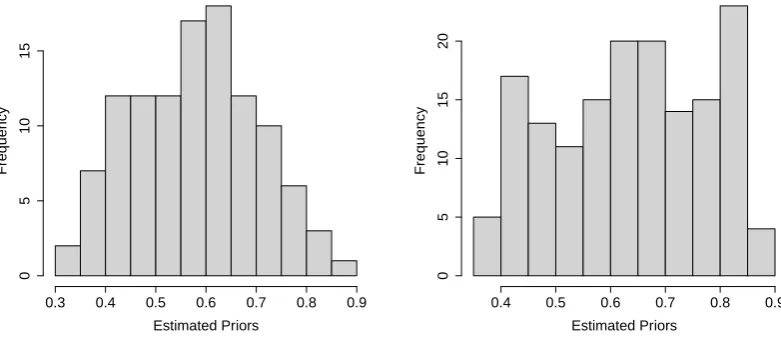
vari-ation in the prior ρt, it is important to quantify its range in the data. Figure 3
plots histograms of the estimated priors from specification (FS:IS) (the results with
(FS:ALT) are very similar), and shows they range from around 0.3 to around 0.9,
with a fairly dispersed distribution. This variation in the prior suggests, along with
heterogeneity in justices’ expertise, that interaction terms may play an important
role in describing voting behaviour of judges in this dataset.
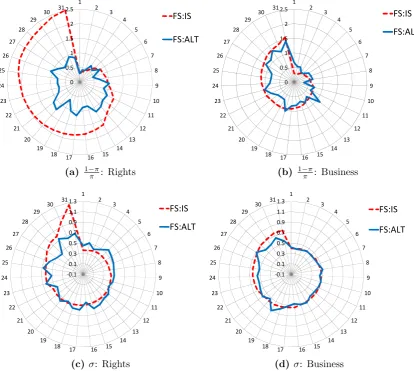
Our two specifications each produce 31 estimates (corresponding to the number
of justices) of 1−ππ and σ for business and rights cases. Table 1 displays a number of
summary statistics related to the distributions of these estimates. The simulation
exercise above shows that not explicitly controlling for heterogeneous effects that
exist across judges and cases tends to inflate estimated differences between decision
makers. This is consistent with our estimates using the US Supreme Court data. As
the table shows, the inclusion of the interaction terms reduces justice heterogeneity
both in terms of variances and ranges. For rights case this reduction is particularly
notable: the variance from the specification with interaction terms is around one
sixth the value of the variance without.
[Table 1 about here.]
6We perform this re-estimation since IS do not report the median value of the structural
pa-rameters across all values of the fitted priors.
7We do not interact the mean value ofother justices’ Segal-Cover ideology or quality scores—
Finally, the radar charts in figure 4 are helpful for comparing the distributions
from the two specifications more directly. Justices are ordered lowest to highest
moving clockwise based on the (FS:IS) estimates. Within this disc we plot both sets
of estimates. The (FS:ALT) estimates, particularly for rights cases, display notably
less heterogeneity.
[Figure 4 about here.]
4
Conclusion
Given the high level of interest within economics in how individuals and groups
of individuals make decisions under uncertainty, the recent two-step methodology
proposed by IS provides a useful way to analyze such problems empirically. They
estimate a voting model of US Supreme Court justices that accounts for voters’
private information (e.g. level of expertise) and their ideological differences and this
methodology can also be applied in other voting contexts.
In order to capture the main theoretical property of the model that voters with
heterogeneous ability react differently to changes in the common prior belief, we
propose the inclusion of interaction terms between case and justice characteristics
in the first stage reduced form estimation. This should help improve the estimates
of the structural parameters, especially where voters differ in their expertise. We
perform some Monte Carlo studies and re-estimate the US Supreme Court data used
in IS to support our estimation approach.
Finally, we end with some remarks to emphasize that we are not simply
advo-cating making the reduced-form estimation in the first stage as flexible as possible,
either by artificially including more regressors (of higher order terms) or, in the
extreme, taking a completely nonparametric approach. While a more flexible
spec-ification in the first stage is appealing theoretically from the point of robustness, it
finite samples. In contrast, our motivation for the inclusion of interaction terms is
led by an inherent implication of voting models when voters are heterogeneous. Our
numerical results show that imposing such theory-driven structure can significantly
improve the structural estimates. Hence a broader message is that economic
the-ory can be used to help inform the specification of the reduced-form component of
References
Besley T. 2006. Principled Agents?: The Political Economy of Good Government.
The Lindahl Lectures. OUP Oxford. ISBN 9780199271504.
Duggan J, Martinelli C. 2001. A Bayesian model of voting in juries. Games and
Economic Behavior 37: 259–294.
Gerling K, Gruner HP, Kiel A, Schulte E. 2005. Information acquisition and decision
making in committees: A survey. European Journal of Political Economy 21:
563–597.
Hansen S, McMahon M, Velasco Rivera C. 2014. Preferences or private assessments
on a monetary policy committee? Journal of Monetary Economics 67: 16 – 32.
Iaryczower M, Lewis G, Shum M. 2013. To elect or to appoint? Bias, information,
and responsiveness of bureaucrats and politicians. Journal of Public Economics
97: 230–244.
Iaryczower M, Shum M. 2012. The value of information in the court: Get it right,
keep it tight. American Economic Review 102: 202–37.
Levy G. 2007. Decision making in committees: Transparency, reputation, and voting
rules. American Economic Review 97: 150–168.
Maskin E, Tirole J. 2004. The politician and the judge: Accountability in
govern-ment. American Economic Review 94: 1034–1054.
Prat A. 2005. The wrong kind of transparency. American Economic Review 95:
862–877.
Sorensen P, Ottaviani M. 2000. Herd behavior and investment: Comment.American
● ● ● ● ● ● ● ● ● ● ●
0.0 0.2 0.4 0.6 0.8 1.0
0 5 10 15 20 Sigma Difference P ercentage Bias ● ● ● ● ● ● ● ● ● ● ● FS:ALT FS:IS
(a)Bias in 1−πA
πA Estimates ● ● ● ● ● ● ● ● ● ● ●
0.0 0.2 0.4 0.6 0.8 1.0
0 5 10 15 Sigma Difference P
ercentage Bias ●
● ● ● ● ● ● ● ● ● ● FS:ALT FS:IS
(b) Bias inσAEstimates
● ● ● ● ● ● ● ● ● ● ●
0.0 0.2 0.4 0.6 0.8 1.0
0 5 10 15 20 25 Sigma Difference P ercentage Bias ● ● ● ● ● ● ● ● ● ● ● FS:ALT FS:IS
(c) Bias in 1−πB
πB Estimates
● ● ● ● ● ● ● ● ● ● ●
0.0 0.2 0.4 0.6 0.8 1.0
0 10 20 30 Sigma Difference P ercentage Bias ● ● ● ● ● ● ● ● ● ● ● FS:ALT FS:IS
(d)Bias inσB Estimates
● ● ● ● ● ● ● ● ● ● ●
0.0 0.2 0.4 0.6 0.8 1.0
0 10 20 30 40 Sigma Difference P
ercentage Bias ● ● ● ● ● ● ● ● ● ● ● FS:ALT FS:IS
(e) Bias in 1−πB πB −
1−πA
πA Estimates
● ● ● ● ● ● ● ● ●
0.2 0.4 0.6 0.8 1.0
0 20 40 60 80 Sigma Difference P ercentage Bias ● ● ● ● ● ● ● ● ● FS:ALT FS:IS
(f ) Bias inσB−σA Estimates
Notes: These figures plot the estimated values as a percentage of the true value
[image:14.595.134.460.99.664.2]Figure 3: Histograms of Estimated Priors
Histogram of Estimated Priors: Business Cases
Estimated Priors
Frequency
0.3 0.4 0.5 0.6 0.7 0.8 0.9
0
5
10
15
Histogram of Estimated Priors: Rights Cases
Estimated Priors
Frequency
0.4 0.5 0.6 0.7 0.8 0.9
0
5
10
15
20
Notes: This figure plots, for business cases (left figure) and rights cases (right figure),
Figure 4: Radar Plots of Supreme Court Data Re-estimation Exercise 0 0.5 1 1.5 2
2.5 1 2 3 4 5 6 7 8 9 10 11 12 13 14 15 16 17 18 19 20 21 22 23 24 25 26 27 28 29 30 31 FS:IS FS:ALT
(a) 1−ππ: Rights
0 0.5 1 1.5 2
2.5 1 2 3 4 5 6 7 8 9 10 11 12 13 14 15 16 17 18 19 20 21 22 23 24 25 26 27 28 29 30 31 FS:IS FS:ALT
(b) 1−ππ: Business
-0.1 0.1 0.3 0.5 0.7 0.9 1.1
1.3 1 2 3
4 5 6 7 8 9 10 11 12 13 14 15 16 17 18 19 20 21 22 23 24 25 26 27 28 29 30 31 FS:IS FS:ALT
(c)σ: Rights
-0.1 0.1 0.3 0.5 0.7 0.9 1.1
1.3 1 2 3
4 5 6 7 8 9 10 11 12 13 14 15 16 17 18 19 20 21 22 23 24 25 26 27 28 29 30 31 FS:IS FS:ALT
(d)σ: Business
Notes: These figures show, for 1−ππ (row 1) andσ(row 2), the estimate of each Jus-tice’s parameter specification (FS:IS) along with the equivalent parameter estimated
under the specification (FS:ALT). In each case, the Justices are ordered lowest to highest moving clockwise based their FS:IS estimates. Column 1 refers to Rights