Original citation:
Machon, Thomas and Alexander, Gareth P.. (2016) Umbilic lines in orientational order. Physical Review X, 6 (1). 011033.
Permanent WRAP URL:
http://wrap.warwick.ac.uk/78258
Copyright and reuse:
The Warwick Research Archive Portal (WRAP) makes this work of researchers of the University of Warwick available open access under the following conditions.
This article is made available under the Creative Commons Attribution 3.0 (CC BY 3.0) license and may be reused according to the conditions of the license. For more details see:
http://creativecommons.org/licenses/by/3.0/
A note on versions:
The version presented in WRAP is the published version, or, version of record, and may be cited as it appears here.
Umbilic Lines in Orientational Order
Thomas Machon and Gareth P. Alexander
Department of Physics and Centre for Complexity Science, University of Warwick, Coventry CV4 7AL, United Kingdom
(Received 6 July 2015; revised manuscript received 23 November 2015; published 28 March 2016)
Three-dimensional orientational order in systems whose ground states possess nonzero gradients typically exhibits linelike structures or defects:λlines in cholesterics or Skyrmion tubes in ferromagnets, for example. Here, we show that such lines can be identified as a set of natural geometric singularities in a unit vector field, the generalization of the umbilic points of a surface. We characterize these lines in terms of the natural vector bundles that the order defines and show that they give a way to localize and identify Skyrmion distortions in chiral materials—in particular, that they supply a natural representative of the Poincaré dual of the cocycle describing the topology. Their global structure leads to the definition of a self-linking number and helicity integral which relates the linking of umbilic lines to the Hopf invariant of the texture.
DOI:10.1103/PhysRevX.6.011033 Subject Areas: Condensed Matter Physics, Interdisciplinary Physics, Soft Matter
I. INTRODUCTION
Three-dimensional systems described by orientational order, and more generally vector fields, are often seen to contain linelike geometrical features. For example, in nematic liquid crystals as escaped disclinations and thick lines [1,2], cholesteric liquid crystals as λ lines or dis-locations [3–7], and as double twist cylinders in blue phases [8,9], in superfluids they arise as the cores of vortices [10–13], and they can be identified in the Skyrmion [14] textures of ferromagnets [15–22], Bose-Einstein condensates [23–28], and liquid crystals [3,29–33]. In this paper we show that a large number of these linelike structures can be identified with a set of natural geometric singularities in a vector field, which we call umbilic lines. These lines, which correspond to local minima of several free energies and Hamiltonians, attain topological significance through their correspondence to Skyrmions, giving a natural relationship between the geo-metric and topological features of orientational order. Typically identified in an ad hoc fashion, our approach gives a principled description and rigorous definition of these lines that can be applied to any system. In addition to giving a more thorough understanding of existing exper-imental systems such as isolated and periodic Skyrmions, oily streaks, confined chiral solitons[3,30], the blue phases [8,9,34], and colloidal dispersions[35], our work motivates
the exploration of closed umbilic loops as examples of topologically nontrivial textures.
Skyrmions in chiral magnets are often described as magnetic whirls that encode a topological winding. In many cases they are easy to recognize when you see them, for instance, in the direct real space images produced by Lorentz transmission electron microscopy[19]. The same can be said for double twist cylinders in blue phases or theλ lines of cholesterics, the latter readily identifiable using fluorescence confocal polarizing microscopy[7]; however, it is telling that there is no general theoretical construction for locating the axes of double twist cylinders in an arbitrary director field, or Q tensor, nor an established fully general definition of the pitch axis in a cholesteric [36]. The theoretical identification of Skyrmions is in terms of a conserved topological charge; it is a global property of the entire system, for instance, given by the integral of a density over the entire domain [see Eq.(10)]. As a global quantity, this does not identify local properties of the texture, such as the real space location of individual Skyrmions. Ad hoc rules may be given, such as taking the maxima of the charge density [integrand in Eq.(10)], or for quasi-two-dimensional samples places where the mag-netization is parallel to a preferred direction, such as that of an applied magnetic field. An influential early paper of Belavin and Polyakov[37]gives local positional informa-tion through the zeros and poles of a meromorphic function. This description is for a two-dimensional domain and a quadratic gradient energy function without any form of spin-orbit coupling usually associated with the stability of Skyrmions. As we explain later, the description they provide is very special—it corresponds to a totally umbilic configuration—and so does not represent a generic
situation. For arbitrary three-dimensional textures there is no general theoretical formalism for identifying localized linelike structures in liquid crystals, magnetic materials, or any other system with orientational order. This may be contrasted with an analogous situation in optics where linelike degeneracies in the electromagnetic field known as Clines (points where the polarization is circular rather than elliptical) can be both observed experimentally and iden-tified, in full generality, from theoretical expressions given in terms of the electric and magnetic fields [38–44]. We provide a fully generic theoretical identification of linelike features in orientational order, applicable to nematic and cholesteric liquid crystals and to Skyrmion textures in chiral magnets, spin configurations of Bose-Einstein con-densates, superfluids, and electronic states.
The umbilics we define are natural geometrical degener-acies of the gradients of the orientational order that convey its topology since they are Poincaré dual to twice the Euler class of the 2-plane bundle of directions that are everywhere orthogonal to the local director. By an application of the Gauss-Bonnet-Chern theorem, the flux of umbilics through any surface is identified with the Skyrmion charge. In this way umbilics provide a natural localization of Skyrmions in two-dimensional systems to collections of points, the centers of the vortex distortions with which Skyrmions are often associated, as well as a robust method for the identification of more subtle excitations, such as merons [45] or “ half-Skyrmions.”In three dimensions umbilic lines provide an identification of structures such as escaped defect lines and Skyrmion tubes, elucidating many systems, particularly those containing closed umbilic loops such as torons [30] and escaped defect lines associated with colloidal dispersions [35], where our formalism shows that the presence of these defect lines is a consequence of symmetries of the system. The relationship given by the Euler class also describes how umbilic lines interact with the disclinations found in nematic order, which allows for a greater variety of three-dimensional textures including knots, a focus of activity across several disciplines [46–51], which can then be entangled by Skyrmions [52] and, consequently, umbilic lines. Theoretically, the extended nature of closed umbilic loops entails additional global properties that we describe in terms of self-linking and linking numbers. An analog of helicity connects these to the Hopf charge in the system in a manner reminiscent of that for fluid flows[53–55]. To our knowl-edge, these global properties afforded to closed umbilic loops have not yet been explored in experimental systems. However, with the increasing precision that topological structures are being manipulated in experimental systems and with the potential for the development of structured metamaterials[56–58], fluidic photonics[59], and ultralow current spintronics[60–62], we hope that they will provide motivation for future developments.
The umbilics we describe are generic traits, exhibited by any vector or line field (or, indeed, Q tensor), and are
closely analogous to several other structural degeneracies, for instance, the lines of circular polarization (Clines) in a generic electromagnetic field [38–41] and the umbilic points of surfaces [63,64] and random fields [42–44, 65–69], from which the terminology derives and of which they are a generalization. To say more, closed orientable surfaces can be classified topologically by their Euler characteristic. The famous Gauss-Bonnet theorem expresses this integer as an integral of the Gaussian curvature over the surface (divided by2π), creating a link between curvature and topology. There is an exactly dual connection in terms of the principal curvatures. Degeneracies in the principal curvatures are called umbilic points, to each of which one may associate a half-integer, the winding number of the principal curvature directions about the degeneracy. The sum of the winding numbers of all the umbilics is again the Euler characteristic. The relationship between this way of representing it and the Gauss-Bonnet theorem is an instance of Poincaré duality. Degeneracies in geometrical physical properties are commonplace; their relevance and significance for the description of global or structural aspects of physical behavior, and the identification of generic traits, has been cemented since Berry’s influential paper on the geometrical phase in quantum mechanics[70,71], and the same Berry phases control aspects of the response in magnetic Skyrmions [72–74].
The umbilics we describe here acquire extra significance in materials where the ground state has non-zero gradients. In these materials the vortex configurations surrounding umbilics often correspond to local minima of the free energy. The most common of these systems are chiral, so for concreteness we consider ordered materials described by a unit magnitude vector field n, which we call the director, and whose free energy has a form similar to
F¼K2
Z
R3½j∇nj
2þ2q
0n·∇×nd3x; ð1Þ
whereKis an elastic constant andq0is the strength of the
by Thorndikeet al.[79],Čoparet al.[80], and Belleret al.
[36], although not with the topological aspect that we give here.
The contents of this paper may be summarized as follows. The next section gives a complete overview of the properties of umbilics, their local identification and structure, through a local geometric analysis of the deriv-atives of the orientational order, and summarizes their relation to current experiments on Skyrmions, λ lines, monopoles, torons, and other topological structures in vector fields. The following section outlines how to express this local analysis in terms of aQtensor so that it can be applied also to line fields. This is largely done by direct algebraic constructions with a focus on the application to blue phases, with the technical details largely omitted. It is hoped that these two sections will present all of the core results of this paper in nontechnical form, using only standard vector calculus, and illustrate the many applica-tions, experimental connecapplica-tions, and unity of concepts across several disciplines. The remainder of the paper gives a more technical account of umbilics, establishing their global topological significance. First, we give a definition in terms of vector bundles and establish the general connection with Skyrmions using the Gauss-Bonnet-Chern theorem. This is followed by a discussion of the variation of the local profile of an umbilic along its contour length and of the topology of the space of such local profiles. The final section gives the global extension to the case of umbilic loops, which we see as having the greatest potential for future developments, both theoretical and experimental.
II. LOCAL STRUCTURE OF ORIENTATIONAL ORDER AND UMBILIC LINES
Three-dimensional orientational order in a material can be given the following generic characterization. At every point in space there is a local symmetry corresponding to rotations which preserve n. Under the action of this rotation, the gradient tensor∇ndecomposes into irreduc-ible representations as
∇inj¼nink∂knjþ ∇·n
2 ðδij−ninjÞ
þn·∇×n
2 ϵijknkþΔij: ð2Þ
The first of these corresponds to the gradients along n, known as bend distortions. The remaining parts correspond to gradients along directions orthogonal ton, the first two of which are isotropic and comprise splay and twist distortions. The final component, Δij, corresponds to the anisotropic orthogonal gradients ofn, and contains saddle-splay distortions. We assume for now that n is a vector, rather than a director. The local description of line fields is exactly the same, as can be seen by introducing a local
orientation for the director field, and we defer a more thorough discussion until later. The decomposition in Eq. (2) carries over into the energy through expressions for the norm j∇nj2, which we write in the well-known form[75]
j∇nj2¼12ð∇·nÞ2þ1
2ðn·∇×nÞ2þ ððn·∇ÞnÞ2
þ2jΔj2; ð3Þ
where (the choice of normalization for the norm ofΔ is motivated by subsequent considerations)
jΔj2¼
∇·n 2
2
þ
n·∇×n 2
2
−1
2∇·½nð∇·nÞ−ðn·∇Þn: ð4Þ
Local minima of free energies such as Eq.(1)can then be expressed in terms of this decomposition. In particular, if
ððn·∇ÞnÞ2¼∇·n¼ jΔj2¼0, then the local energy den-sity of Eq.(1)is given by
K 2
1
2ðn·∇×nÞ2þ2q0n·∇×n
ð5Þ
and achieves an optimal lower bound of −Kq20 for n·∇×n¼−2q0 [8,9]. The local minima of Eq. (1) are
thus characterized by having zero splay, zero bend, twist equal to −2q0, and jΔj2¼0. We define points where
jΔj2¼0 as umbilics of the orientational order; they,
therefore, correspond to regions of the material where the orthogonal gradients of n are isotropic. In computa-tional settings, umbilic lines can be identified by plotting isosurfaces of jΔj2, which are shown as blue tubes throughout this paper. In some cases there is significant variation in the size of the tubes. In part, this reflects the structure of the orientational order around the umbilic, although some features, such as the shrinking to zero size, are artifacts of the finite difference schemes used in the computer simulations and do not represent any physical phenomena.
Ifd1,d2are arbitrary unit vectors orthogonal ton, such
thatfd1;d2;ngform a right-handed set, then the
orthogo-nal gradients can be expressed in this local basis as a 2×2 real matrix with the decomposition
∇⊥n¼∇2·n
1 0
0 1
þn·∇×n
2
0 −1
1 0
þ
Δ 1 Δ2
Δ2 −Δ1
; ð6Þ
Δ1¼12ð∂1n1− ∂2n2Þ; Δ2¼12ð∂1n2þ∂2n1Þ: ð7Þ
The vanishing of Δ is then analogous to the Cauchy-Riemann equations. Indeed, director configurations whose stereographic projection is a meromorphic function have Δ1¼Δ2¼0 everywhere; they are totally umbilic. As
shown by Belavin and Polyakov[37], these arise naturally as the minimizers of Eq.(1)withq0¼0when the domain
is two dimensional. However, this situation, where a two-dimensional surface is totally umbilic, is not generic and, in general, umbilics occur at isolated points in two dimensions and along lines in three dimensions. This is simply because Δ is two dimensional, and one requires bothΔ1¼0 and Δ2¼0, meaning umbilics are codimension 2. The
pres-ence of chirality (q0≠0) or spin-orbit coupling in the free
energy Eq. (1)yields the generic situation.
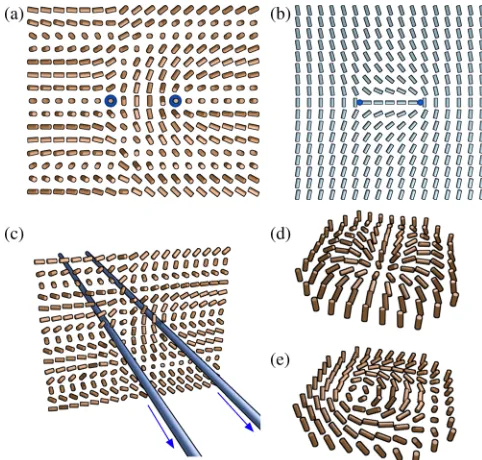
Their dimensionality, coupled with the isotropic nature of∇⊥non umbilic lines, means that umbilics are associated with the centers of vortexlike distortions. For chiral free energies such Eq. (1), the preference for twist leads to umbilic profiles such as those shown in Figs.1(a),1(c), and 1(e), typically seen in materials with chiral interactions. For chiral vortices there is an immediate correspondence with “double twist”[8], traditionally written as∂inj¼−q0ϵijknk,
which is equivalent to the condition of being on an umbilic line, with only twist deformations. Typical double twist configuration, such as shown in Fig.1(e), are axisymmetric and contain an umbilic line along their centerline; however, this umbilic is not generic. In the generic case the umbilics are nonaxisymmetric, such as the two λ lines in the dislocation shown in Fig. 1(a). They can still correspond to regions where the free energy is lower than that of the helical state, as long as the other aspects of the gradient tensor, splay and bend, are sufficiently small. Umbilic lines with local structures dominated by splay and bend dis-tortions, Fig.1(d), can also be energetically favorable for systems with a term of the form [81]
E·ððn·∇Þn−nð∇·nÞÞ; ð8Þ
for an external fieldE, replacing the chiral term in Eq.(1). This term corresponds to the flexoelectric effect in liquid crystalline systems[82]and to Rashba spin-orbit coupling in magnetic systems[81]. By an analogous argument to that given above, it is easy to see that umbilics with splay and bend distortions can correspond to local minima of a free energy with such a term. In this way the existence of Skyrmion lattices, such as those shown in Fig. 2, can be interpreted as due to the energetic preference for umbilic lines and the association between umbilic lines and Skyrmions, given by Eq. (20).
The decomposition Eq. (6) conveys the geometric character of the orientational order. In geometric terms the splay and twist correspond to the mean curvature and
the mean torsion[83,84]of the vector field, with the twist encoding the chirality of the order with surfaces of zero twist separating regions of different handedness.Δcan be thought of as a deviatoric, or spin-2, component of∇nthat conveys the local“shear”of the vector field. Its eigenvec-tors can be used to define principal directions of the curvature of the local orientation. In the case wheren is the normal to a surface, the transformation Eq.(6) is the derivative of the Gauss map, or shape operator of the surface, and the principal directions alluded to are the directions of principal curvature. In the vicinity of an umbilic we may write
Δ¼ jΔj
cosθ sinθ
sinθ −cosθ
; ð9Þ
[image:5.612.315.556.45.275.2]however, from a structural point of view, they can be seen as a composite of winding 1 umbilics, into which they break apart under perturbation. The generic umbilic points of a surface have been classified as stars, lemons, or monstars [64], according to the local profile that the principal curvature directions have in the vicinity of the umbilic point. The same local structure arises in the rotation of the eigenvectors of Δ around the umbilic lines of a generic vector field in three dimensions—it is not hard to see that the eigenvectors ofΔrotate by only half as much as Δitself, i.e., by a half-integer multiple of2π, this being the familiar phenomenon of a real Berry phase[70,71]—so that the local profile of an umbilic line may be classified in the same way as the umbilic points of a surface or theClines of generic electromagnetic fields[38].
We explain later that the windings just described are equivalent to the indices of the umbilics up to a sign, which arises because the orientation of n reverses from one umbilic to another. (The discrepancy is therefore absent ifnis the normal to a surface, since then there is no reversal of its orientation between umbilics, and the index is simply the local winding of the eigenvectors ofΔ.) The sum of the indices of the umbilics yields a topological invariant, equal to 4 times the Skyrmion number of the texture on
the two-dimensional surface. This calculation of the Skyrmion number is dual to the usual method of integrating a curvature form over a surfaceΣ⊂R3, which computes the degree of the mapn:Σ→S2[37,85],
q¼ 1 8π
Z
Σϵabcn
a∂
inb∂jncdxi∧dxj; ð10Þ
where all indices run from 1 through 3. The duality can be viewed as entirely analogous to that in the classical differential geometry of surfaces between the Gauss-Bonnet theorem—integral of the Gaussian curvature— and the calculation of the Euler characteristic using umbilic points of the surface. This correspondence allows one to localize the geometric distortions that characterize Skyrmions—the centers of the vortices—in a principled way.
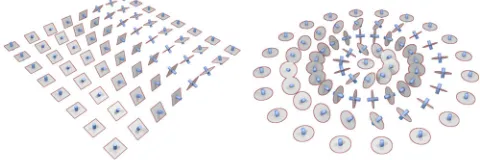
This may be illustrated through the Skyrmion lattice of Fig. 2. Each hexagonal unit cell contains a single Skyrmion. When analyzed in terms of umbilics, one finds that the center of each hexagon corresponds to a nongeneric umbilic of winding numberþ2, while every vertex marks the location of a generic umbilic with winding number−1. The figure shows clearly that the eigenvectors ofΔ rotate around the umbilics at half this rate with windingsþ1and −1=2. This winding does not correspond to the index of the umbilic, however. In Fig.2the eigenvectors ofΔdo not live in the viewing plane, but rather in the spatially varying plane of vectors with normaln. On moving from a central umbilic to one with a−1=2profile,nrotates byπ, reversing the orientation of this plane. Accounting for this change in orientation assigns indices of the same sign to each umbilic in Fig.2(þ2andþ1for each type, respectively). We show later that this can be phrased in terms of a natural orientation carried by each umbilic. Since each vertex is shared between three unit cells, it follows that the total count of umbilics per unit cell is 2þ6×1=3¼4, i.e., exactly 4 times the Skyrmion charge Eq.(10). As already remarked, this duality relation in determining the Skyrmion number between the integration of a curvature form and the count of umbilics is entirely analogous to the calculation of the Euler characteristic of a surface using either the Gauss-Bonnet theorem or the umbilic points. The difference that arises here, illustrated by the example of the Skyrmion lattice, is that the count associated with the umbilics is not simply of their winding numbers, as in the case of surfaces, sincenis not constrained to be a surface normal.
[image:6.612.56.295.44.275.2]This correspondence also allows a robust identification of geometric distortions in materials that do not necessarily correspond to a traditional topological object. Such an example is given by the meron, or half-Skyrmion, which can be seen in magnetic films[45]. A meron can be thought of as carrying Skyrmion charge1=2and as such does not correspond to a topologically well-defined object since Skyrmion charges are, by definition, integers. From the FIG. 2. Skyrmion lattice. Each unit cell possesses a single
central s¼2 umbilic, with the six outer s¼1 umbilics each shared between three unit cells giving a total count of
perspective of umbilic lines, however, a meron can be rigorously identified simply as a pair of generic umbilic lines or a single umbilic line of index2. Figure1(a)shows an image of a dislocation in helical order, which can be identified as a meron. Generic umbilics themselves corre-spond to even more elementary geometric distortions and in cholesterics correspond to the well-known λ lines.
In two-dimensional systems umbilics are points, and give a correspondence between the geometric features of the order and topological distortions in the material. Moving up one spatial dimension, the situation becomes more complex and in three dimensions umbilic points become lines along which their surrounding vortices get extruded. Skyrmions themselves are more subtle in three dimensions, and can only be associated to an arbitrary measuring surface in the material, such as one enclosing a point defect, which must have a corresponding number of umbilic lines intersecting it. Umbilic lines therefore provide a complete, concise picture of the topological content of a three-dimensional texture, without resorting to integrals over local measuring surfaces. In a material domain with no boundaries, such as R3, umbilic lines can only end on singularities inn. Indeed, as a consequence of Eq.(10), any point defect, or magnetic monopole, of chargeqmust have umbilics of total winding 4q emerging from it. This structure is illustrated in Fig.3, where one sees the creation and annihilation of umbilic lines (and, consequently, a Skyrmion) by magnetic monopoles. Recently, this creation and annihilation has been experimentally observed[16]in chiral ferromagnets, and umbilic lines provide a precise physical localization of the lines of Skyrmion charge created by monopoles.
Umbilic lines that do not end on defects or domain boundaries must instead form closed loops. These have been observed, though not identified as such, in several experiments, including torons [30] and nonsingular tex-tures in colloidal dimers[35]; umbilics provide a rigorous way to characterize such objects, which have previously been described in anad hocfashion. In the same way that the local structure of orientational order leads to a global invariant of umbilics, namely Skyrmions, the local structure along umbilic lines leads to global topological invariants of umbilic loops, associated to their linking and twisting. These invariants have not yet been explored experimentally, but their association with helicity and Chern-Simons theory, discussed later, suggests deeper relevance to the physics of three-dimensional orientational order, making the study of closed umbilics of particular interest.
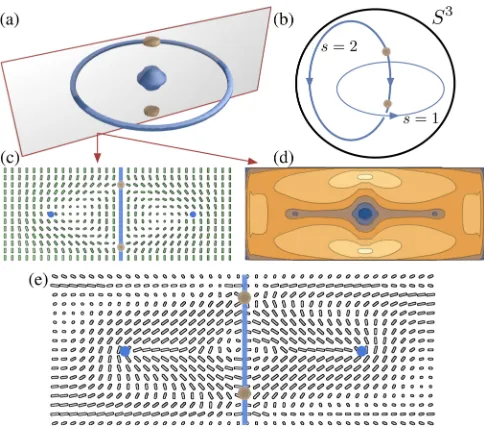
[image:7.612.316.558.352.566.2]A canonical example of an umbilic loop is the toron, shown in Fig. 4, which contains a generic umbilic loop, with a monstar profile for the eigenvectors ofΔ, rather than the axisymmetric profile that was previously assumed. Indeed, with the methods we develop here, one can show that the symmetries of both the toron and the colloidal dimer texture necessitate the creation of this umbilic loop. Both these axisymmetric systems consist of two point
FIG. 3. Transient monopoles and umbilic lines observed in a simulated quench of the free energy [Eq.(1)]. Left: Contours of constant value of jΔj. The blue lines are umbilics, the beige spheres are monopoles (point defects). Each umbilic has winding
n¼1. They are all oriented similarly, so that the sum of the umbilics entering (leaving) the negative (positive) point defect is 4, in accordance with Eq.(20)and corresponding to the Skyrmion created between the monopoles. Top right: Cross section showing non the shaded plane. As a map from the plane to S2, it has degree 1, indicating the presence of a Skyrmion. Bottom right: Contour plot showing the magnitude of logðjΔjÞon the shaded plane; the umbilics are clearly picked out.
FIG. 4. Umbilic lines in a toron. (a) Simulation results showing point defects and characteristic umbilic loop in a toron. The umbilic loop is transverse and has zero self-linking number. The point defects have opposite charge; due to lattice effects the simulation does not resolve the umbilic lines connecting them, though they are clear in the topology of the eigenvector field. (b) Diagram illustrating the umbilic structure of the toron inS3
when the boundary of the cell is collapsed to a point. Note that the umbilic loops connecting the point defects each have strength
[image:7.612.61.287.450.576.2]defects (in the colloidal dimer textures these are effective point defects created by colloidal particles), with an umbilic loop lying in the plane equidistant from the two defects. The existence of this umbilic loop requires that the two point defects have the same local structure, but opposite signs—either both hyperbolic in the case of the toron or both radial in the case of the colloidal dimer texture—and suggests that the creation of such monopole pairs in other systems may well lead to the formation of umbilic loops. As mentioned above, the global invariants of umbilic loops come about through their twisting and linking. If an umbilic forms a closed loop, then the winding of the angle θ, given in Eq.(9), along the contour length of the umbilic (a longitude) conveys an integer invariant that depends on a choice of longitude and of a basis,fd1;d2;ng, along the
loop. This integer is related to a self-linking number of the umbilic loop, which is itself related to the Hopf invariant and structures from contact topology. This connection, between linking of umbilics and the Hopf invariant of n, can be illustrated in Fig. 9, which can be viewed as the linking of two nongeneric umbilics.
An additional aspect of the local geometry is worth emphasizing. The complex structureJ¼ ½01−01acts on the shape operator Eq.(6)by simple composition to produce an equivalent linear transformation:
χ¼J∘∇⊥n
¼−n·∇2×n
1 0
0 1
þ∇·n
2
0 −1
1 0
þ
−Δ 2 Δ1
Δ1 Δ2
:
ð11Þ
This transformation, although equivalent to the shape operator, is independent from it in the sense that they are orthogonal with respect to the natural inner product between matrices, TrðχT∇⊥nÞ ¼0, a property that turns
out to be of some importance in the analysis of the topology of umbilics. χ is the chirality pseudotensor introduced recently by Efrati and Irvine [78] in their study of chiral materials; our description of it provides a complementary perspective to theirs. The spin-2 component Π¼J∘Δ carries equivalent information toΔ. Its eigenvectors can be thought of as defining directions of principal torsion (or twist) and are simply rotated relative to those ofΔbyπ=4 about the director. Nonetheless, for materials with chiral interactions or structure, it is these directions, rather than the eigenvectors of Δ, that are often more visibly recog-nizable, as is elegantly illustrated in the experiments of Armonet al.[86]on the opening of chiral seed pods, and those of Efrati and Irvine[78]on stretched elastic sheets. For this reason, we plot the eigenvectors ofΠrather than those ofΔin all figures in this paper. The eigenvectors ofχ have been used recently[36]to give a definition of the pitch axis for a cholesteric. In the case where ∇·n¼0, the eigenvectors of Π coincide with those of χ, and the
principal directions of torsion can be identified with the pitch axis fromχ. In general, however, this is not the case. Indeed, the (real) eigenvectors ofχdo not always exist and, as such, cannot provide global topological information in a manner analogous to that provided byΔ (orΠ).
III. UMBILICS IN LINE FIELDS AND THE BLUE PHASES
In liquid crystalline phases the orientational order is linelike rather than vectorial. Perhaps the most noticeable feature of this is the presence of line defects, called disclinations, in liquid crystals[87,88], which make mani-fest the nonorientability and are absent in materials with vector order. However, they can arise even in vector-ordered materials if the vector couples to an internal degree of freedom to give nematiclike symmetry; examples include thin films of3He[89]and spin-1 polar condensates [90]. As the director is nonsingular along umbilics, the effect of the nonorientability is primarily restricted to their global identification and structure. Indeed, since umbilics can be identified from the local structure of the director gradients, they have the same local description for line fields as they do for vector fields. One need only choose an orientation for the line field, which may always be done locally, i.e., in regions that do not contain disclination lines. Rather than present a detailed account of the analysis of line fields, we focus on simple illustrations and a practical means for identifying umbilics globally, using one particu-lar physical system—the cholesteric blue phases. These remarkable materials are characterized by periodic orienta-tional order corresponding to crystalline space groups, while remaining three-dimensional fluids. Two distinct cubic structures, BPI with space group O8−ðI4132Þ and BPII with space group O2ðP4232Þ, are observed on varying temperature or the amount of chiral dopant[8,9,91], while several other structures can be induced by applied electric field effects[92–94]or confinement[95], and there is also an amorphous phase, known as BPIII[96]. Their structure arises because the local optimal configuration for the chiral free energy is one of double twist (illustrated in Figs.1 and 6), but this is only locally favorable and the structure becomes energetically unstable if it extends too far. This leads to a frustrated arrangement where locally preferred regions of double twist form periodic arrays interwoven by a network of disclination lines [8,9]. The blue phases have a long-standing association with Skyrmions in chiral magnets, with which they may be considered analogous. This analogy continues to stimulate considerable interchange of ideas between the two fields [3,29,97–99].
the second moment of the molecular orientational distri-bution function. The director field can be recovered from it as the eigenvector associated to the largest eigenvalue. In typical nematic materials, theQtensor is uniaxial and we have Q∝n⊗n−13I. Our first objective is to describe how umbilics may be identified from the Q tensor. The shape operator Eq. (6), and its deviatoric part Δ, change sign under n→−n, and so do not directly give rise to objects compatible with nematic symmetry. However, interestingly, the chirality pseudotensor Eq. (11), and its deviatoric part Π Eq. (17), continue to be globally well defined in the same form even when the director is nonorientable, so that Π admits an immediate extension to a“Q-tensor version.”We use this to identify umbilics in line fields.
The linear transformationΠ, defined fully in Eq. (17), can be embedded in a 3×3 matrix and expressed, in a Cartesian basis, as
Πij¼
1
4ϵilk½nl∂knjþnl∂jnk−njnlnm∂mnk
þ1
4ϵjlk½nl∂kniþnl∂ink−ninlnm∂mnk: ð12Þ
The issue at hand is what a suitable replacement should be if we express the orientational order using aQtensor rather than the director field. The usual approach to obtaining such a replacement is to adopt algebraic methods rather than geometric ones[100]; one constructs a list of potential expressions and selects on the basis of how they reduce when theQtensor is written in terms of the director field. Following this procedure, we find that the expression
~ Πij ¼
1
4ϵilk½2Qlm∂kQjmþQjm∂kQlm
þQlm∂jQkm−Qjl∂mQkm
þ1
4ϵjlk½2Qlm∂kQimþQim∂kQlm
þQlm∂iQkm−Qil∂mQkm ð13Þ
reduces toΠijwhen theQtensor is uniaxial, with constant magnitude, Qij∝ninj−13δij. We subtract its trace and
adopt it as an appropriate Q-tensor analog of Π. In simulations, the umbilic lines can then be identified using isosurfaces where the norm of Π~ drops below a thresh-old value.
Illustrations are given in Fig.5for some standard blue phase textures. The umbilics coincide with structural motifs that have been identified previously, either through sym-metry considerations [101]or by taking a singular value decomposition of theQ tensor[80]. These motifs are the axes of double twist cylinders [8,9]. Two remarks are in order concerning this. First, the pattern of umbilic lines in BPII (see Fig.5) does not correspond to the array of double
twist cylinders traditionally depicted in the literature. In the traditional depiction the double twist cylinders are taken along the twofold axes lying in the faces of the conven-tional unit cell and, indeed, inspection by eye reveals these lines to have the same general structure as model double twist cylinders [8] (see Fig. 1). However, in a Q-tensor description of BPII these are not degeneracies where the local structure is axisymmetric, as in the standard idealized picture of a double twist cylinder; rather, they are twofold lines where theQtensor is maximally biaxial[80,102,103]. Second, it is perhaps worth emphasizing that the umbilics identified in all other blue phase textures also differ from the standard idealized picture of a double twist cylinder. This is because the idealized axisymmetry of the latter constrains it to be a degenerate winding þ2 umbilic, whereas those that are found in periodic textures are generic umbilics, typically with a −1=2 profile for the eigenvectors ofΠ~, i.e., a star umbilic.
[image:9.612.318.557.47.277.2]considerations that the rest of our work is founded upon. It is clear that geometrical considerations can be developed for traceless symmetric tensors, parallel to our description of orientational order. It would be interesting to do so and compare the outcome with the algebraic construction we have given.
In the remainder of this paper we return to the setting of vector orientational order and focus on the global topo-logical aspects represented by umbilic lines. However, before doing so we summarize here how those consider-ations extend to nonorientable line fields. Orientational order defines a splitting of the tangent bundle TR3≅ Ln⊕ξ whether it is orientable or not, although the line bundleLn is nontrivial in the nonorientable case, with the consequence that the directornis not globally defined (as a vector). Rather, the projectorn⊗nprovides a section of Ln⊗Ln. Similarly, the shape operator has to be modified so as to be presented as a section of the twisted bundle ξ⊗ξ⊗L
n [104]. The same description holds for the global character of umbilics in that they still furnish a representative of the Poincaré dual to twice the Euler class of the orthogonal 2-plane bundle ξ. Interestingly, for line fields with knotted disclination lines, the Euler class of the orthogonal 2-plane bundle is usually torsion[52], which the usual Chern-Weil theory of curvature forms is insensitive to. (The curvature form represents only the integral part of the cohomology[105,106].) The integral in Eq. (23)thus does not provide any information in such cases. However, as the umbilic lines are Poincaré dual to twice the Euler class ofξ(and4½n), they continue to capture the topology of the orientational order, even when it is torsion, modulo elements of order 4. As discussed earlier, and shown in Fig.1, one can identify umbilics withλlines in cholesterics. In this way, Eq.(20)can be seen as a global constraint on theλlines in a cholesteric, as determined by the topology of n, with additional subtlety associated with elements in H2ðMÞof order 2 and 4. We anticipate that the elements of order 4 are associated withτlines. For the elements of order 2 the orthogonal 2-plane bundleξadmits a global section and we anticipate that these are associated with distinct “cholesteric ground states”[104].
IV. GLOBAL DEFINITION OF UMBILICS AND THE TOPOLOGY OF VECTOR FIELDS
The umbilic lines we identify convey topological infor-mation about the vector fieldn, specifically, the Euler class of the orthogonal 2-plane bundleξ, through a combination of the Gauss-Bonnet-Chern theorem [107–110] and Poincaré duality. The curvature of a vector bundle repre-sents a characteristic cohomology class that can be inte-grated over homology cycles to produce topological invariants (Euler numbers). By Poincaré duality this can be viewed as a homology class and the umbilics furnish a representative of this Poincaré dual. We develop this general topology of orientational order in terms of a natural
connection on the vector bundle that the spin-2 trans-formationΔ takes values in.
As before, let n be a unit vector field in R3; then, it defines a splitting of the tangent bundle
TR3≅Ln⊕ξ ð14Þ
into a real line bundleLnof vectors parallel tonand a rank-2 real vector bundleξof vectors orthogonal ton. Examples of this splitting are shown in Fig.6. The gradients ofntake values inTR3⊗ξ≅ðLn⊗ξÞ⊕ðξ⊗ξÞ, with the first part containing the bend deformations and the second the perpendicular gradients given locally in Eq. (6). By complete analogy with the classical differential geometry of surfaces, we call these perpendicular gradients the shape operator of the orientational order and think of it as a linear transformation on the orthogonal 2-planes.
The shape operator decomposes in the following way. Local rotations about the director field correspond to a local symmetry and endow the bundle ξ with a natural SO(2) action, under which the tensor productξ⊗ξsplits into a direct sum I⊕J ⊕E, where I and J are trivial line bundles andEis a rank-2 vector bundle. Correspondingly, the shape operator has the decomposition
∇⊥n¼∇2·nIξþn·∇2×nJþΔ; ð15Þ
given previously in Eq.(6). Here,Iξ is the identity trans-formation and J¼n× is a complex structure on ξ, now defined globally, whileΔ has the global definition
ΔðvÞ ¼12½ðv·∇Þnþn×ðn×v·∇Þn; ð16Þ
for anyvinξ. The umbilics are identified with the zeros of Δ; they encode the topology of the orientational order.
[image:10.612.317.557.562.642.2]Without repeating too much of the local description given previously, we record simply that composition with the complex structure again yields the chirality pseudo-tensor[78],χ¼J∘ ∇⊥n, and that the spin-2 component of this,Π¼J∘Δ, can be expressed globally as
ΠðvÞ ¼1
2½n×ðv·∇Þn−ðn×vÞ·∇n; ð17Þ
for any v in ξ, and is also a section of E. We reiterate that althoughΠandΔmay be obtained one from the other by composition with the complex structure, they are orthogonal with respect to the natural inner product
hΠ;Δi ¼1
2TrðΠTΔÞ. At the same time, they share the
same magnitude and the same zero set, the umbilics U. Thus, away from umbilic lines, Π and Δ represent two nonzero orthogonal sections of E, and so they provide a basis for EjR3−U and also define a natural connection 1-form:
A¼hΠ;hΔ;∇ΔΔii: ð18Þ
This 1-form conveys the fundamental topology of the orientational order.
We give in Eq. (18) a global definition of A that emphasizes its naturality and makes clear how it arises. In a local chart it can be represented in terms of the eigenvectors, pþ and p−, of Δ and has components Ai¼2p−a∂ipþa, an expression perhaps closer in form to
the usual way of writing Berry connections. However, one must keep in mind that this representation is only local in the present context; otherwise, it only serves to obfuscate the natural structure. The exterior derivative of A, ΩE¼dA, is the (Berry) curvature of the vector bundle
E. It is equal to twice the curvature of ξ on account of E being a spin-2 subbundle of ξ⊗ξ. (This is also evident from the local expression in terms of the eigen-vectorsp.)
A fundamental property of an umbilic is given by the integral of the connection 1-form [Eq. (18)] around any simple closed loop γ encircling the umbilic. This is the holonomy of the connection, or Berry phase. LetΣbe an oriented surface with boundary γ, as in Fig. 7. If Σ is generic, then the umbilics will intersect it transversally in some number of distinct points. LetfDigbe disjoint small
disks in Σ about each of these intersection points and denote their boundaries byfCig. ThenjΔjis nowhere zero
on Σ−fDig and ∂ðΣ−fDigÞ ¼γ⊔f−Cig, so that by
Stokes’s theorem
Z
γ A−
X
i Z
Ci
A¼
Z
Σ−fDig
dA¼
Z
Σ−fDig
ΩE: ð19Þ
To extend the analysis over the umbilics, we can introduce a local trivialization ofLn⊕ξon each of theDi, which we
denote by the orthonormal basis fd1;d2;ng. Then e1¼
d1⊗d1−d2⊗d2 and e2¼d1⊗d2þd2⊗d1 form a
local basis forE. In such a basis,Δ¼jΔjcosθe1þjΔjsinθe2
and A¼dθþ2ω, where ωi¼ ðd2Þa∂iðd1Þa is the
con-nection 1-form onξfor this basis (the factor of 2 accounts
forEbeing a spin-2 bundle). With this, one finds at once the Gauss-Bonnet-Chern theorem in the form
−1 2π
Z
ΣΩEþ 1 2π
Z
γ A¼
X
i
1 2π
Z
Ci
dθ
¼X
i
indexΣUi; ð20Þ
which defines the index of an umbilic, an integer associated with its intersection with a surface. The sum of these over all of the umbilics is an Euler number of the bundleE. Note that, as alluded to earlier, the index of an umbilic is not simply the winding number of the angleθthat characterizes the local profile, as that is measured relative to a local basis forξ, while the index uses the orientation on the surfaceΣ; there is, therefore, an additional sign according to whether dθis cooriented with Ci or not.
It is instructive to contrast this situation, where the type of profile does not carry topological information, with that of umbilical points of surfaces where the type of profile does carry topological information about the sign of the winding. This occurs because in the case of surfacesnis fixed to be the normal toΣ, and sodθis always cooriented withCi.
[image:11.612.378.496.49.196.2]in this way, the expression for the index in Eq. (20) is rewritten as
indexΣUi¼siIntðUi;ΣÞ; ð21Þ
where IntðUi;ΣÞis the signed number of intersections ofUi
withΣandsi∈Nis the absolute strength of the umbilicUi.
Examples illustrating this are shown in Figs. 1and2; we describe only the latter (the former is essentially identical). Figure2shows a Skyrmion lattice, a well-known structure seen in a variety of systems [15,17–19,28,61,111–113]. The umbilics form a lattice, with s¼2 umbilics each surrounded by six s¼1 umbilics. The eigenvectors ofΠ show the central umbilic having aþ1profile, and the six outer umbilics a −1=2 profile. All the umbilics have the same orientation induced by A, and so their intersection numbers, and thus indices in Eq.(20), are all positive. For theþ1profile,−1=2profile, and the orientations to all be consistent, it is necessary thatnrotates byπwhen passing from the central umbilic to an outer one.
The curvature of the bundleξcan be expressed in terms of the director field as
Ωξ¼−12ϵabcna∂inb∂jncdxi∧dxj: ð22Þ
This is because each 2-plane of the bundle ξis explicitly embedded inR3(see Fig.6) and the expression is just the extrinsic definition of curvature in terms of the (general-ized) Gauss map. Equally, it follows from an explicit calculation in local coordinates for any particular texture, say, a radial hedgehog. A third way to establish it is through a calculation in the style of the Mermin-Ho relation[10], a good account of which has been given by Kamien [114]. The curvature ofEis equal to twice this,ΩE ¼2Ωξ, since E is a spin-2 subbundle of ξ⊗ξ. Therefore, when Σis closed, or the boundary term vanishes, we have
X
i
siIntðUi;ΣÞ ¼
1 2π
Z
Σϵabcn
a∂
inb∂jncdxi∧dxj
¼4q; ð23Þ
or the sum of the indices of the umbilics piercingΣis equal to 4 times the Skyrmion number. This establishes a general relationship between Skyrmions and umbilics. This is illustrated in Fig. 2, where each unit cell contains one s¼2 umbilic and six s¼1 umbilics, each of which is shared between three unit cells, giving a total count of 2þ6×1=3¼4; i.e., there is one Skyrmion in each unit cell. This approach can also be extended to the characterization of merons, or half-Skyrmions, which can be thought of as a single s¼2 umbilic, or two s¼1umbilics, as in the case of the cholesteric dislocation, shown in Fig. 1.
This correspondence between Skyrmions and umbilics can be seen as an instance of Poincaré duality, giving a natural way to localize Skyrmions to a set of points or lines. The set of umbilics U in a three-dimensional system M gives a representative of a cycle inH1ðMÞ. The Poincaré
dual of this is the cocycleeðEÞ∈H2ðMÞ, the Euler class, which depends only on the topology of the bundleEand, hence,n, and gives a global constraint on the total number of umbilic lines in the system in terms of the topology ofn. As a spin-2 vector bundle, eðEÞ ¼2eðξÞ ¼4½n, where
½n∈H2ðMÞis the cocycle represented byn[115]. In the absence of torsion in H2ðMÞ [116], there is a canonical representative of the cocycle 4½n as a 2-form, which is given through the Chern-Weil homomorphism by Pfð−ΩE=2πÞ, which leads to Eq.(20).
An example of the Euler class as a global constraint on umbilics is given by the case of monopoles, illustrated in Fig. 3. These are point defects in the magnetization that mediate changes in the number of Skyrmions[16]. In the local neighborhood of a point defect the topology ofnis described by an integerq∈π2ðS2Þ≅Z, the charge of the
point defect. Through Eq. (23) one finds that a sphere surrounding this point defect must be pierced by umbilics of total index4q. In Fig.3we show a simulation of two1 point defects, or monopoles, in a chiral ferromagnet. There are four umbilics, each of generic type, ending on the point defects in a manner reminiscent of Dirac strings[107]. On a slice in the midplane of the cell ncontains a Skyrmion, illustrating the well-known creation and annihilation of Skyrmions in terms of point defects, observed experimen-tally in Ref.[16].
V. LOCAL PROFILES OF UMBILIC LINES
Simple examples of umbilic lines, such as the Skyrmion lattice in Fig.2, possess translational symmetry along the umbilic, with the tangent vector of the umbilic pointing parallel ton. Both these situations are not generic; the local profile of umbilic lines may change along their length and the tangent vector of the line does not have to be parallel to n. To describe how these quantities can vary, one needs to understand the local structure of umbilic lines, the focus of this section. Ultimately, this local description will lead to the definition of global linking invariants or umbilic loops in the next section. This can be considered analogous to the situation earlier, where the local structure of umbilics in orientational order led to global invariants, namely, Skyrmions.
Generic umbilic lines carry a canonical orientation through the vectorB, defined as
Bi¼ hΠ;∂iΔi ¼ hΔ;ΔiδijA
j; ð24Þ
Δ¼s1e1þs2e2, then an umbilic is defined as the
inter-section of the two surfacess1¼0 ands2¼0, and so its
tangent vector will be∇s1×∇s2. Note that while the values
of s1 and s2 depend on the choice of basis, the tangent
vector does not. In this local form we can write
B¼s1∇s2−s2∇s1þ2ðs21þs22Þω; ð25Þ
so that on an umbilic we have∇×B¼2∇s1×∇s2, and,
hence, the vector∇×Bpoints along umbilic lines, canoni-cally orienting them. As indicated in Fig.7, this orientation is compatible with that induced by the circulation in A previously discussed. As alluded to in Figs. 1and 2, the discrepancy between the type of profile and index of an umbilic depends on the relative orientation betweennand the umbilic line. To measure whether the eigenvectors of a generic umbilic have winding1=2, one should integrateA along a contourγ chosen such that its orientation matches the orientation imparted toξbyn. One can then show that the local profile is 1=2 depending on
sgnðn·∇×BÞ; ð26Þ
the analysis being identical to that given by Berry for C lines in electromagnetic fields[117]. The freedom between the relative orientations of umbilic lines andnmeans that n·∇×Bcan pass continuously through zero, changing the type of profile from1=2to∓1=2, in a similar manner to nematic disclinations [87].
This quantityn·∇×Bcan be used to further character-ize the local structure of umbilic lines. Along an umbilicΔ vanishes and generically we can expect it to vanish linearly. Its local profile is then given by the form of the linear order terms in Δ in the immediate vicinity of the umbilic. Equivalently, generically we can expect the gradients of Δto be nonzero on the umbilic, and the local profile is then given by the structure of∇Δevaluated on the umbilic. As usual, we split the gradients into the components parallel to nand those perpendicular to it, and consider only the latter. The nonzero part of these transverse gradients, evaluated on the umbilics, takes values inξ⊗E, so it is this part that we need to focus on. A section of this bundle characterizing the local profile of the umbilic can be constructed from ∇Δ as follows. If IE is the projection onto E in TR3⊗TR3, then we define the differential operator ∇ξ as ∇ξΔ¼Iξ∇ΔIE. By construction, ∇ξΔ is a section of the bundle ξ⊗E. Under the action of SO(2) the bundle ξ⊗E splits into two rank-2 subbundles, Fþ⊕F−, where Fþ is the spin-1 bundle corresponding toþ1=2profiles andF−is the spin-3 bundle corresponding to−1=2profiles, and we decompose∇ξΔaccording to this splitting as
∇ξΔ¼∇ξΔþþ∇ξΔ−: ð27Þ
A short calculation shows that n·∇×B¼
j∇ξΔþj2−j∇ξΔ−j2, so that if j∇ξΔþj>j∇ξΔ−j, the umbilic has a local þ1=2 profile, while if the converse holds, the profile is of type−1=2.
This analysis allows us to give a description of the space of local profiles for a generic umbilic. Since ∇ξΔjU is nonzero for a generic umbilic, but otherwise arbitrary, the space of local profiles has the homotopy type of the three-sphere. However, there is more structure to it than that. The equality j∇ξΔþj ¼ j∇ξΔ−j defines a Clifford torus sepa-rating the three-sphere into two solid tori corresponding to the different profiles. A natural constraint on an umbilic loop is for its profile to be of constant type, i.e., for n·∇×Bto be of constant sign or the profile to stay within a single solid torus. We call an umbilic loop that satisfies this constraint transverse, as its tangent vector is always transverse to the planes of ξ. This is not an unphysical constraint; transverse umbilic lines are commonly found in various chiral structures—typical λ lines in cholesterics have a local structure in which n is either parallel or antiparallel with the tangent vector to an umbilic. Figure4 shows the transverse umbilic loop found in toron excita-tions in frustrated cholesterics[30,32].
The condition of an umbilic being transverse therefore translates as one of the two profiles having a higher “weight”along the entire length of the umbilic. If this is the case, then we havej∇ξΔj2≠0, with the sign depend-ing on whether the umbilic is positively or negatively transverse. Suppose, for concreteness, that the umbilic is positively transverse. Then, in a local trivialization, we will have∇ξΔþ¼t1fþ1 þt2fþ2, witht21þt22≠0, and the space
of positively transverse umbilics has the homotopy type of a circle. The variation of the profile around a closed, transverse umbilic loop confers another integer winding number. This number depends on how the basis vectors of the trivialization of Fþ wind around the umbilic. The ambiguity can be removed by demanding that each of the basis vectors in the trivialization does not link with the umbilic. As we show in the next section, this winding number can be interpreted as twice a self-linking number for the umbilic loop, and is related to a relative Euler class ofE.
VI. UMBILIC LOOPS
consistently along the loop conveying both geometric and topological information about the orientational order.
Umbilic loops have been observed in experimental systems [3,32,44], and a motivating set of examples is the so-called torons[30], illustrated in Fig.4. These soliton structures can be generated in a frustrated cholesteric cell, with the director held vertical along the top and bottom. As shown in Fig. 4(a), they display a characteristic umbilic loop, in the form of a circle sitting in the midplane of the cell. This loop is of generic type, with the eigenvectors ofΠ having a monstar profile.
Indeed, one can show [118] that the existence of this umbilic loop is a consequence of the symmetries of the particular configuration. Consider the right-hand half of Fig.4(c). Restricted to a path from the top to the bottom of the cell, to the right of the two hedgehogs,ntraces out a great circle on the targetS2. As such, the right-hand half of Fig. 4(c) must cover a hemisphere on the target S2. By symmetry, the other half of the image must cover the other hemisphere. By standard surgery operations, one can then stitch these two pieces together to create a map S2→S2, which must be of odd degree. As a consequence, there must be axisymmetric umbilic lines present in the system. These can either be pushed to infinity or be of finite size. In the case of the toron, one can observe the umbilic loop in the center, along with the winding of the eigenvectors of Π around the boundary.
As with local properties of umbilic lines, much of the structure of loops is encoded in the 1-formA. Previously, we obtained local information about umbilics by integrat-ing A around a meridian. The first step to understanding their global structure is to integrate A along a longitude. Since A is singular on an umbilic, we must define this integral as a limit. IfUiis an umbilic, then letU0ibe a curve
close to Ui that has zero linking number with it. The
integral ofAoverU0iis well defined, and if all the umbilics
in the system are closed loops, we can take the limit U0i→Ui to obtain
Z
Ui
A¼2πX
j
sjLkðUi; UjÞ þ Z
ΣΩE; ð28Þ
where Σ is an orientable surface bounded by Ui. The
requirement that U0i have zero linking with Ui ensures
that the limit is well defined, but in general the result depends upon this choice of framing. The quantity
P
jsjLkðUi; UjÞ ¼eðUiÞ in Eq. (28) is an integer
asso-ciated to the umbilic line, the relative Euler class, and counts the number of umbilics linking Ui. There are two
natural questions to ask of this quantity. The first is whether it corresponds to any local geometric structure of the umbilic line, the second is whether it relates to a global property of n. On both counts the answer is yes. Geometrically, Eq. (28) is related to both a self-linking number and the winding number defined in the previous
section. Globally, we show that it is related to the Hopf invariant ofn.
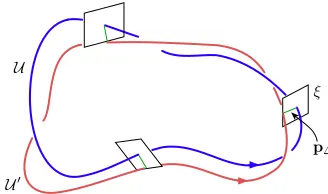
To see this, supposeUis a transverse umbilic loop, then letUˆ be a loop close toUof zero linking number withU. Evaluate one of the eigenvectors ofΔ,pþΔ, say, alongUˆ and then pushUalong this eigenvector field to form a new loop, U0. The linking number LkðU; U0Þis then taken to define the self-linking number of the transverse umbilic, SlðUÞ. This construction is shown in Fig.8. Note that sincepþΔis a line field, SlðUÞmay be a half-integer corresponding top being nonorientable along the longitude ofU.
With this notion in hand, the correspondence between the self-linking number and the winding number coming from the variation of the local profile defined in the previous section can be established. Choose a trivialization
fd1;d2gofξon a neighborhood ofUsuch that the linking
number ofU pushed off along d1 (say) is zero, then the
winding of∇ξΔþ with respect to the chosen trivialization will give twice the self-linking number. Note that the geometric definition of the self-linking number did not depend on the zero of Δ being of linear order. The relationship between the self-linking number and the relative Euler class of a transverse umbilic is then[119]
SlðUÞ ¼SlðUÞ þ21eðUÞ: ð29Þ
[image:14.612.353.517.488.585.2]There is a new term in this equation, SlðUÞ, the transverse self-linking number of U. SlðUÞ is a geometric quantity, preserved under deformations that keep U transverse. A similar notion is studied in the context of contact topology[120], where it provides useful geometric infor-mation, but we do not know of a general discussion in the case of arbitraryn.
FIG. 8. The self-linking number for transverse umbilic loops. The red curveU0is formed by pushingUalong an eigenvector fieldpΔ ofΔ. The self-linking number is then computed as the linking number ofUwithU0. The umbilic must be transverse to ensure that U0 does not crossU. Because the eigenvectors are degenerate on the umbilic, one evaluatespΔon a line close toU,
ˆ
We now turn to the relationship between the linking of umbilics and global properties of n. Associated to the 1-form A is the Chern-Simons 3-form, A∧dA, and it is natural to ask whether the integral over the complement of U,
Z
A∧dA; ð30Þ
gives some information about umbilic lines and n. This integral can be compared to the similar helicity integral for a fluid flow and the Abelian Chern-Simons action. Both these quantities are related to linking numbers, of vortex lines in the case of helicity [53–55] and Wilson loops in Chern-Simons theory[121,122], and, as we show, it is no different for umbilics; Eq. (30) connects the linking numbers of the umbilic loops with the Hopf invariant of n. To proceed, we assume that the material domain isS3, with no defects, and that the zero set of Δ is one dimen-sional. By a compactification, this assumption that the domain isS3is equivalent to examining a system inR3for which limx→∞nðxÞ ¼n0, a constant. An example of such a
system is illustrated by the Hopf fibration, which has been experimentally realized in frustrated cholesterics [32], illustrated in Fig.9, and the aformentioned toron. In both these systems n is constant on the boundary of the cell. Because of this, Δ¼0 on the boundary, and one should consider these systems as having an umbilic line passing through the point“at infinity,”which in Figs.4and9is just the boundary of the system.
Topologically, the configuration in Fig.9is unusual; it is nonsingular but not homotopically equivalent to a constant. The difference is that it has a nonzero Hopf invariant. This integer invariant distinguishes topologically distinct non-singular textures in R3 which are constrained to tend to a constant at infinity and is typically visualized in terms of linking of preimages of two orientations using the Pontryagin-Thom construction [32]. In our setting, how-ever, one can give a slight reinterpretation of the famous Whitehead integral formula[123], similar to that given by Arnold [55] to show that the Hopf invariant is also the Chern-Simons invariant of the bundle ξ. In our interpre-tation, if one takes aωto be a connection form forξ, then dωis the curvature ofξ and the Chern-Simons integral,
1
ð4πÞ2 Z
S3
ω∧dω; ð31Þ
computes the Hopf invariant of n.
Now, we turn back to our integral [Eq. (30)]. As discussed, we assume the material domain is S3 (or R3 with uniform boundary conditions). This means that we can give a global trivialization ofξwith connectionωand our 1-formAcan be written asA¼dθþ2ω. This allows us to write
Z
S3−U
A∧dA¼4
Z
S3−U
ω∧dωþ2
Z
S3−U
dθ∧dω; ð32Þ
or, sinceU has measure zero,
Z
S3−U
A∧dA¼4ð4πÞ2Hþ2
Z
S3−U
dθ∧dω; ð33Þ
where H is the Hopf invariant of n. Now, we need to evaluate the integral ofdθ∧dωoverS3−U. We first do a simpler integral, overS3−NðUÞ, where NðUÞis a neigh-borhood of the umbilic lines. By Stokes’s theorem this can be reduced to an integral over the boundary of NðUÞas
Z
S3−NðUÞ
dθ∧dω¼X
i Z
∂NðUiÞ
ω∧dθ: ð34Þ
[image:15.612.319.552.47.268.2]If we chooseNðUÞsmall enough, then along each meridian of the torusωwill be approximately constant and equal to its value on the umbilic line. The integral over each boundary component can then be written as
X
i Z
∂NðUiÞ
ω∧dθ¼X
i Z
S1L
ωZ S1M
dθ
; ð35Þ
where we have pulled the forms back to each S1. The integral ofdθis trivial; it evaluates tosi2π, wheresi
is the strength of theith umbilic. Finally, we take a limit as NðUÞ→U and obtain a sum of Wilson loop integrals:
lim
NðUÞ→U X
i Z
∂NðUiÞ
ω∧dθ¼2πX
i
si Z
Ui
ω: ð36Þ
Now, from the Gauss-Bonnet-Chern theorem [Eq.(20)] we can relate intergals of ωalong umbilics to integrals of A. Putting this together with the above equations, we obtain
1
ð4πÞ2 Z
S3−U
A∧dA− 1 8π
X
i
si Z
Ui
A
¼4H−1 4
X
ij
sisjLkðUi; UjÞ: ð37Þ
This equation relates analytic data, the integral ofA∧dA and Wilson loop integrals, to topological data, namely, the linking number of the umbilic lines and the Hopf invariant. We hope that this relationship will allow for an interpre-tation of the creation and destruction of Hopf solitons in terms of umbilic lines.
VII. SUMMARY
Historically, the topology of ordered materials has been understood using homotopy theory. Umbilic lines, which arise naturally from the geometry of orientational order, provide an alternative framework in which to understand the structure of such systems. This approach has a distinct advantage over the traditional homotopy theoretic approach, as it is inherently associated with the geometric structure of the system. In this way, it provides a precise and mathematically rigorous way to determine the location of Skyrmions in a given system, particularly in three dimensions where they are realized as lines. In addition, it allows one to identify a number of other features in orientational order, such asλlines, double twist cylinders, and merons.
Locally, the structure of umbilic lines has analogies with many other areas of physics, including Clines of polari-zation, helicity in fluid mechanics, and the chirality pseudotensor introduced recently by Efrati and Irvine in their study of chirality in materials[78]. This local structure reveals the difference between the profile of the umbilic and
its orientation, illustrated in Eq.(26), that does not appear in the geometry of surfaces.
Globally, umbilic lines must satisfy a constraint coming from the Euler class of the bundleE. This global constraint allows one to identify the topology of systems through their umbilic lines, even when the topological class of the system is torsion. In addition to identifying Skyrmions in a system, this constraint allows one to understand the global structure ofλlines, merons, and other similar objects. More subtly, umbilic loops can twist and link, with a number of phenomena appearing, including self-linking numbers and connections to Chern-Simons theory, helicity, and the Hopf invariant. These theoretical constructions are natural geometrically, but the experimental systems where they make an appearance are currently limited in number. We hope that our work will inspire future studies exploring these phenomena.
ACKNOWLEDGMENTS
We thank Mark Dennis, Randy Kamien, Dan Beller, Simon Čopar, Ricardo Mosna, Daniel Sussman, and Antoine Rémond-Tiedrez for useful and invigorating discussions. This work was partially supported by the UK EPSRC through Grants No. A.MACX.0002 (T. M. and G. P. A.) and No. EP/N007883/1 (G. P. A.). T. M. was also partially supported by a University of Warwick Chancellor’s International Scholarship and a University of Warwick IAS Early Career Fellowship.
[1] R. B. Meyer, On the Existence of Even Indexed Disclinations in Nematic Liquid Crystals, Philos. Mag.
27, 405 (1973).
[2] C. Williams and Y. Bouligand,Fils et Disinclinaisons dans un Nématique en Tube Capillaire,J. Phys. (Paris)35, 589 (1974).
[3] P. J. Ackerman, R. P. Trivedi, B. Senyuk, J. van de Lagemaat, and I. I. Smalyukh, Two-Dimensional Sky-rmions and Other Solitonic Structures in Confinement-Frustrated Chiral Nematics, Phys. Rev. E 90, 012505 (2014).
[4] M. Kléman and J. Friedel,Lignes de Dislocation dans les Cholestériques,J. Phys. (Paris), Colloq.30, C4-43 (1969). [5] Y. Bouligand, Recherches sur les Textures des Etats Mésomorphes. 6 Dislocations Coins et Signification des Cloisons de Grandjean-Cano dans les Cholestériques,
J. Phys. II (France)35, 959 (1974).