Erik Schreiner (s1942212)
Public Governance across Borders
Bachelor Thesis
The Exit from G8 Upper
Secondary School Reform
in Germany – a Multiple
Case Study
1st Supervisor: dr. Harry de Boer 2nd Supervisor: dr. Peter Stegmaier
03-07-2019
Ethical review request number: 190407 Word count: 19,270
Faculty of Behavioural, Management and Social Sciences University of Twente
Table of Contents
1. Introduction ... 1
1.1 Educational governance structure in Germany ... 2
1.2 Research question ... 3
2. Theory ... 4
2.1 Theoretical findings ... 4
2.2 Theoretical model ... 6
2.3 The impact of changed ideological positions ... 7
2.4 The impact of perceived policy failure ... 7
3. Methodology ... 8
3.1 Research design ... 8
3.2 Case selection ... 9
3.3 Operationalisation ... 11
3.4 Data collection ... 13
3.5 Data analysis ... 14
4. Findings ... 15
4.1 Federal state-specific context of the G8 reform ... 15
4.1.1 Lower Saxony ... 15
4.1.2 Hesse ... 16
4.1.3 Free and Hanseatic City of Hamburg ... 17
4.2 Interim findings on Lower Saxony ... 18
4.2.1 Change of ideological positions ... 18
4.2.2 Perceived policy failure ... 21
4.3 Interim findings on Hesse ... 24
4.3.1 Change of ideological positions ... 24
4.3.2 Perceived policy failure ... 27
4.4 Interim findings on Hamburg ... 30
4.4.1 Change of ideological positions ... 30
4.4.2 Perceived policy failure ... 33
5. Analysis ... 35
5.1 Change of ideological positions ... 36
5.2 Perceived policy failure ... 39
6. Conclusion ... 42
6.1 Summary ... 42
6.2 Reflection ... 44
7. References ... 46
7.1 Literature ... 46
7.3 Law ... 50
7.4 Election programmes ... 50
7.5 Coalition agreements ... 55
APPENDIX A ... 57
Lower Saxon election programme positions on the G8 policy ... 57
Hessian election programme positions on the G8 policy ... 60
Hamburg election programme positions on the G8 policy ... 65
Lower Saxon coalition agreement positions on the G8 policy ... 68
Hessian coalition agreement positions on the G8 policy ... 69
Hamburg coalition agreement positions on the G8 policy ... 70
APPENDIX B ... 71
Interview (Lower Saxon Ministry of Education and the Arts) ... 71
Survey (Hessian Ministry of Education and the Arts) ... 82
Abstract
1
1. Introduction
“G8 for all is outdated, as is G9 for all”, the former Bavarian Minister of State for Education, Ludwig Spaenle, emphasised in 20161. This citation gives a first hint at the outdatedness of two upper secondary school models in Germany, that have been subject to public debate over the past three decades since German reunification. The G8 upper secondary school reform has been implemented in most of the federal states (Bundesländer) in the west of Germany from 2001 up until 2007 (Huebener & Marcus, 2015). Aiming at the reduction of the length of high school from nine to eight school years after alerting results of the OECD’s Programme for International Student Assessment (PISA), the reform has also been implemented to harmonise educational standards between the Bundesländer and within the European Union (Büttner & Thomsen, 2013; Thomsen & Anger, 2018).
However, the introduction of the G8 school reform – where G8 stands for eight years of higher education at the Gymnasium in preparation for university – also stimulated further debate on the best possible educational regime for the improvement of high school graduates’ performances and the quality of teaching. In addition, the need for the G8 school reform to be implemented has been seen due to the demographical development, with the reform allowing for an earlier labour market entry of students (Büttner & Thomsen, 2013; Huebener & Marcus, 2015). Since the adoption of G8 in the western Bundesländer, the controversial school reform has again been abandoned in these states, with Lower Saxony as the first in 2015. Hence, there has been a trend for G8 discontinuation with a return to the former length of high school (G9) and adjustments in the educational systems after teachers, students and their parents raised complaints about work overload for educational staff on the one hand and increased stress for students, leaving no sufficient time for free time activities, on the other hand (Süddeutsche Zeitung, 2014; Huebener & Marcus, 2015).
Some empirical research on the G8 reform effects suggests that the goal of the reform, namely earlier labour market participation of German high school students, has not been achieved, because affected students were found to repeat classes more often (Büttner & Thomsen, 2016; Huebener & Marcus, 2015), to be more likely to give up their studies at university (Meyer & Thomsen, 2016; Marcus & Zambre, 2018), less likely to enrol at university within one year
2 after high school graduation and more likely to delay enrolment due to higher workload in high school (Marcus & Zambre, 2018).
The goal of the Bachelor thesis is to identify the factors that favour or impede the discontinuation of the G8 upper secondary school reform in relevant Bundesländer. While most of the research on the G8 school reform focuses on the impact and consequences of the reform on the educational development of high school students in Germany (Büttner & Thomsen, 2013; Huebener & Marcus, 2015; Marcus & Zambre, 2016; Meyer & Thomsen, 2016; Homuth, 2017), little research has been done on the topic from a governance or policy analysis perspective, especially in terms of the rare issue of policy termination. Further, the discontinuation or policy termination of the G8 upper secondary school reform offers an intriguing example of the difficulties that still arise in the context of the federalisation of education and the attempts to harmonising governance practices between western and eastern Bundesländer in Germany. Due to the fact, that the PISA study results of 2001 have generally been more positive in eastern
Bundesländer, where G8 used to be the status quo in upper secondary education, the G8 reform was expected to improve the performances and educational development of high school students in former West Germany (Homuth, 2017, p. 19). However, these expected outcomes have strongly been contested after the implementation of the school reform took place in the affected federal states. The societal relevance of the research can also be derived from the fact that there are yearly about 300,000 German high school graduates (Statistisches Bundesamt, n.d.), of which the majority can be assumed to be directly affected by this educational policy. Hence, the Bachelor thesis aims at providing new insights to the topic by analysing the factors that led to discontinuation of the G8 reform in some Bundesländer, retrospectively.
1.1Educational governance structure in Germany
As far as educational policy in the German context is concerned, the authority is entirely distributed to the 16 federal states (Büttner & Thomsen, 2013). In most Bundesländer, the primary education encompasses four years, before students will be allocated to three types of secondary schools based on their educational performance and assessment. The exception form schools that are specialised on supporting students with special needs or certain disabilities, commonly referred to as Förderschule or Sonderschule (cf. Homuth, 2017, p. 22). While the
3 contrast, the Gesamtschule (or Stadtteilschule in Hamburg) is an integrated comprehensive school incorporating the different secondary school requirements of educational performance. Thus, the Abitur can be attained at the Gesamtschule as well, but the provisions differ from those of the Gymnasium. Whereas in former West Germany, the Abitur has typically been received after nine years at the Gymnasium, in former East Germany, graduation happened after eight years of high school. With the German reunification of 1990, the debate about harmonising both educational regimes began, and after Saxony and Thuringia kept the policy of graduation after eight years of high school right after unification, four of the eastern
Bundesländer decided to adopt the G9 school system (Homuth, 2017, p. 17).
However, a second debate followed from the experience of better grade point averages to be found in eastern Bundesländer with having one school year less for graduation, thus marking the turning point not only for the four eastern federal states, but also several western
Bundesländer to reduce the length of high school in the 2000s (Homuth, 2017, p. 18). While there has been experience with G8 in the eastern Bundesländer, the western federal states seemed to struggle with the adoption of the G8 reform because graduation after nine years of high school has been the status quo here since 1949 (cf. Homuth, 2017, p. 17). In order to guarantee a certain quality of high school education throughout Germany, the
Kultusministerkonferenz2 decided in 2000 on a common minimum volume of instruction time for granting students access to the Abitur exams, which is independent of the length of high school years in a Bundesland (Homuth, 2017, p. 9).
1.2 Research question
Whereas contestation towards the legitimacy of the G8 school system in some federal states in Germany is nothing to speak of, others, especially western Bundesländer, seemed to struggle with the shortening of high school duration. Although the decision on implementing G8 came with expectations about promising results, the decision-makers in the respective federal states decided to terminate the reform policy. Therefore, this research is going to focus on the following question: which factors explain the discontinuation of the G8 upper secondary school reform in certain Bundesländer? This research question is further going to be investigated by answering the following theoretical and empirical sub-questions:
1. Theoretical sub-question: Which are the factors for enhancing policy termination as found in the literature?
4 2. Empirical sub-question: To what extent do the factors selected in the theoretical
framework explain the termination of the G8 policy?
Whereas the first sub-question will be approached in the theoretical framework, the empirical sub-question will be answered in the subsequent sections based on qualitative data findings.
2. Theory
To explain the G8 discontinuation, this research will analyse the factors that have led to the discontinuation. While most policy-related research focuses on the implementation of new policies or evaluation on the implementation procedures, the discontinuation or termination of existing policies is relatively unexplored (Kirkpatrick et al., 1999; Bauer, 2006; Graddy & Ye, 2008). This stems from the fact, that policy termination is less common than implementing a new policy because it proves more difficult to exit from already existing governance practices (Bardach, 1976; deLeon, 1978).
2.1 Theoretical findings
Bardach (1976, p. 126-128) characterises policy termination as a conflictual process and explains the difficulty of this political process by the investment that went into establishing a policy in the first place, plus the role of ‘powerful anti-termination coalitions’, which seek to maintain the status quo of a policy. Further, he indicates certain conditions which would favour policy termination, such as administrative or government changes and the delegitimization of ideologies that were determining in adopting a certain policy or changing public opinion towards a policy (Bardach, 1976, p. 130). Contemporary policy termination research further stresses that considerations on economics and efficiencies were less decisive in termination decisions than aspects of ideology and values (Bauer, 2006).
5 fragmentation of the field of the policy’s beneficiaries is stated to have a positive effect on termination decisions, meaning that the less advantaged a group of individuals becomes from a policy, the less it resists a termination decision of that policy. Therefore, policies considered dispensable were characterised by a peripheral ideological occupation of the policy and a weak clientele resistance towards termination.
By incorporating the theoretical assumptions of Bardach (1976) and Bauer (2006), another model on policy termination decision-making is provided by Graddy and Ye (2008) with the example of local hospital services in California. Given the supposition, that it was generally unnecessary to differentiate between policies, programmes or organisations (cf. Bardach, 1976), Graddy and Ye (2008) develop a two-stage model of triggering factors and governance structure to explain the occurrence of policy termination. If those triggering factors were absent, they expect the status quo to prevail. Regarding the political process, it is assumed that the respective decision-makers are influenced by the absence or presence of the theoretical factors in choosing between maintaining the status quo, changing implementation, or terminating policies (cf. Bauer, 2006). However, Graddy and Ye (2008) found policy performance and ideological impacts to have insignificant effects, while financial pressure was a major factor in pushing policy termination. Nevertheless, this has become evident in just one case of public service areas and it is stressed by Graddy and Ye (2008) that policy performance and ideological change can still impact other areas or policies significantly.
6 Overall, it can be assumed that all theoretical findings are equally applicable to all sorts of termination objects, whether these are policies, programmes, or organisations (Bardach, 1976; Graddy & Ye, 2008). While the causal factors on policy termination can be analysed independently (Bauer, 2006), these can best be framed in a two-stage model of impacting factors and a governance structure leading to a decision either on the status quo, the change of implementation, or termination (Graddy & Ye, 2008). While it is stressed – in contrast to Graddy & Ye (2008) – that economics and efficiencies have less impact on termination than ideology and values (Bardach, 1976), Kirkpatrick et al. (1999) have also suggested that for so-called ‘lower level targets’ like policies, less factors were sufficient for explaining policy termination. Due to the variety of triggering factors presented in the literature, there is disagreement about which factors best explain policy termination. This research will give more weight to the considerations of Bardach (1976) and Kirkpatrick et al. (1999) by focusing on the impact of ideological change and perceived policy failure on G8 discontinuation, while excluding the impact of financial resources.
2.2 Theoretical model
7 discontinuation have further been identified: the reversion to G9 and the introduction of a hybrid G8/G9 model.
2.3 The impact of changed ideological positions
The change of the predominant ideological views that led to the adoption of the G8 upper secondary school reform might explain the efforts to terminate the policy in some
Bundesländer. There are several indications in the literature on changes of the ideological regime in which a policy has been adopted as factor for fostering policy termination (Bardach, 1976; Graddy & Ye, 2008; Bauer, 2006). As Graddy & Ye (2008) state, ideology was a driving force to overcome the high burdens to policy termination. While Kirkpatrick et al. (1999) regard to ideological change in terms of government leadership, Bauer (2006) refers to the ‘flattening of ideological occupation’ on the policy, meaning that a policy is more likely to be terminated, if it becomes less a subject of highly politicised discourses between different parties with different ideological views. This research will refer to ideological change in terms of changing ideological positions of political parties on the G8 reform. Therefore, both governing and opposition parties of the respective federal state parliament will be examined.
Expectation 1: The more the ideological positions of political parties on the G8 upper secondary school reform have changed towards termination, the more likely a decision by the respective federal state parliament towards discontinuing the reform policy has become.
2.4 The impact of perceived policy failure
8 factor in some Bundesländer towards policy termination. This research will refer to perceived policy failure by the public perception of the G8 reform to not have met the intended goals of the decision-makers. More precisely, representations of teachers, school principals, students and parents as interest groups will be regarded as the speaking tube of public perception.
Expectation 2: The more there is a public perception of the G8 policy to have failed, the higher the likelihood of its discontinuation as decided by the respective federal state parliament is.
3. Methodology
In the subsequent section, the underlying research design, case selection, operationalisation of the variables, data collection and data analysis methods will be presented.
3.1 Research design
Since Bauer (2006) emphasised, that there was no empirical or theoretical contribution to policy termination outside the United States, and that empirical evidence has been provided mainly in single case studies, he considers more empirical evidence through comparative case studies important. This research aims at investigating the impact of triggering factors leading to G8 discontinuation throughout units of analysis, the Bundesländer, which are also the cases of this research. As setting serves Germany in the time frame between 2001, when G8 has firstly been introduced in a western Bundesland, and 2019. Thus, this research is designed as a multiple case study, that tests the deductively derived theoretical expectations on whether the selected independent variables have triggered G8 discontinuation across the respective Bundesländer. Given that change in ideological positioning and the perceived policy failure are examined, G8 discontinuation should be considered as an outcome of a process that has its starting point in the implementation of the reform.
9 (Stewart, 2012). Therefore, selecting cases on the basis of the independent variables of this research would not have seem appropriate, because they are the explanatory variables, and the actual interest lies in the differing outcomes of G8 discontinuation across separate educational systems. By further categorising cases and selecting cases randomly out of these categories, this reduces to some extent the selection bias. Also, in terms of generalisability, the investigation of this research on the effects of triggering factors derived from related literature adds further strengths on the applicability of these theoretical findings for similar cases.
Concerning further threats to validity, requirements of causal inference presume a time order, correlation, and non-spuriousness. Thinking of G8 discontinuation as an outcome of a process, it can be assumed that the change of ideological positions and the perceived policy failure both precede the dependent variable. On the contrary, correlation between the variables and the non-spuriousness cannot be tested, precisely because of the usage of qualitative data instead of statistical measurements. In fact, this appears to generate more suitable answers to the research question than quantitative research, because the aim is not simply to test a causal relationship, but also to study in-depth how the triggering factors explain G8 discontinuation across the selected cases. The latter mentioned also marks an advantage of the multiple case study over a single case study (Stewart, 2012). Thus, the research design of a multiple case study is suitable to answer the research question.
3.2 Case selection
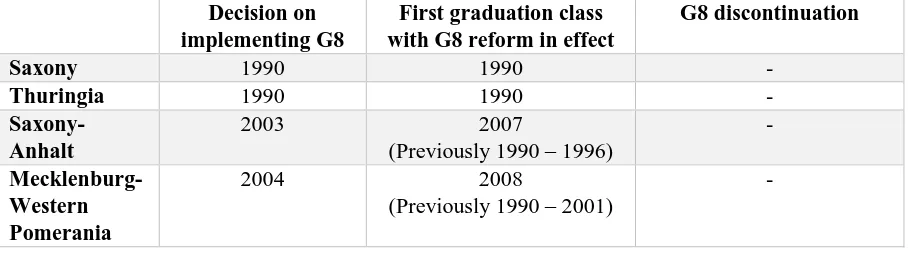
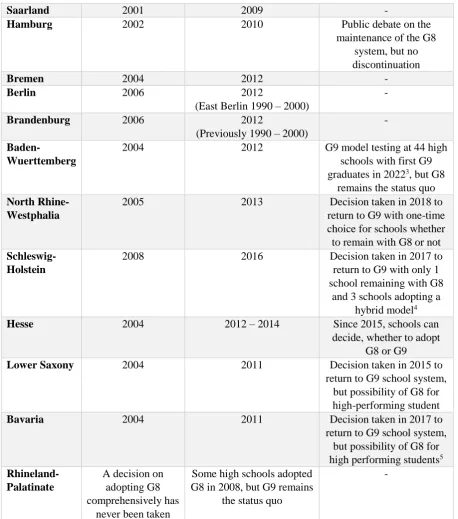
Table 1 gives an overview on the implementation and discontinuation of the G8 upper secondary school reform in the population of 16 Bundesländer; two of them, Saxony and Thuringia always had a high school duration of eight years and showed no efforts to terminate the reform. Out of this population, the samples were selected from the ten western
Bundesländer, that adopted the G8 reform from 2001 until 2008, and according to whether G8 has been discontinued between 2008 and 2019 or not. In addition, this research focuses on G8 discontinuation with regard to the Gymnasium only as the G8/G9 debate does not primarily apply for the integrated comprehensive schools of secondary education.
Decision on implementing G8
First graduation class with G8 reform in effect
G8 discontinuation
Saxony 1990 1990 -
Thuringia 1990 1990 -
Saxony-Anhalt
2003 2007
(Previously 1990 – 1996)
-
Mecklenburg-Western Pomerania
2004 2008
(Previously 1990 – 2001)
[image:13.595.72.527.656.783.2]10
Saarland 2001 2009 -
Hamburg 2002 2010 Public debate on the
maintenance of the G8 system, but no discontinuation
Bremen 2004 2012 -
Berlin 2006 2012
(East Berlin 1990 – 2000)
-
Brandenburg 2006 2012
(Previously 1990 – 2000)
-
Baden-Wuerttemberg
2004 2012 G9 model testing at 44 high
schools with first G9 graduates in 20223, but G8
remains the status quo
North Rhine-Westphalia
2005 2013 Decision taken in 2018 to
return to G9 with one-time choice for schools whether to remain with G8 or not
Schleswig-Holstein
2008 2016 Decision taken in 2017 to
return to G9 with only 1 school remaining with G8
and 3 schools adopting a hybrid model4
Hesse 2004 2012 – 2014 Since 2015, schools can
decide, whether to adopt G8 or G9
Lower Saxony 2004 2011 Decision taken in 2015 to
return to G9 school system, but possibility of G8 for high-performing student
Bavaria 2004 2011 Decision taken in 2017 to
return to G9 school system, but possibility of G8 for high performing students5
Rhineland-Palatinate
A decision on adopting G8 comprehensively has
never been taken
Some high schools adopted G8 in 2008, but G9 remains
the status quo
[image:14.595.70.529.68.588.2]-
Table 1. Overview of G8 implementation and discontinuation
3Cf. Huebener, M. & Marcus, J. (2015). Auswirkungen der G8-Schulzeitverkürzung: Erhöhte Zahl von
Klassenwiederholungen, aber jüngere und nicht weniger Abiturienten. DIW-Wochenbericht 82(18): 447-456. 4 Cf. Landesportal Schleswig-Holstein. (n.d.). Zurück zum Abitur nach neun Jahren. Retrieved from
https://www.schleswig-holstein.de/DE/Fachinhalte/S/schulsystem/rueckkehr_gymnasium9.html on 24th February 2019.
5 Cf. Kain, A. (2017, April 6). Ab 2018/2019: CSU-Landtagsfraktion beschließt Rückkehr zum G9. Passauer
11 Based on this overview, there are four western Bundesländer that decided upon a reversion to the G9 model (Lower Saxony, Bavaria, Schleswig-Holstein, North Rhine-Westphalia), one western Bundesland that introduced a hybrid G8/G9 model serving as a special case (Hesse), and four western Bundesländer (Saarland, Hamburg, Bremen, Baden-Wuerttemberg), that kept the G8 school reform.
The cases attached to each category are diverse, and “are attended to represent the full range of values characterising X, Y, or some particular X/Y relationship” (Seawright & Gerring, 2008), here the relationship between the triggering factors of policy termination and G8 discontinuation. By choosing one case from each category, the sample has not been selected randomly, thus bearing the danger of selection bias (Seawright & Gerring, 2008). However, they have been selected purposively to generate explanations on the theoretical expectations. Having selected the extreme case of Lower Saxony, where G8 has comprehensively been terminated at the Gymnasium without exceptions, this creates an important determinant for the impact of the assumed termination triggering factors. In contrast, Hamburg serves as the opposite case where the status quo of keeping the G8 model at the Gymnasium prevailed. In the case of Hesse, the discontinuation has no comprehensive character as upper secondary schools might choose to keep G8 or adopt the G9 model.
For Lower Saxony, the impact of changed ideological positions and perceived policy failure is expected to be strong in having led to a decision towards policy termination, while it is expected to be weaker in the case of Hesse, where the decision-making outcome has been the introduction of a hybrid G8/G9 model. As the G8 model has been kept at upper secondary schools in Hamburg, the triggering factors are expected to be absent or less predominant here than in Lower Saxony or Hesse, thus presuming that explanations for their impact on G8 discontinuation can be provided.
3.3 Operationalisation
12 liberalism, but for a multi-party system like in Germany and its Bundesländer, it must be assumed that each party shares further facets of ideology, traditionally being either conservatism, liberalism or socialism. Therefore, it needs to be further assumed, that each party represents its own ideology. The position that each political party takes can either be in support of the G8 reform to be implemented or maintained, for a change of the G8 policy implementation or the discontinuation of the G8 reform, e.g. by proposing the introduction of an alternative model.
For operationalising perceived policy failure, it is important to consider the degree to which the G8 reform has not met its intended goals, with the main goal being an earlier labour market participation of German students and thus an improvement of their competitiveness in international comparison. Secondly, the perceived policy failure can refer to problems regarding the implementation of the reform. This research therefore regards the perceptions of interest groups such as representations of teachers, school principals, students and parents as reference point for the perception of policy failure. Failure itself needs to be regarded as a judgement about a policy event, and thus depends on the context (Bovens and ‘t Hart, 1996: 21, as cited in McConnell, 2015). Therefore, the state-specific context of the G8 reform needs to be considered in assessing the perceived policy failure of the G8 reform. Despite differing perceptions, this research measures the public perception of policy failure on the basis of semi-structured expert interviews or open surveys, that were to be conducted with bureaucrats from the respective Ministry of Education and the Arts in order to provide objectivity to some degree. Again, the perception on the G8 policy can either be considered as supportive or opposing, while some more weight should be given to the perceptions of teachers, parents and students, since they are the main affected stakeholders of the G8 reform.
13
3.4 Data collection
In a first step, secondary data have been collected to reconstruct the federal state-specific context of the G8 reform for each case by using online documents, websites, press releases and newspaper articles in the given time setting between 2001 and 2019. As this thesis is designed as a multiple case study, the federal state-specific context provides for a better understanding of the cases (Yin, 2003: 13, as cited in Creswell, 2007). The information has been gathered via Google Search by means of certain key items that relate to the G8 policy in the respective
Bundesland. Thus, it has been possible to provide a contextual overview over the main stakeholders and the pertinent elements of the respective educational system, before the data collection on the variables of interest took place. Nevertheless, the secondary data collected for each Bundesland also contained information that was used to support the assessment of the perceived policy failure from stakeholders such as teachers, school principals, students and parents.
In order to collect data on the changed ideological positions on G8, additional secondary data have been acquired through a content analysis. Therefore, political party statements as in election programmes and coalition agreements have been selected by their explicit or implicit reference to the G8 school reform. More precisely, they have been scanned on certain key items, such as “G8”, “G9”, “Schulzeit”, “Schulzeitverkürzung” or “Abitur nach 12 Jahren”. To provide a better overview of the ideological positions, the selected statements from the political parties have further been translated from German into English and summarised in tables for each political party (Appendix A). While for the Landtag, all political parties that have permanently been represented between the time of G8 implementation and G8 discontinuation were considered, the change of ideological positioning has also been assessed by political parties agreeing on forming a coalition government, where two or more political parties might have changed their initial positioning on the G8 reform as stated in their respective election programme.
14 the introduction of the reform have been met. Semi-structured interviews therefore “allow[s] the interviewer or interviewee to diverge in order to pursue an idea or response in more detail” (Gill et al., 2008), while the prepared questions provide some guidance for the respondent in advance. The duration of each interview was expected to take between 15 and 25 minutes and to be conducted either as face-to-face or telephone interview. In fact, only one respondent has been interviewed face-to-face for Lower Saxony, while no interview partner could be found for Hesse and Hamburg. In this case, the respective respondent has been asked to fill out an open survey addressing the same questions as intended for the interview.
However, a survey deprives the possibility to ask the respondent further questions or to go in more detail at one point or another. As a consequence, a survey may eventually provide less information on the topic of interest than an interview. To complement the information given by the interviewee or respondent and ensure the objectivity of the collected data, the federal state-specific context has been taken into consideration and a triangulation of methods has been used (cf. Yin, 2004). In addition, while the Hessian respondent agreed on answering the questions in an open survey, a respondent for the Ministry of Education and the Arts of Hamburg could not be found for the open survey either. Thus, secondary data have additionally been gathered via Google Search with regard to the representations of teachers, school principals, parents and students in Hamburg to compensate for the lack of information.
3.5 Data analysis
The findings on both variables have been generated through a qualitative content analysis. For the change of ideological positions, the statements referring to the G8 reform have been extracted from election programmes and coalition agreements, which have then been translated from German into English (Appendix A). Further, these statements have been coded descriptively and partially in-vivo, and categorised as either supportive towards the G8 reform (‘G8 introduction’ or ‘G8 maintenance’) or opposing the G8 policy (‘G8 discontinuation’ or ‘G9 maintenance’). For Hesse, there has been an additional category, which encompasses statements that are in support of a parallel offer of the G8 and the G9 model. However, not every statement from the considered election programmes and coalition agreements did clearly refer to the introduction, maintenance or discontinuation of the G8 reform, so that categories could not be assigned to each political party for each legislative period.
15 (Appendix C). These descriptive codes summarised either a perception of policy failure or perceived success of the G8 reform.
4. Findings
In the following section, the federal state-specific context of the G8 reform and interim findings for each selected case will be presented.
4.1 Federal state-specific context of the G8 reform
The context in which the G8 reform policy has been implemented differs in each Bundesland. Therefore, the following sub-sections will briefly provide an overview on the development of the G8 discontinuation process in each case.
4.1.1 Lower Saxony
The Niedersächsischer Landtag decided on the G8 upper secondary school reform to be introduced in 2004 under the coalition government of Christian Democrats (CDU) and Liberals (FDP) at that time (Spiegel Online, 2015). Since its introduction, the G8 reform has been highly disputed in Lower Saxony as students, parents and teachers complained about higher stress and work overload (Süddeutsche Zeitung, 2014). While the first graduates attained the G8-Abitur in 2011, the termination of the G8 policy and comprehensive reversion to the G9 model has then been decided in 2015 by the Landtag under the coalition government of Social Democrats (SPD) and Greens (Spiegel Online, 2015). Nevertheless, this reversion to the G9 model is considered a reform itself and still offers the choice for high-performing students to already attain the Abitur after twelve years of school (Süddeutsche Zeitung, 2014). After the federal state government (Landesregierung) launched a dialogue process in 2013, a forum called “Gymnasien gemeinsam stärken” clearly voted in favour of attaining the Abitur after 13 years of school again, which then has been approved by an expert commission in 2014 (Niedersächsisches Kultusministerium, 2016). The G9 reform came into effect with the 2015/16 school year comprising the grades five until eight, where the school duration got extended to one additional year while maintaining the subject matter (Spiegel Online, 2014a).
16 demanding the structural possibility for earlier Abitur attainment of students who favour G8 (Niedersächsische Direktorenvereinigung, 2014). According to the former Minister of Education and the Arts, Frauke Heiligenstadt, there arised no further criticism on the ‘new G9’ during the legislative procedure, which would further underline the legitimacy of the decision (Kohlmaier, 2015). Whereas Heiligenstadt admitted that there was a shortage of teachers that were needed for one additional school year, strengths of the decision to introduce the G9 model would lie in new elements of future-oriented education with regard to digital media and information, the reduction of the mandatory timetable and career guidance including practical training (Hannoversche Allgemeine, 2016).
4.1.2 Hesse
In the case of Hesse, the decision on an eight-year Gymnasium leading to the Abitur has been made in 2004 by the Hessischer Landtag with the absolute majority of the CDU fraction that formed the government at that time (Trautsch, 2014). Although the Hessian philologists’ association (Hessischer Philologenverband), the state parent advisory council ( Landeseltern-beirat), and the state pupils’ representative body (Landesschülervertretung) warned in a joined press conference against introducing the G8 reform prior to the decision in 2014, the federal state government has been determined to shorten the schooling duration at the Gymnasium. In addition, the Minister President of Hesse from 1999 until 2010, Roland Koch, has been known to defend a position close to business when it comes to education, therefore supporting the transfer of economic standards on educational policy (Trautsch, 2014).
17 In June 2012, after the first G8 cohorts attained the Abitur, the incumbent Minister President of Hesse, Volker Bouffier, indicated that he wants to allow high schools to offer G9 again (Trautsch, 2014). The first Hessian Abitur graduates with the hybrid G8/G9 model to have come into effect are expected to graduate in 2020 (Huebener & Marcus, 2015). However, while most of the upper secondary schools have returned to the G9 model and some maintained G8, the offer of both G8 and G9 at one school has been viewed as a ‘fissure’ of the school landscape (Wettlaufer-Pohl, 2012). At schools which decided to participate in a parallel offer of G8 and G9, a school experiment provides that all students in the 5th and 6th grade start under G8 conditions and that after a monitoring and orientation phase, a decision on either the eight-year or the nine-year course of education should be made by the parents under advice from the teaching staff (Hessisches Kultusministerium, n.d.).
4.1.3 Free and Hanseatic City of Hamburg
The decision to introduce the G8 upper secondary school reform in Hamburg has been made in 2002 by the coalition government of CDU, FDP, and the so-called Partei Rechtsstaatlicher Offensive (PRO) under former CDU mayor Ole von Beust (Spiegel Online, 2014b). Since 2010, the Abitur can be attained after eight years at the Gymnasium (Huebener and Marcus, 2015) and still after nine years at the so-called Stadtteilschule, the integrated comprehensive type of school in Hamburg (Freie und Hansestadt Hamburg, 2013). Both the Gymnasium and the
Stadtteilschule form the ‘two pillars’ of secondary education in Hamburg (Norddeutscher Rundfunk, 2019). A people’s initiative called ‘G9-Jetzt-HH’ has been founded by parents in 2014 who demanded that the upper secondary schools should offer free choice between G8 and G9 (Spiegel Online, 2014b). In contrast, the Elternkammer6 declared itself in favour of the eight-year Gymnasium in 2014 stating that investments in the school quality were more important than re-introducing G9 (Elternkammer Hamburg, 2014).
The Senator for Schools, Ties Rabe, proposed to ask the school councils on their opinion regarding the reversion to the G9 model during a negotiation between the SPD parliamentary group and the G9 initiative in March 2014 (Freie und Hansestadt Hamburg, 2014a). As the school councils were the most important committees of each school – consisting of democratically elected representatives of parents, students and teachers –, it is highly engaged in the decision-making and implementation processes of school reforms (Freie und Hansestadt Hamburg, 2014a). After 53 out of 60 school councils gave their opinion on whether to adopt the G9 model in May 2014, the results showed that 87% of Hamburg’s upper secondary schools
18 are against the reversion to G9, while 11% were in favour of it (Freie und Hansestadt Hamburg, 2014b). In addition, next to the Elternkammer, other representational organs such as the students’ chamber (Schülerkammer), the teachers’ chamber (Lehrerkammer), the State School Advisory Board (Landesschulbeirat) and both teachers’ trade unions gave a statement against
the reversion to the G9 model and in favour of maintaining the Abitur after eight years of upper secondary education (Freie und Hansestadt Hamburg, 2014b).
Concerning the politicisation of the G8 reform in Hamburg, it is further important to note that the CDU, SPD and the Greens have agreed on the so-called Schulfrieden in 2010, which is going to expire in 2020. This agreement forbids the mentioned parties to take any changes in the educational landscape for a time frame of ten years (Meyer, 2017). After a people’s initiative on the reversion to G9 failed in 2014 due to the lack of support (Meyer, 2017), the G8/G9 debate is expected to appear as an election issue for the upcoming Bürgerschaftswahl 2020 again (Norddeutscher Rundfunk, 2018). While the Hamburgian CDU fraction appears to be in favour of G9 reversion, the SPD, Greens and FDP oppose G8 discontinuation at the Gymnasium, because they fear a weakening of the Stadtteilschule, where the Abitur can still be attained after nine years of high school (Meyer, 2018).
Advocates of the Schulfrieden argue for its extension because student performances have improved over the last years and renewed intervention in the form of G9 reversion would do damage to this positively perceived trend (Meyer, 2019). Furthermore, next to the ‘G9-jetzt-HH’ initiative, the ‘Initiative Schulfrieden’ has been founded in response to the G9 supporters and argued the case for a maintenance of the G8 model at the Hamburg Gymnasien as they profess the ‘two pillars’ of Hamburg’s educational system as best practice and oppose an intervention through further reforms (cf. Initiative Schulfrieden, 2014).
4.2 Interim findings on Lower Saxony
In Lower Saxony, the Niedersächsischer Landtag as federal state parliament is the decision-maker on G8 discontinuation. Firstly, the interim findings on the change of ideological positions of the political parties represented in the Landtag and the political parties forming the federal state government (Landesregierung) will be presented. Secondly, the perceived policy failure with regard to the G8 reform in Lower Saxony will be outlined.
4.2.1 Change of ideological positions
19 the latest elections in 2017 by means of their election programmes. Between 2003, the election before a decision on introducing G8 has been made by the federal state parliament, over 2013, before the discontinuation of G8 has been decided, and 2017, as the latest election, the following parties have been permanently represented in the Niedersächsischer Landtag: CDU, SPD, FDP, and the Greens. The considered time frame extends from the 15th (2003 – 2008) to the 18th legislative period (2017 – 2022) of the Landtag. Hence, parties that have been represented in the Landtag for just one or two legislative periods will be disregarded as they do not allow for a comparison of ideological positions.
The Christlich Demokratische Union Deutschlands (CDU) of Lower Saxony explicitly demanded the school duration of the Gymnasium to be shortened to eight years in their election programme of 2003. In 2008, the CDU stressed its support for the prior restructuring of the educational system including the introduction of G8, although the latter has not explicitly been mentioned. By referring to the OECD’s international school performance study with findings on Lower Saxon high school students to have improved in their 2013 election programme, the CDU further assesses the educational policy changes since 2003 as a success. However, in 2015, the SPD-led federal state government changed the school law and reintroduced the G9 model for upper secondary schools. As a consequence, the election programmes of 2017 show how the parties positioned themselves on this decision. Therefore, the CDU firstly proposes concrete measures of how to manage the transition from G8 to G9 with regard to the double cohort in the school year 2020/21. Further, the Lower Saxon CDU proposes measures relating to the ‘future prospects of Abitur graduates’ (CDU Niedersachsen, 2017, p. 24), in suggesting an increase of schooling time for economic and MINT subjects as well as foreign languages. Also, it has been proposed by the CDU to allow ‘high-performing students’ to have sufficient support and the possibility to attain the Abitur after eight years at the Gymnasium.
In 2003, the Lower Saxon state association of the Sozialdemokratische Partei Deutschlands
20 however, the SPD as the leading federal state government party welcomes the reintroduction of the G9 model in Lower Saxony.
The Freie Demokratische Partei (FDP) of Lower Saxony states in its 2003 election programme for the Landtag that the PISA studies revealed educational inefficiencies, that require a shift in schooling policy. Thus, its position in 2003 is favouring the introduction of the G8 school reform, although it is not explicitly mentioned. For the elections five years afterwards, in 2008, the FDP clearly refers to the introduction of G8 as ‘the Abitur [that] can now already be achieved after 12 years of school’ (FDP Niedersachsen, 2008, p. 22) to be an improvement to the educational landscape. Since 2013, the FDP took a stance of the best practice for the educational system to not introduce any further reforms, which would apparently include the abolition of an existing practice such as G8, though the policy itself is not mentioned here explicitly either.
The Greens or Bündnis 90/Die Grünen of Lower Saxony appear to have opposed the introduction of the G8 upper secondary school reform back in 2003 as they state to reject early selection procedures and ‘turbo classes’ leading up to the Abitur (Bündnis 90/Die Grünen Niedersachsen, 2003, p. 6). In 2008, the Greens proposed a major reorganisation of the educational system with the upper school stage (gymnasiale Oberstufe) to be redesigned in accordance with new pedagogical concepts of individual and cooperative learning, thus turning away from addressing the G8/G9 debate directly. Referring to the lesser time that students had to voluntarily engage in youth organisations or follow their hobbies, the Greens blame the ‘Abitur after 12 years’ in their 2013 election programme to keep young people from developing themselves freely. By demanding to extend the schooling time again, the Greens take a position in 2013 to terminate the G8 reform policy. This position has been reinforced by the Greens in 2017, stating that with the transition from G8 to G9, they would have created more learning time and dismantled stress at school (Bündnis 90/Die Grünen Niedersachsen, 2017, p. 57).
21 but established a coalition government with the CDU. The respective coalition agreements will demonstrate how the coalition parties have maintained or changed their positions stated in the election programmes, but more importantly, how the respective Landesregierung has positioned itself on the G8 upper secondary school reform over time.
The coalition government of CDU and FDP agreed in 2003 on introducing the G8 model for the Gymnasium comprehensively. In 2008, the coalition government of CDU and FDP continued and committed itself to the further profiling of each individual school type. In the context of maintaining the G8 model at the Gymnasium, the yellow-black Landesregierung
further aimed at increasing the quality of teaching while also reducing the quantity of mandatory schooling hours per week leading up to the Abitur. The SPD-led coalition government formed in 2013 presents itself with openness towards a reversion to the G9 model at the Gymnasium, planning to discuss feasible measurements for a possible transition from G8 to G9 with those affected by the educational reform. The joined position of SPD and Greens in this coalition agreement appears to primarily reflect the statement of the Greens in their 2013 election programme as they have not been in favour of maintaining the ‘Abitur after 12 years’ at the
Gymnasium due to lesser time for students to develop themselves freely and engage in free-time activities. In contrast, the SPD stated in its 2013 election programme that both G8 and G9 were already available by choosing either the Gymnasium or the Gesamtschule. After the G8 educational model has been discontinued in2015, the coalition government of SPD and CDU formed in 2017 professes the G9 reversion at the Gymnasium, but also commits itself to establish further possibilities for students to attain the Abitur ‘on an accelerated way’ (SPD Niedersachsen & CDU Niedersachsen, 2017, p. 11).
4.2.2 Perceived policy failure
22 model. Other innovative elements of the G9 model introduced in 2015 were the strengthening of the so-called MINT7 subjects and the earlier introduction of the subject Politics and Economy in the 8th grade with an extended aggregate of tuition hours per week (Appendix B). Furthermore, the interviewee characterises the debate on the G8 reform as ‘curative’ for the educational system of Lower Saxony because some weaknesses and traditions would have been questioned more radically (Appendix B).
In 1999/2000, the first turning point towards the G8 reform has been marked by the PISA study results leading to the perception that the age of German students, in which they enter the labour market, was too high on average. Thus, the wish came up to harmonise the educational system with European practices where the school years were less (Appendix B). For instance, the employer association Unternehmerverbände Niedersachsen e.V. or Niedersachsenmetall
declared themselves in favour of G8 at the turn of the millennium. In addition, the support towards G8 also arose from almost every political party in Lower Saxony, and eventually even from the SPD with the former First Minister of Lower Saxony, Sigmar Gabriel (Appendix B). With the federal state government formed by the Christian Democrats and the Liberals in 2003, which were two of the strongest supporters of introducing the G8 reform, the way of abandoning the attainment of the Abitur after nine years at the Gymnasium has been paved. The interviewee recalls that only the Gewerkschaft für Erziehung und Wissenschaft, a German education union, warned against introducing the G8 reform at that time (Appendix B).
The results of the first double cohort in 2011 and the cohorts of the two following years have shown, that students’ performances were not worse than the performances of G9 students. Nevertheless, there has been a public change of mood in 2012/13, according to the interviewee (Appendix B). Thus, particularly parents and students have indicated that the time for students to engage in voluntary activities at school or free-time activities in the afternoon outside school was not sufficient. In addition, students would have to put more effort in learning, although the performances have been the same in comparison to G9 students (Appendix B). Interestingly to note here is that the initial supporters of G8 in 2004 were the ones that demanded a reversion to G9 immediately after the public change of mood in 2012/13, because Abitur graduates began to be perceived as not mature enough to start a vocational training or to enrol at university. For instance, the Niedersächsischer Philologenverband as the main teachers’ association, which
23 strongly advocated the introduction of G8 in 2003/04, quickly decided to intensively advocate the reversion to G9 in 2012/13 (Appendix B).
Whereas the teaching staff of the Gymnasium is primarily represented in the Niedersächsischer Philologenverband with 8,000 members out of 18,000 upper secondary school teaching staff in total, a smaller percentage of upper secondary school teaching staff is member of the
Gewerkschaft für Erziehung und Wissenschaft (GEW), which is part of the Federation of German Trade Unions. While the GEW is more left-wing-oriented and always opposed the G8 reform, the Philologenverband is characterised by the interviewee as a conservative-oriented association, which has been the strongest advocate of the G8 reform (Appendix B). The main representations of parents and students, the Landeselternrat and the Landesschülerrat, were both part of the task force, which has been established after the federal state parliament elections of 2013 to discuss the possibilities of G8 maintenance, G8 modification or G9 reversion. At this point of time there has already been a discussion on the maintenance of the G8 reform in other Bundesländer, with the eastern federal states as exception, according to the interviewee (Appendix B). While the Landeselternrat has decided on neither option, the Landesschülerrat
strongly advocated a reversion to G9. Further, the interviewee remarks that suddenly a mainstream of advocating G9 emerged and that with the support of both employer associations and the Federation of German Trade Unions, the Minister of Education decided on the reversion to G9 in March 2014 (Appendix B).
24
4.3 Interim findings on Hesse
In Hesse, the Hessischer Landtag as federal state parliament is the decision-maker on G8 discontinuation. Firstly, the interim findings on the change of ideological positions of the political parties represented in the Landtag and the political parties forming the federal state government (Landesregierung) will be presented. Secondly, the perceived policy failure with regard to the G8 reform in Hesse will be outlined.
4.3.1 Change of ideological positions
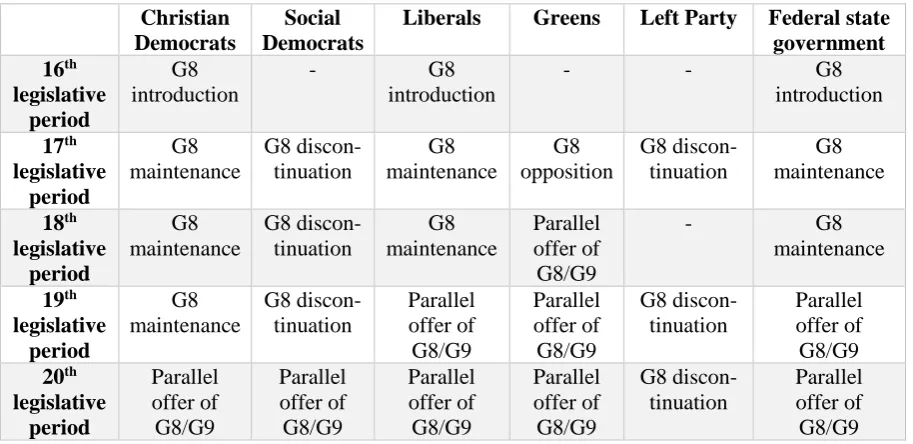
For the change of ideological positions in Hesse, the following paragraphs will at first show the change in positions of the political parties represented in the Landtag from 2003 to the latest elections in 2018 by means of the election programmes. Between 2003, the election before a decision on introducing G8 has been made by the federal state parliament, over 2013, before the hybrid G8/G9 model has been introduced, and 2018, as the latest election, the following parties have been permanently represented in the Hessischer Landtag: CDU, SPD, FDP, Greens, and since 2008 the Left. The considered time frame extends from the 16th (2003 – 2008) to the 20th legislative period (2018 – 2023) of the Landtag.
25 CDU Hessen has changed from full support for the G8 model in 2003 to admitting mistakes and taking measures towards a parallel offer of both G8 and G9 in 2018.
Regarding the positioning of the Hessian SPD on the G8 reform, its 2003 election programme refers to the PISA study results as well. However, from these results the SPD does not conclude – in contrast to other Hessian political parties – the shortening of school duration to be implemented at the Gymnasium. Instead it proposes measures to increase educational justice, for instance. In 2008, the SPD explicitly refers to the G8 reform by intending to bring about its discontinuation. Nevertheless, students at the Gymnasium should still have the possibility to ‘attain the Abitur after twelve years’ (SPD Hessen, 2008, p. 48). This position has been affirmed in the 2009 election programme again by stating that the SPD wants to end ‘the G8 school stress’ and that they will ‘relieve students as well as parents and create permeability again through the abolition of G8’ (SPD Hessen, 2009, p. 5). The notion of the G8 reform to be connected to ‘stress’ from which the affected need to be ‘relieved’ appears interestingly to note here. For their 2013 election programme, the SPD maintains its position of opposing the G8 reform calling it the ‘failed G8 experiment’ (SPD Hessen, 2013, p. 13), which they criticise for not taking into account the different learning speeds and abilities of students. In 2018, the Hessian SPD election programme again emphasises the strong commitment to ‘the Abitur after 13 years at school’ (SPD Hessen, 2018, p. 22) at both the Gymnasium and the Gesamtschule. Further, while implicitly referring to the G9 model as ‘the normal case and a meaningful basis for attaining the Abitur’ (SPD Hessen, 2018, p. 22), students shall receive further opportunities to pass the upper class (Oberstufe) in a time frame that corresponds to individual preferences and learning speed.
26 opposing a prescribed reversion to G9 due to the freedom and autonomy that were to be granted for the schools (FDP Hessen, 2013, p. 5). Although the G8/G9 debate is not mentioned in their 2018 election programme, the FDP still adheres to greater autonomy and responsibility for schools (FDP Hessen, 2018, p. 4). Therefore, the FDP slightly changed its position from aiming at a comprehensive introduction of the G8 model in 2003 to granting schools the choice, whether to adopt G8 or G9 from 2013 on.
Whereas the G8 reform is neither mentioned explicitly nor implicitly in their 2003 election programme, the Hessian fraction of the Green party sees significant problems such as an overload for students connected to the shortening of school time from nine to eight years at the
Gymnasium in 2008 (Bündnis 90/Die Grünen Hessen, 2008, p. 20). Furthermore, the opportunity of students to attain the Abitur after twelve or thirteen years at the Gymnasium is favoured in the Greens’ election programme of 2009 (Bündnis 90/Die Grünen Hessen, 2009, p. 24). In 2013, the Greens still profess the freedom of choice between G8 and G9, while also proposing a further development of the structuring of the G8 model. According to the Greens, the G8 reform has been introduced in an ‘abysmal manner’ in Hesse, speaking of schools still ‘suffering’ from the flawed implementation. In addition, the Greens position themselves against a reversion to G9 that is ‘dictated from above’ (Bündnis 90/Die Grünen Hessen, 2013, p. 33 f.). This positioning towards a hybrid G8/G9 model does not change with the 2018 election programme. It appears that the Greens have changed their support from opposing the shortening of school time in 2008 to delegating the choice to the schools, students and parents on which model is the most fitting for them from 2013 on.
27 During the 16th (2003 – 2008) and 17th legislative period (2008 – 2009), the CDU had an absolute majority in the Hessischer Landtag. Thus, the goals set in the respective election programmes are sufficient for assessing the positioning of the Landesregierung for this time frame. In this sense, coalition agreements only exist for the 18th (2009 – 2014), the 19th (2014 – 2018), and the 20th legislative period (2018 – 2023). The respective coalition agreements will demonstrate how the coalition parties have maintained or changed their positions as stated in their election programmes, but more importantly, how the Landesregierung of Hesse has positioned itself on the G8 upper secondary school reform over time.
Having attained the absolute majority of seats in the Hessian parliament, the positions of the CDU in their 2003 and 2008 election programmes reflect the positions of the Landesregierung
of Hesse during the 16th and 17th legislative period, which are clearly in support of the G8 upper secondary school reform. In 2009, the coalition government of CDU and FDP announces measures implemented on the review of the G8 reform to be continued. While a freedom of choice between G8 and G9 has already been established for the cooperative comprehensive schools, the two political parties adhere to the G8 model at the Gymnasium (CDU Hessen & FDP Hessen, 2009, p. 30). This supportive position towards the G8 policy is consistent with the positions of the CDU and the FDP as stated in their election programmes for the 2009 Hessian state election. In 2014, the coalition government of Christian Democrats and Greens stated that next to the cooperative comprehensive schools, upper secondary schools should have a freedom of choice between G8 and G9 as well (CDU Hessen & Bündnis 90/Die Grünen Hessen, 2014, p. 29 f.). As the CDU has not mentioned the G8 reform in its 2013 election programme explicitly, the Green Party’s positioning seems to be predominant in this issue due to concrete measures being proposed in the coalition agreement regarding the transition processes at the affected schools, which also appear to reflect the goals set in the Green Party’s election programme of 2013. Finally, the 2018 coalition agreement between CDU Hessen and the Hessian Green Party still takes a position in favour of a parallel offer of G8 and G9 at the upper secondary schools (CDU Hessen & Bündnis 90/Die Grünen Hessen, 2018, p. 83). What is intriguing to note here is that the first sentence of the statement on G8 in the coalition agreement has been derived from the 2018 election programme of the Hessian CDU and the last sentence from the Green election programme of 2018.
4.3.2 Perceived policy failure
28 to avoid a double cohort in 2013 (Appendix B). Since the school year of 2013/2014, upper secondary schools have been able to choose between an intermediate level (Mittelstufe / Sekundarstufe I) that consists of five or six years. In addition, both upper secondary schools (Gymnasien) and cooperative comprehensive schools (kooperative Gesamtschulen) with a five-year course of education have been able to participate in a model experiment, within the scope of which G8 and G9 have been offered in parallel at the same school from the 7th grade on (Appendix B). Asking the respondent from the Ministry of Education and the Arts of Hesse (Hessisches Kultusministerium) about his personal assessment on the extent to which the expectations on the G8 reform have been fulfilled, he blinks the question in stating that the Hessian high schools have individually assessed and decided on the best educational practice in regard to G8, G9 or a parallel offer of both (Appendix B).
Regarding the public perception of the G8 reform since its introduction in 2004, the respondent states that it naturally evoked reactions from the public, to which the political side would have adequately reacted to (Appendix B). The criticism of the G8 reform particularly raised from parents was that the workload of students in the intermediate level has been quite burdensome and that there has been less time for students to engage in free-time activities due to the introduction of the reform (Appendix B). However, the tiered implementation of the shortening of school time at the Gymnasien has been regarded as successful by the respondent, with the three steps being pilot schools in the school year 2004/05 and then further schools in the two following school years. Thus, in contrast to other western federal states that have introduced G8, Hesse avoided a doubled number of applicants at universities and the apprenticeship market in 2013, which a double cohort of Abitur graduates would have caused. Instead, the number of additional Abitur graduates has been distributed over three cohorts (Appendix B).
As the largest teachers’ association in Hesse, the Hessischer Philologenverband with its 4,000 members took a position at its representative assembly in Fulda in 2007, that the introduction of the G8 reform has been a clear mistake, because the quantity of education has been reduced and the Abitur would have lost its qualitative value (Kister, 2007). Further, the chairman of the association, Knud Dittmann, denounced the enormous burden which students had to face due to the G8 reform. Also, it has been stated that the implementation of the reform has its problems with regard to the expectation of students attaining the Abitur in a shorter time frame and without loss in quality, because students had less time to learn and revise (Kister, 2007). Moreover, the other teachers’ association, the Gewerkschaft für Erziehung und Wissenschaft
29 2012). In 2012, the Hessischer Philologenverband formulated a resolution on the parallel offer of G8 and G9 at Hessian upper secondary schools, however, which positions the association in favour of granting the Gymnasien the freedom to choose between either G8 or G9, which has already been established for the cooperative comprehensive schools at that time (Hessischer Philologenverband, 2012).
The Landeselternbeirat as the main representation of Hessian parents in educational matters rectified the statements from the Kultusministerium, that the Landeselternbeirat would have approved the introduction of G8, where in fact the opposite would have been the case (Landeselternbeirat von Hessen, 2007). Considering that the approval for general rules with regard to educational goals and the course of education is needed from the Landeselternbeirat
(Hessisches Kultusministerium, n.d.), the apparently incorrect claim from the
Kultusministerium is not negligible. From its press release on G8, it becomes evident that the
Landeselternbeirat predicted several problems connected to the introduction of the reform, that would in fact have occurred quickly after the decision to implement G8 has been made (Landeselternbeirat von Hessen, 2007). Thus, the associations’ perception of policy failure does not primarily address the G8 reform itself but rather its implementation process. The deficiencies mentioned in particular are shortages in personnel, material and space resources at the Hessian upper secondary schools, which would inhibit the development of pedagogical concepts for G8 together with teachers, students and parents at the schools, which is why the
Landeselternbeirat demands strengthened action to address the fundamental causes of the ‘G8
problem’ (Landeselternbeirat von Hessen, 2007).
Regarding the representation of students, the Landesschülervertretung clearly positioned itself towards a reversion to G9, while showing understanding for many schools that lack the strength to implement ‘a reform of the reform’ (Gießener Allgemeine, 2012). The school principals of several Hessian municipalities have decided not to change anything until summer 2013, although it would have legally been possible at that time. Whereas the school authorities warned against the introduction of G9 due to the increased need for further classrooms, the Hesse Trade Associations criticised the rushed introduction of a hybrid G8/G9 model, while being the only stakeholder to continue the support of the G8 model (Gießener Allgemeine, 2012).
30 the needs of students (Appendix B). However, with regard to the freedom of choice between G8 and G9, the Landeselternbeirat still opposed the ministry’s plans as about 89 percent of the Hessian parents would have favoured the nine-year course of education for their children, according to an educational study (Landeselternbeirat von Hessen, 2012). Also, it has been criticised that the freedom of choice has been granted to the schools and not the parents (Gießener Allgemeine, 2012). Instead of the maintenance of G8 for the 5th and 6th grade and a decision on either course of education from the 7th grade, the Landeselternbeirat proposed the nine-years course of education with the possibility to choose G8 from the upper school (Oberstufe) on (Landeselternbeirat von Hessen, 2012).
4.4 Interim findings on Hamburg
In Hamburg, the Hamburgische Bürgerschaft as federal state parliament is the decision-maker on G8 discontinuation. Firstly, the interim findings on the change of ideological positions of the political parties represented in the Bürgerschaft and the political parties forming the federal state government (Senat) will be presented. Secondly, the perceived policy failure with regard to the G8 reform in Hamburg will be outlined.
4.4.1 Change of ideological positions
For the change of ideological positions in Hamburg, the following paragraphs will at first show the change in positions of the political parties represented in the Bürgerschaft from 2001 to the latest elections in 2015 by means of the election programmes. Between 2001, the election before a decision on introducing G8 has been made by the federal state parliament, and 2015, as the latest election, the following parties have been permanently represented in the Hamburgische Bürgerschaft: CDU, SPD, and the Greens. The Liberals (FDP) and the Left Party have only been represented in the Bürgerschaft for three legislative periods between 2001 and 2019. However, in order to generate a comprehensive image of the changed ideological positions of the political fractions in the federal state parliament between 2001 and 2019, their positions will be considered as well. The considered time frame further extends from the 17th (2001 – 2004) to the 21st legislative period (2015 – 2020) of the Hamburgische Bürgerschaft.