http://wrap.warwick.ac.uk
Original citation:Zhang, Dongyang, Joy, Mike, Cosma, Georgina, Boyatt, Russell, Sinclair, Jane and Yau, Jane Yin-Kim. (2013) Source-code plagiarism in universities : a comparative study of student perspectives in China and the UK. Assessment & Evaluation in Higher Education . ISSN 0260-2938
Permanent WRAP url:
http://wrap.warwick.ac.uk/59516
Copyright and reuse:
The Warwick Research Archive Portal (WRAP) makes this work by researchers of the University of Warwick available open access under the following conditions. Copyright © and all moral rights to the version of the paper presented here belong to the individual author(s) and/or other copyright owners. To the extent reasonable and practicable the material made available in WRAP has been checked for eligibility before being made available.
Copies of full items can be used for personal research or study, educational, or not-for profit purposes without prior permission or charge. Provided that the authors, title and full bibliographic details are credited, a hyperlink and/or URL is given for the original metadata page and the content is not changed in any way.
Copyright statement:
"This is an Author's Accepted Manuscript of an article published in Zhang, Dongyang, Joy, Mike, Cosma, Georgina, Boyatt, Russell, Sinclair, Jane and Yau, Jane Yin-Kim. (2013) Source-code plagiarism in universities : a comparative study of student
perspectives in China and the UK. Assessment & Evaluation in Higher Education. ISSN 0260-2938 [© Taylor & Francis], available online at:
http://www.tandfonline.com/10.1080/02602938.2013.870122 "
A note on versions:
The version presented here may differ from the published version or, version of record, if you wish to cite this item you are advised to consult the publisher’s version. Please see the ‘permanent WRAP url’ above for details on accessing the published version and note that access may require a subscription.
Source-code plagiarism in universities – A comparative study of
student perspectives in China and the UK
D. Zhang
College of Information and Management Science, Henan Agricultural University, Zhengzhou, PR China
M.S. Joy
Department of Computer Science, University of Warwick, Coventry, UK
G. Cosma
School of Science and Technology, Nottingham Trent University, Nottingham, UK
R. Boyatt
Department of Computer Science, University of Warwick, Coventry, UK
J.E. Sinclair
Department of Computer Science, University of Warwick, Coventry, UK
J.Y-K. Yau
Department of Computer Science, Malmö University, Sweden
Correspondence address:
Dr. M.S. Joy
Department of Computer Science, University of Warwick, Coventry, CV4 7AL, UK [email protected]
Provide short biographical notes on all contributors here if the journal requires them.
Dongyong Zhang received her PhD from Reading University, UK. She is Associate Professor in the College of Information and Management Science, Henan Agricultural University, China. She has industrial and academic experience in both UK and China. Her research interests include industrial sustainability, and sustainable development of higher education.
Mike Joy received the PhD degree in computer science from the University of East Anglia. He is currently Associate Professor at the University of Warwick. His research interests focus on educational technology and computer science education.
Georgina Cosma received a PhD Degree in computer science from the University of Warwick, and a BSc computer science degree from Coventry University. She is currently a senior lecturer at Nottingham Trent University. Her research interests
include source-code similarity detection, information retrieval, artificial neural networks and other machine learning algorithms.
Russell Boyatt is a Research Associate in the University of Warwick’s Computer Science Department where he is also completing his PhD. His research interests include educational technology, software development and formal methods and he is currently working on the EU Lifelong Learning Project “MALog”, developing learning resources for mathematical logic. His work on educational technology includes online assessment, learning environments and source code plagiarism detection.
Jane Sinclair received her PhD in Computer Science at the Open University, UK. She is an Associate Professor in the Department of Computer Science at the University of Warwick. Her interests include educational technology, computer security and formal methods. Her published research relating to education covers a variety of topics
including plagiarism detection, the student perspective and the use of learning objects.
Source-code plagiarism in universities – A comparative study of
student perspectives in China and the UK
There has been much research and discussion relating to variations in plagiaristic activity observed in students from different demographic backgrounds. Differences in behaviour have been noted in many studies although the underlying reasons are still a matter of debate. Existing work focuses mainly on textual plagiarism and most often derives results by studying (small) groups of overseas students studying in a Western context. This study investigates understanding of source-code plagiarism (i.e. plagiarism of computer
programs) amongst university students in China. The survey instrument was a Chinese translation of a survey previously administered in English in the UK. This paper reports the results of the exploratory survey conducted in China and compares these results to those from the same survey conducted in the UK. The results show that there is a significant difference in understanding between the respondents from the two surveys, and suggest topics which a future and more comprehensive study may focus on.
Introduction
Plagiarism in the academic community is regarded as malpractice and much work has
been conducted on how to detect plagiarism, and how to prevent plagiarism by
educating students that it is unacceptable behaviour (Bradley, 2011; Twomey et al.,
2009). A large volume of pedagogic material is available on university websites and
other websites aimed at instructing students about plagiarism avoidance.
Detection tools and services such as Turnitin (submit.ac.uk) are available to
assist in the process of detecting plagiarism in student coursework consisting of essays
and dissertations.
In the computing disciplines, much coursework consists of computer programs,
and the source-code for these can be plagiarised in a similar way to the contents of an
essay. Tools exist to assist in plagiarism detection, such as MOSS (Bowyer and Hall,
1999), JPlag (Prechelt et al., 2002) and Sherlock (Joy and Luck, 1999), but such tools
are relatively immature, since these do not detect plagiarism sources originating from
the internet.
The incidence of (textual) plagiarism and the motives behind it have often been
viewed from a demographic and in particular, cultural, perspective. The IPPHEAE
project (“Impact of Policies for Plagiarism in Higher Education Across Europe” –
ippheae.eu) is currently comparing and evaluating the policies and procedures for
detecting and preventing plagiarism, within the countries of the EU, and it is hoped that
the further substantial data collected from both staff and students will shed light on the
international students in Western universities. For example, Bamford and Sergiou
(2005) obtained data from 35 international students at London Metropolitan University
over half of whom admitted to having plagiarised. Similarly, Bista (2011) studied
international students at a southern U.S. university while Qi (2008) reports a study
amongst Chinese first year undergraduates in another U.S. university. The general
position often presented is of a higher rate of plagiarism detected amongst international
students (Park, 2003). Indeed, the figures presented are often very stark: for example, Qi
(2008) refers to their own and five previous studies in which the majority of Chinese
students at foreign institutions surveyed had plagiarised. The reasons underlying these
findings are somewhat less clear. Hayes and Introna (2005), in a study involving around
100 postgraduate students from a variety of countries including the UK, China and
Greece, noted a number of possible factors. These include proficiency in written
English, different expectations relating to the examination process (in some countries,
for example, assessment is almost completely by written examination), and differing
understanding of the purpose of language. The latter is a theme explored in depth by
Pennycook (1996) who argues that there are different types and levels of repetition and
memorisation employed by Chinese learners, so that “a student's 'ownership' over a text
may have different causes and different effects” (ibid: 222). This is echoed in a more
recent study by Hu and Lei (2012: 818), who note that “memorization, repetition, and
imitation of authoritative texts are valued as legitimate learning strategies.”
Yakovchuk (2008), in a study of non-native university students in the UK,
further identifies a variety of reasons for plagiarising given by those students, including
content problems (lacking individual ideas, background knowledge or subject
ideas), and laziness. Of these, the only factor specific to international students seems to
be that relating to language. Gulliver and Tyson (2013), in a recent study at an
Australian university, also suggest that students often misunderstand institutional
policies on plagiarism, and note that many do not even read those policies even when
instructed to do so.
Many authors (for example, Sowden (2005) and Leask (2006)) have referred to
cultural influences which might lead to plagiarism. However, Liu (2005) cautions
against inferring that the incidence of plagiarism within certain identifiable groups is
symptomatic of cultural conditioning, and calls for further “extensive empirical
research” (ibid: 239). Liu questions assumptions about Chinese cultural influence,
arguing that plagiarism is not viewed as acceptable. He also notes that some differences
(such as a tradition of memorising and quoting accepted authorities) do exist but are not
in themselves explanations for plagiarism since attribution would still be expected. It is
certainly the case that many studies have been conducted in a context where the
“cultural outsiders” are also linguistic outsiders and hence it is difficult to separate the
two. Stone (2008), in a detailed analysis of Chinese perspectives on intellectual
property, scrutinises the reasons for intellectual property rights for the written word not
having been developed, and argues that ascribing these to the “Confucian tradition” is
“not persuasive” (ibid: 230).
In the context of source-code plagiarism, the dialogue is much less mature.
Instances of industrial plagiarism in China have been reported (Eaton, 2009; Patel,
2005), but data evidencing the incidence of student source-code plagiarism within
source-code plagiarism mostly lack analysis of student cultural or national background
(Chuda et al., 2012; Mann and Frew, 2006), although Sraka and Kaučič (2009) report a
small study conducted in Slovenia. In general, source-code plagiarism is seen to be just
as much of a problem as textual plagiarism, indeed, there is reason to believe that it may
give rise to greater confusion. Mann and Frew (2006) found that students viewed a
proportion of between 60% and 90% similarity in code to be acceptable. Chuda et al.
(2012) report that students who have a good understanding of textual plagiarism were
uncertain as to what constitutes plagiarism in source-code. Joy et al. (2011) discovered
widespread misunderstandings amongst students in the UK concerning certain aspects
of source-code plagiarism.
It would be difficult, if not impossible, to perform an accurate empirical study to
ascertain the comparative frequency of occurrence of source-code plagiarism between
student groups of different nationalities. The detection tools are imprecise, and it is
likely that many instances of source-code plagiarism go undetected or unreported.
Furthermore, access to data would likely be denied, both for ethical reasons, and by
restrictions imposed by institutional authorities.
An alternative approach, such as that adopted by Bamford and Sergiou (2005), is
to gather data direct from students and to ascertain their perceptions about source-code
plagiarism. There is a considerable amount of literature on plagiarism which states that
students with high ethical views who claim to understand about plagiarism are able to
avoid it, however a recent study by Risquez et al. (2011) contradicts this assumption
and suggests that experiential activities are required to reinforce students’
indicator of their understanding, but exploring this further is beyond the scope of this
paper.
The purpose of this paper is twofold. First, we report the results of an
exploratory study conducted with students in several universities in China, highlighting
areas of uncertainty and consistent misunderstanding concerning source-code
plagiarism. Secondly, we perform a comparison with the results of an equivalent study
delivered in the UK (Joy et al., 2011) and consider the implications for future work.
Methodology
This paper follows on from work by Joy et al. (2011) in which a questionnaire was
answered by 770 students in 18 institutions in the UK, and an equivalent
methodological approach to that followed in the current research was taken. Although
770 responses to the UK questionnaire were received, 615 of the respondents answered
“I am a UK student” in response to the question “Which of the following most
accurately describes your background?”, and the analysis here is restricted to that subset
of 615 responses in order to exclude Chinese and other non-UK students from that
sample. The first part of the questionnaire consisted of demographic questions, and the
second part consisted of 15 “scenarios” describing actions related to reusing and
referencing source-code. For each scenario the participants were asked to select one
response from the following Likert scale, to indicate whether or not they thought the
scenario was an example of plagiarism.
a) Yes, definitely;
d) I think it isn't, but I'm not completely sure; e) No, definitely not.
Prior to responding to the scenarios, the participants were reminded of what plagiarism
is, and were given the Wikipedia definition: “... the practice of claiming or implying
original authorship of (or incorporating material from) someone else's written or
creative work, in whole or in part, into one's own without adequate acknowledgement”
(the equivalent Chinese translation from Wikipedia was used in the Chinese survey).
Each of the 15 scenarios was scrutinised by at least 4 academics, experienced in
plagiarism detection and university disciplinary processes, to ensure that each scenario
was very clearly plagiarism or not plagiarism – there were no scenarios which were
“grey areas”. For example, the following scenario was used, and depicts an activity
which is clearly plagiarism, and the correct response is “Yes, definitely”.
“Andy is required to submit a Java applet program for his assignment. He
remembers reading about a similar applet program from a textbook he’s
been using. He goes to find this, and uses this code and then submits it as
his own program without noting that he obtained the code somewhere else.
Is this plagiarism?”
The responses were then coded, with +1.0 for a correct answer (which will
always be either a or e) and -1.0 for an incorrect answer (a or e), +0.5 or -0.5 for a (b or
d) answer, and 0 for (c). This approach allowed a clear description of student responses
to the correct answer, although it is recognised that a Likert scale is not an interval
scale. The original questionnaire was then translated into Chinese by a native speaker
and checked by a second, the Chinese translation was then re-translated back to English
to ensure the meaning had not been altered.
The questionnaire was then published as an on-line survey. A total of 159
responses were gathered from students at 30 universities throughout China, located in
Beijing (2), Shanghai (2), Tianjin (1), and the provinces of Guangdong (2), Hebei (5),
Henan (5), Hubei (1), Hunan (2), Jiangsu (2), Liaoning (1), Shaanxi (2), Shandong (1),
Sichuan (3) and Zhejiang (1) (the numbers of institutions in each location is included in
parentheses).
Data Analysis
The number of respondents (n=159) is sufficient for testing the hypothesis that there is
a difference in the perceptions of plagiarism by Chinese students as compared to UK /
European students. However, further detailed analysis is precluded by the sample size,
and by the voluntary nature of participation in the survey. Indeed, given the size of
China, one would expect regional differences in responses, and perhaps also differences
relating to the type of institution (research-led, regional, etc.). The respondents come
from provinces throughout China, and cover different types of university, including
regional teaching universities and nationally renowned research-led
institutions. 13 institutions are included in the “Project 211” list of 112 nationally
important key universities, 6 in the “Project 985” list of 39 top-ranking universities and
3 in the recently launched “Project 2011” which aims to promote universities'
universities and a few research centers. (Ministry of Education, 2006; 2013a; 2013b).
Although it is difficult to claim that the sample is a representative cross-section of
China students, it nevertheless covers a wide range of geographical locations and
institutional types, and is sufficient for the exploratory nature of this project. This
section presents an overview of the responses.
It is worth noting that of the 159 Chinese respondents, only 70 claimed to have
been informed about plagiarism by their institution, and 114 stated that they understood
what plagiarism meant. As noted above, all respondents were then provided with a
standard definition of plagiarism.
Overall scores
Each answer was allocated a mark in the range of {-1.0, -0.5, 0, +0.5, +1.0}. A total
score was calculated for each student by summing the marks for all their answers. The
total score scale ranged from -15 to +15, -15 allocated if all the responses were
incorrect, and +15 allocated if all responses were correct. The use of an interval scale
was in order to be able to clearly depict the student responses, since the point allocated
to each response gives an indication of how close the student was to the correct answer.
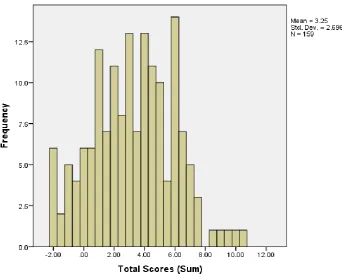
The majority of students (61.6%, n=98) received a total score in the range of
+0.5 and +5.0, 23.9% (n=38) received a total score in the range of +5.5 to +10.5 (10.5
being the highest score achieved by students), 14.5% (n=23) of students achieved a total
Figure 1: Histogram of total scores
Topic 1: Self-plagiarism
The fundamental issue with self-plagiarism is that previous work must be
acknowledged. Two scenarios were presented on the topic of self-plagiarism which
described different ways which a student copied and integrated source-code which they
had authored as part of a programming assignment for which they had gained academic
credit. Scenario 1a describes a case where the student has acknowledged (as a
source-code “comment”) the fact that they copied source-source-code from their own previous work –
this scenario does not constitute plagiarism – and scenario 1b describes a case where the
student has not acknowledged the fact that they copied source-code from their own
previous work – this scenario does constitute plagiarism.
The results for question 1a, revealed that 66.7% (n=106) of respondents
responded “I think it isn't, but I am not completely sure”, whereas the remaining
respondents (i.e. 13.2% (n=21)) answered incorrectly.
Concerning scenario 1b which describes a case where a student copied from one
of their previous source-code assignments without acknowledgement, only 3.8% (n=6)
answered correctly that plagiarism had definitely taken place, 9.4% (n=15) of the
respondents were unsure. The vast majority, 86.8% (n=138), answered incorrectly.
The results of scenarios 1a and 1b suggest that students perceive copying their
own work as not a plagiaristic activity, regardless of whether acknowledgement is
included in the code.
Topic 2: Copying code from books and other sources
Scenario 2a describes a case of plagiarism where a student copied source-code from a
book without acknowledging this fact. Surprisingly, only 25.8% (n=41) of the
respondents believed that this action constitutes plagiarism and only 28.3% (n=45)
thought it was plagiarism but were not completely sure. The remaining 45.9% (n=73) of
the respondents answered incorrectly.
Scenario 2d describes a case where a student read some books for gaining
inspiration and then produced their own source-code not acknowledging any of the
sources they used to gain the inspiration. Since no copying was involved this scenario
this scenario was not plagiarism, whereas 32.3% (n=53) thought that this scenario did
not describe plagiarism but were uncertain. The remaining 32.1% (n=51) answered
incorrectly.
Both scenarios 2a and 2d, involve cases where the student did not provide
references, but the main distinction between the two is that the first scenario, 2a,
describes a clear act of plagiarism about copying source-code from a book, whereas the
second scenario, 2d, describes a case where the student consults books for inspiration
and does not copy any source-code. Although it would have been appropriate for the
student to add a note about the books they used for inspiration, this scenario does not
describe a plagiarist activity. The results show that the majority of students understand
that reading for inspiration does not constitute plagiarism but are unclear whether
copying without referencing constitutes plagiarism.
Scenario 2e describes a case where students had performed a group project and
had ensured that all source-code reuse was acknowledged. The results for this scenario
revealed that the majority, 64.2% (n=102) of the respondents have a clear
understanding that referencing work produced as part of a group does not constitute
plagiarism, and a further 23.3% (n=37) were unsure. In conclusion, the majority of
respondents have a clear understanding that copying work and referencing it does not
constitute plagiarism (2e), however the majority of respondents incorrectly regard the
act of reusing someone else’s work without providing references as not plagiarism (2a).
Scenario 2c describes a similar scenario to 2e where a group of students
all other reused material. 57.9% (n=92) of students responded correctly that this
scenario does not constitute plagiarism, 32.7% (n=52) of students think that the
scenario is not plagiarism but are not completely sure. The remaining 9.4% (n=15) of
the respondents answered incorrectly.
Scenario 2b (q12) describes an act of plagiarism where a student has used code
from a book but has provided an incorrect reference. Since they have taken code from a
book and not referenced the particular book then this act is clearly plagiarism, whether
or not the incorrect reference was deliberate or negligent. Unexpectedly, only 10.7%
(n=17) answered this question correctly and 19.5% (n=31) thought that the scenario
described plagiarism but were not completely sure. The remaining 69.8% (n=111) of
the respondents provided an incorrect response. These results verify the hypothesis that
students do not clearly understand that taking code without providing correct references
constitutes plagiarism.
Topic 3: Copying from another student
Scenario 3a describes a case where a student copies code from their fellow student,
modifies it and submits it as their own work. This is a clear case of plagiarism, even
though the code has been modified, since the source has not been referenced (this is
analogous to paraphrasing in an essay without citing the source). The majority of
students seem to understand this. 57.2% (n=91) of respondents answered correctly that
this scenario constitutes plagiarism and 26.4% (n=42) responded that they think this
scenario constitutes plagiarism but are not completely sure. The remaining 16.4%
Scenario 3c describes a case where a student finds another student’s uncollected
printout which contains the solution to the assignment they are working on, and copies
this solution and submits it. This is another clear case of plagiarism, since the student is
submitting some other student’s work. 43.4% (n=69) of respondents answered
correctly, 27.0% (n=43) thought that this scenario described a case of plagiarism but
were not completely sure, whereas the remaining 29.6% (n=47) of respondents
answered incorrectly.
Scenario 3b describes a slightly different scenario where a student pays someone
to create their assignment. This is also a case of plagiarism, since a student copied and
submitted someone else’s work, but it is also a case of cheating, since the student paid
that someone to produce the code. Surprisingly, only 16.4% (n=26) considered this
scenario to be plagiarism, and 17.0% (n=27) thought that this was plagiarism but were
not completely sure. The remaining 66.6% (n=106) answered incorrectly.
Topic 4: Inappropriate collaboration
Scenario 4a describes a scenario where two students collaborate and work together on
an individual assignment and submit similar solutions. This is referred to as
“inappropriate collaboration” since the students are expected to work on the assignment
alone and collaborating with other students has been forbidden by the instructor. 8.2%
(n=13) correctly responded that this scenario constitutes plagiarism and 14.5% (n=23)
thought that this scenario is plagiarism but are not completely sure. Surprisingly, the
majority, 77.3% (n=123), of the respondents did not consider this scenario to be a case
Scenario 4b describes a scenario where two students working in two different
groups, which are assigned the same coursework, exchange parts of their work. Clearly,
this is a case of plagiarism, since each student submits work that is in part not their own,
and the other student’s contribution is not acknowledged. 13.8% (n=22)of the
respondents considered this scenario to be plagiarism and 22.6% (n=36)of the
respondents thought that this scenario may be plagiarism but were not completely sure.
The majority of respondents, 63.6%(n=101), incorrectly responded that this scenario
did not constitute plagiarism.
A supplementary question had been added to the China survey, and the
corresponding scenario (4c) describes a case where a student posts a programming
question on an on-line forum, receives a solution, and copies that solution into their
assignment, and is clearly a case of plagiarism, since the student submitted someone
else’s work. This question was added following suggestions by Chinese colleagues that
this activity was commonplace in China. Importantly, only 20.1% (n=32) of students
considered this scenario to be a definite plagiarism, whereas 37.7% (n=60) considered
this scenario to be plagiarism but were not completely sure. The remaining 42.1%
(n=67) of students responded incorrectly that this scenario does not constitute
plagiarism.
Clearly, these results indicate that students do not consider inappropriate
Topic 5: Converting to another programming language
In scenario 5a a student takes Java source-code from a book, converts it to C++, and
incorporates it into their assignment without referencing the origin of the Java code. The
languages Java and C++ are similar, the functionality of the programs are the same, and
the act of conversion is analogous to minor paraphrasing in an essay, so this is clearly
plagiarism. 15.1% (n=24) agreed, and a further 17.0% (n=27) thought that this was
plagiarism but were uncertain. The remaining 67.9% (n=108) respondents incorrectly
responded that this scenario did not constitute plagiarism.
Scenario 5b describes a case where the student has acknowledged (as a
“comment”) the fact that they copied source-code from their own previous work and
converted it to another similar programming language. Scenario 5b is not plagiarism.
The majority of respondents, 60.4% (n=96), correctly responded that this scenario was
not plagiarism, whereas 23.9% (n=38) responded that this scenario was not plagiarism
but were not completely sure. The remaining 15.7% (n=25) incorrectly replied that the
scenario described a plagiaristic activity.
The conclusion here is that students do not understand that converting
source-code from one programming language to another constitutes plagiarism.
Topic 6: Falsification as opposed to plagiarism
Topic 6 describes a case where a student’s program displays output different to what is
required by the assignment specification, and the student intentionally modifies the
printouts of the program’s output to make it appear as if the program displays the
adding extra program statements to make it look as if it does. This scenario describes a
case of falsification instead of plagiarism, since the student does not copy someone
else’s work. A total of 45.9% (n=73) of students were certain that this is not plagiarism,
and 5.7% (n=9) of respondents answered incorrectly that this scenario constitutes
plagiarism. The majority of students were uncertain (48.4% (n=77)).
The low percentage of correct answers might simply suggest an imprecise
understanding of the word “plagiarism” in which students infer it also covers cheating
not involving copying.
Comparative Study
The two data sets – the UK and China responses – were then compared to test the
hypothesis that there is a significant difference in understanding between the
respondents from the two surveys, and to identify which of the topics addressed by the
surveys suggested the most significant differences.
Statistical analysis tests
The UK and China student responses were statistically analysed using SPSS software.
The aim of the analysis was to determine significant differences between the two
independent groups on each scenario (i.e. one group consisting of students studying in
the UK and the other group consisting of students studying in China), and determine
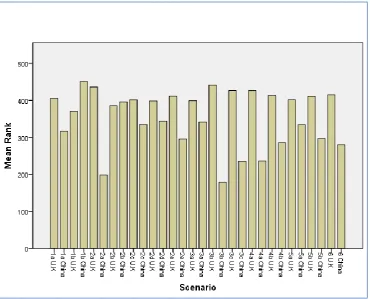
A total of 615 UK student responses were compared to a total of 159 China
student responses. The Mann-Whitney U test was performed to compare the differences
between the responses of UK and China students (Figure 2).
In conjunction with the Mann-Whitney U test, the effect size measure provides
the strength of the relationship between two groups. Cohen (1988) proposed rules of
thumb for interpreting effect sizes: a “small” effect size is a “Cohen’s d” value of 0.20,
a “medium” effect size is 0.50, and a “large” effect size is 0.80.
Significant differences on scenarios with large effect, medium to large, and
medium effect sizes, indicate the areas for which there may be significant and
prominent differences in the responses of UK and China students. Significant
differences with small or minimal effect sizes indicate areas with small differences in
the mean ranks of responses between the two groups. Small effect size differences (and
sometimes medium effect size, based on the r value) suggest common understandings or
Figure 2: Results of the Mann-Whitney U test
Topics that UK students understand but China students misunderstand
Scenario 3b describes a scenario where a student pays someone to create his
assignment. Although this scenario describes an act of cheating, it also constitutes
plagiarism since a student submitted someone else’s work as his own. There was a
significant difference in the mean ranks of UK and China students on scenario 3b,
U=15718.5, p=0.00, r= -0.57, which is considered a medium effect size. This suggests
that there was a variation across the responses of the two groups, and a total of 80.8% of
UK students answered correctly, whereas only 16.4% of China students answered
Scenario 3c, describes a clear case of plagiarism in which a student finds another
student’s uncollected printout of the assignment’s solution and copies this solution and
submits it. 43.4% of China and 80.8% of UK respondents answered correctly. For
scenario 2a, which described a case where a student copied code from a book without
providing acknowledgement, only 25.8% of the responses from China were correct
compared to the 82.1% of the UK responses. The results for 3c revealed significant
differences of medium effect size, U=24790, p=0.00, r= -0.51, and the results for
scenario 2a revealed a significant difference of medium effect size, U=18836.5, p=0.00,
r= -0.54.
Common topics of understanding between UK and China students
Self-plagiarism is a topic for which the responses of UK and China students were
similar, but with significant differences of small effect size. Scenario 1a (acknowledged
copying from a previous assignment) elicited UK student responses which were 89.1%
correct, and China responses which were 66.7% correct, with significant but only small
effect size differences between the two groups, U=37713, p=0.00, r= -0.25.
Scenarios 2c and 2e which clearly state that the students have provided
appropriate acknowledgement to code that is not their own, the results suggest that there
is common understanding between the two groups of students that these scenarios do
not constitute plagiarism, with significant but only small effect size differences between
the two groups, U=40520.5, p=0.00, r= -0.15 for scenario 2c, and U=34282, p=0.00,
answered correctly on scenario 2c, and 93.8% of UK respondents and 64.2% of China
respondents answered correctly for scenario 2e.
For scenario 3a, in which a student copies code from a fellow student, modifies
it and submits it as their own work, a significant difference of small effect size in
responses between the two groups was noted, with significant but only small effect size
differences between the two groups, U=41572.5, p=0.00, r= -0.13. The majority of UK
and China students seem to understand that this is a clear case of plagiarism, with
70.6% of UK respondents and 57.2% of China respondents answering correctly.
Topic 5 is concerned with converting code to another programming language,
and in scenario 5b a case is described where a student takes Visual Basic source-code,
converts it into Java and incorporates it into their assignment but provides a note of this
fact. Scenario 5b is not plagiarism, and 89.4% of UK respondents and 60.4% of China
respondents answering correctly. Therefore, there exists common understanding that
translating code and providing acknowledgement of this fact is not regarded as
plagiarism, with significant but only small effect size differences between the two
groups, U=34500, p=0.00, r= -0.32.
Finally, scenario 6 describes a case of falsification rather than plagiarism, where
a student modifies the program’s output to make it seem as it is working as specified in
the assignment specification. A total of 80.8% of the UK students, and 45.9% of China
students answered correctly (score=1.0). The differences in the responses between the
Common topics of misunderstanding between UK and China students
For the second self-plagiarism scenario (1b) in which copying occurred from a previous
source-code assignment without appropriate acknowledgment, the responses were very
different, the majority of both UK and China students incorrectly responded that this
scenario does not constitute plagiarism. Only 3.4% of UK responses and 3.8% of China
student responses were correct, U=38775, p=0.00, r= -0.20.
Results for scenarios 2b and 2d (copying from books) revealed common
misunderstandings between the two groups. For scenario 2b (incorrect reference) the
difference was not significant and of minimal effect size, U=47592, p=0.59, r= -0.02,
with only 11.2% of UK students, and only 10.7% of China students answering correctly.
Scenario 2d (where a student read some books for gaining inspiration but did not copy)
received correct responses from a total of 47.8% of the UK respondents and 34.6% of
the China respondents. The differences between the two groups were significant but of
small effect size, indicating that both groups concerned, are uncertain about using
resources for gaining inspiration, U=42015.5, p=0.00, r= -0.10.
Scenarios 4a and 4b are both considered as plagiarism. For scenario 4a which
describes a case where two students collaborate and on an individual assignment and
submit similar solutions, only 34.1% of UK respondents and 8.2% of China respondents
answered correctly. Similarly, for scenario 4b, where two students working in two
different groups are assigned the same coursework and exchange parts of their work
only 32.4% of UK respondents and 13.8% of China respondents answered correctly.
These results strongly suggest that UK and China students do not consider inappropriate
two groups were significant, with medium and small effect sizes respectively,
U=24903.5, p=0.00, r= -0.35, for scenario 4a, and U=32672, p=0.00, r= -0.24 for
scenario 4b.
Scenario 5a describes a clear case of plagiarism, where a student takes Java
source-code from a book, converts it to C++, incorporates it into her assignment without
referencing the origin of the Java code. Only 24.2% of UK students and only 15.1% of
China students answered correctly. The difference was significant of small effect size,
strongly indicating the common misunderstanding between the two groups, U=40457.5,
p=0.00, r= -0.12. The conclusion here is that students do not understand that converting
source-code from one programming language to another constitutes plagiarism.
Discussion and Further Work
This paper describes the results of a study, on the topic of source-code plagiarism,
which gathered the perceptions of China students and compared these perceptions to
those gathered from UK students (Joy et al., 2011). For the purposes of conducting a
comparative study, the questionnaire distributed to UK students was translated to the
Chinese language and was then distributed to students studying in China. Importantly,
China was the home country, and Chinese was the native language of all respondents
from China. The results of the comparative study revealed areas of understanding and
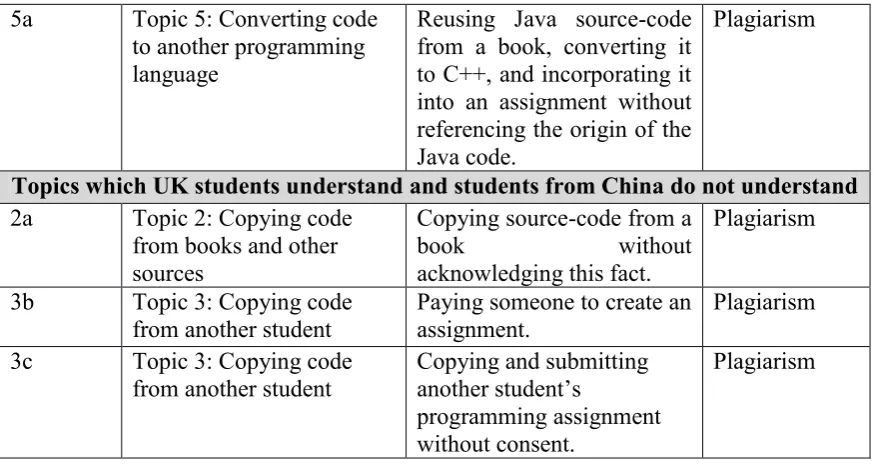
misunderstanding between the two groups and these are summarised in Table 1. Table 1
shows the results for each group (i.e. UK and China) based on the responses of the
majority of students (i.e. n>50%) who answered correctly (score=1.0) on each scenario.
Scenario Scenario topic Scenario Summary Plagiarism
plagiarism Topics of Common Understanding
1a Topic 1: Self-plagiarism and source-code reuse
Copying from own previous work and acknowledging this fact as a source-code “comment”.
Not plagiarism
2e Topic 2: Copying code from books and other sources
Reusing source-code and
acknowledging it. Not plagiarism
3a Topic 3: Copying code from another student
Copying source-code from a fellow student and with consent modifying it and submitting.
Plagiarism
5b Topic 5: Converting code to another programming language
Copying source-code from own previous work and converting it to another similar programming language and acknowledging this fact.
Not plagiarism
2c Topic 2: Copying code from books and other sources
Appropriately referencing all the source-code and other material reused from books and other sources.
Not plagiarism
6 Topic 6: Falsification (as opposed to plagiarism)
Modifying a program’s output to make it seem as it is working as specified in the assignment specification.
Not plagiarism
Topics of Common Misunderstanding
1b Topic 1: Self-plagiarism and source-code reuse
Copying source-code from own previous work without acknowledging this fact.
Plagiarism
2b Topic 2: Copying code from books and other sources
Reusing source-code from a book and providing an incorrect reference.
Plagiarism
2d Topic 2: Copying code from books and other sources
Gaining inspiration from books and then producing source-code without copying.
Not plagiarism
4a Topic 4: Inappropriate collaboration
Inappropriately
collaborating on individual assignments and submitting similar solutions.
Plagiarism
4b Topic 4: Inappropriate collaboration
Members of different groups working on the same coursework exchange parts of their work.
5a Topic 5: Converting code to another programming language
Reusing Java source-code from a book, converting it to C++, and incorporating it into an assignment without referencing the origin of the Java code.
Plagiarism
Topics which UK students understand and students from China do not understand
2a Topic 2: Copying code from books and other sources
Copying source-code from a book without acknowledging this fact.
Plagiarism
3b Topic 3: Copying code
from another student Paying someone to create an assignment. Plagiarism 3c Topic 3: Copying code
from another student
Copying and submitting another student’s
programming assignment without consent.
[image:28.595.80.517.69.303.2]Plagiarism
Table 1: Areas of understanding and misunderstanding
In conclusion, the topics of reuse of the student's own source-code without
acknowledgement; translation of source-code without acknowledging the original
source; and incorrect referencing is evidence of plagiarism, appear to be issues of
concern both in the UK and China.
In addition, some issues such as getting code from another person (for example,
by paying them, or through an online forum) is not perceived as plagiarism; use of code
from a book without acknowledgement; and collaboration on individual assignments
appear not to be fully understood by China participants.
These results indicate specific areas of student misunderstanding about
plagiarism, but more generally they suggest that both UK and Chinese students are
plagiarism. This paper does not address why students misunderstand, and further studies
will be required to elicit the reasons, but we may conjecture that the approach to
instructing students about academic integrity is deficient in some institutions.
In the Chinese context, there is a clear lack of advice given to students, since a
majority of the students participating in this study claim not to have had any instruction,
and this would need to be addressed.
Possible approaches might include richer support materials (especially tailored
to the computing disciplines), or a more fundamental ethics-led approach to student
writing (and coding) skills as suggested by Heitman and Litewka (2011).
Acknowledgments
This work was supported by the Higher Education Reform Research Project of Henan
Agricultural University (Xiao Zheng Jiao [2012] No.3).
References
Bamford, J. and Sergiou, K. 2005. “International Students and Plagiarism: An Analysis of the Reasons for Plagiarism among International Foundation Students.” Investigations in University Teaching and Learning 2(2). London Metropolitan University, available www.londonmet.ac.uk/library/b10884_3.pdf(accessed 16 April 2013).
Bista, K. 2011. “Academic Dishonesty Among International Students in Higher
Bowyer, K. and Hall, L. 1999. “Experience using MOSS to Detect Cheating on Programming Assignments.” In Proceedings of29th Annual Frontiers in Education Conference (FIE99), San Juan, Puerto Rico, 18-22.
Bradley, C. 2011. “Plagiarism Education and Prevention: A Subject-Driven Case-Based Approach.” Oxford: Chandos Publishing.
Chuda, D., Navrat, P., Kovacova, B. and Humay, P. 2012. “The Issue of (Software) Plagiarism: A Student View.” IEEE Transactions on Education 55(1): 22-28.
Cohen, J. 1988. Statistical Power Analysis for the Behavioral Sciences (2nd ed.). Hillsdale, New Jersey: Lawrence Erlbaum.
Eaton, N. 2009. “Plurk has no plans to sue Microsoft – yet.” The Microsoft Blog, available http://blog.seattlepi.com/microsoft/2009/12/15/plurk-has-no-plans-to-sue-microsoft-and150-yet/ (accessed 16 April 2013).
Gullifer, J. M., and G. A. Tyson, 2013. “Who has read the policy on plagiarism? Unpacking students' understanding of plagiarism.” Studies in Higher Education ahead-of-print. DOI 10.1080/03075079.2013.777412
Hayes, N. and Introna, L.D. 2005. “Cultural Values, Plagiarism, and Fairness: When Plagiarism Gets in the Way of Learning.” Ethics and Behavior 15(3): 213-231. DOI: 10.1207/s15327019eb1503_2
Heitman, E. and Litewka, S. 2011. “International perspectives on plagiarism and considerations for teaching international trainees”, Urologic Oncology: Seminars and Original Investigations 29(1): 104-108
Joy, M.S., Cosma, G., Yau, J.Y-K. and Sinclair, J.E. 2011. “Source-code Plagiarism – A Student Perspective.” IEEE Transactions on Education 54(1): 125-132.
Joy, M.S. and Luck, M. 1999. “Plagiarism in Programming Assignments.” IEEE Transactions on Education 51(2): 129-133.
Leask, B. 2006. “Plagiarism, Cultural Diversity and Metaphor — Implications for Academic Staff Development.” Assessment and Evaluation in Higher Education 31(2): 183-199.
Liu, D. 2005. “Plagiarism in ESOL Students: Is Cultural Conditioning Truly the Major Culprit?” ELT Journal 59(3): 234-241. DOI:10.1093/elt/cci043
Mann, S. and Frew, Z. 2006. “Similarity and Originality in Code: Plagiarism and Normal Variation in Student Assignments.” In Proceedings of the8th Australasian Conference on Computing Education (ACE '06), 143-150.
Ministry of Education. 2006. “985 Project” School List.
http://www.moe.gov.cn/publicfiles/business/htmlfiles/moe/s238/201112/xxgk_1 28833.html (in Chinese; accessed 26 October 2013).
Ministry of Education. 2013a. “Project 211” List of Schools.
http://www.moe.edu.cn/publicfiles/business/htmlfiles/moe/moe_94/201002/827 62.html (in Chinese; accessed 26 October 2013).
Ministry of Education. 2013b. Ministry of Education. 2013b. Notice of Ministry of Education and Ministry of Finance's announcement of the result of Collaborative Innovation Center 2012 (Educational Technology Letter [2013] No. 26).
http://www.moe.gov.cn/publicfiles/business/htmlfiles/moe/s7062/201306/xxgk_ 152878.html (in Chinese, accessed 27 October 2013).
Patel, N. 2005. “Open Source and China: Inverting Copyright?” Wisconsin International Law Journal 23(1): 781-805.
Pennycook, A. 1996. “Borrowing Others' Words: Text, Ownership, Memory and Plagiarism.” TESOL Quarterly 30(2): 201-230.
Prechelt, L., Malpohl, G. and Philippsen, M. 2002. “Finding Plagiarisms Among a Set of Programs with JPlag.” Journal of Universal Computer Science 8(11): 1016-1038.
Qi, S. 2008. “A Descriptive Study of Plagiarism in the Writing Assignments of First-year Chinese Students in the American English Language Institute at Stephen F. Austin State University.” MEd thesis, Stephen F. Austin State University. Ann Arbor, MI: ProQuest.
Risquez, A., O’Dwyer, M. and Ledwith, A. 2011. “‘Thou shalt not plagiarise’: from self-reported views to recognition and avoidance of plagiarism”. Assessment and Evaluation in Higher Education 38(1): 34-43.
Sowden, C. 2005. “Plagiarism and the Culture of Multilingual Students in Higher Education Abroad.” ELT Journal 59(3): 226-233.
Sraka, D. and Kaučič, B. 2009. “Source-code Plagiarism.” In Proceedings of the31st International Conference onInformation Technology Interfaces (ITI 2009), Dubrovnik, Croatia, 461-466. DOI 10.1109/ITI.2009.5196127
Stone, C.R. 2008. “What Plagiarism was not: Some Preliminary Observations on Classical China Attitudes Toward what the West Calls Intellectual Property.” Marquette Law Review 92(1): 199-230.
Twomey, T, White, H. and Sagendorf, K., eds. 2009. “Pedagogy, Not Policing: Positive Approaches to Academic Integrity at the University.” Syracuse, NY: The