Original citation:
Sadeghi Bahmani, Dena, Hatzinger, Martin, Gerber, Markus, Lemola, Sakari, Clough, Peter J., Perren, Sonja, von Klitzing, Kai, Von Wyl, Agnes, Holsboer-Trachsler, Edith and Brand, Serge. (2016) The origins of mental toughness – prosocial behavior and low internalizing and externalizing problems at age 5 predict higher mental toughness scores at age 14. Frontiers in Psychology, 7 .
Permanent WRAP URL:
http://wrap.warwick.ac.uk/80512
Copyright and reuse:
The Warwick Research Archive Portal (WRAP) makes this work of researchers of the University of Warwick available open access under the following conditions.
This article is made available under the Creative Commons Attribution 4.0 International license (CC BY 4.0) and may be reused according to the conditions of the license. For more details see: http://creativecommons.org/licenses/by/4.0/
A note on versions:
The version presented in WRAP is the published version, or, version of record, and may be cited as it appears here.
The origins of mental toughness – prosocial behavior
and low internalizing and externalizing problems at
age 5 predict higher mental toughness scores at age 14
Dena Sadeghi Bahmani1*, Martin Hatzinger2, Markus Gerber3, Sakari Lemola4, Peter J. Clough5, Sonja Perren6, Kai von Klitzing7, Agnes Von Wyl8, Edith Holsboer-Trachsler1, Serge Brand1*
1Center for Affective, Stress and Sleep Disorders, Psychiatric Hospital of the University
of Basel, Switzerland, 2Psychiatric Services Solothurn, Department of Adult Psychiatry, Solothurn, Switzerland, Switzerland, 3Department of Sport, Exercise and Health, Division of Sport and Psychosocial Health, Switzerland, 4Department of Psychology, University of Warwick, Coventry, UK, United Kingdom, 5Department of Psychology, Manchester Metropolitan University, Manchester, UK, United Kingdom, 6University of Konstanz, Konstanz, Germany, Germany, 7Department of Child and Adolescent Psychiatry, Psychotherapy, and Psychosomatics, University of Leipzig, Germany, Germany,
8Institute of Psychology, University of Zurich, Switzerland, Switzerland
Submitted to Journal: Frontiers in Psychology
Specialty Section: Psychopathology
ISSN: 1664-1078
Article type:
Original Research Article
Received on: 17 Jun 2016
Accepted on: 02 Aug 2016
Provisional PDF published on: 02 Aug 2016
Frontiers website link: www.frontiersin.org
Citation:
Sadeghi_bahmani D, Hatzinger M, Gerber M, Lemola S, Clough PJ, Perren S, Von_klitzing K, Von_wyl A, Holsboer-trachsler E and Brand S(2016) The origins of mental toughness – prosocial behavior and low internalizing and externalizing problems at age 5 predict higher mental toughness scores at age 14. Front. Psychol. 7:1221. doi:10.3389/fpsyg.2016.01221
Copyright statement:
© 2016 Sadeghi_bahmani, Hatzinger, Gerber, Lemola, Clough, Perren, Von_klitzing, Von_wyl, Holsboer-trachsler and Brand. This is an open-access article distributed under the terms of the Creative Commons Attribution License (CC BY). The use, distribution and reproduction in other forums is permitted, provided the original author(s) or licensor are credited and that the original publication in this journal is cited, in accordance with accepted academic practice. No use,
This Provisional PDF corresponds to the article as it appeared upon acceptance, after peer-review. Fully formatted PDF and full text (HTML) versions will be made available soon.
Frontiers in Psychology | www.frontiersin.org
The origins of mental toughness – prosocial behavior and low internalizing and 1
externalizing problems at age 5 predict higher mental toughness scores at age 14 2
3 4
Dena Sadeghi Bahmani1, Martin Hatzinger2, Markus Gerber3, Sakari Lemola4, Peter J.
5
Clough5, Sonja Perren6, Kay von Klitzing7, Agnes von Wyl8, Edith Holsboer-Trachsler1,
6
Serge Brand1,3
7 8
1 Psychiatric Clinics of the University of Basel, Center for Affective-, Stress- and Sleep 9
Disorders, Basel, Switzerland 10
2 Psychiatric Services Solothurn, Department of Adult Psychiatry, Solothurn, Switzerland 11
3 Department of Sport, Exercise and Health, Division of Sport and Psychosocial Health, 12
University of Basel, Basel, Switzerland 13
4 Department of Psychology, University of Warwick, Coventry, UK 14
5 Department of Psychology, Manchester Metropolitan University, Manchester, UK 15
6 University of Konstanz, Konstanz, Germany 16
7 Department of Child and Adolescent Psychiatry, Psychotherapy, and Psychosomatics, 17
University of Leipzig, Germany 18
8 Institute of Psychology, University of Zurich, Switzerland 19
20
Serge Brand, Ph.D. 21
Psychiatric Clinics of the University of Basel 22
Center for Affective, Stress and Sleep Disorders 23
Wilhelm Klein-Strasse 27 24
4012 Basel – Switzerland 25
+4161 32 55 114 (voice) 26
+4161 32 55 513 (fax) 27
29 30 31
Abstract 32
Background: The concept of mental toughness has gained increasing importance among 33
groups other than elite athletes by virtue of its psychological importance and explanatory power
34
for a broad range of health-related behaviors. However, no study has focused so far on the 35
psychological origins of mental toughness. Therefore, the aims of the present study were: to 36
explore, to what extent the psychological profiles of preschoolers aged five were associated 37
with both 1) mental toughness scores and 2) sleep disturbances at age 14, and 3) to explore 38
possible gender differences. 39
Method: Nine years after their first assessment at age five (preschoolers), a total of 77 40
adolescents (mean age: 14.35 years; SD = 1.22; 42% females) took part in this follow-up 41
study. At baseline, both parents and teachers completed the Strengths and Difficulties 42
Questionnaire (SDQ), covering internalizing and externalizing problems, hyperactivity, 43
negative peer relationships, and prosocial behavior. At follow-up, participants completed a 44
booklet of questionnaires covering socio-demographic data, mental toughness, and sleep 45
disturbances. 46
Results: Higher prosocial behavior, lower negative peer relationships, and lower internalizing 47
and externalizing problems at age five, as rated by parents and teachers, were associated with 48
self-reported higher mental toughness and lower sleep disturbances at age 14. At age 14, and 49
relative to males, females had lower MT scores and reported more sleep disturbances. 50
Conclusions: The pattern of results suggests that mental toughness traits during adolescence 51
may have their origins in the pre-school years. 52
Key-words: mental toughness, sleep, origins, long-term, pro-social behavior, internalizing 53
problems, externalizing problems 54
55
Introduction 56
57
In 2002, Clough, Earle, and Sewell (2002) formulated the concept of Mental 58
toughness in its present form and since then, the In recent years the concept of mental 59
toughness (MT) has gained increasing interest by virtue of its psychological importance and 60
explanatory power with respect to psychological concepts such as coping with stress, self-61
esteem, and motivation and with respect to a broad range of health-related behaviors (see 62
Table 1) (Crust, 2014, Dewhurst et al. , 2012, Gerber et al. , 2013c, Perry et al. , 2013a, Stamp 63
et al. , 2015). Mental toughness refers to an individual’s capacity to be consistently successful 64
in coping with difficult life circumstances and comprises the following dimensions: Control 65
(own life and emotions), Commitment (to personal aims and achievements), Challenge 66
(considering changes in life not as threats but as challenges), and Confidence (in own abilities 67
and in other people) (Clough et al. , 2002a, Perry et al. , 2013b). Thus, MT refers to the 68
tendency to appraise threats and pressure as opportunities to thrive (Thelwell, 2005), actively 69
to seek and approach challenges (Crust, 2008a), and successfully to overcome setbacks and 70
difficulties (Clough et al., 2002a; Dewhurst et al., 2012). Thus, as shown in and apparent from 71
Table 1, MT embodies a range of cognitive-emotional processes closely involved in coping 72
with stress, motivation, self-esteem, unexpected events, and social settings (confidence in 73
other people). 74
75
=================== 76
Table 1 about here 77
=================== 78
79
Initially, studies in this field focused on MT in elite athletes (Clough and Strycharczyk, 2012, 80
Crust, 2007b, 2008b, Fourie and Potgieter, 2001, Jones et al. , 2002, 2007, Loehr, 1994, 81
Thelwell et al. , 2005); these studies showed that mentally tough athletes were able to cope 82
with stress during a competition and to remain more focused and confident (Crust, 2007a, 83
Crust and Azadi, 2010, Kaiseler et al. , 2009, Levy et al. , 2006, Mack and Ragan, 2008, 84
Nicholls et al. , 2008, Sheard, 2009). However, more recent studies have applied the concept 85
of MT to other groups such as healthy older adolescents (Brand et al. , 2014c, Brand et al. , 86
2014e, Gerber, 2011, Gerber et al. , 2013a, Gerber et al. , 2015a, Gerber et al. , 2015b, 87
Gerber, Kalak, 2013c, Gerber et al. , 2012, Gerber et al. , 2015c), healthy younger adolescents 88
(Brand et al., 2014c, 2016), university students (Stamp, Crust, 2015), lower, middle and 89
senior managers, and clerical/administrative workers in early, middle and late adulthood 90
(Marchant et al. , 2009, Perry, Clough, 2013b), as well as those working in education (Crust, 91
2014), and the military (Arthur, 2015). All these studies have shown higher MT scores to be 92
associated with better coping with stress (Gerber et al., 2013a, 2013c), with better sleep 93
quality assessed both subjectively (Brand et al., 2014d, 2014e) and objectively (Brand et al., 94
2014c), and with better physical performance (Crust and Clough, 2005; Gerber et al. 2012). 95
Further, we showed that patients with multiple sclerosis (MS) at illness onset (mean age = 96
32.3 years) reported similar MT traits as healthy adolescents and young adults did (Sadeghi 97
Bahmani et al., 2016). 98
To date, however, no study has considered the origins of mental toughness by asking 99
what psychological dimensions in childhood might predict MT traits in adolescence. The aim 100
of the present study was therefore to address this question. To this end participants from a 101
previous study when they were five years old and at kindergarten (Brand et al. , 2015, 102
Hatzinger et al. , 2008, 2010, Hatzinger et al. , 2007) were contacted at age 14 and assessed 103
once again. We believe that the present study has the potential to shed new light on the origins 104
and development of mental toughness, a psychological attribute, which appears to underlie a 105
broad range of positive behaviors. We further hold that with the present study attention in 106
developmental psychology might shift from psychopathology towards salutogenic 107
dimensions. 108
In this regard, a literature search on the search engine Pubmed with the items 109
‘resilience’, ‘hardiness’ or ‘mental toughness’ in combination with ‘development’ produced 110
very few results (note that the concepts of mental toughness, resilience, and hardiness seem to 111
share a common basis but without being synonyms; see Table 1). For ‘hardiness’, no study 112
could be identified in combination with the term ‘development’. With regard to ‘resilience’ 113
and ‘development’, the following points were identified: resilience is understood as an 114
individual’s skill in successfully adapting to stress and adversity (Skala and Bruckner, 2014). 115
Interpersonal factors associated with resilience include male gender, higher intelligence, 116
aspects of character, temperament, and genes. Family factors include stable and positive 117
relations with an adult, while a broader social environmental factor is being integrated into a 118
community. Concerning the development of resilience, Masten and colleagues (Masten, 2004, 119
Masten et al. , 2004, Masten and Cicchetti, 2012, Masten et al. , 1999, Masten and Tellegen, 120
2012) identified higher IQ and favorable parenting as factors with the potential to protect 121
child development in the context of severe adversity. They also emphasized the relevance of 122
adaptive resources, planfulness/future motivation, autonomy, adult support, and coping skills 123
as possible factors underlying resilience and successful development. Additionally, Masten 124
and Tellegen (2012) found that resilient adults reported high quality relationships with parents 125
and other adults and good cognitive and socio-emotional skills during their childhood, while 126
Sameroff and Rosenblum (2006) identified poor parenting, antisocial peers, low-resource 127
communities, and economic hardship as the main factors impairing resilience. 128
Thus, while research examining the impact of hardiness and resilience on child 129
development is scarce, and while the concept of mental toughness offers a basis for 130
integrating a broad range of coping literature into a common framework (see Table 1), it must 131
be noted that most previous studies have focused on the development of psychopathology. In 132
fact, there is some evidence that psychopathology in preschoolers may persist over time and 133
that childhood psychopathology could predict psychological difficulties in adolescence (Caye 134
et al. , 2016, Giedd et al. , 1999, Paus et al. , 2008, Paus et al. , 1999). In particular, attention 135
has been given to whether behavioral problems such as internalizing and externalizing 136
behavior in preschoolers could predict psychiatric problems in adolescence and adulthood. 137
However, externalizing problems have been more frequently investigated than internalizing 138
problems and, in general, results indicated greater stability over time for externalizing than for 139
internalizing behavior problems (Pihlakoski et al. , 2006). Pihlakoski et al. (2006) have also 140
shown that externalizing problems in boys and girls at age three strongly predicted both 141
externalizing and internalizing problems at twelve years.Externalizing disorders are
142
characterized by disruptive, disobedient, and harmful behaviors that are often manifested 143
physically (e.g., in aggressive, impulsive and non-compliant behavior) (Weisz and Weiss, 144
1991), and seemed to exhibit considerable stability over time throughout development 145
(Pihlakoski et al. 2006). Furthermore, externalizing behaviors have been associated with 146
social aggression, disruptive behavior, a perceived lack of constraint, and risky behaviors; in 147
particular, aggressive and destructive behaviors in early childhood predicted later problems 148
(Pihlakoski et al., 2006). In addition, evidence indicated that childhood psychopathology was 149
associated with higher rates of early substance use and problem substance use (King et al., 150
2004). Externalizing disorders (e.g., conduct problems and ADHD) have been found to have 151
the strongest impact on later tobacco use, and children displaying aggressive behavior at five 152
years were more likely to consume tobacco 14 years later (though, surprisingly, no 153
association was found between externalizing problems and a prediction of DSM-IV nicotine 154
dependence at 21-year follow-up) (Fischer et al. , 2012). However, in general, children with 155
an early onset of conduct problems (onset in preschool) and a high degree of continuity 156
seemed to have a much more negative prognosis than children with a late onset (adolescence) 157
(McMahon, 1999). In conclusion, psychopathology such as externalizing problems in 158
childhood and adolescence appeared to predict unfavorable behaviors such as tobacco 159
consumption in later life while externalizing problems increase smoking (Fischer et al., 2012). 160
Internalizing disorders are characterized by feelings of sorrow, guilt, worry, and 161
somatization (Weisz and Weiss, 1991), and children with internalizing disorders display 162
reactions such as social withdrawal, a lack of pleasure in enjoyable activities, and a lack of 163
energy (Cicchetti and Toth, 1998). Internalizing problems were linked to social deficits (e.g., 164
submissive and inhibited interaction), poor interaction with the peer-group, social isolation 165
and development of a negative self-concept (Fischer et al., 2012) and might lead to 166
internalizing disorders such as depression and anxiety (McMahon, 1999). About 2-3% of 167
children and 6-8% of adolescents suffer from depression and the lifetime prevalence of 168
depression during adolescence was in the range 15-20% (McMahon, 1999). The estimated 169
prevalence of anxiety disorders in childhood and adolescence varied from 9 to 21%. Girls 170
were twice as likely to experience an anxiety disorder (McMahon, 1999), a trend recently 171
further confirmed, in that internalizing problems had increased among recent cohorts of girls 172
as compared to previous cohorts, but not among boys (Bor et al. , 2014). Yet, findings with 173
respect to internalizing behaviors are less consistent than those for externalizing behaviors; 174
this may be due to young children’s limited ability to express anxiety and depression. 175
Moreover, parents seemed to have difficulties in recognizing these emotions in their 176
preschool children (Pihlakoski, Sourander, 2006). Nevertheless, internalizing problems in 2-5 177
years young children have proved to be relatively stable over a two-year follow-up period 178
(Pihlakoski et al., 2006). 179
In addition, there is evidence that peer victimization (e.g., experiencing frequent 180
verbal or physical bullying by peers) in middle childhood was a relevant predictor of 181
internalizing behavior problems and psychological disorders during adolescence (Schwartz et 182
al. , 2015). There have been several indications of a moderate link between peer victimization 183
and some form of internalizing behavior problem such as symptoms of depression, anxiety, 184
loneliness and withdrawal (Schwartz et al., 2015). More specifically, Schwartz et al. (2015) 185
provided evidence that peer victimization in middle childhood could act as a key marker of 186
disorders at later stages of development. These authors found that children who experienced 187
frequent peer victimization in middle childhood were significantly more likely to meet criteria 188
for a major depressive disorder during late adolescence. 189
Additionally, researchers have examined the long-term influence of sleep disturbances 190
on several psychological problems. Existing research has shown that sleep problems were 191
persistent and that individual differences in sleep problems were highly stable over time 192
(Wong, 2010, Wong et al. , 2010). Thus, Wong and colleagues found that having trouble 193
sleeping at age 3 to 8 years was significantly associated with self-reported sleep problems at 194
age 11 to 17. Indeed those who had trouble sleeping in childhood, compared to those having 195
no trouble sleeping, had an almost 2.5 fold greater likelihood of having trouble sleeping in 196
adolescence (Wong, 2010; Wong et al., 2010; Brand et al., 2015 for extensive overview). 197
In summary, previous research has focused on the predictive value of internalizing and 198
externalizing problems, and sleep disturbances during childhood for psychopathology traits in 199
adolescence. However, no evidence is available as regards the predictive value of 200
internalizing and externalizing problems during childhood for psychological constructs such 201
as mental toughness, in adolescence. Therefore, the aim of the present longitudinal study was 202
to shed some light into this issue. We hold that the present data have the potential to add to 203
the existing literature in important ways: First, compared to other psychological constructs as 204
listed in Table 1, the concept of mental toughness has been established only 1.5 decades ago, 205
and to the best of our knowledge, no research has focused on psychological constructs as 206
precursors of adolescent mental toughness. Second, in our opinion, the concept of mental 207
toughness deserves further research, as it has the potential to cover a broad range of cognitive-208
emotional concepts such as coping, self-esteem, motivation, and social confidence in one 209
single construct (see Table 1). 210
Given the lack of previous research, we drew upon findings relating to 211
psychopathology in formulating our hypotheses. Thus, following others (Fischer et al., 2012; 212
Settles et al., 2012; Wong et al., 2010), we anticipated that positive psychological traits 213
evident in childhood (low externalizing and internalizing problems, high prosocial behavior) 214
would predict higher mental toughness scores and also lower sleep disturbances at age 14. 215
Furthermore, based on previous research (Brand et al. , 2014a, b), we expected that higher 216
mental toughness scores would be associated with lower sleep disturbances at age 14. Finally, 217
we expected that compared to boys, girls would report lower mental toughness scores (Brand 218
et al., 2014c, 2016) and more sleep disturbances (Armitage and Hoffmann, 2001; Brand et al., 219
2016; Mong and Cusmano, 2016). 220
221
Method 222
Procedure 223
As described elsewhere (Brand, Hatzinger, 2015), children participating in this study 224
were assessed during their first year in kindergarten (when they were five years old; 225
(Hatzinger, Brand, 2008, 2010, Hatzinger, Brand, 2007). These children were contacted again 226
at age 14. Participants completed self-rating questionnaires covering socio-demographic 227
information, mental toughness and sleep (see below). The general purpose of the follow-up 228
study was explained to the adolescents and their parents. Prior to entry to the study both 229
adolescents and their parents were asked to sign an informed consent form. The study 230
protocol was carried out in accordance with the Declaration of Helsinki and was approved by 231
the local ethics committee. 232
Parts of the ongoing longitudinal study have been already published. Specifically, 233
Brand et al (2015) showed that sleep quality at the age of five predicted psychological traits in 234
areas such as peer relationships and success at coping with stress while, surprisingly, sleep at 235
the age of 14 years was unrelated. In the present study, we focused on the associations 236
between participants’ psychological traits at age five (SDQ, parents’ and teachers’ ratings; see 237
below) and participants’ self-rated mental toughness and sleep disturbances at age 14. This 238
pattern of associations has not been examined so far. Thus, the present data are novel. 239
240
Sample 241
The core sample has been described in detail elsewhere (Brand et al., 2015; Perren et 242
al., 2006). Briefly, preschoolers of kindergartens of Basel (Basel, Switzerland) were assessed 243
as regards their subjective and objective sleep parameters, the level of saliva cortisol under 244
baseline (cortisol awakening response (CAR)) and under challenge conditions (a modified 245
social stress test), and their psychological functioning (Strengths and Difficulties 246
Questionnaire (SDQ, see below for more details; (Goodman, 1997): internalizing and 247
externalizing problems, hyperactivity, negative peer relationship, prosocial behavior), as 248
assessed via parents’ and teachers’ ratings. Of the 95 children at age five (M = 5.4 years, SD 249
= 0.44) for whom parents and kindergarten teachers completed the SDQ, 77 (81.05%) agreed 250
to participate in the follow-up study at age 14, that is, about nine years later. Mean age at 251
follow-up was 14.25 years (SD = 1.21; 32 females and 45 males). As stated in Brand et al. 252
(2015), participants and non-participants at follow-up did not significantly differ as regards 253
age, gender, sleep profiles or psychological traits (internalizing and externalizing problems, 254
hyperactivity, negative peer-relationship, and prosocial behavior) at baseline. Accordingly, 255
age, gender, sleep profiles or psychological traits at baseline were not entered as covariates in 256
all statistical equations of the present study. 257
258
Tools employed at age five 259
Strengths and Difficulties Questionnaire (SDQ; (Goodman, 1997) 260
Parents and teachers completed the SDQ, which consists of 25 items covering the 261
following five dimensions: internalizing problems, externalizing problems, hyperactivity, peer 262
problems and pro-social behavior. An overall score can also be derived, with higher scores 263
reflecting more negative psychological functioning. Each scale consists of 5 items that are 264
rated on a three-point scale ranging from 0 (= not true) to 2 (= certainly true). The sum is 265
calculated to generate subscale scores. In the present study, internal consistency was moderate 266
to high (Cronbach’s alpha = .87). 267
268
Tools participants employed at age 14 269
Mental toughness 270
Participants were asked to fill in the 18-item Mental Toughness Questionnaire 271
(MTQ18; Clough et al., 2002; German version: Gerber et al., 2012; Gerber et al., 2013a, 272
2013b). The MTQ18 is the short version of the MTQ48 questionnaire (Clough et al. , 2002b), 273
which has proved to be a valid and reliable instrument in previous research (Gerber et al., 274
2013b; Perry et al., 2013a). Very high correlations exist between the MTQ18 and MTQ48 275
(Clough et al., 2002a; Gerber et al. 2014, 2015b). Answers on the MTQ18 are given on five-276
point Likert-type scales ranging from 1 (strongly disagree) to 5 (strongly agree). Responses 277
across items are summed, with higher scores reflecting greater MT (Cronbach's alpha = .92). 278
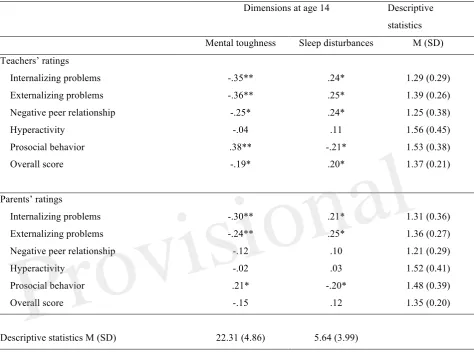
279
Sleep disturbances 280
To assess sleep disturbances, the Insomnia Severity Index (ISI; (Bastien et al. , 2001) 281
was employed; this is a 7-item screening measure for insomnia and an outcome measure for 282
use in treatment research. The items, answered on 5-point rating scales (0 = not at all, 4 = 283
very much), refer in part to DSM-IV (Diagnostic and Statistical Manual of Mental Disorders) 284
criteria for insomnia (American Psychiatric Association, 2000) by measuring difficulty in 285
falling asleep, difficulties remaining asleep, early morning awakenings, increased daytime 286
sleepiness, impaired daytime sleepiness, impaired daytime performance, low satisfaction with 287
sleep, and worrying about sleep. Evidence for the validity and reliability of this instrument 288
has been presented previously (Fernandez-Mendoza et al. , 2012, Gerber et al. , 2016). The 289
higher the overall score, the more the respondent is assumed to suffer from sleep disturbances 290
(Cronbach's alpha = .92). 291
292
Statistical analysis 293
First, a series of Pearson’s correlations was performed between SDQ scores (parents’ 294
and teachers’ ratings of children at age five) and participants’ MT and sleep disturbances 295
scores at age 14. Second, two multiple regression analyses (stepwise backward) were 296
performed with MT scores and sleep disturbances (age 14) as dependent variables and SDQ 297
scores (age 5) as predictors. Third, possible gender differences in MT and sleep disturbances 298
at age 14 were calculated with a series of t-tests. Fourth, the bivariate association between MT 299
and sleep disturbances scores at age 14 was examined with a Pearson’s correlation. The 300
nominal level of significance was set at alpha < .05. Statistics was performed with SPSS® 301
23.0 (IBM Corporation, Armonk NY, USA) for Apple Mac®. 302
303
Results 304
305
Descriptive statistics and bivariate correlations between strengths and difficulties (SDQ) at 306
five years and mental toughness and sleep disturbances at 14 years 307
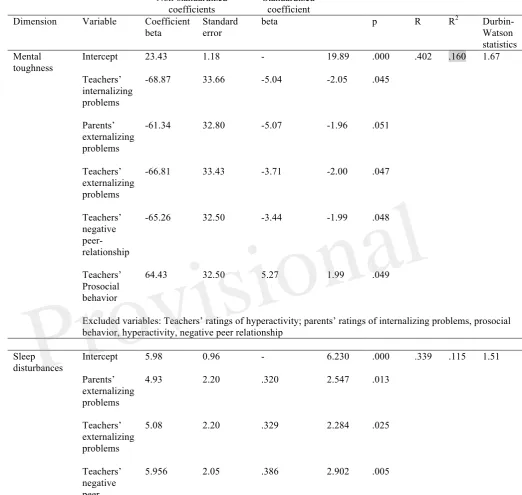
308
All statistical indices are reported in Table 2 and therefore not repeated in the text 309
again. 310
311
312
=================== 313
Table 2 about here 314
=================== 315
316
Lower internalizing and externalizing problems, and higher pro-social behavior, as 317
rated by parents and teachers, were associated with higher MT scores and lower sleep 318
disturbances. Better peer relations and lower overall scores, as rated by teachers, were 319
associated with higher MT scores and lower sleep disturbances. No significant associations 320
were found for hyperactivity (parents’ and teachers’ ratings) or for negative peer relations, as 321
rated by parents. 322
323
As regards sleep disturbances, higher sleep disturbances were associated with higher 324
internalizing and externalizing problems, lower prosocial behavior, as rated by parents and 325
teachers, and with more negative peer relationships and higher overall scores, as rated by 326
teachers. No significant associations were found for hyperactivity (parents’ or teachers’ 327
ratings), or for negative peer relationships and overall scores, as rated by parents. 328
329
MT scores and sleep disturbances 330
The correlation coefficient was r -.45 (p < .05); higher MT scores were related to 331
lower sleep disturbances. 332
333
334
Predicting Mental toughness and sleep disturbances (at 14 years) from strengths and 335
difficulties (SDQ; at five years) 336
337
Table 3 reports the results from the two multiple regression analyses (stepwise 338
backward) with MT scores and sleep disturbances as dependent variables and the strengths 339
and difficulties as predictors (to avoid redundancy and biased calculations, SDQ Total scores 340
were not entered in the equations). 341
342
=================== 343
Table 3 about here 344
=================== 345
Higher Mental toughness scores were associated with lower internalizing problems 346
(parents, teachers), lower externalizing problems, more positive peer relationships, and higher 347
prosocial behavior (teachers). The following variables were excluded from the equation: 348
teachers’ ratings of hyperactivity; parents’ ratings of internalizing problems, prosocial 349
behavior, hyperactivity, and negative peer relationships. 350
351
Higher sleep disturbances were associated with higher externalizing problems (parents, 352
teachers), and more negative peer relationships (teachers). The following variables were 353
excluded from the equation: teachers’ ratings of internalizing problems, prosocial behavior, 354
and hyperactivity; parents’ ratings of internalizing problems, negative peer relationships, 355
prosocial behavior, and hyperactivity. 356
357
358
Gender differences in mental toughness and sleep disturbances 359
A series of t-tests (see Table 4) revealed that females at 14 years, compared to males, 360
had lower MT scores and reported more sleep disturbances. 361
362
363
=================== 364
Table 4 about here 365
=================== 366
367
Discussion 368
The key findings of the present study were that lower scores of internalizing and 369
externalizing problems and negative peer-relationships and higher prosocial behavior scores 370
at age five, as rated by parents and teachers, associated with higher mental toughness scores 371
and lower sleep disturbances scores at age 14. The pattern of results adds to the current 372
literature in an important way in that we were able to shed some light on the origins of 373
adolescent mental toughness by relating this to favorable psychological traits at the age of five 374
years. 375
Three hypotheses were formulated and each of these is considered now in turn. 376
Our first hypothesis was that positive psychological traits during childhood (lower 377
internalizing and externalizing problems, lower negative peer-relationships, higher pro-social 378
behavior) would be associated with greater MT at 14 years, and this was confirmed. We hold 379
that the present study expands upon previous research in being the first to associate adolescent 380
mental toughness from favorable childhood psychological traits. As shown in Tables 2 and 3, 381
both parents’ and teachers’ ratings of children’s lower externalizing, internalizing problems, 382
negative peer relationships and higher prosocial behavior during preschool was associated 383
with higher mental toughness scores during adolescence. 384
Our second hypothesis was that childhood psychological traits would be associated 385
with lower sleep disturbances scores patterns in adolescence, and this hypothesis also 386
received support. We believe that this pattern of results confirms both the assumed association 387
between positive psychological traits and sleep quality. In this view, there is evidence from 388
longitudinal studies that sleep quality impacts on psychological functioning (Brand et al., 389
2015; Hatzinger et al., 2013b, 2014; Kaneita et al., 2009; Roberts and Duong, 2014, 2015; 390
Roberts et al., 2009); the results of a meta-analysis indicated that poor sleep predicted 391
symptoms of depression among adolescents, and not vice versa (Lovato and Gradisar, 2014). 392
On the other hand, psychological traits also impacts on sleep patterns (see Brand et al. 2015 393
for extensive overview), a direction of influence also confirmed in the present study. 394
Our third hypothesis was that, cross-sectionally, higher MT scores would be related to 395
fewer sleep disturbances, and again data confirmed this. Therefore, the present pattern of 396
results is also consistent with previous findings (Brand et al., 2014b,c,e; Brand et al., 2016), 397
and underscores the bi-directionality of sleep and psychological functioning. 398
The data available do not shed any light on why positive psychological traits such as 399
lower internalizing and externalizing problems, lower negative peer-relationships and higher 400
prosocial behavior at five years, and as rated by parents and teachers, should be associated 401
with both self-rated increased MT and lower sleep disturbances nine years later. We know 402
from previous studies (Fischer et al, 2012; Settles et al, 2012; Shin et al., 2012; Wong et al., 403
2010) that increased psychological issues during childhood also increased the risk of 404
increased psychological issues in adolescence and early adulthood. We also know that 405
personality traits remained fairly stable from childhood to adolescence (Keefer et al. , 2013, 406
Moffitt et al. , 2011, Roberts et al. , 2001, Shin, Sung, 2012), and in this view, we also know 407
that higher IQ and positive parenting favor the development of resilience in childhood and 408
provide protection under conditions of severe adversity (Masten et al., 1999). In this context, 409
Masten and Tellegen (2012) reported that resilience increased as a function of high quality 410
relationships with parents and other adults (see also Skala & Bruckner, 2014), cognitive 411
quality, social-emotional skills, adaptive resources, planfulness, future motivation, autonomy, 412
adult support, and coping skills (Masten, 2004; Masten et al., 2004), and that resilience often 413
emerged in childhood and endured, but that there were also late bloomers. Sameroff and 414
Rosenblum (2006) emphasized that, in addition to the behavioral and emotional self-415
regulation characteristic of good mental health and the cognitive self-regulation characteristic 416
of high intelligence, environmental factors such as parenting, peers, and economic conditions 417
may independently and bi-directionally contribute to a child’s resilience. 418
How should these findings be related to the present study? Our proposal is that lower 419
internalizing and lower externalizing problems, lower negative peer-relationships and higher 420
prosocial behavior might be understood as the behavioral and emotional self-regulation that is 421
characteristic of good mental health, the cognitive self-regulation element as suggested by 422
Sameroff and Rosenblum (2006; Keefer et al., 2013, 2006), as well as aspects of the adaptive 423
resources, autonomy and coping skills, as suggested by Masten and colleagues (Masten, 2004; 424
Masten et al., 2004). Additionally, prosocial behavior might be understood as reflecting high 425
quality relationships and stable social-emotional skills (Masten et al., 2004; Masten and 426
Tellegen, 2012; Skala and Bruckner, 2014). Importantly, in the present study lower 427
internalizing and externalizing problems and higher prosocial behavior were associated with 428
greater mental toughness nine years later, suggesting therefore considerable stability in level 429
of psychological traits from childhood to mid adolescence (Caspi et al, 2005; Moffitt et al., 430
2011; Shin et al., 2012). 431
As regards gender differences, our findings confirmed previous results, in that relative 432
to males, females at age 14 had lower MT scores (Brand et al, 2014c, 2016) and more 433
pronounced sleep difficulties (Armitage and Hoffmann, 2001, Mong and Cusmano, 2016). 434
Despite the novelty of the findings, several limitations warrant against their 435
overgeneralization. First, the sample size was small, and a larger sample would have provided 436
greater statistical power and may therefore have revealed other significant associations. 437
Second, the pattern of results might have emerged due to further latent, but unassessed 438
dimensions, which might have biased two or more variables in the same or opposite 439
directions. This holds particularly true, as it is conceivable that latent MT traits and sleep 440
patterns at the age of 5 might have conferred to the MT and sleep disturbances scores at the 441
age of 14. Further, for instance, parenting style was not assessed at both time points. In this 442
regards, there is evidence that children’s and also adolescents’ behavior and sleep are not 443
independent of family functioning, parenting style (Brand et al. , 2009), or parents’ sleep 444
patterns (Bajoghli et al., 2013; Brand et al., 2009; Kalak et al, 2012). Third, no 445
neurophysiological data were gathered at the second time point; previous studies have shown 446
that, for instance, cortisol secretion remained stable over time (Hatzinger et al. , 2013a), while 447
cortisol secretion is not related to sleep patterns (sleep-EEG; actigraphy) 12 months later, 448
suggesting therefore that cortisol secretion may also vary as a function of current physical and 449
psychological processes. Fourth, sleep at age 14 was only assessed subjectively. Fifth, only 450
the MT overall score was applied (MTQ18); employing the long version (MTQ48) would 451
have allowed a more fine-grained analysis of the associations between childhood and 452
adolescent psychological functioning. In this regard, we underscore that the current 453
interpretations rely on the assumption that psychometric properties of the MTQ18 used with 454
adolescents are acceptable. Sixth, it is conceivable that the strengths and difficulties at the age 455
of five years are the result of psychosocial development from very first infanthood to 456
preschool-age, suggesting therefore that the origins of adolescents’ mental toughness might be 457
routed even earlier in development. Seventh and last, the concept of MT has gained increasing
458
interest for its utility among elite and non-elite athletes to explaining a broad range of coping, 459
motivation, self-esteem and health-related behavior (see Introduction and Table 1), future research 460
might focus on the causal relation between MT traits and such constructs as reported in Table 1. 461
462
463
Conclusions 464
Positive psychological traits as reflected in lower internalizing and externalizing 465
problems and higher prosocial behavior at age five was associated with higher mental 466
toughness scores and lower sleep disturbances scores at age 14. The pattern of results 467
suggests that positive psychological traits in childhood seemed to lay the foundation for 468
adolescent mental toughness. This is important because mental toughness has proved to be a 469
stress resilience factor during both adolescence and young adulthood. 470
471
472
Authors’ contributions 473
Study design: DSB, MH, MG, SL, PJC, SP, KVK, AVW, EHT, SB; data gathering: DSB, 474
MH, SP, AVW, SB; data analysis: DSB, MG, SL, SB; interpretation of the data: DSB, MH, 475
MG, SL, PJC, SP, KVK, AVW, EHT, SB; writing the first draft: DSB, MG, EHT, SB; 476
integration of authors’ comments: DSB, MG, SL; SB; final manuscript: DSB, MH, MG, SL, 477
PJC, SP, KVK, AVW, EHT, SB. 478
479
Acknowledgements 480
We thank Christina Stadler and Margarete Bolten (University of Basel, Basel, 481
Switzerland) for data gathering. Further, we thank Nick Emler (University of Surrey, UK) for 482
proofreading the manuscript. 483
484
485
Financial disclosure and conflicts of interest 486
All authors declare no conflicts of interest. The study has been conducted without 487
external funding. 488
489
490
References 491
Armitage, R., and Hoffmann, R. F. (2001). Sleep EEG, depression and gender. Sleep Med Rev. 5, 237-492
246. 493
Arthur, C., Fitzwater, J., Hardy, L., Beattie, S., and Bell, J. (2015). Development and validation of a 494
Military Training Mental Toughness Inventory. Military Psychology, 27, 232-241. 495
Bandura, A. (1977). Self-efficacy: toward a unifying theory of behavioral change. Psychol Rev. 84, 496
191-215. 497
Bajoghli, H., Alipouri, A., Holsboer-Trachsler, E., and Brand, S. (2013). Sleep patterns and 498
psychological functioning in families in northeastern Iran; evidence for similarities between 499
adolescent children and their parents. J Adolesc. 36, 1103-1113. 500
Bastien, C. H., Vallieres, A., and Morin, C. M. (2001). Validation of the Insomnia Severity Index as 501
an outcome measure for insomnia research. Sleep Med. 2, 297-307. 502
Bor, W., Dean, A. J., Najman, J., and Hayatbakhsh, R. (2014). Are child and adolescent mental health 503
problems increasing in the 21st century? A systematic review. Aust N Z J Psychiatry. 48, 606-504
616. 505
Brand, S., Gerber, M., Hatzinger, M., Beck, J., and Holsboer-Trachsler, E. (2009). Evidence for 506
similarities between adolescents and parents in sleep patterns. Sleep Med. 10, 1124-1131. 507
Brand, S., Gerber, M., Kalak, N., Kirov, R., Lemola, S., Clough, P. J., et al. (2014a) Adolescents with 508
greater mental toughness show higher sleep efficiency, more deep sleep and fewer awakenings 509
after sleep onset. J Adol Health, 54:109-13. 510
Brand, S., Gerber, M., Kalak, N., Kirov, R., Lemola, S., Clough, P. J., et al. (2014b). "Sleep well, our 511
tough heroes!"--in adolescence, greater mental toughness is related to better sleep schedules. 512
Behav Sleep Med. 12, 444-454. 513
Brand, S., Hatzinger, M., Stadler, C., Bolten, M., von Wyl, A., Perren, S., et al. (2015). Does 514
objectively assessed sleep at five years predict sleep and psychological functioning at 14 years? 515
- Hmm, yes and no! J Psych Res. 60, 148-155. 516
Brand, S., Kalak, N., Gerber, M., Clough, P. J., Lemola, S., Puhse, U., et al. (2014c). During early and 517
mid-adolescence, greater mental toughness is related to increased sleep quality and quality of 518
life. J Health Psychol. 519
Brand, S., Kalak, N., Gerber, M., Clough, P. J., Lemola, S., Sadeghi Bahmani, D., et al. (2016). 520
During early to mid adolescence, moderate to vigorous physical activity is associated with 521
restoring sleep, psychological functioning, mental toughness and male gender. J Sports Sci. 522
Caspi, A., Roberts, B. W., and Shiner, R. L. (2005). Personality development: stability and change. 523
Annu Rev Psychol. 56, 453-484. 524
Caye, A., Rocha, T. B., Anselmi, L., Murray, J., Menezes, A. M., Barros, F. C., et al. (2016). 525
Attention-Deficit/Hyperactivity Disorder Trajectories From Childhood to Young Adulthood: 526
Evidence From a Birth Cohort Supporting a Late-onset Syndrome. JAMA Psychiatry. 527
Cicchetti, D., and Toth, S. L. (1998). The development of depression in children and adolescents. Am
528
Psychol. 53, 221-241. 529
Clough, P., Earle, K., and Sewell, D. (2002). Mental toughness: The concept and its measurement. In: 530
Cockerill I, editor. Solutions in sport psychology. London: Thomson Learning, pp. 32-46. 531
Clough, P., and Strycharczyk, P. (2012). Developing mental toughness: Improving performance,
532
wellbeing and positive behaviour in others. London: Kogan. 533
Cohen, S., Kamarck, T., and Mermelstein, R. (1983). A global measure of perceived stress. J Health
534
Soc Behav. 24, 385-396. 535
Crust, L. (2007). Mental toughness in sport: A review. International Journal of Sport and Exercise
536
Psychology. 5, 270-290. 537
Crust, L. (2008). A review and conceptual re-examination of mental toughness: Implications for future 538
researchers. Pers. Ind. Diff. 45, 576-583. 539
Crust, L., and Azadi, K. (2010). Mental toughness and athletes' use of psychological strategies. 540
European J Sport Sci. 10, 43-51. 541
Crust, L., and Clough, P. J. (2005). Relationship between mental toughness and physical endurance. 542
Percept Mot Skills. 100, 192-194. 543
Crust, L., Earle, K., Perry, J., Earle, F., Clough, A., and Clough, P. (2014). Mental toughness in higher 544
education: Relationships with achievement and progression in first-year university sports 545
students. Pers. Ind Diff. 69, 87-91. 546
Dewhurst, S. A., Anderson, R. J., Cotter, G., Crust, L., and Clough, P, J. (2012). Identifying the 547
cognitive basis of mental toughness: Evidence from the directed forgetting paradigm. Pers. Ind
548
Diff. 2012;53:587-90. 549
Fernandez-Mendoza, J., Rodriguez-Munoz, A., Vela-Bueno, A., Olevarrieta-Bernardino, S., Calhoun, 550
S. L., Bixler, E. O., et al. (2012). The Spanish version of the Insomnia Severity Index: A 551
confirmatory factor analysis. Sleep Med. 13, 207-210. 552
Fischer, J. A., Najman, J. M., Williams, G. M., and Clavarino, A. M. (2012). Childhood and 553
adolescent psychopathology and subsequent tobacco smoking in young adults: findings from an 554
Australian birth cohort. Addiction. 107, 1669-1676. 555
Fourie, S., and Potgieter, J. R. (2001). The nature of mental toughness in sport. South African Res
556
Sport, Phys Educ Recr. 23 63-72. 557
Gerber, M. (2011). Mentale Toughness im Sport. Sportwissenschaft. 41, 283-299. 558
Gerber, M., Brand, S., Feldmeth, A. K., Lang, C., Elliot, C., Holsboer-Trachsler, E., et al. (2013a) 559
Adolescents with high mental toughness adapt better to perceived stress: A longitudinal study 560
with Swiss vocational students. Pers Ind Diff. 54, 808-814. 561
Gerber, M., Feldmeth, A. K., Elliot, C., Brand, S., Holsboer-Trachsler, E., Pühse, U. (2014). Mental 562
health in Swiss vocational students: The moderating role of physical activity. J Res Adol. 563
2014:doi:10.1111/jora.12097. 564
Gerber, M., Feldmeth, A. K., Lang, C., Brand, S., Elliot, C., Holsboer-Trachsler, E., et al. (2015b). 565
The relationship between mental toughness, stress, and burnout among adolescents: A 566
longitudinal study with Swiss vocational students. Psychol Rep. 117, 703-723. 567
Gerber, M., Kalak, N., Lemola, S., Clough, P. J., Perry, J. L., Pühse, U., et al. (2013b). Are 568
adolescents with high mental toughness levels more resilient against stress? Stress & Health. 569
29, 164-171. doi:10.1002/smi.2447. 570
Gerber, M., Kalak, N., Lemola, S., Clough, P. J., Pühse, U., Elliot, C., et al. (2012). Adolescents' 571
exercise and physical activity are associated with mental toughness. Mental Health and
572
Physical Activity. 5, 35-42. 573
Gerber, M., Lang, C., Feldmeth, A. K., Elliot, C., Brand, S., Holsboer-Trachsler E, et al. (2015c). 574
Burnout and mental health in Swiss vocational students: The moderating role of physical 575
activity. J Res Adol. 1, 63-74. 576
Gerber, M., Lang, C., Lemola, S., Colledge, F., Kalak, N., Holsboer-Trachsler, E., et al. (2016). 577
Validation of the German version of the insomnia severity index in adolescents, young adults 578
and adult workers: results from three cross-sectional studies. BMC Psychiatry. 16, 174. 579
Giedd, J. N., Blumenthal, J., Jeffries, N. O., Castellanos, F. X., Liu, H., Zijdenbos, A., et al. (1999). 580
Brain development during childhood and adolescence: a longitudinal MRI study. Nature
581
Neuroscience. 2, 861-863. 582
Goodman, R. (1997). The Strengths and Difficulties Questionnaire: a research note. J Child Psychol
583
Psychiatry, and allied disciplines. 38, 581-586. 584
Hatzinger, M., Brand, S., Perren, S., Stadelmann, S., von Wyl, A., von Klitzing, K., et al. (2008). 585
Electroencephalographic sleep profiles and hypothalamic-pituitary-adrenocortical (HPA)-586
activity in kindergarten children: early indication of poor sleep quality associated with increased 587
cortisol secretion. J Psych Res. 42, 532-543. 588
Hatzinger, M., Brand, S., Perren, S., Stadelmann, S., von Wyl, A,, von Klitzing, K,, et al. (2010). 589
Sleep actigraphy pattern and behavioral/emotional difficulties in kindergarten children: 590
association with hypothalamic-pituitary-adrenocortical (HPA) activity. J Psych Res. 44, 253-591
261. 592
Hatzinger, M., Brand, S., Perren, S., Von Wyl, A., Stadelmann, S., von Klitzing, K., et al. (2013a). In 593
pre-school children, cortisol secretion remains stable over 12 months and is related to 594
psychological functioning and gender. J Psych Res. 47, 1409-1416. 595
Hatzinger, M., Brand, S., Perren, S., Von Wyl, A., Stadelmann, S., von Klitzing, K., et al. (2013b). In 596
pre-school children, sleep objectively assessed via sleep-EEGs remains stable over 12 months 597
and is related to psychological functioning, but not to cortisol secretion. J Psych Res 47, 1809-598
1814. 599
Hatzinger, M., Brand, S., Perren, S., Von Wyl, A., Stadelmann, S., von Klitzing, K., et al. (2014). In 600
pre-school children, sleep objectively assessed via actigraphy remains stable over 12 months 601
and is related to psychological functioning, but not to cortisol secretion. J Psych Res 55, 22-28. 602
Hatzinger M, Brand S, Perren S, von Wyl A, von Klitzing K, and Holsboer-Trachsler E. (2007). 603
Hypothalamic-pituitary-adrenocortical (HPA) activity in kindergarten children: importance of 604
gender and associations with behavioral/emotional difficulties. J Psych Res. 41, 861-870. 605
Jones, G., Hanton, S., and Connaughton D. (2002). What is this thing called mental toughness? An 606
investigation of elite sport performers. J Applied Sport Psychol. 14, 205-218. 607
Jones, G., Hanton, S., and Connaughton, D. (2007). A framework of mental toughness in the world's 608
best performers. The Sport Psychologist. 21, 243-264. 609
Kaiseler, M., Polman, R. C. J., and Nicholls, A. R. (2009). Mental toughness, stress, stress appraisal, 610
coping and coping effectiveness in sport. Pers Ind Diff. 47, 728-733. 611
Kalak, N., Gerber, M., Kirov, R., Mikoteit, T., Pühse, U., Holsboer-Trachsler, E., et al. (2012). The 612
relation of objective sleep patterns, depressive symptoms, and sleep disturbances in adolescent 613
children and their parents: a sleep-EEG study with 47 families. J Psych Res. 46, 1374-1382. 614
Kaneita, Y., Yokoyama, E., Harano, S., Tamaki, T., Suzuki, H., Munezawa, T., et al. (2009). 615
Associations between sleep disturbance and mental health status: a longitudinal study of 616
Japanese junior high school students. Sleep Med. 10, 780-786. 617
Keefer, K. V., Holden, R. R., and Parker, J. D. (2013). Longitudinal assessment of trait emotional 618
intelligence: measurement invariance and construct continuity from late childhood to 619
adolescence. Psychol Assess. 25. 1255-1272. 620
King, S. M., Iacono, W. G., and McGue, M. (2004). Childhood externalizing and internalizing 621
psychopathology in the prediction of early substance use. Addiction. 99 1548-1559. 622
Kobasa, S. C., Maddi, S.R., and Kahn, S. (1982). Hardiness and health: a prospective study. J Pers
623
Soc Psychol. 42, 168-77. 624
Lazarus, R.S., and Folkman, S. (1984). Stress, appraisal, and coping. New York NY: Springer. 625
Levy, A. R., Polman, R. C., Clough, P. J., Marchant, D. C., and Earle, K. (2006). Mental toughness as 626
a determinant of beliefs, pain, and adherence in sport injury rehabilitation. J Sport Rehab. 15, 627
246-254. 628
Loehr, J. E. (1994). The new toughness training for sports: Mental, emotional, and physical
629
conditioning from one of the world's premier sports psychologists. New York: Penguin Putnam. 630
Lovato, N., and Gradisar, M. (2014). A meta-analysis and model of the relationship between sleep and 631
depression in adolescents: recommendations for future research and clinical practice. Sleep Med
632
Revs. 18, 521-529. 633
Mack, M. G., and Ragan, B. G. (2008). Development of the mental, emotional, and bodily toughness 634
inventory in collegiate athletes and nonathletes. J Athl Train. 43, 125-132. 635
Marchant, D., Polman, R., Clough, J. P., Jackson, J., Levy, A., and Nicholls, A. (2009). Mental 636
toughness: Managerial and age differences. Journal of Managerial Psychology. 24, 428-437. 637
doi:10.1108/02683940910959753. 638
Masten, A. S. (2004). Regulatory processes, risk, and resilience in adolescent development. Ann N Y
639
Acad Sci. 1021, 310-319. 640
Masten, A. S., Burt, K. B., Roisman, G. I., Obradovic, J., Long, J. D., and Tellegen, A. (2004). 641
Resources and resilience in the transition to adulthood: continuity and change. Dev
642
Psychopathol. 16, 1071-1094. 643
Masten, A. S., and Cicchetti, D. (2012). Risk and resilience in development and psychopathology: the 644
legacy of Norman Garmezy. Dev Psychopathol. 24, 333-334. 645
Masten, A. S., Hubbard, J. J., Gest, S. D., Tellegen, A., Garmezy, N., and Ramirez, M. (1999): 646
Competence in the context of adversity: pathways to resilience and maladaptation from 647
childhood to late adolescence. Dev Psychopathol. 11, 143-169. 648
Masten, A. S., and Tellegen, A. (2012). Resilience in developmental psychopathology: contributions 649
of the Project Competence Longitudinal Study. Dev Psychopathol. 24:345-61. 650
McMahon, R. J. (1999). Child and adolescent psychopathology as risk factors for subsequent tobacco 651
use. Nicotine & Tobacco Research. 1 Suppl 2, S45-50. 652
Moffitt, T. E., Arseneault, L., Belsky, D., Dickson, N., Hancox, R. J., Harrington, H., et al. (2011). A 653
gradient of childhood self-control predicts health, wealth, and public safety. Proc Natl Acad Sci
654
U S A. 108, 2693-2698. 655
Mong, J. A., and Cusmano, D. M. (2016). Sex differences in sleep: impact of biological sex and sex 656
steroids. Philosophical transactions of the Royal Society of London Series B, Biological
657
sciences. 371, 20150110. 658
Nicholls, A. R., Polman, R. C. J., Levy, A. R., and Backhouse, S. H. (2008). Mental toughness, 659
optimism, pessimism, and coping among athletes. Pers Ind Diff. 44, 1182-1192. 660
Paus, T., Keshavan, M., and Giedd, J. N. (2008). Why do many psychiatric disorders emerge during 661
adolescence? Nat Rev Neurosci. 9, 947-957. 662
Paus, T., Zijdenbos, A., Worsley, K., Collins, D. L., Blumenthal, J., Giedd, J. N., et al. (1999). 663
Structural maturation of neural pathways in children and adolescents: in vivo study. Science.
664
283, 1908-1911. 665
Perren, S., von Wyl, A., Stadelmann, S., Burgin, D., and von Klitzing, K. (2006). Associations 666
between behavioral/emotional difficulties in kindergarten children and the quality of their peer 667
relationships. J Am Acad Child Adolesc Psychiatry. 45, 867-876. 668
Perry, J. L., Clough, P. J., Crust, L., Earle, K., and Nicholls, A. (2013). Factorial validity of the Mental 669
Toughness Questionnaire-48. Pers Ind Diff. 54, 587-592. 670
Pihlakoski, L., Sourander, A., Aromaa, M., Rautava, P., Helenius, H., Sillanpaa, M. (2006). The 671
continuity of psychopathology from early childhood to preadolescence: a prospective cohort 672
study of 3-12-year-old children. Eur Child Adolesc Psychiatry. 15, 409-417. 673
Roberts, B. W., Caspi, A., and Moffitt, T. E. (2001). The kids are alright: growth and stability in 674
personality development from adolescence to adulthood. J Pers Social Psychol. 81, 670-683. 675
Roberts, R. E., and Duong, H. T. (2014). The prospective association between sleep deprivation and 676
depression among adolescents. Sleep. 37, 239-244. 677
Roberts, R. E., and Duong, H. T. (2015). Is there an association between adolescent sleep restriction 678
and obesity. J Psychosom Res. 79, 651-656. 679
Roberts, R. E., Roberts, C. R., and Duong, H. T. (2009). Sleepless in adolescence: prospective data on 680
sleep deprivation, health and functioning. J Adolesc. 32, 1045-1057. 681
Rosenberg, M. (1965). Society and the adolescent self-image. Princeton NJ: Princeton University 682
Press. 683
Ryan, R. M., and Deci, E.L. (2000). Self-determination theory and the facilitation of intrinsic 684
motivation, social development, and well-being. Am Psychol. 55, 68-78. 685
Sadeghi Bahmani, D., Gerber, M., Kalak, N., Lemola, S., Clough, P.J., Calabrese, P., Shaygannejad, 686
V., Pühse, U., Holsboer-Trachser, E., and Brand, S. (2016). Mental toughness, sleep 687
disturbances and physical activity in patients with multiple sclerosis (MS) compared to healthy 688
adolescents and young adults. Neuropsychiatric Disiease and Treatment, 12, 1571-1579. 689
Sameroff, A. J., and Rosenblum, K. L. (2006). Psychosocial constraints on the development of 690
resilience. Ann N Y Acad Sci. 1094, 116-124. 691
Schwartz, D., Lansford, J. E., Dodge, K. A., Pettit, G. S., and Bates, J. E. (2015). Peer victimization 692
during middle childhood as a lead indicator of internalizing problems and diagnostic outcomes 693
in late adolescence. J Clin Child Adolescent Psychol. 44, 393-404. 694
Settles, R. E., Fischer, S., Cyders, M. A., Combs, J. L., Gunn, R. L., and Smith. G. T. (2012). Negative 695
urgency: a personality predictor of externalizing behavior characterized by neuroticism, low 696
conscientiousness, and disagreeableness. J Abnorm Psychol. 121, 160-172. 697
Sheard, M. (2009). A cross-national analysis of mental toughness and hardiness in elite university 698
rugby league teams. Percept. Motor Skills. 109 213-223. 699
Shin, Y. M., Sung, M. J., Lim, K. Y., Park, K. S., and Cho, S. M. (2102). The pathway of internalizing 700
and externalizing problems from childhood to adolescence: a prospective study from age 7 to 701
14-16 in Korea. Community Ment Health J. 48, 384-391. 702
Skala, K., and Bruckner, T. (2014). Beating the odds: an approach to the topic of resilience in children 703
and adolescents. Neuropsychiatr. 28, 208-217. 704
Stamp, E., Crust, L., Swann, C., Perry, J., Clough, P., and Marchant, D. (2015). Relationships between 705
mental toughness and psychological wellbeing in undergraduate students. Pers. Ind Diff. 75, 706
170-174. 707
Thelwell, R., Weston, N., Greenless, I. (2005). Defining and understanding mental toughness within 708
soccer. J Applied Sport Psychol. 17, 326-332. 709
Weisz, J. R., and Weiss, B. (1991). Studying the "referability" of child clinical problems. J Consult
710
Clin Psychol. 59, 266-273. 711
Wigfield, A., and Eccles, J. S. (2000). Expectancy-Value Theory of Achievement Motivation. 712
Contemp Educ Psychol. 25, 68-81. 713
Wong, M. M. (2010). Pubertal development, sleep problems, and alcohol use: a commentary. Alcohol
714
Clin Exp Res. 34, 2019-2021. 715
Wong, M. M., Brower, K. J., Nigg, J. T., and Zucker, R. A. (2010). Childhood sleep problems, 716
response inhibition, and alcohol and drug outcomes in adolescence and young adulthood. 717
Alcohol Clin Exp Res. 34, 1033-1044. 718
719
720
721
722
723
724
725
Table 1 726
Overview of Mental toughness traits in relation to other psychological concepts (the list doesn’t claim 727
to be complete) 728
Mental toughness
Control Commitment Confidence Challenge
Concept Authors
Resilience (Skala and
Bruckner, 2014)
X X
Hardiness (Kobasa et al. ,
1982)
X X X
Cognitive appraisal of stress
(Lazarus and Folkman, 1984)
X X
Perceived Stress Scale
(Cohen et al. , 1983)
X X X
Self-esteem (Rosenberg,
1965)
X
Self-efficacy (Bandura, 1977) X X
Self-regulation (Keefer, Holden,
2013, Sameroff and Rosenblum, 2006)
X X X
Intrinsic motivation
(Ryan and Deci, 2000)
X X X
Expectancy-value theory
(Wigfield and Eccles, 2000)
X X
729
731
Table 2 732
733
Descriptive statistics and correlations between mental toughness and sleep disturbances at age 14 and 734
teachers’ and parents’ rating of children’s psychological functioning at age 5. 735
736
Dimensions at age 14 Descriptive
statistics
Mental toughness Sleep disturbances M (SD)
Teachers’ ratings
Internalizing problems -.35** .24* 1.29 (0.29)
Externalizing problems -.36** .25* 1.39 (0.26)
Negative peer relationship -.25* .24* 1.25 (0.38)
Hyperactivity -.04 .11 1.56 (0.45)
Prosocial behavior .38** -.21* 1.53 (0.38)
Overall score -.19* .20* 1.37 (0.21)
Parents’ ratings
Internalizing problems -.30** .21* 1.31 (0.36)
Externalizing problems -.24** .25* 1.36 (0.27)
Negative peer relationship -.12 .10 1.21 (0.29)
Hyperactivity -.02 .03 1.52 (0.41)
Prosocial behavior .21* -.20* 1.48 (0.39)
Overall score -.15 .12 1.35 (0.20)
Descriptive statistics M (SD) 22.31 (4.86) 5.64 (3.99)
737
738
[image:29.595.71.546.207.559.2]Table 3 739
Overview of the multiple regression analyses (stepwise backward)with mental toughness and sleep 740
disturbances at age 14 as dependent variables and parents’ and teachers’ ratings of the children’s 741
strengths and difficulties (SDQ) at children’s age five as independent variables 742
Non-standardized coefficients
Standardized coefficient
Dimension Variable Coefficient
beta
Standard error
beta t p R R2
Durbin-Watson statistics Mental
toughness
Intercept 23.43 1.18 - 19.89 .000 .402 .160 1.67
Teachers’ internalizing problems
-68.87 33.66 -5.04 -2.05 .045
Parents’ externalizing problems
-61.34 32.80 -5.07 -1.96 .051
Teachers’ externalizing problems
-66.81 33.43 -3.71 -2.00 .047
Teachers’ negative peer-relationship
-65.26 32.50 -3.44 -1.99 .048
Teachers’ Prosocial behavior
64.43 32.50 5.27 1.99 .049
Excluded variables: Teachers’ ratings of hyperactivity; parents’ ratings of internalizing problems, prosocial behavior, hyperactivity, negative peer relationship
Sleep
disturbances
Intercept 5.98 0.96 - 6.230 .000 .339 .115 1.51
Parents’ externalizing problems
4.93 2.20 .320 2.547 .013
Teachers’ externalizing problems
5.08 2.20 .329 2.284 .025
Teachers’ negative peer
relationships
5.956 2.05 .386 2.902 .005
Excluded variables: Parents’ ratings of internalizing problems, negative peer relationship, prosocial behavior, hyperactivity, teachers’ ratings of internalizing problems, prosocial behavior, hyperactivity.
743 744
[image:30.595.58.581.158.653.2]745
Table 4 746
Mental toughness scores and sleep disturbances, separated by gender. 747
748
Gender Statistical analysis
Females Males
N 32 45
Mental toughness 19.33 (3.19) 25.02 (3.51) t(75) = 2.01, p =.04
Sleep disturbances 7.97 (2.47) 4.41 (2.61) t(75) = 2.21, p =.03
749
750