Performance Study of the Thermo-Electric Generator in the Egyptian
Environment
Mohammed Araby
1, Ayman Haggag
1, Mostafa Eltokhy
1, Ashraf Aboshosha
2, and Sayed Zarrouk
31
Electronics Technology Department, Faculty of Industrial Education, Helwan University
2NCRRT, Atomic Energy Authority, Cairo, Egypt
3
Curricula and Methods of Teaching Industrial Education Department, Faculty of Education, Helwan University
---***---Abstract -
This research work presents a study of applyingThermo-Electric Generator (TEG) in different regions in the Egyptian environment. The difference in the temperatures between the hot side and the cold side of the TEG generates electricity with an efficiency that reaches about 5% of the thermal energy. This study is beneficial for floating solar stations where the solar energy is heating the hot side of the TEG and the water surface (sea, lake or river) is cooling the other side. Based on the mathematical model of the TEG module, simulation is carried pit using MATLAB/Simulink to elaborate its performance in different conditions. Throughout the simulation, the performance of the TEG in Egyptian different governorates with different sea and ambient temperatures is tested and evaluated. Several advanced applications of the use of TEG are proposed and discussed.
Key Words: TEG, Thermoelectric module, Thermoelectric generator, Egyptian weather, Electrical energy
1. INTRODUCTION
Energy and economic systems always face the problem of an increasing shortage in energy supplies. Many researchers are working on enhancing the efficiency of renewable energy sources such as solar energy, wind energy, and heat energy. Our study is concerned with improving the efficiency of converting heat energy into electric energy directly using the thermo-electric effect and studying this application within the Egyptian weather.
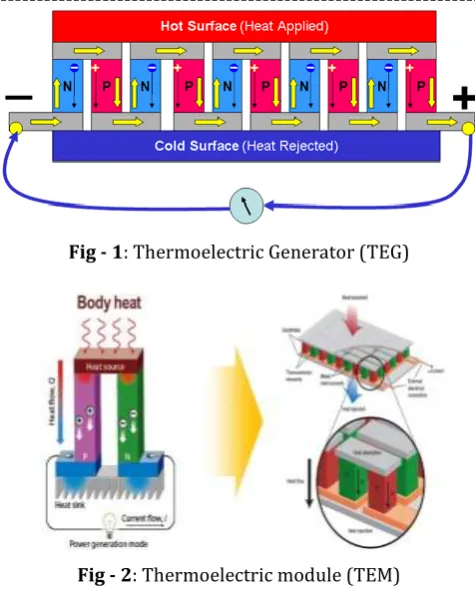
[image:1.595.314.552.219.514.2]In the early 1800s the thermoelectric effect was discovered. If a temperature gradient is applied to a junction of two dissimilar materials, a voltage will be generated. With the development of semiconductors, the thermoelectric turned to be made of P-type and N-type semiconductors where the bandgap and the carriers concentration could be optimized. By connecting many thermocouples electrically in series and thermally in parallel a thermoelectric module (TEM) as shown in Figure 1 and Figure 2 will be formed.
Fig - 1: Thermoelectric Generator (TEG)
Fig - 2: Thermoelectric module (TEM)
TEM devices can be classified into two types, TEG (thermoelectric generator) which converts temperature gradient to electric energy and TEC (thermoelectric cooler) which converts electric energy to temperature gradient. TEM is a solid-state energy converter where there is no mechanical or moving parts and generates no noise, moreover, it is reliable, compact and stable. However, the main problem with the TEM is the low efficiency of energy conversion [1].
Chengzhi Zheng et al in 2019 [2] developed a flexible self-powered sensing element by integrating organic-transistor-based chemical sensors with a flexible power supplier, and an organic thermoelectric (OTE) generator. The constructed OTE array mounted on a paper substrate shows a maximum open-circuit voltage of 0.52 V and a maximum power output of 0.32 µW. Notably, the device can be used to power organic field-effect transistor-based gas sensors with ultralow operating voltage.
© 2019, IRJET | Impact Factor value: 7.34 | ISO 9001:2008 Certified Journal
| Page 1104
consisting of a planar micro super capacitor linked directlyto thermoelectric pn modules of p-Ag2Te and n-Ag2Se nanoparticle thin films. In the TEG-MSC, a Seebeck voltage of 82 mV is generated at a temperature difference of 15.8 K and is rapidly charged with an efficiency of 98% and the proposed device achieves a discharging and charging ratio of 99%.
Steven Lecompte et al in 2019 [4] presented a review of experimental investigations on supercritical operation considering both heat-to-upgraded heat and heat-to-power systems.
The rest of this paper is organized as follows: Section 1 presents the world movement of seeking energy and the history of Seebeck coefficient, the effect of developing semiconductors on developing TEM and how TEG works. Section 2 shows how to obtain the mathematical model of the TEG and the factors affecting it. Section 3 shows the electrical parameters and how to determine the TEG characteristics. Section 4 presents a simulation of the HZ-20 TEG module using MATLAB/Simulink and getting the relationship between the voltage and current-power. Section 5 studies the application of using TEG in the Egyptian weather conditions. Section 6 shows the results of power output of every governorate during the year 2017. Section 7 proposes several advanced applications for the use of TEG. Finally, section 8 is the conclusion.
2. THEORY AND MATHEMATICAL MODEL
In order to obtain a mathematical model for the TEG, there are many effects that should be considered, like Joule effect, Seebeck effect, Peltier effect, Thomson effect and Thermal conduction [5].
Joule effect is generated inside the module when the electric current (I) flows in the thermoelectric element in both the hot side and cold side with the same amount of energy:
Q Joule = I2R (1)
where R is the electric resistance, I is the electric current. Seebeck effect is generating voltage between two dissimilar materials when a temperature deference is applied:
α = V/∆T (2)
where α is the Seebeck coefficient, V is the Voltage, ∆T is the temperature deference.
Thermal conductivity is a Fourier process which is described by:
Qth = -∆T Kth (3)
Where Kth is the Thermal conductivity.
Peltier effect is the heat effect when electric current flows through two dissimilar junctions:
QPeltier = α ∆T I (4)
Thomson effect is too small so it neglected.
3. ELECTRICAL PARAMETERS OF THE TEG
The following parameters are used to determine the TEG characteristics:
Th: Hot side temperature. Tc: Cold side temperature.
∆T: Temperature difference between the hot side and cold side.
Vm: Matched voltage. Wm: Matched power. R: Internal resistance.
RL: Load resistance (matched to internal resistance where R=RL).
So, the electrical resistance could be defined by:
R=RL=Vm2/Wm (5)
and Seebeck coefficient:
α= 2Vm/∆T (6)
and if:
RL=mR (7)
Where m is the ratio between the internal and load resistance, So the electric current is:
I=α∆T/(1+m)R (8)
and when the load is matched the current will be:
Im= α∆T/2R (9)
In TEG applications, it is important to maximize the output current which is the short-circuit current at VL=0:
ISC=2Im=2Wm/Vm (10)
and the TEG output voltage is:
V=-R(I-ISC) (11)
4. SIMULATION OF THE TEG
The parameters of the TEG could be calculated from the basic specifications of the TEG manufacture’s datasheet by using equations (5) to (11).
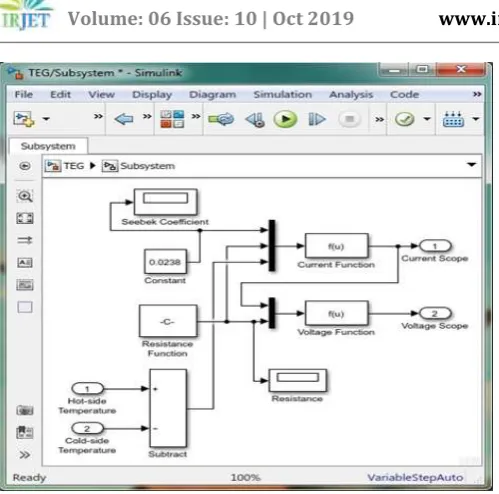
The TEG model is implemented using MATLAB/Simulink as shown in Figure 3. By using the HZ-20 module, its basic specifications are:
TH = 230°c TC = 30°c Wm = 19 W Vm = 2.38 V
Max Efficiency = 4.5% R = 0.2981Ω
Fig - 3: MATLAB/Simulink model for the TEG
[image:3.595.310.559.174.257.2]By making the cold-side temperature a constant at 30°c and the hot-side temperature a variable from 30°c to 230°c the output parameters of the system voltage, current and power at the matched load are shown in Figure 4.
Fig - 4: I-V & I-W output characteristics
So, the maximum power is 19W at 2.38V and 7.982A which are matching with the manufacture’s datasheet.
5. APPLICATION IN THE EGYPTIAN ENVIRONMENT
To make the TEG works efficiently, it is necessary to maximize ∆T to get a higher output power. So that Th will be provided by the solar energy and Tc will be provided by surface temperatures of the Egyptian seas (Red Sea and Mediterranean Sea).
Temperatures in degrees can be obtained from meteoblue website [6] which gives a graph of the weather conditions for every governorate in Egypt around the whole year. Surface temperatures of the Egyptians seas can be obtained from seatemperature.org website [7] which is based on graphs derived from the historical sea surface data of many
years. Our study will only be applied to cities which have water bodies.
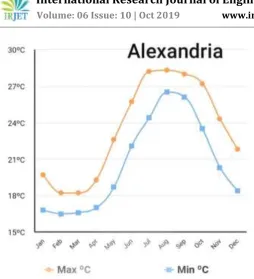
Figure 5 shows a sample of ambient temperatures of the Egyptian governorates during the year 2018 and Figure 6 shows a sample of sea surface temperatures during the year 2018.
Fig - 5: Sample of Temperatures of Egyptian Governorates in 2018
6. SIMULATION RESULTS
[image:3.595.44.276.389.551.2]By simulating HZ-20 TEG module by using Th and Tc from temperature of every governorate in Egypt that has water body, we obtain the power output in Watts as shown in Table 1.
Table -1: Power output in Watts from the TEG in the Egyptian Governments during 2017
Jan Mar May Jul Dep Nov
Alexandria 0.056 1.81 1.92 1.27 0.565 0.32
Matrouh 0.094 1.32 2.86 1.65 0.62 0.18
Port Said 0.265 2.08 1.27 1.85 0.808 0.547
Sues 0.283 1.36 2.14 2.67 1.76 0.696
Sharm
El-Shaikh 0.056 0.99 1.59 2.67 2.65 0.47
Dahab 0.037 1.56 2.26 2.56 3.04 0.97
Hurghada 0.094 1.43 2.06 2.06 2.44 0.43
Alquseir 0.037 1.83 2.51 1.87 1.87 0.359
Shalateen 0.359 1.83 2.69 2.4 2.14 0.73
[image:3.595.304.564.416.603.2]© 2019, IRJET | Impact Factor value: 7.34 | ISO 9001:2008 Certified Journal
| Page 1106
Fig - 6: Sample of sea surface temperatures in EgyptFig - 7: Power output in Watts from North coast area
Fig - 8: Power output in Watts from Sinai area
Fig - 9: Power output in Watts from Red Sea coast area
7. PROPOSED ADVANCED APPLICATIONS
In this section we will propose several advanced applications that can make use of the TEG.
7.1 Radioisotope Thermoelectric Generator
Radioisotope Thermoelectric Generator generates electrical power by converting the heat which is released from the nuclear decay of radioactive isotope into electric power as shown in Figure 10.
Since 1961 U.S. and NASA have used 41 radioisotope power system as a power source for 26 space systems on 25 missions for scientific stations on the moon, highly sophisticated deep space interplanetary missions to Jupiter, Saturn and beyond, Earth orbital weather, robotic explorer spacecraft on Mars, The New Horizons mission to Pluto [8] [9] [10].
Fig - 10: Radioisotope
7.2 Car Waste Heat Recover
[image:4.595.41.287.371.498.2] [image:4.595.311.559.451.584.2]Fig - 11: Interface between TEG and exhaust manifolder
7.3 PV/TEG Combination
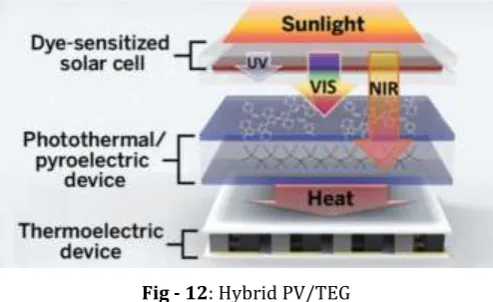
The combination between PV and TEG as shown in Figure 12, prevents the drop in the electric efficiency of the PV. Moreover, converting the waste thermal power to electric power by the TEG and adding this power to the PV power, the total system output will be increased [13] [14].
Fig - 12: Hybrid PV/TEG
3. CONCLUSIONS
This paper performed a study about using the TEG in the Egyptian environment. It is recommended to increase the temperature difference ∆T by searching for a place that has high ambient temperature and a water body which has a low temperature.
[image:5.595.39.291.88.278.2]It is recommended to concentrate sun rays on the TEG by using lenses on parabola or a solar box to retain the heat and use big heat sink as much as possible made of a good heat conductive material as shown in Figure 13.
Fig - 13: Proposed sea surface TEG setup
This paper introduced the application of the TEG in open areas. It is recommended to use the TEG in industries which use ovens and also in electric cars by converting waste heat generated from batteries into useful electric energy. It is recommended in open area applications to combine the TEG with the PV Photovoltaic where TEGs are used to generate electricity at an efficiency of ~5% of the heat energy while the cooling increases the efficiency of the PV with about ~19%. So, it is recommended to apply one combined module of TEG and PV.
REFERENCES
[1] Lauren Howard, Dragoslav Grbovic, Anthony Pollman,
“Modeling and Simulation Approach to Inform TEG Waste Heat Harvesting Prototype for Fossil Fuel Exhaust”, Proceedings of the 3rd International Conference of Energy Harvesting, Storage, and Transfer (EHST'19) Ottawa,, Canada – June 18-19, 2019.
[2] Chengzhi Zheng, Lanyi Xiang, Wenlong Jin, Hongguang
Shen, Wenrui Zhao, Fengjiao Zhang, Chong-an Di, and Daoben Zhu, “A Flexible Self-Powered Sensing Element with Integrated Organic Thermoelectric Generator”, Adv. Mater. Technol. 2019, 1900247 , doi: 10.1002/admt.201900247.
[3] Kyungwhan Yang, Kyoungah Cho, Seunggen Yang,
Yoonbeom Park, and Sangsig Kim ,”A Laterally Designed all-in-one Energy Devise Using A Thermoelectric generator-coupled Micro Supercapacitor” ,Nano Eenergy 60,667-672,2019.
[4] Steven Lecompte, Erika Ntavou, Bertrand Tchanche,
George Kosmadakis, Aditya Pillai, Dimitris Manolakos and Michel De Paepe, “Review of Experimental Research on Supercritical and Transcritical Thermodynamic Cycles Designed for Heat Recovery Application”, Appl. Sci. 2019, 9, 2571; doi:10.3390/app9122571.
[5] Saim Memon and Khawaja Noman Tahir, “Experimental
[image:5.595.38.285.400.551.2]© 2019, IRJET | Impact Factor value: 7.34 | ISO 9001:2008 Certified Journal
| Page 1108
[6] www.meteublue.com. [7] www.seatemperature.org.
[8] Robert L. Catalad, Gary L. Bannett, "U.S. Radioisotope
Power Systems and Applications: Past, Present and Future", NASA Glenn Research Center, Metaspace Enterprises, USA. https://ntrs.nasa.gov/
search.jsp?R=20120000731,2019-05-20T07:30:36+00:00Z.
[9] Scott Wilson1, Sal Oriti, “MATURATION OF DYNAMIC
POWER CONVERTORS FOR RADIOISOTOPE POWER SYSTEMS”, NASA Glenn Research Center, Cleveland, OH, 44135, 216.433.6681, Nuclear and Emerging Technologies for Space, American Nuclear Society Topical Meeting Richland, WA, February 25 – February 28, 2019.
[10] Robert Cataldo1, Kris Zacny, and Paul Schmitz ,”
RadioisotopePowerSystemstoEnableExtendedLunarScie nceandIn-SituResourceUtilizationMissions”, ANS NETS 2018 – Nuclear and Emerging Technologies for Space , https://ntrs.nasa.gov/search.jsp? R=20180004489 2019-08-06T12:43:10+00:00Z.
[11] Malavika E J, Akhil Raj C, Abin K A, Anitha P, "Waste Heat
Recovery from Automobils", GRD Journals, Global Research and Development Journal for Engineering, National Conference on Emerging Researrch Trend in Electrical and Electronics Engineering (ERTEE)/March 2018
[12] Rui Quan, Guangyin Liu, Chengji Wang, Wei Zhou, Liang
Huang, Yadong Deng, "Performance Investigation of an Exhaust Thermoelectric Generator for Military SUV
Application", Coatings
2018,8,45;doi:10.3390/coating8010045.
[13] Sajjad Mahmoudinezhada, Alireza Rezaniakolaeia, Lasse
Aistrup Rosendahl ,”Numerical parametric study on the performance of CPV-TEG hybrid system”, 10th International Conference on Applied Energy (ICAE2018), 22-25 August 2018, Hong Kong, China.
[14] H. Hashim, J.J. Bomphrey, G. Min, "Model for Geometry
Optimisation of Thermoelectric Devices in Hybrid PV/TE System", Renewable Energy 87 (2016) 458-463, ELSEVIER Ltd.
BIOGRAPHIES
Mohammed Araby was born in Cairo, Egypt on 29/7/1989. He received his B.Sc. from the Faculty of Industrial Education, Helwan University in May 2013. Since 26/9/2013 he has worked at the Engineering Company for Electronics & Control. In 2015 he joined the master program in the Faculty of Industrial Education, Helwan University.
Ayman Haggag was born in Cairo, Egypt in 1971. He received his B.Sc. degree from Ain Shams University, Egypt, in June 1994, M.Sc. degree from Eindhoven University of Technology, The Netherlands, in December 1997, and Ph.D. degree from Chiba University, Japan, in September 2008. Since March 1996, he has been with the Electronics Technology Dept., Faculty of Industrial Education, Helwan University, Egypt. His current research interests are in the fields of Network Security and Wireless Security.
Mostafa Eltokhy was born in Kaluobia, Egypt, in 1970. He received his B.Sc. degree from Zagazig university, Banha branch, Egypt, and M.Sc. degree from Technical University, Eindhoven, The Netherlands in 1993 and 1998, respectively. He received his Ph.D. degree from Osaka University, Osaka, Japan in 2003. Presently, he is an Associate Professor of Electronics Engineering at Department of Electronics Technology, Faculty of Industrial Education, Helwan University, Cairo, Egypt. His current research interests are in high performance digital circuits and analog circuits. He is a member of the IEEE.