Parallel Computing with a Bayesian Item Response Model
Kyriakos Patsias1, Mona Rahimi2, Yanyan Sheng3*, Shahram Rahimi2 1Motorola Mobility, Chicago, USA
2Department of Computer Science, Southern Illinois University, Carbondale, USA
3Department of Educational Psychology & Special Education, Southern Illinois University, Carbondale, USA Email: *[email protected], [email protected]
Received February 4,2012; revised February 17, 2012; accepted February 25,2012
ABSTRACT
Item response theory (IRT) is a modern test theory that has been used in various aspects of educational and psychologi- cal measurement. The fully Bayesian approach shows promise for estimating IRT models. Given that it is computation- ally expensive, the procedure is limited in practical applications. It is hence important to seek ways to reduce the execu- tion time. A suitable solution is the use of high performance computing. This study focuses on the fully Bayesian algo- rithm for a conventional IRT model so that it can be implemented on a high performance parallel machine. Empirical results suggest that this parallel version of the algorithm achieves a considerable speedup and thus reduces the execution time considerably.
Keywords: Gibbs Sampling; High Performance Computing; Message Passing Interface; Two-Parameter IRT Model
1. Introduction
Item response theory (IRT) provides measurement mod-els that describe a probabilistic relationship between cor-rect responses on a set of test items and a latent trait. With many advantages (see [1]), it has been found useful in a wide variety of applications in education and psy-chology (e.g. [2-4]) as well as in other fields (e.g. [5-10]).
Parameter estimation offers the basis for theoretical advantages of IRT and has been a major concern in the application of IRT models. While the inference of items and persons on the responses is modeled by distinct sets of parameters, simultaneous estimation of these parame-ters in IRT models results in statistical complexities in the estimation task, which have made estimation proce-dure a primary focus of psychometric research over dec-ades [11-14]. Recently, because of the availability of high-computing technology, the attention is focused on fully Bayesian estimation procedures, which offer a number of advantages over the traditional method (see e.g. [15,16]). Albert [17] applied Gibbs sampling [18], one of the most efficient Markov Chain Monde Carlo (MCMC [19,20]) algorithms, to the two-parameter nor-mal ogive (2PNO) [21] model. Since a large number of iterations are needed for the Markov chain to reach con-vergence, the algorithm is computationally intensive and requires considerable amount of execution time, espe-cially with large datasets (see [22]). Hence, achieving a speedup, and thus reducing the execution time, will make
it more practical for researchers or practitioners to im-plement IRT models using Gibbs sampling.
High performance computing (HPC) employs super-computers and computer clusters to tackle problems with complex computations. HPC utilizes the concept of par-allel computing to run programs in parpar-allel and achieve a smaller execution time or communication time, which is affected by the size of the messages being communicated between computers. With parallel computing, many large- scale applications and algorithms utilize Message Pass-ing Interface (MPI) standard to achieve better perform-ance. The MPI standard is an application programming interface (API) that abstracts the details of the underlying architecture and network. Some examples of applications that use MPI are crash simulations codes, weather simu-lation, and computational fluid dynamic codes [23] to name a few.
In view of the above, parallel computing can poten-tially help reduce time for implementing MCMC with the 2PNO IRT model, and as the size of data and/or chain increases, the benefit of using parallel computing would increase. However, parallel computing is known to excel at tasks that rely on the processing of discrete units of data that are not interdependent. Given the high data de-pendencies in a single Markov chain for IRT models, such as the dependency of one state of the chain to the previous state, and the dependencies among the data within the same state, the implementation of parallel computing is not straightforward. The purpose of this study is hence to overcome the problem and develop a
high performance Gibbs sampling algorithm for the 2PNO IRT model using parallel computing. This paper focuses on all-to-one and one-to all broadcast operations. The aim is to achieve a high speedup while keeping the cost down. The cost of solving a problem on a parallel system is defined as the product of parallel runtime and the number of processing elements used.
The remainder of the paper is organized as follows. Section 2 reviews the 2PNO IRT model and the Gibbs sampling procedure developed by Albert [17]. Section 3 illustrates the approach taken in this study to parallelize the serial algorithm. In Section 4, the performance of the developed parallel algorithm is investigated and further compared with that from serial implementation. Finally, a few summary remarks are given in Section 5.
2. Model and the Gibbs Sampler
The 2PNO IRT model provides a fundamental frame-work in modeling the person-item interaction by
assum-ing one ability dimension. Suppose a test consists of k
multiple-choice items, each measuring a single unified
ability, . Let yij n k represent a matrix of n
y
examinees’ responses to k dichotomous items, so that
is defined as
ij y
1, if person answers item correctly , 0, if person answers item incorrectly
ij i j y i j
1, , , 1, ,
i n j k. The probability of person i
ob-taining correct response for item j can be defined as
1
1 222π
j i j t
ij j i j
P y t
e d , (1)where j and j denote item parameters, i denotes
the continuous person trait parameter, and denotes
the unit normal cdf.
The Gibbs sampler involves updating three sets of pa-rameters in each iteration, namely, an augmented
con-tinuous variable Zij (which is positive if yij 1 and
negative if yij 0), the person parameter i, and the
item parameters j, where j
j, j
from theirrespective full conditional distributions, namely,
0, ,0
, 1 ~
, 0
j i j ij ij
j i j ij
N if Z N i y
f y , (2)
2 2 2
1
~ ,
1 1
ij j j j
i 2
j j
j
Z
N
j
, (3)
1 1
~ ' ,
j N j
x x x Z x x
I j 0
, (4)where x
, 1
, assuming ~
, 2
i N
, j0
and p
j 1 (see [17,22]).Hence, with starting values 0 and 0 ,
observa-tions
Z l , l, l
can be simulated from the Gibbs sampler by iteratively drawing from their respective full conditional distributions specified in Equations (2), (3) and (4). To go from
Z l1, l1, l1
to
Z l, l, l
,it takes three transition steps: 1) Draw Z l ~ p Z
l1, l1
;2) Draw l ~ p
Z l, l1
;3) Draw l ~ p
Z l, l
.This iterative procedure produces a sequence of
l, l
, l = 0, ··· , L. To reduce the effect of the start-ing values, early iterations in the Markov chain are set as burn-ins to be discarded. Samples from the remaining iterations are then used to summarize the posteriorden-sity of item parameters and ability parameters .
The algorithm takes less than 13 minutes for a 2000- by-10 dichotomous (0-1) data matrix and 10,000 total iterations when implemented in Fortran using the Mi-crosoft Powerstation 4.0 compiler and the IMSL Fortran numerical library [22]. For a longer chain with 50,000 iterations, it takes about 60-90 minutes for each execu-tion. With every execution taking more than 12 minutes on a single computer, using this algorithm with large datasets is computational expensive. This further limits the use of IRT models under fully Bayesian framework in various applications.
3. Methodology
The study was performed using the Maxwell Linux clus-ter, a cluster with 106 processing nodes. Maxwell uses the message passing model via the MPICH MPI frame-work implementation. One of the 106 nodes acted as the root node, while the rest of the nodes acted as slave nodes. The root node was responsible for generating and
partitioning the matrix y, transmitting the submatrices,
updating and broadcasting θ, execution time recording,
as well as the same duties as the slave nodes.
Each node on the cluster has an Intel Xeon dual CPU quad-core processor clocked at 2.3 GHz, 8 GB of RAM, 90 TB storage, and Linux 64bit operating system. MPICH allows the user to choose how many nodes to use before the execution of a program so that various number of processing nodes may be used in every execution.
3.1. Parallelism with the Gibbs Sampler
decom-position is a great fit for the 2PNO IRT algorithm since the input and intermediate data can easily be partitioned as illustrated in Figures 1 and 2.
With this approach, the first processing node, P0,
re-ceives a sub matrix, yP0, of size n × g that corresponds
to the elements of the y matrix from y0,0 to yn–1, g–1, where
g k P and P is the number of processing nodes. The
second processing node, P1, receives a sub matrix of y,
1 P
y , of size n × g that corresponds to the elements of the
[image:3.595.59.285.217.414.2]y matrix from y0, g to yn–1, 2g–1 and so forth. Consequently,
Figure 1. The input y matrix mapped for five processing units.
Figure 2. The Z matrix, and α and γ vectors mapped for five processing units.
each processing node updates the Gibbs samples as in the serial algorithm, but with a smaller input data set. That is,
instead of operating on the whole input matrix y, they
operate on a part of it of size n × g.
Decompositions of Z, α, and γare depicted in Figure
2, where we see that each processor is updating a block
of Z, α, and γ from Equations (2) and (4), respectively,
where j = 1,···, g. For instance, P0 updates a block of Z,
0 P
Z , from Z0,0 to Zn–1, g–1, a block of α, P0, from α0 to αg–1, and a block of γ, P0, from 0 to γg–1.
Sinceθ is of size n × 1 (a column vector), it is not
de-composed. However, a problem arises with the update of
θ. For simplicity, consider the update of the first element
of θ, which requires the updated α, γ, and the first row of
Z. Yet, any given processing node has only a part ofα, γ,
and the first row of Z. The solution is to assign one of the
processing nodes (e.g., the root) to update θ and
broad-cast it to the rest of the units. The naïve approachto
up-date θwould be to have all the units send their part of α,
γ and Z to the root so that it has the complete Z, α andγ
to updateθ from Equation (3) and then broadcast θ to the
rest of the nodes. A problem with this approach is that the data communicated are too large, which causes the parallel algorithm to take a longer execution time than the serial algorithm.
A better approach is one that minimizes the commu-nication cost. This can be achieved by having every node
g Z 1
i j ij j j
to calculate
and 21 g
j j
andsend ψi and τ to the root for it to update from
2 2
1
~ ,
1 1
i P i
P P
N
, (5)This way, each processing node is sending a vector of
size n + 1 to the root and one message of size n is
broad-casted by the root. The total data transferred between all the nodes by this approach is
1
2l n P l n P lP n1
.As a comparison, the total data transferred between all the nodes by the naïve approach is
2
2
l ng g P l n P lP g n n , which equals lP(2n + 2) when g = 1, lP(3n + 4) when g =
2, and so forth. When g > 1, the total data transferred
using the naïve approach are considerably more than that
of the proposed approach (n is usually in the order of
thousands).
3.2. Implementation
[image:3.595.59.286.458.705.2]illus-trated in the previous section, the MPI_Gather and MPI_Bcast routines were used for collective communi-cations. See the Appendix for part of the source code of the parallel algorithm in updating the model parameters.
3.3. Performance Analyses
In order to investigate the benefits of the proposed paral-lel solution against its serial counterpart, four
experi-ments were carried out in which sample size (n), test
length (k), and number of iterations (l) varied as below:
n =2000, k = 50, l = 10,000,
n =5000, k = 50, l = 10,000,
n =2000, k = 100, l = 10,000,
n =2000, k = 50, l = 20,000.
In all these experiments, one (representing the serial algorithm) to nine processing nodes were used to imple-ment the Gibbs sampler. Their performances were evalu-ated using four metrics in addition to the execution time. These metrics are the total overhead, relative speedup, relative efficiency, and cost:
The total overhead can be calculated as
0 P S
T PT T , (6)
where P is the number of available processing nodes, TS
is the fastest sequential algorithm execution time and TP
is the parallel algorithm execution time.
Relative speedup is the factor by which execution
time is reduced on P processors and it is defined as
S P
S T T . (7)
Efficiency describes how well the algorithm manages
the computational resources. More specifically, it tells us how much time the processors spend executing important computations [24]. Relative efficiency is defined as
S
E T PT P. (8)
The definition of cost of solving a problem on a
par-allel system is the product of parpar-allel runtime and P.
Consequently, cost is a quantity that reveals the sum of individual processing node runtime.
4. Results and Discussion
Results from the four experiments are summarized in
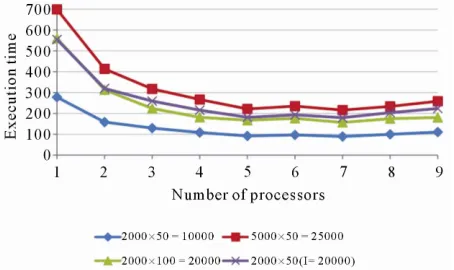
Figures 3-7. Note that the values plotted represent the average of ten runs. As expected, the execution time de-creased as the number of processing nodes inde-creased in
all the experimented conditions (see Figure 3).
In terms of efficiency and cost, the algorithm per-formed better using two to five processing nodes (see
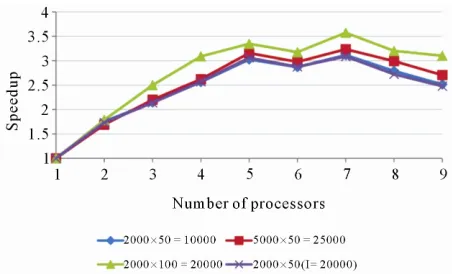
Figures 4 and 5). When using up to seven nodes, the
communication overhead (see Figure 6) is sufficiently
low in order to not affect the overall speedup (see Figure
[image:4.595.311.538.87.222.2]7). The algorithm had the smallest execution time when
[image:4.595.309.536.262.402.2]Figure 3. Execution time of the algorithm using one through nine processors in all the experiments.
[image:4.595.311.536.441.577.2]Figure 4. Relative efficiency of using parallel algorithm over the serial algorithm in all the experiments.
Figure 5. Cost of the algorithm using one through nine proc- essors in all the experiments.
five or seven processing nodes were used (see Figure 3).
When nine processing nodes were used, the communica-tion overhead reached the highest, which caused a rela-tively higher total execution time and lower speedup.
It is noted that the overhead increased as the number of processing nodes increased and it reached the maxi-mum with eight or nine processing nodes. This is be-cause in the parallel algorithm, the overhead of
commu-nication is a result of nodes sending ψ and τ to the root
Figure 6. Total overhead of using parallel algorithm over the serial algorithm in all the experiments.
Figure 7. Relative speedup of using parallel algorithm over the serial algorithm in all the experiments.
in every iteration. Note that the total data transferred
be-tween all the nodes during execution is lP(2n + 1). The
biggest part of idling occurs when the root waits to
re-ceive ψ and τ from all the slave nodes and when the slave
nodes wait for the root node to calculate θand broadcast
it to them. The communication overhead increases more than the computation speedup when a certain amount of processors are used (ranges from four to seven proces-sors in the experiments performed). As a result, the speedup does not increase with increasing processor count, and consequently, the cost increases dramatically.
Furthermore, a close examination of Figure 7
indi-cates that the experiments with input matrix sizes 2000 ×
50, 5000 × 50, and 2000 × 50 (with number of iterations l
= 20,000), follow identical paths. The common input
value of these experiments is the number of items, k. The
plot for the experiment with input matrix size 2000 × 100 shows that the algorithm maintains a higher speedup compared to the other experiments. Even though the ex-periment with input matrix size 2000 × 50 has smaller input size, the experiment with input matrix 2000 × 100 maintains a higher speedup over all the processors. The
same pattern is observed from Figure 4. In particular, the
plot for the experiment with input matrix size 2000 × 100 shows that the algorithm maintains a higher efficiency
compared to the other experiments where k = 50. These
are because the size of the messages communicated in every iteration from the slave nodes to the root, and from
the root to the slave nodes, depends only on n. As k
in-creases, the message size and communication overhead remain unaffected. Because of this, the processors spend more time performing computations and hence the effi-ciency and speedup increase.
5. Conclusions
This study developed a high performance Gibbs sam-pling algorithm for the 2PNO IRT model with the pur-pose of achieving a lower execution time possible using the available hardware (Maxwell cluster). The algorithm was implemented using the ANSI C programming lan-guage and the message passing interface. Experiments were performed to evaluate its performance with various dataset sizes or iteration lengths. Results indicated that the parallel algorithm (for the given problem size) per-formed better, in terms of efficiency and cost, using two to five processing nodes. On the other hand, the algo-rithm had the smallest execution time when nine proc-essing nodes were used.
The design of a parallel 2PNO IRT model has proved to be justifiable. Given the high data dependencies for such problems, the solution initially appeared to be non-trivial. By using domain decomposition, we man-aged to avoid communication for the state dependencies. Nevertheless, communication in every iteration of the Markov chain cannot be avoided because of the data de-pendencies within the state. By modifying the serial al-gorithm, the size of the data communicated in every it-eration was managed to be reduced to make a speedup possible.
This study achieved parallelization through a column- wise decomposition and the use of all-to-one and one- to-all broadcast schemes. Further studies can be under-taken to increase the speedup and the efficiency, and minimize the cost and the total overhead. For example, the data may be decomposed differently or an all-to-all broadcast scheme may be adopted in order to achieve smaller communication overhead.
REFERENCES
[1] R. Hambleton, H. Swaminathan and H. J. Rogers, “Fun- damentals of Item Response Theory,” SAGE Publications, Thousand Oaks, 1991.
[2] M. J. Kolen and R. L. Brennan, “Test Equating: Methods and Practices,” Springer-Verlag, New York, 1995. [3] S. E. Embretson and S. P. Reise, “Item Response Theory
for Psychologist,” Lawrence Erlbaum Associates Inc., Mahwah, 2000.
[image:5.595.59.285.257.394.2]R. Mislevy, L. Steinberg and D. Thissen, “Computerized Adaptive Testing: A Primer,” Lawrence Erlbaum Associ- ates Inc., Mahwah, 2000.
[5] J. Bafumi, A. Gelman, D. K. Park and N. Kaplan, “Prac- tical Issues in Implementing and Understanding Bayesian Ideal Point Estimation,” Political Analysis Advance Ac- cess, Vol. 13, No. 2, 2005, pp. 171-187.
doi:10.1093/pan/mpi010
[6] N. Bezruckzo, “Rasch Measurement in Health Sciences,” JAM Press, Maple Grove, 2005.
[7] C. H. Chang and B. B. Reeve, “Item Response Theory and Its Applications to Patient-Reported Outcomes Meas- urement,” Evaluation & the Health Professions, Vol. 28, No. 3, 2005, pp. 264-282.
doi:10.1177/0163278705278275
[8] U. Feske, L. Kirisci, R. E. Tarter and P. A. Plkonis, “An Application of Item Response Theory to the DSM-III-R Criteria for Borderline Personality Disorder,” Journal of Personality Disorders, Vol. 21, No. 4, 2007, pp. 418-433. doi:10.1521/pedi.2007.21.4.418
[9] G. W. Imbens, “The Role of the Propensity Score in Es- timating Dose-Response Functions,” Biometrika, Vol. 87, No. 3, 2000, pp. 706-710. doi:10.1093/biomet/87.3.706 [10] S. Sinharay and H. S. Stern, “On the Sensitivity of Bayes
Factors to the Prior Distribution,” The American Statisti- cian, Vol. 56, No. 3, 2002, pp. 196-201.
doi:10.1198/000313002137
[11] A. Birnbaum, “Statistical Theory for Logistic Mental Test Models with a Prior Distribution of Ability,” Journal of Mathematical Psychology, Vol. 6, No. 2, 1969, pp. 258- 276. doi:10.1016/0022-2496(69)90005-4
[12] F. B. Baker and S. H. Kim, “Item Response Theory: Pa- rameter Estimation Techniques,” 2nd Edition, Dekker, New York, 2004.
[13] R. D. Bock and M. Aitkin, “Marginal Maximum Likeli-hood Estimation of Item Parameters: Application of an EM Algorithm,” Psychometrika, Vol. 46, No. 4, 1981, pp. 443-459. doi:10.1007/BF02293801
[14] I. W. Molenaar, “Estimation of Item Parameters,” In: G. H. Fischer and I. W. Molenaar, Eds., Rasch Models: Foun- dations, Recent Developments, and Applications, Springer- Verlag, New York, 1995, pp. 39-51.
[15] R. K. Tsutakawa and J. C. Johnson, “The Effect of Un- certainty of Item Parameter Estimation on Ability Esti- mates,” Psychometrika, Vol. 55, No. 2, 1990, pp. 371-390. doi:10.1007/BF02295293
[16] R. K. Tsutakawa and M. J. Soltys, “Approximation for Bayesian Ability Estimation,” Journal of Educational Statistics, Vol. 13, No. 2, 1988, pp. 117-130.
doi:10.2307/1164749
[17] J. H. Albert, “Bayesian Estimation of Normal Ogive Item Response Curves Using Gibbs Sampling,” Journal of Educational Statistics, Vol. 17, No. 3, 1992, pp. 251-269. doi:10.2307/1165149
[18] S. Geman and D. Geman, “Stochastic Relaxation, Gibbs Distributions, and the Bayesian Restoration of Images,” IEEE Transactions on Pattern Analysis and Machine In- telligence, Vol. 6, No. 6, 1984, pp. 721-741.
doi:10.1109/TPAMI.1984.4767596
[19] A. F. M. Smith and G. O. Roberts, “Bayesian Computa- tion via the Gibbs Sampler and Related Markov Chain Monte Carlo Methods,” Journal of the Royal Statistical Society, Series B, Vol. 55, No. 1, 1993, pp. 3-24.
[20] L. Tierney, “Markov Chains for Exploring Posterior Dis-tributions (with Discussion),” Annals of Statistics, Vol. 22, No. 4, 1994, 1701-1762. doi:10.1214/aos/1176325750 [21] F. M. Lord and M. R. Novick, “Statistical Theories of
Mental Test Scores,” Addison-Wesley, Boston, 1968. [22] Y. Sheng and T. C. Headrick, “An Algorithm for
Imple-menting Gibbs Sampling for 2PNO IRT Models,” Jour-nal of Modern Applied Statistical Methods, Vol. 6, No. 1, 2007, pp. 341-349.
[23] R. Noronha and K. P. Dhabaleswar, “Performance Evalua- tion of MM5 on Clusters with Modern Interconnects: Scalability and Impact,” Euro-Par 2005 Parallel Process- ing, 2005, Vol. 3648, pp. 134-145.
doi:10.1007/11549468_18
[24] I. Foster, “Designing and Building Parallel Programs: Concepts and Tools for Parallel Software Engineering,” Addison-Wesley, Boston, 1995.
Appendix
The pseudo code for updating the values of Z, ψ, τ, θ, α,
and γ is shown below. First of all, Z is updated through
the function update_Z. Then, update_PSI_TAU is called
to update ψ and τ and MPI_Gather is called to send ψ
and τ to the root. The root receives ψ and τ and calls
up-date_TH to update θ and afterwards broadcasts θ by
calling MPI_Bcast. Finally, α and γ are updated from a
function call to update_A_G. In order to reduce
commu-nication overhead, ψ and τ are sent in the same message.
To achieve that, an array of size n +1 is set up, where the
first n entries consist of the elements of ψ and entry n +1
consists of τ (the name of this array in the code is
PSI_TAU_array). // Start iteration:
for (m = 0; m < l; m++){ count++;
update_Z(Z, y, TH, A, G, r);
update_PSI_TAU(PSI_TAU_array, Z, A, G); MPI_Gather (PSI_TAU_array, n+1,
MPI_DOUBLE, PSI_TAU_rec, n+1, MPI_DOUBLE, ROOT, MPI_COMM_WORLD);
if (rank == ROOT){ double TAU_array[size]; int ind = 0;
// Retrieve PSI and TAU from PSI_TAU_rec:
for (j = 0; j < size; j++){ for (i = 0; i < n+1; i++){
if (i < n)
gsl_matrix_set(PSI_matrix, i, j, PSI_TAU_rec[ind++]);
else
TAU_array[j] = PSI_TAU_rec[ind++]; }
}
update_TH (TH, THV, TAU_array, PSI_matrix, count, r);
// Transfer TH data into a buffer so that it can be broad-casted:
for (i = 0; i < n; i++){
TH_array[i] = gsl_vector_get(TH, i); }
}
MPI_Bcast (TH_array, n, MPI_DOUBLE, ROOT, MPI_COMM_WORLD);
// Transfer TH received to a vector structure: for (i = 0; i < n; i++){
gsl_vector_set (TH, i, TH_array[i]); }