http://dx.doi.org/10.4236/ojs.2012.25059 Published Online December 2012 (http://www.SciRP.org/journal/ojs)
Bootstrap-T Technique for Minimax Multivariate
Control Chart
Johnson A. Adewara1, Kayode S. Adekeye2 1
Distance Learning Institute, University of Lagos, Lagos, Nigeria 2
Department of Mathematical Sciences, Redeemer’s University, Redemption City, Nigeria Email: [email protected]
Received August 8,2012; revised September 10, 2012; accepted September 22, 2012
ABSTRACT
Bootstrap methods are considered in the application of statistical process control because they can deal with unknown distributions and are easy to calculate using a personal computer. In this study we propose the use of bootstrap-t multi- variate control technique on the minimax control chart. The technique takes care of correlated variables as well as the requirement of the distributional assumptions needed for the operation of the minimax control chart. The bootstrap-t
technique provides the mean ˆB of all the bootstrap estimators i1
B ˆ ˆ
B i B
where ˆi is the estimate using the
bootstrap sample and B is the number of bootstraps. The computation of the proposed bootstrap-t minimax statistic was performed on the values obtained from the bootstrap estimation. This method was used to determine the position of the four control limits of the minimax control chart. The bootstrap-t approach introduced to minimax multivariate control chart helps to detect shifts in the mean vector of a multivariate process and it overcomes the computational complexity of obtaining the distribution of multivariate data.
th
i
Keywords: Bootstrap; Minimax; Multivariate Data; Control Limits; Process Control
1. Introduction
The high rate of interest in multivariate control charts is now on increase after a volume of research in all areas of univariate control charts. Multivariate control charts have the advantage of being able to monitor multiple quality characteristics simultaneously for both changes in the mean vector and the correlation structure while main- taining a specified probability of Type I error (α). Multi- variate control charts are at a disadvantage because it is difficult to identify which subset of the quality character- istics are responsible for a signal since any single char- acteristic or combination of characteristics could have experienced a shift in mean value, variance, or correla- tion.
Many industrial applications today have several corre- lated quality characteristics that needed to be monitored simultaneously. Each item in the sample is inspected and the values of each of its quality characteristics are deter- mined. The information from the sample, contained in the sample statistics, is used to determine whether the process appears to be in control with reasonable variation. If the mean vector of one or more of the variables ap- pears to have deviated from its desired value, or if the variation in one or more of the variables seems to have
control limits for the minimax control chart. In this paper, we introduce the concept of bootstrapping technique to address the issues of uncorrelated variables as well as the distributional assumptions of minimax control charts. Furthermore, the control limits for minimax control chart were determined for varying level of significance to en- able process control operators to make a robust choice of control limits that will suite their purpose.
2. Method
The minimax control chart developed by [9] is similar to the charts proposed by [11] and [12]. The minimax con- trol chart also uses the minimum and maximum stan- dardized sample means to make the decision if the pro- cess should be considered in control or out of control. However, the minimax chart uses both lower and upper control limits on both the maximum and minimum stan- dardized sample means. This is facilitated by the devel- opment of the capability to determine the value of the joint density function of the maximum and minimum standardized sample means. This not only facilitates a method for setting the control limits, but also allows for the comparison of the performance of the minimax chart relative to other charts through computation of the out- of-control average run length.
The minimax chart operates by controlling the mini- mum and maximum standardized sample means. The correlation between the quality characteristic variables, which is assumed to be known, is incorporated into the construction of the control limits for the minimum and maximum standardized sample mean. In addition, the chart operates at a relatively low and fixed probability of Type I error (α). There are several advantages of using the minimax control chart. Although the construction of the chart is fairly complex, the application of the chart is extremely straight-forward. The computations involve the standardization of each of the mean quality charac- teristic values. The maximum and minimum of these values are then plotted, each against its upper and lower control limits.
The minimax chart monitors p quality characteristics simultaneously. At fixed time intervals, a sample of size n is taken and the value of each of the quality character- istics is determined. Let Xij represent the value of quality characteristic i of item j for i
1, 2,,p
and
1, 2,j ,n
, and let X
X1,X2,,Xp
T containsthe sample mean value for each quality characteristic. Although the observations may be correlated within each sample, the samples are assumed independent of each other. In addition, it is assumed that X is distributed with a multivariate normal distribution with known pro-
cess mean vector
1,2,,p
T and covariance2
matrix ij, where
2
is the variance of the ith
quality characteristic and ii 2
is the covariance between the ith quality characteristic and the jthquality characteris- tic. The covariance structure is assumed to remain stable over time leaving only a shift in the mean vector to cause an out-of-control situation.
The minimax chart requires the minimum and maxi- mum standardized sample means to fall between their respective control limits. In order to obtain the minimum standardized sample mean Z
1 and the maximum stan-
Z p , each of the elements of dardized sample mean
ii
the sample mean vector, X isstandardize using
i i
i
ii
n X Z
(1)
Note that Zi is simply the standardized sample mean
for the ith quality measure and Z[i] is an order statistic
defining the ith smallest value of the p standardized sam- ple means. Therefore Z[1] and Z[p] are determined from
, , ,
.Z Z Z Z
1 2 p There are four control limits for
the minimax chart. These are UCL[1] and LCL[1] i.e. the
respective upper and lower control limits for Z[1] and
UCL[p] and LCL[p] are the respective upper and lower
control limits for Z[p]. It should be noted that the minimax
chart is essentially two dependent charts. One chart monitors and controls Z[1] and the other chart monitors
and controls Z[p]. The charts are dependent because the
joint distribution of Z[1] and Z[p] is used to construct the
control limits. The probability of a Type I error, α, is the sum of the probabilities of a Type I error in the Z[1] chart,
1 , and a Type I error in the Z[p] chart, α[p].
In this paper, the control limits proposed by [9] for the minimax control chart were adopted. These control limits are given in Equation (2)
1
1
: d 1
: d
:1 d 1
:1 d
p
p
UCL f Z z
LCL f Z z
UCL f Z z
LCL f Z z
(2)
These control limits are function of the probability of Type I error
, and the distribution of the trans- formed variable. It is worthy to note that the control lim- its depends heavily on the value of chosen. There- fore, we consider varying the value of to obtain the four control limits of the minimax control chart.Bootstrap-T Method
based on the central limit theorem (cf. [14] and [15]), even if the statistic is not standardized (cf. [16] and [17]). Let 1 N
ˆ # Z b t( ) B
X ,,X
be an iid sample following the distri- bution F with mean, and variance 2. The standard bootstrap procedure is to draw with replacement a ran- dom sample of size N from
X1,,XN
, ,
. Denote the bootstrap sample by
X1 XN
and denote their mean and standard deviation by XN and SN. Suppose
1, , N
FN indicate the empirical distribution of X X ,
then the sampling distribution of
XN XN
under FN
is the bootstrap approximation of the sampling distribu-
tion of
XN
ˆ
under F. Its approximation error is
shown to be negligible by the proposition derived by [14] and [15]). The bootstrap technique provides the mean
B
of all the bootstrap estimators
1
ˆ ˆ
B i i B
B
(3)
where ˆi is the estimate using the bootstrap sample
and B is the number of bootstraps.
th
i
1 2
, , ,
The bootstrap handles cases where a standard distribu- tion cannot be assumed. The control limit is estimated by resampling the observed data to estimate the distribution of the observed variable. For many problems in statistics, we are interested in the distribution of values from a random sample of the population. If the underlying dis- tribution from which the values are drawn is known, we can use developed theory to generate the sampling dis- tribution. [13] proposed the use of bootstrapping when there is little or no significant information about the un- derlying distribution. The idea behind the bootstrap is very simple, namely that (in the absence of any other information), the sample itself offers the best guide of the sampling distribution. By resampling with replacement from the original sample, we can create a bootstrap sam- ple, and use the empirical distribution of our estimator in a large number of such bootstrapped samples to construct confidence intervals and tests for significance. In this paper, the bootstrap-t method is employed.
The bootstrap-t method procedure directly estimates the standard normal distribution (Z) from the data, much like the use of the normal and t tables. We generate B bootstrap samples x x xB
and for each we com- pute
ˆ ˆ ˆe b S b
Z b
ˆ b
ˆ
(4)
where is the value of for the bootstrap sam- ple xb
ˆ b
, and is the estimated standard error of
for the bootstrap sample
e
Sˆ b
b
x th
. The percen- tile of Z b
is estimated by the value tˆ
such that
(5)
# · is the B· th
where value in the ordered list of the smallest value of the Z b s
·1000
B
in interval
. For in- stance, if , the estimate of the 90% point is thesmallest value of the
900th Z b s
ˆ tˆ 1 S bˆe , ˆ tˆ S bˆe
. The “bootstrap-t” confidence interval is
In this study we adopt the bootstrap-t method given in Equation (4) to generate the data set that we used to ob- tain the control limits for the minimax control chart de-veloped by [9]. The vector Z b Zi
, i1, 2,,p
is now defined as the standardized bootstrap sample
mean vector. The maximum sample mean Z b p is
defined as the maximum of the elements of the vector
max
b
Z
Z that is, b p Z b i
Z b 1
. Also, the mi-
nimum standardized sample mean is defined
as the minimum of the elements of the bootstrap vector
1 min
i
b
b Z b
. These mi-
Z as given by Z
nimum and maximum statistics are then implemented on the control limits in Equation (2).
3. Results
The data used in this study for illustrative purpose were collected from the production line of a soft drinks manu- facturing company in Nigeria. We considered five im- portant quality characteristics of the soft drink. These are: X1 = Contents in ml, X2 = Brix, X3 = pressure, X4 = CO2,
and X5 = Temperature. The data was first tested for auto-
correlation and it was discovered that the data are uncor- related. Thereafter, the data was bootstrapped using the approach described in Section 2. The result of the boot- strap analysis is presented in Table 1.
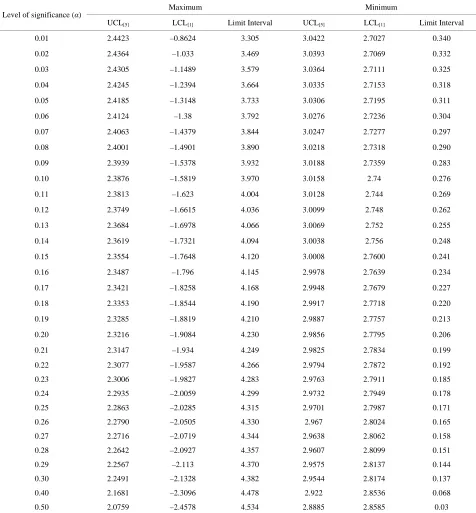
To obtain the control limits in Equation (2), an algo- rithm was developed and implemented on C language using different levels of significance () from 1% to 50%. The Control limits for five variables case consider- ed in this study were determined for varying level of sig- nificance from 0.01 to 0.5. The obtained control limits are presented in Table 2
4. Discussion of Results
The results in Table 1 represent the summary of the de- scriptive statistics of the bootstrap data and the original data from the production line, where * , SD*(b), and Z*(b)are the mean, standard deviation, and the stan- dardized values of the bootstrapped data. The bootstrap statistics shows the same feature with the real data. The Control limits in Table 2 are obtained for five vari-
( )
Table 1. Summary of result for the bootstrap data for five variables.
Variable
1 2 3 4 5
X b 349.090 10.199 44.075 69.657 3.730
SD b
0.5128 0.0086 0.3132 0.3767 0.0080
Z b
–0.0757 –0.1287 0.0479 0.0313 –0.0741
348.8153 10.1875 44.225 69.775 3.7238
X
Table 2. The minimax control limits for varying level of significance (α).
Maximum Minimum Level of significance (α)
UCL[5] LCL[1] Limit Interval UCL[5] LCL[1] Limit Interval
0.01 2.4423 –0.8624 3.305 3.0422 2.7027 0.340
0.02 2.4364 –1.033 3.469 3.0393 2.7069 0.332
0.03 2.4305 –1.1489 3.579 3.0364 2.7111 0.325
0.04 2.4245 –1.2394 3.664 3.0335 2.7153 0.318
0.05 2.4185 –1.3148 3.733 3.0306 2.7195 0.311
0.06 2.4124 –1.38 3.792 3.0276 2.7236 0.304
0.07 2.4063 –1.4379 3.844 3.0247 2.7277 0.297
0.08 2.4001 –1.4901 3.890 3.0218 2.7318 0.290
0.09 2.3939 –1.5378 3.932 3.0188 2.7359 0.283
0.10 2.3876 –1.5819 3.970 3.0158 2.74 0.276
0.11 2.3813 –1.623 4.004 3.0128 2.744 0.269
0.12 2.3749 –1.6615 4.036 3.0099 2.748 0.262
0.13 2.3684 –1.6978 4.066 3.0069 2.752 0.255
0.14 2.3619 –1.7321 4.094 3.0038 2.756 0.248
0.15 2.3554 –1.7648 4.120 3.0008 2.7600 0.241
0.16 2.3487 –1.796 4.145 2.9978 2.7639 0.234
0.17 2.3421 –1.8258 4.168 2.9948 2.7679 0.227
0.18 2.3353 –1.8544 4.190 2.9917 2.7718 0.220
0.19 2.3285 –1.8819 4.210 2.9887 2.7757 0.213
0.20 2.3216 –1.9084 4.230 2.9856 2.7795 0.206
0.21 2.3147 –1.934 4.249 2.9825 2.7834 0.199
0.22 2.3077 –1.9587 4.266 2.9794 2.7872 0.192
0.23 2.3006 –1.9827 4.283 2.9763 2.7911 0.185
0.24 2.2935 –2.0059 4.299 2.9732 2.7949 0.178
0.25 2.2863 –2.0285 4.315 2.9701 2.7987 0.171
0.26 2.2790 –2.0505 4.330 2.967 2.8024 0.165
0.27 2.2716 –2.0719 4.344 2.9638 2.8062 0.158
0.28 2.2642 –2.0927 4.357 2.9607 2.8099 0.151
0.29 2.2567 –2.113 4.370 2.9575 2.8137 0.144
0.30 2.2491 –2.1328 4.382 2.9544 2.8174 0.137
0.40 2.1681 –2.3096 4.478 2.922 2.8536 0.068
[image:4.595.60.536.217.730.2]ables scenario. It should be noted that the control limits for situation for more than five variables can be obtained by an extension of the program used in this study. From the bootstrap data, the value of the minimu m
and the value of the maximum . If the management is interested in tak- ing decision based on 1% level of significance , then the control limits from Table 2 will be
, ,
and . Therefore, the maximum value
1 0.076
5 0.048
0.01
L L
1 3.042
1Z b Z b
UC
Z b
5 2.442 LCL
1 2.703LCL
5
5 0.862 UCwill be within the control limits whereas, the minimum value Z b
1 3.031L
will be lying outside the lower control limit. However, if the management is interested in taking decision based on 5% level of significance , then the control limits from Table 2 will be
, ,
and . This will give the same conclusion as that of when
0.05
5L
LCL
2.419 LCL
1 2.72 0.01UC
5 1.315 UC is used. Furthermore, the re- sults show that the control limit interval increases as the level of significance increases. For instance, the control limit interval when 0.01 are 3.304 for the maxi- mum and 0.339 for the minimum. When 0.05, the control limit intervals are 3.734 for the maximum and 0.311 for the minimum.
5. Conclusion
This work used the bootstrap techniques to set up the control limits for a minimax control chart. The control li- mits for minimax control chart were determined for vary- ing level of significance to enable process control opera- tors to make a robust choice of control limits that will suite their purpose. Furthermore, the derived control li- mits for a five variable scnerio showed that the smaller the control limit interval, the higher the false alarm rate and hence high Type I error probability. Therefore, the obtained value of control limits in Table 2 will help the management to take decision on the level of significance to use for monitoring purpose. An extension or review of the used algorithm will provide the control limits for multivariate problem with less or greater than five vari- ables.
REFERENCES
[1] J. Rehmert, “A Performance Analysis of the Minimax Multivariate Quality Control Chart,” Master of Science Dissertation, Department of Industrial and Systems En- gineering, Virginia Polytechnic Institute and State Uni- versity, Blacksburg, 1997
[2] H. Hotelling, “Multivariable Quality Control—Illustrated by the Air Testing of Sample Bombsight,”In: C. Eisen- hart, M. W. Hastay and W. A. Wallis, Eds., Techniques of
Statistical Analysis, McGraw Hill, New York, 1947, pp. 110-122.
[3] A. M. Polansky, “A General Framework for Constructing Control Charts,” Quality and Reliability Engineering In- ternational, Vol. 21, No. 6, 2005, pp. 633-653.
[4] R. Y. Liu and J. Tang, “Control Charts for Dependent and Independent Measurements Based on the Bootstrap,” Journal of the American Statistical Association, Vol. 91, No. 436, 1996, pp. 1694-1700.
[5] I. A. Jones and W. H. Woodall, “The Performance of Boot- strap Control Charts,” Journal of Quality Technology,Vol. 30, No. 4, 1998, pp. 362-375.
[6] Y. L. Lio and C. Park, “A Bootstrap Control Chart for Birnbaum-Saunders Percentiles,” Quality and Reliability Engineering International, Vol. 24, No. 5, 2008, pp. 585- 600.
[7] H. I. Park, “Median Control Charts Based on Bootstrap Method,” Communications in Statistics—Simulation and Computation, Vol. 38, No. 1, 2009, pp. 558-570.
[8] P. Phaladiganon, S. B. Kim, V. C. P. Chen, J. G. Baek and S. K. Park, “Bootstrap-Based T2 Multivariate Control Charts,” Communications in Statistics—Simulation and Computation,Vol. 40, No. 5, 2011, pp. 645-662.
doi:10.1080/03610918.2010.549989
[9] A. Sepulveda, “The Minimax Control Chart for Multi- variate Quality Control,” Ph.D. Dissertation, Virginia Po- lytechnic Institute and State University, Department of In- dustrial and Systems Engineering, Blacksburg, 1996.
[10] J. A. Adewara, K. S. Adekeye, O. E. Asiribo and S. B. Adejuyigbe, “Minimax Multivariate Control Chart Using a Polynomial Function,” Applied Mathematics,Vol. 2, No. 12, 2011, pp. 1539-1545. doi:4236/am..2011.212219 [11] A. J. Hayter and K. L. Tsui, “Identification and Quantifi-
cation in Multivariate Quality Control Problems,” Journal of Quality Technology,Vol. 26, No. 3, 1994, pp. 197-208. [12] N. H. Timm, “Multivariate Quality Control Using Finite Intersection Tests,” Journal of Quality Technology,Vol. 28, No. 2, 1996, pp. 233-243.
[13] B. Efron, “Bootstrap Methods: Another Look at the Jack- knife,” The Annals of Statistics,Vol. 7, No. 1, 1979, pp. 1-26. doi:10.1214/aos/1176344552
[14] P. J. Bickel and D. A. Freedman, “Some Asymptotic The- ory for the Bootstrap,” The Annals of Statistics, Vol. 9, No. 6, 1981, pp. 1196-1217.
[15] K. Singh, “On the Asymptotic Accuracy of Efron’s Boot- strap,” The Annals of Statistics,Vol. 9, No. 6, 1981, pp. 1187-1195.
[16] R. J. Beran, “Estimated Sampling Distributions: The Boot- strap and Competitors,” The Annals of Statistics, Vol. 10, No. 1, 1982, pp. 212-215.