Association FME-CWM
University of Twente
Moniek Klein Gunnewiek
February 2012
MASTER THESIS
INTERNATIONAL OUTSOURCING
Author:
Moniek Klein Gunnewiek
S1019600
University:
University of Twente
MSc Business Administration - International Management
Company:
Association FME-CWM
FME International Business
Supervisors:
Mr J. Kraaijenbrink
University of Twente – Assistant Professor
Mr S.J.A. Löwik
University of Twente – Lecturer/PhD Candidate
Mr M.H.H. van Lin
FME-CWM – Head International Business
Place:
The Hague
EXECUTIVE SUMMARY
The core activity of technological companies is the manufacturing of products. This research focused on the decision making of these companies concerning outsourcing part of manufacturing to international suppliers. Before engaging in any strategic practice a company has to assess its internal and external environment. Hence, the central research question of this thesis is: which internal and external factors influence the decision of Dutch technological companies to outsource manufacturing processes to international suppliers?
To answer this question a conceptual outsourcing framework is developed, which incorporates internal and external factors that are derived from different theories. These factors help rationalize the decision making process and determine whether international outsourcing is a viable option for the company. The theoretical perspectives on which the framework is based, are Transaction Cost Theory (TCT), Resource Based View (RBV), Organisation Theory (OT), Knowledge Based View (KBV) and Location Theory (LT).
The applicability of the conceptual framework and the used theories are tested in the context of Dutch technological companies. By means of the qualitative method of conducting semi-structured interviews with purchasing managers, rich data is gathered that increased the understanding of international outsourcing from the viewpoint of these companies. These data provided input to further develop the subsequent quantitative data collection method of an online questionnaire. This mixed design has the advantage of being able to interpret and explain the quantitative results with the results of the qualitative method.
The obtained results indicated that the international outsourcing framework can be a useful tool to support the decision making processes since most factors are deliberated by the managers of Dutch technological companies. However, companies should implement the international outsourcing framework with caution as further research is needed to increase its validity. Outsourcing is a viable option when certain advantages can be realized by matching the manufacturing of certain components with country differences in external factors.
The results of this research show that companies still embrace outsourcing as a means to become more cost efficient, which is the predominant reason of the TCT. Therefore, outsourcing is a viable option when it reduces costs. However, this theory also states that outsourcing is a viable option when no specific assets are needed for the manufacturing of the products. Even though this can be confirmed, this research indicated that Dutch technological companies also outsource products for which specialized machines and tools or skills and experience of employees is required. Outsourcing high asset specific components does increase searching and negotiation costs, but can be implemented in practice. Especially for these components, long-term relations with suppliers is vital and is perceived as beneficial since it increases commitment, trust and development of inter-firm routines.
The results of this research indicate that outsourcing is a viable option when companies want to improve their competitiveness by transforming their company into a flexible entity which is in line with the OT. Companies want to adapt more easily to changes in the environment. According to this theory, a virtual organisation is a suitable design for such companies. However, the Dutch technological companies keep the highly knowledge-intensive and creative activities like R&D, Design and Engineering in-house since these are a source of their competitive advantage. For these manufacturing processes, outsourcing is not perceived as a viable option.
The KBV asserts that outsourcing is a viable option when a company lacks the unique knowledge needed to manufacture a product. However, access to specialized knowledge and innovations is not an important outsourcing motive for Dutch technological companies. The results do confirm that companies mainly outsource the manufacturing of components of which the required knowledge is of low strategic value. Moreover, mainly matured and explicit knowledge is transferred to the supplier. Through computer-aided designs, moulds or specifications it is easy to explain and state in detail what the company wants and how this should be manufactured by the supplier. For successful outsourcing it is important that the supplier has an extensive knowledge base, since it has to integrate the knowledge needed to manufacture the product. In addition, being able to communicate in a common language simplifies this knowledge transfer.
TABLE OF CONTENTS
LIST OF TABLES ... 7
LIST OF FIGURES ... 7
ABBREVIATIONS ... 8
PREFACE ... 9
1. INTRODUCTION ... ...10
1.1 Background ... 10
1.2 Objective ... 12
1.3 Research questions ... 12
1.4 Research approach ... 13
1.5 Scope of research... 13
1.6 Theoretical relevance.. ... 13
1.7 Outline of thesis ... 13
2. THEORETICAL FRAMEWORK ... 15
2.1 Definition of international outsourcing ... 15
2.2 The evolution of outsourcing ... 16
2.3 Theoretical perspectives ... 17
2.3.1 Transaction Cost Theory ... 18
2.3.2 Resource Based View ... 21
2.3.3 Organisational Theory ... 22
2.3.4 Knowledge-Based View ... 22
2.3.5 Location Theory ... 23
2.4 Internal factors ... 24
2.4.1 Motives for international outsourcing ... 25
2.4.2 Frequency and experience ... 27
2.4.3 Product factors ... 28
2.5 External factors ... 29
2.6 Conclusion ... 31
3. METHODOLOGY ... 33
3.1 Testing the validity of the conceptual framework ... 33
3.2 Measurement of factors ... 33
3.3 Data collection ... 36
3.3.1 Interview ... 37
3.3.2 Questionnaire ... 37
3.3.3 Sample population and size ... 39
3.4 Data processing, analysis and reporting ... 41
4. RESULTS ... 42
4.1 Internal factors ... 42
4.1.1 Motives ... 42
4.1.2 Frequency ... 44
4.1.3 Experience ... 45
4.2 External factors ... 48
4.2.1 Uncertainty ... 48
4.2.2 Proximity ... 49
4.2.3 Location factors ... 49
5. CONCLUSION ... 54
5.1 Research questions ... 54
5.1.1 Internal factors ... 54
5.1.2 External factors ... 56
5.2 International Outsourcing Framework ... 57
5.3 Implications ... 58
5.4 Limitations and future research ... 62
REFERENCES ... 64
APPENDICES ... 69
A. Different definitions of outsourcing ... 70
B. Outsourcing location measures ... 71
C. Operationalization ... 73
D. Interview protocol ... 75
E. Results of qualitative research ... 78
F. Questionnaire ... 80
G. Classification of the technological industry ... 84
LIST OF TABLES
Table 1. The different forms of business relocation ... 16
Table 2. The development of outsourcing ... 17
Table 3. Motives for international outsourcing ... 27
Table 4. Frequency and experience ... 28
Table 5. Product factors ... 29
Table 6. External factors ... 30
Table 7. Interview participants ... 40
Table 8. Importance of motives for outsourcing ... 43
Table 9. Asset specificity and knowledge specificity... 47
Table 10. Strategic value ... 48
Table 11. Importance of location factors ... 52
LIST OF FIGURES
Figure 1. A review of outsourcing research and future insights ... 18Figure 2. Conceptual framework ... 32
Figure 3. Sample composition ... 41
Figure 4. Importance of motives compared with realized advantages... 44
Figure 5. The influence of location factors on outsourcing ... 53
ABBREVIATIONS
FME Association FME-CWM
FDI Foreign Direct Investment
TCT Transaction Cost Theory
RBV Resource Based View
OT Organisational Theory
KBV Knowledge-Based View
LT Location Theory
LCC Low Cost Country
IPR Intellectual Property Right
CSR Corporate Social Responsibility
PREFACE
This master thesis explores the internal and external factors, which influence the decision to outsource manufacturing processes to international suppliers. Based on theory, an international outsourcing framework is developed of which the different factors are tested by means of qualitative and quantitative research. Consequently, the framework is adjusted to make it applicable to the technological industry in the Netherlands.
The results of this research are based on technological companies that are located in the Netherlands and which are member of the association FME-CWM. In the past few months, I have had in-depth interviews with purchasing managers who are experienced in the field of international outsourcing. In addition, the technological companies were invited to complete a questionnaire, which was useful for finding conclusive answers. I would like to thank all participants for their offered time, valuable information, suggestions and outsourcing insights.
Furthermore, I would like to acknowledge Micha van Lin and Bas van Vroonhoven for their guidance and the possibility to do this assignment commissioned by the FME. I would like to thank my fellow colleagues of the International Business department for their support and for giving me an enjoyable time during the process of writing my thesis.
I would also like to thank Jeroen Kraaijenbrink and Joris Heuven, from the University of Twente, for their positive criticism and helpful comments. In addition, I want to express appreciation to Sandor Löwik for reading my final thesis and for participating as a commission member during the colloquium.
Last but not least, I would like to thank my boyfriend Sebastian for motivating and helping me succeed in becoming a Master in Science.
Moniek Klein Gunnewiek
1.
INTRODUCTION
The technological (manufacturing) industry is an important cornerstone of the Dutch economy. This sector is a source of direct and indirect employment. Approximately 400.000 people are employed in the technological industry, which makes it the second largest sector in terms of volume of labour. Moreover, employment in the technological sector leads to additional jobs within other sectors like business services or transportation1. The technological sector is a source of economic prosperity because it accounts for a relatively large share (54%) of total export, which ultimately contributes to a strong economy. The sector is also a source of innovation. The core activity of this industry is the manufacturing of products. Companies in the Netherlands operate at the leading edge of advanced technology due to world-class standards of education, craftsmanship and industrial development. Amongst others the development of technological innovations makes manufacturing more efficient, increases productivity in multiple sectors and creates new products and supplementary services for existing and new target markets. Innovation is also important for Dutch technological companies in order to stay competitive. Globalisation has for example led to an increase in international competition due to the reduction of trade barriers. The Dutch companies have to compete with manufacturers from Low Cost Countries (LCCs). Innovation is key to staying competitive in the global market. Other challenges that technological companies nowadays seem to face are a lack of excellent personnel and scarcity of raw materials. Next to these external dynamics, the internal organisation of these companies also changed. The technological companies used to execute all the activities of their supply chain in-house. However, global access to suppliers and resources, advanced logistics and improved Information and Communication Technologies made it possible to restructure their company. The vertical integrated companies are transformed into flexible and less costly entities by means of outsourcing some activities of the supply chain to international suppliers.
1.1
Background
FME-CWM, in short FME, is a non-governmental association of companies in the technological industrial sector. FME is the largest industrial employers’ organisation in the Netherlands with 2600 member companies and 130 affiliated trade companies. Their members operate across the full spectrum of business activities, ranging from primary metal manufacturing to shipbuilding, from the electronic - to the automotive industry and from capital goods to industrial automation. These member companies are mainly Small and Medium-sized Enterprises (SMEs) but also include some multinationals like e.g. Philips, Royal Haskoning and Stork. Together they employ a workforce of 275.000 people and enjoy a total turnover of 60 billion euros, of which 60 percent is generated through exports. FME’s mission statement is to strengthen the position of the technological industry in the Netherlands and abroad, by means of lobbying, advice and services designed to improve the competitiveness of its members. Key task of the association is to look after the interests of its members and provide service both in the social and economic field. The organisation is built on three pillars:
- Policy and collective labour agreements: FME devotes itself to conducting research, present solutions and give advice related to problems that affect the whole technological sector or to problems an individual member company faces. The association manifests itself within various Dutch and international institutions and bodies. For example, the FME is affiliated to employers’ organisation VNO-NCW and retains good relations with national ministries and government commissions. Across national borders, FME stands for the wellbeing of the Dutch technological sector in European bodies like CEEMET2 and Orgalime3, that consecutively uphold relations with EU authorities. In addition, a FME representative is positioned in Brussels to reinforce these connections.
1 According to the Rabobank, 1 job in the industrial sector results in 1,5 jobs in other sectors. 2
CEEMET: Council of European Employers of the Metal, Engineering and Technology-based industries. 3
- Services: FME helps their members on a variety of topics like labour, environment, energy, international business and technology. Experts can assist by means of the Service Desk, which can be called by entrepreneurs when having relatively simple questions concerning their business. For more complex problems and comprehensive assistance, FME’s consultants provide direct support to the technological companies. For example, export consultants can help members when entering new foreign markets of which little is known. Moreover, lawyers and mediators are employed by the FME to solve legal disputes of members with other parties.
- Trade associations: In 130 trade associations, companies are working together to improve their business. Trade associations are e.g. building and security; electronics and mechatronics; medical; mobility; mechanical engineering and process technology; marine technology; etc.
The International Business department of the FME is specialized in informing, supporting and consulting Dutch companies in the technological industrial sector on all issues relating to international business worldwide. Focus is on business development in primarily the oil & gas sector; sustainable energy technologies; medical technology; infrastructure and sport; high-tech and outsourcing. Their international activities consist of organising numerous group entries to international trade fairs; company representations; network meetings; seminars and workshops; matchmaking events and trade missions held both at home and abroad. The International Business department provides information on request and acts as an intermediary. It will put appropriate parties into contact with each other for e.g. investment purposes and all kinds of industrial cooperation. Some examples are: subcontracting, agencies, contract production, market surveys and export consulting activities.
In addition to their services, FME wants to inform and educate their members on a structural basis on the rationale and circumstances that make international outsourcing a viable strategy for their company. International outsourcing is the allocation of activities which were formerly conducted in-house to foreign suppliers. Transferring ownership and control is inherent in this outsourcing process. Among the members of the FME, international outsourcing is a hot topic. The International Business research of May 2011, which is conducted by the FME among its members, indicated that 40% of the respondents are outsourcing (part of) the manufacturing of their products to international suppliers. Moreover, 14% specified that they currently are not outsourcing, but think that it might be an interesting option in the future. Consequently, this research focuses on outsourcing manufacturing processes. The decision to outsource is influenced by a number of factors which can make it highly complex. A wrong decision can lead to higher product costs, misuse of resources and lost opportunities, customers and market shares (Tayles & Drury, 2001). Despite the acknowledged importance of this decision, FME members which are currently outsourcing do not always appear to make the decision whether to ‘make or buy’ on a rational basis. The advisors of FME International Business experienced that a few members decided to outsource for the wrong reasons, have false expectations or focus on a short-term planning. Some appeal to the ‘everybody is doing it’ fallacy and therefore believe that outsourcing must be the best choice. Others motivated their decision by stating that ‘it saves money’, but don’t take into account the hidden costs such as quality management, transport and logistics, and Intellectual Property transfer risks. By studying multiple companies, this research will assess what are the shared motives and realized advantages for engaging in outsourcing and which factors need to be considers to make outsourcing a viable option.
changes in the external surrounding within which it operates. External factors include e.g. economic, political, legal and cultural forces that influence a company. These external factors are beyond the control of the company and affect its business decisions. Differences in these factors for example result in particular countries having a comparative advantage in the manufacturing of certain products. For a company that is trying to survive in a competitive global market, this implies that it will benefit by sourcing each value-creating manufacturing process at that location where these external conditions are most conducive to the performance of that activity. So outsourcing is a viable option when certain advantages can be realized by matching certain manufacturing processes with country differences in economic, political, legal and cultural factors to for example reduce costs and maximize added value. On the contrary, there are also certain conditions, based on a combination of internal factors and external factors, which make outsourcing of manufacturing to international suppliers a difficult and unsatisfactory undertaking. Some manufacturing processes are less amendable for outsourcing purposes because they engender high transaction costs, jeopardize the competitive advantage of a company or are difficult to transfer between the company and a foreign supplier.
The strategy that is chosen by a company is based on an assessment of its internal and external environment. This determines if a company can create value through outsourcing, what products can be outsourced and to which location. It is important to note that the assessment of the internal and external environment is a continuous process. The outsourcing strategy that is chosen does not remain supreme and therefore companies continuously need to verify if the intended advantages still can be realized. For example, it seems that companies progressively shift their outsourcing practices from China to suppliers in India, since the projected cost savings are diminishing due to rising labour costs in China. The outsourcing of manufacturing to external suppliers should be beneficial compared to making it in-house, and should therefore endure the additional costs and risks associated with outsourcing to a supplier located in a foreign country of which perhaps little is known (Hymer, 1976).
1.2
Objective
Goal of this research is to obtain a rich understanding of the international outsourcing phenomenon from the viewpoint of Dutch technological companies. It will explain the internal and external factors that managers must consider according to theory and actually are considered in practice when deciding if the company should (continue to) outsource manufacturing to international suppliers. The results of this research will provide input for an outsourcing platform and an educational program that will be developed by the FME. Goal of these aforementioned means are to structurally inform and educate FME members on the rationale and conditions that make outsourcing a viable option. This can help current outsourcing companies to reconsider their strategy, but can also support companies that think that international outsourcing might be an interesting option in the future.
1.3
Research questions
The central research question of this thesis is:
“Which internal and external factors influence the decision of Dutch technological companies to outsource manufacturing processes to international suppliers?”
Sub questions:
1.4
Research approach
To be able to come to a sound conclusion regarding the formulated research questions, a deductive research approach is applied. First, a critical review and synthesis of the literature on international outsourcing is completed. This review will help to develop a good understanding of international outsourcing and to build a conceptual framework encompassing internal and external factors that should be considered simultaneously when making international outsourcing decisions. Then, this conceptual framework is tested by means of qualitative research and complemented with quantitative research. Data is obtained from FME members by means of conducting interviews with - and distributing questionnaires to purchasing managers who are extensively involved in making (out)sourcing decisions within their company. Ultimately, the qualitative and quantitative data is analysed and compared and synthesized with theory in order to verify the internal and external factors included in the conceptual framework or, when necessary, to design an enriched version.
1.5
Scope of research
The scope of this research is set by multiple aspects. First, this research focuses on the internal and external factors that influence the decision making process prior to outsourcing manufacturing processes to international suppliers. The implementation and management of the relationship with foreign suppliers are out of the scope of this research due to time constraints. The decisions relating to e.g. the contact, contract and control stages are significant for successful outsourcing. Nonetheless, the internal and external factors are of main importance because companies should first decide if outsourcing is a viable option and under what conditions before they implement the outsourcing process. Second, the scope of this research is narrowed by its application to the technological industrial sector. This is because the FME maintains the interests of its members that are active in this sector. In specific, focus is on manufacturing companies located in the Netherlands. The primary activity of these companies is the manufacturing of products. Accordingly, this study is limited to manufacturing outsourcing. The transfer of (part of) the manufacturing of products is of interest. The outsourcing of support activities within a company like e.g. ICT, callcenters or finance is out of the scope of this thesis. Finally, this research is directed at purchasing managers. It is expected that multiple managers are involved in this process and that the definitive decision is made by corporate management. However, purchasing managers of the technological companies are acquainted with the details of an outsourcing decision. They gather all internal information by deliberating engineers and operations managers and they search the market for alternative sourcing options. Purchasing managers implement, control and manage the outsourcing process on a daily basis. This results in having specific knowledge about all the internal and external factors that could make outsourcing a success or a failure, and should therefore be incorporated when making an outsourcing decision.
1.6
Theoretical relevance
applied to the international, dynamic environment and should therefore continue to be taken under discussion. “The international dimension of outsourcing, due to its evolving nature, continuous to be an important context for research” (Hätönen et al, 2009). The 21st century environment with high global competition and complex new challenges, innovative technological developments and interesting emerging countries can lead to different considerations when companies decide to outsource internationally. Hence, studying the combination of internal and external factors that are applied in the context of Dutch technological companies will ultimately result in an enriched understanding of the concept of international outsourcing.
1.7
Outline of the thesis
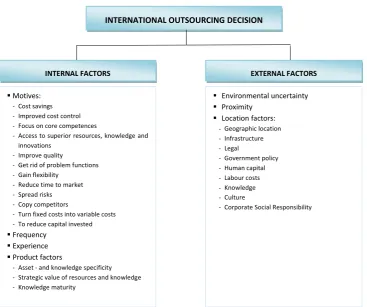
In the following chapter, the literature about international outsourcing is critically reviewed. Different definitions of the concept of international outsourcing are synthesized into a working definition, followed by an evolution of the practice of outsourcing. Key academic theories are described and applied to outsourcing. These theoretical perspectives are the sources of the different internal and external factors that are extracted and highlighted in the subsequent section. This chapter ends with a conceptual framework in which these factors are combined alongside a summary of when outsourcing, according to theory, is seen as a viable option.
Chapter 3 elaborates on the research methodology selected for testing the proposed conceptual framework. This framework is operationalized by specifying the exact measures that are used to assess the internal and external factors that are included in the framework. The methodology is discussed and finally the manner in which the obtained data is processed and analysed to determine which factors influence the decision to outsource manufacturing and to discover which explanations underlie these factors.
Chapter 4 analyses the data that is obtained by means of the interviews and questionnaire. The results regarding the internal factors are presented. The main motives for companies to engage in international outsourcing and the characteristics of the manufacturing processes and products being outsourced are examined. The findings regarding the external factors are explored to search for forces that are uncontrollable but do affect companies’ decision to outsource. This chapter finalises with conclusions about the results of this research.
2.
THEORETICAL FRAMEWORK
In the previous chapter, the focus of this research is explained and the research questions are formulated. The first step, in examining which internal and external factors influence the decision to outsource manufacturing to international suppliers, contains a critical review of the literature. First, a working definition on the concept of international outsourcing is provided, followed by a description of how the practice of outsourcing has evolved throughout the decades. Next, five prominent theories are applied to international outsourcing. These theoretical perspectives are described and reviewed in order to identify the different factors that influence the outsourcing decision. Subsequently, these factors are divided into internal and external factors. The internal factors relate to the different motives to engage in outsourcing and the characteristics of the manufacturing of the product. External factors are associated with the environmental conditions and the advantages of foreign locations. The final section of this chapter presents the conceptual framework which combines the factors that are, according to theory, influencing the outsourcing decision.
2.1
Definition of international outsourcing
To provide a working definition of the term ‘international outsourcing’, which is suitable for the purpose of this research, different definitions used in academic literature are reviewed (see appendix A). In order for a strategy to be referred to as ‘international outsourcing’ several conditions need to be met. First, the activities are no longer pursued internally by the company, but are acquired from external suppliers (Quinn & Hilmer, 1994; Gilley & Rasheed, 2000; Ellram & Billington, 2001; Quélin & Duhamel, 2003). This necessitates breaking up the value chain and vertically disintegrate the chain by outsourcing manufacturing rather than conducting it in-house. Second, companies have leeway in deciding what it will outsource (Bailey, 2002; Barthélemy, 2003). Companies can decide to outsource the complete manufacturing of a product versus remaining some manufacturing processes in-house. In addition, management can also decide to outsource some components of the product but not all. Third, activities are outsourced to independent third parties. (Rothery & Roberson, 1996; Greaver, 1999; McCarthy & Anagnostou, 2004; Chase et al, 2005; Mol et al, 2005). Ownership and control are transferred to the external supplier. The company has no ownership rights over the supplier, which means that next to manufacturing also the development, planning, knowledge, administration, and responsibilities of the products or components are outsourced. Fourth, manufacturing needs to be allocated to a foreign supplier (Ok, 2010). Manufacturing can be outsourced to suppliers located within the same country, but this research focuses on international outsourcing, because the manufacturing of products are commonly outsourced to suppliers located across borders due to locational advantages. By integrating all the conditions mentioned above, a working definition of the term ‘international outsourcing’ is formulated. In this research, the concept of international outsourcing refers to:
The decision to transfer (part of) the manufacturing processes, which have previously been conducted in-house, to specialized independent suppliers located in a foreign country.
Table 1. The different forms of business relocation
Note: Adapted from “Insight into offshoring - Perspectives on offshoring in the Netherlands”, by M.L. Biermans & M.J. van Leeuwen, 2006, SEO Economic Research, No. 954, p. 10. Copyright 2006 by SEO Economic Research.
Accordingly, offshoring and outsourcing can take place simultaneously, but can also be independent phenomena. Next to ownership and control, there are other determining factors that influence the choice of strategy. For example, Antràs (2003) found that the characteristics of a product play a role in the choice between FDI and outsourcing. He states that when a product is capital intensive and/or relatively new, FDI is likely to prevail. So the level of specificity and standardization of a product appears to be different for outsourcing endeavours relative to manufacturing it in a foreign subsidiary. Grossman & Helpman (2002, 2003) consider search and matching costs, customization costs, and protection of Intellectual Property Rights (IPRs) as factors that differentiate between foreign subsidiaries (FDI) and outsourcing suppliers. The majority of FDIs are done by large, research-intensive companies operating in oligopolistic markets. For further clarification, the practice of outsourcing is also different from alliances, partnerships and joint ventures because of the one-directional resource flow from the supplier to the company. In addition, the companies do not share profit and there is no mutual contribution (Belcourt, 2006). These are all different ways of entering foreign markets.
2.2
The evolution of outsourcing
In absence of developed external markets, companies traditionally conducted all their activities in-house. They transformed raw materials into final products in their own factory and distributed it via their trucks to the company-owned stores. The company did its own payrolling and taxes, etc. However, during the second industrial revolution increased specialization led to the first wave of outsourcing. So sourcing out work to external suppliers, because a company chooses not to or is no longer able to manufacture it in-house, is not a new phenomenon. Although outsourcing was already practised in these early days, it took companies till the 1980s before they embraced outsourcing as a strategy.
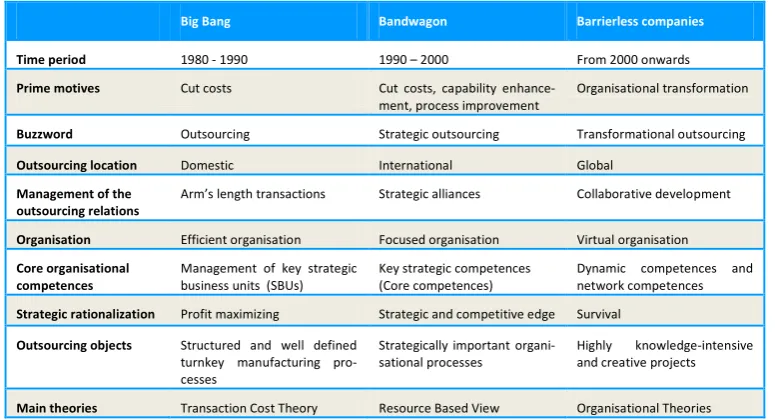
Following the extensive literature review of Hätönen & Eriksson (2009) on the development of outsourcing, three eras are identified in which different outsourcing objects and ways of managing the outsourcing relations are prevalent. See table 2 for an overview of the development of outsourcing. This first era is titled as the Big Bang because of the sudden breakthrough and the adoption of the outsourcing strategy by many companies in the 1980s. Companies predominantly began outsourcing low-tech manufacturing processes to become more cost efficient and maximize profits. The objects were first transferred to independent domestic parties, but enhanced infrastructures and lower logistics costs resulted in an increase of outsourcing manufacturing across borders (Slack, 2003). In addition, better education and advanced capabilities of some low-wage countries made outsourcing of high-tech manufacturing more attractive for companies.
Success stories from companies that already practised outsourcing, impelled other companies to ‘jump the Bandwagon’ in the early 1990s. It was in the beginning of this era that outsourcing really became popular (Morgan, 1999). Companies began outsourcing to expert suppliers in order to provide value to strategically important organisational processes of which they lack the resources, skills or competences. Furthermore, companies focused on their core competences to gain competitive advantage and therefore also outsourced peripheral activities. The outsourcing of strategic activities required closer company-supplier relations. This was established by means of strategic alliances. By the end of this era, outsourcing was practised in nearly all industries.
Location Ownership
Onshore Offshore
Outsourcing National outsourcing International outsourcing
Due to the popularity it gained in the preceding Bandwagon era, outsourcing became more common and the practice as such was no longer a source of competitive differentiation (Lawton & Michaels, 2001). Therefore, the focus of companies changed to developing new adaptive business models that generate a competitive advantage and changes the industry’s rules of the game (Engardio, 2006). More knowledge-intensive and creative activities like IT, product development and R&D will be outsourced and this is realised by means of collaborative relationships with suppliers.
Table 2. The development of outsourcing
Big Bang Bandwagon Barrierless companies
Time period 1980 - 1990 1990 – 2000 From 2000 onwards
Prime motives Cut costs Cut costs, capability
enhance-ment, process improvement
Organisational transformation
Buzzword Outsourcing Strategic outsourcing Transformational outsourcing
Outsourcing location Domestic International Global
Management of the outsourcing relations
Arm’s length transactions Strategic alliances Collaborative development
Organisation Efficient organisation Focused organisation Virtual organisation
Core organisational competences
Management of key strategic business units (SBUs)
Key strategic competences (Core competences)
Dynamic competences and network competences
Strategic rationalization Profit maximizing Strategic and competitive edge Survival
Outsourcing objects Structured and well defined
turnkey manufacturing pro-cesses
Strategically important organi-sational processes
Highly knowledge-intensive and creative projects
Main theories Transaction Cost Theory Resource Based View Organisational Theories
Note: From “30+ years of research and practice of outsourcing – Exploring the past and anticipating the future”, by J. Hätönen & T. Eriksson, 2009, Journal of International Management, Vol. 15, No. 2, p. 145. Copyright 2009 by Elsevier Inc.
2.3
Theoretical perspectives
Figure 1.A review of outsourcing research and future insights
Note: From “30+ years of research and practice of outsourcing – Exploring the past and anticipating the future”, by J. Hätönen & T. Eriksson, 2009, Journal of International Management, Vol. 15, No. 2, p. 152. Copyright 2009 by Elsevier.
Researchers have applied multiple theories to the practice of outsourcing, which emphasizes the complex nature of this concept. Consequently, for this research a relatively holistic approach is adopted. The Transaction Cost Theory, the Resource Based View and Organisational Theory are seen as the main theories that are used to explain the concept throughout the three eras (see also table 2. of paragraph 2.2). In this paragraph, these theories are reviewed in order to determine the different internal and external factors that influence the outsourcing decision. However, in seeking to explain these factors in the context of technological companies, the Knowledge Based View is expected to be a relevant addition. This theory is appropriate in the context of this research, because the sample population also comprehends high-tech companies that create a competitive advantage by pioneering on recent developments in scientific technological knowledge. Moreover, since the focus of this study is on international outsourcing, a theory that elaborates on the allocation of activities to a foreign supplier is needed. For that reason the Location Theory is added. Combined, these theories approach outsourcing from multiple viewpoints and will therefore explain different but also complementary internal and external factors influencing the decision and practice of outsourcing.
2.3.1 Transaction Cost Theory
- Contact phase: transaction costs include search and information costs, which are expenses made by the company when determining that the needed products or components are obtainable in the market; costs relating to examination of which supplier offers the lowest price; etc.
- Contract phase: transaction costs consist of bargaining costs incurred by the company when wanting to come to an acceptable agreement with the supplier; costs relating to the time and money needed to write an efficient contract; etc.
- Control phase: transaction costs include monitoring and enforcement costs required to ensure that the supplier meets the terms and conditions of the contract; the costs of (legal) actions taken when the supplier does not adhere to what has been agreed upon; additional expenses for checking if the product quality standards are realized; etc.
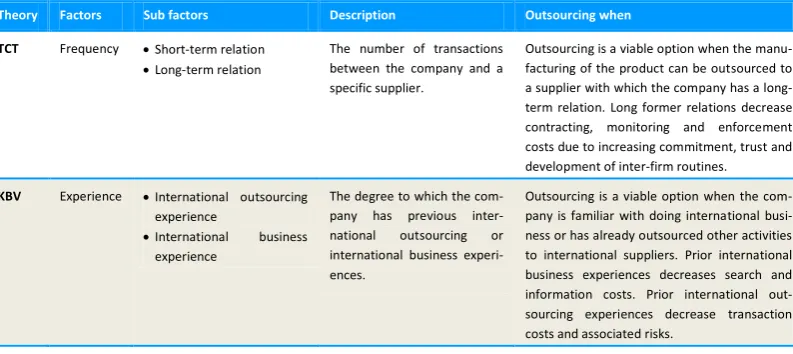
Companies have to take both the manufacturing and transaction costs into account and should choose the most cost efficient option. When the external supplier is somehow able to manufacture the needed components or products at a lower cost than the company is able to do in-house, manufacturing should be outsourced. But when the search -, information -, bargaining -, monitoring - and enforcement costs are sufficiently large, in-house manufacturing is preferred. Williamson (1975, 1985, 1995) identified the characteristics of the products that determine if in-house manufacturing or outsourcing is the most cost efficient option. The primary factors that increase the costs of transactions are: Asset specificity, Uncertainty and Frequency.
Asset specificity
Asset specificity refers to “transaction-specific assets that are the physical and human investments which are specialized and unique to a task” (Erramilli & Rao, 1993, p. 21). A high specific asset is idiosyncratic and unique to the company. Being able to develop and manufacture a highly specific product requires investments in specific assets. Three dimensions of asset specificity are (Williamson, 1983; Malone et al, 1987; Masten et al, 1991):
- Site specificity: the degree to which specific natural resources, needed to manufacture the product, are accessible at a particular location and can only be transferred at a great cost.
- Physical asset specificity: the degree to which specialized machine tools, customized equipment or complex computer systems are needed to manufacture the product.
- Human asset specificity: the degree to which specialized human skills, knowledge, and experience of the
employees are needed to manufacture the product.
Previous research indicates that products or components which require high asset specific investments reduce the degree of practising outsourcing (Globerman, 1980; Monteverde & Teece, 1982; Stuckey, 1983; Masten, 1984; Anderson & Schmittlein, 1984; Hennart, 1988; Lieberman, 1991; Hallwood, 1990; Lyons, 1995). Products or components characterized by low asset specificity are more appropriate for outsourcing purposes, because these can be manufactured with standard equipment and non-specialized knowledge (Williamson, 1975). In addition, relatively simple and complete contracts can be made between the company and the supplier and non-performing suppliers can easily be replaced by many other providers in the market.
associated behaviour of the supplier. Because the bargaining, monitoring and enforcement costs of these comprehensive contracts increases, TCT states that in these situations in-house manufacturing is preferred over outsourcing.
Uncertainty
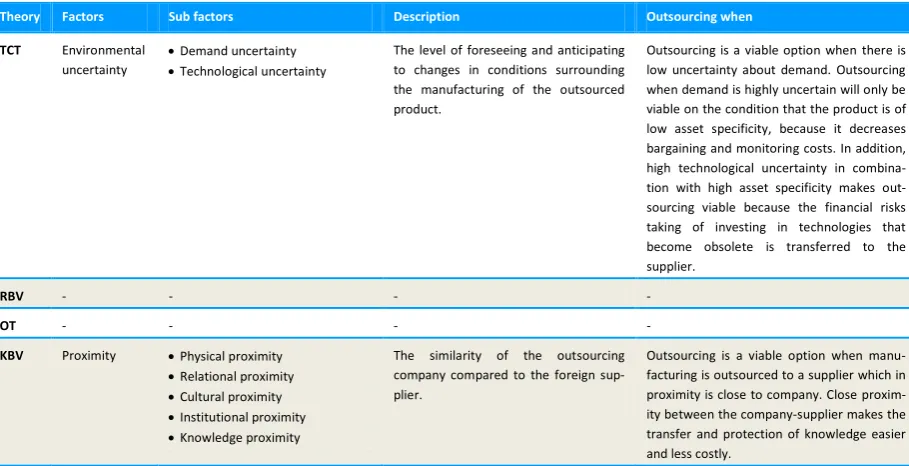
Different types of uncertainty are found in literature when studying the decision between in-house manufacturing and outsourcing. In this research, uncertainty considers the level of foreseeing and anticipating to changes in conditions surrounding the manufacturing of a product. This environmental uncertainty consists of demand uncertainty which contains volatility of sales, and technological uncertainty which relates to technological improvement. Conditions of high volatility in the demand environment will not necessitate in-house manufacturing. However, when asset specificity is high, demand uncertainty will positively influence the decision to continue to manufacture the product in-house. This is because uncertainty could impede the writing of an efficient outsourcing contract and accompanied on-going negotiations with suppliers on prices. Transaction costs will rise due to increases in bargaining costs. In outsourcing decision making, bounded rationality stresses that managers rationality is limited by the information they have and their ability to process all the information and knowledge. Therefore, it is unlikely that they can foresee every possible changing event, which consequently leads to contracts being incomplete. The formulated outsourcing contracts between the company and the supplier are lacking in specification or necessitate constant adjustments. This can result in opportunistic behaviour. In this case, opportunistic behaviour is self-interest seeking of the supplier by for example asking exorbitant prices for the manufacturing of the product. When asset specificity is low, however, there are numerous suppliers in the market which can manufacture that product for the company, so competition will diminish opportunistic behaviour. In sum, in-house manufacturing will only be more cost efficient in high demand uncertain environments in combination with high asset specificity (Levy, 1985; Lieberman, 1991; MacMillan et al, 1986; Walker & Weber, 1984, 1987; Williamson, 1985).
The reverse applies to technological uncertainty. When there is high technological uncertainty, meaning that the probability increases that a technology required to manufacture a product becomes obsolete, outsourcing is preferred. This especially applies to specialized assets, for which irreversible investments are at risk if there is uncertainty about their value and profitability in the long term. These specialized assets have a very low value in their secondary use because they are highly specific to a certain activity, making their value decrease remarkably if technological change renders them obsolete in their primary use (Balakrishnan & Wernerfelt, 1986). When innovations are accomplished, specialized assets may need to be scrapped and substituted by machinery and equipment that embody the advanced technologies. Most likely companies will not want to invest in technological assets when they are not sure they can earn back these fixed costs by manufacturing and selling a substantial amount of products to their customers. So low uncertainty allows for greater investments in technological assets and companies will therefore probably decide to keep manufacturing of the product in-house (Balakrishnan & Wernerfelt, 1986; Crocker & Reynolds, 1993; Walker & Weber, 1984, 1987).
Frequency
difficulties of writing a comprehensive contract, because it allows parties to adapt to new information when it becomes available. Note that this only counts if it is “self-enforcing; the short-run value of reneging must be less than the long-run value of the relationship” (Baker et al, 2001, p. 40). Moreover, economies of scale cannot be realized by in-house manufacturing because products of high asset specificity are often of relatively low volume.
In sum, according to the TCT, the goal of a company is to minimize costs by choosing the most efficient option of supplying products to its customers. Outsourcing is expected to prevail when asset specificity is low. In addition, when asset specificity is high in combination with a high level of technological uncertainty outsourcing is also expected to be preferred. However, high asset specificity in combination with a high level of demand uncertainty can result in outsourcing difficulties and an increase of transaction costs. In this situation, in-house manufacturing or relational outsourcing contracts with particular suppliers are preferred. Decision makers should balance the total of the manufacturing costs of the supplier plus the transaction cost of outsourcing with the investments needed to manufacture the product at a low unit cost within the company.
2.3.2 Resource Based View
The Resource Based View (RBV) states that creating sustained competitive advantage depends on the unique resources and capabilities that a company can compete with. Resources are the tangible (e.g. factories, products, raw materials, labour force) and intangible (e.g. brand, reputation) assets a company holds or has control over. Capabilities are the ‘bundles’ of resources that are needed to perform certain manufacturing processes. For a resource or capability to be a source of competitive advantage it has to be (Barney, 1986a, 1986b, 1991; Amit & Schoemaker, 1993; Peteraf, 1993; Som, 2009):
- Valuable: valuable resources can improve a companies’ market position. It enables the company to create value and outperform competition by exploiting opportunities or it helps neutralizing its threats. The valuable resources enable the company to implement strategies that improve its effectiveness and efficiency.
- Rare: for a resource to be of value it must be in short supply relative to demand. The company must possess a valuable resource that its direct and future competitors do not have.
- In-imitable: valuable and rare resources can only lead to sustainable competitive advantage if competitors cannot imitate this strategic asset. A source of inimitably is causal ambiguity, which follows from not knowing on which resource the competitive advantage is based. This particularly happens with knowledge-based or socially complex resources because these are idiosyncratic to the company (Peteraf, 1993; Mahoney & Pandian, 1992; Barney, 1991).
- Non-substitutable: the value-creating, rare and in-imitable resources cannot be substituted with some other strategically comparable resource.
industries, a focused company reduces risks and enhances responsiveness to changing market conditions and customer needs.
2.3.3 Organisational Theory
Organisational Theory (OT) is used to study the behaviour and management of companies. These theorists state that companies have to transform their business to stay competitive in the 21st century. The rapidly changing global world requires a more flexible design. Besides, improved logistics, advanced Information and Communication Technologies and global access to resources, suppliers and talent makes it possible to redesign the company into an adaptive entity with loosely coupled networks of organisational actors. The virtual company is seen as a suitable structure that can cope with competitive pressures (Bleecker, 1994; Davidow & Malone, 1992). In a virtual company, most of the key activities are outsourced to distinct world-class suppliers that can develop and manufacture these products more effectively. In seeking for innovative ways of value creation and greater efficiencies, the particular outsourcing suppliers continuously change (Galbraith, 1995). The outsourcing activities are managed from a small headquarter, which coordinates e.g. that the components manufactured by outsourcer A are transferred to outsourcer B which assembles the product and transfers the finished product to outsourcer C which finally distributes it to the retailers. “This use of an organisational hub to manage suppliers serves to (a) enhance global competitiveness; (b) increase work force flexibility; (c) develop inter-organisational synergies in key organisational functions; and (d) reduce administrative overhead and fixed costs” (Fitzpatrick & Burke, 2000, p. 15). So, this radical transformation enables companies, even new and small companies, to act on a global scale by combining strategic flexibility with value creation and cost reductions.
2.3.4 Knowledge-Based View
The Knowledge-Based View (KBV) is grounded on the RBV of the firm, but emphasizes that knowledge is the most significant resource that can create sustainable competitive advantage. Whereas other resources can lead to superior performance, it is the integration and application of knowledge needed to transform these resources into a valuable product that makes it the most unique and in-imitable resource (Grant, 1996). Hence, if a company knows more than its rivals it can gain a competitive advantage, even if the other resources controlled by the company are not unique (Penrose, 1959; Romer, 1992). KBV theorists assert that strategic advantages created by knowledge can be sustained due to the difficulty of imitation. Knowledge is socially complex and idiosyncratic to the firm. Applying the KBV to outsourcing raises the question of whether a company should transfer the necessary knowledge to manufacture a product to an outsourcing supplier or should the product be manufactured in-house? Different factors, relating to the nature of the knowledge underlying a product and the ability to transfer and protect this knowledge, need to be considered when answering this question:
- Strategic value of knowledge: knowledge can be considered strategic when it enables the company to
execute its competitive strategy better than its rivals (Zack, 1999); it exploits the competitive resources and capabilities to its full potential; and it is valuable, rare, in-imitable and non-substitutable. Companies should not outsource the manufacturing of products that are based on strategic knowledge, because then it will lose its uniqueness and it necessitates protection of Intellectual Property.
- Knowledge maturity: refers to “the extent to which an activity offers the opportunity to learn how to perform the activity more effectively or efficiently” (Zack, 2010, p. 38). In this research, it relates to the question if a new and improved version of the product can be designed or if it can be manufactured more efficiently? If the answer is no, than the knowledge underlying a product is matured. Maturity can be caused by the company finding itself not capable of learning and accumulating knowledge or by the whole industry which has reached the state-of-the-art level of development of the product.
knowledge which is personal, difficult to formalize and can only be observed through its application. The former can easily be shared by communication between companies, the transfer of the latter is slow, costly, and uncertain (Kogut & Zander, 1992). So if the knowledge needed to manufacture a product is highly specific, which is explicit knowledge, it is ideal for outsourcing purposes because it can easily be transferred to the supplier.
- Proximity: refers to the similarity of the outsourcing company in comparison to the foreign supplier based on physical location, relation, culture, institutionand knowledge.
o Physical proximity: influences the effort, time, and cost of transferring knowledge through different media (Kraut et al, 2002). Tacit knowledge sharing necessitates rich, direct and frequent communication which is best realized by companies in close proximity (DeCarolis & Deeds, 1999).
o Relational proximity: refers to “duration and quality of the experience that the two contracting parties have working together” (Cummings, 2003, p. 17). Long-term positive outsourcing relations will make the transfer more effective and efficient and decreases the risk of misappropriation (Kotabe et al, 2003).
o Cultural proximity: refers to cultural differences between the company and the supplier, which complicate the knowledge transfer (Javidan et al, 2005). E.g. language, norms and values, etc.
o Institutional proximity: the environment comprises of legal, regulatory and governmental institutions. Factors like IPRs can obstruct knowledge transfer and protection.
o Knowledge proximity: refers to “how large a gap exists between the source and the recipient in terms of their knowledge bases” (Cummings, 2003, p. 15). The larger the gap between the company and the supplier, the more problems the supplier has with integrating the knowledge needed to manufacture the product.
So the greater the difference between the company and the outsourcing supplier - based on location, relation, culture, institution and knowledge - the more difficult and costly it will be to transfer and protect knowledge from misappropriation.
- Experience: refers to the degree to which the company has previous international outsourcing or international business experiences. Prior positive international outsourcing experience will contribute to a more open attitude towards outsourcing other components or manufacturing processes as well (Graf & Mudambi, 2005). In addition, knowledge of a particular location, because of prior international business endeavours, will make it a more attractive outsourcing destination.
In sum, outsourcing the manufacturing of products that is based on strategic knowledge will jeopardize the current and future competitive advantage of the company. However, mature knowledge diminishes the opportunity to learn, which in combination with high knowledge specificity makes it appropriate for outsourcing endeavours. There is little potential for performing the activity more effectively or efficiently and it is easy to explain and document how the product should be manufactured. It also reduces the risk of misappropriation of knowledge. Outsourcing to suppliers which operate in an environment which in proximity is close to that of the company, makes the transfer and protection of knowledge less difficult and less costly. Finally, it is expected that companies choose outsourcing locations over which they have knowledge, generated either by previous outsourcing or international business experiences.
2.3.5 Location Theory
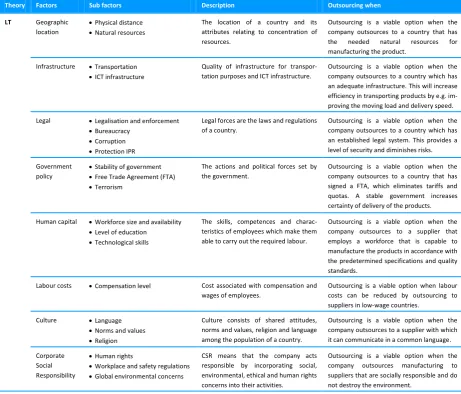
- Political: elements of a countries’ political climate such as nationalism, terrorism, stability of government, trade restrictions, and international organisations which can influence the success of international business.
- Physical: elements of nature such as location, topography, climate and natural resources. Location and
topography are for example important factors influencing the efficiency of transporting the manufactured products. The natural resources need to be considered because these might be essential for manufacturing the products.
- Economic: factors like unit labour costs, just like other manufacturing factors, ultimately determine the price the company has to pay for the outsourced manufactured product. Outsourcing to LCCs will reduce operational costs.
- Sociocultural: elements of culture such as attitudes and beliefs, religion and language are important to international managers. Managers have to understand the characteristics of a specific foreign culture, need to accept the differences and adapt to the norms and values of this culture when doing business with this country. Important is to reflect if companies can communicate by a common language or if foreign managers prefer to do business in their local language. If so, the disadvantages of using an interpreter need to be considered.
- Technological: the technological skills affect how resources are converted to products. To be able to manufacture the technological products, the employees of the supplier need to be skilled in e.g. welding, processing and shaping metal and need to know how to make a product based on technological drawings or a mould.
- Legal: the foreign laws and regulations govern the constraints in which international companies must operate. An established legal system and security of IPR are important to protect the product from being copied by the supplier.
- Labour: composition, skills, and attitudes of labour are of importance because these forces affect productivity and ultimately a companies’ profitability. The quality and quantity of labour are significant, because the workforce has to be able to manufacture the product as was required by the company.
Although these environmental factors affect doing international business in general, it is expected that this will also affect the success of international outsourcing. The way and potential of doing business with a specific foreign supplier will likely be influenced by these external factors. In addition, when companies are already outsourcing manufacturing to a certain location, it is expected that a negative impact of changes in environmental circumstances will lead to a reconsideration of the outsourcing strategy. When outsourcing to a particular country is no longer beneficial due to increasing costs and risks, companies will probably look for other outsourcing destinations.
2.4
Internal factors
2.4.1 Motives for international outsourcing
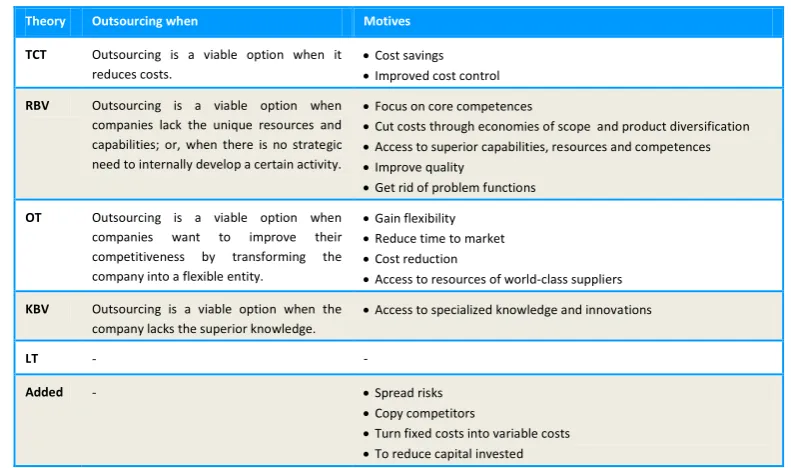
In psychology, a motive is seen as ‘a particular internal factor or condition that tends to initiate and sustain activity’ (Guilford). When applying this thought to this research, it can be said that the motives for companies to start outsourcing manufacturing to international suppliers are internal factors influencing organisational behaviour. There is a thin line between internal factors and external stimuli and it is even expected that they act in cooperation. However, in this research, it is decided that motives are combined under the heading of internal factors, because external stimuli alone are ineffective in companies engaging in outsourcing and require some internal help. External factors can force companies to adjust their internal processes, but the decisions concerning how this is done and which strategy is chosen to remain competitive are internal activities.
The number of companies that practice international outsourcing is growing rapidly. The increasing connectivity and interdependency of companies and markets in the world economy has induced companies to focus on their core business, and scatter other value adding activities around the world to places with locational advantages (Farrell, 2010). The heavy worldwide competition forces companies to maximize productivity and profitability. “Outsourcing has become an activity in the companies’ value chain, whereby competitive advantages may be gained when products are manufactured effectively and economically by outside suppliers” (Javalgi et al, 2009, p. 156). International outsourcing has become a widespread competitive strategy for companies of different sizes operating in distinct industries. The motives for outsourcing were in the beginning mainly based on cost savings, but come to be more versatile in time.
It is clear that companies outsource activities because they consider it as beneficial in one way or the other. Prior research found that motives vary between companies and countries. For example, Kakabadse & Kakabadse (2002) concluded that significant differences exist between the USA and Europe. American companies motivated their outsourcing decision from a more strategic perspective by continuously aiming to achieve best practices, improving (service) quality, focusing on core competences and leverage new technology. In contrast, European companies view outsourcing as a way to reduce costs and to gain economies of scale. The study of Quélin & Duhamel (2003) among large European manufacturing companies verified that cost savings is the key driver for outsourcing. However, they also found that focusing on core activities and gaining flexibility are important motives for outsourcing as well. When concentrating on the Netherlands, Deloitte’s (2009) application of the global outsourcing survey for the Dutch market found that when it comes to a companies’ largest outsourcing contract, cost reduction was the primary driver in their decision to outsource. It is even believed that the financial crisis and the economic recession strengthened this motive. Ok (2011) further specified this financial motive by determining that reduction of labour cost is by far the most important reason of Dutch companies for engaging in international outsourcing. This is followed by improved competitiveness; strategic decisions taken by the group head; and reduction of other costs.
than that it contributes to the company. Focusing on less, but manageable core activities reduce the costs of a company.
Outsourcing enables the company to focus on its core competences (RBV) and activities that lead to a competitive advantage (Alexander & Young, 1996b; Belcourt, 2006; Gilley & Rasheed, 2000; Heikkilä & Cordon, 2002; Jennings, 2002; Kakabadse & Kakabadse, 2000, 2002; Kremic et al, 2006; Kumar & Eickhoff, 2005; Lacity et al, 1994; Leavy, 2001, 2004; Lonsdale & Cox, 1998; Prahalad & Hamel, 1990; Quélin & Duhamel, 2003; Quinn, 1999; Quinn & Hilmer, 1994, 1995; Saunders et al, 1997; Zhu et al, 2001). By outsourcing peripheral activities, the functional scope of a company will be reduced which ultimately results in a focused company that is more flexible (OT) and better able to adapt to changes in the environment (Gilley & Rasheed, 2000; Heikkilä & Cordon, 2002; Jennings, 2002; Kremic et al, 2006; Quélin & Duhamel, 2003; Quinn & Hilmer, 1995). It increases strategic flexibility, but it also eases the management of manufacturing capacity and the required number employees. The problem of hiring and firing employees when dealing with volatility in sales is transferred to the supplier. For example, during this economic recession the automotive industry will sell less than what was predicted, because customers tend to postpone big investments in products. Moreover, companies have to deal with seasonal changes. In addition, shorter product life cycles, increased competition and changing customer demands impose companies to faster deliver the product to the market. Outsourcing can reduce the time to market (OT) (Jennings, 2002; Kumar & Eickhoff, 2005; Lonsdale & Cox, 1998; Quinn & Hilmer, 1995) by accelerating e.g. the manufacturing or distribution of the products by contracting world-class suppliers and utilizing their additional capabilities. Finally, as said, outsourcing allows for transferring difficult to manage functions or activities which are too time-consuming to develop internally. By getting rid of these problem functions (RBV) (Belcourt, 2006; Kremic et al, 2006; Lacity et al, 1994) resources become available to support core functions.
Outsourcing is also a means to get access to superior resources, skills and knowledge (RBV, OT, KBV) (Belcourt, 2006; Gilley & Rasheed, 2000; Jennings, 2002; Kakabadse & Kakabadse, 2000, 2002; Kumar & Eickhoff, 2005; Lacity et al, 1994; Leavy 2001, 2004; Lonsdale & Cox, 1998; Quinn, 1999; Quinn & Hilmer, 1994, 1995; Zhu et al, 2001) that are not available in-house and will supplement the companies’ capabilities. For example, technological companies in the Netherlands appear to have a shortage of technological labour. The industry is one of the main sectors that has to deal with the ageing of the population and is therefore looking for technological labour that can replace the current workforce that is entitled to a pension. Moreover, for the sector to be able to grow, additional excellent employees are needed. Growth based on innovation changes the type of employees required for the job. The demand for higher educated employees will increase. Not only for R&D, but also the mechanisation of the manufacturing call for employees that have know-how and are qualified to work with these complex robots and machines. Since there is a lack of this type of employees in the Netherlands, outsourcing can support gaining access to skilled labour across borders. In general, whether it is by accessing skilled labour, knowledge, new technologies or other resources, outsourcing can improve quality (RBV) (Belcourt, 2006; Gilley & Rasheed, 2000; Jennings, 2002; Lacity et al, 1994; McFarlan & Nolan, 1995; Quinn, 1999; Quinn & Hilmer, 1995) when activities are transferred to expert suppliers.
In literature, additional motives that influence the decision to outsource are found. Outsourcing is also practised in order to reduce the companies’ risk (Kremic et al, 2006; Quinn & Hilmer, 1995) and to copy competitors (Kremic et al, 2006; Lacity et al, 1994) when they seem to have success with outsourcing internationally or because it is fashionable. For the last motive, it is important to note that the information, a company has obtained about the successful outsourcing endeavours of another player in the market, may be too optimistic. Moreover, imitating the success of other companies is not a premise for success in your own company.