
Structuring cans and wants A multiple case study on the pros and cons of clinical laboratory organization models in The Netherlands
60
0
0
Full text
(2) Structuring CANS and WANTS A multiple case study on the pros and cons of clinical laboratory organization models in The Netherlands.. Author L.A. (Bart) van Oort MSc. University of Twente, Enschede, The Netherlands School of Management & Governance Student Health Sciences Track: Health Technology Assessment Supervision Prof. Dr. G.C.M. Kusters Dr. P.C. Carrera Department Health Technology & Services Research (HTSR) School of Management & Governance University of Twente, Enschede, The Netherlands. 2.
(3) Summary Background and objectives Nowadays, hospital laboratories are searching for modes of cooperation with other clinical chemistry and haematology laboratories in order to overcome enforced savings while preserving quality levels. In this thesis the pros and cons of different organizational structures of clinical laboratory cooperation are described. On the basis of the available theory expectations on the effects of organizational structures can be drawn. This thesis contributes to the scientific pool of knowledge by describing the efficiency and quality features of different organizational structures of laboratories. In the context of optimizing the delivery of care and the allocation of resources, this study is not only scientifically relevant, but also socially relevant. One can perceive a trend towards centralization and cooperation concepts for organizing laboratory services. Decision making on organizational structures is part of a broader theorem of transaction cost economics. Williamson (1985) defines transaction costs as all costs involved with arranging and executing a contract. Organizations have to examine so called ‘make or buy decisions’. The theory of Coles & Hesterly (1998) assumes that make or buy decisions are based on the extent of asset specificity of a service, the uncertainty of predicting situations affecting planning and adaptation of a transaction, and the quality of a service. Methods A multiple case study has been performed on the basis of three clinical laboratory organizations in The Netherlands. Based on a centralization-ownership continuum, three typical organizational structures were selected: 1. Outsourcing – Stichting Atal-Medial and Kennemer Gasthuis, 2. Integration – Deventer Ziekenhuis, Slingeland Ziekenhuis Doetinchem and Streekziekenhuis Koningin Beatrix Winterswijk, 3. Hybrid form (outsourcing & integration) – Lab West B.V., Medisch Centrum Haaglanden and HagaZiekenhuis The cases were studied by conducting interviews with three groups of key informants (N= 15), and by analyzing quantitative data derived from year reports. Results and conclusions The data gathering process was hindered by the lack of willingness of hospitals to share quantitative data for this study. Additionally, in interviews specialists within the hospitals were asked to indicate their level of satisfaction with laboratory services. However, the actual service level in the hospitals studied was not known, which makes comparing results more difficult. Keeping this in the back of the mind, it is concluded that the rational choice for an organizational structure is influenced by both the environmental and organizational circumstances (CANS) and the strategy of the executive boards of the hospitals (WANTS). The chosen structure of organizing laboratory services can be justified in all cases against the background of their specific ‘CANS’ and ‘WANTS’. Hospitals that think about cooperation concepts for laboratory services need to reflect about what level of quality they want to deliver at what cost. The relationship of laboratory organization and the efficiency and quality of laboratories remains uncertain.. Structuring CANS and WANTS – L.A. (Bart) van Oort. 3.
(4) Preface This thesis is written as part of the Health Sciences (MSc.) programme at the University of Twente. With a background in Public Administration, my wish was to combine the knowledge on organizational aspects of public sector, with the new organizational dynamics that comes from a regulated health care market. Having seen this wish, I discussed the developments in diagnostics, specifically on clinical laboratories with Prof. Dr. Ron Kusters, professor economic effects of laboratory diagnostics. Based on the uncertainties and pressures in the field, it seems a good idea to make an overview of the organizational models used in clinical laboratory organization in The Netherlands, and to describe the strengths and weaknesses of the modes of organization. Confronted with the new dynamics in puzzling and powering within the framework of the regulated health care market an overview of the pros and cons in clinical laboratory organization are examined in this thesis. Writing this thesis was not possible without the aid, advises and energy of certain persons, and I would like to thank them here. My supervisors from the University of Twente, Prof. Dr. Ron Kusters and Dr. Percivil Carrera, both bound to the department Health Technology and Services Research (HTSR) of the School of Management and Governance of the University of Twente. The personnel of the clinical laboratory of the Jeroen Bosch Ziekenhuis located in ‘s-Hertogenbosch because of their flexibility to introduce me in the practice of laboratory activities. Finally I will thank all respondents who were willing to discuss the developments in clinical laboratory organization and the implications of organizational structures.. L.A. (Bart) van Oort Enschede, December 2nd 2012. Structuring CANS and WANTS – L.A. (Bart) van Oort. 4.
(5) Content Chapter 1: Introduction ................................................................................................................ 6 Chapter 2: Organizational structures of hospital laboratory health care ....................................... 10 2.1 Organizational structures of medical laboratories ...................................................................... 10 2.2 Dutch laboratory system ............................................................................................................. 17 2.3 Final remarks ............................................................................................................................... 20 Chapter 3: Research Methodology .............................................................................................. 21 3.1 Design .......................................................................................................................................... 21 3.2 Case selection .............................................................................................................................. 22 3.3 Operationalization ....................................................................................................................... 23 3.4 Sources of data ............................................................................................................................ 24 3.5 Data analysis ................................................................................................................................ 26 Chapter 4: Case ‘Atal-Medial & Kennemer Gasthuis’.................................................................... 27 4.1 Background of the case ............................................................................................................... 27 4.2 Analysis ........................................................................................................................................ 28 4.3 Case ‘Synergos’ ............................................................................................................................ 32 4.4 Concluding remarks ..................................................................................................................... 33 Chapter 5: Case ‘Deventer Ziekenhuis, Slingeland Ziekenhuis Doetinchem, en Streekziekenhuis Koningin Beatrix Winterswijk’..................................................................................................... 34 5.1 Background of the case ............................................................................................................... 34 5.2 Analysis ........................................................................................................................................ 35 5.3 Concluding remarks ..................................................................................................................... 39 Chapter 6: Case ‘Lab West B.V. (Medisch Centrum Haaglanden & Haga Ziekenhuis)’ .................... 41 6.1 Background of the case ............................................................................................................... 41 6.2 Analysis ........................................................................................................................................ 42 6.3 Concluding remarks ..................................................................................................................... 44 Chapter 7: Analysis per group ..................................................................................................... 46 7.1 Group observations ..................................................................................................................... 46 7.2 Concluding remarks ..................................................................................................................... 47 Chapter 8: Conclusion and discussion .......................................................................................... 48 8.1 Approach ..................................................................................................................................... 48 8.2 Results ......................................................................................................................................... 48 8.3 Conclusion ................................................................................................................................... 49 8.4 Recommendations....................................................................................................................... 51 8.5 Discussion .................................................................................................................................... 51 Bibliography ............................................................................................................................... 54 Appendices ................................................................................................................................ 57 Appendix 1: Questionnaire head of laboratory................................................................................. 58 Appendix 2: Questionnaire member of executive board .................................................................. 59 Appendix 3: Questionnaire specialist within hospital organization .................................................. 60. Structuring CANS and WANTS – L.A. (Bart) van Oort. 5.
(6) Chapter 1: Introduction The perspective in The Netherlands on health and health care is changing. The country is faced with a mix of four ‘concerns’. In the first place health care costs are rising while budgetary constraints linked with the economic crisis demand a containment of health care costs. Secondly, the demand for health care is increasing and changing due to issues such as the ageing population and the relative and absolute increase in the number of patients with chronic diseases. Thirdly, new technologies for diagnosis, treatment and care are more widely available and demanded by citizens. Finally, a substantial shortage of staff is expected (Raad voor de Volksgezondheid en Zorg, 2010). E.I. Schippers MSc., Minister of Health, Welfare & Sports signals an increase in health care costs as a result of increasing demand for health care and increased possibilities for diagnostics, treatment and care as a result of medical innovation. In the ‘Beleidsagenda 2012’ the Minister states that the costs of health care are rising more rapidly than the economic growth. Therefore the health care costs put an increasing pressure on the national budget. In addition to greater control over health expenditures, equal access, and increase in quality, are leading policy focuses (Ministerie van Volksgezondheid, Welzijn & Sport, 2012). To achieve such an agenda, action is needed to alter the structure, purchasing and financing of health care. Firstly, patients should only be referred to a specialist if necessary. Secondly, selective purchasing should consider both performance and specialization. Finally, a high complex but low volume health care should be provided in fewer hospitals (Ministerie van Volksgezondheid, Welzijn & Sport, 2012). More recently, in an implementation analysis requested by the Minister, the Nederlandse Zorgautoriteit (NZa) proposed to follow the direction of performance based financing for primary care diagnostics. The Minister signaled, in line with her statement that the current structure of primary and secondary care does not respond to the demand for health care, that it is of public interest to stimulate a more general and integrated view in order to achieve general diagnostics. Adequate primary care diagnostics can prevent unnecessary referrals to the specialist and unnecessary diagnostics in the hospitals (Kamerstukken 2011/2012, 33000-XVI VWS-begroting 2012 Lijst van vragen, p. 83). The NZa advises a performance-related financing for the primary care diagnostics. Primary care diagnostics purchasing, they argue, should be designed in a way similar to the current practice in the more specialist health care branches, in which health care insurers are able to purchase care on the basis of price-quality ratios. This is possible because the good supplied has a substitutive character. Furthermore the NZa proposes the implementation of a function directed performance model with integrated tariffs (Nederlandse Zorgautoriteit, 2011). This is supposed to be an incentive for hospitals to save costs on their hospital laboratory services. By introducing free tariffs or maximum tariffs hospitals have an incentive to save costs within the organization by purchasing externally. Efficient operational arrangements in hospital diagnostics are crucial given today’s more competitive market. To an increasing extent there is attention for efficient operational management. As a result, cooperation and the scaling-up of laboratories are explored. Costs of the service package are compared to the other providers outside the own hospital organization or work area. The quality and costs of services have to map out. Insight in efficiency of operational management and costs. Structuring CANS and WANTS – L.A. (Bart) van Oort. 6.
(7) becomes still more crucial when performance based financing is introduced, as proposed in the advice of the NZa for primary care diagnostics (School, Lems, & Kortlandt, 2010). Laboratories could develop a value-added strategy and a price compression / product innovation strategy in order to be prepared for future threats and opportunities. The core competency of laboratory professionals must be refocused towards providing additional knowledge services related to in vitro diagnostic services in order to add value (Bossuyt, Verweire, & Blanckaert, 2007). To enhance efficiency and reduce costs Bossuyt et al (2007) suggest to consolidate, integrate or outsource, and to form alliances and networks of medical laboratories. Most importantly, additional value needs to be created by providing knowledge services related to in vitro diagnostics. This is based on the analysis that in most European countries laboratory business models suffers from fragmentation, redundancy and excess capacity (Bossuyt, Verweire, & Blanckaert, 2007). The pursuit of cost savings and the enhancement of quality have led to changing hospital laboratory structures as illustrated by the following examples. 1. In the southern part of The Netherlands, in the Eindhoven region, the hospitals Máxima Medisch Centrum (MMC), Catharina Ziekenhuis Eindhoven (CZE) and the laboratory Synergos studied the possibility of a cooperation in 2008. Based on this study further feasibility studies were executed. In the 2008 annual report of the Máxima Medisch Centrum, department clinical laboratory, the reference point is the foundation of a new juridical entity. However in the 2009 annual report of the Máxima Medisch Centrum, department clinical laboratory, is stated that a merger in the short term is no option since the financial advantages are insufficient according to the corporation Synergos. The laboratories of Máxima Medisch Centrum and Catharina Ziekenhuis Eindhoven explore to what extent their objectives can be achieved through intensive cooperation. From the 2010 annual report of the Máxima Medisch Centrum, department clinical laboratory, can be derived that Synergos is no longer intensively involved in the merger process. In this annual report an intended merger with the laboratory of the Catharina Ziekenhuis Eindhoven is elaborated. In the end of April 2010 the “Businessplan gezamenlijk klinisch laboratorium Catharina-Ziekenhuis en Máxima Medisch Centrum” was presented. This research showed the costs of exploitation could decrease with 11 % in case of a merger. However half the saved costs could be achieved through the harmonization of both core laboratories in a collective tender. The executive boards – Raad van Bestuur – of both hospitals decided to harmonize both core laboratories and stop further merger (Máxima Medisch Centrum afdeling klinisch laboratorium, 2008; Máxima Medisch Centrum afdeling klinisch laboratorium, 2009; Máxima Medisch Centrum afdeling klinisch laboratorium, 2010). 2. Another initiative that deserves particular attention is the Santeon concept. Santeon is a cooperation between six top-clinical hospitals in The Netherlands. By cooperation in the fields of purchasing, human resource management, automation, and responsibility for the buildings expenditures can be saved. The Santeon cooperation differs from the example mentioned above. The main difference is that the hospitals do not compete with each other in their service area, in contrast to what was the case in the other example. The Santeon concept is not tied up to the scale of a hospital level, but can be applied too on the clinical laboratory level in terms of the mentioned cooperative elements. Structuring CANS and WANTS – L.A. (Bart) van Oort. 7.
(8) Nowadays, hospital laboratories are searching for modes of cooperation with other clinical chemistry and haematology laboratories in order to overcome enforced savings while preserving quality levels. The field of study of clinical chemistry deals with medical laboratory research of blood and other bodily fluids. The origin of the discipline is the biochemistry, which aims to show or exclude diseases by searching for materials like salt, protein, and metabolic products in bodily fluids (NVKC, 2012). This paper takes the organizational arrangements directed at cooperation as central notion. The aim is to describe pros and cons of organizational structures such as integration, partnerships and outsourcing by reviewing efficiency and quality. The thesis focuses on laboratories that recently changed their organization within the framework of cooperation structures. Per selected organizational structure, the strengths and weaknesses are described. According to results of the proposed analysis it is possible to examine whether or not there is a relationship between the organizational structure and the retrieved values on the criteria of study, and what characterizes this relationship in terms of efficiency and quality. Finally, based on the results, recommendations are formulated. The goal of this paper is to describe the pros and cons of several organizational structures in the field of laboratory diagnostics. On the basis of the available theory, expectations on the effects of organizational structures can be drawn. This thesis contributes to the scientific pool of knowledge by describing the efficiency and quality as perceived by several stakeholders of different organizational structures of laboratories. In the context of optimizing the delivery of care and allocation of resources, this study is not only scientifically relevant, but also socially relevant. This thesis refers to the situation of 2012. Data is collected in the summer of 2012. However, the selected organizational arrangements have been in place for different periods of time. The specific time frames are indicated in the chapters 4, 5, and 6. Given this introduction the following research question is formulated:. What are the strengths and weaknesses of different organizational structures in hospital laboratory health care in terms of efficiency and quality? The study is structured around three sub questions. First the organizational structures are described and outlined into detail according to theory: 1) What are the characteristics of different organizational structures in hospital laboratories and what are their expected strengths and weaknesses according to theory? Cases of hospital laboratories are selected based on their organizational structure. Based on the empirical findings derived from interviews and year reports, an examination of the nature of organizational structures in terms of efficiency and quality is made. As a result the organizational structure of the hospital laboratory and their scores on the dimensions (efficiency and quality) of study are compared with respect to the strengths and weaknesses of each approach. 2) What are the results of different organizational structures in hospital laboratories in The Netherlands in terms of efficiency and quality?. Structuring CANS and WANTS – L.A. (Bart) van Oort. 8.
(9) 3) Is there a relation between the way hospital laboratory services are organized in hospitals in The Netherlands, and the efficiency and quality of hospital laboratories? In the first chapter a background is provided to indicate the developments and challenges in today’s healthcare. Examples are given of new approaches in hospital laboratory health care. These new approaches can be found in the sphere of organizational structures with a focus on cooperation. In the second chapter theoretical concepts are explained. A broad theorem of make and buy decisions is provided as a framework for organizational structures. Then the organizational structures directed towards cooperation are described: outsourcing, integration and the hybrid form is distinguished. Furthermore, the expected effects on efficiency and quality as well as potential disadvantages are considered based on theory. Hypotheses are then formulated based on the expected effects. In the end, sub question one is answered. In the third chapter the research methodology is elaborated. The design is described as well as the case selection process. An operationalization of concepts is given and the link to the conceptualization is explained. In the remaining part the methods of data collection and data networking are described. In the fourth, fifth and sixth chapters the cases ‘Atal-Medial and Kennemer Gasthuis’, ‘Deventer Ziekenhuis, Slingeland Ziekenhuis Doetinchem, and Streekziekenhuis Koningin Beatrix Winterswijk’ and ‘Lab West B.V. – Medisch Centrum Haaglanden and HagaZiekenhuis’ are discussed. The results on the indicators are described and an analysis is made of the effects on goal attainment of efficiency and quality measures. In each of these chapters an answer is formulated, per organizational structure, on sub question two. In the seventh chapter a comparison of the responses of key informants interviewed is made. In the final chapter, an answer is given to sub question three. Then, conclusions are drawn based on the results and analyses of the three cases and the observations of the key respondents comparing as well as the additional materials. As a result, the main research question of this thesis is answered. Furthermore recommendations are described and limitations of the findings are discussed.. Structuring CANS and WANTS – L.A. (Bart) van Oort. 9.
(10) Chapter 2: Organizational structures of hospital laboratory health care In this chapter a specification of organizational structures is given. Then, a model is elaborated and its elements for evaluating laboratory organization are discussed. To put the arrangements into a broader perspective, an overview of the characteristics of laboratory health care in The Netherlands is given. This is an important discussion, as barriers for organizational embedding are identified.. 2.1 Organizational structures of medical laboratories A trend towards a more centralized organization and cooperation of medical laboratories is observed. In this section, the possibilities for decreasing costs and while simultaneously maintaining or even improving quality are elaborated and its implications for the organizational structure are analyzed. An overview is given of the broader theorem the organizational structures are embedded in. Then, a specification is made of the several options that exist within the framework of the centralization-ownership grid of medical laboratories can be organized in today’s practice. Finally, a model is given that is used for framing the answers to the research question.. 2.1.1 Make or buy decisions Following Williamson (1985), transaction costs are ‘the costs of drafting, negotiating, and safeguarding an agreement’. Transaction costs thus are the costs for arranging, monitoring and enforcing a contract, and are opposed to production costs (Genugten van, 2008). Transaction costs can be used as basis for this analysis that examines make or buy decisions, since empirical evidence shows that integration decisions consistently support transaction cost explanations including asset specificity and uncertainty. Asset specificity refers to a situation where assets are specially designed use in a single organizational (physical asset specificity) or to a situation where individuals are less valuable to other firms as they have very firm-specific knowledge and skills. Uncertainty is the degree to which decision makers are able to predict situations of planning and adaptation of a transaction. The relationship between asset specificity and uncertainty, transaction costs, and vertical integration is less clear when economies of scale are considered simultaneously. Larger firms (hospitals) are better able to realize scale effects in service production than smaller firms (Coles & Hesterly, 1998). In addition, the quality of goods seems a particularly important issue in industries where quality is a very competitive distinction for the firm – as it is for laboratory services. When the potential harm as a result of poor supplier performance is high and performance is costly and / or difficult to measure, then firms will use vertical integration to ensure an acceptable level of quality. For example, the responsibility for a mistake in the emergency room (ER) may be assigned to the ER, although it is a result of bad performance of other services like radiology or laboratory services. Even if it is unclear who is to blame and / or when the ER was not clearly involved in it, the hospital’s reputation providing high quality services is likely to suffer. However, some parts of an organization, such as the laundry contractor, are unlikely to cause such serious consequences, when making mistakes (Coles & Hesterly, 1998). Based on this line of reasoning, hospitals are expected to integrate those services that significantly impact quality and, in case of poor supplier performance, could cause serious harm to patients. This Structuring CANS and WANTS – L.A. (Bart) van Oort. 10.
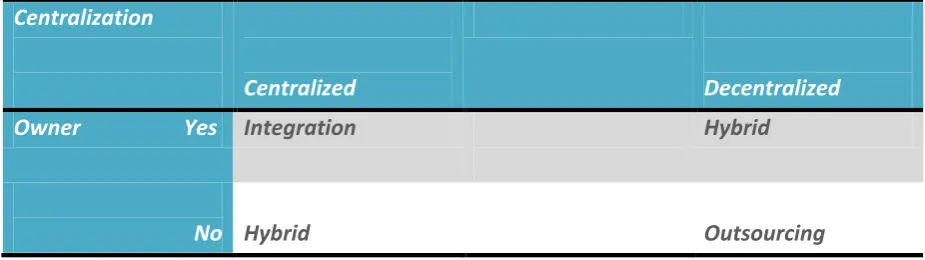
(11) is confirmed by the results of an empirical study of 196 hospitals in the United States, where the level of integration of services on a scale of 0-1, where 0 represents appropriate for outsourcing and 1 represents appropriate for integration, is 0.51 for laundry services and 0.95 for laboratory services (Coles & Hesterly, 1998). Of course the health sector in the United States significantly differs from the Dutch, however, quality impacts of services can be considered to be generalizable. After all, the quality of laboratory testing needs to be constant, no matter where it is performed. Based on this data the assumption can be made that integration principles (make) are more focussed on quality, whereas outsourcing principles (buy) more refer to an economically efficient approach.. 2.1.2 Organizational structures The discussion of make or buy decisions is part of a broader theorem which is described above. If the costs for producing a good or service by the organization itself are lower than buying it from the market, transactions will be organized by the organization itself, as Coase (1937) suggested. In addition, Coase argued that the costs of constant recontracting are high compared to long-term contracts with an organization’s own employees. To lower costs and increase transactions organizations tend to be larger. Therefore, organizations make use of the concepts combination and integration. A combination is when transactions are organized by one organization, when they previously were organized by two or more organizations. A combination becomes integration when the organization of transactions is involved, when this was previously carried out between organizations on the market. Organizations can expand in either or both of these two ways (Coase, 1937). The degree of centralization refers to the locus of authority for making decisions that affect the organization. In the literature two types of authority are distinguished, formal and personal authority. This thesis focuses on the formal authority stemming from ownership, since this study is concerned with laboratory services, which can be provided in-house or be purchased on the market. In contrast, personal authority focuses on knowledge and expertise (Pugh, Hickson, Hinings, Macdonald, Turner, & Lupton, 1963). In comparing centralization relative to decentralization the typology of Sah & Stiglitz is helpful. These authors separate polyarchies and hierarchies. In polyarchies there are several decision makers who can undertake projects independently of one another. In hierarchies, decision making is concentrated. Only a few individuals (or just one individual) are able to undertake projects while others in the organization provide support in decision making (Sah & Stiglitz, 1986). A categorization of the organizational structures can be made, based on the degree of centralization and ownership of an organization. The organizational structures distinguished here reflect the continuum of centralization and ownership. The characteristics of the structures on this continuum result in some expectations on efficiency and quality. The continuum is visualized below in figure 2.2 which indicates the landscape of centralization (towards decentralization or centralization) and whether or not an hospital is owner / shareholder.. Structuring CANS and WANTS – L.A. (Bart) van Oort. 11.
(12) Centralization. Owner. Yes. Centralized. Decentralized. Integration. Hybrid. No Hybrid. Outsourcing. Figure 2.1 The centralization – ownership landscape. The necessity to specialize and more integrated health care as indicated by the policy intentions of the Dutch government, and the literature review suggest that these models will achieve both a decrease of costs and an increase of quality based on rationalization principles. In the succeeding sub sections the organizational models are elaborated.. 2.1.3 Outsourcing In a decentralized mode the responsibility for day-to-day operations within an organization is downwards or outwards diffused. As a special category of decentralization outsourcing is mentioned. By outsourcing arrangements outside vendors are hired. In its most extreme form the total control is turned over to an outside contractor (Friedman & Mitchell, 1993). In the figure below the idea of outsourcing is performed. The laboratory is no longer part of the hospital and is applied by responsibility of an actor outside the hospital organization.. Figure 2.2: A schematic illustration of outsourcing the laboratory in a hospital organization in which satellite laboratories remain in the participating hospitals for emergency tests. The rest of the tests (about 75% of production) is applied in a central laboratory. As an option to achieve rationalization effects and / or decrease fixed costs effects, large parts or the whole work area of the hospital laboratory can be outsourced to a separate medical laboratory. Outsourcing could increase the number of patient samples handled (Henker, et al., 2005). At present there are some examples of outsourced laboratories with the motivation that a specific test can be Structuring CANS and WANTS – L.A. (Bart) van Oort. 12.
(13) done better, more often, at lower cost by an external organization. Due to higher level of expertise, the external organization could be more efficient and is therefore expected to take advantage of greater economies of scale (Bossuyt, Verweire, & Blanckaert, 2007). The risk of a virtual organization – an extreme level of outsourcing – is degeneration into a ‘hollow organization’ that cannot adapt to changing circumstances. The more core products are outsourced, the greater the potential for erosion of core competencies, if these core competences are embodied in core products (Bossuyt, Verweire, & Blanckaert, 2007). In terms of efficiency, therefore, the cost price on laboratory tests is expected to decrease. Due to larger series of patient samples the core laboratory is able to achieve economies of scale. The total costs are expected to decrease with the fall of fixed costs (overhead, infrastructure). In addition savings can be made in the number of staff (labour costs), since the 24hour service is applied with a higher number of patient samples. Outsourcing structures are expected to gain stronger effects from economies of scale compared with integration forms due to the commercial service of laboratory activities. Due to the centralized organization of quality management and a more specialized orientation of both centralized and decentralized laboratories on tests to apply, should increase the specialist satisfaction. The laboratory staff applies the tests more often and become better with it. However, this effect can be decreased if the operation led to a higher turn-around time of patient samples. Patient samples need to be transported to commercial laboratories. There are some disadvantages that fall beyond the operationalization of the concepts, but deserve attention here. These factors mostly do not reflect efficiency and / or quality issues, but are effects of the new organizational structures that executive boards have to realize. With the outsourcing of laboratory activities the autonomy of the hospital is expected to decrease as well as the possibilities to vary with the supplied services. Furthermore the cost savings are uncertain. It is assumed to achieve economies of scale, but short term effects seem to differ from long term effects. Finally as already referred to, the satisfaction of specialists is uncertain and depends on a quick and reliable delivery.. 2.1.4 Regional networks – integration The idea of integration is to create a regional value-added laboratory network, which can integrate diagnostics generated in decentralized testing sites (Friedman & Mitchell, 1993). This type of organizational structure is, according to theory, faced with a number of advantages. Consolidation and integration of laboratory services could decrease excess capacity, fragmentation and redundancy, while simultaneously the exploitation of process expertise knowledge is facilitated. Furthermore existing fixed costs of plants and equipment are spread over a larger base. Higher analysis volume lowers unit costs and the turn-around time (TAT) improves, allowing more rapid diagnosis (Bossuyt, Verweire, & Blanckaert, 2007). Establishment of integrated networks can enhance efficiency by exploiting economies of scale, optimal capacity utilization, optimal process design and reduced input costs. Likewise, integrated networks could create additional value by harmonization of test results within the network (Bossuyt, Verweire, & Blanckaert, 2007). However integrated health care is a necessary but not sufficient requirement to determine the success of integrated vertical meta-networks. A large part of explaining the success lays in (1) market forces, (2) the organization and management of those Structuring CANS and WANTS – L.A. (Bart) van Oort. 13.
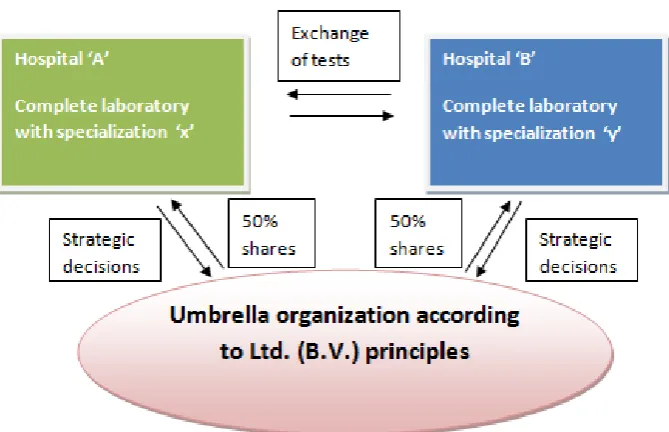
(14) collaborative networks and (3) whether the network is able to offer higher quality testing services at lower costs (Friedman, 2001). As an example the cooperation between the hospital laboratories of Deventer Ziekenhuis, Slingeland Ziekenhuis Doetinchem and Streekziekenhuis Koningin Beatrix Winterswijk are operating on behalf of the (regionally defined) health care providers mentioned above by collecting larger numbers of patient samples in order to achieve economies of scale. By organizing this way the cooperation of Deventer, Doetinchem and Winterswijk is not an outsourced structure, because the health care providers are part of their hospital organizations. The central idea is the exchange of tests. For instance all tests in the field of virology are applied in Deventer, whereas the tests in the field of allergy are applied in Doetinchem.. Figure 2.3: A schematic illustration of integrating the laboratory in an hospital organization in which complete laboratories over the hospitals remain with specializations on certain laboratory disciplines. The specialized tests are exchanged between the hospitals. Based on a higher analysis volume (economies of scale) and larger spreading of investment costs as the specified advantages the efficiency is expected to improve in terms of cost price. Labour costs of laboratory tests also decreases, since each hospital has its own specializations. Therefore not every hospital need to have a specialist for each type of diagnostics and time intensive analyses can now be done with a higher number of tests. Furthermore, production analyses are expected to increase because of larger series. Every participant in the network focuses on its core competency to add value to the network. For the indicator quality more specialized organization of processes could result to an increase in specialist satisfaction. As a result specialist satisfaction is expected to increase more than in the outsourcing arrangement, since the service level remains the same instead of being less. As for outsourcing, again some disadvantages need to be acknowledged. With specialization as necessary factor for integration the decrease of flexibility and autonomy of the hospital is again applicable. When working in (regional) networks with integrated laboratory activities, agreements have to be made with the other partners in the cooperation. Therefore a mode of governance has to be chosen, which encounters more deliberation in comparison to outsourcing in which only contracting is sufficient. Furthermore the interests of different stakeholders need to be harmonized Structuring CANS and WANTS – L.A. (Bart) van Oort. 14.
(15) if the cooperation is intended to be successful in terms of efficiency and quality. As a consequence the organizational structure integration like the outsourcing structure shows evident positive expectations in terms of all criteria investigated. However this organizational structure is focussed more on quality issues compared to outsourcing.. 2.1.5 Hybrid: Outsourcing & Integration To differentiate from the make or buy decision problem, hybrid forms can be distinguished. Mainly cooperation and competition are referred to as opposite models. However balancing cooperation and competition in inter-organizational relationships can result to positive effects as studies in private sector suggest. Typically in competition many organizations are producing the same or related products and compete for consumers and suppliers. In cooperation frequent exchanges among partners appear, including business, information and social exchange. Based on these typical principles a mixture of competition and cooperation is introduced: co-opetition (Barretta, 2008). This hybrid tries to obtain greater advantages compared with competition or cooperation solely for every organization involved in inter-organizational relationships by producing the positive effects of both competition and cooperation. More concrete imagine a pie that is distributed. Co-opetition allows for a redistribution of the pie by which a greater portion can be dedicated to patient care rather than to negative externalities of competition and / or cooperation. Apart from economic advantages, also – among other things – improvements in the effectiveness of health-care services can be achieved (Barretta, 2008). In the most common hybrid organizations of laboratory activities the clinical laboratories are formally decentralized from the hospital organization and become therefore an autonomous organization. Simultaneously, however, the participating hospitals are shareholders of the created laboratory organizations. An example is the Limited (Ltd. / B.V.) like the Medlon organization, a result of cooperation between Medisch Spectrum Twente and the Ziekenhuisgroep Twente. This Ltd. is 100% subsidiary company of the supporting hospitals. However organizations involved in inter-organizational relationships need a coordination system in which planning, coordination, monitoring and appraising are regulated. Good governance of interorganizational relationships is one of the success factors for this kind of model. The hybrid organizations are expected to feel more freedom of action. The laboratory organizations can follow their own policies and strategies according to their own interests instead of being an integral part of the hospital in which it is a business applied according to the interests of the hospital. In the figure 2.4 below the hybrid organization is visualized:. Structuring CANS and WANTS – L.A. (Bart) van Oort. 15.
(16) Figure 2.4: A schematic illustration of hybrid (outsourcing & integration) laboratory organization in a hospital organization in which complete laboratories within the hospitals remain with specializations on certain laboratory disciplines. The specialized tests are exchanged between the hospitals. The strategic decision making on what specializations and centralization of activities is delegated to an umbrella organization. An organization according to Ltd. principles by shareholder status of Hospital ‘A’ (50%) and Hospital ‘B’ (50%) Having seen the characteristics of the hybrid form, the effects in terms of efficiency may be expected positive. In terms of cost efficient production effects are expected since economies of scale can be achieved by a larger sample base and exchange of tests. Also labour can be charged more optimally by working with larger amounts of patient samples. However the freedom to act is uncertain due to the fully shareholder ship of the hospitals. Therefore the largest effects in terms of efficiency are expected for outsourcing separately. For the indicator quality the specialization on core competencies of the network participants and the centralization of quality management the specialist satisfaction is – as an effect of the consequences of the outsourcing principle – due to the loss of autonomy expected to increase less strongly compared to integration and more strongly compared to outsourcing. The disadvantages of the hybrid form of outsourcing and integration are a cross-over of the disadvantages mentioned in the organizational structures of outsourcing and integration separately. Again drawbacks lay in the sphere of less flexibility and autonomy, the creation of deliberation structures and interdependency between stakeholders. The hybrid form may be the most balanced organizational change in terms of efficiency and quality, it is also faced with most disadvantages.. Structuring CANS and WANTS – L.A. (Bart) van Oort. 16.
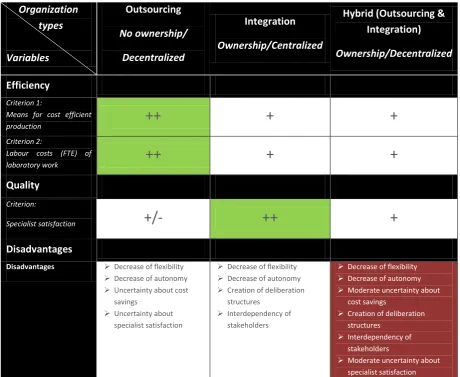
(17) 2.1.6 Comparative overview of organizational structures In this paragraph an overview is given of the expectations derived from theory on the indicators efficiency and quality as well as the disadvantages of the distinguished organizational structures. Based on this overview it is possible to distillate the main focus of the organizational structures. In table 2.1 an overview is given with the help of pros and cons (--, -, +-, +, ++) of the organizational structures on the distinguished indicators according to theory. Furthermore with a green background the main pros of the organizational structure are given, whereas the red background shows the most cons. Organization types. Outsourcing Integration No ownership/ Ownership/Centralized. Variables. Decentralized. Hybrid (Outsourcing & Integration) Ownership/Decentralized. Efficiency Criterion 1: Means for cost efficient production. ++. +. +. Criterion 2: Labour costs (FTE) of laboratory work. ++. +. +. +/-. ++. +. Quality Criterion: Specialist satisfaction. Disadvantages Disadvantages. Decrease of flexibility Decrease of autonomy Uncertainty about cost savings Uncertainty about specialist satisfaction. Decrease of flexibility Decrease of autonomy Creation of deliberation structures Interdependency of stakeholders. Decrease of flexibility Decrease of autonomy Moderate uncertainty about cost savings Creation of deliberation structures Interdependency of stakeholders Moderate uncertainty about specialist satisfaction. Table 2.1: An overview of expected effects of organizational structures derived from theory on efficiency and quality. As well as the disadvantages of the type of organization.. 2.2 Dutch laboratory system The following section describes the situation of hospital laboratory health care in The Netherlands to put the mentioned organizational arrangements in a perspective. This is of importance since the organization of laboratory health care is logically partially determined by the organization of the Dutch health care system. Therefore before referring to organizational structures it is good to give insight in some characteristics of the Dutch laboratory health care situation. According to the NVKC there are 90 laboratory organizations of which eight are academic laboratories, 24 are general practitioner laboratories and 27 laboratories are in top clinical hospitals. The rest is arranged in Structuring CANS and WANTS – L.A. (Bart) van Oort. 17.
(18) general hospitals. Total costs of in vitro diagnostics are approximately € 298 million, which is 0,5% of the total health care expenditure (289*10⁶/ 55.484*10⁶) (Nederlandse Vereniging voor Klinische Chemie, 2011). The costs of diagnostic resources are low relative to other western European countries. The year reports of the European Diagnostic Manufacturers Association (EDMA) provide a comparative overview of European countries in the field of diagnostics. Note that numbers are for all in vitro diagnostics (clinical chemistry and micro biology together) and only reflect the reagents, variable resources, and equipment (EDMA, 2011).. Figure 2.5 Costs of In Vitro Diagnostics (IVD) with the share of IVD costs against the Total Health Expenditure (THE) based on data of the European Diagnostic Manufacturers Association (EDMA) (Source: EDMA, 2011) In the Dutch health system primary care diagnostics and secondary care diagnostics are distinguished. Primary care diagnostics are applied on behalf of a primary health practitioner, mostly the general practitioner or obstetrician. Several groups of providers can request those tests: general practitioners, obstetricians, primary health care diagnostic centres, hospitals, production cooperators, independent private clinics, care groups and foreign laboratories. In primary care diagnostics main problems are signalled by the NZa in (1) the deviant funding over the several groups of providers, (2) the superseded performance and tariffs, (3) the interrelation of primary care en secondary care diagnostics (Nederlandse Zorgautoriteit, 2011). The secondary care diagnostics are diagnostics that are applied within the framework of Diagnosis Related Group (Diagnose Behandel Combinatie, DBC) in the secondary health care (Nederlandse Zorgautoriteit, 2011). Diagnostics have a supporting role (in different forms) in the health care process of medical decision making. 60-70% of all medical decisions are partially based on laboratory results. However, due to the competition, the desire for efficient production and to overcome overcapacity, providers are entering each other’s region. This lead hospitals to outsource laboratory service, to cooperate with other hospitals or both (School, Lems, Kortlandt, 2010). Structuring CANS and WANTS – L.A. (Bart) van Oort. 18.
(19) Product characteristics In this section the characteristics of laboratory testing are elaborated. The type of product to investigate is of importance when investigating the most appropriate organizational structure, since the characteristics determine partially the barriers and possibilities of organizational models. Technology is a fundamental part in today’s laboratory work but does not assure analytical quality. Therefore analytical quality is still a major issue for clinical laboratories (Plebani, 2007). The tests can be divided roughly into two groups, the high volume low complex tests and the low volume high complex tests. The high volume low complex tests (about 75% of all tests) are easily to apply and can be applied as mass production, whereas the low volume high complex tests are difficult to apply and require less time between sample and analysis. Furthermore laboratory organizations are bounded by strictly set time norms for particular tests. All laboratory organizations agree that all hospitals need to have a laboratory itself to apply the emergency tests. In terms of organizational structures this means that hospitals always need to have a laboratory within their hospital due to the 24 hours, 7 days a week service. Furthermore hospitals try to cooperate to increase the volume of both low volume high complex tests (specialization) and the mass production to achieve efficiency and quality improvements. Centralization For both economic and quality opportunities outsourcing plans for centralization are developed worldwide. This results in newly integrated healthcare delivery systems that encompass laboratory networks and centralized core laboratory facilities (Guidi & Lippi, 2006). The tendency towards centralization is led by the principle of economies of scale. Some economies of scale result to payment of lower prices for inputs. Products or services are bought in large amounts, finance costs are lower, and lower wages can be paid if the firm develops monopoly power in the labour market. Otherwise economies of scale are a consequence of changes in the level of output are translated into changes in the cost of output. This is justified since total costs, average costs and marginal costs are all related to the level of output, that is ‘C = C(Q)’ where C is cost and Q is quantity (Morris, Devlin, & Parkin, 2007).. 2.2.1 Comprehensive perspective In this paragraph a more comprehensive perspective is described in order to show that the organizational models need to be embedded in a broader context. Panteghini (2004) argues that costs aspects should be reviewed in a wider overall context of health economics. The true impact of diagnostic testing can only be achieved if not only the costs per test but also the value outside the scope of the laboratory practice should be taken into account (Panteghini, 2004). This comprehensive perspective is not only demanded in terms of costs, but in terms of the value for patients too. Here commoditization, outsourcing and the establishment of ‘megalaboratories’ that simply focus on analytical results are observed as risk factors for the effective governance of the total testing process and therewith the errors in laboratory medicine. Administrators need to focus more on effective modes of action in the clinical context in which tests are required and used rather than focusing on the cost reduction per test and other efficiency indicators (Plebani, 2007).. Structuring CANS and WANTS – L.A. (Bart) van Oort. 19.
(20) 2.3 Final remarks In chapter two the specified characteristics of laboratory services were discussed in order to get some insight on the barriers and facilitators of laboratory services related to organizational structures. A specification was then made on several organizational structures in laboratory testing. The concepts of outsourcing, integration separately and a hybrid of outsourcing and integration were described and based on the literature review, expectations were formulated on the examined criteria of research here. We are thus able to answer the first sub question of the study: What are the characteristics of different organizational structures in hospital laboratories and what are their expected strengths and weaknesses according to theory? All three models are expected to achieve efficient management and increase quality albeit by different magnitudes. Those are the strengths of the forms that achieve results by rationalization principles and economies of scale. Outsourcing is more concentrated on efficiency whereas integration focuses more on quality. The hybrid form shows balanced positive effects by combining rationalization principles from both outsourcing and integration. Weaknesses in the diverse approaches lay in the field of loss of autonomy in terms of the ability to make decisions, and the necessity to specialize and therefore the loss of applications within the hospital organization. The hybrid form seems to have most disadvantages. In the end special attention is given to comprehensiveness of laboratory services. Central argument here is a broader view on laboratory testing focussing on the patient, quality and effectiveness, rather than focussing on efficiency only. This part is included to reflect on the major concern that hospitals only focus on costs when deciding on organizational models. The specific expected effects of organizational structures on efficiency and quality according to theory, are in line with the broader theorem of make and buy decisions that is used in this thesis. It is argued that integration principles are more focussed on quality, whereas outsourcing principles more refer to an economically efficient approach.. Structuring CANS and WANTS – L.A. (Bart) van Oort. 20.
(21) Chapter 3: Research Methodology In this chapter methods and procedures employed in this mixed methods research are described. In consideration of the nature of the thesis questions, a multiple case study design using a qualitative approach is employed.. 3.1 Design In this paper a multiple case study design using a qualitative approach is employed. Qualitative analysis is a method for examining and interpreting social research data non numerically. This type of research aims to discover underlying meanings and patterns of relationships (Babbie, 2007). This thesis uses individual interviews as qualitative data. The purpose of the interviews is to indicate the ideas of respondents about the phenomena of interest (Trochim, 2006). Interviews are an appropriate method here, to gain insight in the core ideas of the organizational arrangements. In order to get a comprehensive overview of pros and cons of laboratory arrangements, three groups of key informants are distinguished. If possible a mixed method approach of quantitative and qualitative procedures is employed. A mixed methods research is a design that aims to collect, analyse and mix both quantitative and qualitative data in (here) a series of studies to understand the research problem (Creswell & Plano Clark, 2007). This is of importance to verify the statements done in the interviews, and provide an overview of actual data of manpower and production. A case study design is an empirical inquiry which focuses on the contemporary phenomenon within the real-life context. Boundaries between the context and the phenomenon are not clearly evident. The theoretical framework is a template in case study research and in terms of generalization its purpose is to generalize to the theoretical propositions and not to the population as it is in statistical research (Yin, 1994). In this thesis a multiple case study design is used to reveal support by replication logic for theoretically contrasting results for predictable reasons. The theoretical framework identifies the conditions, if a particular phenomenon is likely to be found or not. This type of design provides an in depth study of complex situations. The phenomenon cannot be isolated from the context. The arrangement of clinical laboratories is such a complex phenomenon, since it deals with efficiency and quality effects, that cannot be excluded from consequences for the rest of the patient process. Results of case studies describe the phenomenon rather than predicting future behaviour. This is appropriate for the goal of writing a descriptive overview of pros and cons. The unit of analysis is the major entity analyzed in the study. The arrangement of laboratory organization is the unit of analysis here. The unit of observation is the unit upon which data are analyzed. The interviews with key informants and the quantitative data from year reports are unit of observation here. The replication of a multiple design enables to explore differences within and between cases. This is of importance since the goal of this thesis is to make a comparative description of pros and cons of different arrangements. In terms of reliability, a measure is considered to be reliable if the result pops up over and over again. The use of structured interviews in this thesis is helpful for consistent measurement, since the same questions can be posed to the key informants again and again. Of course, the availability of quantitative data used in this thesis is limited. However, one can easily Structuring CANS and WANTS – L.A. (Bart) van Oort. 21.
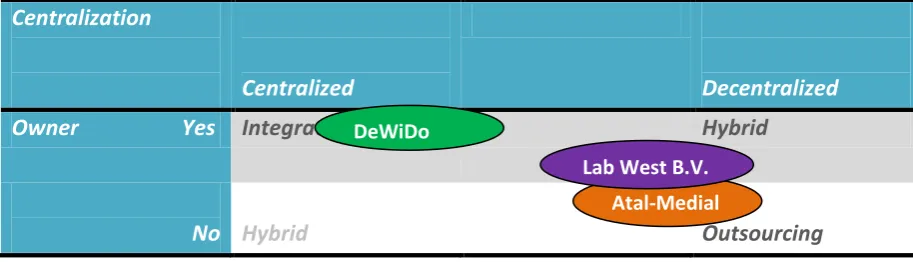
(22) measure the same criteria of production and manpower, as mentioned in year reports of laboratories. However, it is of importance to describe the changes in setting in further research. The validity refers to the accuracy of the instrument. Does it actually measure the intervention you want to measure. The operationalization of indicators efficiency and quality refers specifically to a hospital setting. Constructs seem well operationalized, since the results reflect on the indicators we want to be measured. An often mentioned weakness of multiple case studies is the limited possibility to generalize. However, the purpose of generalization is to generalize to theoretical propositions. The lack of rigor in collection, construction and analysis of empirical materials is observed as limitation of case study research. In the following paragraphs however an extensive explanation is given to validate this process.. 3.2 Case selection Cases in the multiple design are purposefully selected based on organizational structures as described in chapter two in order to describe strengths and weaknesses of particular arrangements. Cases are selected based on their correspondence with the typical organizational structures. The organizational arrangements are categorized, according to a centralization – ownership landscape. Centralization refers to a concentration of decision making power, without the ability to undertake projects independently of one another. Ownership refers to the fact whether or not the hospital is owner of the laboratory organization. This categorization is helpful, to create an overview of the typical forms of organization according to theory and the situations of the selected cases. In the paragraphs below an explanation is given for the locations of the selected cases.. Centralization. Owner. Yes. Centralized. Decentralized. IntegrationDeWiDo. Hybrid Lab West B.V. Atal-Medial. No Hybrid. Outsourcing. Figure 3.1 The centralization – ownership landscape with the locations of the selected cases. 1. For outsourcing the cooperation between Atal-Medial and Kennemer Gasthuis is selected. The tests of Kennemer Gasthuis are applied by the independent organization Stichting Atal-Medial, with the restrictions that still hospital managers are represented in the supervisory board of Atal-Medial and the application of all tests is situated in a centralized location within the hospital. Therefore this example is most similar to the typical situation of the outsourcing model. 2. For the regional organized network of integration the cooperation between Deventer Ziekenhuis, Slingeland Ziekenhuis Doetinchem, and Streekziekenhuis Koningin Beatrix Winterswijk is chosen. Integration of their laboratory activities is a result of working in a regional network, where the production is fully applied in house in one of these three hospitals. Therefore this is an example of integration principles.. Structuring CANS and WANTS – L.A. (Bart) van Oort. 22.
(23) 3. For the hybrid of outsourcing and integration the organization of LabWest BV is taken. In this cooperation Medisch Centrum Haaglanden and HagaZiekenhuis are joint shareholders of LabWest both hospitals are shareholder for both 50% of LabWest. This is typical for a regional organized network of integration and outsourced since hospital boards opt for a Limited (Ltd. – B.V.). However the application of all tests is still situated within the participating hospitals. In selecting the cases, a laboratory organization was selected if the arrangement characteristics are most similar to the typical form of organization according to theory. Next to it, the will to cooperate with this thesis was important in the case selection process. Only one laboratory organization refused cooperation.. 3.3 Operationalization The variables examined in the study are specified by a number of criteria. In the section below the variables are conceptualized first and consequently the criteria are operationalized by reflecting the elements of the conceptualization and objects of the study. Success: Success is observed here as goal attainment. In case of increasing efficiency and increasing quality the goals of the organizational structure are achieved and is consequently indicated as successful. Respondents are asked for the expected effects on indicators efficiency and quality and only limited underlining of the expectations by quantitative data is given. As a consequence the extent of success is referred to as an expectation of success. To provide a comprehensive overview of success disadvantages outside the scope of efficiency and quality, such as governance issues, have a prominent role in the interviews by asking respondents for (potential) disadvantages of own and alternative organizational structures. In addition expectations are formulated to provide a complete overview. Efficiency: In measuring efficiency this thesis refers to organizational efficiency, which is defined as the ratio of input and output. It shows the ratio of the resources and their mix within an organization that result to products and / or services and how much is absorbed by the economic system of the hospital. Often a distinction is made between human resources and materials as inputs, and the use of materials as supplies and as equipment (Katz & Kahn, 1978). Efficiency has to do with an optimal division of resources (inputs) in order to achieve the largest possible output considering the amount of resources. Therefore in the operationalization a comparison of inputs and outputs of the laboratory’s productivity ratios needs to be covered. Respondents are asked for financial advantages observed and the means by which cost efficient production is achieved. If available the production (number of analyses) and the labour costs of the laboratory (number of FTE) are analyzed. Quality: In the conceptualization of quality, the satisfaction of requesting specialists is explored. As written in the introduction the primary goal of hospital laboratory specialists is to provide high-quality Structuring CANS and WANTS – L.A. (Bart) van Oort. 23.
(24) laboratory services. According to Cowan (2005) the elements high quality laboratory services include: (1) accurate and precise analysis, (2) timely, clearly and concise reporting, and (3) delivery of service most valuable to the user of the service. The criteria of Cowan (2005) for high-quality laboratory services are fully covered with the inclusion of specialist satisfaction and the effects argued by heads of laboratories and members of executive boards. Specialists are asked what is specifically important from their discipline and satisfied specialists are with the current service level of the clinical laboratory. In addition heads of laboratories and members of executive boards are asked for the effects of their perspective of organizational structures. At the same time, the effects on quality the heads of the laboratories argue to show up, are checked for current experience by asking specialists. Disadvantages: In chapter two the schedule was expanded with the disadvantage category to reflect on the effects that fall outside the scope of efficiency and quality. Respondents are asked for the (potential) effects of the selected organizational structures and their expectations about prospective organization of laboratory activities. Types: To determine the organizational structure of the cases the following indicators are used. In the first place it is observed whether or not the model is that of decentralization. According to Friedman & Mitchell (1993) in outsourcing arrangements (the most extreme form of decentralization) outside vendors are hired. Secondly Friedman & Mitchell (1993) argue that the idea of integration is to create a regional value-added laboratory network, which can integrate diagnostics generated in decentralized testing sites. Cases are reflected as to whether or not the hospital is owner / shareholder of the laboratory organization. In order to indicate what type can be distinguished for both criteria the agreements of hospitals and the expression of relationships in year reports are analyzed to make a categorization.. 3.4 Sources of data In order to analyze the efficiency and quality of hospital laboratories interviews with stakeholders will be conducted in order to gain information about the choice for the laboratory organization, the intended effects on efficiency and quality, as well as reflecting on the satisfaction of specialists and the expectations in laboratory arrangements. In addition, year reports of the period 2008-2011 are only used to retrieve quantitative data of the number of analyses and the number of manpower (FTE). Description of interview and protocol In this thesis interviews are used as method of data collection. As main advantages interviews can provide in-depth information and are a good instrument for measuring attitudes. However interviews are time consuming and may produce reactive effects such as socially desirable answers. To avoid bias the interviewer should be non-judgmental to the responses of the interviewee (Tashakkori & Teddlie, 2003).. Structuring CANS and WANTS – L.A. (Bart) van Oort. 24.
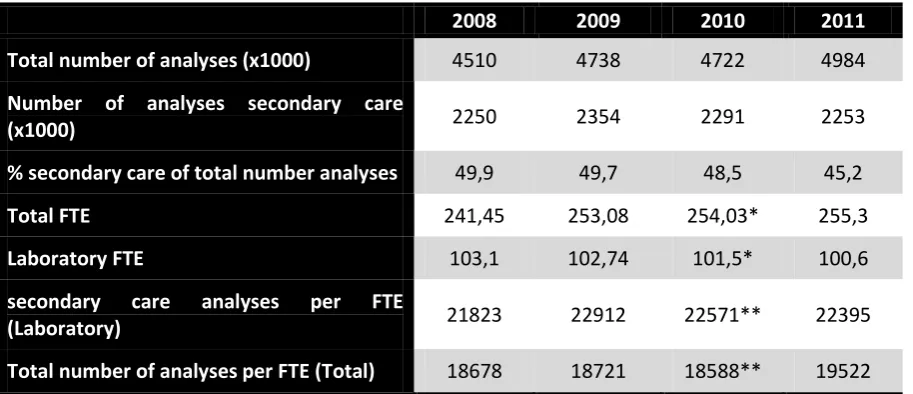
(25) Interviews are appropriate for this study since the different opinions of various stakeholders are explored. Specialist satisfaction is observed and this fits since one of the main strengths of interviews is the measurement of attitudes. In addition potential differences over groups are made transparent by interviewing in a standardized open way. This means that written out questions in advance are asked among respondents. The purpose is to reduce interviewer effects during the interview. Furthermore the interview is highly focused on the purpose of the interview (Patton, 1990). The questionnaires of the distinguished groups of respondents are shown in appendix A, B, and C. Key Informants For a description of the advantages and disadvantages of organizational structures it is necessary to interview different groups within the constructions. Therefore interviews are applied with the following groups: the head of the laboratory, member of the executive board of hospital, specialist within the hospital. In the section below the groups of respondents are introduced and the choice of selected groups is elaborated. The head of the laboratory department as well as the member of the executive board will be asked to review, among other things, the central idea behind the choice of laboratory organization, the effects on efficiency and quality, the disadvantages of the current organization and its alternatives in order to create insight in the effects of an organizational structure. Requesting specialists within the hospital will be asked about their satisfaction of laboratory services and their ideas about laboratory organization. The participants are selected by the position they have and / or randomly selected from the disciplines within the hospital. In order to get a representative sample from the group of specialists outside the laboratory a stratified random sample is chosen. Under a stratified random sample, disciplines are divided into two strata and then specialists are randomly sampled separately from each stratum (Shadish, Cook, & Campbell, 2002). Stratification is used here since differences between disciplines are expected. Based on data of the year report of the Jeroen Bosch Ziekenhuis laboratory an overview is made of the ten specialism’s that require most tests. There are differences in both the number and the kind of tests required by the specialism. Therefore, the numbers one, two and ten of the specialism’s that require most tests are selected. These are internal medicine (interne geneeskunde), cardiology (cardiologie), and neurology (neurologie) respectively. Per discipline ideally two specialists are randomly invited for the key-informant interview. This is justified since the selected disciplines are different in characteristics that the potential differences over disciplines are included within this data collection. Furthermore the potential differences in types of tests per discipline and / or number of tests, and its effects on the quality from a specialist perspective, can clarify an issue by the selection of most different disciplines. Data gathering In total 15 interviews have been conducted. Distinguished over the groups, 5 interviews are conducted with a head of the laboratory (response rate: 5/6), 3 interviews are conducted with a member of the executive board (response rate: 3/5), and 7 interviews are conducted with specialists within the hospital (response rate: 7/12). Distinguished over the cases, 6 interviews are conducted in the Atal-Medial case (response rate: 6/10), 6 interviews are conducted in the Deventer-DoetinchemStructuring CANS and WANTS – L.A. (Bart) van Oort. 25.
(26) Winterswijk case (response rate: 6/7), and 3 interviews are conducted in the LabWest B.V. case (response rate: 3/6). In addition one extra interview is conducted, with a respondent that report oneself to participate in this thesis. The case was most similar to the Atal-Medial case. This was interesting since it could strengthen or weaken the observations done in the Atal-Medial case. The results of the extra interview are described in paragraph 4.3. The interviews conducted with the head of the laboratories and the members of the executive board of the hospitals have a length of about one hour. The interviews with the specialists have a duration of approximately a quarter of an hour. The difference in time is caused by the fact, that specialists want to spend minimum of their time to the questionnaire. All interviews are held in the period 26th of July up to and including 27th of September. The interviews are conducted in Dutch. This may have resulted in translation issues in describing the results.. 3.5 Data analysis To process the data resulting from the interviews, a qualitative data analysis (QDA) software programme ´Atlas Ti, version 6.2´is used. The operationalization of the concepts in this thesis was used in order to code the interviews. The codes used to categorize the quotations are the following: English. Nederlands. Means. Middelen. Goals:. Doelen:. 1. Efficiency. 1. Efficiëntie. 2. Quality. 2. Kwaliteit. 3. Governance. 3. Bestuur. Expectations. Verwachtingen. All statements that respondents made, are classified in categories, such as efficiency. The author categorized statements over the codes. As a result, the programme allows us to pop up all comments related to for instance ‘efficiency’. Then a structured description of (intended) effects in the result sections was possible and statements are described in the result chapters. The coding process was applied for the different cases and for the groups of specialists separately. Additionally, the software is used to count the number of comments related to efficiency or quality. As a consequence, this could give reason to indicate or strengthen perspectives per case. The programme is not used to reveal relationships. This was hardly possible since intended effects could not be checked for real effects. Furthermore transcriptions are sent back to respondents to make some comments on the transcription. Respondents sent back the transcriptions with some remarks in the period 3rd of August up to and including 29th of September. These versions are used as basis for the results in this thesis. Respondents that gave permission to publish their name are in the result chapters mentioned with their names.. Structuring CANS and WANTS – L.A. (Bart) van Oort. 26.
Figure

+7




Outline
Related documents
The total coliform count from this study range between 25cfu/100ml in Joju and too numerous to count (TNTC) in Oju-Ore, Sango, Okede and Ijamido HH water samples as
Also, both diabetic groups there were a positive immunoreactivity of the photoreceptor inner segment, and this was also seen among control ani- mals treated with a
The most important contributions of this paper are (i) the proposal of a concern mining approach for KDM, what may encourage other groups to start researching on
other insured benefits or earnings: any pre-tax earned income from part-time or temporary (less than 12 months) work received while you are incapacitated, as well as any
There are infinitely many principles of justice (conclusion). 24 “These, Socrates, said Parmenides, are a few, and only a few of the difficulties in which we are involved if
19% serve a county. Fourteen per cent of the centers provide service for adjoining states in addition to the states in which they are located; usually these adjoining states have
Хат уу буудай нъ ТгШсит ёигит зүйлд хамаарагддаг нэг настай ихэечлэн зусах хэлбэртэй үет ургамал бөгөөд уураг ихтэй, шилэрхэг үртэй, натур жин их байдгаараа
Assessing the Impact of Biodiversity Conservation in the Management of Maize Stalk Borer (Busseola f
Field experiments were conducted at Ebonyi State University Research Farm during 2009 and 2010 farming seasons to evaluate the effect of intercropping maize with
