Segregable Smart Moving Trash Bin
Subham Chakraborty1, Sayan Chowdhury2, Soumadip Das3, Sayansri Ghosh4, Rimona Dutta5, Sayan Roy Chaudhuri6
1, 2, 3, 4, 5, 6
Department of Electronics and Communication Engineering, Guru Nanak Institute of Technology, Maulana Abul Kalam Azad University of Technology (MAKAUT), Kolkata, West Bengal
Abstract: Because of the increasing population, day by day the environment is facing many issues including cleanliness and hygiene. In most of the cities, the overflowed trash bins are causing an unhealthy environment which is leading to different types of diseases. Unhygienic environment degrade the standard of our living. For fighting against this condition we have developed a prototype of Smart Garbage Disposal System. A Smart Moving Dustbin is developed with the help of Embedded System which can go and collect trash from human according to the instruction given to it. Instruction can be given to dustbin easily by using apps in a smartphone. Trash bin will sense and open automatically if it is not full. In this system, separate spaces are provided for biodegradable and non-biodegradable waste materials.
In this way, waste management system can be designed which will help to protect the environment from pollution which are caused by improper disposal of garbage and in turn will improve the standard of our living.
Keywords: Embedded System, Arduino UNO (ATmega328); Servo Motor (MG995); Ultrasonic Sensor (HC-SR04); L298N Motor Driver, biodegradable and non-biodegradable;
I. INTRODUCTION
Garbage management is becoming a global problem due to a rapid growth in population, disorganization of city governments and lack of public awareness in many countries like India. Due to the lack of maintenance and attention by the authorities as well as pubic the garbage bins are mostly seen to be overflowing. So, we thought of a method can be followed in overcoming this problem. We are presenting this paper as a response to solve this growing problem of proper garbage disposal and its management in an effective and efficient way.
As here the dustbin is moving according to the instruction, it can reach to the individual who needs to use it. Users don’t have to open the dustbin it will open automatically by sensing the presence of the user. Movement of trash bin can be controlled by mobile apps that available in Google Play Store.
Separate chambers are also introduced in the prototype for segregating biodegradable and non-biodegradable waste materials. If trash bin is full at any time, it will not open to collect any garbage further. We have to then empty it first. It will send a message to the mobile of the controller when it is full. Controller can even track the dustbin status at any time. By using mobile app, the controller can easily check how many times the dustbin is opened in that day.
A. Necessary Electronic Equipment Needed To Design This Prototype
1) Ultrasonic Sensor (HC-SR04)
2) Arduino UNO
3) Servo Motor (180 degree rotation) - MG 995,
4) L298N Motor Driver,
5) 100 rpm Torque Motor,
6) Two HC-06 or HC-05 Bluetooth Module,
7) Jumper wires,
8) Breadboard.
II. WORKINGOFCOMPONENTS
1) Ultrasonic Sensor: Ultrasonic Sensor HC SR04 is used to measure the distance between the object and the sensor by using sound waves. Here it senses the presence of the user and become opened if it is not full.
2) Arduino UNO: Arduino Uno is an open-source microcontroller board. It is based on ATmega 328 and houses 20 digital input/output pins of which 6 can be used as PWM outputs and 6 can be used as analog inputs. Apart from a number of pins it also houses a 16 MHz resonator providing the clock speed, a power port, a USB connection port, as in-circuit system programming (ICSP) header and a reset button. It can either be powered by a USB cable or an externally supplied 9 Volt battery.
Fig. 2 Arduino UNO
3) Servo Motor: Servo motor MG 995 is an electrical device having lifting or rotating efficiency. If you want to rotate an object at some specific angles or distance, then we can use a servo motor. A servo motor can be DC or AC based on the type of power it uses. It is used here to open the lid of the trash bin if user if present in front of the trash bin.
Fig. 3 Servo Motor MG 995
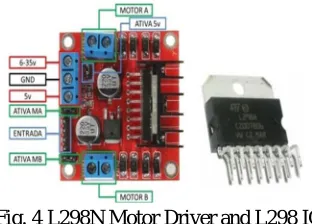
4) L298N Motor Driver: It is a dual H-bridge motor driver to drive DC motors. It can control speed and direction of more than one DC motor at a time. DC motor having operating voltage between 5-35 Volts and peak current value up to 2 Amperes can be controlled by this motor driver. In this module two blocks for the motor A and B, and the other block for the Ground pin, Voltage Common Collector pin and 5 Volts pin is provided. Here L298N is used to control the two 100 rpm DC motors of the chassis.
Fig. 4 L298N Motor Driver and L298 IC
5) Torque Motor: It is an electric motor in which torque is used as turning force for driving purpose. Speed and fastness of driving force is dependent on the torque power of the motor. Here we have used 100rpm (100 revolutions per minute) torque motor to drive the chassis of trash bin according to requirement. Here left and right torque motors are connected to the L298N motor driver and driver is connected with the PWM (pulse width modulation) pin of Arduino.
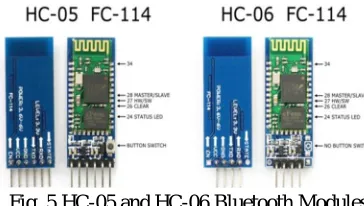
6) Bluetooth Module: The HC-06 or HC-05 Bluetooth module is used for wireless serial communication. Both can work as slave only in wireless communication. A master Bluetooth device is paired with it and follows the command and instruction of master device. Here we use Bluetooth module to track the trash bin status and control the chassis connected to the bin.
Fig. 5 HC-05 and HC-06 Bluetooth Modules
7) Jumper Wire: It is an electric wire having connectors at the ends so that they can be easily connected into components like Arduino, Motor driver, Ultrasonic sensor etc. These wires come in single or may be couple of them as cables. These cables are mostly used for their simplicity in prototype building or testing circuits and breadboards without having the need for joining the cables or soldering them.
Fig. 7 Jumper Wires/Cables
III.WORKINGPRINCIPLEANDCIRCUITDIAGRAM
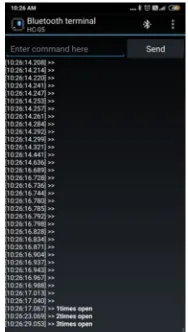
The Ultrasonic Sensor emits an ultrasonic sound which travels through the air and if there is an object or an obstacle on its path it will bounce back to the module. Arduino will use trigger of the sensor to generate ultrasonic sound and the echo pin present on ultrasonic sensor to measure sound wave reflecting back. When sensor detects an object present near the dustbin which is at a distance of 10cm or less than that Arduino will open the dustbin. Arduino will close the dustbin after sometime, which we consider as the probable time in which an average person can properly use the trash bin. We can track the condition of the trash bin, whether it is full or not, or the number of times the trash bin is used obtained from the number of times the servo motor operates in order to open or close the lid of the trash bin from our smartphone via Bluetooth connection between trash bin and a smartphone. Here the Bluetooth app ‘Bluetooth Terminal’ is used.
Here a probabilistic approach is used to detect the approximate number of times of opening the lid of the trash bin after which the particular trash bin can be considered to be full. Here the limit is totally depended on the two parameters,
1) Volume of the trash bin,
2) Type of waste usually generated on that particular area
A survey is needed to find out the type of waste on that area because in different places like hospitals, market areas, shopping malls, corporate sectors, factories type of waste is also different. Based on the result of survey and our requirement we can set the limit and program this system. Different proximity sensors can also be used in order to detect the limit up to which the trash bin is filled. In that case we have to take care about the sensing material and type of waste material.
We have placed the dustbin over a chassis having two 100 rpm torque motors so as to control the motion of the dustbin to move it anywhere at any direction on a smooth plane via Bluetooth control app ‘Arduino Bluetooth RC Car’ in the smartphone (as the chassis also, can be connected with the smartphone through Bluetooth).
In this way smart moving dustbin is going to work and after using for several number of times, if it becomes full it will send a message in the controller’s smartphone and it will not open even if the ultrasonic sensor senses an object if front of it. It will again work if somebody empties the dustbin and resets the Arduino button.
A. Circuit Diagrams
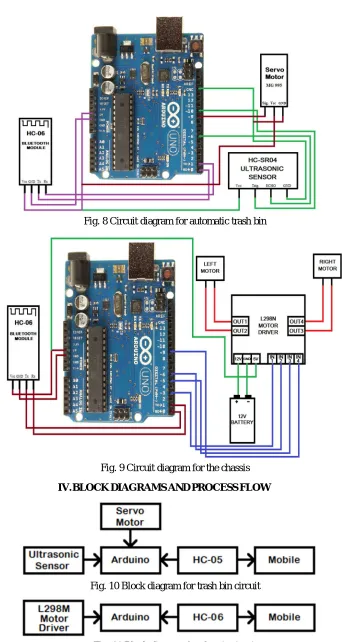
Fig. 8 Circuit diagram for automatic trash bin
Fig. 9 Circuit diagram for the chassis
IV.BLOCKDIAGRAMSANDPROCESSFLOW
Fig. 10 Block diagram for trash bin circuit
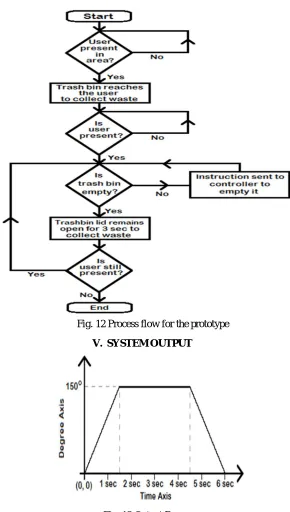
[image:4.612.158.459.94.306.2]Fig. 12 Process flow for the prototype
[image:5.612.164.454.69.581.2]V. SYSTEMOUTPUT
Fig. 13 Output Response
This system has two main output responses. First one is due to the sensing the presence of the user and opening the lid of dustbin. Second one is the response of the chassis according to the instruction given to it. We can graphically represent the first output response caused by the rotation of servo motor with respect to time when ultrasonic sensor senses the presence of the user. Here servo motor rotates up to 150 degree to open the lid of trash bin.
Here is the representation of the graph by equations-
y = 100t for 0 ≤ t ≤ 1.5 (1)
y = 150 for 1.5 ≤ t ≤ 4.5 (2)
(Assuming lid remains open for 3 seconds) y = - 100t + 600 for 4.5 ≤ t ≤ 6 (3)
VI.IMPLEMENTATIONANDITSOUTPUT
We have implemented our concept and created a prototype. Here are some pictures of our prototype clicked in working condition.
1) Fig. 14: The trash bin with movable chassis and its complete circuit which is ready for service.
2) Fig. 15: Trash bin lid is opened as it sensed the presence of the user. Ultrasonic sensor has sensed the legs of the user and with the help of servo motor the lid of the trash bin opened to collect waste.
3) Fig. 16: Interface of ‘Bluetooth Terminal’ app. By using ‘Bluetooth Terminal’ app in the smartphone, the controller can track the dustbin condition. Using this app the controller can also see the frequency of opening of the dustbin on that day with exact clock timings.
4) Fig. 17: Here the user is trying to use the dustbin but as the dustbin is full the lid is not opening it sent the message to the controller. After the dustbin becomes empty again and reset button is pressed it can be used again.
5) Fig. 18: Interface of ‘Bluetooth RC Controller’. By using this app, the controller can move the trash bin according to the presence of user to collect the waste. Trash bin will reach to user and come back after collecting the waste.
[image:6.612.195.449.164.687.2]Fig. 14 Trash bin with movable chassis
Fig. 15 Trash bin lid open on sensing the user
[image:6.612.204.430.238.528.2] [image:6.612.270.364.545.711.2]Fig. 17 Interface of ‘Bluetooth Terminal’ app showing trash bin is full
Fig. 18 Interface of ‘Bluetooth RC Control’ app to control the chassis
VII. CONCLUSIONS
This reduces the total number of trips for garbage collection vehicle and therefore reduces the cost for waste management and its collection. This system can be used in both private as well as public sector. This system can also be used in Government sector too. This system can be installed in various public sectors like Railway stations, Bus stops, Colleges, Shopping malls, Multiplexes, Shops, Parks.
VIII. ACKNOWLEDGEMENT
We are thankful to our colleagues who provided their time and effort. We are also grateful to Dr. Sunipa Roy, Head of the Department, Department of Electronics and Communication Engineering, Guru Nanak Institute of Technology for the insights and expertise and Mr. Sayan Roy Chaudhuri, Assistant Professor, Department of Electronics and Communication Engineering, Guru Nanak Institute of Technology for being our project guide and providing us with immense assistance as well as insights which greatly assisted for the development of the prototype.
REFERENCES
[1] https://play.google.com/store/apps/details?id=ru.sash0k.bluetooth_terminal&hl=en [2] https://play.google.com/store/apps/details?id=braulio.calle.bluetoothRCcontroller&hl=en
[3] United Nations Environmental Programme (2013), “Guidelines for National Waste Management Strategies Moving from Challenges to Opportunities” [4] N.M. Yusof, A.Z. Jidin, M.I. Rahim, “Smart Garbage Monitoring System for Waste Management”, MATEC Web of Conferences Engineering Technology
International Conference, Vol. 97, EDP Sciences (2017), p.01098
[5] M.K. Ghose, A.K. Dikshit, S.K. Sharma, “A GIS based transportation model for solid waste disposal – A case study on Asansol Municipality”, Journal of Waste Management
[6] L.A. Guerrero, G. Maas, W. Hogland: Solid waste management challenges for cities in developing countries, Journal of Waste Management
[7] Nádvorník, Pavel Smutný (2014) “Remote Control Robot Using Android Mobile Device” 2014 15th International Carpathian Control Conference (ICCC) 374, 978-1-4799-3528-4/14 ©2014 IEEE