Journal of Algebra Combinatorics Discrete Structures and Applications
The rainbow vertex-index of complementary graphs
∗
Research Article
Fengnan Yanling
1∗∗, Zhao Wang
1∗ ∗ ∗, Chengfu Ye
1§, Shumin Zhang
1§§1. Qinghai Normal University
Abstract: A vertex-colored graph Gisrainbow vertex-connected if two vertices are connected by a path whose internal vertices have distinct colors. The rainbow vertex-connection number of a connected graph
G, denoted byrvc(G), is the smallest number of colors that are needed in order to makeGrainbow vertex-connected. If for every pairu, vof distinct vertices,Gcontains a vertex-rainbowu−vgeodesic, thenGisstrongly rainbow vertex-connected. The minimumkfor which there exists ak-coloring ofG
that results in a strongly rainbow-vertex-connected graph is called thestrong rainbow vertex number srvc(G)ofG. Thusrvc(G)≤srvc(G)for every nontrivial connected graphG. A treeT inGis called arainbow vertex treeif the internal vertices ofT receive different colors. For a graphG= (V, E)and a setS ⊆V of at least two vertices,anS-Steiner tree ora Steiner tree connecting S (or simply,an S-tree) is a such subgraphT = (V0, E0)ofGthat is a tree withS ⊆V0. ForS ⊆V(G)and|S| ≥2, anS-Steiner treeT is said to be arainbow vertexS-treeif the internal vertices ofT receive distinct colors. The minimum number of colors that are needed in a vertex-coloring ofGsuch that there is a rainbow vertexS-tree for everyk-setS ofV(G)is called thek-rainbow vertex-indexofG, denoted by
rvxk(G). In this paper, we first investigate the strong rainbow vertex-connection of complementary
graphs. Thek-rainbow vertex-index of complementary graphs are also studied.
2010 MSC:05C15, 05C40
Keywords: Strong rainbow vertex-connection number, Complementary graph, Rainbow vertexS-tree,k-rainbow vertex-index
1.
Introduction
The graphs considered in this paper are finite undirected and simple graphs. We follow the notation of Bondy and Murty [1], unless otherwise stated. For a graph G, let V(G), E(G), n(G), m(G), and G, respectively, be the set of vertices, the set of edges, the order, the size, and the complement graph ofG.
∗
Supported by the National Science Foundation of China (No. 11161037, 11101232, 11461054) and the Science Found of Qinghai Province (No. 2014-ZJ-907).
∗∗
E-mail: [email protected] (Corresponding Author)
∗ ∗ ∗
E-mail: [email protected]
§
E-mail: [email protected]
§§
LetG be a nontrivial connected graph on which an edge-coloringc:E(G)→ {1,2,· · ·, n}, n∈N, is defined, where adjacent edges may be colored the same. A path is rainbowif no two edges of it are colored the same. An edge-coloring graph Gis rainbow connected if any two vertices are connected by a rainbow path. Clearly, if a graph is rainbow connected, it must be connected, whereas any connected graph has a trivial edge-coloring that makes it rainbow connected; just color each edge with a distinct color. Thus, in [4] L. Chen, X. Li, H. Lian defined therainbow connection numberof a connected graph
G, denoted by rc(G), as the smallest number of colors that are needed in order to make G rainbow connected. They showed that rc(G)≥diam(G) where diam(G)denotes the diameter of G. For more results on the rainbow connection, we refer to the survey paper [2],[3],[4] and [12], and a new book [10] of Li and Sun.
In [8], Krivelevich and Yuster proposed the concept of rainbow vertex-connection. A vertex-colored graph Gisrainbow vertex-connected if two vertices are connected by a path whose internal vertices have distinct colors. The rainbow vertex-connection number of a connected graph G, denoted by rvc(G), is the smallest number of colors that are needed in order to make Grainbow vertex-connected. For more results on the rainbow vertex-connection, we refer to the survey paper [5] and [9]. An easy observation is that ifGis of ordern, thenrvc(G)≤n−2andrvc(G) = 0if and only ifGis a complete graph. Notice that rvc(G)≥diam(G)−1 with equality if the diameter is1 or2.
If for every pair u, v of distinct vertices, G contains a vertex-rainbow u−v geodesic, then G is
strong rainbow vertex-connected. The definition of strongly rainbow vertex-connected was defined by Li et al. in [11]. The minimum k for which there exists a k-coloring of G that results in a strongly rainbow vertex-connected graph is called the strong rainbow vertex-connection number srvc(G) of G. Thusrc(G)≤srvc(G)for every nontrivial connected graphG.
IfGis a nontrivial connected graph of ordernwhose diameter isdiam(G), then
diam(G)−1≤rvc(G)≤srvc(G)≤n−s, (1)
where sdenote the number of pendent vertices inG.
Proposition 1.1. Let Gbe a nontrivial connected graph of ordern. Then
(a)srvc(G) = 0 if and only ifGis a complete graph;
(b)srvc(G) = 1if and only if diam(G) = 2 if and only ifrvc(G) = 1.
A treeT inGis called arainbow vertex treeif the internal vertices ofT receive different colors. For a graphG= (V, E)and a setS ⊆V of at least two vertices,anS-Steiner tree ora Steiner tree connecting S (or simply, an S-tree) is a such subgraph T = (V0, E0) of G that is a tree with S ⊆ V0. For more problems onS-Steiner tree, we refer to [6] and [7].
ForS ⊆V(G)and|S| ≥2, anS-Steiner treeT is said to be arainbow vertex S-tree if the internal vertices ofT receive distinct colors. The minimum number of colors that are needed in an vertex-coloring ofGsuch that there is a rainbow vertexS-tree for everyk-setS ofV(G)is called the k-rainbow vertex-index of G, denoted by rvxk(G). Thevertex-rainbow index of a graph was first defined by Yaping Mao
in [13].
2.
The strong rainbow vertex-connection of complementary
graphs
In this section, we investigate the rainbow vertex-connection number of a graphGaccording to some constraints to its complement G. We give some conditions to guarantee that srvc(G) is bounded by a constant.
Theorem 2.1. IfGis a connected graph with diam(G)≥3, then
srvc(G) =
1, if diam(G)≥4; 2, if diam(G) = 3.
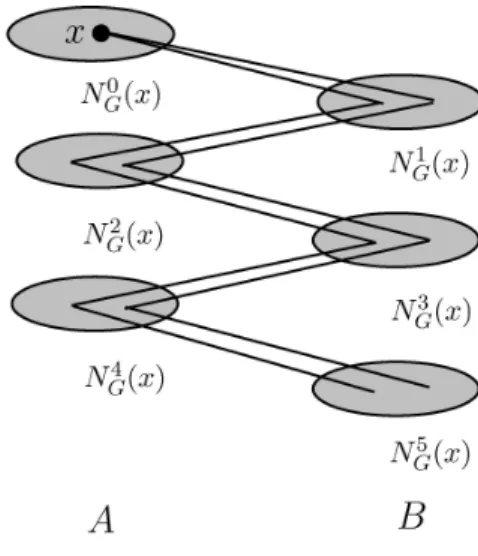
Proof. We choose a vertexxwitheccG(x) =diam(G) =d≥3. LetNGi(x) ={v:dG(x, v) =i}where
0≤i≤d. SoN0
G(x) ={x}, N
1
G(x) =NG(x)as usual. ThenS0≤i≤dN i
G(x)is a vertex partition ofV(G)
with |NGi(x)|=ni. LetA=Si is evenN i
G(x),B =
S
i is oddN i
G(x). For example, see Figure1, a graph
withdiam(G) = 5.
So, ifd= 2k(k≥2), thenA=S
0≤i≤d is evenN i
G(x),B=
S
1≤i≤d−1is oddN i
G(x); ifd= 2k+ 1(k≥
2) then A =S
0≤i≤d−1is evenNGi(x), B =
S
1≤i≤d is oddNGi(x). Then by the definition of complement
graphs, we know thatG[A] (G[B])contains a spanning completek1-partite subgraph(completek2-partite
subgraph) where k1=dd+12 e(k2=dd2e). For example, see Figure 1,G[A]contains a spanning complete
tripartite subgraphKn0,n2,n4,G[B] contains a spanning complete tripartite subgraphKn1,n3,n5.
Figure 1. Graphs for the proof of Theorem2.
First of all, we see that G must be connected, since otherwise, diam(G) ≤ 2, contradicting the conditiondiam(G)≥3.
Case 1. d≥5.
In this case, k1, k2≥3. We will show thatdiam( ¯G)≤2 in this case. Foru, v ∈V(G), we consider
the following cases:
Subcase 1.1. u, v∈A oru, v∈B.
If u, v ∈ A, then u, v is contained in the spanning complete k1-partite subgraph of G[A]. Thus dG(u, v)≤2. The same is true for u, v∈B.
Subcase 1.2. u∈Aandv∈B.
If u = x, v ∈ B, then u is adjacent to all vertices in G[B]\N1
G(x). So dG(u, v) = 1 for v ∈
G[B]\NG1(x). Forv∈NG1(x), letP =ux3v, wherex3∈NG3(x). Clearly,dG(u, v) = 2.
Ifu6=x, without loss of generality, we assume thatu∈N2
G(x)andv∈NG1(x). LetQ=ux5v, where x5∈NG5(x). ThusdG(u, v) = 2.
Case 2. d= 4.
It is obvious that A =NG0(x)∪NG2(x)∪NG4(x), B = NG1(x)∪NG3(x). SoG[A](G[B])contains a spanning complete 3-partite subgraphKn0,n2,n4 (complete bipartite subgraphKn1,n3). So, we will show
that diam(G)≤2.
Subcase 2.1. u, v∈A oru, v∈B.
If u, v ∈ A, then u, v is contained in the spanning complete k1-partite subgraph of G[A]. Thus dG(u, v)≤2. If u, v ∈ B, then u, v is contained in the spanning complete bipartite subgraph ofG[B]. Also we have dG(u, v)≤2.
Subcase 2.2. u∈Aandv∈B.
If u=x, v ∈B, then u is adjacent to all vertices inN3
G(x). For v ∈NG1(x), let P =ux3v, where x3∈NG3(x). Clearly,dG(u, v) = 2. SodG(u, v)≤2.
Ifu6=x, then we assume thatu∈N2
G(x)andv∈NG1(x). LetQ=ux4v, wherex4∈NG4(x). Thus
dG(u, v) = 2. Supposeu∈N4
G(x)andv∈NG3(x). LetR=ux1v, wherex1∈NG1(x). ThusdG(u, v) = 2.
Ifu∈N2
G(x)andv∈NG3(x), thenS=uxvis a path of length2. Thendiam(G)≤2. So, by Proposition
1, we havesrvc(G) = 1.
Case 3. d= 3.
In this case, A = N0
G(x)∪N
2
G(x), B = N
1
G(x)∪N
3
G(x). So G[A] contains a spanning complete
bipartite subgraphKn0,n2. So, we giveGa vertex-coloring as follows: color vertexxwith1and color all
vertices of N3
G(x)with2. It is easy to see that for any u∈N
2
G(x), v∈N
1
G(x), there is a rainbow {1,2}
path connecting them in G. Sosrvc(G) = 2in this case.
For the case of diam(G) = 2, srvc(G) can be very large since diam(G) may be very large. For example, let G =Kn\E(Cn), where Cn is a cycle of length n in Kn. Then G =Cn and srvc(G) ≥
diam(G)−1 =dn
2e −1by(1).
3.
The
k
-rainbow vertex-index of complete multipartite graphs
Theorem 3.1. Let Kn1,n2,···nl be a complete multipartite graph. If k < 2`, then rvxk = 1; If k ≥2`, then rvxk = 2. Where S={v1, v2,· · ·vk}(that is the rainbow S-tree we choose) and Vni,(1≤i≤l)are the vertices of the partition ofKn1,n2,···n`.
Proof. If k < 2`, then we can find a partition Vni,(1 ≤ i ≤ l) of Kn1,n2,···nl with Vni∩S ≤ 1. If Vni∩S =∅, then we can choose a vertexv ∈ Vni as the root vertex of the rainbowS tree and all the
other vertices are leaves. Sorvxk(Kn1,n2,···n`) = 1. IfVni∩S= 1, then we choose the vertexv∈Vni as
the root vertex of the rainbowS tree, and all the other vertices are leaves. Sorvxk(Kn1,n2,···n`) = 1.
If k ≥ 2` and there exists Vni such that |S∩Vni| ≤ 1, then we can choose the vertex v in Vni
as the root of the rainbow tree and all the other vertices are the leaves the same as when k <2`. So
rvxk(Kn1,n2,···nl) = 1.
Supposek≥2`and|S∩Vni| ≥2 for anyVni. Now we give a rainbow vertex-coloring as follows.
c(Vni) =
1, if 1≤i≤`−1; 2, if i=`.
Next we prove it is a k-rainbow vertex-coloring. Choose one vertexv in Vn` as the root vertex of the
rainbow tree. Obviouslyv is adjacent to all the vertices inVn1∩S, Vn2∩S, . . . Vn`−1∩S. Then choose a
vertex in v0 ∈V
n1. Since v0 is adjacent to all the remaining vertices in Vn`∩S, one can prove that the
4.
The
k
-rainbow vertex-index of complementary graphs
Theorem 4.1. IfGis a connected graph with diam(G)≥3, thenrvxk( ¯G)≤2 and the bound is tight.
Proof. We choose a vertexxwitheccG(x) =diam(G) =d≥3as Figure1. ThenG[A](G[B])contains
a spanning complete k1-partite subgraph (completek2-partite subgraph). If the rainbowS-tree contains
inG[A](G[B]), thenrvxk( ¯G)≤2by Theorem3.1. Now we consider the rainbowS-tree does not contain
in G[A] or G[B]. IfS∩NG1(G) =∅, then we choose xas the root vertex, and all the other vertices are the leaves. So one can prove that there is a rainbow S-tree. SupposeS∩N1
G(G)6=∅. Now we give a
rainbow vertex-coloring as follows.
c(x) = 1,
c(v) = 2, v∈V(G)\x.
We choose the vertex x as the root of the rainbow tree. We know xis adjacent to all the vertices in
NGj(x)∩S,(j∈ {2,3,4,· · · }), and there must be av∈NGj(x),(j∈ {2m+ 1and m≥1})such that vis adjacent toN1
G(x)∩S. one can prove that the tree is rainbowS-tree.
LetGis a connected graph ofdiam(G) = 3. We havervxk( ¯G) = 2, so the bound is tight.
Acknowledgement: The authors are very grateful to the referees’ valuable comments and
sugges-tions, which helped greatly to improve the presentation of this paper.
References
[1] J. A. Bondy and U. S. R. Murty,Graph theory, GTM 244, Springer, 2008.
[2] G. Chartrand, G. L. Johns, K. A. McKeon and P. Zhang, Rainbow connection in graphs, Math. Bohem., 133, 85–98, 2008.
[3] G. Chartrand, G. L. Johns, K. A. McKeon and P. Zhang, The rainbow connectivity of a graph, Networks, 54(2), 75–81, 2009.
[4] L. Chen, X. Li and H. Lian, Nordhaus-Gaddum-type theorem for rainbow connection number of graphs, Graphs Combin., 29(5), 1235–1247, 2013.
[5] L. Chen, X. Li and M. Liu,Nordhaus-Gaddum-type theorem for the rainbow vertex connection number of a graph, Utilitas Math., 86, 335–340, 2011.
[6] X. Cheng and D. Du,Steiner trees in industry, Kluwer Academic Publisher, Dordrecht, 2001. [7] D. Du and X. Hu,Steiner tree problems in computer communication networks, World Scientific, 2008. [8] M. Krivelevich and R. Yuster, The rainbow connection of a graph is (at most) reciprocal to its
minimum degree three, J. Graph Theory, 63(3), 185-191, 2010.
[9] X. Li and Y. Shi,On the rainbow vertex-connection, Discuss. Math. Graph Theory, 33(2), 307–313, 2013.
[10] X. Li and Y. Sun, Rainbow connections of graphs, SpringerBriefs in Math., Springer, New York, 2012.
[11] X. Li, Y. Mao and Y. Shi,The strong rainbow vertex-connection of graphs, Utilitas Math., 93, 213– 223, 2014.
[12] X. Li, Y. Shi and Y. Sun, Rainbow connections of graphs–A survey, Graphs Combin., 29(1), 1-38, 2013.
[13] Y. Mao, The vertex-rainbow index of a graph, arXiv:1502.00151v1 [math.CO], 31 Jan 2015.