OUTSOURCING COUNTER-INSURGENCY: STATE INVESTMENT IN PRO-GOVERNMENT MILITIAS AS A RESPONSE TO REBEL STRENGTH
Bailee Donahue
A thesis submitted to the faculty of the University of North Carolina at Chapel Hill in partial fulfillment of the requirements for the degree of Master of Arts in the Department of Political Science, Concentration in Comparative Politics .
Chapel Hill 2017
Approved by:
Mark J. C. Crescenzi Stephen Gent
ABSTRACT
BAILEE DONAHUE: Outsourcing Counter-insurgency: State Investment in Pro-government Militias as a Response to Rebel Strength
(Under the direction of Mark J. C. Crescenzi.)
TABLE OF CONTENTS
LIST OF TABLES . . . v
LIST OF FIGURES . . . vi
INTRODUCTION . . . 1
Militias in Civil War . . . 2
Rebel Threat and Investment in PGMs . . . 5
Empirical Strategy . . . 10
Findings . . . 14
Robustness Check . . . 19
Conclusion . . . 22
APPENDIX . . . 25
Bivariate Probit . . . 25
LIST OF TABLES
Table
1 Frequency of Observations . . . 11
2 Cross Tab of Dependent Variables . . . 11
3 Descriptive Statistics . . . 14
4 Descriptive Statistics . . . 14
5 Results of Logit with Random Intercepts: Semiofficial . . . 16
6 Results of Logit with Random Intercepts: Government Trained . . . 17
7 Summary Statistics of Relative Rebel Strength (Continuous) . . . 20
8 Logit with Random Intercepts - Continuous . . . 20
LIST OF FIGURES
Figure
1 Histogram of Relative Rebel Strength . . . 12
2 Violin Plot Dichotomous IVs at 0 and Continuous IVs at Mean . . . 18
3 Violin Plot Dichotomous IVs at 1 and Continuous IVs at Mean . . . 19
INTRODUCTION
Governments often turn to pro-government militias (“PGMs”) during civil war to as-sist in counter-insurgent activities. These PGMs are thought to provide governments with improved intelligence gathering capabilities, to act as force multipliers, and to secure civil-ians. Simultaneously, PGMs have been found to engage in civilian abuse and shirk counter-insurgent duties, even to the point of being counterproductive to the counter-counter-insurgent goals of the state. PGMs have a fraught popular image as both protectors of the people in the face of violence against rebels through civilian defense forces and as perpetrators of atrocity against civilian populations.
By allowing for the existence of PGMs in civil war, the state is allowing a further reduc-tion of its monopoly on violence within its borders during civil war. Despite the fact that using PGMs can be counterproductive, governments persist in permitting PGMs to operate in their borders. Governments even take further steps to invest in PGMs. This raises the question, under what conditions do governments invest in PGMs during civil war?
This study develops a theory of why governments invest in PGMs during civil war. This investment occurs despite the classic principal-agent dilemmas that the government faces when it contracts out its counter-insurgent activity to the pro-government militia. I argue that the degree to which a government is willing to invest in a PGM is mediated by the relative threat imposed by the rebel group(s) that the government is facing during the civil war. Governments facing relatively weak PGMs are more likely to invest in PGMs to create effective counter-insurgents because they are less concerned that a PGM that shirks its duties or defects to the rebel group will be able to shift the war in favor of the rebels. Therefore, I argue that the likelihood of investment in PGMs increases as rebels become weaker relative to the state.
literature on pro-government militias and relative rebel capacity. I then develop a theory of PGM investment in response to rebel capacity to address the question under what conditions do governments invest in PGMs during civil war. I then present an empirical test using cross-national data. I conclude by discussing the implications of my results and suggest future avenues of research.
Militias in Civil War
Traditionally, civil war literature has focused on the dyadic relationship between rebel and state treating them as unitary actors (Fearon and Laitin 2003; Walter 2002; Harbom, Melander and Wallensteen 2008; Arreguin-Toft 2001). A growing trend in the field has been to delve into the black box of both the state and the rebel group to study the plethora of actors within (Bapat and Bond 2012; Christia 2012; Krause 2013; Kalyvas 2008; Staniland 2014). This intellectual strand has moved beyond the assumption of the state acting as a unitary actor to investigate the role of violent non-state actors that fight against rebels during conflict. Scholars have begun to explore when and where it is in the states best interest to not keep a monopoly over the use of violence in its territory. In particular, it is important for scholars to understand when governments not only allow for the existence of pro-government militias but also invest in militias.
propensity to commit violence against civilians closely tracks with that of the sponsoring government(Cohen and Nord˚as 2015; Stanton 2015).
Another motivation for using PGMs is to decrease the cost to the government’s security forces while fighting the PGM. Mobilizing a pro-government militia rather than a conven-tional army is a cost-saving mechanism. This cost-saving is true of both wealthy and poor nations. PGMs extend the government’s reach into more peripheral areas where sending regular forces becomes too costly (Jentzsch, Kalyvas and Schubiger 2015).
A final motivation for using militias is that they are generally thought of as an effec-tive counter-insurgent tool. It is thought that militias may help mitigate the “identification problem” (Kalyvas 2006; Lyall 2010). Counter-insurgents often suffer from an inability to separate rebels from civilians if they have ineffective intelligence gathering efforts at the local level. It is argued that the government may respond by developing militias which have valuable local knowledge and superior intelligence gathering capabilities in compar-ison to regular armed forces (Kalyvas 2006; Kilcullen 2010). During the Iraq War, Sunni militias in the Anbar province helped to influence the dynamics of the civil war in Iraq. Intelligence gathered by the Awakening Councils was essential for the success of the surge in Iraq (Biddle, Friedman and Shapiro 2012). Militias may also be mobilized after military purges in order to make up for the loss of intelligence gathering capabilities (Eck 2015). Given that rebel groups rely on their ability to blend in with the civilian population, hav-ing effective intelligence resources is essential to achievhav-ing counter-insurgency success in civil war. Clearly, there is incentive for governments to choose to use militias to combat rebels during civil war, yet, the prospect of using militias may be incredibly costly to the supporting government.
them by the government. In order to ensure that the PGM has the resources necessary to appropriately execute this contract, the government may choose to invest resources into the PGM such that the PGM can increase its efficiency.
A mechanism by which this contract is often enforced is the potential repression of the PGM by the government for not faithfully executing the contract. A government that has provided a PGM with training, logistic support, or legitimacy cannot easily punish the group by taking these assets away. Accordingly, it may be necessary to repress uncooperative militias. Punishment becomes costlier as the PGM becomes more powerful. Since the enforcement of this contract is sustained by the threat of repression, a government is making a risky calculation by investing in PGMs.
A PGM, as the agent, has the opportunity to faithfully carry out its contract with the government or the PGM can shirk its duties. A PGM that shirks its responsibilities is costly to the state because the PGM does not achieve the states strategic aims while the PGM can pursue its own aims. The activities of the PGM, especially predation upon the civilian population, can exacerbate the tensions between government and civilians that allowed for the rebels to exist in the first place. The opportunity that the PGM has to pursue its own agenda may also have long-term consequences for the investing government. A PGM may act as a spoiler at the end of the civil war as members of the PGM profit from conflict. If not offered sufficient demobilization incentives, the militias that the government trained may turn into the rebels the government will face in the future.
An example of the dilemma faced by governments when deciding to invest in PGMs is that of Nigeria in response to Boko Haram. The Nigerian security forces, in 2013, pro-moted the formation of civilian defense forces in the beleaguered province of Borno. These groups, known as the Civilian Joint Task Force (“CJTF”), are lightly armed, trained, paid and provided uniforms by the government. The CJTF, in turn, creates checkpoints, provides intelligence to the Nigerian Security Service, and conducts searches.
forces, the Nigerian government has suggested that it will absorb some CJTF members into the armed forces and will employ others in government jobs such as firemen. There is concern regarding the Nigerian government’s ability to commit to such a program as similar job efforts in southern Nigeria have failed to bare fruit due to weak state capacity. If the CJFT’s joblessness is not addressed, Nigeria could be faced with government trained, aggrieved and mobilized fighters. As noted by Borno’s governor, “If we can’t educate them, we have created a Frankenstein’s monster,”(The Economist, 2016).
It is apparent that the use of militias can often be counterproductive to the strategic aims of the investing government. While investing in PGMs may marginally increase the propensity for the government to be successful in civil war and reduce the cost of fighting to the governments forces, investing in PGMs may exacerbate the issues present in the principal-agent relationship between the government and the PGM. Investing in a PGM may very well make it more difficult to punish or repress the PGM in the future. Thus, it is imperative to understand under what conditions do governments make the choice to invest in PGMs despite the associated risks.
Rebel Threat and Investment in PGMs
Putting rebel capacity into the context of this relative relationship, rebels are most often weaker than the state. For example, the Sendero Luminoso was never a direct threat to the central interests of the Peruvian government in Lima but rather a problem in its remote hinterlands. Thus, it is unlikely that the Sendero Luminoso would ever become a direct threat to the government of Peru. At times, rebel groups are able to accrue enough resources to become a viable conventional threat to the government like Renamo in Mozambique. Very rarely do rebels reach the point of becoming significantly more powerful than the state like the case of the National Salvation Front in Romania.
The government’s conflict costs track closely with the relative strength of the rebels it faces. Empirically, increasing the strength of rebels relative to the state increases the conflict costs for the government. When rebels are relatively strong to the state, they are more likely to produce higher levels of violence and challenge both peripheral and core government interests. Relatively strong rebels are a direct threat to the survival of the regime. While less powerful insurgent groups are limited to fighting the government using guerrilla and other unconventional conflict tactics, more powerful rebels are more likely to confront the government in a conventional manner. Conflicts involving relatively strong rebels while costly to the government are quickly ended and often decisively decided (Buhaug, Gates and Lujala 2009). Conflicts in which rebels are stronger are more likely to end in either a formal agreement or rebel victory all else equal (Cunningham, Gleditsch and Salehyan 2009).
The Logic of Investment
This variation in relative rebel capacity influences the strategic decision that the govern-ment makes when constructing its relationship with its PGM. A governgovern-ment’s investgovern-ment into a PGM created to fight a rebel group in a civil war is a byproduct of the government’s expectations regarding the relative threat imposed by the rebel group. PGMs typically ap-pear in a conflict after the conflict has been initiated (Peic 2014). Therefore, I argue that the government is able to assess the relative capabilities of the rebel group as well as its strate-gic needs at the time of choosing to allow the existence of a PGM and choosing whether or not to invest in it.
A rational state facing a rebel group at parity with its own capabilities or stronger may want to create a PGM as a force multiplier in its conflict with the rebel group. For the reasons noted above however, the government may be concerned that investing in PGMs may be counterproductive. A government in such a situation may not want to sink scarce resources into a pro-government militia and would prefer to invest those resources directly into its conventional military instead. The government may also be concerned that the PGM will not remain in the service of the investing government during the civil war. A PGM that switches to the side of the rebels in a situation of government-rebel parity could tip the scales in favor of the rebels through its defection. The prospect of switching-sides may become more likely if the rebels are able to effectively co-opt the PGM. This capability increases as the relative capacity of the rebel group increases. The militia itself can create its own fiefdom in the conflict zone, perhaps opening up a second front that the government does not want to face. Due to these risks, a government facing a rebel group at parity or greater will be less likely to invest in its PGM(s).
likelihood of counter-insurgent success. In addition, governments may be less concerned with a PGM shirking its duties or switching sides to fight alongside the rebels because it is more difficult for weaker rebel groups to effectively co-opt PGMs. Accordingly, these governments will be more likely to invest in PGMs.
H1: A government is more likely to invest in a PGM as rebels become relatively weak to the
state.
For the purposes of this paper, I operationalize state investment in two ways: the pro-vision of semiofficial status and government training. These two forms of investment are among the costliest forms of investment due to the potential visibility of these activities. This is not an exhaustive list of possible investments that a government can make in PGMs. Other forms of investment could be the provision of arms, logistic support, and battlefield collaboration. These additional forms of investment are not included due to data limitations.
Semiofficial Status as Investment
Given the theoretical framework above, a government is more likely to extend semiof-ficial status to a PGM as rebels become weaker relative to the government. By extending semiofficial status to the PGM By providing semiofficial status, the government is making a trade-off by limiting the degree to which it is able to distance itself from the PGM. Thus, by officially acknowledging the link between itself and the PGM the government in effect is linking its legitimacy to that of the PGM. By acknowledging the link, the government reduces some of the surveillance problems associated with the principal-agent relationship (Stanton 2015).
Another benefit of extending semiofficial status to a PGM is to garner legitimacy amongst the local population which weaker rebel groups rely on. Legitimizing a militia by providing semiofficial status may be a costly signal to civilians in embattled territory that the government has popular support (Carey, Colaresi and Mitchell 2015b). Since weaker rebel groups will typically rely on the local population, part of conducting a suc-cessful counter-insurgency is to bolster the image of the government within vulnerable populations.
This form of investment also poses a threat to the investing government. Semiofficial militias may further alienate the local population through predation. These acts may then be attributed to the government. In addition, a semiofficial militia may eclipse the legitimacy of the state in the militia’s area of operation if the locals do not attribute the services provided by the PGM as being from the government. Incorrect attribution may create opportunity for PGMs to set up fiefdoms in the territory that they operate in. This makes a PGM difficult to repress if it benefits from popular support. Further, the ability for a PGM to consolidate support may be an effective launching pad for leveraging the government for additional concessions to end the war or for the PGM to begin its own insurgency.
Government Training as Investment
Training is another form of investment that is likely to increase as rebels become weaker relative to the government. Successfully training militia forces so that they may effec-tively transfer intelligence from the local population to the government allows for improved counter-insurgent operations. This is especially important with weak rebels hiding amongst the population. In addition, government training instills a degree of professionalism in the PGM ranks which allows for better collaboration between the state and the PGM.
later on.
Empirical Strategy
To test my hypothesis, I require a measurement of the presence of PGMs in civil wars as well as measurements of different forms of investment that a government may make in its PGM. I begin by using the UCDP dyadic dataset to define the sample size of civil wars. As is a common practice, I define a civil war as a conflict that has greater than 25 battle deaths per year. I include dyads for the years 1989 - 2004. I then use the Pro-government Militias Database to determine when PGMs are present in year of the conflict(Carey, Mitchell and Lowe 2013). Violent non-state actors are included in the dataset when they meet the fol-lowing criteria: the group is identified by a sources as pro-government or sponsored by the government, is identified as not part of the regular security forces, is armed, and has some level of organization.1 Using Stantons data as a starting point, I then identify the militias were present during those conflict years to fight militias. Stantons data is limited to civil wars with 1000 battle deaths or more. For the additional conflicts present in my data, I use Lexus Nexus to verify that militias were present during conflict years to fight militias. This process leads to a dataset that includes 790 observations of 72 countries.
I test two dependent variables that capture different elements of investment in militias by governments:Government Trained PGM PresentandActive Semiofficial PGM Present.
Government Trained PGM Present is a dichotomous variable which takes on the value of 1 when there is a pro-government militia active in the dyad that has received training from the government and 0 if it has not. Active Semiofficial PGM Presentis also a dichotomous variable which takes on a value of 1 when there is a semiofficial militia active in the dyad that has received semiofficial status from its patron government and 0 when there is not a semiofficial militia active in the dyad. PGMs are coded as semiofficial if the PGMs “have a formally and/or legally acknowledged status, in contrast to the looser affiliation of
informal PGM. A semiofficial PGM might be subordinate to the regular security forces but is separate from the regular police and security forces,” (Carey, Mitchell and Lowe 2013). In contrast, an informal PGM is a PGM that is not officially or formally acknowledged by the government. The semiofficial PGM is active in the dataset when there are observations of the militia being active in that year. Table 1 presents the frequency of observations of each of the dependent variables in the data.
Table 1:Frequency of Observations
0 1
Semiofficial Status 336 454 Government Training 235 555
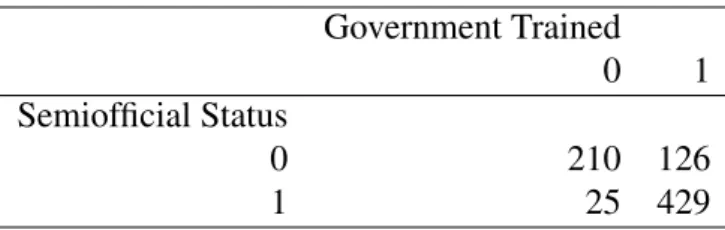
Table 2 provides a cross tabulation of the dependent variables. As can be seen in the table, there is a high degree of correlation between the two variables.2
Table 2:Cross Tab of Dependent Variables
Government Trained
0 1
Semiofficial Status
0 210 126
1 25 429
Fig. 1:Histogram of Relative Rebel Strength
The measurement for relative rebel capacity is adopted from the VNSA dataset (Cun-ningham, Gleditsch and Salehyan 2009). This measurement relies on a holistic approach to encoding relative rebel capacity not only relying on the number of rebel troops but also ac-counting for more qualitative forms of relative rebel capacity. The variable separates rebel groups into five categories of strength relative to the state: much stronger, stronger, parity, weaker, much weaker. A group that is much stronger is coded as 5, a group that is strong relative to the government is coded as a 4, a rebel group at parity with the government is labeled a 3, a rebel group that is weaker than the government is a 2, and finally a rebel group that is much weaker than the government is a 1.
Figure 1 is a histogram of the distribution of observations of relative rebel strength in the data set. As expected, there are more observations of weak and much weaker rebels than those that are at parity or strong relative to the government. Given that the variable is coded in such a way, I expect that the coefficient for relative rebel capacity will be positive indicating that as rebels become weaker relative to the government one will observe more investment in the PGM.
2016). States that have greater resources may be able to make larger investments in their PGMs. Accordingly, I include the natural log of GDP per capita drawn from the Penn World Tables measure of GDP per capita to account for (ln) GDP per Capita(Feenstra, Inklaar and Timmer 2015).
Further, I include a measurement of democratic aid provided to the government. Gov-ernments that rely mostly on democratic aid will be more cautious with regards to the vio-lence they allow their militias to commit. This suggests that these governments will want better trained and more capable PGMs. While, governments that have sources of aid from non-democratic states may be far less concerned with the international audience cost of be-ing linked to indiscriminate violence committed by their PGMs. The AID 2.0 database has measurements of aid. I then code the adjusted value based on purchasing-price parity from democracies. For the purposes of coding this variable, democracies are countries that are at least a 7 on the Polity2 scale. I then take the natural log of the measurement of democratic aid.
I also code whether the rebels control territory as a means of capturing another dimen-sion of rebel strength that is not necessarily captured in the relative rebel strength measure. It is possible that governments are more likely to invest in PGMs when rebels control ter-ritory because this may make the rebels harder to defeat and would require greater invest-ment. I use the NSA dataset’s dichotomous measurement of territorial control to capture this (Cunningham, Gleditsch and Salehyan 2009).
I includeMultiple Militiasas a dichotomous variable that is coded 0 when there are not multiple militias present in the conflict. Rather than choosing to invest in one group, a gov-ernment may choose to mobilize several militias to fight rebels thus outsourcing violence to several weak groups rather than simply empowering one militia. One can think of the 17 militias the Indonesian government had fighting against the Fretelin. I code this variable using the PGMD dataset. To account for the age of the insurgency, I include a measurement of the duration of conflict taken from theUCDP Dataset.
Balcells and Kalyvas Balcells, Kalyvas, Balcells and Justino (2014) dataset on the tech-nology of civil war. A government may be more likely to invest in PGMs when fighting an ethnic conflict. I create a dichotomous variableIdentityto indicate whether the conflict is ethnic or not adopted from the UCDP dataset. I include a measurement of regime type which is a 21-point indicator from the Polity IV dataset (Marshall and Jaggers 2015).
Tables 3 and 4 present summary statistics of key independent variables.
Table 3:Descriptive Statistics
(ln) Battle Death (ln) GDP Capita (ln) Democratic Aid Multiple Militias
Minimum 1.17 5.04 8.55 0.00
Median 1.82 7.55 19.59 1.00
Mean 1.76 7.57 19.26 0.52
Maximum 2.38 10.53 23.09 1.00
Standard Dev. 0.49 2.24 6.29 0.48
Table 4:Descriptive Statistics
Duration Territorial Control Irregular Polity 2 Identity
Minimum 0.00 0.00 0.00 1.00 0.00
Median 8.00 0.00 1.00 11.00 1.00
Mean 10.80 0.40 0.63 12.30 0.76
Maximum 54.00 1.00 1.00 21.00 1.00
Standard Dev. 24.30 0.47 0.47 8.19 0.47
Findings
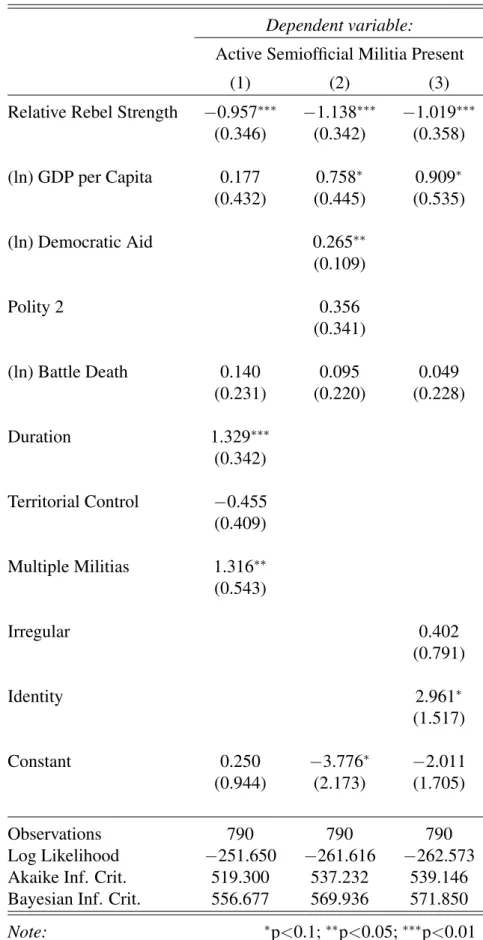
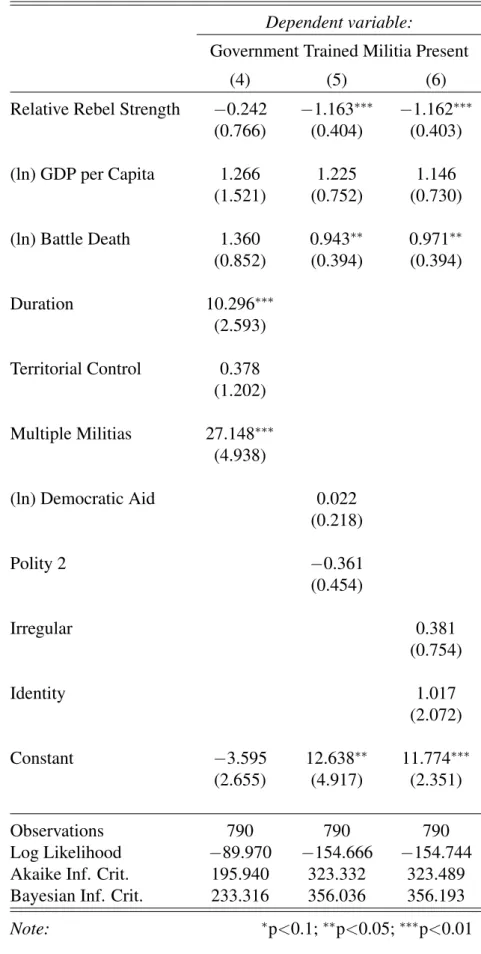
The findings of my analysis are presented in Tables 5 and 6. Since the dependent vari-ables of interest are both dichotomous, I use logistic regression models with random in-tercepts for conflict to test my hypothesis.3 As per my hypothesis, I expect that Relative Rebel Strengthwill be negative. As expected, the coefficient forRelative Rebel Strengthis negative for all models.
For models with Active Semiofficial Militia Presentas the dependent variable, relative rebel strength is statistically significant for all models. This provides initial support for
my hypothesis that as rebels become weaker relative to the government, the likelihood of observing a government extending semiofficial status to a PGM increases.
For models withGovernment Trained Militia Presentas the dependent variable, relative rebel strength falls in and out of statistical significance. This may be a result of government training being a noisy variable. This variable is coded based on whether or not government trained militias are reported. It is possible that there is some measurement error in this vari-able. Accordingly, my hypothesis is partially supported by these models. As rebels become weaker relative to the state, the likelihood of observing an active government trained militia may increase.
In addition to my key explanatory variable,(ln) Battle Deathis positive and statistically significant for models 5 and 6. This suggests that as conflict intensity increases, the like-lihood of observing a government trained PGM in a dyad may also increase. The models that have semiofficial PGM active is also positive but not significant at typical levels of sta-tistical significance. Duration is also positive and statistically significant in Models 1 and 4, suggesting that as the age of a civil war increases so to does the likelihood of viewing both government trained and semiofficial militias. Multiple Militias is also positive and statistically significant.
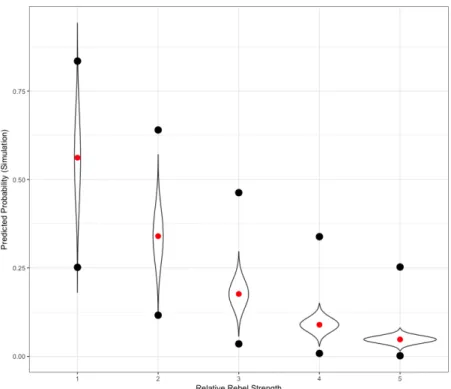
In order to understand what these findings mean substantively, I simulate and plot pre-dicted probabilities for the model with semiofficial status as the dependent variable of in-terest with lower AIC indicating better fit. For the purposes of this simulation, I hold all continuous variables at their mean and set dichotomous variables at either 0 or 1. Figure 2 is a plot of the simulated predicted probability of observing an active semiofficial militia in a conflict given the 5 different values of relative rebel strength with all continuous variables at their means and the dichotomous variables Multiple Militias and Territorial Control held at 1.
Table 5:Results of Logit with Random Intercepts: Semiofficial
Dependent variable:
Active Semiofficial Militia Present
(1) (2) (3)
Relative Rebel Strength −0.957∗∗∗ −1.138∗∗∗ −1.019∗∗∗
(0.346) (0.342) (0.358) (ln) GDP per Capita 0.177 0.758∗ 0.909∗
(0.432) (0.445) (0.535)
(ln) Democratic Aid 0.265∗∗
(0.109)
Polity 2 0.356
(0.341)
(ln) Battle Death 0.140 0.095 0.049
(0.231) (0.220) (0.228)
Duration 1.329∗∗∗
(0.342) Territorial Control −0.455 (0.409) Multiple Militias 1.316∗∗ (0.543)
Irregular 0.402
(0.791)
Identity 2.961∗
(1.517)
Constant 0.250 −3.776∗ −2.011
(0.944) (2.173) (1.705)
Observations 790 790 790
Log Likelihood −251.650 −261.616 −262.573
Akaike Inf. Crit. 519.300 537.232 539.146 Bayesian Inf. Crit. 556.677 569.936 571.850
Table 6:Results of Logit with Random Intercepts: Government Trained
Dependent variable:
Government Trained Militia Present
(4) (5) (6)
Relative Rebel Strength −0.242 −1.163∗∗∗ −1.162∗∗∗
(0.766) (0.404) (0.403)
(ln) GDP per Capita 1.266 1.225 1.146
(1.521) (0.752) (0.730) (ln) Battle Death 1.360 0.943∗∗ 0.971∗∗ (0.852) (0.394) (0.394)
Duration 10.296∗∗∗
(2.593) Territorial Control 0.378
(1.202) Multiple Militias 27.148∗∗∗
(4.938)
(ln) Democratic Aid 0.022
(0.218)
Polity 2 −0.361
(0.454)
Irregular 0.381
(0.754)
Identity 1.017
(2.072)
Constant −3.595 12.638∗∗ 11.774∗∗∗
(2.655) (4.917) (2.351)
Observations 790 790 790
Log Likelihood −89.970 −154.666 −154.744
Akaike Inf. Crit. 195.940 323.332 323.489 Bayesian Inf. Crit. 233.316 356.036 356.193
Fig. 2:Violin Plot Dichotomous IVs at 0 and Continuous IVs at Mean
The violin plot shows that the predicted probability of observing an active semiofficial PGM increases as rebels become weaker relative to the state. We should approach the re-sults of this study with a degree of caution, considering the degree of uncertainty illustrated by the range of predicted probabilities surrounding the point estimate. As noted in the de-scriptive statistics, there are far more observations of much weaker and weaker rebel groups which correspond to values of 1 and 2 respectively. This suggests that there is still a great deal of variation within the group. This is perhaps a result of the sheer amount of variation between the rebel groups within these categories.
A random sampling from those groups that receive a score of 2 include the LTTE in Sri Lanka, FARC in Colombia, GAM in Indonesia and UNITA in Angola. These groups may have similar military capacity scaled by the size of the state they are fighting but these groups vary dramatically in their capacity to mobilize resources, their popular support, the centrality and strength of their hierarchy. These aspects are qualitatively accounted for in the measure but in turn create a great deal of within group variation in the measure. Thus, the measure of rebel capacity should be seen as a flawed measure.
Fig. 3:Violin Plot Dichotomous IVs at 1 and Continuous IVs at Mean
a conflict with all continuous variables held at their mean and dichotomous variables held at 0. Figure 3 shows an even greater degree of uncertainty in the predicted probability of observing an active semiofficial militia at level 1 and 2 of relative rebel strength.
Robustness Check
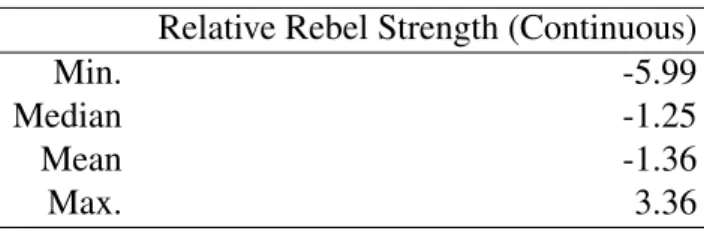
Due to the poor variation of the original measurement of relative rebel strength, I use a measurement of relative rebel strength that is continuous as a robustness check. The measurement is constructed by making a ratio of rebel troops squared over total government troops adopted from the NSA dataset (Cunningham, Gleditsch and Salehyan 2009). I then take the natural log of the ratio. Due to missing data for estimates of rebel troops, the number of cases for this analysis drops to 668 observations of 99 conflicts in 69 countries. Table 7 provides summary statistics for this measurement. Once again, the hypothesis that investment increases as rebels become relatively weak suggests that we should expect a negative coefficient.
Table 7:Summary Statistics of Relative Rebel Strength (Continuous)
Relative Rebel Strength (Continuous)
Min. -5.99
Median -1.25
Mean -1.36
Max. 3.36
variable specifications as the previous model. Once again, I run a logit model with random intercepts on conflict. Table 8 presents the results of the analysis.
Table 8:Logit with Random Intercepts - Continuous
Dependent variable:
Active Semiofficial Militia Preset Relative Rebel Strength (Continuous) −0.354∗∗
(0.173)
(ln) Battle Death 0.098
(0.239)
(ln) GDP per Capita 0.211
(0.437)
Duration 1.380∗∗∗
(0.346)
Multiple Militias 0.906
(0.555)
Territorial Control −1.140
(0.810)
Constant −1.140
(0.766)
Observations 668
Log Likelihood −225.000
Akaike Inf. Crit. 466.000
Bayesian Inf. Crit. 502.000
Note: ∗p<0.1;∗∗p<0.05;∗∗∗p<0.01
is statistically significant and positive. In order to understand what these findings mean sub-stantively, it is best to graph the predicted probability of observing the dependent variable.
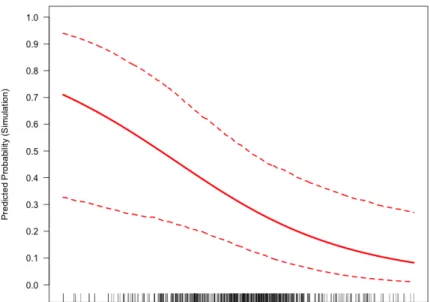
Figure 4 presents the predicted probability of observing an active semiofficial militia given values of relative rebel strength. For this simulation, all continuous variables are held at their means and the dichotomous variables are at 1. The predicted probabilities are constructed via simulation. The solid red line is the point estimate and the red dotted lines are the 95 percent confidence intervals. The black dashes along the x axis show the distribution of the observations along the continuum of relative rebel strength.
Fig. 4:Predicted Probability(Simulation)
Conclusion
This paper was initially motivated by asking under what conditions do governments invest in their PGMs during civil war? This investment occurs despite PGMs often being counterproductive for the state’s objectives in civil war. This paper proposes that govern-ments take into account the relative capabilities of their opponents when choosing to invest in a PGM. For governments facing rebels at parity with or stronger than the state, invest-ment in PGMs may pose further threat to the state’s survival. As PGMs become weaker relative to the state, the conditions of the civil war being fought change to allow for the effective outsourcing of counter-insurgency to PGMs. This paper finds mixed support for this theory. While my findings are statistically significant, the substantive findings of my study should be met with a degree of skepticism.
strategic purposes. A government may choose to invest in a co-opted PGM to ensure loy-alty and to gain local favor while the directly developed PGM may be more essential for carrying-out behavior that allows the government to reduce accountability. An example of this distinction is the case of the two militias mobilized against the Sendero Luminoso in Peru. The Ronda Compensina group was a grass-root level PGM that the Peruvian gov-ernment co-opted to protect civilians. The Colina Group was created by the govgov-ernment to carry out assassinations and other controversial activities. There may be unaccounted for variation in the reason for investing.
The analysis may be extended to different forms of investment, such as the provision of arms or logistic support that may help delve deeper into this relationship. The variables that are used in this current analysis do not provide a scale of investment. Instead, it simply looks at whether there was some form of investment or not. A more encompassing study of investment may consider the degree of investment by the government.
A better understanding of when governments choose to invest in PGMs is highly rele-vant. Do governments choose to invest in PGMs as a last resort and in response to a series of losses? Or do governments pre-emptively invest in PGMs? Future research could address the relationship between location, rebel capability and the mobilization of PGMs. Previous empirical studies have linked rebel capacity to the location of where the conflict is taking place. While I attempt to control for some spacial dependencies in my analysis, a more fine-grained study of where PGMs are active and fighting insurgents would be of great con-sequence. Another important avenue for future research is the effectiveness of PGMs. This study takes for granted that PGMs are thought to be effective counter-insurgents. While anecdotal evidence suggests that this may be the case, there is a paucity of empirical studies regarding the effectiveness of PGMs. This may be a result of the difficulty of operationaliz-ing what it means to be an effective PGM due to the plethora of objectives that governments have when they are choosing to create a PGM.
APPENDIX Bivariate Probit
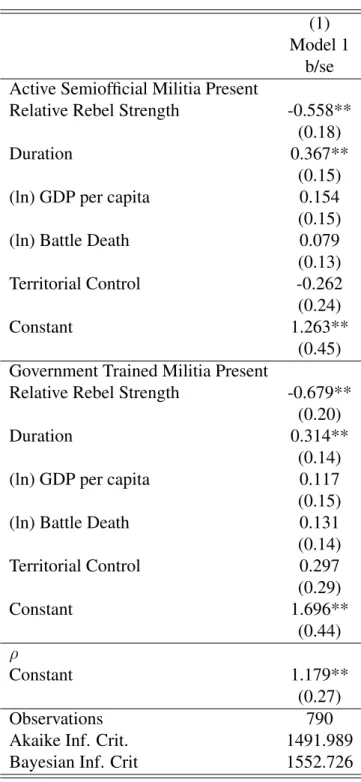
Table 9:Results of Bivariate Probit with Clustered Standard Errors
(1) Model 1
b/se Active Semiofficial Militia Present
Relative Rebel Strength -0.558** (0.18)
Duration 0.367**
(0.15)
(ln) GDP per capita 0.154
(0.15)
(ln) Battle Death 0.079
(0.13)
Territorial Control -0.262
(0.24)
Constant 1.263**
(0.45) Government Trained Militia Present
Relative Rebel Strength -0.679** (0.20)
Duration 0.314**
(0.14)
(ln) GDP per capita 0.117
(0.15)
(ln) Battle Death 0.131
(0.14)
Territorial Control 0.297
(0.29) Constant 1.696** (0.44) ρ Constant 1.179** (0.27) Observations 790
Akaike Inf. Crit. 1491.989
REFERENCES
Arreguin-Toft, Ivan. 2001. “How the weak win wars: A theory of asymmetric conflict.”
International Security26(1):93–128.
Balcells, Laia, Stathis N Kalyvas, Laia Balcells and Patricia Justino. 2014. “Does warfare matter? Severity, duration, and outcomes of civil wars.” Journal of Conflict Resolution
58(8):1390–1418.
Bapat, Navin A and Kanisha D Bond. 2012. “Alliances between militant groups.”British Journal of Political Science42(4):793.
Biddle, Stephen, Jeffrey A Friedman and Jacob N Shapiro. 2012. “Testing the surge: Why did violence decline in Iraq in 2007?”International Security37(1):7–40.
Buhaug, Halvard, Scott Gates and P¨aivi Lujala. 2009. “Geography, rebel capability, and the duration of civil conflict.”Journal of Conflict Resolution53(4):544–569.
Campbell, Bruce and Arthur Brenner. 2002. Death squads in global perspective: Murder with deniability. Springer.
Carey, Sabine C, Michael P Colaresi and Neil J Mitchell. 2015a. “Governments, informal links to militias, and accountability.”Journal of Conflict Resolution59(5):850–876.
Carey, Sabine C, Michael P Colaresi and Neil J Mitchell. 2015b. “Risk Mitigation, Regime Security, and Militias: Beyond Coup-proofing.”International studies quarterly.
Carey, Sabine C and Neil J Mitchell. 2017. “Pro-Government Militias.”Annual Review of Political Science20(1).
Carey, Sabine C, Neil J Mitchell and Will Lowe. 2013. “States, the security sector, and the monopoly of violence: A new database on pro-government militias.” Journal of Peace Research50(2):249–258.
Christia, Fotini. 2012. Alliance formation in civil wars. Cambridge University Press.
Clayton, Govinda. 2013. “Relative rebel strength and the onset and outcome of civil war mediation.”Journal of Peace Research50(5):609–622.
militias? Patterns of sexual violence in recent armed conflicts.”Journal of Conflict Res-olution59(5):877–898.
Cunningham, David E, Kristian Skrede Gleditsch and Idean Salehyan. 2009. “It takes two: A dyadic analysis of civil war duration and outcome.” Journal of Conflict Resolution
53(4):570–597.
de Rouen Jr, Karl R and David Sobek. 2004. “The dynamics of civil war duration and outcome.”Journal of Peace Research41(3):303–320.
Eck, Kristine. 2015. “Repression by proxy: How military purges and insurgency impact the delegation of coercion.”Journal of Conflict Resolution59(5):924–946.
Fearon, James D and David D Laitin. 2003. “Ethnicity, insurgency, and civil war.”American political science review97(01):75–90.
Feenstra, Robert C, Robert Inklaar and Marcel P Timmer. 2015. “The next generation of the Penn World Table.”The American Economic Review105(10):3150–3182.
Gent, Stephen E. 2011. “Relative rebel strength and power sharing in intrastate conflicts.”
International Interactions37(2):215–228.
Harbom, Lotta, Erik Melander and Peter Wallensteen. 2008. “Dyadic dimensions of armed conflict, 19462007.”Journal of Peace Research45(5):697–710.
Jentzsch, Corinna, Stathis N Kalyvas and Livia Isabella Schubiger. 2015. “Militias in civil wars.”Journal of Conflict Resolution59(5):755–769.
Kalyvas, Stathis N. 2006. The logic of violence in civil war. Cambridge University Press.
Kalyvas, Stathis N. 2008. “Ethnic defection in civil war.”Comparative Political Studies.
Kilcullen, David. 2010. Counterinsurgency. Oxford University Press.
Krause, Peter. 2013. “The political effectiveness of non-state violence: A two-level frame-work to transform a deceptive debate.”Security Studies22(2):259–294.
Marshall, Monty G and Keith Jaggers. 2015. “Polity IV project: Political regime character-istics and transitions, 1800-2015.”.
Melander, Erik, Ther´ese Pettersson and Lotta Themn´er. 2016. “Organized violence, 1989– 2015.”Journal of Peace Research53(5):727–742.
Mitchell, Neil J, Sabine C Carey and Christopher K Butler. 2014. “The impact of pro-government militias on human rights violations.”International Interactions40(5):812– 836.
Peic, Goran. 2014. “Civilian Defense Forces, State Capacity, and Government Victory in Counterinsurgency Wars.”Studies in Conflict & Terrorism37(2):162–184.
Staniland, Paul. 2014. Networks of rebellion: Explaining insurgent cohesion and collapse. Cornell University Press.
Stanton, Jessica A. 2015. “Regulating militias: Governments, militias, and civilian targeting in civil war.”Journal of Conflict Resolution59(5):899–923.