Ibrahim et al. High-Risk Births and Infant Mortality
African Journal of Reproductive Health September 2019; 23 (3):120
ORIGINAL RESEARCH ARTICLE
Child’s Risk Attributes at Birth and Infant Mortality Disparities in
Nigeria
DOI: 10.29063/ajrh2019/v23i3.11
Elhakim A. Ibrahim
1,2*; Sunday A. Adedini
1,3; Amos O. Oyedokun
1, Akanni I. Akinyemi
1,4and
Ayotunde Titilayo
1Department of Demography and Social Statistics, Obafemi Awolowo University, Ile Ife, Nigeria1; Department of Demography, College of Public Policy, The University of Texas at San Antonio, USA2; Demography and Population Studies Programme, The University of the Witwatersrand, Johannesburg, South Africa3; Takemi Program in International Health, Harvard T.H. Chan School of Public Health, Boston, USA4
*For Correspondence: Email: [email protected]; Phone: +234 813-300-7465
Abstract
Births in avoidable high-risk contexts defined by the interplay of sub-optimal childbearing age, short spacing, and first and high birth order incur elevated risks of childhood death. However, the extent of disparities in risks of dying in infancy vis-à-vis the continuum of non-high-risk and (un)avoidable high-risk attributes at birth as determined by mother‘s age at childbirth, child spacing, and birth order characteristics is yet to be adequately explored in Nigeria as elsewhere. To fill this gap, chi-square association test and Cox‘s proportional hazards regression were used to analyze data of 31,260 nationally representative children aged 0-59 months drawn from 2013 Nigeria Demographic and Health Survey. Disparities in infant mortality risks were mainly examined across the spectrum of birth-related risk attributes at birth broadly categorized as no extra high-risk, unavoidable first-order risk and combined avoidable high-risk. The risks of dying in infancy differed significantly by risk attributes to the extent dictated by other confounders. Also, infant mortality risks varied significantly by all moderating factors excluding religion, water source, toilet type and place of delivery. Interventions targeted at reducing avoidable high-risk fertility rate and strengthening health system to provide life-saving care to most-at-risk children would engender rapid improvement in infant survival. (Afr J Reprod Health 2019; 23[3]:120-133).
Keywords: Infant Mortality, High-Risk Birth, Fertility Behaviour, Disparities, Nigeria
Résumé
Les naissances dans des contextes à risque élevé évitables, définies par l'interaction d'un âge de procréation sous-optimal, d'un espacement réduit, et du premier rang de naissance élevé, entraînaient des risques élevés de mortalité infantile. Toutefois, l'ampleur des disparités en matière de risque de décès dans la petite enfance par rapport au continuum d'attributs à haut risque non haut risque et (in) évitables haut risques à la naissance, déterminée par l'âge de la mère à la naissance, l'espacement des naissances et le rang de naissance les caractéristiques n‘a pas encore été explorée de manière adéquate au Nigeria comme ailleurs. Pour combler cette lacune, le test d‘association du khi-deux et la régression des hasards proportionnels de Cox ont été utilisés pour analyser les données de 31 260 enfants représentatifs au niveau national, âgés de 0 à 59 mois tirés de l‘enquête démographique et de santé réalisée en 2013 au Nigéria. Les disparités dans les risques de mortalité infantile ont été principalement examinées à travers le spectre d'attributs de risque liés à la naissance, généralement classées dans la catégorie comme pas de haut risque supplémentaire, à très haut risque, risque inévitable de premier ordre et le haut évitable combiné. Les risques de mourir dans la petite enfance différaient considérablement par les attributs de risque dans la mesure dictée par d'autres facteurs de confusion. En outre, les risques de mortalité infantile variaient de manière significative en fonction de tous les facteurs modérateurs, à l'exclusion de la religion, de la source d'eau, du type de toilette et du lieu de livraison. Les interventions visant à réduire le taux de fécondité évitable à haut risque et à renforcer le système de santé afin de fournir des soins vitaux aux enfants les plus exposés, engendreraient une amélioration rapide de la survie des nourrissons. (Afr J Reprod Health 2019; 23[3]: 120-133).
African Journal of Reproductive Health September 2019; 23 (3):121
Introduction
High rate of mortality in infancy constitutes major demographic and public health concern in Nigeria. Successive administrations in Nigeria have made concerted efforts to reverse this trend through myriads of policies and programmes. The interventions were tied to various laudable initiatives like the Millennium Development Goals (MDGs) programmes (which transitioned to Sustainable Development Goals), National Policy on Population for Sustainable Development, National Child Health Policy, the Integrated
Maternal, New-born and Child Health
intervention, the Midwives Service Scheme and the Maternal and Child Health component of the
Subsidy Reinvestment and Empowerment
Programme 1. Nevertheless, the gains made were inadequate in meeting the country‘s infant and child mortality reduction targets1.
Nigeria contributes approximately 11 and 24 percent of estimated infant mortality burden globally and in sub-Saharan Africa respectively2. Besides, huge proportion of children dying before age 5 increasingly concentrates in the period of infancy. This progressive increase in the proportion of deaths during eleven months after birth indicates growing vulnerability of dying during infancy than any other time prior to age five 1,2. Accordingly, infant deaths account for approximately three-quarters of estimated under-five deaths in Nigeria 2. Furthermore, recent statistics suggest a sharp inter-survey drop in the pace of reduction in infant mortality rate from 25 percent between 2003 and 2008 to 8 percent between 2008 and 20131.
Arguably, Nigeria‘s high infant mortality profile is substantially rooted in women's sub-optimal fertility behaviours aside other factors. Data from Nigeria Demographic and Health Survey (NDHS) reports1,3 attest to this assertion. According to the reports, an average Nigerian woman tends to give birth to approximately six children over her reproductive years. In relation to this high fertility phenomenon, close to two-thirds
of the children are born in practically preventable risk contexts characterized by early/late childbearing, close interval between births and extreme birth order, with slight decrease in proportion from approximately 65 to 63 percent between 2003 and 2013.
Evidently, high fertility coexists with high childhood mortality2. Also, studies have found increased risks of deaths among infants born to teenage or old mothers, in quick succession and of first or high birth order4-13. In general, maternal age at birth, preceding birth interval and order of birth characteristics have been used in classifying child's birth-related risks of death into three broad hypothetical categories, namely, not in high-risk, unavoidable first birth risk and avoidable high-risk which encompasses a range of single and combined avoidable high-risks dimensions1,5,14.
However, there is paucity of evidence on the pattern and extent of infant mortality disparities across the continuum of the hypothetical risk categories. Summary estimates of under-five mortality risks by these vulnerability indicators as routinely presented in the NDHS reports have two major limitations that form the bases for this investigation. Firstly, they are not generalizable to all critical age segments under five, especially the first year of birth in which the greater proportion of under-five deaths occurs. Secondly, the estimates are not adjusted for demographic, socioeconomic and healthcare services covariates that have been found to influence child health and survival outcomes. To address this gap, this study draws on 2013 NDHS kids-recode data to examine the risks of dying in infancy by child‘s risk attributes at birth and constituent domains taking into cognizance the contributions of other correlates.
Methods
Data source and study sample
Ibrahim et al. High-Risk Births and Infant Mortality
African Journal of Reproductive Health September 2019; 23 (3):122 implemented between February and June 2013 by
the Nigeria Population Commission to elicit information on demographic and health indicators at the national and state levels. The study protocol and survey instruments for 2013 NDHS were approved by the National Health Research Ethics Committee of the Federal Ministry of Health, Nigeria. Informed consent was obtained from all the study participants including parents and guardians1.
The study sample was restricted to total number of live births reportedly had by successfully interviewed women in the five years prior to the survey. Based on this criterion, this study included a weighted total of 31,260 live births delivered for 0-59 months preceding the survey. The data were released for use in this study by ICF International.
Definition and classification of variables
The outcome measure is risk of dying in infancy (RDI) measured as the duration of survival within the first 11 months of birth. The RDI was mainly predicted by child‘s risk attribute at birth; which, in line with Demographic and Health Surveys (DHS) definitions, was determined by interacting maternal age at birth (‗<18/younger‘, ‗ 18-34/middle‘ and ‗35+/older‘), birth order (classified
as ‗1/first‘, ‗2-3/middle‘ and ‗4+/higher‘) and preceding birth interval (grouped as ‗<24/short‘ and ‗24+/long‘) attributes1,14.
The derived child‘s risk attributes were classified into three main comparative groups as follows:
1. Non-high risk (i.e. risk trait of successive live births of order 2-3 and preceding birth interval 24-59 months to mothers 18-34 years);
2. Unavoidable first-order risk (i.e. risk trait of first live births to mothers aged 18-34); and
3.
Avoidable high-risk (i.e. risk trait ofsuccessive live births with any or a combination of birth order >3 [too high order], preceding birth interval <24 months [too short interval], or mothers age at birth <18 [too young mother] or >34 [too old mother]
characteristics). Consequently, the avoidable high-risk attribute was further disaggregated as avoidable single-factor high-risk (i.e. risk trait of successive live birth born with only one indicator of avoidable high-risk attributes)
avoidable double-factor high-risk (i.e. risk trait of successive live birth born with two elements of avoidable high-risk attributes), and avoidable triple-factor high-risk (i.e. risk trait of successive live birth born with three indicators of avoidable high-risk attributes).
Moreover, seventeen supplementary covariates included based on evidence from extant literature were grouped as:
a. Child bio-demographic characteristics: child‘s sex (female vs. male), birth type (single vs. multiple), birth size (small vs. average, large) b. Maternal/household‘s demographic and
socioeconomic characteristics: marital status (not in union vs. in union), education (none vs. primary, secondary/higher), religion (Christianity vs. Islam; Others), region of residence (South East vs. North Central, North East, North West, South-South, South West), place of residence (urban vs. rural), household size (small vs. large, very large), wealth status (poor vs. rich), water sources (unimproved, improved), and toilet type (unimproved, improved)
c.
Maternal healthcare access/use characteristics: distance to facility (big challenge vs. not big challenge), prenatal care visit (none vs. one/more), prenatal care provider (unskilled vs. skilled), tetanus immunization (not received vs. received) and place of delivery (elsewhere vs. facility).For instance, research have shown that child‘s sex6–10,15–17, birth multiplicity status6,10,12,18 and birth size8,17,19 play significant roles in child survival. Similarly, several studies have established that risks of childhood death vary substantially by mother‘s marital status7
African Journal of Reproductive Health September 2019; 23 (3):123 region of residence9,11, healthcare access and
utilization9,12,19,21 and wealth status7–9,15,18, as well as household size12 and sanitation and hygiene7,9,20.
Statistical analyses
Pearson‘s Chi-square test was used to explore variations in infant deaths distribution by risk status dimensions and categories in selected covariates. In addition, based on Mosley-Chen analytical framework22, disparities in infant mortality risks were investigated by comparing hazard ratios from Cox‘s proportional hazards regression models. Detailed explanation of proportional hazards regression technique as well as justification for its use in childhood mortality research is well documented5,8,9.
In line with the study objective, hazard ratios were examined across one bivariate and five multivariate models. These models were estimated on the assumption that the pattern of resulting mortality risks by risk dimensions under focus will vary considerably under the influence of different set of covariates. Consequently, the bivariate model examined relationship between risk attributes on infant deaths, while the first multivariate model adjusted for child-specific bio-demographic predictors. Whereas the second and third multivariate models modified for mother-specific demographic/socioeconomic and healthcare access/use characteristics, respectively, the fourth model accounted for joint contributions of all child- and mother-specific covariates. Meanwhile, the fifth multivariate model included only a set of correlates with predictive value of p<0.05 in a backward stepwise elimination regression. Data were analyzed with STATA version 14.023 and statistical significance evaluated at p≤.05.
Results
Population distribution and survival status
Table 1 presents the distributions of the study population and infant deaths by child‘s risk
attributes and selected covariates. Overall, a total of 31,260 live births were delivered 0-59 months prior to the survey comprising 29,273 (93.6%) and 1,987 (6.4%) children who survived and died in infancy, respectively. In aggregate, 22.6% of the study population were born with non-high-risk characteristics compared with 63.5% born with avoidable high-risk attributes, comprising 34.4, 26.9 and 2.2% in single-, double- and triple-factor high-risk subgroups. Moreover, relative to their counterparts in the study were 49.5% female, 96.6% singleton and 16.8% small birth-size children. Also, children whose mothers were not in union, uneducated, Christians, poor, declared small household size, rural resident, located in south east region, had no prenatal care and received no tetanus injection constituted 4.2, 49.1, 36.7, 46.5, 40.5, 65.0, 8.9, 59.2 and 68.7% of total in each of the respective parameters.
Besides, the pattern of infant deaths varied significantly by risk attributes at birth. Overall, least proportion of infant deaths occurred among children in non-high-risk group (4.8%) relative to those in unavoidable first-order risk (6.3%) and avoidable high-risk (6.9%) groups (ꭓ2=36.68, p<.001). Similarly, results of disaggregated avoidable high-risk dimension showed that infancy deaths were least prevalent among babies born with avoidable single-factor high-risk characteristics (5.5%) proportionate to their equals born with avoidable double- (8.3%) and triple-factor (13.1%) high-risk attributes (ꭓ2=146.37, p<.001).
In addition, occurrence of deaths in infancy varied significantly by all correlates except religion and perception about distance to health facility (Table 1). Consequently, the proportion of children who died before age 1 differed by child‘s sex (ꭓ2
Ibrahim et al. High-Risk Births and Infant Mortality
African Journal of Reproductive Health September 2019; 23 (3):124 Table 1: Population distribution and survival status, 31,260 children born 0-59 months prior to 2013 NDHS
Parameters
Population a Survival Status b Chi-Square Estimate 31260 (%) Alive (93.6) Dead (6.4)
Risk Attribute
Non-High-Risk 7079 (22.6) 95.2 4.8 38.68***
Unavoidable First-Order Risk 4317 (13.8) 93.7 6.3
Avoidable High-Risk 19864 (63.5) 93.1 6.9
First-Level Disaggregation
Risk Attribute
Non-High-Risk 7079 (22.6) 95.2 4.8 146.37***
Unavoidable First-Order Risk 4317 (13.8) 93.7 6.3
Avoidable High-Risk Dimensions:
Avoidable Single-Factor High-Risk 10749 (34.4) 94.5 5.5
Avoidable Double-Factor High-Risk 8421 (26.9) 91.7 8.3
Avoidable Triple-Factor High-Risk 694 (2.2) 86.9 13.1
Second-Level Disaggregation
Risk Attribute
Non-High-Risk 7079 (22.6) 95.2 4.8 230.15***
Unavoidable First-Order Risk 4317 (13.8) 93.7 6.3
Avoidable Single-Factor High-Risk Dimensions:
Too Young Mother 298 (1.0) 90.1 9.9
Too Old Mother 302 (1.0) 95.8 4.2
Too Short Interval 2211 (7.1) 92.9 7.1
Too High Order 7939 (25.4) 95.1 4.9
Avoidable Double-Factor High-Risk Dimensions:
Too Young Mother + Too Short Interval 197 (0.6) 88.2 11.8
Too Young Mother + First Order 1727 (5.5) 90.9 9.1
Too Old Mother + Too Short Interval 43 (0.1) 100.0 0.0
Too Old Mother + First Order 52 (0.2) 94.4 5.6
Old Mother + Too High Order 3707 (11.9) 93.8 6.2
Too Short Interval + Too High Order 2694 (8.6) 89.6 10.4
Avoidable Triple-Factor High-Risk Dimensions:
Too Young Mother + Too Short Interval + Too High Order
4 (0.0) 100.0 0.0
Too Old Mother + Too Short Interval + Too High Order
690 (2.2) 86.8 13.2
Child’s Sex
Female 15482 (49.5) 94.2 5.8 16.31***
Male 15778 (50.5) 93.1 6.9
Birth Type
Single 30190 (96.6) 94.2 5.8 379.81***
Multiple 1070 (3.4) 79.3 20.7
Birth Size
Small 5244 (16.8) 88.9 11.1 241.56***
Average 12581(40.2) 94.3 5.7
Large 13435 (43.0) 94.9 5.1
Marital Status
Not in Union 1328 (4.2) 92.1 7.9 5.33*
In Union 29932 (95.8) 93.7 6.3
Mother’s Education
None 15355 (49.1) 92.8 7.2 52.03***
Primary 6013 (19.2) 93.3 6.7
Secondary/Higher 9892 (31.6) 95.1 4.9
African Journal of Reproductive Health September 2019; 23 (3):125
Christianity 11475 (36.7) 94.1 5.9 5.17
Islam 19300 (61.7) 93.4 6.6
Others 485 (1.6) 93.5 6.5
Wealth Status
Poor 14543 (46.5) 92.4 7.6 66..13***
Rich 16717 (53.5) 94.7 5.3
Household Size
Small 12658 (40.5) 92.1 7.9 90.74***
Large 14227 (45.5) 94.6 5.4
Very large 4375 (14.0) 95.1 4.9
Water Source
Unimproved 16226 (51.9) 93.2 6.8 9.59*
Improved 15034 (48.1) 94.1 5.9
Toilet Type
Unimproved 18897 (60.5) 93.3 6.7 11.59**
Improved 12363 (39.5) 94.2 5.8
Place of Residence
Rural 20331 (65.0) 93.0 7.0 41.52***
Urban 10929 (35.0) 94.9 5.1
Region of Residence
South East 2788 (8.9) 92.9 7.1 40.57***
North Central 4271 (13.7) 94.3 5.7
North East 5465 (17.5) 93.6 6.4
North West 11542 (36.9) 92.8 7.2
South South 2902 (9.3) 95.0 5.0
South West 4292 (13.7) 94.9 5.1
Distance to Facility
A Barrier 10045 (32.1) 93.6 6.4 0.08
Not a Barrier 21215 (67.9) 93.7 6.3
Prenatal Care Visit
None 18499 (59.2) 92.0 8.0 206.59***
One/More 12761 (40.8) 96.0 4.0
Prenatal Care Provider
Unskilled 19029 (60.9) 92.1 7.9 195.19***
Skilled 12231 (39.1) 96.1 3.9
Tetanus Vaccination
Not Received 21488 (68.7) 92.5 7.5 156.75***
Received 9772 (31.3) 96.2 3.8
Place of Delivery
Elsewhere 20046 (64.1) 93.1 6.9 25.84***
Facility 11214 (35.9) 94.6 5.4
Notes: a, column dist number and percentage; b, row percent distribution; *p<.05, **p<.01, ***p<.001
of residence, prenatal care visit (ꭓ2=206.59, p<.001), prenatal care provider (ꭓ2=195.19, p<.001), tetanus vaccination (ꭓ2=156.75, p<.001) and incidence of infant death.
Risk status at birth and infant mortality risks
nexus
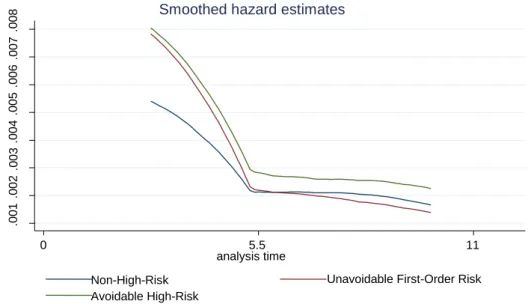
Findings from Figures 1 and 2 and Tables 2a and 2b illustrate the patterns and relative degrees of
infant mortality risks per risk attributes that characterized the births of the study population. Overall, the results showed significant disparities in exposure to mortality risks across risk categories. The Kaplan-Meier‘s plots (Figures 1 and 2) revealed that chances of dying and magnitude of infant mortality disparities by various risk dimensions were more pronounced
Ibrahim et al. High-Risk Births and Infant Mortality
African Journal of Reproductive Health September 2019; 23 (3):126 Table 2a: Proportional hazards regression estimates of risks of dying in infancy by risk attributes of 31,260 children born 0-59 months prior to 2013 NDHS
Parameters
Model 1 Model 2 Model 3 Model 4 Model 5 Model 6
bHR 95% C.I. mHR1 95% C.I. mHR2 95% C.I. mHR3 95% C.I. mHR4 95% C.I. mHR5 95% C.I.
Risk Attribute(Non-High-Risk, ref.) 1.00 1.00 1.00 1.00 1.00 1.00
Unavoidable First-Order Risk 1.32** (1.10,1.60) 1.36** (1.13,1.64) 1.33** (1.10,1.61) 1.34** (1.11,1.63) 1.31** (1.08,1.59) 1.32** (1.08,1.60)
Avoidable High-Risk 1.45*** (1.26,1.67) 1.39*** (1.20,1.59) 1.62*** (1.41,1.87) 1.41*** (1.22,1.63) 1.58*** (1.37,1.82) 1.60*** (1.39,1.84)
First-Level Disaggregation
Risk Attribute(Non-High-Risk, ref.) 1.00 1.00 1.00 1.00 1.00 1.00
Unavoidable First-Order Risk 1.32** (1.10,1.60) 1.36** (1.13,1.64) 1.33** (1.10,1.61) 1.34** (1.11,1.63) 1.31** (1.08,1.59) 1.32** (1.08,1.60)
Avoidable High-Risk Dimensions:
Avoidable Single-Factor High-Risk 1.14 (0.96,1.34) 1.09 (0.92,1.28) 1.31** (1.11,1.55) 1.11 (0.95,1.31) 1.26** (1.07,1.49) 1.28** (1.08,1.50)
Avoidable Double-Factor High-Risk 1.74*** (1.50,2.03) 1.67*** (1.44,1.94) 1.92*** (1.65,2.24) 1.69*** (1.46,1.96) 1.89*** (1.63,2.19) 1.90*** (1.64,2.21)
Avoidable Triple-Factor High-Risk 2.81*** (2.13,3.71) 2.59*** (1.93,3.47) 3.40*** (2.59,4.48) 2.70*** (2.06,3.55) 3.20*** (2.41,4.25) 3.21*** (2.40,4.29)
Second-Level Disaggregation a
Risk Attribute(Non-High-Risk, ref.) 1.00 1.00 1.00 1.00 1.00 1.00
Unavoidable First-Order Risk 1.32** (1.10,1.60) 1.36** (1.13,1.64) 1.33** (1.10,1.61) 1.34** (1.11,1.63) 1.31** (1.08,1.59) 1.32** (1.08,1.60)
Avoidable Single-Factor High-Risk Dimensions:
Too Young Mother 2.09** (1.30,3.36) 1.75* (1.08,2.85) 1.74* (1.08,2.79) 1.80* (1.11,2.90) 1.39 (0.85,2.25) 1.39 (0.85,2.25)
Too Old Mother 0.88 (0.50,1.55) 0.84 (0.48,1.48) 1.00 (0.57,1.76) 1.07 (0.61,1.87) 1.04 (0.59,1.83) 1.03 (0.59,1.81)
Too Short Interval 1.49*** (1.18,1.89) 1.46** (1.16,1.85) 1.49** (1.17,1.88) 1.43** (1.13,1.80) 1.40** (1.11,1.76) 1.44** (1.14,1.81)
Too High Order 1.02 (0.85,1.22) 0.96 (0.81,1.15) 1.24* (1.03,1.50) 1.00 (0.83,1.20) 1.24* (1.03,1.48) 1.24* (1.04,1.49)
Avoidable Double-Factor High-Risk Dimensions:
Too Young Mother + Too Short Interval 2.53*** (1.56,4.08) 2.67*** (1.65,4.33) 2.18** (1.35,3.53) 2.20** (1.36,3.56) 2.22** (1.38,3.57) 2.21** (1.37,3.57)
Too Young Mother + First Order 1.93*** (1.56,2.40) 1.91*** (1.54,2.37) 1.61*** (1.29,2.00) 1.74*** (1.40,2.16) 1.53*** (1.23,1.89) 1.52*** (1.23,1.89)
Too Old Mother + First Order 1.17 (0.35,3.87) 1.14 (0.34,3.85) 1.08 (0.32,3.61) 1.35 (0.41,4.52) 1.13 (0.33,3.86) 1.24 (0.36,4.24)
Too Old Mother + Too High Order 1.31** (1.07,1.59) 1.24* (1.02,1.50) 1.64*** (1.34,2.01) 1.38** (1.13,1.68) 1.71*** (1.41,2.08) 1.72*** (1.42,2.10)
Too Short Interval + Too High Order 2.21*** (1.87,2.61) 2.11*** (1.79,2.50) 2.64*** (2.21,3.16) 2.03*** (1.72,2.40) 2.51*** (2.11,2.99) 2.55*** (2.14,3.04)
Avoidable Triple-Factor High-Risk Dimension:
Too Old Mother + Too Short Interval + Too High Order
2.83*** (2.14,3.73) 2.60*** (1.94,3.49) 3.46*** (2.63,4.56) 2.72*** (2.07,3.57) 3.28*** (2.47,4.36) 3.30*** (2.47,4.41)
African Journal of Reproductive Health September 2019; 23 (3):127 Table 2b: Proportional hazards regression estimates of risks of dying in infancy by risk attributes of 31,260 children born 0-59 months prior to 2013 NDHS
Parameters a
Model 1 Model 2 Model 3 Model 4 Model 5 Model 6
bHR 95% C.I. mHR1 95% C.I. mHR2 95% C.I. mHR3 95% C.I. mHR4 95% C.I. mHR5 95% C.I.
Risk Attribute(Non-High-Risk, ref.) 1.00 1.00 1.00 1.00 1.00 1.00
Unavoidable First-Order Risk 1.32** (1.10,1.60) 1.36** (1.13,1.64) 1.33** (1.10,1.61) 1.34** (1.11,1.63) 1.31** (1.08,1.59) 1.32** (1.08,1.60)
Avoidable High-Risk 1.45*** (1.26,1.67) 1.39*** (1.20,1.59) 1.62*** (1.41,1.87) 1.41*** (1.22,1.63) 1.58*** (1.37,1.82) 1.60*** (1.39,1.84)
Child’s Sex (Female, ref.) 1.00 1.00 1.00
Male 1.21*** (1.09,1.34) 1.21*** (1.09,1.34) 1.20*** (1.09,1.34)
Birth Type (Single, ref.) 1.00 1.00 1.00
Multiple 3.51*** (2.89,4.25) 3.50*** (2.89,4.23) 3.51*** (2.90,4.25)
Birth Size (Small, ref.) 1.00 1.00 1.00
Average 0.56*** (0.48,0.64) 0.60*** (0.52,0.69) 0.60*** (0.52,0.70)
Large 0.49*** (0.43,0.56) 0.54*** (0.48,0.62) 0.54*** (0.47,0.61)
Marital Status (Not in Union, ref.) 1.00 1.00 1.00
In Union 0.76* (0.60,0.96) 0.70** (0.56,0.88) 0.70** (0.56,0.87)
Mother’s Education (None, ref.) 1.00 1.00 1.00
Primary 0.99 (0.85,1.15) 1.06 (0.90,1.23) 1.09 (0.94,1.26)
Secondary/Higher 0.74** (0.59,0.93) 0.84 (0.67,1.06) 0.90 (0.75,1.09)
Wealth Status (Poor, ref.) 1.00 1.00 1.00
Rich 0.86* (0.74,1.00) 0.90 (0.77,1.05) 0.89 (0.77,1.03)
Household Size (Small, ref.) 1.00 1.00 1.00
Large 0.54*** (0.47,0.61) 0.50*** (0.45,0.57) 0.51*** (0.45,0.58)
Very large 0.45*** (0.37,0.53) 0.41*** (0.34,0.50) 0.41*** (0.34,0.50)
Place of Residence (Rural, ref.) 1.00 1.00 1.00
Urban 0.84* (0.71,0.99) 0.84* (0.70,0.99) 0.90 (0.77,1.05)
Region of Residence (South East, ref.) 1.00 1.00
North Central 0.74* (0.57,0.95) 0.78 (0.60,1.02)
North East 0.79 (0.59,1.04) 0.79 (0.59,1.06)
North West 0.90 (0.69,1.18) 0.89 (0.67,1.18)
South South 0.63*** (0.48,0.83) 0.62*** (0.48,0.81)
Ibrahim et al. High-Risk Births and Infant Mortality
African Journal of Reproductive Health September 2019; 23 (3):128
Distance to Facility (A Barrier, ref.) 1.00 1.00
Not a Barrier 1.14* (1.00,1.29) 1.21** (1.07,1.36)
Prenatal Care Visit (None, ref.) 1.00 1.00
One/More 0.69** (0.54,0.88) 0.71** (0.56,0.90)
Prenatal Care Provider (Unskilled, ref.) 1.00 1.00 1.00
Skilled 0.83 (0.63,1.08) 0.87 (0.66,1.14) 0.66*** (0.56,0.79)
Tetanus Vaccination (Not Received, ref.)
1.00 1.00 1.00
Received 0.79* (0.65,0.97) 0.82 (0.67,1.01) 0.78* (0.65,0.94)
African Journal of Reproductive Health September 2019; 23 (3):129 Figure 1: Kaplan-Meier plot of hazards of dying in infancy by three-dimension risk attributes
Figure 2: Kaplan-Meier plot of hazards of dying in infancy by five-dimension risk attributes
.0
0
1
.0
0
2
.0
0
3
.0
0
4
.0
0
5
.0
0
6
.0
0
7
.0
0
8
0 5.5 11
analysis time
Non-High-Risk Unavoidable First-Order Risk
Avoidable High-Risk
Smoothed hazard estimates
.0
0
2
.0
0
4
.006
.0
0
8
.0
1
0
.0
1
2
.014
.0
1
6
0 5.5 11
analysis time
Non-High-Risk Unavoidable First-Order Risk
Av. Single-Factor High-Risk Av. Double-Factor High-Risk Av. Triple-Factor High-Risk
Smoothed hazard estimates
h
a
z
a
rd
r
a
te
h
a
z
a
rd
r
a
Ibrahim et al. High-Risk Births and Infant Mortality
African Journal of Reproductive Health September 2019; 23 (3):130 afterwards. The plots further depicted that,
compared with others, avoidable high-risk traits exposed newborns to far greater hazards of deaths throughout the infancy period, mainly accentuated by double and triple avoidable high-risk attributes.
In consonance with the illustrated results, the hazard ratios per risk attribute presented in Table 2a established that relative to children in non-high-risk group, risks of dying in infancy were substantially elevated for those in unavoidable first-order risk group by 36-32% (p<.01) and for those in avoidable high-risk group by 62-39% (p<.001). Further results at first level of disaggregation affirmed consistent dose-response trends in risks of death by avoidable high-risk constituent groups with babies born in one- and three-factor high-risk contexts being exposed, respectively, to the least (p≥.01) and the most (p<.001) accentuated hazards of dying in infancy compared to those born in non-high-risk context. Meanwhile, supplementary results at second disaggregation level revealed considerably mixed infant mortality risk differentials across the specific one-, two- and three-factor high-risk dimensions as influenced by various set of covariates adjusted for.
Table 2b showed results for only the correlates with between-group mortality risk variations at p≤.05 level of significance. The results revealed that males and non-singletons were at least 20% and 250% times more likely to die in infancy than females and singletons (p<.001). Also, the results showed significant inverse relationship between risks of infant death and size at birth (small, 1.00 vs. average, 0.60-0.56 vs. large 0.54-0.49; p<.001) and household size (small, 1.00 vs. large 0.54-0.50 vs. very large 0.45-0.41; p<.001). Furthermore, the fully adjusted hazards differed significantly (mHR4, p≤.05) by mother marital status (not in union, 1.00 vs. in union, 0.70; p<.01), region of residence (south east, 1.00 vs. south south, 0.62; p<.001), place of residence (rural, 1.00 vs. urban, 0.84; p<.05), distance to facility (big challenge, 1.00 vs. not a big challenge, 1.21; p<.01) and prenatal care visit (none, 1.00 vs. one/more, 0.71; p<.01).
Discussion
The study attempts to investigate how three key fertility-related risk factors- maternal age at childbirth, preceding birth interval and birth order- interact to determine a child‘s risk status at birth and the associated hazards of dying during infancy. Evidence from this study established significant disparities in infant mortality risks across risk dimensions. In aggregate, the chances of dying during infancy were significantly higher for children born in unavoidable first-order risk context and highest among those born in avoidable high-risk circumstances proportionate to their peers born in non-high-risk situation. At the first level of disaggregation, the study revealed a corresponding dose-response excess mortality risks among children having avoidable single-, double- and triple-factor high-risk attributes compared with their reference counterparts. Besides, children born with unavoidable first-order risk attribute were more likely to die in infancy than those born in single avoidable high-risk context. The Kaplan-Meier hazards plots illustrated these differentials and further showed, in conformity with other studies5,9, that children were most at risk of dying during neonatal period as evident in the sharp drop in survival curve during this period and steady drop afterwards. These observed patterns of risks of infant death by aggregate risk groups are in agreement with findings from previous studies1,5.
African Journal of Reproductive Health September 2019; 23 (3):131 attribute and combined old mother-first order
attributes were respectively associated with the least mortality risks within avoidable single- and double-factor high-risk constituent groups with consistently insignificant difference from comparable risks in the reference group.
Besides, the study showed that firstborns having hypothetically ―protective‖ middle-age mother attribute suffered greater hazards of infant mortality than firstborns having hypothetically ―risky‖ old mother attribute. However, first-order children were far more likely to die in infancy if mothers were young than if mothers were of middle or old childbearing age. These findings compare substantially with previously reported results based on larger pool of data5. This study established that although close birth spacing, first and high birth orders expose a child to elevated mortality risks during infancy, early childbearing significantly raises the likelihood of infant deaths than childbearing in any other reproductive age range.
Previous research have linked increased risks of childhood deaths with early and late childbearing, extremes of birth order and close birth spacing with temporal and spatial variations in degrees of influence on newborn survival4–13. Scholars adduced that high birth complications, physiological depletion and nutritional inadequacies associated with extreme childbearing age, increased congenital malformation, vertical disease transmission and disrupted lactation attributable to close spacing as well as parity-related competition among siblings as some of the factors that could plausibly explain higher mortality vulnerability among children born in the avoidable high-risk contexts13,24,25.
More importantly, this study further proved that the set and number of correlates taken into consideration have significant but varied effects on infant mortality risks disparities relative to child‘s risk status at birth. For example, the high infant mortality risks for children of young mothers were found to attenuate when additional child and mother characteristics were adjusted for; the risks further diminished and became
insignificant when all the covariates were jointly taken into account. It could be argued, based on this evidence, that equitable access to resources and life-saving healthcare have the potential to moderate childhood mortality risks related to early childbearing.
It could also be observed that modifying for child bio-demographic covariates resulted in marginal decrease in hazards of dying among high order children, whereas the risks accentuated significantly when maternal characteristics were adjusted for. Furthermore, the risks experienced by children with dual short interval-high order and triple old mother-short interval-high order attributes waned when child bio-demographic and healthcare indicators were respectively taken into consideration; whereas controlling for
mother/household‘s demographic and
socioeconomic covariates amplified the groups‘ risks of dying in infancy relative to those born free of high-risk attributes. These suggest that factors such as mother marital, education and wealth status as well as place of residence play more important roles in high order children‘s survival during infancy than child-specific and obstetric care factors.
Besides, this study adds to body of literature that have identified child‘s sex6–8,10,15, birth type6,10,12,18 and birth size8,17,19 as key drivers of infant mortality, as risks of death were significantly higher among male, non-singleton and small birth-size children than their peers with opposite characteristics. The consistent excess risks of deaths among males suggested that physiological and genetic factors rather than socioeconomic factors underscore the observed sex differentials in mortality risks in Nigeria. As have been reported6,17, barring a circumstance in which cultural preference for male child exposes female child to increased mortality risks, early neonatal medical conditions to which males are biologically more susceptible contribute significantly to females‘ survival advantage in infancy over males6,17.
Ibrahim et al. High-Risk Births and Infant Mortality
African Journal of Reproductive Health September 2019; 23 (3):132 status7, education6–9,12,15, region and place of
residence8,9,15,16, wealth status8,9,15, household‘s size12, prenatal healthcare utilization9,12,19,21. This affirms the significant health and survival benefits that accrue to children through mothers‘ socioeconomic status, location of residence and healthcare utilization. It is not unexpected that women who are educated, married and residents in urban centres would be better positioned to access and utilize reproductive and child health services which are vital to optimizing health and improving survival outcomes for both mother and child6,7,9,15. Likewise, spatial differential in women‘s socioeconomic status as well as fertility and health-seeking behaviours underpins regional differences in infants‘ risks of dying1,7,9
. Lastly, perceived ease of geographic access to healthcare did not translate to reduced mortality risks in contrast to findings from other investigations7,21. It suffices to state that unobserved effects of the difference in quality of healthcare services available to mothers and of the extent to which they effectively utilize such services could explain the unexpected facility distance-infant mortality risks relationship found in this study.
Conclusion
The risks of dying in infancy differed significantly by risk attributes at birth, while children whose births occurred in multiple high-risk contexts suffered the most risk. This study adds to the discourse on the nexus between fertility behaviour and child survival, especially in Nigeria, by establishing that types of covariates considered in model estimation bear significantly on pattern of infant mortality risks associated with child‘s risk attribute at birth. Moreover, infant mortality risks are mostly influenced by bio-demographic factors.
Policy
Implications
and
Recommendation
for
Future
Research
The findings from this study underscore the imperative for policy formulation and actionable
interventions targeted at achieving zero high-risk births among women of childbearing age with the purpose of expediting improvement in infant survival and infant mortality rate in Nigeria. In addition, health system should be further strengthened to provide quality life-saving care for most-at-risk children at lowest level of service delivery while closing the demographic and socioeconomic gaps in child survival.
Furthermore, attempt should be made in future investigations based on the risk at birth dimension to examine children‘s level of exposure to mortality risks in other critical age segments under five years. Such studies will augment existing knowledge on the links between maternal fertility behavior and child health and survival. This study is, however, limited by common analytical and data accuracy challenges as have been documented in previous studies16,21.
Acknowledgement
The investigators thank ICF International for permitting the use of the 2013 NDHS data for this study.
Contribution of Authors
EAI conceived and designed study, performed data analysis and drafted the manuscript. SAA led the supervision of the study. SAA and AIA assisted in improving the study analytical framework. EAI, AOO and AT revised the result section. All authors reviewed the manuscript, provided critical feedback and approved the final version of the manuscript.
References
1. National Population Commission (NPC) [Nigeria] and ICF International. Nigeria Demographic and Health Survey 2013. Abuja, Nigeria, and Rockville, Maryland, USA; 2014.
2. UN-IGME. Levels and Trends in Child Mortality Report 2017. New York; 2017.
African Journal of Reproductive Health September 2019; 23 (3):133
4. The Alan Guttmacher Institute. Family Planning Can Reduce High Infant Mortality Levels. 2002;(Series No. 2):1–4.
5. Rutstein SO and Winter R. The effects of fertility behavior on child survival and child nutritional status: Evidence from the Demographic and Health Surveys, 2006-2012. 2014.
6. Mahy M. Childhood Mortality in the Developing World. A Review of Evidence from the Demographic and Health Surveys. Maryland; 2003.
7. Van Der Klaauw B, Wang L, Zhang J, Van Der Klaauw B and Wang L. Child mortality in rural India. J Popul Econ 2011; 24: 601–28.
8. Ezeh OK, Agho KE, Dibley MJ, Hall JJ and Page AN. Risk factors for postneonatal, infant, child and under-5 mortality in Nigeria: a pooled cross-sectional analysis. BMJ Open 2015; 5(3): e006779. 9. Adedini SA, Odimegwu C, Imasiku ENS, Ononokpono
DN and Ibisomi L. Regional Variations in Infant and Child Mortality in Nigeria: A Multilevel Analysis. J Biosoc Sci 2015; 47(02): 165–87. 10. Rutstein SO. Infant and child mortality: Levels trends
and demographic differentials. Revised edition. Voorburg Netherlands International Statistical Institute, 1984.
11. Akinyemi JO, Adedini SA and Odimegwu CO.
Individual v. community-level measures of
women‘s decision-making involvement and child survival in Nigeria. South African J Child Heal 2017; 11(1): 26–32.
12. Jamal Uddin M and Zakir Hossain M. Predictors of Infant Mortality in a Developing Country. Asian J Epidemiol 2008; 1(1): 1–16.
13. Kozuki N, Lee AC, Silveira MF, Sania A, Vogel JP, Adair L, Barros F, Caulfield LE, Christian P, Fawzi W, Humphrey J, Huybregts L, Mongkolchati A, Ntozini R, Osrin D, Roberfroid D, Tielsch J, Vaidya A, Black RE, Katz J and Child Health Epidemiology Reference Group (CHERG) Small-for-Gestational-Age-Preterm Birth Working Group. The associations of parity and maternal age with small-for-gestational-age, preterm, and neonatal and infant mortality: a meta-analysis. BMC Public Health 2013; 13(Suppl 3): S2.
14. Rutstein SO and Rojas G. Guide to DHS Statistics. Calverton, Maryland; 2006.
15. Hosseinpoor AR, Doorslaer E Van, Speybroeck N, Naghavi M, Mohammad K, Majdzadeh R, Delavar
B, Jamshidi H and Vega J. Decomposing
socioeconomic inequality in infant mortality in Iran. Int J Epidemiol 2006; 35: 1211–9.
16. Izugbara C. Whose child is dying? Household
characteristics and under-5 mortality in Nigeria. South African J Child Heal 2014; 8(1): 16–22. 17. Khoury MJ, Marks JS, McCarthy BJ and Zaro SM.
Factors affecting the sex differential in neonatal mortality: The role of respiratory distress syndrome. Am J Obstet Gynecol 1985; 151(6): 777–82. 18. Uthman OA, Uthman MB and Yahaya I. A population-
based study of effect of multiple birth on infant mortality in Nigeria. BMC Pregnancy Childbirth 2008; 8(1): 41.
19. Titaley CR, Dibley MJ and Roberts CL. Type of delivery attendant, place of delivery and risk of early neonatal mortality: analyses of the 1994-2007 Indonesia Demographic and Health Surveys. Health Policy Plan 2012; 27(5): 405–16.
20. Gubhaju B, Streatfield K and Majumder AK.
Socioeconomic, demographic and environmental determinants of infant mortality in Nepal. J Biosoc Sci 1991; 23(04): 425–35.
21. Adedini SA, Odimegwu C, Bamiwuye O, Fadeyibi O and Wet N De. Barriers to accessing health care in Nigeria: implications for child survival. Glob Health Action. 2014; 7(1): 23499.
22. Mosley WH and Chen LC. An Analytical Framework for the Study of Child Survival in Developing Countries. Popul Dev Rev 1984; 10(Supplement): 25–45.
23. StataCorp. Stata Release 14. College Station, Texas: StataCorp LP; 2014.
24. Conde-Agudelo A, Rosas-Bermudez A, Castaño F and Norton MH. Effects of birth spacing on maternal, perinatal, infant, and child health: a systematic review of causal mechanisms. Stud Fam Plann 2012; 43(2): 93–114.
25. Rutstein SO. Further Evidence of the Effects of