Analogy between a two-well Bose-Einstein condensate and atom diffraction
H. L. Haroutyunyan and G. NienhuisHuygens Laboratorium, Universiteit Leiden, Postbus 9504, 2300 RA Leiden, The Netherlands 共Received 20 December 2002; published 27 May 2003兲
We compare the dynamics of a Bose-Einstein condensate in two coupled potential wells with atoms dif-fracting from a standing light wave. The corresponding Hamiltonians have an identical appearance, but with a different set of commutation rules. Well-known diffraction phenomena as Pendello¨sung oscillations between opposite momenta in the case of Bragg diffraction, and adiabatic transitions between momentum states are shown to have analogies in the two-well case. They represent the collective exchange of a fixed number of atoms between the wells.
DOI: 10.1103/PhysRevA.67.053611 PACS number共s兲: 03.75.Kk, 03.75.Be, 32.80.Pj
I. INTRODUCTION
The most common approach to the description of a trapped Bose-condensed gas is based on the mean-field ap-proximation, which yields the Gross-Pitaevski equation for the macroscopic wave function. This wave function, which depends on the number of atoms, plays the role of the mode function for the Maxwell field. This approach is reliable when the condensate is trapped in a single quantum state in a potential well. However, when the condensate is separated into two or more parts, so that more than one quantum state is populated, the mean-field approach is not evidently justi-fied. It has been shown by Javanainen and Yoo 关1兴that two originally separate parts of a condensate that are initially in a Fock state and that are brought to overlap will reveal an interference pattern that varies in position from one realiza-tion to another. This effect, which has also been observed experimentally 关2兴, cannot be described by a single macro-scopic wave function. A simple model for a condensate in a double potential well is defined by a field-theoretical Hamil-tonian for a boson-Hubbard dimer 关3,4兴, which can be ex-pressed in terms of SU共2兲angular-momentum-type operators with a quadratic term. This latter term represents the interac-tion between atoms in a well. The mean-field approximainterac-tion is basically equivalent to classical equations of motion for the expectation values of the SU共2兲 operators 关5,6兴. The quantum regime has mainly been studied numerically, lead-ing to collapse and revival关5兴, and to nonclassical dynamics arising from the periodic modulation of the coupling be-tween the wells关7兴. The formation of a two-well condensate by the raising of the barrier has been analyzed theoretically 关8兴. The situation of a Bose-Einstein condensate共BEC兲in a two-well trap is also studied experimentally关9,10兴.
A very similar Hamiltonian describes the situation of an atom diffracting from a standing-wave optical potential. This problem has received attention already in the early days of laser cooling关11兴. More recent work has developed the band structure of the energy spectrum 关12兴, and a number of re-gimes have been distinguished that allow an analytical de-scription 关13兴. In a simple version of the model, the Hamil-tonian is identical in form as in the two-well problem mentioned above. Now the quadratic term represent the ki-netic energy of the atom. The only difference between the two cases is that the commutation rules for the operators in
the diffraction case are slightly simplified compared to the case of SU共2兲symmetry.
In this paper, we discuss the analogy and the differences between these two systems. We point that a number of ana-lytical solutions known for the diffraction problem can be carried over to the two-well system. The physics of these cases is discussed.
II. BEC IN A DOUBLE POTENTIAL WELL
We consider a potential consisting of two wells. When the barrier between the wells is not too low, the ground state and the first excited state 兩g
典
and兩e典
of a single atom are well approximated as the even and odd superposition of the low-est bound states in the two wells. Therefore, these states can be described as兩g
典
⫽ 1冑
2共兩1典
⫹兩2典
), 兩e典
⫽ 1冑
2共兩1典
⫺兩2典
), 共1兲with兩1
典
and兩2典
the localized states in either well. When the energy separation between the excited and the ground state is indicated asប␦, the off-diagonal element of the one-particle Hamiltonian Hˆ1 between the localized states is具
1兩Hˆ1兩2典
⫽⫺ប␦/2 .At the low energies that are of interest here, the two-particle interaction is well approximated by the standard contact po-tential U(rជ,rជ
⬘
)⫽(4ប2a/m)␦(rជ⫺rជ⬘
), with a the scattering length. The second-quantized field operator is now⌿ˆ共rជ兲⫽aˆ
gg共rជ兲⫹aˆee共rជ兲⫽aˆ11共rជ兲⫹aˆ22共rជ兲, 共2兲
in terms of the wave functionsiand the annihilation
opera-tors aˆi of the single-particle states. The annihilation
Hˆ⫽
冕
drជ⌿ˆ†共rជ兲H 1⌿ˆ共rជ兲⫹
冕
drជdrជ⬘
⌿ˆ†共rជ兲⌿ˆ†共rជ⬘
兲U共rជ,rជ⬘
兲⌿ˆ共rជ兲⌿ˆ共rជ⬘
兲. 共3兲The wave functions 1 and2 of the localized states have
the same form, and we assume that they do not overlap. Then the interaction term can be expressed exclusively in the pa-rameter defined by
ប⫽4ប
2a
m
冕
drជ兩1共rជ兲兩4, 共4兲
which measures the strength of the interatomic interaction. Performing the integrations in Eq.共3兲leads to the expression for the Hamiltonian
Hˆ⫽⫺ប␦
2 共aˆ1 †
aˆ2⫹aˆ2 †
aˆ1兲⫹
ប 2 共aˆ1
†
aˆ1†aˆ1aˆ1⫹aˆ2 †
aˆ2†aˆ2aˆ2兲,
共5兲
where we took the zero of energy halfway the two energy levels of a single atom. This is also known as the boson-Hubbard dimer Hamiltonian关3兴.
Hamiltonian共5兲can also be expressed in terms of SU共2兲 operators by applying the standard Schwinger representation of two modes. This leads to the definition
Jˆ0⫽
1 2共aˆ1
†aˆ 1⫺aˆ2
†aˆ
2兲, Jˆ⫹⫽aˆ1 †aˆ
2, Jˆ⫺⫽aˆ2 †aˆ
1. 共6兲
These operators are related to the Cartesian components of angular momentum by the standard relations Jˆ⫾⫽Jˆx⫾iJˆy
and Jˆ0⫽Jˆz. They obey the commutation rules for
angular-momentum operators
关Jˆ0,Jˆ⫾兴⫽⫾Jˆ⫾, 关Jˆ⫹,Jˆ⫺兴⫽2Jˆ0, 共7兲
which generate the su共2兲 algebra. Hamiltonian 共5兲 can be rewritten in the form
Hˆ⫽⫺ប␦
2 共Jˆ⫹⫹Jˆ⫺兲⫹បJˆ0 2⫹ប
4 共Nˆ
2⫺2Nˆ兲, 共8兲
with Nˆ⫽aˆ1†aˆ1⫹aˆ2 †
aˆ2 the operator for the total number of
particles. Obviously, Hamiltonian共8兲commutes with Nˆ , and it is block diagonal in the number of particles N. For each value of N, Hamiltonian 共8兲can be expressed as
HˆN⫹
ប 4 共N
2⫺2N兲,
with the N-particle Hamiltonian
HˆN⫽⫺
ប␦
2 共Jˆ⫹⫹Jˆ⫺兲⫹បJˆ0 2
, 共9兲
where the operators are now restricted to the N⫹1 Fock states 兩n,N⫺n
典
with n⫽0,1, . . . N, with n particles in well1 and N⫺n particles in well 2. In the language of angular
momentum, this manifold of states corresponds to the angular-momentum quantum number J⫽N/2, and the 2J
⫹1 Fock states are eigenstates of Jˆ0 with eigenvalue⫽n
⫺N/2 with ⫽⫺J,⫺J⫹1, . . . ,J. Note that is half the difference of the particle number in the two wells. For an even number of particles, the angular-momentum quantum number J as well as the ‘‘magnetic’’ quantum numbers are integer, whereas these number are half integer in case of an odd number of particles. The action of the operators Jˆ0 and Jˆ⫾ on the Fock states has the well-known behavior
Jˆ0兩
典
⫽兩典
, Jˆ⫹兩典
⫽f⫹1兩⫹1典
,Jˆ⫺兩
典
⫽f兩⫺1典
, 共10兲with f⫽
冑
(J⫹)(J⫺⫹1). The dependence of the strength of the hopping operators Jˆ⫾ reflects the bosonic accumulation factor, which favors the arrival of an additional bosonic atom in an already occupied state.When the quadratic term in Eq.共9兲would be replaced by a linear term, the evolution would be a uniform rotation in the (2J⫹1)-dimensional state space with angular frequency
冑␦
2⫹2. The presence of the quadratic term makes thedy-namics considerably more complex. Therefore, we compare this dynamics with another well-known case in which a simi-lar quadratic term appears.
III. STANDING-WAVE DIFFRACTION OF ATOMS
The translational motion of a two-level atom in a far de-tuned standing-wave light field is described by the effective Hamiltonian
Hˆd⫽⫺
ប2
2m 2
z2⫺
បR2
⌬ cos2kz, 共11兲
with⌬⫽0⫺ is the difference of the resonance frequency
and the optical frequency, and R is the Rabi frequency of
each of the traveling waves that make up the standing wave. The Hamiltonian takes a particularly simple form in momen-tum representation, since the kinetic-energy term is diagonal in momentum and the potential energy changes the momen-tum by ⫾2បk. Therefore, we introduce momentum
eigen-states 兩
典
which have the momentum 2បk. Then apartfrom an irrelevant constant, Hamiltonian 共11兲 can be repre-sented in the algebraic form
Hˆd⫽⫺
ប␦
2 共Bˆ⫹⫹Bˆ⫺兲⫹បBˆ0
2, 共12兲
where ⫽2បk2/m determines the kinetic-energy term and ␦⫽R
2
/2⌬ the atom-field coupling. The operators occurring on the right-hand side共r.h.s.兲are defined by the relations
They differ from the corresponding relations共10兲in that now the strength of the hopping operators is uniform.
This Hamiltonian共12兲has the same form as Eq.共9兲, even though they describe completely different physical situa-tions. The difference is mathematically characterized by the commutation relations. The SU共2兲relations共7兲are replaced by the simpler set
关Bˆ0,Bˆ⫾兴⫽⫾Bˆ⫾, 关Bˆ⫹,Bˆ⫺兴⫽0, 共14兲
which is easily found from their explicit expressions 共13兲. The two operators Bˆ⫾are found to commute. A result of this difference is that the state space in the two-well case has a finite dimension 2J⫹1⫽N⫹1, whereas the momentum space has an infinite number of dimensions.
A mathematically identical set of operators occurs in the description of the dynamics of the Wannier-Stark system, consisting of a particle in a periodic potential with an addi-tional uniform force关14兴. In that case, the eigenstates of Bˆ0
represent the spatially localized Wannier states, rather than the momentum states.
We recall three approximate solutions of the evolution governed by Hamiltonian 共12兲, which are valid in different situations, and which allow analytical solutions.
The Raman-Nath regime is valid for interaction times that are so short that the atom has no time to propagate. Then the quadratic term in Eq. 共12兲can be neglected, and the evolu-tion is determined by the atom-field coupling␦(t). The evo-lution operator is simply Uˆ⫽exp关i(Bˆ⫹⫹Bˆ⫺)/2兴, where
⫽兰dt␦(t) is the integral of the coupling constant over the evolution period. The matrix elements of the resulting evo-lution operator for the pulse can be found by operator alge-bra in the form关14兴
具
⬘
兩Uˆ兩典
⫽i⬘⫺J⬘⫺共兲, 共15兲in terms of Bessel functions. For an initial state兩
典
with a well-determined momentum, the time-dependent state fol-lowing the pulse can be expressed as兩⌿共t兲
典⯝
兺
⬘
e⫺it⬘2兩
⬘
典具
⬘
兩Uˆ兩典
. 共16兲This leads to explicit analytical expressions for diffraction experiments 关11兴. The probability of transfer of n units of momentum is proportional to兩Jn()兩2.
The Bragg regime is valid when the coupling ␦ between neighboring momentum states is small compared to the kinetic-energy separation ⬇2ប of the initial state 兩
典
from its neighboring states兩⫹1典
. This initial state leads to an oscillating time-dependent state between the two states 兩典
and兩⫺典
with the same kinetic energy兩⌿共t兲
典
⫽cos⍀t2 兩
典
⫹i sin ⍀t2 兩⫺
典
, 共17兲apart from an overall phase factor. This can only occur when the momentum transfer 2 共in units of 2បk) is an integer,
which corresponds precisely to the Bragg condition.
The Pendello¨sung frequency is given by ⍀⫽␦(␦/ 2)2⫺1/关(2⫺1)!兴2 关13兴. This expression is fully analo-gous to the effective Rabi frequency for a resonant multipho-ton transition, with nonresonant intermediate states 关15,16兴.
The regime of adiabatic coupling arises for a time-dependent atom-field coupling ␦(t) that varies sufficiently slowly, so that an initial energy eigenstate remains an eigen-state. The adiabaticity condition in the present case reads
d␦
dtⰆ␦. 共18兲
When an atom passes a standing wave with a sufficiently smooth variation of the intensity, and the Bragg condition is fulfilled, the presence of two initially degenerate eigenstates 兩⫾
典
leads to interference after the passage, which produces two outgoing beams. Because of the similarity between the two Hamiltonians共9兲and共12兲, these well-known diffraction cases can be expected to have analogies in the dynamics of the two-well problem.IV. SYMMETRY CONSIDERATIONS OF GENERIC HAMILTONIAN
Hamiltonians 共9兲 and 共12兲can be represented in the ge-neric form
Hˆ⫽⫺ប␦Lˆx⫹បLˆz2, 共19兲
with Lˆx⫽(Lˆ⫹⫹Lˆ⫺)/2, Lˆz⫽Lˆ0, where the operators Lˆi
rep-resent Jˆi or Bˆi, depending on the commutation rules and the
corresponding algebra that they obey. In the two-well case, the eigenstates 兩
典
of the operator Lˆz represent numberstates in the two-well case, with the eigenvalue half the number difference between the wells. In the diffraction case, the states兩
典
are momentum eigenstates. In this latter case, the coupling between neighboring momentum states is inde-pendent of 关Eq.共13兲兴, whereas in the two-well case the dependence of the hopping operator indicated in Eq. 共10兲 reflects the bosonic accumulation effect. A consequence of this is also that the Hamiltonian in the diffraction case couples an infinite number of states兩典
, whereas in the two-well case the number of coupled states has the finite valueN⫹1. In the diffraction case, we restrict ourselves to the situation that the Bragg condition is respected. Therefore, both in the diffraction case and in the two-well caseattains either integer or half-integer values. The action of Lˆz is the
same in both cases.
⫽⫺Lˆz, Pˆ Lˆ⫾Pˆ⫽Lˆ⫿, so that Pˆ inverts Lˆyand Lˆz, and
com-mutes with Lˆx. It follows that Hamiltonian 共19兲 commutes
with Pˆ , so that it is invariant for inversion of. Therefore, the Hamiltonian has vanishing matrix elements between the even and the odd subspaces, which are the eigenspaces of Pˆ with eigenvalue 1 and⫺1, respectively. For half-integer values, these spaces are spanned by the states
兩
典
⫹⬅兩
典
⫹兩⫺典
冑
2 , 兩典
⫺⬅兩
典
⫺兩⫺典
冑
2 , 共20兲for positive values of. In the case of integer values, the state 兩⫽0
典
also belongs to the even subspace. The even and odd subspace evolve independently from one another. This symmetry property of H depends on the fact that it is quadratic in the operator Lˆz.The action of the quadratic term in Hamiltonian 共19兲 on the new basis is simply given by the relation Lˆz2兩
典
⫾⫽2兩
典
⫾. The action of the coupling term in the
Hamil-tonian can be expressed in a general form by introducing coefficients Ffor non-negative values of . In the case of the su共2兲algebra, we define F⫽f, whereas in the diffrac-tion case we simply have F⫽1. The matrix elements of Lˆx
can be fully expressed in terms of the coefficients F for positive. Within the even or the odd subspace, the operator
Lˆxhas off-diagonal matrix elements only between two states for which the values of differ by one, and we find
⫾
具
⫹1兩Lˆx兩典
⫾⫽1
2F⫹1, 共21兲
provided that the value of is positive. These matrix ele-ments coincide with those on the basis of the states兩
典
. For the state 兩⫽0典
, which belongs to the even subspace of a manifold of states with integer values, the matrix element is⫹
具
1兩Lˆx兩0典
⫽F1/冑
2. 共22兲On the other hand, in a manifold of states with half-integer values, Lˆx has a single nonzero diagonal element for
⫽1/2, that is given by
⫾
具
1/2兩Lˆx兩1/2典
⫾⫽⫾F1/2. 共23兲Hence, in the case of half-integer values, the Hamiltonian projected on the even and the odd subspace differ exclu-sively in the diagonal matrix element for ⫽12, for which
we find
⫾
具
1/2兩Hˆ兩1/2典
⫾⫽ប 4 ⫿1
2ប␦F1/2. 共24兲
For integer values of , the Hamiltonian for the odd sub-space is identical to the Hamiltonian for the even subsub-space
with Ɒ1. The only difference is that the even subspace also contains the state 兩0
典
, which is coupled to the other states by the matrix element⫹
具
1兩Hˆ兩0典
⫽具
0兩Hˆ兩1典
⫹⫽⫺ប␦F1/冑
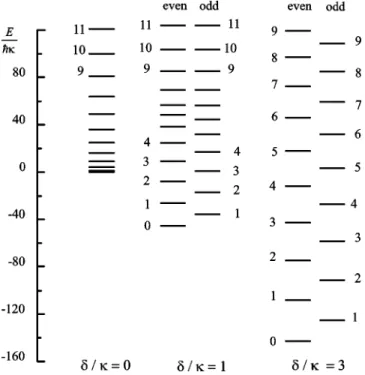
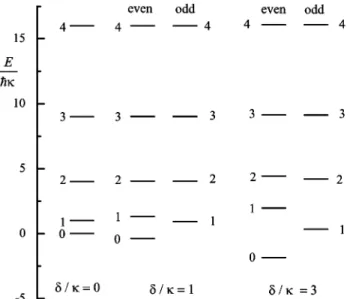
2. 共25兲In both cases, the difference between the Hamiltonian parts on the even and odd subspaces are proportional to ␦. These differences are responsible for the energy splitting be-tween the even and the odd energy eigenstates. Moreover, since these differences in the Hamiltonian parts occur for low values of, we expect that for a fixed value of␦/, the even-odd energy splittings decrease for increasing values. This is confirmed by numerical calculations. In Figs. 1 and 2, we display the energy levels of the Hamiltonian, for a few values of ␦/, both for the double-well case 共with N
⫽100), and for the diffraction case. The energy levels are found to be alternatingly even and odd, with increasing en-ergy. In the two-well case, the energy shifts and splittings due to the coupling are larger for the same value of␦/ and the same value of. This arises from the factor F, which is unity in the diffraction case, whereas in the two-well case it decreases from⬃J⫽N/2 at⫽0 to zero at⫽J. In fact,
the condition for weak coupling is that matrix elements cou-pling the states 兩
典
and 兩⫺1典
are small compared with their unperturbed energy separation. This condition can be expressed as⫽2␦
F
2⫺1⬍1. 共26兲
This confirms that for a given value of ␦/, the region of weakest coupling occurs for the highest values of. In the
FIG. 1. Energy levels in units of ប for the double well with
two-well case, the lowest-energy states start out to be nearly equidistant for low- values as long as is large.
V. PENDELLO¨ SUNG OSCILLATIONS
The energy splittings between the even and the odd eigen-states give rise to time-dependent eigen-states that oscillate be-tween the states 兩⫾
典
. In the diffraction case, they corre-spond to the well-known Pendello¨sung oscillations in the Bragg regime. Here we show that similar oscillations can occur for the two-well problem, and we give an analytical estimation of the oscillation frequencies. For the generic Hamiltonian given by Eq. 共19兲, the Bragg condition is ful-filled when inequality共26兲holds.The energy differences between the even and odd states to lowest order in can be found from the effective Hamil-tonian for two degenerate states that are coupled via a num-ber of nonresonant intermediate states. This situation occurs for the states兩⫾
典
, with their 2⫺1 intermediate states. In this case, the intermediate states can be eliminated adiabati-cally, as demonstrated in Sec. 18.7 of Ref.关15兴. The resulting effective Hamiltonian for these two states兩⫾典
has an off-diagonal element that is the ratio between two products. The numerator contains the product of the successive 2 matrix elements ⫺ប␦F⬘/2 of the Hamiltonian coupling neighbor-ing states, and the denominator is the product of the 2⫺1 unperturbed energy differences of the degenerate states 兩⫾
典
with the successive intermediate states. In the diffrac-tion case, this result coincides with the calculadiffrac-tion given in Ref.关12兴, which was obtained by diagonalizing a tridiagonal matrix and keeping only the lowest order in␦/.Generalizing this result to the present case of the two states 兩⫾
典
, we find that the effective Hamiltonian has the diagonal element具
⫾兩Hˆe f f兩⫾典
⫽ប2, 共27兲and the off-diagonal element
具
⫿兩Hˆe f f兩⫾典
⫽⫺ប⍀/2, 共28兲with⍀ an effective oscillation frequency given by
⍀⫽共⫺1兲2⫹1 1 22⫺1
␦2
2⫺1
1
[(2⫺1)!]2F. 共29兲
The factor F is just the product of the coefficients F suc-cessively coupling the states intermediate between 兩
典
and 兩⫺典
. In the diffraction case, we simply have F⫽1, whereas in the case of SU共2兲 symmetry, applying to the double well, we findF⫽共J⫹兲!
共J⫺兲!. 共30兲
These expressions are valid both for integer and half-integer values of. The eigenstates of the effective Hamiltonian are the even and odd states, and the eigenvalue equations are
Hˆe f f兩
典
⫾⫽(ប2⫿ប⍀/2)兩典
⫾. For integer values of,the frequency ⍀ is negative, so that the even states兩
典
⫹ are shifted upwards and the odd states are shifted downwards in energy. The opposite is true for half-integer values of . In both cases, the ground state is even, and the energy eigen-states for increasing energy are alternatingly even and odd. In view of the results of the numerical calculation mentioned above, one may expect that this alternating behavior of the even and odd eigenstates is valid for all finite values of the ratio ␦/. It is interesting to notice that in the special case that ⫽J⬅N/2, Eq. 共29兲 for the two-well case coincides with the ground-state energy splitting of two coupled quan-tum anharmonic oscillators, which model two coupled vibra-tional degrees of freedom in a molecule 关17兴.For an initial state 兩
典
, the effective Hamiltonian Hˆe f fleads to a time-dependent state that is given by Eq. 共17兲, apart from an irrelevant overall phase factor. This shows that the oscillating solution 共17兲 corresponding to the Bragg re-gime of diffraction can be generalized to the case of a con-densate in a double well. The same expression共17兲remains valid, while the oscillation frequency ⍀ is determined by Eqs. 共29兲and共30兲. This describes a state of the condensate atoms in the double well in the weak-coupling limit. In this case, the state oscillates between the Fock states 兩n1,n2
典
⫽兩N/2⫹,N/2⫺
典
and兩n1,n2典
⫽兩N/2⫺,N/2⫹典
.Obviously, when the initial state is given by 兩
典
⫾, the system is in a stationary state, and no oscillations occur. In this case, Pendello¨sung oscillations can still be induced by including in the Hamiltonian a term that is linear in Lˆz. Inthe diffraction case, there is no obvious physical realization of such a term. For the Wannier-Stark system, where the quadratic term in Lˆz2is absent, the linear term can be realized by imposing a uniform force, which gives rise to Bloch os-cillations关14,18兴. In the case of the BEC in a double well, a term បLˆz in the Hamiltonian can be realized by imposing an energy difference ប between the single-particle ground states in the two wells. When this term is periodically vary-ing, it can be used for coherent control of the condensate 关20兴. The additional term couples the even and odd
spaces, thereby breaking the symmetry of the Hamiltonian. On the basis of the states 兩
典
⫾, the effective Hamiltonian attains the off-diagonal element⫾
具
兩Hˆe f f兩典
⫿⫽ប. 共31兲When we assume that both␦ andare small compared with the splitting due to the interparticle interaction, so that we remain in the Bragg regime, the two states 兩⫾
典
remain decoupled from the other number states, and we have an effective two-state system. In practice, the parameter can be easily controlled, so that many effects of two-state atoms 关19兴can also be realized for these two states. For example, in analogy to the excitation of ground-state by an adiabatic sweep across the resonance, one could create an effective transfer from the state兩典
to the state兩⫺典
by varying the parameteradiabatically from a positive to a negative value that is large compared to⍀. This gives an effective collec-tive transfer of n⫽2atoms from one well to the other one.VI. TIME-DEPENDENT COUPLING
When the coupling ␦(t) varies with time, the time-dependent eigenstates of the Hamiltonian are coupled to each other. The eigenstate that correlates in the limit␦→0 to the state兩
典
⫾is denoted as兩⫾典
. Note that even eigenstates are only coupled to other even eigenstates, and odd eigenstates to odd eigenstates. The coupling results from the time depen-dence of the eigenstates. In fact, the term in the Schro¨dinger equation coupling兩⫾典
to兩⫾典
is proportional to冓
⫾共t兲冏
ddt
冏
⫾共t兲
冔
⫽⫺具
⫾共t兲兩Lˆ
x兩⫾共t兲
典
ប␦˙共t兲 E⫾⫺E⫾,
⫽. 共32兲
This coupling is ineffective in the case that the r.h.s. of Eq. 共32兲 is small compared with (E⫾⫺E⫾)/ប. In this case, an initial eigenstate remains an eigenstate at all times. This is the standard case of adiabatic following, which has been dis-cussed in the diffraction case关13兴. Since within the even or the odd subspace there are no degeneracies, the dynamics of adiabatic following is particularly simple. When the coupling coefficient ␦ is smoothly switched on, with the system ini-tially in the state 兩
典
⫽(兩典
⫹⫹兩典
⫺)/冑
2, the time-dependent state is obviously兩⌿共t兲
典
⫽e⫺i(t)共兩⫹典
e⫺i(t)/2⫹兩⫺典
ei(t)/2)/冑
2, 共33兲with (t)⫽兰tdt
⬘
关E
⫹(t
⬘
)⫹E
⫺(t
⬘
)兴/2ប the average phaseand(t)⫽兰tdt
⬘
关E⫹(t⬘
)⫺E⫺(t⬘
)兴/ប the accumulated phase difference of the two eigenstates. In a time interval that the coupling ␦ is constant, the phase difference (t) increases linearly with time, and state 共33兲 gives rise to expectation values oscillating at the single frequency 关E⫹(t⬘
)⫺E⫺(t
⬘
)兴/ប. When the coupling is switched off again, the phase difference approaches a constant limiting value ¯⫽(⬁). State 共33兲 at later times corresponds to a linear superposition of the states 兩⫾
典
proportional to兩
典
cos(¯ /2)⫹兩⫺典
sin(¯ /2). Again, as we see, this effect that is known in the diffraction case also has a counterpart for the double-well problem, where adiabatic switching of the coupling between the wells leads to a linear superposition of the Fock states 兩n1,n2典
⫽兩N/2⫹,N/2⫺典
and兩n1,n2典
⫽兩N/2⫺,N/2⫹
典
. By proper tailoring of the pulse, the final state can be made to coincide with either one of these Fock states, with the even state 兩典
⫹ or with the odd state 兩典
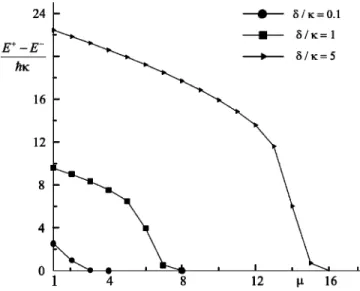
⫺, depending on the precise value of the accumulatedphase difference ¯ , which in turn is determined by the en-ergy difference E⫹⫺E⫺ between the even and the odd eigenstate. In Fig. 3, we plot this energy difference in the two-well case, for N⫽100, and for a few values of␦/. This shows that these splittings decrease monotonously for in-creasing quantum number . When ␦/ is not small, the decrease starts out to be slow, and then falls rapidly to zero . In contrast, when the coupling term␦(t) has the form of a short pulse around time zero, such that the action of the quadratic term can be neglected during the pulse, the initial state兩
典
couples to all other states兩⬘
典
. The state vector has exactly the same form 共16兲 as for diffraction in the Raman-Nath regime. For the two-well problem, the evolution opera-tor takes the form Uˆ⫽exp(iLˆx) with ⫽兰dt␦(t), whichhas matrix elements that can be expressed in the Wigner rotation matrices 关21兴by
具
⬘
兩Uˆ兩典
⫽i⬘⫺d⬘
J
共兲, 共34兲
with J⫽N/2. A comparison with Eq.共15兲shows that for the two-well-problem, the Wigner functions play the same role as the Bessel functions in the diffraction case.
VII. CONCLUSION
In this paper, we have analyzed both the similarity and the difference between the dynamical behavior of atom diffrac-tion from a standing wave and a Bose-Einstein condensate in
a double-well potential. In both cases, the Hamiltonian is given by the generic form共19兲, the only difference being in the commutation rules for the operators Lˆi with i⫽x, y ,z.
Well-known diffraction phenomena as Pendello¨sung oscilla-tions between opposite momenta in the case of Bragg dif-fraction, and the result of adiabatic transitions between mo-mentum states have counterparts in the behavior of the atom distribution over the two wells, in the case that the coupling between the wells is weak compared to the interatomic inter-action or slowly varying with time. A common underlying reason for these effects is the symmetry of the Hamiltonian for inversion↔⫺, and the energy splitting between even and odd states arising from the coupling term. In these cases, effective coupling occurs between the states 兩n1,n2
典
and兩n2,n1
典
with opposite imbalance between the particlenum-bers in the two wells. These states are coupled without popu-lation of the intermediate states, so that a number of n1
⫺n2 particles oscillate collectively between the two wells.
The interparticle interaction is essential for this effect to
oc-cur. A simple analytical expression is obtained for the Pen-dello¨sung frequency. An initial state 兩n1,n2
典
with awell-determined number of atoms in each well can be transferred to a linear superposition of 兩n1,n2
典
and兩n2,n1典
, which is ahighly entangled state of the two wells. A similar analogy is obtained to diffraction in the Raman-Nath regime. For the double-well problem this requires that the coupling is suffi-ciently short to ignore dynamical effect of the atomic inter-action during the coupling. The well-known diffrinter-action pat-tern in terms of the Bessel function is replaced by elements of the Wigner rotation matrix for the double well. These effects do not show up in the mean-field approximation, where the Gross-Pitaevski equation holds.
ACKNOWLEDGMENT
This work is part of the research program of the ‘‘Stich-ting voor Fundamenteel Onderzoek der Materie’’共FOM兲.
关1兴J. Javanainen and S.M. Yoo, Phys. Rev. Lett. 76, 161共1996兲. 关2兴M.R. Andrews, C.G. Townsend, H.-J. Miesner, D.S. Durfee, D.M. Kurn, and W. Ketterle, Science共Washington, D.C., U.S.兲 275, 637共1997兲.
关3兴G. Kalosakas and A.R. Bishop, Phys. Rev. A 65, 043616 共2002兲.
关4兴J. Javanainen and M.Y. Ivanov, Phys. Rev. A 60, 2351共1999兲. 关5兴G.J. Milburn, J. Corney, E.M. Wright, and D.F. Walls, Phys.
Rev. A 55, 4318共1997兲.
关6兴J.R. Anglin and A. Vardi, Phys. Rev. A 64, 013605共2001兲. 关7兴G.L. Salmond, C.A. Holmes, and G.J. Milburn, Phys. Rev. A
65, 033623共2002兲.
关8兴C. Menotti, J.R. Anglin, J.I. Cirac, and P. Zoller, Phys. Rev. A 63, 023601共2001兲.
关9兴N.R. Thomas, A.C. Wilson, and C.J. Foot, Phys. Rev. A 65, 063406共2002兲.
关10兴T.G. Tiecke, M. Kemmann, Ch. Buggle, I. Shvarchuck, W. von Klitzing, and J.T.M. Walraven, e-print cond-mat/0211604. 关11兴R.J. Cook and A.F. Bernhardt, Phys. Rev. A 18, 2533共1978兲;
A.Zh. Muradyan, Izv. Akad. Nauk Arm. SSR, Fiz. 10, 361 共1975兲; A.F. Bernhardt and B.W. Shore, Phys. Rev. A 23, 1290 共1981兲; P.L. Gould, G.A. Ruff, and D.E. Pritchard, Phys. Rev.
Lett. 56, 827共1986兲.
关12兴M. Wilkens, E. Schumacher, and P. Meystre, Phys. Rev. A 44, 3130共1991兲.
关13兴C. Keller, J. Schmiedmayer, A. Zeilinger, T. Nonn, S. Du¨rr, G. Rempe, Appl. Phys. B: Lasers Opt. 69, 303共1999兲.
关14兴H.L. Haroutyunyan and G. Nienhuis, Phys. Rev. A 64, 033424 共2001兲.
关15兴B.W. Shore, The Coherent Theory of Atomic Excitation共Wiley, New York, 1990兲, p. 1005.
关16兴D.M. Giltner, R.W. McGowan, and S.A. Lee, Phys. Rev. A 52, 3966共1995兲.
关17兴L. Bernstein, J.C. Eilbeck, and A.C. Scott, Nonlinearity 3, 293 共1990兲.
关18兴M. Ben Dahan, E. Peik, J. Reichel, Y. Castin, and C. Salomon, Phys. Rev. Lett. 76, 4508 共1996兲; E. Peik, M. Ben Dahan, I. Bouchoule, Y. Castin, and C. Salomon, Phys. Rev. A 55, 2989 共1997兲.
关19兴L. Allen and J.H. Eberly, Optical Resonance and Two-level Atoms共Wiley-Interscience, New York, 1975兲.
关20兴M. Holthaus, Phys. Rev. A 64, 011601共2001兲.