IJART- Vol-4, Issue-1, February, 2019 Available online at http://www.ijart.info/ DOI: https://doi.org./10.24163/ijart/2017/4(1):01-08
1 Oyewo et al., 2019 INTERNATIONAL JOURNAL OF APPLIED RESEARCH AND TECHNOLOGY
ISSN 2519-5115 RESEARCH ARTICLE
Smallholder Layer Bird Production In Afijio Local Government Area,
Oyo State Nigeria
1Adesope, A. A. A 4Agbaje, M.A 3Yusuf, W.A., 2Oyewo, I.O
1Forestry Research Institute of
Nigeria Jericho Hill Ibadan Nigeria
2Federal College of Forestry,
(FRIN) P.M.B 5087 Hill Forest, Jericho Ibadan Nigeria
3Department of Economics,
Nile University of Nigeria, Abuja
4Department of Agricultural
Economics, University of Ibadan Nigeria
Corresponding author:
Oyewo, I.O
Received: Nov 28, 2018 Revised: Jan 24, 2019 Published: Feb 28, 2019
ABSTRACT
Assessing the economics of production in poultry
enterprise is a veritable tool to ensure continuity in the
business. This study examined the profitability of layer
bird production in Afijio LGA using questionnaire on
randomly selected 110 layer bird farmers in the study area.
Data were analysed using descriptive statistics, costs and
returns analysis, and regression technique. The result
revealed that the average number of birds in each farm was
180; average total fixed cost per farm per year was N553,
000, while the average total variable cost was N1,
311,600.00. The total cost incurred in stocking the farm
was N1, 864,600 and the total number of crates of eggs
produced per month was 180 while the price per crate was
N500. Total revenue generated was N1, 530,000 per year
and the gross margin was N218, 400.00. The cost of feed,
price per day, old chick, labour and quantity of birds
stocked had a negative relationship with the gross margin
at 1%. The study therefore recommended that farmers
should be provided with loan facilities and inputs should be
subsidized in the study area.
IJART- Vol-4, Issue-1, February, 2019 Available online at http://www.ijart.info/ DOI: https://doi.org./10.24163/ijart/2017/4(1):01-08
INTRODUCTION
Poultry production is the fastest growing component of global meat production, with developing and transitional countries assuming a leading role (Assa, 2012). Poultry farming today is a huge business that is split into several operations including hatcheries, pullet farms for meat production or farms for egg production. Poultry production as an aspect of livestock production is important to the biological, economical, and social development of the people in any nation (Oladeebo and Ambe-Lamidi, 2007). The contribution of poultry production to total output increased from 26% in 1995 to 27% in 1999 with an increase in egg production alone accounting for about 13% during the period (Ojo, 2003). The development of the poultry industry in Nigeria has been described as the fastest means of bridging the protein deficiency gap prevailing in the country. Unlike it is with pigs and cattle, there are fewer religious or social taboos associated with poultry. Hence products from poultry provide an acceptable form of animal protein to a vast majority of people. Poultry production assures quick returns within weeks in the case of broilers, and in months, in the case of layers (Rajendran and Moharity, 2003). Poultry farming serves as an auxiliary occupation to complement the income from small and marginal farm space because of its vast potential to bring about rapid economic growth, particularly benefiting the weaker section of the populace (Ekunwe et al., 2006). The poultry industry plays an important role in the development of Nigeria economy. It is a major source of eggs and meat, which have nutritional value, particularly in the supply of protein (Olagunju and Babatunde, 2011). Each operation in the poultry farm can become a business by itself. Some farms specialize in producing eggs for market, some in hatching chicks. Other businesses focus on feed preparation or on using the waste from poultry farms
for compost production and fertilizing. If managed and marketed well, all segments of the poultry business can be profitable. Poultry meat and eggs offer considerable potential for meeting human needs for dietary animal supply (Folounsho and Onibi, 2005). Broiler production is usually done to meet seasonal demands while layer production is embarked upon for regular supply of eggs for various uses by households. Commercial layer farms play an important role in meeting national protein needs (Kabir and Haque, 2010) through the supply of eggs in addition to poultry meat. Adepoju, (2008) observed that problems such as high cost of feed, other production cost, disease and poor marketing and distribution network are problems plaguing the poultry industry which make it difficult for existing farms to expand while new entrepreneur are reluctant to go into the business. In addition, Murtala (2004) also, observed that the price of eggs does not vary proportionately with the rise in prices of feed and the cost involved in commercial layer production. This study therefore, analysed economics of layer production in Afijio Local Government, Oyo State, Nigeria and provides answers to the following research objectives:
i. analyse the costs and returns in layer production?
ii. determine the factors influence profitability in layer production?
iii. analyse the constraints to layer production?
LITERATURE REVIEW Poultry Production in Nigeria
IJART- Vol-4, Issue-1, February, 2019 Available online at http://www.ijart.info/ DOI: https://doi.org./10.24163/ijart/2017/4(1):01-08
Highly Pathogenic Avian Influenza (HPAI) across several countries in 2003 and especially, the confirmation of the epidemic in Nigeria in February 2006, brought attention of the Government of Nigeria (GON) and the international community to focused on the sub-sector by the (Adene, 2004). The types of poultry that are commonly reared in Nigeria are chickens, ducks, guinea fowls, turkeys, pigeons and more recently ostriches. Those that are of commercial or economic importance given the trade in poultry, however, are chickens, guinea fowls and turkeys, amongst which the chickens predominate.
Egg Production
The egg production cycle lasts for about one year. The pullets and layer hens are raised mainly in environmentally controlled poultry houses in cage systems. To make the maintenance process easier, automated feeding, watering, and egg collection systems were developed. Feed and water are moved on rotating belts which pass by the cages. Another rotating belt collects the eggs and sends them to the sorting chamber to be tested for fertility, graded, and sorted according to size, making them ready for delivery to the market (Farran, 2009), Laying hens in egg producing farms are usually of small body frame and body weight compared to broilers. They can be classified into two groups: dual purpose chickens or egg producing chickens. Egg producing chicken breeds have been bred and raised for maximum egg production (up to 300 eggs per year) rather than high meat yield (Beutler, 2007). Dual purpose chickens are smaller in size than commercial meat breeds. They are used for meat as well as egg production, and can produce around 200 to 250 eggs per year (Farran, 2009), There have been several developments to increase the marketing value of eggs. These developments include omega-3 eggs; folate and lutein enriched eggs, as well
as free run and organic eggs. These specialty eggs increase the value of eggs, and have caused a noticeable change in the market.
MATERIALS AND METHODS
This study was carried out in Afijio Local Government Area Oyo State, Nigeria. It is located in the south-western zone of the state, it covers a total land mass of 1.365km2 with about 30 towns and villages. Afijio Local Government has a population of 84,504 (2006, NPC). There are 10 wards in Afijio local government; Ilora I, Ilora II, Ilora III, Fiditi I, Fiditi II, Aawe I, Aawe II, Akinmorin/Jobele, Iware, and Imini.
IJART- Vol-4, Issue-1, February, 2019 Available online at http://www.ijart.info/ DOI: https://doi.org./10.24163/ijart/2017/4(1):01-08
0 1X1 2X2 3X3 4X4 5X5 6X6 7X7 8X8 9X9 10X10 11X11
Where,
π = Profit (Naira)
X1 = Age (Years)
X2 = Educational background X3 = Years of experience (Years) X4 = Feed (kg)
X5 = Labour
X6 = Drugs (N)
X7 = Price of matured layer (N) X8 = Birds in stock
X9 = Price of day old chick (N) X10 = Mode of production
X11 = Quantity of old birds (Numbers)
= The Stochastic error term
RESULTS AND DISCUSSIONS
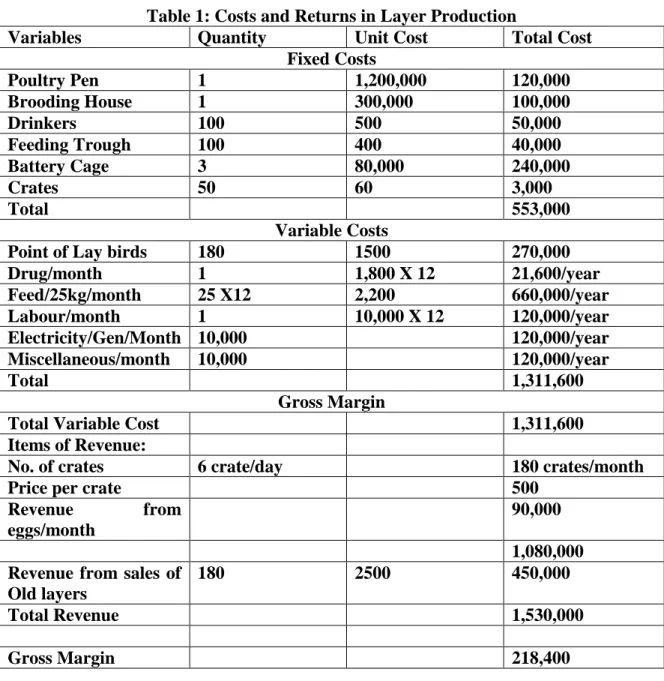
Table 1: Costs and Returns in Layer Production
Variables Quantity Unit Cost Total Cost
Fixed Costs
Poultry Pen 1 1,200,000 120,000
Brooding House 1 300,000 100,000
Drinkers 100 500 50,000
Feeding Trough 100 400 40,000
Battery Cage 3 80,000 240,000
Crates 50 60 3,000
Total 553,000
Variable Costs
Point of Lay birds 180 1500 270,000
Drug/month 1 1,800 X 12 21,600/year
Feed/25kg/month 25 X12 2,200 660,000/year
Labour/month 1 10,000 X 12 120,000/year
Electricity/Gen/Month 10,000 120,000/year
Miscellaneous/month 10,000 120,000/year
Total 1,311,600
Gross Margin
Total Variable Cost 1,311,600
Items of Revenue:
No. of crates 6 crate/day 180 crates/month
Price per crate 500
Revenue from
eggs/month
90,000
1,080,000 Revenue from sales of
Old layers
180 2500 450,000
Total Revenue 1,530,000
Gross Margin 218,400
Table 1 shows that on the average a smallholder layer farmer in Afijio local government spends N553,000 on fixed
IJART- Vol-4, Issue-1, February, 2019 Available online at http://www.ijart.info/ DOI: https://doi.org./10.24163/ijart/2017/4(1):01-08
far exceeds the total revenue, however, it promises to pay off since the gross margin is positive and in excess of the variable costs (N218, 000.00). This is an
indication that a smallholder farmer can continue in the business while settling the fixed costs incurred in setting up the farm.
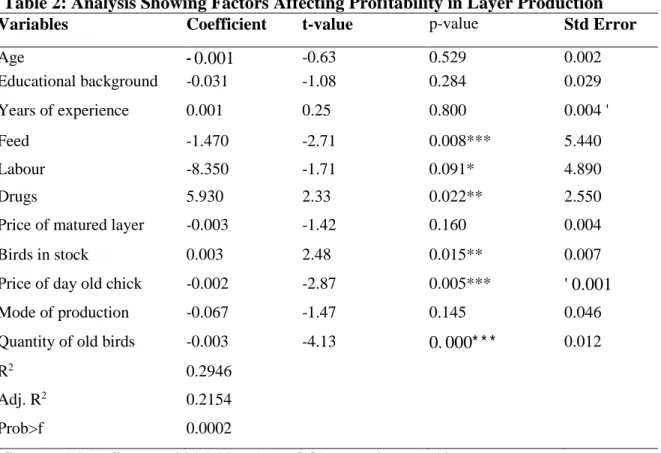
Table 2: Analysis Showing Factors Affecting Profitability in Layer Production
Variables Coefficient t-value p-value Std Error
Age -0.001 -0.63 0.529 0.002
Educational background -0.031 -1.08 0.284 0.029
Years of experience 0.001 0.25 0.800 0.004 '
Feed -1.470 -2.71 0.008*** 5.440
Labour -8.350 -1.71 0.091* 4.890
Drugs 5.930 2.33 0.022** 2.550
Price of matured layer -0.003 -1.42 0.160 0.004
Birds in stock 0.003 2.48 0.015** 0.007
Price of day old chick -0.002 -2.87 0.005*** ' 0.001
Mode of production -0.067 -1.47 0.145 0.046
Quantity of old birds -0.003 -4.13 0.000* * * 0.012
R2 0.2946
Adj. R2 0.2154
Prob>f 0.0002
Source: Field Survey, 2016. Number of Observation =: 110
Note: *** = Significant at 1%, ** = Significant at 5%, * = Significant at 10%
The Table 2 showed the factors influencing the profitability of layer production using the multiple regression analysis. Of the eleven variables considered, only 6 were statistically significant. Cost of feed was found to have a negative but significant relationship with the gross margin. This implies that as the poultry owners spent more on feeding, there was an increase in the cost of production and therefore a reduction in profitability. A unit increase in the amount of feed leads to a 1.470 unit decrease in profitability. The amount spent on labour also had a negative relationship with the gross margin. This implies that a higher cost of labour reduced the amount of profit generated from the sale of eggs. Cost of drugs however had n significant positive relationship with the gross margin. A
IJART- Vol-4, Issue-1, February, 2019 Available online at http://www.ijart.info/ DOI: https://doi.org./10.24163/ijart/2017/4(1):01-08
before stocking also had a significant negative relationship with the gross margin. This could be as a result of the low productivity of such birds while the farm
continued to incur the cost of feeding them. A unit increase in the stock of old birds lead to a 0.003 unit decrease in the gross margin.
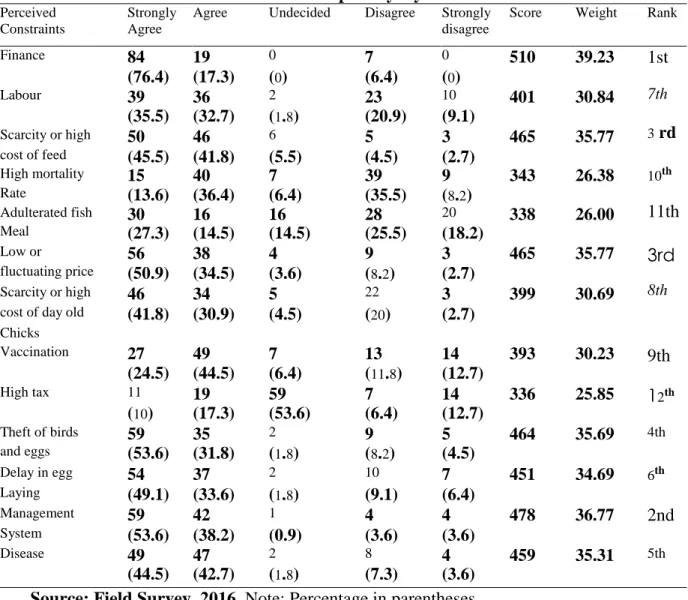
Table 3: Constraints in poultry layer Production
Perceived Constraints
Strongly Agree
Agree Undecided Disagree Strongly
disagree
Score Weight Rank
Finance 84 19 0 7 0 510 39.23 1st
(76.4) (17.3) (0) (6.4) (0)
7th
Labour 39 36 2 23 10 401 30.84
(35.5) (32.7) (1.8) (20.9) (9.1)
3 rd
Scarcity or high 50 46 6 5 3 465 35.77
cost of feed (45.5) (41.8) (5.5) (4.5) (2.7)
10th
High mortality 15 40 7 39 9 343 26.38
Rate (13.6) (36.4) (6.4) (35.5) (8.2)
11th
Adulterated fish 30 16 16 28 20 338 26.00
Meal (27.3) (14.5) (14.5) (25.5) (18.2)
Low or 56 38 4 9 3 465 35.77 3rd
fluctuating price (50.9) (34.5) (3.6) (8.2) (2.7)
8th
Scarcity or high 46 34 5 22 3 399 30.69
cost of day old (41.8) (30.9) (4.5) (20) (2.7)
Chicks
9th
Vaccination 27 49 7 13 14 393 30.23
(24.5) (44.5) (6.4) (11.8) (12.7)
High tax 11 19 59 7 14 336 25.85 12th
(10) (17.3) (53.6) (6.4) (12.7)
Theft of birds 59 35 2 9 5 464 35.69 4th
and eggs (53.6) (31.8) (1.8) (8.2) (4.5)
Delay in egg 54 37 2 10 7 451 34.69 6th
Laying (49.1) (33.6) (1.8) (9.1) (6.4)
Management 59 42 1 4 4 478 36.77 2nd
System (53.6) (38.2) (0.9) (3.6) (3.6)
Disease 49 47 2 8 4 459 35.31 5th
(44.5) (42.7) (1.8) (7.3) (3.6)
Source: Field Survey, 2016. Note: Percentage in parentheses
Table 3 shows the perception of farmers on the various constraints in layer production. The five-point Likert-scale was used to examine these positive perceptions. Among the perceived constraints in layer production, finance was found to be the highest as it ranked 1st
with a total score of 510 while high tax was found to be the least constraint as it had a score of 336 which placed it at the 12th position. Poor management system
came 2nd while both scarcity or high cost
of feed and low or fluctuating price came 3rd. Theft of birds find eggs, disease and
delay in the laying of eggs came 4th , 5th
and 6th respectively. In the lower half,
labour, scarcity or high cost of day old
chicks, vaccination, high mortality rate and adulterated fish meal was 7th, 8th, 9th, 10th
IJART- Vol-4, Issue-1, February, 2019 Available online at http://www.ijart.info/ DOI: https://doi.org./10.24163/ijart/2017/4(1):01-08
7 Oyewo et al., 2019
CONCLUSION
The findings reveal that layer production is profitable in the study area. Analysis of the result also showed that inputs such as cost of feed, amount spent on drugs, price, number of birds in stock, price of day old chicks and quantity of old birds had a significant relationship with the profitability of layer production in the study area. Finance, poor management, scarcity or high cost of feed, low or fluctuating prices, theft of birds and eggs, disease and delay in the laying of eggs were the major problems associated with layer production in the study area.
RECOMMENDATIONS
The study therefore recommends that farmers should have access to loans and credit facilities at low interest rate in order to help them boost their production level. Farm inputs such as drugs and vaccines should be made available to the farmers at the right time and at subsidized prices. Layer farmers should endeavour to form cooperatives to enable them to access loans from the various financial institutions. Resource personnel like extension agents should be motivated to visit and educate farmers regularly on modern poultry production. Efforts should be made to improve maize production through the provision incentives in order to provide feed for the poultry industry.
REFERENCES
1. Adene, D. F. (2006). Avian Influenza: The Trans-continental Plague.
(WPSAS-Ghana, Poultry Seminar) Accra,
“The Structure and Importance of the Commercial and Village! Based Poultry Industry In Nigeria” ppl09 (Technical Report)
2. Adepoju, A.A (2008). Technical Efficiency of Egg Production in Osun State, Nigeria, International Journal of Agricultural
Economics and Rural Development 1(1):7-14.
Assa M.M. (2012). Poultry Production and Rural Poverty among Small-Scale Famers in
Mzimba District of Malawi. Livestock Search
for Rural Development. Vol. 24, pp 177.
3. Beutler, A. (2007).Introduction to Poultry Production in Saskatchewan, University of Saskatchewan, Saskatoon, Saskatchewan, S7N 5A8.
4. Ekunwe P.A, Soniregun O.O, and Oyedeji J.O, (2006): Economics of Small Scale Deep Litter System of Egg Production in Oredo Local Government Area of Edo State, Nigeria. International Journal of
Poultry Science Vol. 5(1): 81 - 83.
5. Faran, (2009). Personal Communication. Federal Government of Nigeria/United Nations International Children’s Emergency Fund, (1994): Nutritional Status of Women and Children in Nigeria. In: ICN report, Lagos Nigeria. 6. Folorunso, O.R.. and G.E. Onibi, (2005): Assessment of Nutritional Quality of Eviscerated Waste from Selected Chicken Types.
7. In Onibi, G.E., Agele, S.O and. Inoni, O.E, (2010). Cost and returns to Artisanal Fishing in Delta state, Nigeria.
FAMAN Journal. Vol. 11(1): 62 – 70
8. Kabir F. and Hague M.T. (2010). Poultry Marketing in West Africa: Ghana EPAR Brief No. 83. Prepared for the Market Assess Team of the Bill and Melinda Gates Foundation. May 28, 2010.
9. Murtala, A (2004). Cost and Return Analysis of Poultry Egg Marketing in Bauchi Matropolis, Nigeria In: A. Ibrahim, B.G Shettima, I.M Sulumbe, and H.A Abdullahi. (eds). Economic Analysis of Poultry Egg Production in Kaduna North Local Government Area of Kaduna State, Nigeria. Proceedings of the 23rd Annual National Conference of Farm Management
Society of Nigeria, December, 14 - 17 2009,
Pp. 635 - 640.
10. Ojo, S.O, (2003). Productivity and Technical Efficiency of Poultry Egg Production in Mlgeriii International Journal
of Poultry Science, 2: 459 - 464.
IJART- Vol-4, Issue-1, February, 2019 Available online at http://www.ijart.info/ DOI: https://doi.org./10.24163/ijart/2017/4(1):01-08
8 Oyewo et al., 2019
12. Oladeebo, J.O, and A.I Ainbe - Lamidi, (2007). Profitability, Input Elasticities and Economic Efficiency of Poultry production among Youth Farmers in Osun State, Nigeria. International Journal of
Poultry Science 6(12): 994 - 998.
13. Olagunju F.I, and Babatunde R.O, (2001): Impact of Credit on Poultry Productivity in South West Nigeria, Asian Research Publishing Network (ARPN),
Journal of Agriculture and Biological Science
(10): 105 - 117.
14. Omotosho, O.A and Ladele, A.A (1988). Management problems in large scale poultry business in Nigeria. Farm
Management Journal 3: 27-35.
15. Orebiyi, J.S, Henri - Ukoha, A, Ben - Chendo, N.G, Tasie, C.M, and Ekine, D.I, (2012). Determinants of the Credit Supplied by the International Fund for Agricultural Development (IFAD) to Rural Farmers -
Beneficiaries in Rivers State, Nigeria.
International Journal of Agricultural
Economics, Management and Development
(1JAEMD) Department of Agricultural
Economics and Extension, Faculty of Agriculture, Kogi State University, Anyigba, Nigeria. Pp 84 - 96.
16. Ranjendran K, and Moharity S, (2003): Comparative Economic Analysis and Constraints in Egg Production Under Cage Vs Deep Litter System of Rearing in
International Journal of Poultry Science 2(2):
153 - 158.
17. Subhash Sarker, Joynal Abedin and Fakhrul Islam, (1999). Performance of Commercial
Farms: A Profitability and Efficiency Analys
is. BangladeshJournal of Agricultural