TECHNICAL UNIVERSITY OF CLUJ-NAPOCA
ACTA TECHNICA NAPOCENSIS
Series: Applied Mathematics, Mechanics, and Engineering Vol. 61, Issue III, September, 2018
FUTURE NETWORKED MANUFACTURING – A BREAKTHROUGH
CONCEPT AND ITS IMPLEMENTATION
Max HOSSFELD, Clemens ACKERMANN
Abstract: The 4th Industrial Revolution is causing significant changes to society and industry alike. All players have to adapt quickly, as technology-cycles get shorter, as entire markets rapidly change, and as new competitors with disruptive business models surface. Such challenges cannot be faced by an isolated player. The issue requires an agile collaboration network of partners from various sectors and interdisciplinary research to create a new ecosystem, thus securing as well as creating jobs. This allows to drastically limit the (financial) risks involved in R&D, it ups the speed of research, and it enhances the quality of the outcome. ARENA2036 is such a platform. It enables partners form industry and research to conjointly develop breakthrough technologies. This paper fathoms ARENA2036 as a way of shaping the Fourth Industrial Revolution. It addresses the basis of cooperative research platforms, the preconditions of joint R&D, and the benefits of this interdisciplinary environment.
Key words: Industry 4.0, Digitalization, work of the future, network, manufacturing
1. FACING THE CHALLENGES OF THE FOURTH INDUSTRIAL REVOLUTION
Founder and executive chairman of the World Economic Forum, Klaus Schwab, aptly yet somewhat dramatically summarizes the general consensus regarding the Fourth Industrial Revolution as follows: Technological Innovations will revolutionize the industry; for humanity – everything changes [1]. There is no doubt that we are on the brink of said Fourth Industrial Revolution. And albeit that we might not know every parameter of it just yet, we do begin to fathom that it will integrally transform almost every aspect of live. It is already transforming our understanding of the possibilities regarding the interplay of technologies, and it surely will transform our understanding of the potential interplay between the physical and the digital world.
It is rather obvious that such a seismic shift comes with intricate challenges on all fronts. As innovation cycles get ever shorter, questions regarding technological feasibility, the costs and risks of high-impact research, flexibility in as
well as the acceleration of R&D-processes, the integration of small and medium-sized businesses in Industry 4.0 innovation processes, and many more similar considerations are in the foreground, when thinking about ways that ought to enable one to be part of the innovators’ network. Beyond that, questions arise that have an even wider scope: In his book The Rise of the
Robots, Martin Ford famously asks: how and
what alters our notion of work and will there soon still be any? How will society as a whole change in the future based on the innovations of today? [2] And lastly, Where and how does innovation originate in the first place?
However, being at the brink of a revolution also means that one has the chance to actively define the aforementioned missing parameters, thus pivotally shaping the next cycle of innovations.
network and by subsequently fathoming a way that allows to integrally realize its complexities.
2. FUTURE NETWORKED MANUFACTURING (A)
Established definitions of networked manufacturing usually focus on aspects regarding a consistent data flow so as to ensure an uninterrupted communication within production, thus enabling an optimized co-ordination, which leads to better control in and around manufacturing. This is to say that – qua definition – networked manufacturing mainly deals with increasingly digitalizing production processes, which ultimately allow for the realization of a decentralized system of value creation. In order to implement such a network with a consistently digitalized production and a decentralized system of value creation, numerous experts from various fields have to seamlessly work together.
One example of implementing and further developing some key aspects of FNM is, accordingly, by means of a new approach to researching it. More precisely, this means that by creating a closely knit network of researchers from the sciences as well as from the industry and by bringing them together in an environment that allows for the actualization of the potentials inherent to FNM, the network beyond production – i.e. alongside the entire value chain – can also be thought and implemented holistically. The consequence of implementing FNM understood in such a way, would be that innovation could happen anywhere in the value chain. Accordingly, individualized products – in software and hardware – could simultaneously be developed and continuously adapted. One such hub that aims at implementing the aforementioned key aspects of a network of innovation and ultimately value creation is ARENA2036.
3. THE ARENA2036 RESEARCH CAMPUS – AN INTERDISCIPLINARY INNOVATION-HUB
In a recent Harvard Business Review article, David Burkus poignantly observes that “Innovation is not an idea problem.” Instead – and with reference to corporate R&D-departments – he continues, “it’s a recognition problem.” [4] In other words, this means that it is the limited capability to recognize innovative ideas worth pursuing within the somewhat stiff frameworks of established corporations that restrict a long-term approach to the creation of value. The consequence of this is that typical corporate R&D is rather working on reforming their respective products in order to ensure stable short- and mid-term profits instead of running the risk of disrupting their business case by facilitating truly revolutionary thought. In a word: they are merely researching so as to further develop.
As opposed to this, the research and innovation platform ARENA2036 – viz. the Active Research Environment for the Next Generation of Automobiles – stands for novel ways of collaborative research by means of interdisciplinary as well as transinstitutional cooperation, thus aspiring to actualize disruptive potentials. As such, it is a platform that allows experts from the sciences as well as from the industry to conjointly work on topics such as future mobility, the future of production, and the future of work in the context of digitization. The common goal that all partners are striving to achieve is the implementation of the anthropocentric “versatile production of the future for intelligent, multi-material lightweight construction with functional integration.” Both technological branches of this research – i.e. regarding production and pertaining to the product on the other – are key to the development and finally to the implementation of a sustainable Industry 4.0 along the entire value chain.
accident-free, individualized and fully integrated lightweight vehicle. In order to cover such a highly complex field, some 200 researchers from about 32 world-class scientific as well as industrial partners, pool their competencies on the ARENA2036 research campus. The premise for instituting a truly productive collaborative network that encompasses the sciences as well as the industry are: Resolving any legal presuppositions for a functioning Public-Private Partnership (PPP), sufficient public funding so as to generate research funds from the industry, and finally, an actual research campus.
Initially, the University of Stuttgart together with six more partners answered a call by the German Federal Ministry of Education and Research (BMBF) for the formation of a so-called Research Campus – a PPP for Innovation (fig. 1). Since then, ARENA2036 has turned into a flagship-project that is also supported by the European Fund for Regional Development (EFRE), and, of course, by its more than 32 partners. The goal of the initiative is to create an ecosystem that facilitates high-risk precompetitive research, which has the potential of leaping to the next curve of technological development. Since early this year, such a physical environment has been realized in the form of the ARENA2036’ state-of-the-art research factory.
Fig. 1. Strategic Triangle of ARENA2036.
The 10.000 m2 ARENA2036-building, is located on the University of Stuttgart campus in Germany. Its trend-setting architecture resembles the ARENA2036’ core-research topics: it is constructed using lightweight material, it is highly energy efficient, and it not
least allows for utter flexibility regarding the working environment as well as the production processes. As for the working environment, this means that it is specifically designed to facilitate an atmosphere of belonging with the entire project as well as to serve as a place for testing new ways of creatively working together. More precisely, the working spaces of the ARENA2036 building feature the following key aspects: there are 2.500 m2 of office area and flexible as well as open office space(s) so as to guarantee short distances, quick transfers, and heightened creativity. There are furthermore recreational areas as well as brainstorming areas that – among other things – serve to level out established hierarchies and to foster “out of the box”-thinking. Simultaneously, the 7.500 m2 shop floor allows for actually giving the flexible production of the future an honest try.
Additionally, the ARENA2036-building has a twofold knock-on effect: on the one hand, it heightens the ARENA2036 visibility by attracting numerous visitors from state, federal as well as international politics, from the industry, and from the general public. On the other, it initiates cooperation beyond the research campus, thus serving as a catalyst that strengthens the industry in the surrounding region as well as of German as a whole.
4. THE ARENA2036 PROJECT-SCAPE: STATUS QUO AND QUO VADIS
ARENA2036 started its endeavors with four initial base projects, which conjointly aimed at contributing to the implementation of the ARENA2036-vision: bringing to life the versatile production of the future for intelligent, multi-material lightweight construction with functional integration. This ambitious vision will be achieved by pursuing the aforementioned three strategic goals: First, Mobility2036, which will for example be characterized by multi-material lightweight construction with functional integration, thus redefining the borders of lightweight design based on multifunctionality and new materials. Second: the anthropocentric Production2036, which will be highly efficient due to its versatility as well as completely flexible because it will be universally digitalized. And lastly, Work2036, which fathoms a novel research environment that continuously changes according to the requirement of the worker, the product, and production. All three strategic goals are being
thought, conceived, and implemented within the framework of digitalization. In July 2013, ARENA2036 launched the four initial projects “Leifu”, “DigitPro”, “ForschFab”, and “Khoch3”. The first of these four projects, “LeiFu”, stands for “Intelligent lightweight construction with functional integration” and aims at both, a lighter and also cheaper car of the future. The second one, the “Digital Prototype”, is simulating a holistic production process along the entire value chain. The goal of the third initial project, “ForschFab”, is to enable the agile production of the future automobile based on a continuous production at an optimal optimal operating point due to versatile production systems. Lastly, “Khoch3” is the overarching area of research that investigates new types of cooperation with a focus on ways to promote creativity, cooperation, and competence transfers so as to create an integrative and agile workplace that allows actualizing interdisciplinary potentials.
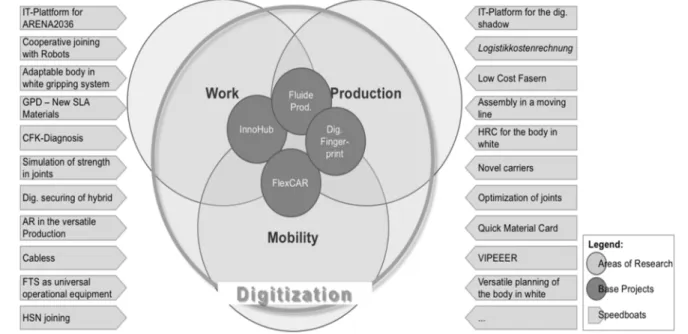
Fig. 2. The ARENA2036 Project-Scape.
In mid 2018, ARENA2036 successfully applied for being a federally acknowledged Research Campus for the coming five years: i.e. the second phase of a successful PPP for Innovation. Thus far, there are some 60 research projects up and running, plus an additional 22 completed projects (fig. 2). The increase of ARENA2036-projects – from four projects in 2013 to some 90 projects – is just one indicator
showing that the PPP is not only a sustainable but a particularly trend-setting endeavor.
The following four phase 2 projects focus on researching the mobility, production, and work of the future within the context of digitalization and will be launched in late summer of 2018:
• Agile InnovationHub – cooperative
• Digital Fingerprint – intelligent data
collection, editing, and transfer along the entire value chain
• FlexCAR – an open vehicle platform
with open soft- and hardware interfaces for future mobility
• Fluid Production – an anthropocentric,
cyberphysical production system for future mobility
The first one of those projects is developing tools to foster creativity and invention within a network of researchers, whilst it is accompanying the innovation processes of the latter three projects. They, in turn, deal with manufacturing processes and product creation in an increasingly digitized production.
Each of the four projects has a certain perspective on the topics at hand: The Digital Fingerprint focuses on individual components, FlexCAR concentrates on the product with the entire network of value creation in mind, and Fluid Production brings production itself into focus. Together, these four joint projects span the key aspects of Future Networked Manufacturing.
5. FUTURE NETWORKED MANUFACTURING (B)
From the perspective of an FNM-approach – and bearing in mind the established definition consulted above – the joint project Fluid Production surely lies at the heart of the endeavours to guarantee a consistent data flow, which facilitates an uninterrupted communication within production.
In turn, this seamless communication enables an optimized co-ordination that eventually augments control in and around manufacturing. More precisely, Fluid Production aims at an anthropocentric, cyberphysical concept of production that is based on the flexibility of all means of production, which, accordingly, have to be able to dynamically (re-)configure themselves (locally). One of the main advantages of such a novel approach to production systems is the possibility to intelligently sequence production; viz. the product is enabled to choose its optimal path
through production, or, vice versa, the means of production are perpetually reconfiguring themselves in such a way that they choose the optimal individual operation at the perfect time. This means not only that production is capable of operating with a minimum of determinations but also that potential bottlenecks can easily be eliminated.
Consequently, flexibility and overall efficiency increase significantly. Also, the seamless reconfigurability of all means of production – i.e. a production made up of micro factories – ensures a swift response time to any change within the network of suppliers.
Taken together, this means that decisions can be made much closer to the point of the actual creation of value. When going one step further, Fluid Production bears the potential to decentralize production within the value creating network by virtually pooling the means of production, which enables a permanent out- and insourcing of individual operations.
Those manufacturers that were formerly designated as suppliers are now equally involved in the production processes, since they are enabled to fetch relevant tasks based on the accessibility of live production data. In other words, the Fluid Production approach to FNM levels production capacities along the entire value creating system by means of dynamic load balancing within the production network.
Such a modus operandi for production processes benefits from novel contractual processes as well. The currently applied skeleton agreements that require negotiations almost every single time a new participant enters the network or whenever there are changes in production processes or product specifications require a fundamental revision. However, with the growing dynamic within the system of value creation, contractual processes have to become more flexible as well.
Consequently, the bilaterally negotiated skeleton agreements that usually only apply to a specific arrangement shall be replaced by a multilaterally negotiated model agreement that also copes with topics such as intellectual property rights within the entire network.
a quasi-open-source environment is simplified to such an extent that the Fluid Production-concept could be fully implemented.
Building on parts of the Fluid Production, FlexCAR aims at dissolving the classic product life cycle and at augmenting the flexibility within the network of production by creating an open vehicle platform with open soft- and hardware interfaces.
By opening the platform for and by granting access to every supplier, the determined structure and the predefined properties of products as well as the rigid hierarchies within the system of value creation dissolve.
This decentralization not only changes the role of suppliers from being rather passive members of the supply chain to becoming proactive competitors, but also facilitates novel approaches to innovation by making development cycles more flexible and by decentralizing innovative potentials.
Once such an open platform is realized, the ensuing product becomes update- and upgradable. Taken together, FlexCAR promises new possibilities to realize entirely novel business models for OEMs as well as for suppliers.
The former mainly become platform operators that are responsible for security and safety of the product, whereas the latter not only deliver components to the OEM but also enter after sales due to the update- and upgradability of the product.
For these two approaches to work, every component needs a Digital Fingerprint, since both, production and product, rely on the consistent availability as well as accessibility of data.
For example, the update- and upgradability of any product only becomes feasible, if a seamless integration of new components into the existing (digital) ecosystem is possible.
Accordingly, the Digital Fingerprint completes the FNM-approach at hand by guaranteeing the consistency of the data flow along the entire – now intelligent – value chain. In other words, the Digital Fingerprint enables the individual adjustment of the manufacturing process by constantly granting the opportunity to assess each component;
during production as well as once it is integrated in the product.
The actual value added of this approach increases with the number of intelligent components that are directly interconnected and consistently interpreted.
The actualization of such congeneric projects with a realization horizon far in front requires not only the necessary physical research infrastructure but also an environment of cooperative collaboration so as to generate further projects that support the general vision of, in this case, realizing key aspects of FNM.
6. COOPERATION AND COLLABORATION
Accordingly, the complex, and rapidly growing ARENA2036-project-scape, requires first a collective vision shared by everyone involved. But in order to work towards a vision, there also needs to be a continuous institutional will to cooperate.
Beyond such structural cooperation – as a fundamental condition for the realization of any PPP – there needs to be an ecosystem that allows for active collaboration. In this context, the former has to be understood teleologically – i.e. all parties involved are creating the structural conditions to work together towards a common goal; viz. towards that which will stand as the
opus.
Complementing this is the latter, which connotes the collective work beneath one roof that not only facilitates learning from each other but also a specific research campus culture: the
labor. In a word, cooperation signifies an
operative prerequisite for any kind of
functioning partnerships, whereas collaboration
connotes the actual process of joint laboring. One aspect of cooperation that makes the joint research at ARENA2036 possible is its membership structure. The network of partners is made up of the University of Stuttgart, the Stuttgart University of Media Studies, various research institutes, large firms, and SMEs.
as well as material sciences to ergonomics and knowledge management.
The significant aspect for the ARENA2036-research endeavors was to get all the different legal forms to cooperate in order to eventually be able to come together beneath the one roof. As of today, all partners agree to the same statutes and oblige to the same NDA.
By these means, all of the 32 ARENA2036-members are enabled to actually work collaboratively with each other on their respective research projects.
This is to say that bothaspects, cooperation as well as collaboration, are a conditio sine qua non in order to sustainably ensure the actualization of all synergy potentials that exist in the Stuttgart region and beyond as well as for the realization of the research endeavors at hand.
Beyond these immediate on campus research activity, a steady transfer of the findings back to the industry as well as to university teaching and research is a crucial factor in measuring the success of ARENA2036.
7. CONCLUDING REMARKS
Bearing all this in mind, ARENA2036 is not
the answer to every challenge posed by the Fourth Industrial Revolution, but it is a platform that helps defining the parameters of it by way of collaborative research.
Such a joint research approach makes ARENA2036 an enabler that facilitates a way of inquiry that simultaneously rethinks product and production in the physical as well as in the digital world, whilst supporting the amalgamation of both.
This can be achieved by consolidating already existing competencies in the Stuttgart region as well as by connecting experts from all over the world. In doing so, ARENA2036 brings together various partners from the sciences and from the industry, thus enabling everyone
involved, to benefit from a network of trailblazers that – taking up Klaus Schwab again – conceive technological innovations, which help to revolutionize the industry.
FNM has been identified as a possible key to such a way of thinking and working, as well as a facilitator that allows conceiving production and product(s) of the future simultaneously.
ARENA2036 approaches the way toward its implementation by way of a research program that centers around the topics mobility, production, and work of the future in the context of digitization.
At the heart of this program lie three joint projects that fathom and implement a digitized, interconnected, and self-(re)configuring production – Fluid Production – for a vehicle as an open platform with open soft- and hardware interfaces; FlexCAR.
Both projects depend on the flexibility of all means of production and on a consistent data-flow within production and across various components, which is the focus of the research conducted in the Digital Fingerprint.
8. ACKNOWLEDGMENTS
We are grateful to all our partners for their commitment to ARENA2036 and for their dedicated research.
8. REFERENCES
[1.] Schwab, Klaus., The Fourth Industrial
Revolution, 1st edition, New York, NY,
(2017).
[2.] Ford, Martin., The Rise of the Robots – Technology and the Threat of a Jobless
Future. 1st edition, New York, NY, (2015).
[3.] Burkus, David. Innovation Isn’t an Idea
Problem, Harvard Business Review (2013,
Productia conectata a viitorului – concept si implementare
Rezumat: A patra revoluție industrială provoacă schimbări semnificative atât în societate, cât și în industrie. Toți jucătorii trebuie să se adapteze rapid, pe măsură ce ciclurile tehnologice devin mai scurte, pe măsură ce piețele întregi se schimbă rapid, și pe măsură ce noii concurenți cu suprafețe de afaceri aflate în dezordine. Astfel de provocări nu pot fi întâmpinate de un jucător izolat. Problema necesită o rețea de colaborare agilă de parteneri din diferite sectoare și cercetare interdisciplinară
pentru a crea un nou ecosistem, asigurând astfel, precum și creând locuri de muncă. Acest lucru permite limitarea drastică a riscurilor (financiare) implicate în cercetare și dezvoltare, creșterea vitezei de cercetare și sporirea calității rezultatului. ARENA2036 este o astfel de platformă. Acesta permite partenerilor să formeze industria și cercetarea pentru a dezvolta împreună tehnologii inovatoare. Această lucrare susține ARENA2036 ca o modalitate de modelare a celei de-a patra revoluții industriale. Ea abordează baza platformelor de cercetare cooperatiste, condițiile prealabile ale cercetării și dezvoltării comune, precum și beneficiile acestui mediu interdisciplinar.
Max HOSSFELD, ARENA2036, [email protected]