TECHNICAL UNIVERSITY OF CLUJ-NAPOCA
ACTA TECHNICA NAPOCENSIS
Series: Applied Mathematics, Mechanics, and Engineering Vol. 60, Issue II, June, 2017
MULTICRITERIAL SELECTION OF PLASTIC MATERIALS IN THE
DESIGN PROCESS
Radu Mircea MORARIU-GLIGOR, Rareş RUSAN, Ioan BLEBEA
Abstract: The choice of plastic materials in the design activity is based on technical properties as well as on aesthetic and environmental properties. The multitude of properties considered, as well as the variety of applications in which plastics are used, make their choice difficult. In this study it is presented an application which makes it easy to choose plastic materials, using a multitude of combinations of criteria. Key words: multicriterial selection, plastics material, design
1. INTRODUCTION
In the design process, the choice of materials is an extremely important stage through which is made the connection between the mathematical model used and the actual realization of a product.
Choosing the material is a difficult stage thanks to the extremely high number of existing materials, and an error can lead to either an inadequate piece or a high cost.
When selecting a material, it is not only necessary to take into account the properties necessary to achieve a certain functional performance, but also the way it is processed, its impact on the environment, the aesthetic properties, and the way of recycling it.
Most of the time, the choice of materials is based on the designer's experience, the materials being selected from catalogs or tables based on low data regarding their properties.
There are applications where the properties of the materials are not very important, the main criterion for choosing them is the cost price. On the other hand, there are (more frequent) situations where there is a number of limitations imposed on the materials used, so their selection becomes a laborious and difficult action.
Materials are chosen depending on physical, mechanical, thermal, electrical or chemical,
environmental or aesthetic properties. It is only from listing the properties that there is a wide variety of features to be considered. Until recently, metallic materials were predominant in machine and tools parts. Along with industrial development, other types of materials (e.g. polymers) that can replace metallic materials with success. Choosing materials based only on reason and experience can lead to inappropriate solutions, with negative effects on functioning operation and cost price.
The essence of the material selection process is not to replace one material with another, but to select that material, which together with the associated processes (production, processing, recycling) provide a better solution. For example, pressure casting of an mixed metal can be replaced by injection molding of a polymer, etc.
The paper presents a method and software tool to choose materials for specific uses, depending on their physical, environmental and aesthetic properties.
2. SELECTION OF MATERIALS IN INDUSTRIAL DESIGN
When there are no limitations on the choice of material, the designer must choose from a variety of materials.
into account a wide variety of properties such as: physical, mechanical, thermal, electrical, optical, ecological, processing, acoustic, tactile.
A classification of the materials is illustrated in the figure 1.
Fig. 1. Classification of materials [1]
Fig. 2. Multi-dimensional map (MDS) of the mechanical attribute similarity [1]
Each material is characterized by a series of technical data, such as: modulus of elasticity, elasticity limit, tensile strength, compressive strength, stiffness, Vickers hardness, temperature of use, etc.
The most useful classification of design materials should group materials having similar values of these technical attributes. So, a graphical representation of properties was chosen, which allowed the discovery of similarities between different materials. Such a representation, which combines multiple properties into a single map, is called multi-dimensional scaling, or MDS (fig. 2) [1].
MDS is a way to reveal similarities and differences between group members using information about many attributes.
Applied to materials, first, the "distance" between each material and any other material in the group is calculated, taken in pairs. "Distance" is a measure of difference. If all the attributes of two materials are identical, the distance between them is zero. If all, except one
is the same, and an attribute is ten times different, the distance can be given a value of 10.
Figure 2 is an example MDS map for engineering materials based on 15 of their mechanical and thermal attributes.
3. MULTICRITERIAL SELECTION OF MATERIALS
The study accomplished by the authors and presented in this paper refers to plastic materials, in all their range of data: physical, technical, aesthetic and ecological, sufficient.
It was considered that the most convenient way of comparative analysis for groups of materials is based on two-dimensional maps [2]. In order for the results of the analysis to be relevant, the material group will be chosen according to a set of criteria defined by the parameter value limits (physical, mechanical, aesthetic, environmental, etc.).
Thanks to the different marginal values for each of the two analytical parameters, the difference in marginal values may be very wide in some materials, while the others may be more limited.
Also, the placement of each material in the two-dimensional map gives a very clear picture of the ratio of the values of the two parameters of analysis among the materials in the group, which can lead to the formulation of some practical conclusions of the relation between the parameters and the relative influence mode.
In conclusion, in the selection phase of plastic materials, such a representation in the form of a two-dimensional map of the parameters is very useful. In this case, one of the parameters is declared the main parameter (e.g. the modulus of elasticity), and the second parameter (e.g. elongation) is a secondary parameter, but which must be taken into account when making the choice, so that the chosen material meets the best fitting of the values of both imposed parameters.
Starting from the idea that in the current practice of designing, the engineer will want a particular material starting from a defining parameter (main) that lies between some extreme values but will impose some other restrictive secondary conditions for other Materials available for design
parameters, the information contained in the representation in the form of two-dimensional maps become very useful.
Also representations, in the form of two-dimensional maps, are very easy to interpret from the analysis of the position and the extension of each material within the map, where two or more materials or a combination of materials can be found satisfying the requirements.
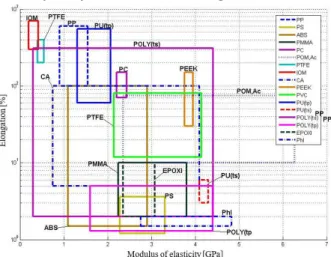
The following is an example of analyzing a group of materials by comparing two representative technical parameters: modulus of elasticity and elongation. Initially, a group of 17 plastics, whose technical data is shown in Table 1, was taken into consideration and the two-dimensional map of Figure 3 was derived.
The group of plastics was selected according to the criterion: the medium value of the modulus of elasticity between 0.30 and 4.35 [GPa], this being considered the main parameter of analysis, which is why the ordering of the materials in the table is made ascending according to its values.
Analyzing the obtained map, it follows that for the same modulus of elasticity limits: 0.31 - 4.31 [GPa], we will find more materials differing in the width of the extreme values: Example Polycarbonate - PC: 2.21 - 2.44 [GPa], PTFE: 0.40-0.55 [GPa], but also materials with wider dispersion, e.g. rigid polyester - POLY (tp): 1.60 - 4.40.
Table 1. First selection of materials
SYMBOL OF MATERIAL
The modulus of elasticity [GPa]
Elongation [%] Min.
val. Max.
val.
Mean val.
Min. val.
Max. val. IOM 0,20 0,42 0,31 300,00 700,00 PTFE 0,40 0,55 0,48 200,00 400,00 PP 0,90 1,55 1,23 100,00 600,00 PU (tp) 1,31 2,07 1,69 60,00 550,00 ABS 1,10 2,90 2,00 1,50 100,00 PC 2,21 2,44 2,33 70,00 150,00 POLY (ts) 0,30 4,41 2,36 2,00 310,00 CA 0,75 4,10 2,43 5,00 100,00 EPOXI 2,35 3,08 2,72 2,00 10,00 PS 2,28 3,31 2,80 1,20 3,60 POLY (tp) 1,60 4,40 3,00 1,30 5,00 PMMA, Acr 2,24 3,80 3,02 2,00 10,00 PVC 2,14 4,14 3,14 11,93 80,00 Phl 2,76 4,83 3,80 1,50 2,00
PEEK 3,76 3,95 3,86 30,00 150,00 PU (ts) 4,10 4,30 4,20 3,00 6,00 POM, Ac 2,35 6,27 4,31 10,00 75,00
Thus, if the designed plastic component has to have a modulus of elasticity as narrow as possible, one of the plastic materials with the lowest dispersion of the respective parameters will be chosen: Ionomer IOM, Polytetrafluoroethylene - PTFE, Polycarbonate - PC, Thermostable polyurethane - PU (ts).
On the other hand, if the defining element for the projected component is the elongation value, then the map in Figure 3 leads us to other options: for high elongation values we will choose materials such as Ionomers - IOM, Polytetrafluoroethylene - PTFE, Polypropylene PP, PU thermoplastic polyurethane (PE), Polycarbonate - PC, Polyether Ether (PEEK), and if the elongation has to be lower, we will choose: Resins - EPOXY, PS polystyrene, PU (Pt) or Phenolic resins - Phl.
If the modulus of elasticity of the plastic is desired to be about 2.4 GPa, but the specific elongation is not less than 60%, having the map of Figure 3, the choice of the material will be very easy to make. The material that meets both conditions is Polycarbonate (PC).
The problem of choice can also be reversed, starting from a secondary parameter, e.g. the elongation is less than 5[%], but also the modulus of elasticity is at least 2.4 [GPa]. The materials that meet these two conditions are: Polystyrene - PS, Phenolic resins - Phl and possibly Polyurethane thermorigide - PU (ts).
The lower the number of selected materials, the comparative analysis is easier and the results are more relevant.
By imposing a series of material value-limiting restrictions, a material stint is made to a maximum of 8 - 12 materials, so analysis will be much easier and more effective.
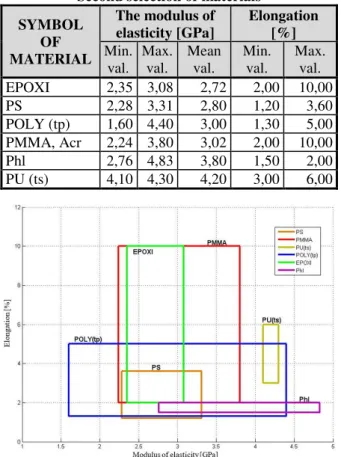
For the selection of the most suitable plastics for a particular design case, we start from the nomination of the main parameter, e.g. the modulus of elasticity, whose values are within certain limits, for example 2.70 < E <4.20 [GPa], followed by the choice of the materials that fall between these values (Table 2), the secondary physical-technical parameter, e.g. the elongation, and finally the drawing of the two-dimensional map for the group of 6 selected materials, shown in Figure 4.
The materials are ordered in ascending order according after the main parameter values.
Table 2.
Second selection of materials SYMBOL
OF MATERIAL
The modulus of
elasticity [GPa] Elongation [%] Min.
val. Max.
val.
Mean val.
Min. val.
Max. val. EPOXI 2,35 3,08 2,72 2,00 10,00 PS 2,28 3,31 2,80 1,20 3,60 POLY (tp) 1,60 4,40 3,00 1,30 5,00 PMMA, Acr 2,24 3,80 3,02 2,00 10,00 Phl 2,76 4,83 3,80 1,50 2,00 PU (ts) 4,10 4,30 4,20 3,00 6,00
Fig. 4. Map of parameters modulus of elasticity and elongation for a group of 6 plastics material
From the analysis of the diagram (Figure 4), it is easy to make comparisons and correlations that can be made between the 6 materials. Thus, if the Polyester - PU (ts) has the widest
dispersion of the modulus of elasticity (1.60 - 4.40 [GPa]), in the case of polystyrene - PS the dispersion is much smaller (2,28 - 3,31). As well as Polymethylmethacrylate - PMMA and Resins - EPOXI have the widest dispersion of elongation, (2.0 - 10 [%]), whereas phenolic resins Phl are the least elastic (1.50 - 2.0 [ %]).
4. SOFTWARE FOR MULTI-CRITERIAL SELECTION OF MATERIALS
As it has been shown above, there is a very large number of commercial materials from which the selection is made, with different properties, manufacturing and processing technologies and costs. Thus, choosing materials becomes a difficult task, especially when multiple criteria have to be taken simultaneously.
The ALMATPRO.EXE application allows you to select materials based on several criteria: physical and mechanical properties, environmental and aesthetic (fig. 5).
Fig. 5. ALMATPRO application interface
For this purpose, a database was created in which materials were included, specifying for each of them a number of properties such as: modulus of elasticity, elongation, tensile strength, Vickers hardness, elasticity limit, temperature of use, specific heat, thermal conductivity, density, recoverable energy, sound height, sound clarity, tactile impression, etc. The application (Fig. 5) shows four menus: File, Filtering, Charts and Help.
With the File menu, files containing material data are managed, the commands: New - to create a new file, Open - open an existing file,
The Filtering menu opens the page for data filtering. From hidden list Criterion: select a filtering criterion. In the Minimum Limit and
Maximum Limits fields, the minimum or
maximum values of the selected criterion are automatically entered. These values can be changed to select a smaller number of materials.
Fig. 6. Selection of materials according to a certain criterion
The selection of materials based on the criteria is done cascade, so after selecting a criterion it can continue with the imposition of new limits for other selection criteria.
Figure 6 illustrates the selection of materials whose modulus of elasticity values are between
1 and 5 [GPa], yielding 14 materials.
Next, choose the elongation parameter for which limit values 0 and 10 % are imposed, obtaining 5 materials (Figure 7).
Fig. 7. Selection of materials after the second parameter
The situation shown in Figure 7 is considered when the material filtration was performed according to two criteria (modulus
of elasticity with values between 1 and 5 [GPa]
and elongation between 0 and 10 %.
Further limits can be imposed for other parameters, for example if it is desired to filter with the condition that the Tensile Strength is between 0 and 5 [Mpa / m2]. As a result of this new restriction, only 4 materials are selected (Figure 8).
After selecting the materials according to the required criteria, the application generates two-dimensional maps by calling the Charts menu.
Fig. 8. Selection of materials after the third parameter
Fig. 9. Two-dimensional map Modulus of elasticity vs.
Elongation
In the hidden list Criterion 1: the first parameter is selected and in the hidden list
Criterion 2: the second parameter used to generate the two-dimensional map is chosen.
Fig. 10. Two-Dimensional map Tensile Strength vs. the
Figure 9 illustrates the two-dimensional map of the Modulus of elasticity vs. Elongation for the 5 selected materials.
Similarly, other two-dimensional maps can be viewed, such as: Tensile strength vs.
Vickers hardness (Figure 10), Temperature of
use vs. Specific dilation (Figure 11), etc.
Fig. 11. Two-Dimensional Map Temperature of Use vs.
Specific dilation
5. CONCLUSIONS
The choice of materials in the design process is an essential but also a difficult stage.
The multitude of materials, the desire to get a lower cost, and the use of cheap manufacturing processes make this a very difficult step.
The large number of parameters of the materials to be tracked and correlated makes the choice of materials a laborious and difficult task.
With the presented application, by imposing a set of criteria, the designer can restrict the material selection range to a maximum of 5 - 6 materials.
Then, studying two-dimensional maps, the designer can choose one or two materials to meet the multitude of imposed requirements.
6. REFERENCES
[1] Ashby, M.F., Materials Selection in Mechanical
Design, 2nd Edition, Butterworth Heinemann,
Oxford, UK, ISBN 0-7506-4357-9, 1999.
[2] CES 4 , The Cambridge Engineering Selector,
Version 4, Granta Design, Cambridge, UK, www.granta.co.uk, pp. 14-17, 2002.
[3] Charles, J.A., Crane, F.A.A. and Furness,
J.A.G., Selection and Use of Engineering
Materials, 3rd Edition, Butterworth Heinemann,
Oxford, UK, ISBN 0-7506-3277-1, 1997
[4] Harper, C.A. (Editor), Handbook of Materials
for Product Design, 3rd Edition, McGraw Hill,
New York, USA, ISBN 0-07-135406, 2001.
SELECŢIA MULTICRITERIALĂ A MATERIALELOR PLASTICE ÎN PROCESUL DE PROIECTARE
Rezumat: Alegerea materialelor plastice, în cadrul activităţii de proiectare, se bazează atât pe proprietăţile tehnice cât şi pe cele estetice şi de mediu. Multitudinea de proprietăţi luate în considerare fac ca alegerea acestora să fie dificilă. În lucrare este prezentată o aplicaţie cu ajutorul căreia se realizează într-un mod facil şi operativ alegerea multicriterială a materialelor plastice, utilizând o multitudine de combinaţii între criterii.
Cuvinte cheie: selecţie multicriterială, materiale plastice, proiectare.
Radu Mircea MORARIU-GLIGOR, Lecturer, Technical University Of Cluj-Napoca, B-dul. Muncii, no. 103-105, Department Of Engineering Mechanical Systems, E-mail: [email protected], 0264-401654;
Petru Rares RUSAN, Phd, Student. Dipl. Eng., Technical University of Cluj-Napoca, B-dul. Muncii, no. 103-105, Department of Engineering Design & Robotics, Office phone: 0743062756, [email protected]
![Fig. 1. Classification of materials [1]](https://thumb-us.123doks.com/thumbv2/123dok_us/7999842.2120942/2.892.73.405.263.610/fig-classification-of-materials.webp)
![Figure 6 illustrates the selection of materials whose modulus of elasticity values are between 1 and 5 [GPa], yielding 14 materials](https://thumb-us.123doks.com/thumbv2/123dok_us/7999842.2120942/5.892.483.828.332.528/figure-illustrates-selection-materials-modulus-elasticity-yielding-materials.webp)