Corresponding Author: Adnan Ajis, Department of Operation and Management Information System, Faculty of Business & Accountancy, University of Malaya, Malaysia
International Journal of Business and Management 4 (2): 01-11, 2020 e-ISSN: 2590-3721
© RMP Publications, 2020 DOI: 10.26666/rmp.ijbm.2020.2.1
THE CORE ELEMENTS OF MOTIVATIONAL FACTORS THAT INFLUENCE
FACEBOOK USERS TO SELF-DISCLOSURE
Adnan Ajis, and Noor Akma Mohd Salleh
Department of Operation and Management Information System, Faculty of Business & Accountancy, University of Malaya, Malaysia
Abstract: This study examines the motivational factors that influence Facebook users among the Malaysian Army to self-disclosure by adapting the Uses and Gratification Theory. All data were obtained from 1513 Facebook users in various military units in Peninsular of Malaysia, Sabah and Sarawak. Its dimension of breadth and depth measures the self-disclosure. The study found that information sharing, social interaction and self-expression are positively associated with breadth of self-disclosure and; relaxing entertainment and self-expression are positively related to the depth of self-disclosure. Meanwhile, social interaction is negatively associated with depth of self-disclosure. However, information sharing is not related to depth of self-disclosure and relaxing entertainment is not related to breadth of self-disclosure.
Key words: Self-disclosure, Uses and Gratification Theory, Facebook, Motive, and Social media
INTRODUCTION
Social Networking Site (SNS) like Facebook is new borderless information sharing platforms today that allow users to share any information over the world. Its features provide users for online multipurpose usage [1]; and attract people to use this SNS such as to develop online relationships [2]; exchange ideas, to post updates and comments [3]; to share information [4]; social interaction [5]; entertainment [6]; and many other features available from social media. However, the growth of Facebook has been overshadowed by disseminating and disclosing information issues. People share a variety of information online and at the same time it can be disseminated by other users to various platforms of SNS. This situation has created Facebook as a platform that contributes to millions of users to online self-disclosure [7].
The issue of self-disclosure happens everywhere in the world including in military organisations in which information shared in social media can be accessed and misused by others [8]. Meanwhile, some self-disclosure on Facebook can be exploited by third parties and contributes to information security threats especially an organisation like the armed forces [9]. Self-disclosure also can be manipulated to conduct social engineering and to launch network penetration or hacking activities to
organisations' online network [10]. It will lead to the data security leakage, disrupt the organisation’s information security, and also reflect bad reputation to the organisation. For instance, the use of social media has been exploited by terrorist groups like al-Qaeda to communicate among themselves, communicate with those who sympathise with their struggles, tools for propaganda and spread their ideology [11].
LITERATURE REVIEW
Self-disclosure on Facebook
Facebook is the most popular SNS with 2.45 billion users worldwide [15]. Many Facebook features offered multipurpose usage for individuals to use it [16]. Some of the features are comments, videos, live telecast, news, friend lists, photos, game, messenger, events, etc. [17].
Some Facebook features provide people to socialise, share information or entertainment [18]. Facebook is also be used by people to connect with their families and close friends, maintenance relationship with an acquaintance and develop relationships with new friends [19]. Usually, users create and develop a relationship by asking each other from the friend lists that provided by SNS [20]. Facebook features also provide people to communicate by text, photo, video and sharing information on the open forum platform [6]. People have opportunities to share and exchange contents with their friends such as daily activities, photos, video, music and other information. Additionally, for those with similar interests, they can share videos or pictures via created fan pages [21].
Self-disclosure takes place in SNS especially on Facebook because of the features that available on Facebook itself, which offers the opportunity to develop individual personality, through self-disclosure activities such as expressing feelings and opinions [6][22]. However, Facebook users have the option to decide either disclosing personal information or otherwise, whether the information that they want to reveal is false or real information [23]. It all depends on the user's choice and wisdom. Users have the option of whether the information to disclose is explicit as writing a user's thoughts or feelings or implicitly like post picture to Facebook that have multiple interpretations of others [24].
Previous studies on self-disclosure have divided self-disclosure into multiple dimensions. For instance, Sheldon [25] divided self-disclosure into two dimensions: breadth and depth where breadth referred to the variety of topics are discussed and shared with online friends; while depth referred to the level of intimacy and detail of the topics being discussed. Lin & Utz [26] also categorised self-disclosure into two dimensions, namely: breadth and depth. Meanwhile, Carpenter & Greene [27] also divided the self-disclosure dimension into two, namely breadth and depth. Other researchers have differently viewed in explaining and examining the dimension of self-disclosure. This study adopted two dimensions of self-disclosure, namely; depth and breadth of self-disclosure as used by many previous researchers [28][29]. According to Park, Jin, & Jin [30], self-disclosure can be measured by
both quantity and quality that can be interpreted as breadth and depth of self-disclosure.
Uses and Gratification Theory (UGT)
The UGT is the sociology theory related to the motives of people using the media. This theory about people use media due to specific motives depending on the individual's needs [31]. Users will continue to engage with social media if their gratifications and needs are in line with the tool [32]. The basis of this theory is that people use media to fulfil their needs that lead to the satisfaction of social media use [33]. It provides UGT relevant in explaining the use of social media although this theory is also used in other areas [22].
The UGT has been a useful theoretical framework for studying social media usage since computer-mediated communication is the latest tool [34]. The UGT is found to be relevant to the study of social media because the theoretical basis is about the intentions of individuals to communicate and use the media [22]. By using UGT will enable the technology and media researchers to describe the various purposes or motives of social media usage that will provide a better understanding of differing users' behaviour, outcome and perceptions.
Motives for Facebook Use
Users’ motives are the factors that influence self-disclosure on social media like Facebook. Most of the motives of social media usage are related to self-disclosure. According to the UGT, people are using social media due to motives that provide satisfaction and fulfil their needs. For instance, Chang & Heo [35] studied the factors that lead to information disclosure on Facebook by identifying several motives such as time spent, number of contacts, perceived risks and benefits. Special & Li-Barber [24] focused on different motives such as passing the time, entertainment and relationship maintenance. Meanwhile, Frison & Eggermont [4] in their study had identified four Facebook motives namely escapism, relationship maintenance, information sharing and pass time. Recent study by Su et al. [5] has identified eight motives on social media usage which are sharing, connecting, organising, relaxing, branding, monitoring, expressing and learning. This study has identified four core elements motivational factors that influence Facebook users to self-disclosure, namely information sharing, social interaction, relaxing entertainment and self-expression.
Information sharing
others [36]. Another definition of information sharing referred to one-to-many communication [22], to show, exchange, share, post and popularise information [2][5]. This study defines information sharing as the extent to which individuals use Facebook to share, popularise, provide, and exchange personal information or other information. Previous studies consistently found that information sharing as a motivational factor for people using social media like Facebook [37]. Meanwhile, social media itself required people to self-disclosure [38] and through the personal information sharing, people will develop relationships and lead to Facebook self-disclosure [26]. Another study by Smock et al. [39] found the factors lead to self-disclosure were information sharing and encourage people to post more status update on Facebook. Therefore, this study hypothesis is as follows:
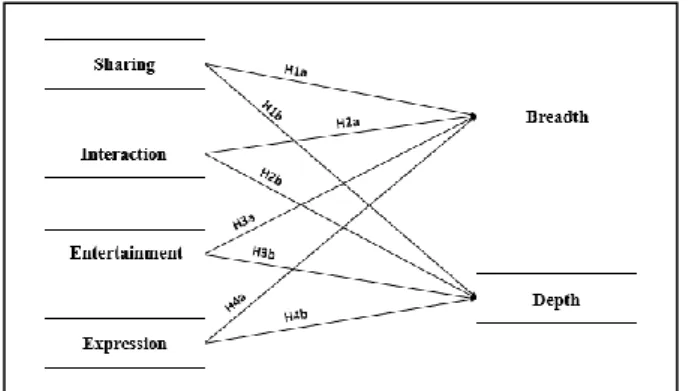
H1a - Information sharing positively influences the breadth of self-disclosure.
H1b - Information sharing positively influences the depth of self-disclosure.
Social interaction
Various definitions of social interaction have been discussed by previous researchers such as relationship maintenance [40]; the process of individual maintains a relationship [41]; and a process in which the relationship is revealed, maintained or transformed [42]. Hall [43] referred social interaction as mutual understanding between the two parties that conducting social interaction, information exchange, and pays attention to the exchange of information from the two parties involved in the relationship. This study defines social interaction as the extent to which individuals use Facebook to communicate or interact with others in order to maintain relationships with friends and family, find new friends and share common interest or value.
The function of social interaction is to maintain relationships [5][44] and also create new friends [6][39]. According to Whiting & Williams [22], 88 per cent of people using social media for social interaction. Previous studies have proven the relationship between Facebook motives and self-disclosure. Tosun [45] found that people who like online self-disclosure tend to use Facebook by embarking on new relationships and managing romantic relationships. Hollenbaugh & Ferris [44] found the relationship maintenance positively associated with self-disclosure (breadth and amount) and virtual community has a positive relationship to depth of self-disclosure. Su et al. [5] also found a positive result on the motive of connecting to social media. Their study emphasised in the development
of new friends, contact existing and old friends and keep in touch with family which can be considered as social maintenance that leads to self-disclosure. Therefore, this study hypothesis is as follows:
H2a – Social interaction positively influences the breadth of self-disclosure.
H2b – Social interaction positively influences the depth of self-disclosure.
Relaxing entertainment
Whiting & Williams [22] referred to relaxing entertainment as the use of social media for entertainment and enjoyment purposes. Tanta et al. [46] referred to this motive as the need to avoid something, release tension, shift of unhappy to a happy situation. Another definition of relaxing entertainment as entertainment or fun to users [47]; enjoyable and entertains [48]; be entertained, pass time, and forget about work or other things [6]; enjoyable and entertains [2]; feel relaxed, decrease anxiety, decrease mental stress and decrease stress [5]. This study defines relaxing entertainment as the extent to which individuals use Facebook for entertainment, releasing stress and enjoyment. Relaxing entertainment as a motivational factor for people who happy using Facebook [2][39], and reduce stress [5] [6]. They use Facebook in a relax and stress-free manner such as interacting with people who share common interests [49]; to exchange opinions [22]; to share recent activities [50]; to send a message on a friends’ wall [44]. This process will cause people to share information or self-disclosure which ultimately leads to a close relationship [51]. A feeling of closeness also can be developed by entertaining post [52][53]. Another study by Lee & Lee [6] found positive significant on the coefficient of entertainment with Facebook. Researchers have suggested the result as anyone who emphasises on entertainment is more likely to be a heavy Facebook user that leads to self-disclosure. Therefore, this study hypothesis is as follows:
H3a – Relaxing entertainment positively influences the breadth of self-disclosure.
H3b – Relaxing entertainment positively influences the depth of self-disclosure.
Self-expression
thoughts freely, express our point of view unreservedly and let our voice be heard. This study defines self-expression as the extent to which individuals use Facebook to express their emotion and opinions.
The role of expression that contributes to disclosure is described in UGT in which self-expression itself has been known as a motive of people using Facebook [6][48]. Among the activities on self-expression that lead to self-disclosure were to tell others about ourselves [48]; to show self-personality [2]; express self-emotions to others [6]; to seek attention from others [54]; to express self-opinion [22]. Alhabash et al. [48] in their study on the UGT of Facebook had found significant positive on all Facebook user groups with self-expression as a motivation to use Facebook. Balakrishnan & Shamim [54], in their study found that the motivational factor to use Facebook was significantly positive predicted by self-presentation and other motives. Meanwhile, the study by Alhabash & Ma [2] found that self-expression had a positive relationship to the social media platform. All findings by previous studies discussed on Facebook motives lead to self-disclosure. Therefore, this study hypothesis is as follows:
H4a – Self-expression positively influences the breadth of self-disclosure.
H4b – Self-expression positively influences the depth of self-disclosure.
RESEARCH FRAMEWORK
The purpose of this study is to examine the motivational factors that influence people to self-disclosure on Facebook among the Malaysian Army personnel. The customisation of UGT in the research model is useful in order to examine the predictors of self-disclosure motives on Facebook. The research framework as shown in Figure 1 is adapted from the UGT and literature review. The UGT has been used to identify the motives of people using social media depending on the individual’s needs [31]. The study investigates the relationship between Facebook motives and self-disclosure as proven in previous studies but in different background of participants like the studies of [4][5][39][44][55]. In order to achieve the research purpose, this study has explored the relationship between study variables and emphasise on the research purpose.
Figure 1: Proposed Model of Self-disclosure on Facebook
RESEARCH METHODS
This study used a cross-sectional survey design to test the research purpose and research hypotheses. The research measurement, participants and procedures are as discussed below.
Measures
All the constructs were measured by adapting the previous validated instruments and guided by the research purpose of this study. All instruments were estimated by five-point Likert Scale running from strongly disagree to strongly agree. The survey was conducted in the Malay language but the original instruments were in English. Thus, the research instruments were translated to Malay language from
the original source, which was English. The language translation process used was back-to-back techniques to ensure the linguistic validity and accuracy of the meaning of research instrument [56]. The instruments had been developed by adapted from previous studies in English. It then translated to Malay Language and again translated back to English by both English and Malay Language Subject Matter Experts. Then, the comparison was made between the two sets of languages to find the accuracy of the words that were used and not spelt out from the original version.
taken into account to improve the developmental research items. The questionnaire was then tested through a pilot test involving 150 Facebook users among military personnel that not included in the main survey. Based on the pilot test, it was found that all constructs had a Cronbach’s alpha above 0.7 which indicated internal consistency and considered for further investigation [57].
Participants
The participants were the Facebook users among the Malaysian Army personnel who holding the rank of Private Soldier to Lieutenant Colonel. These groups were found to be active social media users. Three types of sampling technique were used. The first technique was the multi-stage cluster sampling design technique to identify the target sample because the Army is a large organisation which stationed in various locations. The second technique, proportionate stratified random sampling was used in each Army unit. The target population would be stratified into four subgroups based on military ranks, namely lower ranks (Private soldier to Corporal), senior ranks (Sergeant to Warrant Officer 1), junior officers (Second Lieutenant to Captain) and senior officers (Major and Lieutenant Colonel). Therefore, individuals that involved in this study for each stratum in Army units would be selected based on simple random sampling technique like fishbowl-draw.
Data was collected from 1513 Facebook users. The age of participants was ranged from 18 to 57 years old (M = 5.52, SD = 1.083). The sample was predominantly male (n = 1255, 82.9%) and female (n = 258, 17.1%) who were officers (n = 225, 14.9%). Meanwhile, Non-commissioned rank (n = 196, 13%) and junior rank (n = 1092, 72%). The majority participants logged on into Facebook
several times each day (n = 642, 42.4%) and the majority of them logged in less than 1 hour per day (n= 867, 56.6%).
Procedures
The data were collected among respondents from the Malaysian Army personnel who had a Facebook account by using a self-administered questionnaire approach. This approach employed the drop-off and collect method and through the assistance of the Administrative Officer (AO) from the respective units in the Malaysian Army. Facebook motives were measured first, followed by self-disclosure of Facebook (breadth and depth), demographic and descriptive information.
RESULTS
Measurement model
This model had measured six reflective constructs with 50 items which eight items were excluded from developed research instruments during the design adjustment process due to its factor loadings less than the recommended threshold of 0.7. The revised template was used to conduct all subsequent evaluations.
Table 1 demonstrates the results of the measurement model which is consists of composite reliability (CR), AVE, inter-correlations and square root of AVE. The results show that all the constructs have high reliability with the CR exceed 0.7. The convergent validity is measured by scrutinising the constructs’ AVE and has found all constructs above than a recommended threshold of 0.5. Meanwhile, the square root of AVE is greater than the construct’s correlation with any other construct that indicating good discriminating validity.
Table 1: The Results of CR, AVE, and Inter-correlations of the Latent Variables
CR AVE BSD DSD RE SE SI IS
BSD 0.876 0.598 0.773
DSD 0.897 0.669 0.540 0.818
RE 0.887 0.593 0.342 0.333 0.770
SE 0.948 0.682 0.490 0.627 0.420 0.826
SI 0.860 0.533 0.381 0.201 0.501 0.299 0.730
IS 0.894 0.569 0.475 0.401 0.474 0.596 0.467 0.755
Notes: BSD = breadth of self-disclosure; DSD = depth of self-disclosure; RE = relaxing entertainment; SE = self-expression; SI = social interaction; IS = information sharing.
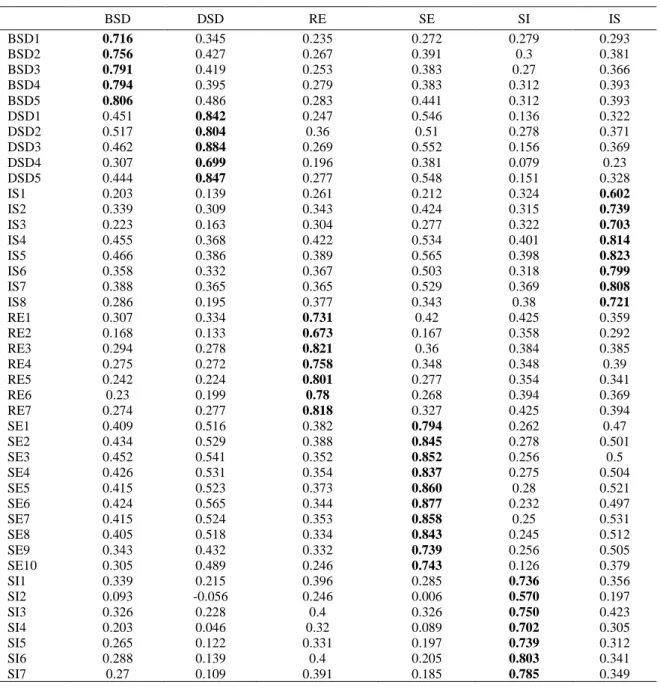
Table 2 shows the results of cross-loading of all items in this study. All item loadings record results of at least 0.5 [58] and are in their respective clusters (bold value) according to the constructs developed. The results also find that loading of each cluster of items (bold value) recorded higher values than other
Table 2: PLS loadings and Cross-loadings
BSD DSD RE SE SI IS
BSD1 0.716 0.345 0.235 0.272 0.279 0.293
BSD2 0.756 0.427 0.267 0.391 0.3 0.381
BSD3 0.791 0.419 0.253 0.383 0.27 0.366
BSD4 0.794 0.395 0.279 0.383 0.312 0.393
BSD5 0.806 0.486 0.283 0.441 0.312 0.393
DSD1 0.451 0.842 0.247 0.546 0.136 0.322
DSD2 0.517 0.804 0.36 0.51 0.278 0.371
DSD3 0.462 0.884 0.269 0.552 0.156 0.369
DSD4 0.307 0.699 0.196 0.381 0.079 0.23
DSD5 0.444 0.847 0.277 0.548 0.151 0.328
IS1 0.203 0.139 0.261 0.212 0.324 0.602
IS2 0.339 0.309 0.343 0.424 0.315 0.739
IS3 0.223 0.163 0.304 0.277 0.322 0.703
IS4 0.455 0.368 0.422 0.534 0.401 0.814
IS5 0.466 0.386 0.389 0.565 0.398 0.823
IS6 0.358 0.332 0.367 0.503 0.318 0.799
IS7 0.388 0.365 0.365 0.529 0.369 0.808
IS8 0.286 0.195 0.377 0.343 0.38 0.721
RE1 0.307 0.334 0.731 0.42 0.425 0.359
RE2 0.168 0.133 0.673 0.167 0.358 0.292
RE3 0.294 0.278 0.821 0.36 0.384 0.385
RE4 0.275 0.272 0.758 0.348 0.348 0.39
RE5 0.242 0.224 0.801 0.277 0.354 0.341
RE6 0.23 0.199 0.78 0.268 0.394 0.369
RE7 0.274 0.277 0.818 0.327 0.425 0.394
SE1 0.409 0.516 0.382 0.794 0.262 0.47
SE2 0.434 0.529 0.388 0.845 0.278 0.501
SE3 0.452 0.541 0.352 0.852 0.256 0.5
SE4 0.426 0.531 0.354 0.837 0.275 0.504
SE5 0.415 0.523 0.373 0.860 0.28 0.521
SE6 0.424 0.565 0.344 0.877 0.232 0.497
SE7 0.415 0.524 0.353 0.858 0.25 0.531
SE8 0.405 0.518 0.334 0.843 0.245 0.512
SE9 0.343 0.432 0.332 0.739 0.256 0.505
SE10 0.305 0.489 0.246 0.743 0.126 0.379
SI1 0.339 0.215 0.396 0.285 0.736 0.356
SI2 0.093 -0.056 0.246 0.006 0.570 0.197
SI3 0.326 0.228 0.4 0.326 0.750 0.423
SI4 0.203 0.046 0.32 0.089 0.702 0.305
SI5 0.265 0.122 0.331 0.197 0.739 0.312
SI6 0.288 0.139 0.4 0.205 0.803 0.341
SI7 0.27 0.109 0.391 0.185 0.785 0.349
Notes: BSD = breadth of self-disclosure; DSD = depth of self-disclosure; RE = relaxing entertainment; SE = self-expression; SI = social interaction; IS = information sharing.
Structural Model Assessment
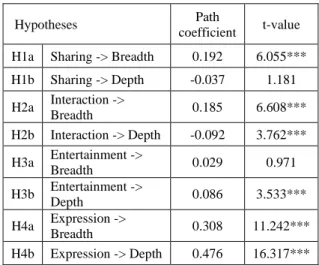
Table 3 shows the results of a structural model analysis by using SmartPLS 3.0. The model explains 47% of the variance in depth of self-disclosure and 32% in breadth of self-disclosure. There is a statistically significant negative correlation between social interaction and depth of self-disclosure. Meanwhile, the study finds a positive correlation between information sharing, social interaction, self-expression and breadth of self-disclosure; and a
information sharing and depth of self-disclosure and the relationship between relaxing entertainment and
breadth of self-disclosure are not significant. Thus, H1b and H3a are not supported.
Table 3: The summary of standardised path coefficients and significance level
Hypotheses Path
coefficient t-value
H1a Sharing -> Breadth 0.192 6.055***
H1b Sharing -> Depth -0.037 1.181
H2a Interaction ->
Breadth 0.185 6.608***
H2b Interaction -> Depth -0.092 3.762***
H3a Entertainment ->
Breadth 0.029 0.971
H3b Entertainment ->
Depth 0.086 3.533***
H4a Expression ->
Breadth 0.308 11.242***
H4b Expression -> Depth 0.476 16.317*** *p<0.001
DISCUSSION
Research Findings
This study examines the factors that influence self-disclosure. The proposed factors are categorized into two; first, the breadth of self-disclosure which is influenced by information sharing, social interaction, relaxing entertainment and self-expression that lead users among military personnel to disclose personal information on Facebook. Second, the depth of self-disclosure which is influenced by information sharing, social interaction, relaxing entertainment and expression that lead users to Facebook self-disclosure. The Facebook motives are confirmed to have four constructs that influence to self-disclosure, comprising information sharing, social interaction, relaxing entertainment and self-expression which derived from the UGT [31]. This finding is in accordance with previous research such as information sharing [2]; social interaction [4]; relaxing entertainment [26]; and self-expression [6]. In concurrence with earlier research on self-disclosure motives, users tend to use Facebook for these factors in establishing and maintaining relationship among them which measured by a total of 32 items. The results of this study are expected to be in line with the UGT and other social media motives [28][44][59] which confirming these affective responses that influence Facebook motives and self-disclosure.
Based on the proposed hypotheses, only three (H1a, H2a and H4a) of the four hypotheses proposed are supported in which having a direct relationship with the breadth of self-disclosure. Meanwhile, on the
depth of self-disclosure relationship, only three (H2b, H3b and H4b) of four have significant hypotheses. Some results are expected and in line with the findings from previous research that studied the motives on social media or Facebook [2][4][37][44][60].
Although relaxing entertainment is found to have no direct relationship with breadth of self-disclosure (H3a) but it has a relationship with depth of self-disclosure (H3b). Meanwhile, information sharing has no direct relationship to the depth of self-disclosure (H1b) but this construct has a direct relationship with breadth (H1a).
This insignificant relationship is interesting findings because based on recent studies [28], entertainment is found to have a positive relationship on the depth and breadth of self-disclosure. However, in this study, entertainment only has a positive effect on depth but not significant for breadth.
Furthermore, for the three positive relationships on the breadth of self-disclosure (H1a, H2a and H4a) and the results indicate that people use Facebook as fulfilling the information sharing, social interaction and self-expression. In this context, Facebook offers and allows people to share information, connect with people, establish and maintain relationships, express opinion or to criticise others. All these features are required on Facebook in order to start and develop the interpersonal relationship.
Meanwhile, two positive relationships of the depth of self-disclosure (H3b and H4b) especially on H3b shows that people use Facebook because they are happy, feel relaxed, enjoy and entertain. However, a negative relationship on depth by social interaction (H2b) indicates that those people with a close relationship will not disclose personal information on Facebook with their close friends.
This result represents that Facebook as a medium for people to meet their personal gratification. In this respect, it provides additional support to the media uses and gratifications literature. These findings are in line with previous findings showing information sharing as a motivating factor in social media use [37][60]. Meanwhile, Hollenbaugh & Ferris [44] revealed that Facebook could be used to create new relationships and manage romantic relationships. Entertainment increases Facebook usage [62] and Self-expression have been identified as another Facebook motives that influencing people to use social media [6][22][49].
Besides Facebook fulfils human relationships, it also provides satisfaction in the form of Facebook motives, as suggested in H1a to H4b. Facebook motives recognise to have a strong effect on Facebook users that lead to self-disclosure [44]. The Facebook motives influence people to use this application and establish a relationship online. The users utilise Facebook with their motives such as information sharing, social interaction, relaxing entertainment or self-expression.
Based on structural model hypothesis analysis, Self-expression is the most dominant Facebook motive that has a strong positive relationship with both of self-disclosure dimension; breadth (Std Beta = 0.308) and depth (Std Beta = 0.476). It is followed by information sharing and social interaction for the breadth of self-disclosure. Meanwhile, for the depth of self-disclosure, relaxing entertainment is the strongest motives (positive relationship) after self-expression, while information sharing is the only motive shows a negative relationship with depth. Theoretical and Practical Contribution
In theoretical contribution, this study extends the literature on the UGT that related to self-disclosure
in the particular context of Facebook users in the Malaysian Army. The results suggested that the proposed Facebook motive model based on literature and the UGT [31] assists in developing the motivational factors that influence people to self-disclosure.
As previous literature has provided various variables for predicting social media motives, this study has identified several key variables that influence Facebook usage in the context of the Malaysian Army environment. This study confirms that there are four similar Facebook motives with previous studies. The Facebook motives confirm derived from this research are Social Interaction, Information Sharing, Self-expression and Relaxing Entertainment.
This research also has practical implications in predicting Facebook motives behaviour in the organisation. This contribution relates to the factors that influenced military personnel to use Facebook. There are four factors known as Facebook motives that influence users to use Facebook which are information sharing, social interaction, relaxing entertainment and self-expression. These factors lead to self-disclosure whether the breadth, depth or both breadth and depth of self-disclosure. Two factors, namely social interaction and self-expression have been found to influence breadth and depth directly at the same time. Information sharing only affects to the breadth while relaxing entertainment affects to the depth. Thus, by understanding the factors that influence military personnel to use Facebook, it will help the organisation review its policies and training methods based on users behaviour patterns influenced by Facebook motives.
Limitation and Directions for Future Research
The research limitation that concerns the social media context is focusing more on Facebook as it is the most popular social media today. However, most of the military personnel have more than one type of social media such as Twitter, Instagram or WhatsApp. So self-disclosure can take place on any social media platform based on the individual's option.
that emphasises the confidentiality, integrity and ability of information, it should be suggested that the most appropriate type of social media for its soldiers in order to reduce and protect its information security.
REFERENCES:
[1] Hellman, M., & Wagnsson, C. (2015). New media and the war in Afghanistan: The significance of blogging for the Swedish strategic narrative. New Media and Society, Vol. 17, No. 1, pp. 6-23.
[2] Alhabash, S., & Ma, M. (2017). A Tale of Four Platforms: Motivations and Uses of Facebook, Twitter, Instagram, and Snapchat Among College Students? Social Media + Society, Vol. 3, No. 1.
[3] Vyas & Ttrivedi (2014). Role of social networking tool in dissemination of information at SMT Hansa Mehta Library. e-Library Science Research Journal, Vol. 2, No. 9, pp. 2-9.
[4] Frison, E., & Eggermont, S. (2016). Gender and Facebook motives as predictors of specific types of Facebook use: A latent growth curve analysis in adolescence. Journal of Adolescence, Vol. 52, pp. 182-190.
[5] Su, C., Chiu, C., Chou, Y., and Chico, C. (2018). Patterns of motives for social network site use among sixth grade pupils in Taiwan. Telematics and Informatics,Vol.35, No. 6, pp. 1782-1793.
[6] Lee, S. W., & Lee, J. (2017). A comparative study of KakaoStory and Facebook: Focusing on use patterns and use motives. Telematics and Informatics, Vol. 34, No. 1, pp. 220-229. [7] Bazarova, N. N., & Choi, Y. H. (2014).
Self-disclosure in social media: Extending the functional approach to disclosure motivations and characteristics on social network sites. Journal of Communication, Vol. 64, No. 4, pp. 635-657.
[8] Colwill, C. (2010). Human factors in information security: The insider threat - Who can you trust these days? Information Security Technical Report.
[9] Sophos (2010). Security Threat Report: 2010. Boston, Massachusetts: Sophos Group. [10] Mouton, F., Leenen, L., and Venter, H. S.
(2016). Social engineering attack examples. Computers & Security, Vol. 59, pp. 86-209. [11] Sethi, U. (2013). Social Media - A Tool for the
Military, pp. 125-129. Scholar Warrior, Spring.
[12] Zhu, H., Wu, H., Cao, J., Fu, G., & Li, H. (2018). Information dissemination model for social media with constant updates. Physica A, Vo. 502, pp. 469-482.
[13] Niekerk and Maharaj (2013). Social Media and Information Conflict. International Journal of Communication, Vol. 7, pp. 1162-1184. [14] Kefi, H., and C. Perez (2018). Dark Side of
Online Social Networks: Technical, Managerial, and Behavioral Perspectives. In Encyclopedia of Social Network Analysis and Mining. (pp. 1-22). Springer New York. [15] Statista. (2019). Number of monthly active
Facebook users worldwide as of 3rd quarter
2019. Retrieved from
https://www.statista.com/statistics/264810/nu mber-of-monthly-active-facebook-users-worldwide/
[16] Horzum, M. B., & Demirhan, E. (2017). The role of chronotype on Facebook usage aims and attitudes towards Facebook and its features. Computers in Human Behavior, Vol. 73, pp. 125-131.
[17] Ryan, T., & Xenos, S. (2011). Who uses Facebook? An investigation into the relationship between the Big Five, shyness, narcissism, loneliness, and Facebook usage. Computers in Human Behavior, Vo. 27, No. 5, pp. 1658-1664.
[18] Hughes, D. J., Rowe, M., Batey, M., & Lee, A. (2012). A tale of two sites: Twitter vs. Facebook and the personality predictors of social media usage. Computers in Human Behavior, Vol. 28, No. 2, pp. 561-569. [19] Lee, E., Ahn, J., & Kim, Y. J. (2014).
Personality traits and self-presentation at Facebook. Personality and Individual Differences, Vol. 69, pp. 162-167.
[20] Horzum, M. B., & Demirhan, E. (2017). The role of chronotype on Facebook usage aims and attitudes towards Facebook and its features. Computers in Human Behavior, Vol. 73, pp. 125-131.
[21] Hew, K. F. (2011). Students’ and teachers’ use of Facebook. Computers in Human Behavior, Vol. 27, No. 2, pp. 662-676.
[22] Whiting, A., & Williams, D. (2013). Why people use social media: a uses and gratifications approach. Qualitative Market Research: An International Journal, Vol. 16, No. 4, pp. 362-369.
[23] Zhao, S., Grasmuck, S., & Martin, J.(2008). Identity Construction on Facebook: Digital Empowerment in Anchored Relationships. Computers in Human Behavior, Vol. 24, pp. 1816-1836.
[24] Special, W. P., & Li-Barber, K. T. (2012). Self-disclosure and student satisfaction with Facebook. Computers in Human Behavior, Vol. 28, No. 2, pp. 624-630.
[26] Lin, R., & Utz, S. (2017). Computers in Human Behavior Self-disclosure on SNS : Do disclosure intimacy and narrativity in fl uence interpersonal closeness and social attraction? Computers in Human Behavior, Vol. 70, pp. 426-436.
[27] Carpenter and Greene (2016). Social Penetration Theory. The International Encyclopedia of Interpersonal Communication, First Edition, John Wiley & Sons, Inc.
[28] Mouakket, S. (2018). The role of personality traits in motivating users’ continuance intention towards Facebook: Gender differences. The Journal of High Technology Management Research, Vol. 29, No. 1, pp. 124-140.
[29] Baruh, L., & Cemalcılar, Z. (2018). When more is more? The impact of breadth and depth of information disclosure on attributional confidence about and interpersonal attraction to a social network site profile owner. Journal of Psychosocial Research on Cyberspace, Vol. 12, No. 1.
[30] Park, N., Jin, B., & Annie Jin, S. A. (2011). Effects of self-disclosure on relational intimacy in Facebook. Computers in Human Behavior, Vol. 27, No. 5, pp. 1974-1983. [31] Katz, E., Blumler, J. G., & Gurevitch, M.
(1974). Utilization of Mass Communication by The Individual. Beverly Hills, CA: Sage. [32] Ku, Y. C., Chu, T. H., & Tseng, C. H. (2013).
Gratifications for using CMC technologies: a comparison among SNS, IM, and e-mail. Computers in Human Behavior, Vol. 29, No. 1, pp. 226–234.
[33] Lariscy, R.W., Tinkham, S.F. and Sweetser, K.D. (2011). Kids these days: examining differences in political uses and gratifications, internet political participation, political information efficacy, and cynicism on the basis of age. American Behavioral Scientist, Vol. 55, No. 6, pp. 749-764.
[34] Ifinedo, P. (2016): Applying uses and gratifications theory and social influence processes to understand students' pervasive adoption of social networking sites: Perspectives from the Americas. International Journal of Information Management, Vol. 36, No. 2, pp. 192-206.
[35] Chang, C. W., & Heo, J. (2014). Visiting theories that predict college students' self-disclosure on Facebook. Computers in Human Behavior, Vol. 30, pp. 79-86.
[36] Helmstadter, E. (2003) The institutional economics knowledge sharing. Basic issues. En E. Helmstadter (Ed.) The economics of knowledge sharing. A new institutional approach (pp. 11-38), Edgard Elgar, Cheltenham, M.A.
[37] Ghaisani, A. P., Handayani, P. W., & Munajat, Q. (2018). ScienceDirect Users ’ Motivation in Sharing Information on Social Media. Procedia Computer Science, Vol. 124, pp. 530–535. [38] Kwak, K. T., Choi, S. K., & Lee, B. G. (2014).
SNS flow, SNS self-disclosure and post hoc interpersonal relations change: Focused on Korean Facebook user. Computers in Human Behavior, Vol. 31, No. 1, pp. 294–304. [39] Smock, A. D., Ellison, N. B., Lampe, C., &
Wohn, D. Y. (2011). Facebook as a toolkit: a uses and gratification approach to unbundling feature use. Computers in Human Behavior, Vol. 27, No. 6, pp. 2322–2329.
[40] Ellison, N., Vitak, J., Gray, R., & Lampe, C. (2014). Cultivating Social Resources on Social Network Sites: Facebook Relationship Maintenance Behaviors and Their Role in Social Capital Processes. Journal of Computer-Mediated Communication, Vol. 19, pp. 855-870.
[41] Dindia, K., & Canary, D. J. (1993). Definitions and theoretical perspectives on maintaining relationships. Journal of Social and Personal Relationships,Vol. 10, pp. 163–173.
[42] Schwanda, V., & Bazarova, N. N. (2014). Relational maintenance on social network sites : How Facebook communication predicts relational escalation. Computers In Human Behavior, Vol. 35, pp. 124–131.
[43] Hall, J. A. (2018). When is social media use social interaction? Defining mediated social interaction. New Media & Society.
[44] Hollenbaugh, E.E. and Ferris, A.L. (2014). Facebook self-disclosure: examining the role of traits, social cohesion, and motive, Computers in Human Behavior, Vol. 30, pp. 50-58.
[45] Tosun, L. P. (2012). Motives for Facebook use and expressing ‘‘true self’’ on the internet.
Computers in Human Behavior, Vol. 28, pp. 1510-1517.
[46] Tanta, I., Mihovilović, M., & Sablić, Z. (2014). Uses and gratification theory - Why adolescents use facebook? Medijska istrazˇivanja, Vol. 20, No. 2, pp. 85-110. [47] Dolan, R., Conduit, J., Fahy, J., and Goodman,
S. (2015). Social media engagement behaviour: A uses and gratifications perspective. Journal of Strategic Marketing, Vol. 24, No. 3, pp. 1-17.
[48] Alhabash, S., Chiang, Y.H., and Huang, K. (2014). MAM & U&G in Taiwan: Differences in the uses and gratifications of Facebook as a function of motivational reactivity. Computers in Human Behavior, Vol. 35, pp. 423-430. [49] Sheldon, P., Bryant, K. (2016). Instagram:
[50] Sheikh, I., Ahmed, Y., & Igale, A. B. (2014). Motives As Predictors Of Facebook Addiction : Empirical Evidence From Somalia. The Journal of the South East Asia Research Centre for Communications and Humanities, Vol. 6, No. 2, pp. 47-68.
[51] Altman, I. and Taylor, D.A. (1973). Social Penetration: The Development of Interpersonal Relationships. Holt, Rinehart, & Winston, New York,459.
[52] Lin, R., Levordasha, A., & Utz, S. (2016). Ambient intimacy on twitter. Cyberpsychology. Journal of Psychosocial Research on Cyberspace, Vol. 10, No. 1. [53] Utz, S. (2015). The function of self-disclosure
on social network sites: Not only intimate, but also positive and entertaining self-disclosures increase the feeling of connection. Computers in Human Behavior, Vol. 45, pp. 1-10. [54] Balakrishnan, V., & Shamim, A. (2013).
Malaysian Facebookers: Motives and addictive behaviours unraveled. Computers in Human Behavior, Vol. 29, No. 4, pp. 1342-1349. [55] Alhabash, S., Park, H., Kononova, A., Chiang,
Y. H., Wise, K. (2012). Exploring the motivations of Facebook use in Taiwan. Cyberpsychology, Behavior, and Social Networking, Vol. 15, pp. 304-311.
[56] Venkatesh, V., Thong, J. Y., & Xu, X. (2012). Consumer acceptance and use of information technology: Extending the unified theory of
acceptance and use of technology. MIS Quarterly, Vol. 36, No. 1, pp. 157-178. [57] Hair, J.F., Black, W.C., Babin, B.J. and
Anderson, R.E. (2010). Multivariate Data Analysis: 7th Edition. Pearson, New York. [58] Hair, J. F., Black, W. C., Babin, B. J. &
Anderson, R. E. (2014). Multivariate Data Analysis. Pearson New International Edition (7th edition). Pearson Education Limited. [59] Hur, K., Kim, T.T., Karatepe, O.M., & Lee, G.
(2017). An exploration of the factors influencing social media continuance usage and information sharing intentions among Korean travelers. Tourism Management, Vol. 63, pp. 170-178.
[60] Munar, A., & Jacobsen, J. (2014). Motivations for Sharing Tourism Experiences Through Social Media. Tourism Management. Vol. 43, pp. 46-54.
[61] Zhao, C., Hinds, P., & Gao, G. (2012). How and to whom people share Share : The Role of Culture in Self-disclosure in Online Communities.Proceedings of the ACM 2012 Conference on Computer Supported Cooperative Work - CSCW ’12.