The
dual
phosphodiesterase
3
and
4
inhibitor
RPL554
stimulates
CFTR
and
ciliary
beating
in
primary
cultures
of
bronchial
epithelia
Mark J. Turner,1,2Elizabeth Matthes,1,2Arnaud Billet,1,2Amy J. Ferguson,3David Y. Thomas,2,4 Scott H. Randell,5Lawrence E. Ostrowski,3Kathy Abbott-Banner,6and John W. Hanrahan1,2,7 1Department of Physiology, McIntyre Medical Sciences Building, McGill University, Montreal, Canada;2McGill CF
Translational Research Centre, Montreal, Canada;3Marsico Lung Institute, University of North Carolina, Chapel Hill, North
Carolina;4Department of Biochemistry, McIntyre Medical Sciences Building, McGill University, Montreal, Canada; 5Department of Cell Biology and Physiology and the Marsico Lung Institute/Cystic Fibrosis Center, University of North
Carolina, Chapel Hill, North Carolina;6Verona Pharma plc, London, United Kingdom; and7Research Institute of the McGill
University Health Centre, Montreal, Canada
Submitted 9 September 2015; accepted in final form 30 October 2015
Turner MJ, Matthes E, Billet A, Ferguson AJ, Thomas DY, Randell SH, Ostrowski LE, Abbott-Banner K, Hanrahan JW.The dual phosphodiesterase 3 and 4 inhibitor RPL554 stimulates CFTR and ciliary beating in primary cultures of bronchial epithelia.Am J Physiol Lung Cell Mol Physiol310: L59 –L70, 2016. First published November 6, 2015; doi:10.1152/ajplung.00324.2015.—Cystic fibrosis (CF), a genetic disease caused by mutations in the CFTR gene, is a life-limiting disease characterized by chronic bacterial airway infec-tion and severe inflammainfec-tion. Some CFTR mutants have reduced responsiveness to cAMP/PKA signaling; hence, pharmacological agents that elevate intracellular cAMP are potentially useful for the treatment of CF. By inhibiting cAMP breakdown, phosphodiesterase (PDE) inhibitors stimulate CFTR in vitro and in vivo. Here, we demonstrate that PDE inhibition by RPL554, a drug that has been shown to cause bronchodilation in asthma and chronic obstructive pulmonary disease (COPD) patients, stimulates CFTR-dependent ion secretion across bronchial epithelial cells isolated from patients car-rying theR117H/F508delCF genotype. RPL554-induced CFTR ac-tivity was further increased by the potentiator VX-770, suggesting an additional benefit by the drug combination. RPL554 also increased cilia beat frequency in primary human bronchial epithelial cells. The results indicate RPL554 may increase mucociliary clearance through stimulation of CFTR and increasing ciliary beat frequency and thus could provide a novel therapeutic option for CF.
cystic fibrosis; CFTR; phosphodiesterase; RPL554; ciliary beating
THE COMMON,AUTOSOMAL RECESSIVEdisease cystic fibrosis (CF)
results from mutations to the gene encoding cystic fibrosis transmembrane conductance regulator (CFTR) (52), a plasma membrane anion channel. Defective CFTR-dependent anion transport leads to a host of pathologies that affect the pancreas, small intestine, sweat glands, and airways (5, 34, 35, 49, 50, 64). In the airways, reduced secretion contributes to the accu-mulation of thick, sticky mucus and impaired mucociliary clearance, which in turn leads to bacterial colonization and chronic inflammation (41, 60). CFTR is tightly regulated by the cAMP/PKA signaling pathway (3, 12, 13, 17, 27, 54, 61), and therefore, pharmacological agents that elevate intracellular
cAMP concentration ([cAMP]i) have been suggested as
poten-tial therapeutic options for the treatment of CF (31). Cyclic nucleotide phosphodiesterases (PDEs) terminate signaling by hydrolyzing cyclic nucleotides (7). The PDE superfamily in-cludes 11 gene families and over 30 isozymes, each with multiple splice variants that together comprise almost 100 different variants (42). Expression and localization of PDE isoenzymes are cell and tissue specific, and many PDEs are often expressed in specific microdomains that allow for highly organized spatiotemporal cyclic nucleotide signaling. For de-tailed reviews of PDEs, see Conti and Beavo (14), Francis et al. (21), and Maurice et al. (42).
PDE3 and PDE4 have been shown to regulate CFTR in primary airway epithelial cells and in epithelial cell lines. PDE4A5, PDE4C1, PDE4D2, and PDE4D3 expression was demonstrated in primary human airway epithelial cells (22), and PDE3 and PDE4 inhibitors have been shown to elevate [cAMP]i in airway epithelia, when added alone (12) or in
combination with activators of adenylyl cyclase (22, 65). Furthermore, both PDE3 and PDE4 inhibitors have been shown to activate CFTR-dependent anion secretion across the human airway epithelial cell line Calu-3 (12, 48) while Barnes et al. (4) demonstrated increased CFTR channel activity when apical membrane patches excised from Calu-3 cells were exposed to a PDE4 inhibitor. CFTR can interact physically with PDE4D (38) and PDE3A (48), and exposure to a PDE3A inhibitor leads to clustering of CFTR and PDE3A into mem-brane microdomains and augments CFTR channel function (48). These results suggest that inhibitors of PDE3 and PDE4 could potentially be useful therapeutics for CF.
More recently, Blanchard et al. (6) demonstrated that the PDE4 inhibitor rolipram, when used in combination with CFTR potentiators and correctors, stimulates CFTR activity in primary human bronchial epithelial (HBE) cells homozygous for the most common CF mutationF508del(10). In addition to their CFTR-activating properties, PDE3 and 4 inhibitors also have beneficial anti-inflammatory and bronchodilator effects, which would provide additional benefits to CF patients. Di Paola et al. (19) demonstrated PDE3 inhibition significantly reduced tissue inflammation and the release of proinflam-matory cytokines in a rat model of myocardial inflammation
while PDE4 inhibition has also been shown to reduce the release of proinflammatory cytokines from a number of cell types, including airway epithelial cells, as well as suppress-ing recruitment of inflammatory cells to the airways (24 –26, 37, 40, 45, 68).
Of further interest, there is increasing evidence to suggest that dual inhibition of PDE3 and PDE4 can have additive or synergistic anti-inflammatory, bronchodilator, and CFTR- ac-tivating effects (1, 39, 44, 48) suggesting that targeting both PDEs may be of greater benefit than inhibiting one alone. RPL554 is a “first in class” inhaled dual PDE3/4 inhibitor that has significant bronchodilator and anti-inflammatory activity in clinical trials (20). RPL554 has been demonstrated to induce sustained relaxant effects on contractile responses induced by spasmogens (histamine and carbachol) and electrical field stim-ulation in isolated airway tissue (human bronchial and guinea pig tracheal preparations). The degree of bronchial wall relax-ation was greater than in tissue treated only with a2-agonist
or anti-muscarinics, even when those agents were administered at maximal concentrations (9). Interestingly, RPL554 also interacts in an additive or synergistic manner with2-agonists
or anti-muscarinics, respectively, when administered in com-bination in in vitro and in vivo experimental model systems (8, 30). The fact that RPL554 inhibits PDEs involved in CFTR regulation, as well as possessing anti-inflammatory and bron-chodilator properties, suggests it could afford therapeutic ben-efit in CF patients. PDE inhibitors may also act on airway cilia since their motility is also controlled by cAMP/PKA (2, 18, 55, 63) probably through phosphorylation of dynein light chain in the axoneme (36) Indeed, the PDE4-selective inhibitor Roflimulast N-oxide increased ciliary beat frequency (CBF) in HBE (43).
The purpose of this study was to examine the effect of RPL554 on CFTR function in cell lines and primary HBE from CF patients withR117H/F508delandF508del/F508del geno-types. R117H reduces single channel conductance and open probability but does not affect trafficking to the plasma mem-brane or activation by cAMP/PKA (11, 57, 62). F508del
reduces open probability and nearly abolishes trafficking to the plasma membrane without altering single channel conductance (10, 15). We also examined the effect of RPL554 on ciliary beating. Here we show that RPL554 stimulates the activity of wild-type (WT) andR117HCFTR, and this is primarily due to inhibition of PDE4. RPL554 also increases CBF primarily through inhibition of PDE4. These results suggest RPL554 as an attractive therapeutic option for CF and reveal novel mech-anisms by which inhaled RPL554 may improve lung function in chronic obstructive pulmonary disease (COPD) and asthma patients.
METHODS
Culture of Chinese hamster ovary cells.The Chinese hamster ovary cell line CHO, expressing WT CFTR (61), was cultured in minimum essential media (MEM) containing 5% fetal bovine serum and the selecting drug methotrexate (100 mM) for 2 days. Cells were grown in T75flasks (Corning), incubated at 37°C in humidified air containing
5% CO2-95% O2, and passaged every 7 days using trypsin/EDTA. For
automated patch-clamp experiment, CHO were subcultured in 25-cm2
plates and used at 80% confluence (⬃1 million cells).
Culture of CFBE cells.The HBE cell line CFBE was cultured in MEM supplemented with 10% (vol/vol) FCS, 100 U/ml penicillin,
100g/ml streptomycin, and 2g/ml puromycin as a selection agent. Cells were grown in T75 flasks (Corning), incubated at 37°C in
humidified air containing 5% CO2-95% O2, and passaged every 7
days using trypsin/EDTA. 80,000 cells were seeded onto collagen-coated 6.5-mm Corning Costar 0.4-m pore, polyester membrane inserts and kept submerged 48 h until cells had formed a highly resistive monolayer with transepithelial electrical resistance (TEER) ⬎400⍀/cm2as measured using an epithelial volt-ohmmeter (World
Precision Instruments). The apical medium was then removed and cells were maintained at the air-liquid interface (ALI) for another 7 days before being studied.
Isolation and culture of primary HBE cells. Human lung tissues were procured under the auspices of Institutional Review Board-approved protocols at McGill University and the University of North Carolina. Three lung specimens unused for transplantation were obtained from non-CF individuals, and threeF508del/F508del spec-imens and threeR117H/F508delspecimens were procured after lung transplantation. The non-CF andF508del/F508delcells were from the CF Canada Primary Airway Cell Biobank at the McGill CF Transla-tional Research Centre (CFTRc).R117H/F508delcells were from the Univeristy of North Carolina CF Center Tissue Procurement and Cell Culture Core. Isolation, culture, and differentiation of pHBE cells were adapted from procedures previously described by Fulcher et al. (23). Briefly, airway epithelial cells were isolated from bronchial tissue by enzyme digestion and cultured in bronchial epithelial growth medium on type I collagen-coated plastic flasks (Vitrogen 100, Pure-Col; Advanced BioMatrix) and then trypsinized, counted, and cryo-preserved. Cells were seeded onto collagen coated 6.5-mm Costar 0.4-m pore, polyester membrane inserts (Corning) and grown under submerged conditions for 4 days before the apical media were re-moved and the cells were allowed to differentiate at an ALI for a minimum of 21 days before use. The isolation and growth media were complemented with antibiotics selected according to recent patient microbiology reports. However, only penicillin and streptomycin were added to the ALI cultures.
RNA extraction and quantitative real-time PCR. Total cellular RNA was extracted and purified using the RNase Easy Mini Kit (Qiagen, Toronto, ON, Canada) according to the manufacturer’s instructions. For reverse transcription, 500 ng RNA were incubated with 4 l VILO Mastermix (Life Technologies, Burlington, ON, Canada) in a reaction volume of 20l for 1 h at 42°C and for 5 min at 85°C. Then, 250 ng cDNA, 10l TaqMan Fast Advanced Master-mix, and 1l TaqMan Gene Expression Assay primers were added to the wells of a MicroAmp EnduraPlate Optical 96-Well Fast Reaction Plate in a reaction volume of 20l. The quantitative PCR reaction consisted of 20 s at 95°C and then 40 cycles of 95°C (1 s) and 60°C (20 s) and was carried out in a QuantStudio 7 Flex Real-Time PCR system. ⌬⌬CT analysis was carried out using QuantStudio 7 Flex
Real-Time PCR system software in which the expression of each PDE gene was normalized to expression of GAPDH within that sample. Analysis of the standard curves made for each primer revealed primer efficiency to be⬎90% for each primer used.
Patch-clamp experiments. The effects of RPL554 on CFTR cur-rents were measured using an automated patch-clamp technique. CHO cells were detached with Detachin (Genlantis, San Diego, CA) cen-trifuged for 5 min at 1,000 rpm, resuspended in MEM (without serum), and used immediately on the Qpatch 16X system (Sophion Bioscience). The holding potential was set to ⫺40 mV during the entire experiment, and two voltage protocols were used to measured whole cell CFTR current. To control for the effect of various drug or concentration and test the absence of leak, a single depolarization from⫺40 at 0 mV was applied. After 5 min, the current/voltage (I–V) relationship was determined by pulsing from⫺40 mV between⫺80 and⫹80 mV in 20-mV increments. Experiments were conducted with single-hole Qplate at room temperature.
Corn-ing Costar 0.4-m pore) and cultured in serum- and antibiotic-free medium with 20 l medium applied to the apical membrane 24 h before study. Cells were mounted into modified Ussing chambers (Physiological Instruments, San Diego, CA) containing 5 ml sa-line, which was continuously gassed with 5% CO2-95% O2.
Mono-layers were clamped at 0 mV using a Multichannel Voltage-Current Clamp (Physiological Instruments) and currents recorded using a Powerlab 8SP (AD Instruments) and analyzed using LabChart 7.0 software. Transepithelial resistance (Rte) was
moni-tored by applying a 10-mV pulse (duration: 2 s) every 30 s and calculating resistance by Ohm’s law.
Measurements of CBF.Primary HBE cells were grown on 12-mm collagen-coated Millicell 0.4-m pore inserts and cultures were visu-alized using a⫻20 phase objective on a Nikon TE2000 microscope, and high-speed videos (60 fps) were recorded from 5 separate fields of each culture. CBF was determined from the videos using the whole field analysis option within the SAVA software package (58), and the average of the five measurements was used as the baseline CBF for that culture. Cultures were then treated with pharmacological agents and CBF was again determined from the average of five measure-ments taken⬃1, 5, and 30 min after treatment. Data were analyzed as both the absolute change in CBF at each time point and the change in CBF relative to baseline. Each experiment was repeated at least three times with cells from three different donors (nⱖ9).
Solutions and reagents.All reagents were purchased from Sigma-Aldrich apart from CFTRinh172 (Cystic Fibrosis Foundation
Thera-peutics), RPL554 (Verona Pharma, London, UK), and TNF-␣(R&D Systems, Minneapolis, MN). Gases were purchased from MEGS Speciality Gases (Montreal, Canada). For patch-clamp recordings, the external bath solution contained the following (in mM): 145 NaCl, 4 CsCl, 1 CaCl2, 1 MgCl2, 10 glucose, and 10 tetradecyl sulfate (TES)
and titrated to pH 7.4. The intrapipette solution contained the follow-ing (in mM): 113 L-aspartic acid, 113 CsOH, 27 CsCl, 1 NaCl, 1
MgCl2, 1 ethyleneglycoltetraacetic acid, 1 TES, and 3 MgATP and titrated to pH 7.2. For short-circuit current (Isc) measurements, the
basolateral saline solution consisted of the following (in mM): 115 NaCl, 25 NaHCO3, 1.2 MgCl2, 1.2 CaCl2, 2.4 KH2PO4, 1.24
K2HPO4, and 10D-glucose, while the apical saline solution consisted
of the following (in mM): 1.2 NaCl, 115 Na-gluconate, 25 NaHCO3,
1.2 MgCl2, 4 CaCl2, 2.4 KH2PO4, 1.24 K2HPO4, and 10D-glucose. Statistical analysis. Statistical analysis was performed using GraphPad Prism 5 software. Student’st-test, one-way ANOVA (with Tukey’s multiple comparison posttest), or two-way ANOVA (with Bonferroni posttest) was carried out where applicable to determine statistical significance between measurements.P⬍0.05 was consid-ered statistically significant.
RESULTS
RPL554 does not activate CFTR directly but potentiates
forskolin-stimulated CFTR currents in CHO cells.To first gain
insight into possible direct effects of RPL554, whole cell currents were recorded in CHO cells expressing CFTR. No activation was observed with RPL554 alone, indicating it does not act directly on CFTR and does not elevate cAMP signifi-cantly in CHO cells, which might be due to low basal flux through the cAMP pathway or insensitivity of endogenous PDEs to RPL554 (Fig. 1). Forskolin (10 M) stimulated currents of 35.6 ⫾ 15.2 pA/pF at ⫹40 mV (P ⬍ 0.001 vs. unstimulated cells; n ⫽ 3; Fig. 1A), which was significantly reduced to 6.19⫾2.70 pA/pF by CFTRinh172 (P⬍0.05;n⫽
3), demonstrating CFTR was active in these cells. However. RPL554 potentiated CFTR activity when cells were stimulated with a submaximal concentration of forskolin. Two micormo-les of forskolin alone stimulated a CFTR-dependent current of 10.19⫾ 0.81 pA/pF at ⫹40 mV (n⫽ 4), and this was dose dependently increased by RPL554, which reached statistical significance at 0.3 M RPL554 (Fig. 1B). At the highest concentration of RPL554 tested (10 M), CFTR-dependent currents were 103.34⫾13.13 pA/pF at⫹40 mV (n⫽13;P⬍
0.001 vs. forskolin alone; Fig. 1B) meaning 10M RPL554 had potentiated forskolin-stimulated CFTR activity⬃10 fold. Therefore, although RPL554 failed to stimulate CFTR activity alone, the fact it could enhance forksolin-stimulated CFTR activity to such an extent indicates its potential to enhance CFTR activity.
RPL554 acts as a CFTR activator in WT CFBE cells. We
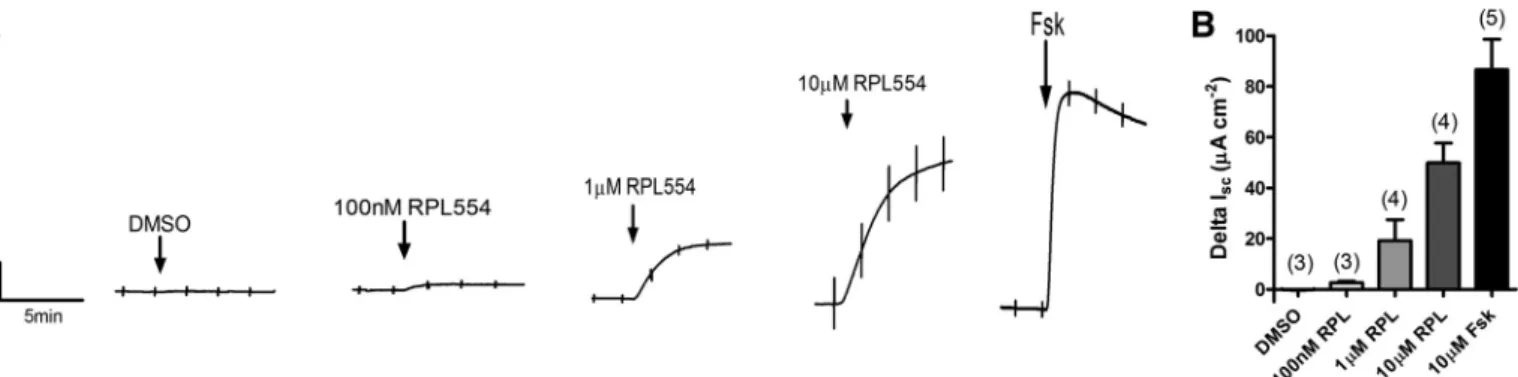
next examined whether RPL554 was able to activate WT CFTR in the human airway epithelial cell line CFBE. RPL554 dose dependently increased CFTR-dependentIscwith the
high-est concentration of RPL554 thigh-ested (10M) increasingIscby
49.8⫾7.8A cm⫺2(n⫽4). For comparison this was 57.6⫾
3.8% of the stimulation produced by a maximal (10 M) con-centration of forskolin (86.5 ⫾ 12.0 A/cm2; n⫽ 5; Fig. 2).
Therefore, these data suggested that RPL554, via inhibition of PDE3 and/or PDE4, raised [cAMP]ilevels sufficiently to
acti-vate CFTR-dependent transepithelial anion secretion to levels that are comparable with those produced by forskolin. Thus
Fig. 1. RPL554 does not stimulate cystic fibrosis transmembrane conductance regulator (CFTR) di-rectly but potentiates forskolin-stimulated CFTR current in Chinese hamster ovary (CHO) cells. CFTR-dependent currents in CHO cells express-ing CFTR were measured usexpress-ing the broken patch, whole cell patch configuration.A: CFTR-depen-dent current obtained at⫹40 mV in response to stimulation of cells with RPL554 or forskolin (Fsk). Data represent means⫾SE;P⬍0.001;n
⫽3–19.B: increase in CFTR-dependent currents obtained at⫹40 mV by increasing concentrations of RPL554 after cells had been prestimulated with forskolin (2M). Data represent means⫾SE; *P
RPL554 activates robust secretion by this human airway cell line in the absence of other secretagogues.
PDE expression is altered in CF pHBE cells compared with
WT pHBE cells.RPL554 is a dual PDE3/4 inhibitor; therefore,
we examined the expression of these PDE isoenzymes, to-gether with other PDE isoforms as well as examining whether their expression was altered in CF. Expression of a subset of eight known PDE isoforms was assessed in HBE cells from three non-CF donors, three patients homozygous forF508del, and three patients carrying R117H/F508del. By assessing the relative expression of each PDE gene tested when normalizing to the expression of GAPDH, we were able to get an indication of which PDE genes were most abundantly expressed in HBE cells. As shown in Fig. 3A, PDE4D was expressed in relatively high abundance in WT cells, which is unsurprising given the body of evidence implicating PDE4D in CFTR regulation in human airway epithelia. However, there was a very low ex-pression of PDE3A when normalized to GAPDH exex-pression across all three genotypes, indicating PDE3A is expressed at very low levels in HBE cells relative to other PDE isoforms. An unexpected finding was the abundance of PDE7A and PDE8A expression in all three genotypes, raising the question as to their role in cyclic nucleotide signaling in human airway epithelia. When normalizing the PDE gene expression relative to the WT patients, we observed a 5.1⫾2.3-fold upregulation of PDE3A and a 3.9 ⫾ 1.9-fold upregulation of PDE4D in
F508del/F508delcells compared with WT (P⬍0.001 vs. WT;
n⫽3 for each; Fig. 3B), which suggests a loss of CFTR at the cell surface may modulate expression of proteins involved in CFTR regulation.
PDE inhibition does not stimulate CFTR-dependent trans-epithelial ion transport in HBE F508del/F508del cells but
increases the response to VX-770. To assess whether 1)
RPL554 had similar CFTR stimulatory effects in HBE cells as those observed in CFBE cells and 2) RPL554 was able to potentiate the activity of mutant CFTR, the effect of RPL554 was tested inF508del/F508delHBE cells. To gain insight into the mechanism of action, the effects of RPL554 were also compared with those of the PDE3-selective inhibitor milrinone and the PDE4-selective inhibitor rolipram. Cells were pre-treated for 24 h with VX-809 (1M) and VX-770 (100 nM) to mimic the current treatment for F508del/F508delpatients. A submaximal concentration of forskolin (2 M) stimulated an increase in Isc of 2.9 ⫾ 0.3 A cm⫺2 (n ⫽ 25; Fig. 4).
However, subsequent exposure to specific PDE inhibitors did not further enhanceIscand actually caused a small decrease in
CFTR-dependent Isc. PDE-stimulated increases in Isc after
forskolin stimulation were⫺0.3⫾0.1,⫺0.3⫾ 0.1,⫺1.0⫾ 0.4, and⫺0.1⫾0.1A/cm2by milrinone (10M), rolipram
(10M), milrinone⫹rolipram, and RPL554 (10M),
respec-Fig. 2. RPL554 stimulates CFTR-dependent short-circuit current (Isc) in wild-type (WT) CFBE cells. CFBE cells expressing WT CFTR were grown at air-liquid interface (ALI) for 7 days beforeIscmeasurements were made in an Ussing chamber.A: example experiments in whichIscwas measured in response to increasing concentrations of RPL554 (100 nM to 10M) and forskolin (10M).B: summary of the data. Data represent means⫾SE;nnumbers are displayed in parenthesis.
Fig. 3. Phosphodiesterase (PDE) isoform expression in human bronchial epithelial (HBE) cells. HBE cells were isolated and cultured as described in METHODS and gene expression was assessed using quantitative PCR.A: ex-pression of each PDE gene when normalized to the exex-pression of GAPDH in each sample. **P⬍0.01, significant difference between WT andF508del/ F508delcells.B: expression of each PDE gene, normalized to the expression of GAPDH in each sample, and normalized to the expression levels seen in WT cells. *P ⬍0.05, ***P ⬍ 0.001, significant difference between WT and
tively (n ⫽ 5–7; Fig. 4). These results suggest that F508del
CFTR at the membrane was fully activated by forskolin fol-lowing rescue by the corrector VX-809 and chronic potentia-tion by VX-770, and thus any subsequent increases in cAMP were unable to further stimulate CFTR-dependent anion trans-port. We also investigated whether PDE inhibition could stim-ulate F508del CFTR in noncorrected cells (i.e., cells not treated for 24 h with VX-809 or VX-770). In these conditions, forskolin (2 M) stimulated a negligible increase in Isc of
0.05⫾0.02A/cm2(n⫽12), while subsequent stimulation of
cells with either rolipram (10M) or RPL554 (10M) caused highly variable increases in Isc that were not significantly
different to DMSO controls (DMSO⫽0.05 ⫾0.03A/cm2;
rolipram ⫽ 0.13 ⫾ 0.10 A/cm2; RPL554 ⫽ 0.03 ⫾ 0.15 A/cm2;P⬎ 0.05;n⫽ 3– 6; Fig. 5) These data demonstrate
thatF508delCFTR does not respond to cAMP stimulation in
noncorrected cells. However, PDE inhibition was able to sig-nificantly increase the VX-770-stimulated increase inIscfrom
0.34 ⫾ 0.13 A/cm2 in control cells to 0.74 ⫾ 0.06 and
0.80⫾0.05A/cm2in rolipram and RPL554-stimulated cells,
respectively (P ⬍ 0.05 vs. control; n⫽ 3– 6; Fig, 5). Thus, although ineffective at stimulatingF508delCFTR alone, PDE
inhibitors can augment VX-770-dependent potentiation of
F508delCFTR suggesting that RPL554 and VX-770 in
com-bination might provide additional benefit toF508del/F508del
patients.
RPL554 stimulates CFTR-dependent transepithelial ion
trans-port in pHBE R117H/⌬F508 cells by inhibiting PDE4.Next,
we explored the role of different PDEs in modulating the response of CF HBE cells (R117H/F508del) to cAMP stimu-lation. A submaximal concentration of forskolin (2M) stim-ulated an increase inIscof 1.4⫾0.1A/cm2(n⫽16; Fig. 6).
Inhibiting basal PDE activity with either milrinone, rolipram, milrinone⫹ rolipram, or RPL554 caused negligible increases inIsc(0.1⫾0.02, 0.5⫾0.1, 0.1⫾0.3, and 0.2⫾0.2A/cm2,
respectively; n ⫽ 3–7; Fig. 7), suggesting that PDE3 and 4 inhibition alone did not elevate [cAMP]isufficiently to
stimu-lateR117H CFTR. However, when added after exposure to a
submaximal concentration of forskolin, stimulation was ob-served with the specific PDE4 inhibitor rolipram (0.9 ⫾ 0.2
A/cm2; P ⬍ 0.01; n⫽ 6), a combination of specific PDE3
and PDE4 inhibitors (milrinone ⫹ rolipram; 0.7 ⫾ 0.1 A/ cm2;P⬍0.05;n⫽5), and with the dual PDE3/PDE4 inhibitor
contrast, the response to milrinone alone after submaximal forskolin stimulation was negligible (⫺0.03 ⫾ 0.1 A/cm2; n⫽5; Fig. 7) indicating that PDE3 has little role in regulating CFTR. Together, these results identify PDE4 as the primary regulator of CFTR-dependent transepithelial ion secretion in
HBE R117Hcells prestimulated with forskolin. Interestingly,
when R117H/F508del HBE cells were pretreated with
VX-809, forskolin-stimulatedIscwas enhanced but not the response
to PDE inhibitors (Figs. 6 and 7). This suggests that CF cells have diminished regulation of the cAMP microdomain sur-rounding CFTR, which is not fully corrected by VX-809 and may be due to alterations in both the cytoskeleton (46) and the localization of PDE4.
PDE3 and 4 contribute to compartmentalization of cAMP
signaling in CF airway epithelia. A well-established role for
PDEs is to compartmentalize cAMP in a specific subcellular microdomain to allow for efficient spatiotemporal cAMP sig-naling to occur (4) although this role has been challenged with respect to CFTR regulation (46). To investigate the role of PDEs during global and localized elevations of cAMP, CF
(R117H/⌬F508) HBE cells were stimulated with forskolin to
increase [cAMP] throughout the cell, or apical adenosine, to increase cAMP preferentially in the subapical membrane
mi-crodomain. Forskolin stimulated a larger increase in CFTR-dependentIsc(1.4⫾0.1A/cm2;n⫽16), compared with that
induced by apical adenosine (0.2⫾ 0.2A/cm2;P ⬍0.001; n ⫽ 6; Fig. 8A). However, the subsequent response to PDE inhibitors was similar in cells stimulated with either agonist. Milrinone⫹rolipram increasedIscby 0.6⫾0.1 and 0.8⫾0.3 A/cm2after pretreatment with forskolin and adenosine,
re-spectively (P ⬎ 0.05; n ⫽ 3–9; Fig. 8B), and RPL554 in-creasedIsc by 0.9⫾ 0.2 and 0.7⫾ 0.2A/cm2, respectively
(P⬎0.05;n⫽3–9; Fig. 8B). Together, these data imply that PDE regulation occurs predominantly in the subapical cAMP compartment in HBER117H/F508delcells.
VX-770 and RPL554 have additive effects on
CFTR-depen-dent anion transport. Given that we have already shown that
PDE inhibition enhances CFTR activity in R117H/F508del
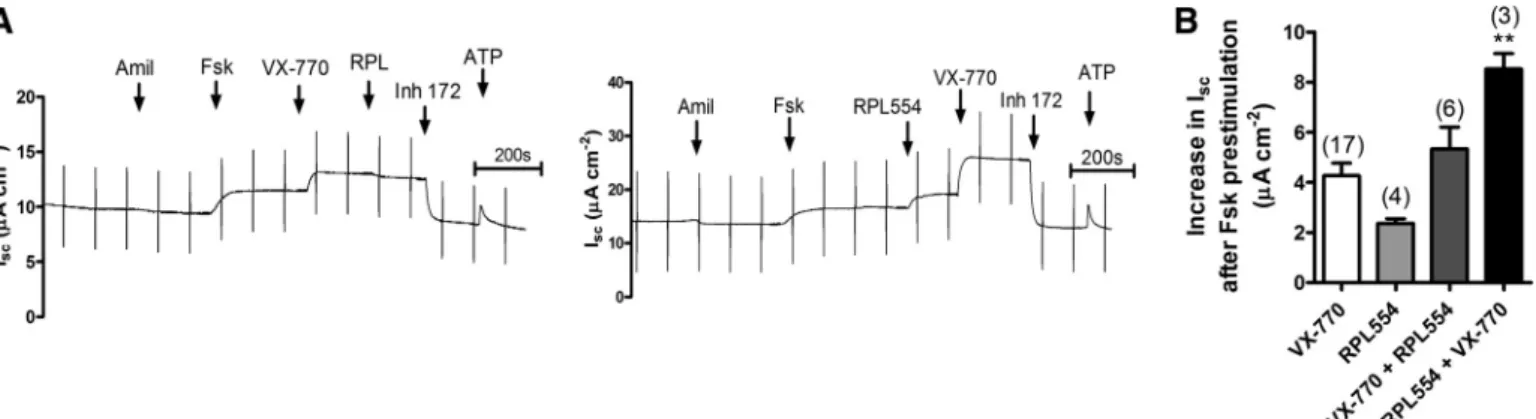
HBE cells, it was interesting to test the effect of PDE inhibition in combination with the clinically approved CFTR potentiator VX-770 (Kalydeco). To this end, R117H/F508del cells were stimulated with 2M forskolin and then treated with either 10
(n ⫽ 4), and the subsequent addition of VX-770 caused a further increase of 6.2 ⫾ 0.3 A/cm2. The net increase in
CFTR-dependent Isc under these conditions (8.6 ⫾ 0.6 A/
cm2) was significantly greater than when either agonist was
added alone (P⬍0.01;n⫽3; Fig. 9B). Adding VX-770 after forskolin stimulation caused Isc to increase by 4.3 ⫾ 0.5 A/cm2(n⫽ 17) However, subsequent addition of RPL554
failed to increase CFTR activity further and the total stimula-tion was only about half that when RPL554 was added first. These data indicate that larger responses are obtained with these agents in combination; however, the enhanced response depends on the order of exposure. Thus a combination therapy involving VX-770 and RPL554 could provide additional ben-efits toR117H/F508delpatients although this may depend on their order of administration and pharmacokinetics.
Exposure of R117H/F508del HBE cells to proinflammatory cytokines does not alter the effect of PDE inhibition on
CFTR-dependent Isc.In an attempt to mimic the pathophysiological
state of CF airways,R117H/F508HBE cells were treated with the proinflammatory cytokine TNF-␣(1 ng/ml) for 24 h before assessing the CFTR-dependent Isc in response to PDE3/4
inhibition. Pretreatment with TNF-␣did not significantly alter
the response to PDE inhibition after prestimulation with sub-maximal forskolin (2M); milrinone stimulation was negligi-ble in control cells (0.3 ⫾ 0.2 A/cm2; n ⫽ 3) and in
TNF-␣-treated cells (⫺0.01 ⫾ 0.02 A/cm2; P ⬎ 0.05 vs.
control;n⫽ 3; Fig. 10), demonstrating that PDE3 inhibition does not modulate CFTR activity, even when cells are in a proinflammatory state. Similarly, in cells that had been pretreated with TNF-␣and stimulated with forskolin, there was no increase (P⬎0.05;n⫽3) in theIscresponse to rolipram (2.6⫾0.1 vs.
1.9⫾0.4A/cm2), milrinone⫹rolipram (2.0⫾0.4 vs. 2.2⫾0.1 A/cm2), and RPL554 (1.5⫾0.4 vs. 1.7⫾0.3A/cm2) when
compared with control cells (Fig. 10).
RPL554 increases CBF in HBE cells.In addition to
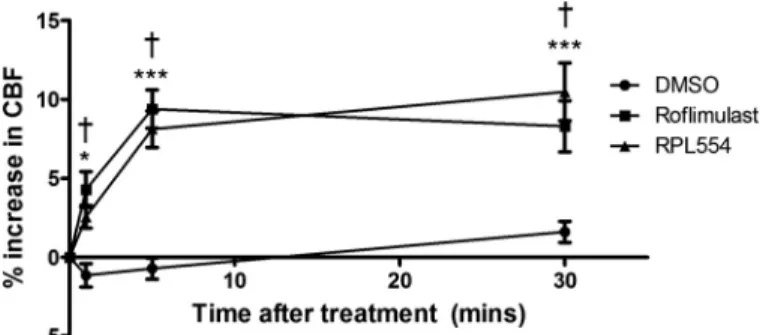
CFTR-dependent anion secretion, mucocilary clearance depends on ciliary beating, a process that is also regulated by cAMP signaling (2, 18, 36, 55, 63). We therefore measured CBF in WT HBE cells to assess whether it is increased by RPL554. Treatment of cells with RPL554 for 30 min significantly increased CBF by 2.6⫾0.8% at 1 min posttreatment compared with time-matched DMSO controls (P⬍0.05;n⫽11), 8.1⫾ 1.2% at 5 min posttreatment (P⬍0.001;n⫽11) and 10.4⫾ 1.8% at 30 min posttreatment (P ⬍ 0.001;n⫽ 11; Fig. 11).
The effect of RPL554 was almost identical to that of the selective PDE4 inhibitor roflumilast (Fig. 11), providing evi-dence that RPL554 increases ciliary beating and therefore is predicted to promote mucociliary clearance in both WT and CF patients.
DISCUSSION
By inhibiting phosphodiesterase-dependent breakdown of cAMP, PDE3, and PDE4 inhibitors have previously been shown to stimulate CFTR in human airway epithelial cells, suggesting they could be a therapeutic option for the treatment of CF. Here, we investigated the effect of RPL544, a dual PDE3/4 inhibitor that has bronchodilator effects in asthma and COPD patients (20), for its ability to restore CFTR function in several cell types, including primary HBE. Firstly, we demon-strated that although RPL554 was not able to stimulate CFTR in CHO cells, indicative of low basal adenylyl cyclase activity, it was able to potentiate CFTR activity when cells were stimulated by a submaximal concentration of forskolin (Fig. 1). These findings imply that inhibition of PDE3 and 4 in CHO cells enhanced the increase in [cAMP]i after forskolin
stimu-lation sufficiently to further stimulate CFTR. By contrast,
RPL554 did stimulate CFTR in the bronchial epithelial cell line CFBE under basal conditions in a dose-dependent manner (Fig. 2). Although the highest concentration of RPL554 tested was less potent than forskolin, PDE3/4 inhibition was clearly able to raise [cAMP]i sufficiently to activate CFTR. These results
with CFBE cells are similar to those reported for the airway cell line Calu-3 in which PDE3 and PDE4 inhibitors induced 10 – 85% of the forskolin response (12). More specifically, the fact that PDE4D has been shown to be involved in cAMP compartmentalization (4) suggests that the effects of RPL554 may be mediated by increased cAMP levels within the CFTR microdomain that depends on transmembrane adenylyl cyclase (tmAC) activity. The distinct effects of RPL554 in CHO and CFBE cells suggest CFBE cells have much higher basal tmAC activity and consequentially cAMP turnover and highlight the cell-type specific effects of RPL554.
We next compared the effects of the dual PDE3/4 inhibitor RPL554 with those of the PDE3-selective inhibitor (milrinone) and the PDE4-selective inhibitor (rolipram). CFTR-dependent anion transport was measured in primary HBE cells from CF patients carrying F508del/⌬F508del or R117H/F508del al-leles. Quantitative PCR results revealed upregulation of PDE3
Fig. 7. PDE4 inhibition stimulates CFTR-dependentIscinR117H/F508delHBE cells after prestimulation with forskolin.R117H/F508delHBE cells were isolated and cultured as described inMETHODSandIscmeasurements were made in Ussing chambers. Cells were treated with DMSO or the CFTR corrector VX-809 (3
M) for 24 h before study.A: representative experiments in whichIscwas measured in response to treatment with the PDE3 inhibitor milrinone (10M apical;
and PDE4D expression in CF cells when compared with WT cells, but the overall level of PDE3 expression was very low compared with PDE4D and, interestingly, PDE7A and PDE8A (Fig. 3). InF508del/F508delcells pretreated with VX-770 and VX-809, forskolin stimulated CFTR-dependent Isc; however,
PDE inhibitors did not cause further Isc increases suggesting
that F508del CFTR was maximally activated after forskolin
stimulation (Fig. 4). This is perhaps surprising when one considers that the gene expression of PDE3 and PDE4D was upregulated in F508del/F508del cells; however, it is worth noting that mRNA abundance may not strictly be proportional to protein expression. In noncorrectedF508del/F508delcells, forskolin failed to increase CFTR-dependent Isc and
subse-quent PDE inhibition also did not activate CFTR, demonstrat-ing the importance of VX-809 and VX-770 therapy for these patients. However, in the presence of PDE inhibitors, VX-770-stimulatedIscwas significantly enhanced compared with
con-trol cells, suggesting PDE inhibitors can stimulate CFTR after potentiation by VX-770 (Fig. 5). InR117H/F508delcells, PDE inhibition alone failed to stimulate CFTR-dependent Isc,
al-though rolipram, milrinone ⫹ rolipram, and RPL554 all in-creasedIsc when cells were prestimulated with forskolin. The
lack of effect of milrinone as well as similar Isc stimulations
elicited by the PDE4-selective inhibitor rolipram and the dual PDE3/4 inhibitor RPL554 suggests PDE4 inhibition mediates most stimulation ofR117H CFTR (Figs. 6 –7). This is consis-tent with the very low PDE3 gene expression measured in these cells and agrees with other studies that have demonstrated PDE4 activity to be significantly higher than PDE3 activity in HBE cells (16) and PDE4 to be the predominant regulator of CFTR in human airway epithelia (4, 6). However, PDE3 inhibition stimulates CFTR in Calu-3 cells (12, 48) raising the possibility that PDE regulation of CFTR differs in airway gland and surface epithelia. The negative effects of PDE inhibition inF508del/F508delcells compared with the positive effects inR117H/F508delcells show that the CFTR response to PDE inhibitors inR117H/F508delcells must be due to the
R117Hallele. This highlights a difference in the regulation of
R117H CFTR andF508del CFTR sinceR117H CFTR is not
Fig. 8. PDE3/4 contributes to cAMP compartmentalization inR117H/F508del
HBE cells.R117H/F508delHBE cells were isolated and cultured as described inMETHODSandIscmeasurements were made in Ussing chambers.A: increase in CFTR-dependentIscafter cells were stimulated with either forskolin (2M) or apical adenosine (Ado; 10M).B: furtherIscincrease after subsequent
inhibition of PDE3/4 using either milrinone (10M)⫹rolipram (10M) or RPL554 (10 M) was also assessed. ***P⬍ 0.001, significant difference between forskolin and adenosine. Data represent means⫾SE;nnumbers are displayed in parenthesis.
Fig. 10. TNF-␣treatment does not modulate PDE inhibitor-stimulated CFTR-dependentIscinR117H/F508delHBE cells.R117H/F508delHBE cells were isolated and cultured as described inMETHODS and Isc measurements were made in Ussing chambers. Cells were treated with PBS (control) or TNF-␣(1 ng/ml) 24 h before the study and CFTR-dependent Isc was measured in response to milrinone (10M), rolipram (10M), milrinone⫹rolipram, and RPL554 (10M) after cells were prestimulated with forskolin (2M). Data represent means⫾SE;n⫽3– 4.
fully stimulated by forskolin and can be further modulated by local changes in cAMP, in contrast to rescuedF508delCFTR. When responses to submaximal forskolin and apical adeno-sine were compared in R117H/F508del HBE cells, forskolin stimulated higher CFTR-dependent anion transport than aden-osine (Fig. 8A). This parallels earlier findings in Calu-3 cells using the patch-clamp technique (28). RPL554 and the com-bination of milrinone⫹rolipram caused similar increases inIsc
regardless of whether the cells had been prestimulated with forskolin or adenosine, indicating that PDE3/4 inhibition abol-ished the compartmentalized nature of cAMP signaling pro-duced by adenosine receptor stimulation. PDE4-dependent compartmentalization of cAMP in Calu-3 airway epithelial cells was reported by Barnes et al. (4), who showed that inhibitors of PDE4, but not PDE3, can abolish the lateral confinement of cAMP signals that are induced by adenosine receptor activation. The PDE4 inhibitor rolipram also stimu-lated CFTR when added to excised patches and augmented adenosine-stimulated CFTR activity to levels observed during forskolin stimulation. By contrast, Kelley et al. (32) showed that CFTR in Calu-3 is strongly activated by the PDE3 inhib-itor milrinone and weakly stimulated by rolipram. Similar results were reported by Penmatsa et al. (48), who found that the PDE3 inhibitor cilostazol stimulated CFTR more strongly than rolipram in Calu-3 cells. They also demonstrated an interaction between CFP-PDE3A and YFP-CFTR in HEK cells using fluorescence resonance energy transfer (FRET) and co-immunoprecipitated HA-PDE3A with Flag-CFTR. Although some findings remain controversial, they reinforce the impor-tance of PDE activity in regulating local cAMP levels in HBE cells.
Considering that RPL554 increases forskolin-stimulated CFTR channel activity, it was interesting to examine its effects in the presence of VX-770, a clinically prescribed CFTR potentiator. VX-770 binds directly to CFTR to increase chan-nel gating and thus potentiates its activity after stimulation with cAMP agonists (29, 66). We observed that VX-770 further enhanced CFTR activity in cells treated with forskolin and RPL554 (Fig. 9). Thus these findings demonstrate CFTR ac-tivity can still be increased by CFTR potentiators, even after forskolin and RPL554 stimulation, highlighting that gating limits CFTR activity in the presence of cAMP and that
fors-kolin and RPL554 did not stimulate CFTR to its maximal activity in R117H/⌬F508 cells. However, when cells were stimulated with forskolin and then potentiated with VX-770, subsequent addition of RPL554 failed to further activate CFTR. This indicates that forskolin-induced phosphorylation of CFTR is sufficient for a maximal response to VX-770, and once VX-770 has potentiated CFTR further increases in [cAMP]i, due to PDE inhibition have no effect on CFTR
activity. Interestingly, when RPL554 was added first followed by VX-770, the netIscincrease was significantly greater than
when either agonist was added alone or combined in the reverse order. This implies that combining these two drugs provides the highest level of CFTR stimulation although this will likely depend on the pharmacokinetics of both com-pounds and require administration of RPL554 before VX-770. It is important to note that, in these studies, VX-770 was added acutely so it remains to be seen what would happen in the clinic under chronic dosing conditions.
CF airways are chronically inflamed, mediated by high levels of proinflammatory cytokines, including IL-8 and TNF-␣ (33, 51, 56, 59). Therefore, we examined whether CFTR-dependent anion transport in response to PDE inhibitors was altered in cells exposed to proinflammatory cytokines. However, 24-h treatment with TNF-␣ did not affect the re-sponse to PDE inhibition as only PDE4 inhibition stimulated CFTR-dependent Isc in control and TNF-␣-treated cells (Fig.
10). However, these data do show that the effects of RPL554 are not compromised by the presence of TNF-␣and therefore support its potential therapeutic use in CF airways.
Mucociliary clearance depends on CFTR-driven fluid secre-tion and ciliary beating; therefore, we examined the effect of RPL554 on CBF. CBF was increased significantly, consistent with the regulation of CBF by cAMP signaling (Fig. 11). A similar increase in CBF was observed with roflumilast, which is in agreement with previous findings (43). The similar in-creases in CBF induced by roflumilast and RPL554 suggest the response was mediated by inhibition of PDE4. Although equiv-alent experiments were not yet performed using CF cells, since CBF is regulated by PKA-dependent phosphorylation of dy-nein light chains, the regulation of CBF is probably not CFTR dependent and should be similar in CF cells.
In summary, we have demonstrated for the first time that the PDE3/4 dual inhibitor RPL554 stimulates CFTR in well-differentiated HBE cells from R117H/F508del and therefore could provide therapeutic benefits to patients carrying at least
one R117H allele. The mechanism of action apparently
in-volves exclusively PDE4 and is additive with the effect of VX-770; therefore, it may further enhance CFTR activity in combination with VX-770. RPL554 also increased CBF in well-differentiated HBE cells, which again was seemingly mediated by PDE4 inhibition. These findings imply that RPL554 would serve to improve lung function in CF patients by 1) stimulating CFTR-dependent anion transport allowing for mucus hydration and2) increasing CBF to enhance muco-ciliary clearance. Furthermore, CFTR activation causes relax-ation of rat and human airway smooth muscle (47, 53, 67); thus RPL554 activation of CFTR may contribute to clinical im-provement in COPD patients through improved mucus clear-ance by the epithelium or through airway smooth muscle relaxation and subsequent bronchodilation.
ACKNOWLEDGMENTS
We thank Bob Bridges (Rosalind Franklin University) and CFFT, Inc. for CFTRinh172.
GRANTS
This work was supported by the UK CF trust, Verona Pharma plc, and the Canadian Institutes of Health Research.
DISCLOSURES
M. J. Turner was funded by a fellowship from Verona Pharma and K. Abbott-Banner is an employee of Verona Pharma.
AUTHOR CONTRIBUTIONS
M.J.T., L.E.O., K.A.-B., and J.W.H. conception and design of research; M.J.T., E.M., A.B., and A.J.F. performed experiments; M.J.T., E.M., A.B., and A.J.F. analyzed data; M.J.T., L.E.O., K.A.-B., and J.W.H. interpreted results of experiments; M.J.T., E.M., and A.B. prepared figures; M.J.T. drafted script; M.J.T., S.H.R., L.E.O., K.A.-B., and J.W.H. edited and revised manu-script; M.J.T., E.M., A.B., A.J.F., D.Y.T., S.H.R., L.E.O., K.A.-B., and J.W.H. approved final version of manuscript.
REFERENCES
1. Abbott-Banner KH, Page CP.Dual PDE3/4 and PDE4 inhibitors: novel treatments for COPD and other inflammatory airway diseases.Basic Clin Pharmacol Toxicol114: 365–376, 2014.
2. Allen-Gipson DS, Blackburn MR, Schneider DJ, Zhang H, Bluitt DL, Jarrell JC, Yanov D, Sisson JH, Wyatt TA.Adenosine activation of A2B receptor(s) is essential for stimulated epithelial ciliary motility and clear-ance.Am J Physiol Lung Cell Mol Physiol301: L171–L180, 2011.
3. Anderson MP, Rich DP, Gregory RJ, Smith AE, Welsh MJ.
Genera-tion of cAMP-activated chloride currents by expression of CFTR.Science
251: 679 –682, 1991.
4. Barnes AP, Livera G, Huang P, Sun C, O’Neal WK, Conti M, Stutts MJ, Milgram SL.Phosphodiesterase 4D forms a cAMP diffusion barrier at the apical membrane of the airway epithelium. J Biol Chem 280: 7997–8003, 2005.
5. Berschneider HM, Knowles MR, Azizkhan RG, Boucher RC, Tobey
NA, Orlando RC, Powell DW.Altered intestinal chloride transport in cystic fibrosis.FASEB J2: 2625–2629, 1988.
6. Blanchard E, Zlock L, Lao A, Mika D, Namkung W, Xie M,
Scheitrum C, Gruenert DC, Verkman AS, Finkbeiner WE, Conti M, Richter W.Anchored PDE4 regulates chloride conductance in wild-type and DeltaF508-CFTR human airway epithelia. FASEB J28: 791–801, 2014.
7. Butcher RW, Sutherland EW.Adenosine 3=,5=-phosphate in biological materials. I. Purification and properties of cyclic 3=,5=-nucleotide phos-phodiesterase and use of this enzyme to characterize adenosine 3=,5= -phosphate in human urine.J Biol Chem237: 1244 –1250, 1962. 8. Calzetta L, Cazzola M, Page CP, Rogliani P, Facciolo F, Matera MG.
Pharmacological characterization of the interaction between the dual phosphodiesterase (PDE) 3/4 inhibitor RPL554 and glycopyrronium on human isolated bronchi and small airways. Pulm Pharmacol Ther 32: 15–23, 2015.
9. Calzetta L, Page CP, Spina D, Cazzola M, Rogliani P, Facciolo F, Matera MG.Effect of the mixed phosphodiesterase 3/4 inhibitor RPL554 on human isolated bronchial smooth muscle tone.J Pharmacol Exp Ther
346: 414 –423, 2013.
10. Cheng SH, Gregory RJ, Marshall J, Paul S, Souza DW, White GA, O’Riordan CR, Smith AE.Defective intracellular transport and process-ing of CFTR is the molecular basis of most cystic fibrosis. Cell 63: 827–834, 1990.
11. Clancy JP, Ruiz FE, Sorscher EJ.Adenosine and its nucleotides activate wild-type and R117H CFTR through an A2Breceptor-coupled pathway.
Am J Physiol Cell Physiol276: C361–C369, 1999.
12. Cobb BR, Fan L, Kovacs TE, Sorscher EJ, Clancy JP. Adenosine
receptors and phosphodiesterase inhibitors stimulate Cl⫺ secretion in Calu-3 cells.Am J Respir Cell Mol Biol29: 410 –418, 2003.
13. Cobb BR, Ruiz F, King CM, Fortenberry J, Greer H, Kovacs T,
Sorscher EJ, Clancy JP.A2adenosine receptors regulate CFTR through PKA and PLA2.Am J Physiol Lung Cell Mol Physiol282: L12–L25, 2002.
14. Conti M, Beavo J. Biochemistry and physiology of cyclic nucleotide phosphodiesterases: essential components in cyclic nucleotide signaling.
Annu Rev Biochem76: 481–511, 2007.
15. Dalemans W, Barbry P, Champigny G, Jallat S, Dott K, Dreyer D, Crystal RG, Pavirani A, Lecocq JP, Lazdunski M.Altered chloride ion channel kinetics associated with the delta F508 cystic fibrosis mutation.
Nature354: 526 –528, 1991.
16. Dent G, White SR, Tenor H, Bodtke K, Schudt C, Leff AR, Magnus-sen H, Rabe KF.Cyclic nucleotide phosphodiesterase in human bronchial epithelial cells: characterization of isoenzymes and functional effects of PDE inhibitors.Pulm Pharmacol Ther11: 47–56, 1998.
17. Derand R, Montoni A, Bulteau-Pignoux L, Janet T, Moreau B, Muller JM, Becq F.Activation of VPAC1 receptors by VIP and PACAP-27 in human bronchial epithelial cells induces CFTR-dependent chloride secre-tion.Br J Pharmacol141: 698 –708, 2004.
18. Di Benedetto G, Manara-Shediac FS, Mehta A.Effect of cyclic AMP on ciliary activity of human respiratory epithelium. Eur Respir J 4: 789 –795, 1991.
19. Di Paola R, Mazzon E, Paterniti I, Impellizzeri D, Bramanti P, Cuzzocrea S.Olprinone, a PDE3 inhibitor, modulates the inflammation associated with myocardial ischemia-reperfusion injury in rats. Eur J Pharmacol650: 612–620, 2011.
20. Franciosi LG, Diamant Z, Banner KH, Zuiker R, Morelli N, Kamer-ling IM, de Kam ML, Burggraaf J, Cohen AF, Cazzola M, Calzetta L, Singh D, Spina D, Walker MJ, Page CP.Efficacy and safety of RPL554, a dual PDE3 and PDE4 inhibitor, in healthy volunteers and in patients with asthma or chronic obstructive pulmonary disease: findings from four clinical trials.Lancet Respir Med1: 714 –727, 2013.
21. Francis SH, Blount MA, Corbin JD. Mammalian cyclic nucleotide phosphodiesterases: molecular mechanisms and physiological functions.
Physiol Rev91: 651–690, 2011.
22. Fuhrmann M, Jahn HU, Seybold J, Neurohr C, Barnes PJ, Hippen-stiel S, Kraemer HJ, Suttorp N.Identification and function of cyclic nucleotide phosphodiesterase isoenzymes in airway epithelial cells.Am J Respir Cell Mol Biol20: 292–302, 1999.
23. Fulcher ML, Gabriel S, Burns KA, Yankaskas JR, Randell SH.
Well-differentiated human airway epithelial cell cultures.Methods Mol Med107: 183–206, 2005.
24. Gantner F, Kupferschmidt R, Schudt C, Wendel A, Hatzelmann A.In vitro differentiation of human monocytes to macrophages: change of PDE profile and its relationship to suppression of tumour necrosis factor-alpha release by PDE inhibitors.Br J Pharmacol121: 221–231, 1997.
25. Haddad JJ, Land SC, Tarnow-Mordi WO, Zembala M, Kowalczyk D,
Lauterbach R.Immunopharmacological potential of selective phospho-diesterase inhibition. I. Differential regulation of lipopolysaccharide-me-diated proinflammatory cytokine (interleukin-6 and tumor necrosis factor-alpha) biosynthesis in alveolar epithelial cells.J Pharmacol Exp Ther300: 559 –566, 2002.
26. Haddad JJ, Land SC, Tarnow-Mordi WO, Zembala M, Kowalczyk D,
Lauterbach R.Immunopharmacological potential of selective phospho-diesterase inhibition. II. Evidence for the involvement of an inhibitory-kappaB/nuclear factor-kappaB-sensitive pathway in alveolar epithelial cells.J Pharmacol Exp Ther300: 567–576, 2002.
27. Hentchel-Franks K, Lozano D, Eubanks-Tarn V, Cobb B, Fan L,
Oster R, Sorscher E, Clancy JP.Activation of airway Cl⫺secretion in human subjects by adenosine.Am J Respir Cell Mol Biol31: 140 –146, 2004.
28. Huang P, Lazarowski ER, Tarran R, Milgram SL, Boucher RC, Stutts MJ.Compartmentalized autocrine signaling to cystic fibrosis transmem-brane conductance regulator at the apical memtransmem-brane of airway epithelial cells.Proc Natl Acad Sci USA98: 14120 –14125, 2001.
29. Jih KY, Hwang TC.Vx-770 potentiates CFTR function by promoting decoupling between the gating cycle and ATP hydrolysis cycle.Proc Natl Acad Sci USA110: 4404 –4409, 2013.
30. Keir S, Page CP.RPL554, a dual phosphodiesterase (PDE) 3/4 inhibitor acts synergistically with muscarinic receptor antagonists and beta-adreno-ceptor agonists to produce bronchodilation in vivo.Am J Respir Crit Care Med1889: A4218, 2014.
31. Kelley TJ, Al-Nakkash L, Cotton CU, Drumm ML. Activation of
endogenous deltaF508 cystic fibrosis transmembrane conductance regula-tor by phosphodiesterase inhibition.J Clin Invest98: 513–520, 1996. 32. Kelley TJ, al-Nakkash L, Drumm ML.CFTR-mediated chloride
33. Khan TZ, Wagener JS, Bost T, Martinez J, Accurso FJ, Riches DW.
Early pulmonary inflammation in infants with cystic fibrosis.Am J Respir Crit Care Med151: 1075–1082, 1995.
34. Knowles MR, Stutts MJ, Spock A, Fischer N, Gatzy JT, Boucher RC.
Abnormal ion permeation through cystic fibrosis respiratory epithelium.
Science221: 1067–1070, 1983.
35. Kopelman H, Corey M, Gaskin K, Durie P, Weizman Z, Forstner G.
Impaired chloride secretion, as well as bicarbonate secretion, underlies the fluid secretory defect in the cystic fibrosis pancreas.Gastroenterology95: 349 –355, 1988.
36. Kultgen PL, Byrd SK, Ostrowski LE, Milgram SL.Characterization of an A-kinase anchoring protein in human ciliary axonemes.Mol Biol Cell
13: 4156 –4166, 2002.
37. Leclerc O, Lagente V, Planquois JM, Berthelier C, Artola M,
Eich-holtz T, Bertrand CP, Schmidlin F. Involvement of MMP-12 and
phosphodiesterase type 4 in cigarette smoke-induced inflammation in mice.Eur Respir J27: 1102–1109, 2006.
38. Lee JH, Richter W, Namkung W, Kim KH, Kim E, Conti M, Lee MG.
Dynamic regulation of cystic fibrosis transmembrane conductance regu-lator by competitive interactions of molecular adaptors.J Biol Chem282: 10414 –10422, 2007.
39. Liu S, Veilleux A, Zhang L, Young A, Kwok E, Laliberte F, Chung C, Tota MR, Dube D, Friesen RW, Huang Z.Dynamic activation of cystic fibrosis transmembrane conductance regulator by type 3 and type 4D phosphodiesterase inhibitors.J Pharmacol Exp Ther314: 846 –854, 2005.
40. Manning CD, Burman M, Christensen SB, Cieslinski LB, Essayan
DM, Grous M, Torphy TJ, Barnette MS. Suppression of human
inflammatory cell function by subtype-selective PDE4 inhibitors cor-relates with inhibition of PDE4A and PDE4B.Br J Pharmacol128: 1393–1398, 1999. 25.
41. Matsui H, Grubb BR, Tarran R, Randell SH, Gatzy JT, Davis CW, Boucher RC.Evidence for periciliary liquid layer depletion, not abnormal ion composition, in the pathogenesis of cystic fibrosis airways disease.
Cell95: 1005–1015, 1998.
42. Maurice DH, Ke H, Ahmad F, Wang Y, Chung J, Manganiello VC.
Advances in targeting cyclic nucleotide phosphodiesterases.Nat Rev Drug Discov13: 290 –314, 2014.
43. Milara J, Armengot M, Banuls P, Tenor H, Beume R, Artigues E, Cortijo J.Roflumilast N-oxide, a PDE4 inhibitor, improves cilia motility and ciliated human bronchial epithelial cells compromised by cigarette smoke in vitro.Br J Pharmacol166: 2243–2262, 2012.
44. Milara J, Navarro A, Almudever P, Lluch J, Morcillo EJ, Cortijo J.
Oxidative stress-induced glucocorticoid resistance is prevented by dual PDE3/PDE4 inhibition in human alveolar macrophages.Clin Exp Allergy
41: 535–546, 2011.
45. Molnar-Kimber K, Yonno L, Heaslip R, Weichman B.Modulation of TNF alpha and IL-1 beta from endotoxin-stimulated monocytes by selec-tive PDE isozyme inhibitors. Agents Actions39 Spec No: C77-79, 1993. 46. Monterisi S, Favia M, Guerra L, Cardone RA, Marzulli D, Reshkin SJ, Casavola V, Zaccolo M.CFTR regulation in human airway epithelial cells requires integrity of the actin cytoskeleton and compartmentalized cAMP and PKA activity.J Cell Sci125: 1106 –1117, 2012.
47. Norez C, Jayle C, Becq F, Vandebrouck C.Bronchorelaxation of the human bronchi by CFTR activators.Pulm Pharmacol Ther 27: 38 –43, 2014.
48. Penmatsa H, Zhang W, Yarlagadda S, Li C, Conoley VG, Yue J,
Bahouth SW, Buddington RK, Zhang G, Nelson DJ, Sonecha MD, Manganiello V, Wine JJ, Naren AP.Compartmentalized cyclic adeno-sine 3=,5=-monophosphate at the plasma membrane clusters PDE3A and cystic fibrosis transmembrane conductance regulator into microdomains.
Mol Biol Cell21: 1097–1110, 2010.
49. Quinton PM. Chloride impermeability in cystic fibrosis. Nature 301: 421–422, 1983.
50. Quinton PM, Bijman J.Higher bioelectric potentials due to decreased chloride absorption in the sweat glands of patients with cystic fibrosis.N Engl J Med308: 1185–1189, 1983.
51. Ranganathan SC, Parsons F, Gangell C, Brennan S, Stick SM, Sly PD; Australian Respiratory Early Surveillance Team for Cystic Fibrosis.
Evolution of pulmonary inflammation and nutritional status in infants and young children with cystic fibrosis.Thorax66: 408 –413, 2011. 52. Riordan JR, Rommens JM, Kerem B, Alon N, Rozmahel R, Grzelczak
Z, Zielenski J, Lok S, Plavsic N, Chou JL, Drumm ML, Iannuzzi C, Collins FA, Tsui, LC.Identification of the cystic fibrosis gene: cloning and characterization of complementary DNA.Science245: 1066 –1073, 1989.
53. Robert R, Thoreau V, Norez C, Cantereau A, Kitzis A, Mettey Y, Rogier C, Becq F. Regulation of the cystic fibrosis transmembrane conductance regulator channel by beta-adrenergic agonists and vasoactive intestinal peptide in rat smooth muscle cells and its role in vasorelaxation.
J Biol Chem279: 21160 –21168, 2004.
54. Rollins BM, Burn M, Coakley RD, Chambers LA, Hirsh AJ, Clunes MT, Lethem MI, Donaldson SH, Tarran R.A2B adenosine receptors regulate the mucus clearance component of the lung’s innate defense system.Am J Respir Cell Mol Biol39: 190 –197, 2008.
55. Schmid A, Bai G, Schmid N, Zaccolo M, Ostrowski LE, Conner GE, Fregien N, Salathe M.Real-time analysis of cAMP-mediated regulation of ciliary motility in single primary human airway epithelial cells.J Cell Sci119: 4176 –4186, 2006. 26.
56. Schuster A, Haarmann A, Wahn V.Cytokines in neutrophil-dominated airway inflammation in patients with cystic fibrosis.Eur Arch Otorhino-laryngol1: S59 –60, 1995.
57. Sheppard DN, Rich DP, Ostedgaard LS, Gregory RJ, Smith AE,
Welsh MJ.Mutations in CFTR associated with mild-disease-form Cl-channels with altered pore properties.Nature362: 160 –164, 1993.
58. Sisson JH, Stoner JA, Ammons BA, Wyatt TA. All-digital image
capture and whole-field analysis of ciliary beat frequency.J Microsc211: 103–111, 2003.
59. Sly PD, Brennan S, Gangell C, de Klerk N, Murray C, Mott L, Stick SM, Robinson PJ, Robertson CF, Ranganathan SC; Australian Re-spiratory Early Surveillance Team for Cystic Fibrosis.Lung disease at diagnosis in infants with cystic fibrosis detected by newborn screening.
Am J Respir Crit Care Med180: 146 –152, 2009.
60. Smith JJ, Travis SM, Greenberg EP, Welsh MJ.Cystic fibrosis airway epithelia fail to kill bacteria because of abnormal airway surface fluid.Cell
85: 229 –236, 1996.
61. Tabcharani JA, Chang XB, Riordan JR, Hanrahan JW. Phosphoryla-tion-regulated Cl⫺ channel in CHO cells stably expressing the cystic fibrosis gene.Nature352: 628 –631, 1991.
62. Tabcharani JA, Rommens JM, Hou YX, Chang XB, Tsui LC, Riordan JR, Hanrahan JW. Multi-ion pore behaviour in the CFTR chloride channel.Nature366: 79 –82, 1993.
63. Tamaoki J, Kondo M, Takizawa T.Effect of cAMP on ciliary function in rabbit tracheal epithelial cells.J Appl Physiol66: 1035–1039, 1989. 64. Taylor CJ, Baxter PS, Hardcastle J, Hardcastle PT.Failure to induce
secretion in jejunal biopsies from children with cystic fibrosis.Gut29: 957–962, 1988.
65. Tyrrell J, Qian X, Freire J, Tarran R. Roflumilast combined with adenosine increases mucosal hydration in human airway epithelial cultures after cigarette smoke exposure.Am J Physiol Lung Cell Mol Physiol308: L1068 –L1077, 2015.
66. Van Goor F, Hadida S, Grootenhuis PD, Burton B, Cao D, Neuberger T, Turnbull A, Singh A, Joubran J, Hazlewood A, Zhou J, McCartney J, Arumugam V, Decker C, Yang J, Young C, Olson ER, Wine JJ, Frizzell RA, Ashlock M, Negulescu P.Rescue of CF airway epithelial cell function in vitro by a CFTR potentiator, VX-770.Proc Natl Acad Sci USA106: 18825–18830, 2009.
67. Vandebrouck C, Melin P, Norez C, Robert R, Guibert C, Mettey Y, Becq F.Evidence that CFTR is expressed in rat tracheal smooth muscle cells and contributes to bronchodilation.Respir Res7: 113, 2006. 68. Wright LC, Seybold J, Robichaud A, Adcock IM, Barnes PJ.