DOROTHEA DIX HOSPITAL:
CENTER BUILDING REUSE STUDY
April 5, 2017
UNC DCRP Masters Project
Chase Nicholas
Contents
Executive Summary ... 1
1. Background ... 2
The Site ... 2
The Center Building ... 2
2. Project Context ... 6
Dix Park ... 6
Downtown Raleigh ... 6
Local Real Estate Market ... 7
3. Case Studies ... 8
The Commons at Grand Traverse: Traverse City, Michigan ... 8
Richardson Olmsted Complex: Buffalo, New York ... 9
The Presidio: San Francisco, California ... 10
Case Studies: Lessons ... 12
4. Reuse Options ... 13
5. Structuring a Partnership ... 15
6. Envisioning a Core Project at the Center Building ... 18
Site Preparation and Rehabilitation ... 18
Establishing Anchor Uses ... 20
7. Recommendations ... 24
Bibliography ... 26
Executive Summary
At the time of this writing, a visitor to Dix Park would find little evidence of the park’s pending
transformation. The vast landscape remains relatively pristine, without earthmovers, cranes, or the droning of drills and hammers. Yet this early stage is humming with mental activity, the
proliferation of ideas, and the conceptualization of a new place. The ground is long broken on the construction of a new vision for these 306-acres.
At the heart of the park is the Center Building, the original hospital building and key historic
resource on the 306-acre park. The fate of the Center Building remains, like the entirety of the Park, the subject of discussion and speculation. This report attempts to add rigor and perspective to this discussion through research and modelling. This report argues for preservation and attempts to disentangle some of the complexity of an adaptive reuse project for the building. It is the intention of the author that this report will augment ongoing park visioning activities and serve as both a reference and point of conversation for those involved in the planning of the park and preservation of its real estate.
This report concludes with a hypothetical model of reuse intended as a demonstration of feasibility. This model one of many reuse scenarios that could bring new life to the Center Building. The
purpose of the model proposed here is not to stymie alternative ideas, but to serve as a springboard for them.
This report begins with a summary of background information about the park and the Center Building that will be relevant to decisions about the building’s reuse. This section includes relevant
1.
Background
The Site
In the spring of 2005 the City of Raleigh finalized its purchase of 308 acres of the Dorothea Dix Hospital campus from the State of North Carolina for $52 million. The purchase includes
approximately 80 acres designated in 1990 as the Dix Hill Historic District in the National Register of Historic Places. The Dix Hill District includes 30 of the 71 buildings on the campus. Twelve buildings are considered contributing structures in the District. The campus includes large areas of open space available for immediate use by the city, large portions of land and buildings leased back to the State of North Carolina for continuing use by the Department of Health and Human Services, and three additional leases by the Capital Area Soccer League, the Healing Place, and North Carolina State University Daycare. The City of Raleigh will regain control of the entire campus over the next several decades. The State’s lease on the portion of the campus east of the Norfolk Southern right-of-way, including all of the Dix Hill Historic District, has a total length of 10 years. The state lease on the portion of the campus west of the Norfolk Southern right-of-way has a total length of twenty-five years.1
The Center Building
The original Center Building was constructed in 1856 and designed by A.J. Davis, whose notable works in North Carolina include the State Capitol Building, Blandwood Mansion, and several buildings on the campus of the University of North Carolina at Chapel Hill.2 The 726-foot Center
Building is constructed of stuccoed brick and detailed in a Tuscan Revival style. The west (north) wings housed male dormitories, and the east (south) wing housed female dormitories.3
The Dix Hill Historic District includes the Center Building as a non-contributing structure due its extensive alterations and additions. In 1926, the west wing was burned and rebuilt inside of its brick shell. The central pavilion was removed in 1951 and replaced with the McBryde Building to provide additional patient dormitories. Fireproof stair towers were added to the wings in 1893, and the shallow gabled roof has been replaced with a flat one. Numerous additions have been made to the Center Building, including multiple extensions to both wings, the addition of connected support facilities in the rear of the Center Building, and the addition of the surgery building to the front of the Center building in 1975.4Despite the Center Building’s many alterations over the past two
centuries, the original three-story wings remain largely intact and true to Davis’s design.
1Summary Term Sheet Prepared by the State of North Carolina: Sale of Dorothea Dix Property, 2015,
http://pulse.ncpolicywatch.org/wp-content/uploads/2015/01/Dorothea-Dix-terms.pdf
2 Davis, Edward T. and John L. Sanders, A Romantic Architect in Antebellum North Carolina: The Works of Alexander Jackson
Davis. Raleigh, NC: Historic Preservation Foundation of North Carolina, 2000.
3Little, Ruth. “Dix Hill” National Register of Historic Places Nomination Form. 1990. Retrieved from
http://rhdc.org/sites/default/files/Dix%20Hill%20NRHD.pdf
The Dix Hill Historic District is listed on the National Register in part because of the site’s
significance in the history of the medical treatment of the mentally ill in North Carolina. In 1848, nationally-active reformer, Dorothea Dix, began to lobby the General Assembly for the construction of a new hospital dedicated to the ethical treatment of the mentally ill. Dix believed in a regiment of treatment focused on active employment in crafts and agriculture, exercise and recreation in the open air, and tranquil rural surroundings. This reform perspective was embodied in the design philosophy of Dr. Thomas Kirkbride, superintendent for the Philadelphia Hospital for the Insane. Kirkbride developed a linear plan of asylum design including a central administrative building and two flanking male and female wings. Kirkbride recommended siting new asylums in agrarian surroundings away from urban centers, where fresh air and natural light could aid in patient treatment.5A.J. Davis designed the Center Building according Kirkbride’s principles. Numerous
other examples Kirkbride-style asylums, including Broughton Hospital in Morganton, North Carolina, were constructed during the second half of the nineteenth century. In the twentieth century, the Kirkbride philosophy was supplanted by more decentralized approaches to asylum design.
Physical Structure
The east and west wings of the Center Building are constructed of stuccoed-brick and contained numerous small private rooms and one larger shared dayroom per floor. These rooms are divided by load-bearing walls that cannot be altogether removed to produce large open spaces. Any future use of the east and west wings must be able to utilize a heavily-subdivided floor plan.
Fortunately, integral structural elements of the Center Building appear to be largely intact. A 2015 Dewberry Facilities Study found no major deficiencies in the vertical and horizontal elements of the Center Building wings, with the exception of a deficient connection between the south wing and McBryde West A. The buildings were found to have numerous aesthetic flaws and aging
mechanical, electrical, plumbing, and roof systems.6 These issues will add rehabilitation cost, but
are not detrimental to reuse.Aesthetic Contribution
Numerous aesthetic alterations have rendered the wings of the Center Building unattractive. The shallow-pitched roofs and cornices have been removed and the original windows have been
replaced with historically incorrect modern windows. The walls have also been restruccoed without the original scoring that simulated large stone blocks. The large, modern McBryde building
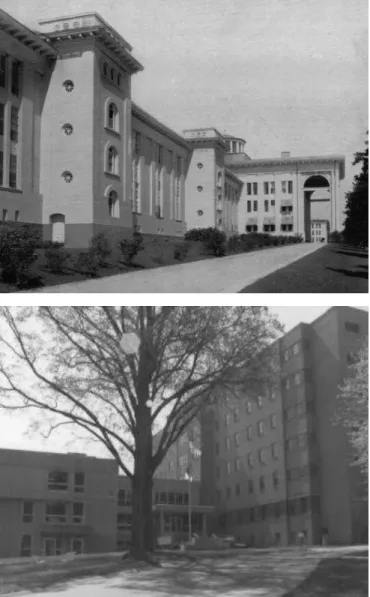
vulgarizes these structures and distracts from their historical character. Likewise, McBryde and the Hargrove surgery building disrupt the long axial façade of the original Center Building. The original and current appearance of the Center Building are shown in Figure 1.1.
5 Ibid.
6Dewberry, “Dorothea Dix Campus Facilities Study,” Report Prepared for City of Raleigh Parks, Recreation, and Cultural
Historic Designation
The rehabilitation and reuse of the Center Building by private investors can be
incentivized by the availability of tax credit equity. Additionally, the use of Federal and State Historic Rehabilitation Tax Credits ensures high-quality rehabilitation through compliance with Secretary of the Interior standards. However, the Center Building is currently designated as a non-contributing structure in the Dix Hill Historic District. It therefore cannot be considered a
“certified historic structure” for the
purposes of claiming Federal and State Historic Rehabilitation Tax Credits.
The 2005 Dorothea Dix Campus Master Plan prepared by LandDesign, Inc. suggests the entirety of the Center Building may be eligible for designation as a contributing structure in a revised, expanded Dix Hill Historic District. This conclusion is based on the fact that by the time of revision, the McBryde Building, constructed in 1950, would be eligible as a contributing resource in its own right. Consequently, the entirety of the Center Building as it exists today could be listed as a single contributing resource.
There is reason to believe this type of designation may not be in the best interest of the park. Whether or not the McBryde Building deserves historic designation, it is not necessarily a strong historic resource for Dix Park for the aesthetic concerns discussed above. If designated as part of a single contributing Center Building resource, its demolition may render the rehabilitation of the wings ineligible as a tax credit project.7
7
Technical Preservation Services [TPS]. “Historic Preservation Tax Incentives.” 2012. Retrieved from
https://www.nps.gov/tps/tax-incentives/taxdocs/about-tax-incentives-2012.pdf.According to TPS, certified rehabilitation
projects must “damage, destroy, or cover materials or features, whether interior or exterior, that help define the building’s historic character.” The scale and centrality of the McBryde Building would realistically render it a definitive element.
Figure 1.1: Historic (top) and current (bottom) Center Building
Historical Sensitivity
The Center Building is a place deeply colored by memory. Its construction was an optimistic
endeavor in the humane treatment of the mentally ill. However, as a place of treatment and a place of work the hospital could be both trying and tragic. New use for the Center Building must respect and honor, rather than erase, the lives of the thousands who lived and worked in the hospital.
2.
Project Context
Dix Park
At the time of this writing, the City of Raleigh has chosen Michael Van Valkenburg Associates as lead consultant in the development of Dix Park, but has not yet adopted an official plan. Even at this early stage, it is clear that the Park will be defined by its use as a space for public recreation rather than private development.8 Activities and uses that will be central to the Park in the future are
already partially in place. Raleigh Parks and Recreation programming, including craft and fitness classes, began in the park in 2016. Twenty-five thousand attendees converged on the park’s “Big Field” for Destination Dix, a day of celebration including local food and craft vendors, musical
performances, entertainment activities, and park outreach.9 These types of activities are already
beginning to define the “destination park” concept planned for Dix Park.
Downtown Raleigh
Planning for the adaptive reuse of the Center Building at Dix Park requires considering not just the
site’s context within the park, but the greater urban and regional context. Just as Dix Park as a whole is defined by its proximity to downtown Raleigh, so are the real estate assets it contains. In 2015, the City of Raleigh adopted the 10-year Downtown Experience Plan to guide the rapid growth of downtown Raleigh. The plan identifies four “Framework Themes” and five “Catalytic Project Areas” that illustrate key goals of the plan. Western Boulevard, the northern border of the Dix Park property, forms the southern boundary of the Downtown Plan area. The Center Building is approximately a mile from the center of the Downtown Plan Area and half a mile from the Nash Square and Gateway Center Catalytic Project Areas.10 Improved connectivity across Western
Boulevard will further link the Park and the Center Building with the downtown core.11
Plans for the Gateway Center, the nearest Catalytic Project Area to the Center Building, should be a consideration in the planning for the Center Building. The Downtown Plan recommends capitalizing on existing anchors in this Project Area, including City Plaza, Red Hat Amphitheater, the Duke
8 Consultation with Kate Pearce, Dix Park Senior Planner, February 8, 2017. 9City of Raleigh, “Dorothea Dix Park 2016 Year-in-Review,” December, 2016. 10
City of Raleigh, Downtown Plan: The Next 10 Years. September 15, 2015. Retrieved from
https://www.raleighnc.gov/content/PlanDev/Documents/UrbanDesign/Downtown/DowntownPlan.pdf
Energy Center for the Performing Arts, and the Raleigh Convention Center, by expanding tourism and recreation uses to the Southwest. One of the two concepts for Project Area calls for a new cultural or sporting anchor in this area. The other calls for the development of an Urban Innovation Campus for a cluster of new businesses. Both concepts foresee greatly increased density and significant vertical development. The Gateway Center is described as the only sector of downtown fit for multiple blocks of “large-scale mixed-use development.”12
Local Real Estate Market
The successful reuse of the Center Building requires tapping into the strengths of the surrounding regional and local markets. Using today’s market data to make judgments about market strengths at the time of the project’s delivery is a precarious endeavor. The State’s lease of the Center Building will not expire until 2025, and project delivery will likely not occur until several years thereafter. However, understanding general trends in demand is necessary for modelling the feasibility of reuse. The following market overview focuses on trends in key sectors of the downtown Raleigh real estate market.
Residential
The overall market picture in downtown Raleigh is one of multi-decade growth characterized by an
influx of new jobs, residents, and amenities. Since 2000, Raleigh’s downtown population has more
than doubled as the result of numerous multi-family and mixed-use projects. The pace of new residential growth is only expected to accelerate toward the end of the decade. The Downtown Raleigh Alliance projects that by 2020, downtown Raleigh will have approximately 5,500 residential units, triple the 2020 count. In 2015, downtown multi-family vacancy rates (4.8%) were well below the Triangle average (7%), indicating a promising environment for continued growth.13
Office
Increasing demand for downtown residences has been matched by increasing demand for downtown office space in the past decade. Downtown Raleigh boasts the highest rental rate, the highest worker density, and one of the lowest vacancy rates in the Triangle region. Public employers have historically formed the economic base of the area, but the entry and growth of science and technology service companies like Red Hat and Citrix have driven employment increases in recent years. This industry is bolstered by the highly-qualified young talent provided by the numerous higher-education institutions throughout the city and region. Additionally, a strengthening start-up culture in downtown Raleigh, fostered by incubators like HQ Raleigh and Nest, promises
endogenous growth.
12City of Raleigh, Downtown Plan, 41.
13Downtown Raleigh Alliance [DRA], State of Downtown Raleigh 2016, 2016, Retrieved from
The Downtown Raleigh Alliance projects a 26% increase in downtown employment between 2015 and 2030, indicating a sustained increase in office demand.14
Tourism
Though not a sector of the real estate market, tourism is a pillar that supports a number of real estate subsectors, including hospitality, retail, and civic uses. Raleigh’s numerous museums, event
spaces, and festivals make it a strong magnet for visitors seeking entertainment and cultural experiences. Recent growth in the sector suggests a bright future for tourism and the sectors it influences. Since 2007, the City has experienced 33% growth in tourism.
In 2014, 3 of the top 4 tourism attractions in downtown were museums. The North Carolina Museum of Natural Sciences and the Marbles Kids Museum top this list, followed by the Raleigh Convention Center and the North Carolina Museum of History. Festivals also generate considerable tourism draw. In 2014, the IBMA world of bluegrass festival brought over 180,000 visitors to
downtown Raleigh for a single event.15
The success of tourism in downtown Raleigh partially explains recent growth in hospitality. In 2017, construction will finish on the Residence Inn by Marriott near the Raleigh Convention Center and Duke Center for the Performing Arts. Plans for two new downtown Raleigh hotels were approved in early 2017. Even with these new developments, demand for downtown lodging is likely to continue to outstrip supply.
3.
Case Studies
Planning for the Center Building will greatly benefit from the perspective provided by successful adaptive reuse projects around the country. This section presents three case studies of projects of a similar character, scale, and context as the Center Building. These cases were also chosen for their diverse results and approaches to project management.
The Commons at Grand Traverse: Traverse City, Michigan
Between 1885 and 1980 Traverse City State Hospital (originally, Northern Michigan Asylum for the Insane) occupied a 600-acre site near downtown Traverse City, Michigan. The main hospital, known as Building 50, was constructed in the Kirkbride style with a central administrative building and two axial wings. The central administrative building was demolished in 1963 and replaced with a two-story building. Like at Dorothea Dix Hospital, the rural setting and agrarian activities were central to
patients’ therapeutic treatment.16
14Ibid.
The hospital was closed by the State of Michigan in 1980 and slated for demolition. The City of Traverse City and the Charter Township of Garfield responded by forming the Coalition for Logical Land Use to advocate for the preservation of the site and the reuse of it structures. In 1990, the Coalition adopted the Adaptive Reuse Feasibility Plan for Traverse City State Hospital detailing the
“acquisition, preservation, restoration, and redevelopment” of the Grand Traverse Commons. The
Grand Traverse Commons Redevelopment Corporation (GTCRC) was formed to acquire the property and implement the plan.17
In 1992, GTCRC chose Kids Creek Development Company (KCDC) as the master developer for the property. KCDC developed a new master plan for the property, but was ultimately overwhelmed by the enormity of the undertaking and filed for bankruptcy before their vision could be fully
implemented. The GTCRC chose the Minervini Group as the new master developer for the site. The GTCRC allowed the Minervini group increased flexibility and additional project uses to make the development plan financially feasible.18 Between 2001 and 2010 the Minervini Group rehabilitated
over 300,000 square feet of space in Building 50 and nearby campus buildings for condos, retail, office, and restaurant use.19
In addition to local support in the forms of project leadership, planning guidance, and concurrent campus investments from the City of Traverse City and the Charter Township of Garfield, the
Minervini redevelopment project required significant state and federal financial assistance. Notably, the redevelopment made significant use of Federal Historic Rehabilitation Tax Credits, the
Brownfields Program, and the Michigan Renaissance Zone Program. The Renaissance Zone program provides significant tax abatement for businesses and residences located in a five-acre zone
surrounding Building 50.20
In 2008, Traverse City Michigan adopted the Grand Traverse Commons Master Plan with the objectives of building on the past, collaborating with other stakeholders, soliciting input, and implementing new ideas. The continuing transformation of Building 50 from a single-use,
continuing-care retirement center to a mixed-use development is a key idea of the Master Plan.21
Richardson Olmsted Complex: Buffalo, New York
In 2009 the Richardson Center Corporation (RCC) adopted the Master Plan for the Richardson Olmsted Complex in Buffalo, New York. At the core of the RCC’s vision was the rehabilitation of the
17 Ibid., 7.
18 Ibid., 8.
19 The Minervini Group, “Committed to the Asylum: Preserving history, re-using buildings and growing the economy by creating a neighborhood,” 2015,
https://www.michigan.gov/documents/deq/ERRMC_TC_Keynote_Minnervini_GrandTraverseCommons_505360_7.pdf 20 Partnerships for Change and Otwell Mawby, P.C., 18-20.
21Partnerships for Change and Otwell Mawby, P.C., “Grand Traverse Commons Master Plan,” 8, 2010,
historic hospital complex to serve as the “crowning jewel of a mixed-use, multi-purpose civic campus of public and private activities.”22
In 2014, the RCC broke ground on the first phase of the redevelopment called the “Core Project”,
consisting of the central administrative tower and its two adjacent wards. The RCC identified four
uses for the Core Project: a Buffalo visitor’s center, event and conference space, a home for the Buffalo Architecture Center, and a boutique hotel. The 2009 Master Plan emphasizes the
integration of these four complementary uses that can share revenue-generating facilities and the
application of a common branding vehicle, the “ROC” (Richardson Olmsted Complex). The Core project encompasses 188,000 square feet, and is planned to be followed by a second phase of development known as the “Expanded Core.” The Expanded Core will make use of additional wards and outbuildings for office, arts, residential, entertainment, academic, and restaurant uses that will complement the ROC.23Additional important planning considerations for these buildings include the
reorientation of vehicular traffic and parking to the north side of the complex and the preservation of the southern parklike entrance for ceremonial purposes.24
The largest component of the Core Project in terms of square footage is the boutique hotel, the Hotel Henry, which will occupy both adjacent wards to the Tower Building. The Master Plan found hospitality to be a good match for the site for several reasons. First, the small rooms are
reminiscent of the original sleeping quarters. Second, the hotel and conferences uses are highly complementary. A boutique approach that can make use of the historic assets, location, and small scale of the building, and that would not need to offer a full suite of amenities like a pool or fitness center to guests, is a natural fit for the site. The Hotel Henry is slated for completion in the Spring of 2017, and brands itself as a unique experience. It additionally advertises for the attached “Urban
Resort Conference Center.” The Hotel will consist of 88 rooms and suites.25
The Richardson Center Corporation created the for-profit subsidiary, the Richardson Center Development Corporation (RCDC), to develop the Core Project. The RCDC funded the Core Project with $54 million in state appropriations and $15 million in state and federal historic tax credits.26
The Presidio: San Francisco, California
Unlike the Commons at Grand Traverse and the Richardson Olmsted Complex, the Presidio began its life as a military base rather than mental hospital. The Presidio is simultaneously a National Park, urban park, and mixed-use development. At over 1400 acres, it dwarfs the Dix campus and the
22 Chan Krieger Sieniewicz Architecture and Urban Design, Master Plan for the Richardson Olmsted Complex, September, 2009.
Retrieved from https://richardson-olmsted.com/files/documents/planning_and_reports/master_plan_full_report.pdf
23 Ibid., 64. 24 Ibid.
25 "Hotel Henry," Website for the Urban Resort and Conference Center. Accessed February 23, 2017. Retrieved from
http://www.hotelhenry.com/
26Governor’s Press Office, “Governor Cuomo Announces Richardson Olmsted Complex Redevelopment Project Breaks Ground
other cases presented here. Despite these differences, the redevelopment of the Presidio offers valuable lessons for the redevelopment of the Dix campus.
Between 1776 and 1994 the Presidio served alternatively as a Spanish imperial outpost, a Mexican fort, and a U.S. army base. Inn 1994 the entire property was transferred to the National Parks Service. The U.S. Congress created the Presidio Trust in 1996 as steward and administrator of the
park’s land and 700 buildings. The Presidio Trust Act explicitly recognizes the Trust’s role in
protecting the Presidio from “development and uses which would destroy the historic and natural
character of the area and cultural and recreational resources.”27 The Presidio Trust was tasked with
becoming financially self-sufficient and making effective use of local public, private, and non-profit sector resources. 28
The heart of the Presidio is the Main Post, which functioned as the center of military activity before becoming the center of visitor activity. The Main Post is intended to serve as a gateway to the visitor experience and center of orientation for visitor activity. Unlike the Kirkbride-plan hospitals, the Main Posts consists of a collection of moderately-sized buildings focused on a central parade. The Main Post consists of over a million square feet of building area. The Presidio Trust
Management Plan (PTMP) envisioned preservation of these resources and repurposing for
orientation services (including museum space), cultural activities (including a theater), event space, lodging, office space, residential units, and cafes.29
The Main Post did not immediately live up to this vision. In 2010, the Presidio Trust published the Main Post Update to the PTMP. The update acknowledged that the Main Post suffered from a lack of connectivity and activity. The update recommended the construction of additional circulation routes and a small lodge to make the Post more welcoming. Additionally, the update called for more flexibility in building use to allow for additional cultural, educational, and public-serving uses.30 The rehabilitation and expansion of the historic Presidio Theatre and Presidio Chapel are
notable additions to the Main Post in the 2010 update. Together with additional lodging and
accommodations, these projects are meant to add activity to the Main Post while accomplishing the
Trust’s preservation goals.
The PTMP predicted the rehabilitation of historic resources would account for over 10% of total capital expenses between 2000 and 2030. The Trust’s requirement to become financially self -sufficient put significant strain on the organization to find diverse revenue sources to pay for capital outlays, and to pursue strategic partnerships to minimize public capital expenditures. The PTMP recommended attracting private investment by offering loan guarantees and facilitating the use of
27Presidio Trust Management Plan, 2002. Retrieved from
http://www.presidio.gov/presidio-trust/planning-internal/Shared%20Documents/Planning%20Documents/PLN-301-PTMP02-Plan.pdf, 9.
28 Ibid.
29Presidio of San Francisco, “Main Post Update to the Presidio Trust Management Plan,” November, 2010. Retrieved from
http://www.presidio.gov/presidio-trust/planning-internal/Shared%20Documents/Planning%20Documents/PLN-301-MpuToPtmp_20101124.pdf
historic rehabilitation tax credits. An important trade-off in this relationship is the reduced rental rates the trust receives from tenants who fund their own rehabilitations. However, this type of investment is nevertheless viewed as less risky for the Trust. The Trust employed long-term ground leases to facilitate these private investments. At the end of the ground lease term, the Trust recoups the land and all tenant improvements. The Trust focused initial private investments on easily rehabilitated properties at the Main Post and offered lease terms of over five years on directly leased-properties31 and sixty years for land-leased properties.32
Case Studies: Lessons
These case studies are only a sampling of the projects that are feasible on large historic sites near urban centers. They differ in terms of scale, use, financing, and ownership structure, but
nevertheless demonstrate several unifying considerations in project development that are transferable to adaptive reuse of Dix Park real estate.
First, a phased approach was used in each of these cases. The Minervini Group describes their
phasing process as “one bite at a time.”33 Phasing is a natural product of the size of these
developments, market absorption rates, and the limited capacity of public and private actors to operate at a very large scale. Phasing is also a strategy for mitigating risk and allowing development to progressively adapt to changing market and planning conditions.
Second, a central focal point in each case is the planning of a strong core around which subsequent development revolves. In the case of the Richardson Olmsted Complex, this focal point (aptly
named the “Core Project”) is also the initial project on the site. These focal points provide a mixture
of complementary uses that anchor ongoing reuse projects elsewhere at the site. Often these focal points also serve as a gateway for visitors and include visitor programming. Finally, these focal points act as the image or symbol of the site. As such, they are both the first and last impression for visitors.
Third, the retention of historical architecture and legacy is critical to each case. The Minervini Group
considered the “castle-like” appearance of Traverse City State Hospital to be a key asset in the
effort to reuse the site. In each case, realizing the full value of this asset requires substantial initial investment in rehabilitation. In each case, rehabilitation succeeded in producing the win-win outcome of preservation and economic value. Private actors rehabilitating to the Secretary of the
Interior’s standards also benefited from tax credit financing.
31Presidio Trust Management Plan.
4.
Reuse Options
This report has attempted to locate the historic Dorothea Dix Hospital within existing physical, social, cultural, and economic contexts. These considerations, together with guidance from similar projects around the country, help to illuminate several promising new uses for the Center Building.
Hospitality
The heavily compartmentalized floor plan of the Center Building’s wings provides a natural starting
point for conversion to lodging. Permanent residential uses are likely to over-privatize this historic space, and are therefore not recommended. Hospitality uses allow for broader access while existing harmoniously with other forms of programming.
The “urban resort” concept pursued by the Richardson Olmsted Corporation demonstrates how hospitality spaces can incorporate semi-public spaces like art galleries and museums. At the Richardson Olmsted Complex, the temporary exhibits of the Buffalo Architecture Center are
interspersed throughout the hotel, while the main exhibit is located at the main entrance. Durham’s
21c Museum Hotel also offers guests a chance to experience contemporary art in dedicated
exhibition space, while highlighting historic aspects of the property. Additionally, hospitality use can anchor destination retail like fine dining.
Hospitality use also fits well within the contexts of the park and downtown Raleigh. If Dix Park is to become a regional, and even national, destination, it will generate endogenous lodging demand. Park programming like festivals and performances, and private events like weddings naturally complement and sustain hospitality uses. Additionally, the site’s location, only a short distance from
the Raleigh Convention Center and the downtown core, suggests convention and tourism demand will bolster lodging demand at the Park.
The compatibility of hospitality use with the historic legacy of the site is a concern for this use. If featured too prominently, hospitality uses may set the wrong tone for visitors to the Center Building. Hospitality uses must be pursued in a way that respects the legacy of the site and the memory of those who lived and worked at the hospital. It is therefore recommended that hospitality use only be pursued in conjunction with civic uses, and, to the extent possible,
subordinated to them. Section 6 of this report is dedicated to demonstrating how this balance can be achieved, and how hospitality is feasible as a revenue-generating anchor on a mixed-use site.
Civic/Institutional
albeit with somewhat greater difficulty than conversion to lodging. Any museum use needs to be able to succeed with this more traditional layout, rather than an open concept.
Event space is another way to achieve the aim of public access. The public and private park events discussed above will generate demand for indoor reception space. A large, open reception hall will likely need to be located in the reconstructed central pavilion, with ancillary uses located in the adjacent portions of the Center Building’s wings. For example, permanent historic exhibitions will
need to be located in the historic hospital wings.
Finally, a Park welcome center is a natural fit for the Center Building. This use blends well with permanent exhibitions. However, it is not certain at this point whether the principal entrance to the park will be near the hospital campus or at the opposite edge of the park. Access will ultimately dictate where any welcome center should be located.
The City of Raleigh is in the unique position to have many state museums. In most situations, these museums are in modern or otherwise customized spaces, and are unlikely to make full use of the Center Building.34 Nevertheless, museum use is worth exploring further, and a small-format
museum could be highly compatible with the Center Building’s structural constraints. Section 6 of this report provides space for a small-format museum in a mixed-use project.
Office
The NC DHHS currently uses the Center Building for office space. The small patient suites are adequate for traditional office, and could possibly be opened further to accommodate users with demand for more contemporary open-concept office space. The strong office market in downtown Raleigh indicates this space could be valuable square footage; however, the location lacks the visibility and walkable proximity to downtown amenities that has driven office growth in downtown Raleigh in recent years. Office space in a rehabilitated Central Building is unlikely to garner Class A office rents. However, particular users may be able to accommodate the idiosyncrasies of this space. For example, a combination of open and enclosed spaces may be desirable for co-working and incubator office uses. The original corridors may be repurposed as open office space and patient rooms may be combined to create small offices for users who need lockable spaces.
Additional demand for office may be generated internally by the Park’s administrative functions,
but this demand is not likely to account for a significant portion of the total space. Other
prospective tenants include non-profit corporations—especially those specializing in social services and healthcare—and campus-based tenants that need scalable spaces and may eventually make use of other assets in the Park.
Section 6 of this report demonstrates how several thousand feet of office space could be made available to a variety of tenants in a mixed-use project.
Retail
Retail uses are an unlikely fit for the wings of the Center Building, but may be a fit in a
reconstructed central pavilion to support the uses listed above. Restaurant use, especially, could support hospitality and civic uses, support users of other park facilities, and provide a destination in its own right. Retail use, like office and hospitality use, privatizes spaces and should only be
considered in conjunction with public uses and access.
Mixed-Use Programming
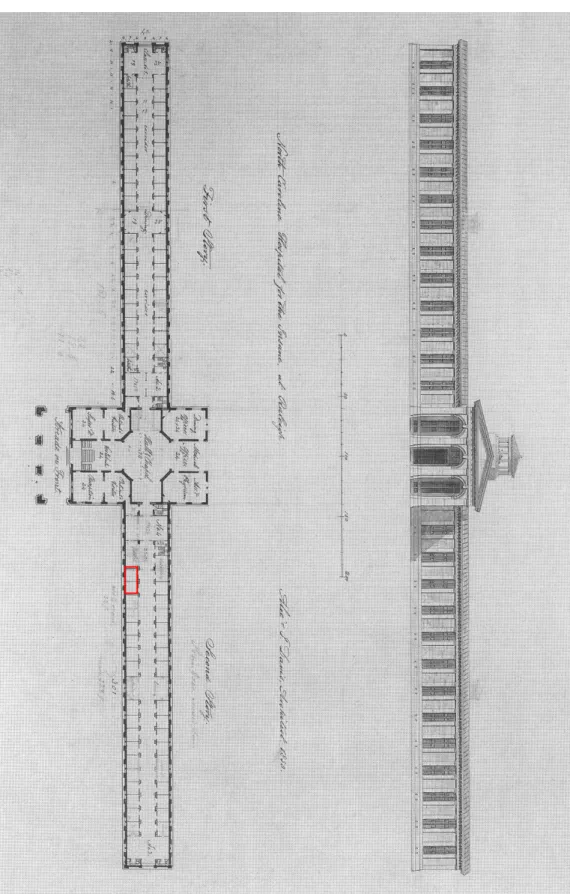
The original A.J. Davis plans for the Center Building are provided in appendix A.35 Each wing of the
original Center Building (excluding all additions) has as gross floor plate area of approximately 11,900 square feet. If restored to its original size, the pavilion will have a gross floor plate area of approximately 9,600 square feet. Assuming the pavilion will have a mezzanine in place of the second floor, a conservative estimate for total useable area of the rehabilitated Center Building is 87,000 square feet – about 10% larger than the Raleigh Building located at 7 West Hargett Street. A large hotel, full-scale museum, or corporate headquarters may be able to occupy this space as a single user.
Alternatively, smaller-footprint hospitality, civic, and office users could share this space. The benefits of a mixed-use project are numerous. First, mixing compatible uses increases the viability of each use individually. Museum and restaurant patrons become hotel guests; office tenants become event space users. Second, mixed-uses promote daytime and evening activity. Hospitality and office uses are naturally asynchronous on a daily and weekly basis. Event and restaurant uses benefit by having day, evening, weekday, and weekend users, and the park benefits from a safe and lively scene. Third, mixing uses helps to diversify the rehabilitation investment and mitigate risk. Mixed uses support overall success and also protect against overall failure. Over time, proven-successful uses can be expanded and less-proven-successful uses moved or replaced. Finally, mixing public, quasi-public, and private uses ensures a level of access is available to all possible users, while some of the site can be employed in supportive, revenue-generating activity.
5.
Structuring a Partnership
The case studies section provides examples of multiple approaches to structuring public-private partnerships for large, multi-phase real estate projects. Each of these cases combine multiple funding sources and leverage private investment. However, they vary in the level of public and
private management in site development. Either a for-profit or non-profit entity can be a “Master Developer” for the site. Three alternatives are discussed below.
Private Master Developer
The Commons at Grand Traverse serve as a model of the for-profit master developer. The GTCRC first chose Kids Creek Development Company as master planner and developer, before later settling on the Minervini Group for the role. The Minervini Group, in turn, oversees rehabilitation,
syndicates tax credit to equity investors, hires managing partners for certain uses and leases to end-user tenants. Revenues from these tenants are used, in-part, to pay the land lease.
Public Agency Master Developer
The Presidio serves as a model for the public agency master developer. The Presidio Trust was established by Congress and capitalized with federal funding. Its employees are federal employees. The Presidio initiated development with the rehabilitation and leasing of residential units, guided by the strength of the local residential market. As a public agency maintaining control of these
projects, the Trust itself was not able to take advantage of federal historic rehabilitation tax credits.
The Presidio Trust also engages private developers in the rehabilitation and use of the Presidio’s
real estate. The Trust engages local developers through an RFP (Request for Proposals) process. Carefully-selected developers then lease sites on a long-term basis, conduct tax-credit
rehabilitations, and lease to tenants. Engaging private developers in this way allows the Trust to maintain a limited staff and benefit from the existing development resources in the region. Rents are revenues are returned to the Trust through base rents on ground leases, and occasionally through percentage leases. Through its Programmatic Agreement with the National Parks Service and the California State Historic Preservation Office, the Presidio Trust is also able to streamline oversight of the rehabilitation process.
It is important to understand that a public master developer does not guarantee that completed projects will maximize public benefit or even strike a balance between public benefit and revenue generation. At the Presidio, the requirement of self-sufficiency can means pursuing revenue to the detriment of other, less remunerative uses. Ultimately this situation can result in exclusivity instead of access and homogeneity instead of diversity.36
Statutory Corporation as Master Developer
The Richardson Olmsted Complex serves as a model of the statutory corporation master developer. The Richardson Center Corporation was formed by the State of New York to plan and rehabilitate the Richardson Olmsted Complex. The agency is a 501(c)(3) not for profit organization capitalized by one-time and recurring funds of the State of New York. Its Board of Directors, originally appointed
by Governor George Pitaki, is composed of local private and public sector leaders, as well as important local stakeholders.
As master developer, the RCC undertook rehabilitation activities, and formed a private subsidiary, the Richardson Olmsted Redevelopment Corporation, to acquire and syndicate historic
rehabilitation tax credits to private investors. The RCC land-leases the space to a private hotel developer, returning revenues to the RCC. As a non-profit Master Developer, the RCC was able to gain local support for redevelopment and maintain the credibility to disburse of state funding. The RCC also maintained direct control over the rehabilitation of the Core Project. 37
The Trust for Governor’s Island is another example of the non-profit master developer model. The Trust was created by the City of New York and tasked with planning, redeveloping, and managing
Governor’s Island.
Approaches for Dix Park
The statutory corporation as master developer is one promising model for Dix Park. A version of this
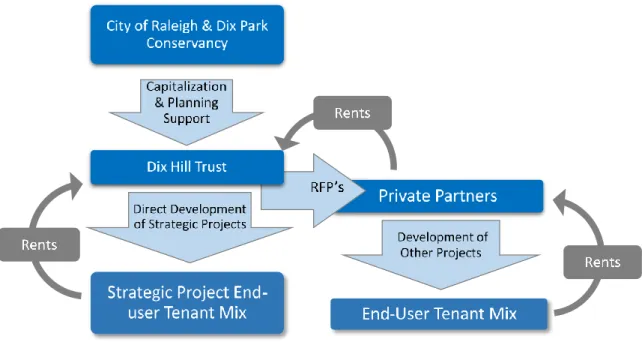
model might include the establishment of a “Dix Hill Trust” capitalized by the City of Raleigh and the work of the Dix Park Conservancy. The Trust would have special expertise in and purview over the real estate assets at Dix Park, and would be staffed by a small development team. The Trust would be tasked with completing a historic structures and cultural landscape report, master planning for park real estate, stabilization and basic renovation the exterior shells of all retained structures, and possibly some direct development activities. The Trust could be particularly effective in launching the Center Building as a “core project” to anchor the surrounding campus. The Trust could also form a for-profit subsidiary to undertake tax-credit funded activities at the Center Building when
possible. Figure 7.1 provides a diagram to clarify this model.
Key activities of the Trust could include demolition of the McBryde and Surgery buildings,
reconstruction of the central pavilion structure, restoration of the hipped roof, and general interior and exterior rehabilitation. The Trust would then land-lease sections within the building to various users or hire managing partners (for the office and hotel uses) in conjunction with a master plan,
and return rents to the Corporation’s development fund. Over time, the Corporation would release RFQ’s to the private development community for outer campus buildings as they become available.
As an alternative approach, the City may establish a public agency as master developer for the site. This agency could engage in the same planning, demolition, and stabilization activities—albeit in the absence of tax credits—before inviting private developers to provide qualifications for planned uses in the Center Building. Long-term land-leases would enable developers to undertake tax credit rehabilitations of historic portions of the building. These developers can then manage or lease to
subtenants. Public investment in development could be focused on the central pavilion, which will likely be ineligible for tax credits and is more likely to be employed for public use.
6.
Envisioning a Core Project at the Center Building
This section builds on the previous section and presents a hypothetical plan for the reuse of the Center Building to demonstrate the feasibility of a mixed-use project. This plan is not a substitute for a rigorously vetted program for Park real estate; it does, however, illuminate possibilities and show the basic mechanics of a partnership to repurpose this historic building.
Site Preparation and Rehabilitation
A significant amount of site work must be done before rehabilitation of the Center Building can even begin. This report envisions a reconstructed pavilion between the two historic wings.
Demolition of the McBryde and Surgery buildings, as well as any unwanted additions to the Center Building, will have to take place in the absence of historic tax credit financing. Likewise, new construction will not be eligible for tax credits.
The costs of demolition and the reconstruction of the pavilion are outside the scope of this report. Likewise, lack of data on existing building conditions, as well as the complexity of the site, have made it difficult to estimate the cost of the general rehabilitation of the historic hospital wings. A comprehensive historic structures report could serve as a repository of this information. In the
interim, one option for approximating costs is to borrow estimates from peer projects. At the ROC,
stabilization (not including emergency stabilization), and core project rehabilitation costs amounted to
approximately $200 per square foot over the 160,000 square feet of space in the core project. Assuming construction costs are comparable in Raleigh and Buffalo, Table 6.1 shows the possible total rehabilitation costs for the historic wings of the hospital for low, medium, and high cost scenarios. Additionally, this table shows the possible values of historic tax credits for low, medium, and high proportions of Qualified Rehabilitation Expenses (QREs) for each scenario. The rehabilitations of the historic wings are estimated to cost $9-16 million, while the value of historic tax credits in the rehabilitation of the wings is likely
between $2-4 million, after syndication. These numbers do not include any new construction costs.
Given the apparent value of tax credit equity in the rehabilitation of the hospital’s historic wings,
the importance of revising the Historic District nomination to include these wings is critically important.
Establishing Anchor Uses
A mixed-use plan is heavily recommended to fill the space, reduce risk, promote daytime and evening activity, and ensure public access and revenue generating uses are in balance. The
unyielding floor plan of the Center Building’s wings suggest office and hospitality will be highly appropriate in these areas, while the open space of a restored pavilion lends itself to event and civic use. Additionally, some space should be reserved in each wing for supporting uses, providing space for a small museum or temporary exhibits.
Concentrating revenue-generating uses in the wings and public uses in the pavilion also maximizes the utilization of historic tax credits. Concentrating the majority of long-term use in new
construction avoids issues with disqualified leases that can prevent the utilization of historic tax credits or lead to recapture. Disqualified leases are discussed in Appendix C.
Table 6.1: Rehab Costs and Tax Credit Value Sensitivity Eligible SF* 63,000
State HTC 15%
Federal HTC 20%
State HTC Price $0.73
Federal HTC Price $0.80
Rehab Cost PSF Total Rehab Cost
$150 $ 9,450,000 $200 $ 12,600,000 $250 $ 15,750,000
Rehab Cost PSF 85% 90% 95%
$150 $2,158,734 $2,285,719 $2,412,703 $200 $2,878,313 $3,047,625 $3,216,938 $250 $3,597,891 $3,809,531 $4,021,172
*As s umes centra l pa vi l i on recons truction i s i nel i gi bl e.
A rendering of the divisions of space shown as Figure 6.1.
Civic Development
Reservation of the central portions of each wing, the entirety of one ground-floor wing, and the ground ground-floor and mezzanine levels of a restored central pavilion would provide approximately one third of the gross floor area as civic use. Ensuring the ground floor and mezzanine level of the pavilion are publicly accessible also marks the Center Building as a public structure.
The single wing-floor reserved for civic use could be used as temporary or permanent exhibit space, meeting space, or educational space. Visitor services would be permanently housed in this space or on the opposite wing, adjacent to the center building. The reconstructed pavilion, with an open ground floor and mezzanine on the second level, could serve as a gathering and educational space, and could double as event space on evenings and weekends, as desired, to generate additional revenues. Event space rental revenue is outside the scope of this analysis.
Hospitality Development
The development of a hotel occupying the majority of the top two floors of the Center Building is an opportunity to incorporate a revenue-producing use that is appropriate for both the building and the Park. This report therefore takes an in-depth look into the feasibility of this use. While
Figure 6.1: Hypothetical Division of Space
Table 6.2: Square Footage of Hypothetical Uses
Use Floors Gross SF % of Building
Civic/Institutional 1,2* 29,100 33%
Hospitality 2,3 39,200 45%
Event/Hospitality 3 9,600 11%
Office/Co-working 1 9,100 10%
87,000
*As s umes mezza ni ne on 2nd fl oor of templ es = 50% fl oor.
hospitality uses would likely include amenities in addition to just lodging, this report focuses solely on lodging revenue to assess the feasibility of hotel development.
Hotel development could be best accomplished through partnership with a private developer with the skill and appetite to manage a hotel long-term. To begin the project, RFP’s could be solicited to private developers. A long-term land lease to the developer could provide the ownership security necessary for the developer to use historic tax credits in the project while never foregoing private ownership. A land lease of at least 60 years will likely be necessary to attract tax credit equity
investors to any developer’s project.38 Additionally, an updated Historic Register nomination could
allow this developer to utilize federal and historic rehabilitation tax credit equity for a large portion of the development costs.
Hospitality uses are a privatization of space, and should be planned in a way that does not detract from the public feeling of the building. Placing the primary reception area for hospitality uses on the second or third floor of the pavilion building moves this use away from the publicly-oriented ground floor. Consultation with the Richardson Center Corporation and Deborah Berke Partners
Architecture & Interior Design suggests that hotel rooms could be created on the second and third floors of the Center Building by combining two, and for larger suites three, patient rooms. The central corridor, a signature of the Kirkbride design, must be retained to conform to the Secretary
of the Interior’s standards.39
Analysis of the original floor plan (Figure A.1) suggests that approximately 20 suites could be created per wing, per floor. Developing the top two floors of each wing for hospitality uses would yield approximately 84 rooms—a reasonable size for a small hotel, and comparable to
the ROC’s Hotel Henry (88 rooms). The size of this use could be further reduced as needed to accommodate other uses or public input.
Appendix A contains a detailed model estimating the returns for an 84-room hotel in the Center Building. This analysis based on the local average daily room rate (ADR) in downtown of $135.00 (average of the market), and a stabilized occupancy rate of 73%, the
38Consultation with Jeffrey Eichenfield and Joshua Bagley, Presidio Trust Asset Management, March 13, 2017. 39 Consultation with Stephen Brockman, Deborah Berke Partners Senior Principal, March 8, 2017.
Table 6.3: Basic Hotel Development Figures Assumptions
Rooms 84
Square Feet 39,200
General Rehabilitation Costs $ 200 psf
Fit-Up Costs per Room $ 10,000
Average Daily Rate (ADR) $ 135 (Year 1)
Tax Credit Basis $ 9,064,433 (QRE's)
Tax Credit Equity $ 2,436,066
Purchase Price $ 3,400,000
Going-In Cap Rate 8.5%
Going-Out Cap Rate 9.0%
Performance
IRR (10-Year Hold) 20.08%
Cash from Operations 31.9%
downtown Raleigh average.40 This model assumes demolition of the McBryde and Surgery Buildings
and emergency stabilization have already been undertaken. It assumes base rehabilitation costs of $200 per square foot, incorporates tax credit equity, private equity, and debt. A purchase price of $3,400,000 has also been incorporated and used to calibrate the return. Key figures are presented in Table 6.3.
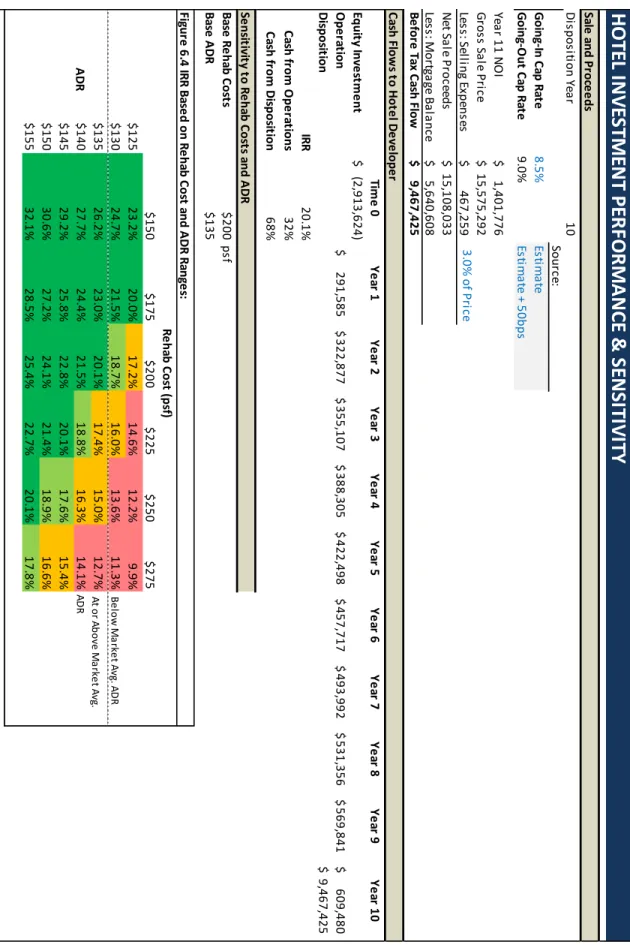
This model generates a return of 20 % over the 10-year hold period. Assuming a 9% going-out cap rate, the hotel leasehold is sold in Year 10 for $15,575,000. About 32% of total cash flows come from operation of the asset, while 68% come from disposition (Appendix A). This is indicative of a medium-risk asset. This risk could be partially mitigated by a longer hold period.
Returns generated by this model is highly sensitive to several factors, including ADR and general rehabilitation costs. Figure 6.4 compares the effect of these variables on IRR to demonstrate the
model’s sensitivity. Even at higher levels of rehabilitation, the project remains feasible with only minor increases in ADR. However, as rehabilitation costs approach $275, the project becomes largely infeasible under the assumptions provided here. However, feasibility could be increased by reducing the purchase price.
As an alternative or in addition to a purchase price, an annual base rent or percentage rent could be used to return revenue to the Park throughout the life of the hotel project. Percentage rents, which require tenants (the hotel developer in this case) to pay a certain percentage of revenues over a set break point in base rent, are a common feature of retail lease agreements, and could be used effectively to ensure returns to public and private partners are balanced.
Finally, it is important to clarify the role of tax credit equity in this hotel development project. If tax credit equity is removed from the model, the project, as written, is infeasible (with an IRR of 13% and a debt service coverage ratio of less than 1.2 in Years 1 through 5. However, the purchase price
40 HVS Convention, Sports & Entertainment, Raleigh Downtown Hotel Market Study: Final Results, August 18, 2015, Retrieved
from http://www.raleighconvention.com/hotelstudy/
Figure 6.4 IRR Based on Rehab Cost and ADR Ranges
#REF! $150 $175 $200 $225 $250 $275
$125 23.2% 20.0% 17.2% 14.6% 12.2% 9.9%
$130 24.7% 21.5% 18.7% 16.0% 13.6% 11.3%
$135 26.2% 23.0% 20.1% 17.4% 15.0% 12.7%
$140 27.7% 24.4% 21.5% 18.8% 16.3% 14.1%
$145 29.2% 25.8% 22.8% 20.1% 17.6% 15.4%
$150 30.6% 27.2% 24.1% 21.4% 18.9% 16.6%
$155 32.1% 28.5% 25.4% 22.7% 20.1% 17.8%
Rehab Cost (psf)
At or Above Ma rket Avg. ADR Bel ow Ma rket Avg. ADR
A
D
can be dialed down by the amount of tax credit equity ($2,436,066) to produce the same return as in the base scenario. The equity that was previously provided by state and federal rehabilitation programs is now extracted from the City, which must sell the building at a third of the base case price to ensure investors an adequate return. Additionally, this scenario requires a higher equity commitment from investors and makes returns even more sensitive to ADR and rehabilitation costs.
Office Development
Development of co-working, incubator-style office space on the ground floor of one wing could provide added revenue generation that works harmoniously with adjacent civic uses. Access to these premises could be provided through a separate entrance, if desired. Alternatively, ground floor office could provide space for Parks administration and staff. This development could be undertaken by a private partner or by the Trust itself, depending on expected end-users.
Consultation with a local broker specializing in the leasing of office space in rehabilitated historic properties suggests rehabilitated office space in the Center Building is unlikely to yield top-of-the-market rents. However, high quality office rehabilitations can bring strong rents. Recent
experiences in the local market suggest office space in the Center Building, if finished to a high standard today, could be rented to tenants for around $28.00 per square foot.41 Revenue generated
for the Park will depend on the whether the office project is developed by the Trust directly or by a private partner.
7.
Recommendations
Four key recommendations for near-term planning work are discussed below. This list is derived from the preceding research and consultation with leading professionals in the use of Park real estate.
1. Collaborate with NCSHPO and NPS to revise the Dix Hill Historic District.
As shown in Section 6, tax credit equity can play a sizeable role in financing the rehabilitation of the Center Building. The National Register District must be revised to include the historic portions of the Center Building. However, some agreement must be reached about the treatment of the McBryde Building. Its inclusion to the District must not prevent its demolition or otherwise preclude the significant alteration of the Center Building. The optimum strategy moving forward is clear
articulation of project vision and rehabilitation goals with the NC SHPO and the NPS to chart a path forward. This negotiation will also be necessary to establish the regulatory certainty needed to satisfy tax credit investors.
2. Engage in robust, open, participatory planning for Dix Park’s real estate.
A common theme among consultants contacted throughout the course of the writing of this report is the importance of thorough planning for park real estate. This report has focused on options and feasibility, and has attempted to stay value-neutral. Yet values are inextricable from project
planning. The City of Raleigh has produced an ambitious vision for Dix Park, and an ambitious plan for the Center Building will eschew feasibility for possibility. A strong plan for this core project will pursue uses that are harmonious with both the volumes of the structure and the values of the community. Only robust participatory planning can reveal community values. This point is only made more important by the sensitive history and enduring memory of the Dorothea Dix Hospital in thousands of private lives and in our culture at large.
It is possible that several of the uses proposed in this report are ultimately unfavorable for the site. However, it is recommended that these uses at least be proposed to the community.
3. Consider the creation of a Dix Hill Trust to plan, develop, and manage strategic assets.
The importance of public use and access at Dix Park suggests that development and asset
management would also benefit from public guidance. Moreover, the scale of the campus merits the attention of a dedicated staff with special expertise in its past and future. The creation of a Trust to oversee critical development projects can accomplish these goals. Additionally, the Trust can leverage the private development community to take on additional projects throughout the campus.
The Center Building is the most strategic real estate asset in the Park. It is both the historic center of the site and its public face. A Trust will be leverage the public support necessary to make the
building’s reuse a success. Likewise, it will be able to control the branding of this project in the
present and future.
4. Pursue mixed-use strategies for programming at the Center Building.
The Center Building is a large enough asset to support several mutually-sustaining uses. It is also a critical enough asset that it should be shared. The hypothetical program presented in this report is only one iteration of a mixed-use plan for the building. It attempts to show that public and private
uses can feasibly coexist, and that private uses need not dominate visitors’ impression of the
Bibliography
Chan Krieger Sieniewicz Architecture and Urban Design. Master Plan for the Richardson Olmsted Complex. Prepared for the Richardson Olmsted Corporation. September, 2009. Retrieved from
https://richardson-olmsted.com/files/documents/planning_and_reports/master_plan_full_report.pdf.
City of Raleigh, “Dorothea Dix Park 2016 Year-in-Review,” December, 2016.
City of Raleigh. Downtown Plan: The Next 10 Years. September 15, 2015. Retrieved from
https://www.raleighnc.gov/content/PlanDev/Documents/UrbanDesign/Downtown/Downto wnPlan.pdf.
Davis, Edward T. and John L. Sanders. A Romantic Architect in Antebellum North Carolina: The Works of Alexander Jackson Davis. Raleigh, NC: Historic Preservation Foundation of North Carolina, 2000.
Dewberry. “Dorothea Dix Campus Facilities Study,” Report Prepared for City of Raleigh Parks, Recreation, and Cultural Resources Department. October 9, 2015.
Downtown Raleigh Alliance. State of Downtown Raleigh 2016. 2016. Retrieved from http://godowntownraleigh.com/_files/sod_website.pdf.
Consultation with Andrew Stewart, Empire Properties President of Asset Management. By Chase Nicholas. March 11, 2017.
Consultation with Ben Steel, Empire Properties Vice President of Asset Management. By Chase Nicholas. March 15, 2017.
Consultation with Christine Krolewicz, Project Manager for the Richardson Olmsted Complex. By Chase Nicholas. March 8, 2017.
Consultation with Jeffrey Eichenfield and Joshua Bagley, Presidio Trust Asset Management. By Chase Nicholas. March 13, 2017.
Consultation with Jim Goodmon, Capitol Broadcasting Company. By Chase Nicholas. March 1, 2017.
Consultation with Kate Pearce, Dix Park Senior Planner. By Chase Nicholas. February 8, 2017.
Consultation with Stephen Brockman, Deborah Berke Partners Senior Principal. By Chase Nicholas. February 8, 2017.
HVS Convention, Sports & Entertainment. Raleigh Downtown Hotel Market Study: Final Results. August 18, 2015. Retrieved from http://www.raleighconvention.com/hotelstudy/
LandDesign, Inc. “Dorothea Dix Campus Master Plan.” 2005. Retrieved from
Little, Ruth. “Dix Hill” National Register of Historic Places Nomination Form. 1990. Retrieved from http://rhdc.org/sites/default/files/Dix%20Hill%20NRHD.pdf.
Minervini Group. “Committed to the Asylum: Preserving history, re-using buildings and growing the
economy by creating a neighborhood.” 2015. Retrieved from
https://www.michigan.gov/documents/deq/ERRMC_TC_Keynote_Minnervini_GrandTravers eCommons_505360_7.pdf
National Parks Service. Historic Preservation Tax Incentives. 2012. Retrieved from https://www.nps.gov/tps/tax-incentives/taxdocs/about-tax-incentives-2012.pdf
O’Rorke, Marjorie. Haven on the Hill: A History of North Carolina's Dorothea Dix Hospital. Raleigh, NC: North Carolina Office of Archives and History, 2009.
Partnerships for Change. Grand Traverse Commons Master Plan. 2010. Retrieved from http://www.traversecitymi.gov/downloads/gtcmasterplan.pdf
Summary Term Sheet Prepared by the State of North Carolina: Sale of Dorothea Dix Property. January 9, 2015 (PDF uploaded by NC Policy Watch). Retrieved from
http://pulse.ncpolicywatch.org/wp-content/uploads/2015/01/Dorothea-Dix-terms.pdf.
Technical Preservation Services [TPS]. “Historic Preservation Tax Incentives.” 2012. Retrieved from
https://www.nps.gov/tps/tax-incentives/taxdocs/about-tax-incentives-2012.pdf.
"Hotel Henry." Website for the Hotel Henry Urban Resort and Conference Center. Accessed February 23, 2017. Retrieved from http://www.hotelhenry.com/
Governor’s Press Office.“Governor Cuomo Announces Richardson Olmsted Complex
Redevelopment Project Breaks Ground in Buffalo.” October 10, 2014. Retrieved from
https://www.governor.ny.gov/news/governor-cuomo-announces-richardson-olmsted-complex-redevelopment-project-breaks-ground-buffalo
Presidio Trust Management Plan. 2002. Retrieved from
http://www.presidio.gov/presidio- trust/planning-internal/Shared%20Documents/Planning%20Documents/PLN-301-PTMP02-Plan.pdf, 9.
Presidio of San Francisco. “Main Post Update to the Presidio Trust Management Plan.” November,
Appendix
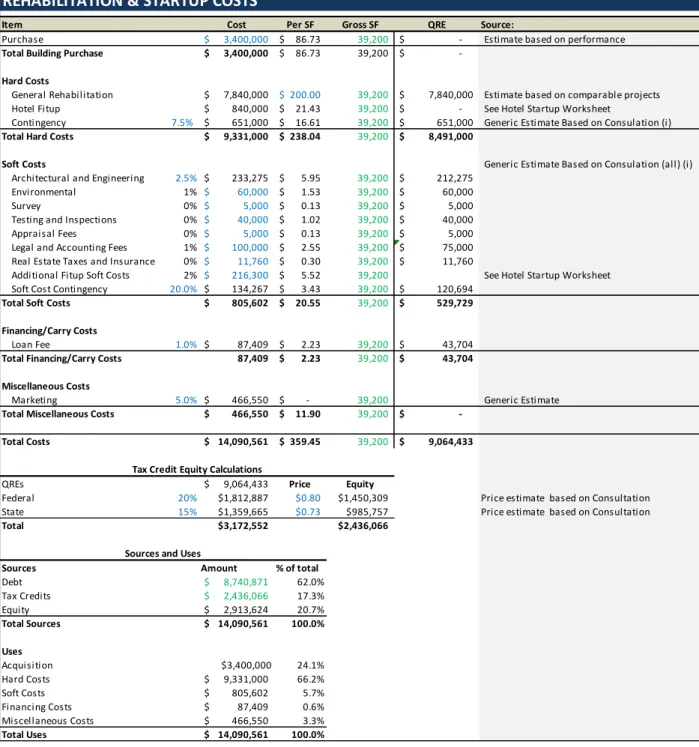
Figure A.2:Hotel Development Startup Costs
Item Cost Per SF Gross SF QRE Source:
Purchase $ 3,400,000 $ 86.73 39,200 $ - Estimate based on performance
Total Building Purchase $ 3,400,000 $ 86.73 39,200 $
-Hard Costs
General Rehabilitation $ 7,840,000 $ 200.00 39,200 $ 7,840,000 Estimate based on comparable projects Hotel Fitup $ 840,000 $ 21.43 39,200 $ - See Hotel Startup Worksheet
Contingency 7.5% $ 651,000 $ 16.61 39,200 $ 651,000 Generic Estimate Based on Consulation (i)
Total Hard Costs $ 9,331,000 $ 238.04 39,200 $ 8,491,000
Soft Costs Generic Estimate Based on Consulation (all) (i) Architectural and Engineering 2.5% $ 233,275 $ 5.95 39,200 $ 212,275
Environmental 1% $ 60,000 $ 1.53 39,200 $ 60,000 Survey 0% $ 5,000 $ 0.13 39,200 $ 5,000 Testing and Inspections 0% $ 40,000 $ 1.02 39,200 $ 40,000 Appraisal Fees 0% $ 5,000 $ 0.13 39,200 $ 5,000 Legal and Accounting Fees 1% $ 100,000 $ 2.55 39,200 $ 75,000 Real Estate Taxes and Insurance 0% $ 11,760 $ 0.30 39,200 $ 11,760
Additional Fitup Soft Costs 2% $ 216,300 $ 5.52 39,200 See Hotel Startup Worksheet Soft Cost Contingency 20.0% $ 134,267 $ 3.43 39,200 $ 120,694
Total Soft Costs $ 805,602 $ 20.55 39,200 $ 529,729 Financing/Carry Costs
Loan Fee 1.0% $ 87,409 $ 2.23 39,200 $ 43,704
Total Financing/Carry Costs 87,409 $ 2.23 39,200 $ 43,704 Miscellaneous Costs
Marketing 5.0% $ 466,550 $ - 39,200 Generic Estimate
Total Miscellaneous Costs $ 466,550 $ 11.90 39,200 $ -Total Costs $ 14,090,561 $ 359.45 39,200 $ 9,064,433
QREs $ 9,064,433 Price Equity
Federal 20% $1,812,887 $0.80 $1,450,309 Price estimate based on Consultation State 15% $1,359,665 $0.73 $985,757 Price estimate based on Consultation
Total $3,172,552 $2,436,066
Sources Amount % of total
Debt $ 8,740,871 62.0%
Tax Credits $ 2,436,066 17.3% Equity $ 2,913,624 20.7%
Total Sources $ 14,090,561 100.0% Uses
Acquisition $3,400,000 24.1%
Hard Costs $ 9,331,000 66.2% Soft Costs $ 805,602 5.7% Financing Costs $ 87,409 0.6% Miscellaneous Costs $ 466,550 3.3%
Total Uses $ 14,090,561 100.0% Tax Credit Equity Calculations
Sources and Uses
Figure A.2: Hotel Fit-up Estimate
Figure A.3: Project Loan
Assumptions
Rooms 84
Gross Hotel Square Footage 39,200
Hotel Operator Cost Cost Cost per GSF # of units unit Source: Hard Cost
Hotel Fitup $ 840,000 21.43 10,000 per room Generic estimate from Consulation (i) Contingency 3% 25,200 0.93 Generic estimate from Consulation (i)
Total Hard Cost $ 865,200 32.04
Soft Cost (% of hard cost) 25% $ 216,300 8.01 Generic estimate from Consulation (i)
Cap Ex $ 400,000 14.81 Generic estimate from Consulation (i)
Total $ 1,481,500 54.87
HOTEL FITUP ESTIMATE
Item Source:
Project Cost $ 11,654,494
Loan to Cost 75% Current conventional business banking loan/cost ratio
Loan Amount $ 8,740,871
Interest Rate 6% Current conventional business banking loan rate
Loan Fee 1%
Loan Fee Amount $ 87,409
Term (Years) 20 Current conventional business banking loan amortization
Monthly Payment $ 62,622
Annual Payment $ 751,468
I/O Annual Payment $ 524,452
I/O Monthly Payment $ 43,704