Highly Restrictive Goals Turn Temptations into Multifinal Means
Allison Price
The University of North Carolina at Chapel Hill Spring 2016
A thesis presented to the faculty of The University of North Carolina at Chapel Hill in partial fulfillment of the requirements for the Bachelor of Arts degree with Honors in Psychology.
Acknowledgements
I would like to thank my advisor, Dr. Steven Buzinski, for his expertise, collaboration, and guidance that advanced my Honors Thesis and augmented my psychology experience. I would like to further thank Dr. Keith Payne and Keenan Jenkins for serving on my Honors Committee. This project was supported by a David Bray Peele Memorial Research Award from the
Abstract
A goal that is characterized by highly restrictive demands threatens personal behavioral freedoms, activating psychological reactance. Reactance is a goal to restore the freedom to engage in those threatened behaviors. As such, temptations that are forbidden by the highly restrictive goal satisfy the goal to indulge in an appealing behavior (the definition of temptation), and the freedom goal activated by psychological reactance. The present work investigated the hypothesis that highly restrictive goals transform temptations into multifinal means.
Highly Restrictive Goals Turn Temptations into Multifinal Means
Self-control is required to resist the desire to indulge in a temptation and instead maintain focal goal pursuit (Fishbach, Friedman, & Kruglanski, 2003). A focal goal that is characterized by restrictive demands provokes a threat to an individual’s behavioral freedom, which in turn activates psychological reactance. Reactance, the goal to restore the threatened freedom, then interferes with focal goal pursuit (Buzinski & Price, 2015). One potential reason why is that in the presence of a highly restrictive goal (e.g., you are forbidden from eating sweets), indulging in a temptation (e.g., eating a brownie) actually satisfies two goals: the temptation goal (e.g., to eat something tasty), and the goal of restoring personal freedom. A temptation in such a context is perceived as more valuable than a temptation to a less restrictive goal because it serves to attain multiple goals simultaneously. This increased value contributes to the failure of self-control to maintain focal goal pursuit, and rather promotes indulgence in the very temptations that the highly restrictive focal goal forbids.
Goals
Goals are desirable end states that one intends to attain through action. They orient
attention towards thoughts and actions that promote their attainment and away from thoughts and actions that impede their attainment (Kruglanski et al., 2002; Locke & Latham, 2002). For instance, in an automobile-driving task, Locke and Bryan (1969) provided participants
Self-control helps power the directive function of goals, guiding an individual towards their attainment and overriding desires and urges (Galliot et al., 2007; Baumeister, Schmeichel, & Vohs, 2007). A temptation is a goal that conflicts and competes with a focal goal for
allocation of motivational and attentional resources (Kruglanski et al., 2002). Shah and Kruglanski (2002) found that the extent to which an accessible alternative goal was unrelated (i.e., competing) to the focal goal diminished focal goal pursuit (i.e., persistence and
performance), focal goal commitment, and the generation of effective means of focal goal pursuit. As a result of pulling resources away from the focal goal, the presence of a competing goal deters focal goal pursuit and impedes its attainment. In order to maintain focal goal pursuit, individuals must monitor the potential activation of competing goals. Focal goals that are
characterized by highly restrictive demands provoke a threat to an individual’s freedom, which activates psychological reactance, a conflicting goal to restore personal freedom.
Psychological Reactance
The magnitude of reactance is a function of the importance, number, and proportion of threatened freedoms, and the greater the magnitude of reactance, the more an individual will attempt to restore the threatened freedom (Brehm, 1966; S. S. Brehm & Brehm, 1981). Highly restrictive goals, particularly, are characterized by rigid demands and exhortations, provoking a threat to a high number and proportion of freedoms. Personal freedom is then reestablished through increased desire for the restricted behavior (i.e., indirect restoration) and/or increased indulgence in the restricted behavior (i.e., direct restoration; Buzinksi & Price, 2015).
A highly restrictive goal restricts or threatens indulgence in temptations (Buzinski & Price, 2015). Temptations are, by definition, appealing behaviors in which individuals are motivated by their desirability to engage in (Leander, Shah, & Chartrand, 2009). In the absence of a highly restrictive goal, indulging in a temptation satisfies a single goal, namely the goal to engage in an appealing behavior. However, in the presence of a highly restrictive goal, indulging in a temptation satisfies two goals: the focal temptation goal, and the additional goal of reducing reactance.
Multifinality
An individual perceives a means, or an action that promotes goal attainment, as either unifinal or multifinal. Unifinality describes a behavior that satisfies a single goal whereas multifinality describes a behavior that simultaneously satisfies two or more goals (Kruglanski et al., 2002). A unifinal means typically possesses a stronger cognitive association with its single goal, increasing the expectancy of attaining the goal and leading to greater perceived
addition to its greater desirability, the compounded value of a multifinal means is preferred to a unifinal means when a context considers value alone (Kruglanski et al., 2013).
In early work supporting this “multifinality preference effect,” Wilson and Nisbett (1978) asked passersby customers at a department store to select the highest quality pair of nylon
stockings among four identical pairs. Participants chose the rightmost pair more often, in which the rightmost pair satisfied two goals: the focal goal to make a reasonable choice, assigned by the experimenter, and the background goal to reach quick closure after examining the array in order to continue shopping. Assuming the participants scanned the array left to right (e.g., Maass & Russo, 2003), the rightmost pair was the last pair to be examined and, unlike its alternatives, was able to satisfy both goals.
When an individual sets a highly restrictive goal, he provokes a threat to a previously held freedom, thereby activating psychological reactance, or the goal to restore the personal freedom. As a consequence of activating this additional goal, the means he selects, or the behavior he will engage in, unconsciously becomes multifinal. Consequently, he will show a preference for the now multifinal temptation (the means to restore freedom and to engage in an appealing behavior).
Reactance, Temptations and Multifinality
The present research investigates why individuals indulge in focal goal-damaging
temptations as an attempt to restore their personal freedoms in the presence of a highly restrictive goal. As previously discussed, when a goal is not highly restrictive, indulging in a temptation (i.e., an appealing, but goal-damaging behavior) attains a single goal, namely the temptation goal. In this case, indulging in a temptation is a unifinal means to a focal, temptation goal. However, when a goal is highly restrictive, indulging in a temptation attains two goals: the temptation goal and the freedom goal. Indulging in a temptation becomes a multifinal rather than unifinal means, and consequently has relatively greater perceived value. In this situation,
engaging in a goal-congruent action still only attains a single goal (e.g., adhering to the highly restrictive diet plan), rendering the goal-congruent action a unifinal means. Therefore, when a goal is highly restrictive, as opposed to less restrictive, one should be more likely to indulge in a temptation due to the added motivational force and value attributable to multifinal as opposed to unifinal means.
In support of the current investigation, Stok, de Vet, de Wit, Renner, and de Ridder (2015) found that while restrictive and suggestive eating rules were equally effective in
lifted. During in an initial task, participants were told they were not allowed to eat M&Ms, that it was better if they did not eat M&Ms, or, as a control, were not presented M&Ms. During the second task, all participants were permitted to eat M&Ms freely. There was not a difference in consumption during the first task, but participants who were restricted from eating M&Ms consumed significantly more during the second task than the suggested non-eaters. Additionally, the participants who were suggested to not eat M&Ms did not consume more than the control group during the second task, indicating the negative behavioral after-effect (i.e., increased consumption) experienced by the restricted non-eaters was due to the restrictiveness of the rule. The restrictive rule likely induced psychological reactance, the goal to restore personal freedom to freely eat M&Ms. While M&Ms remained a unifinal means for suggested non-eaters, M&Ms became a multifinal means for restricted non-eaters, attaining the additional freedom goal. As a result of the restrictive rule transforming M&Ms into a multifinal means, the restricted non-eaters increased their consumption to restore their personal freedom.
in the absence of the health goal, there were not any differences in temptation evaluations and consumption. Buzinski and Price (2015) posited that the highly restrictive goal frame provoked a threat to an individual’s personal freedom, which activated psychological reactance and shifted motivation from focal goal pursuit (i.e., health/fitness-related goal) towards restoring a sense of personal freedom. Personal freedom was restored through increased desire for the temptation and increased temptation indulgence (i.e., eating cookies), providing support for the notion that the highly restrictive goal frame transformed the temptation into a multifinal means.
As previously discussed, multifinal means have higher perceived value (desirability) than unifinal means, and when considering value, are preferred to unifinal means (i.e., the
multifinality preference effect). Buzinski and Price (2015) found that a highly restrictive goal frame caused an increase in the desirability of temptations (i.e., cookies). This finding suggested that the highly restrictive goal may have caused the cookies to become multifinal. In the absence of the highly restrictive goal, the temptation remained a unifinal means, satisfying only the temptation goal. It is theoretically consistent, then, that when the highly restrictive goal frame activated psychological reactance, adding the goal to restore personal freedom, it turned the temptation multifinal, thus increasing participants’ desire for, and indulgence in, the temptation.
individual’s preference for multifinal means promotes temptation indulgence and, ultimately, self-regulatory failure.
The Present Research
We hypothesized that when goals are framed as highly restrictive, temptations will become multifinal and will be perceived as less instrumental and more desirable than unifinal means. We conducted three studies to test our hypothesis. Study 1 manipulated goal
restrictiveness and measured multifinality outcomes (i.e., perceived instrumentality and
desirability) of temptation- and goal-related means. Study 2 replicated the methodology of Study 1 and measured temptation goal accessibility to create a proxy for temptation-goal activation. Study 3 measured temptation goal accessibility, manipulated goal restrictiveness and measured multifinality outcomes of restricted and non-restricted temptations.
Study 1
A highly restrictive goal activates psychological reactance, the goal to restore personal freedom. A consequence of activating reactance is that the highly restrictive goal transforms its temptations into multifinal means, increasing their desirability and diminishing their
instrumentality. We predicted that the presence of a highly restrictive (vs. less restrictive) goal would increase the perceived value (measured in terms of their desirability to participants) of temptations, indicating their transformation to multifinal means. Study 1 activated a health-related goal, manipulated goal restrictiveness (highly restrictive vs. less restrictive) and target food item (i.e., goal-related vs. temptation-related), and measured the perceived instrumentality and value of the target items.
Ethics statement. The author’s institutional review board (IRB) approved this experiment. Participants completed online informed consent questionnaires.
Participants. One hundred forty-eight volunteers (76 female, 82 male) from Amazon Mechanical Turk participated in exchange for small monetary compensation. The age of participants ranged from 29 to 69 years, with a mean age of 36.01 years.
Procedure. Participants were told that the study was investigating how individuals receive health-related information from scientific readings. They would be introduced to an article excerpt and asked to complete a comprehension assessment, followed by a questionnaire.
Goal restrictiveness. The first task was described as an excerpt from a recent “Journal of
Health and Wellness” article and served to both activate a health goal, and to experimentally manipulate goal restrictiveness. Adapted from the procedures of Zhang, Kruglanski, and Fishbach (2007) and Regan and Brehm (1972), half of the participants were randomly assigned to receive a freedom-threatening essay that forbade them from eating processed food (i.e., “You are simply not allowed to eat processed food.”), which framed the goal (i.e., to not eat processed food) as highly restrictive. The remaining participants received a non-threatening essay that suggested that they do not eat processed food (i.e., “It is better if you do not eat processed food.”) as part of the less restrictive goal group. On the next screen participants completed a one-item manipulation check (“Indicate how restricting the article excerpt’s recommendations are for your eating behaviors.”) on a 5-point Likert scale that ranged from 1 (very) to 5 (not at all).
Multifinality. Participants were next given a questionnaire that was described as a
“Health Attitudes and Behaviors Inventory” (i.e., “HABI”), which served as a within-subjects manipulation of target item, as well as a measure of item instrumentality and desirability.
to be controlled, and they were asked to evaluate the instrumentality (e.g., “To what extent would Pop-Tarts be effective in satisfying your hunger?”) and value (e.g., “How desirable do you find Pop-Tarts?”) of four temptation-related means (i.e., processed foods) and four goal-related means (i.e., non-processed foods) using a Likert scale that ranged from 1 (not at all) to 5 (extremely). The instrumentality and value scores for the four temptation-related items and the four goal-related items were averaged to create composite scores. This resulted in our obtaining means for temptation desire (α = .50), temptation instrumentality (α = .52), goal desire (α = .46), and goal instrumentality (α = .50). After completing the questionnaire, participants were checked for suspicion, fully debriefed, and thanked for their participation.
Results
Manipulation check. In order to check on the effectiveness of our goal restrictiveness manipulation, we conducted a one-way ANOVA on the restrictiveness manipulation check item. The analysis indicated that the manipulation likely did not effectively manipulate the goal restrictiveness variable, F < 1. Participants in the highly restrictive goal condition (M = 3.15, SD
= 1.24) perceived the goal to be equally restrictive as participants in the less restrictive goal condition (M = 3.09, SD = 1.00).
Temptation instrumentality. To investigate the influence of goal frame and means type on the instrumentality of temptations, a 2 (goal restrictiveness: highly restrictive vs. less
restrictive) x 2 (means type: temptations-related vs. goal-related) mixed methods ANOVA was conducted with goal restrictiveness as the between subjects variable and means type as the within subjects variable. There were no significant effects, Fs < 1.
(means type: temptations-related vs. goal-related) mixed methods ANOVA was conducted with goal restrictiveness as the between subjects variable and means type as the within subjects variable. Again, there were no significant effects, Fs < 1.
Discussion
The results from Study 1 do not provide support for our hypothesis. We predicted that a highly restrictive goal would increase the perceived value (i.e., desirability) and decrease the perceived instrumentality of temptations, indicating their status as multifinal means. However, the results did not reveal any significant differences in desirability or instrumentality between the temptation-related and goal-related means across levels of restrictiveness. Therefore, we cannot conclude if the presence of the highly restrictive goal transformed the temptations into multifinal means or if they remained unifinal means.
We believe that our results are due to two major limitations of Study 1. One possible explanation for the results is the failure to manipulate goal restrictiveness in this sample. If participants in the highly restrictive condition did not perceive the message to be highly
restrictive, then psychological reactance and the freedom goal were not activated. This, in turn, means that the temptations would still only attain a single goal (i.e., be unifinal, as opposed to multifinal). Another possible explanation is that we did not measure the accessibility of the temptation goal. That is, we were not able to control for which participants the temptation goal was active while completing the study. If the temptation goal was not active, then once again, the temptations would only satisfy a single goal (the freedom goal). This would mean that the
Study 2
Study 2 investigated the effects of goal restrictiveness and means type on the perceived desirability and instrumentality of temptation-related and goal-related items. When a temptation goal is active, the presence of a highly restrictive goal should result in temptations satisfying two goals, thereby transforming them to multifinal means. Therefore, we hypothesized that highly restrictive (vs. less) goals would result in the temptations having higher perceived desirability and less perceived instrumentality than goal-related alternatives. Study 2 used the methodology of Study 1 and included a supplemental measure of temptation goal accessibility.
Method
Ethics statement. The author’s institutional review board (IRB) approved this experiment. Participants completed online informed consent questionnaires.
Participants. One hundred sixty-four volunteers (89 female, 70 male, 5 failed to respond) from Amazon Mechanical Turk participated in exchange for small monetary compensation. The age of participants ranged from 20 to 76 years, with a mean age of 38.78 years.
Procedure. Study 2 used the same cover story, manipulation of goal restrictiveness, manipulation check, and measure of multifinality outcomes (temptation instrumentality α = .64; temptation desire α = .65; goal instrumentality α = .55; goal desire α = .53) as Study 1. The only modification from Study 1 to Study 2 was that before participants were introduced to the article excerpt, they were first asked to complete the following questionnaire.
Accessibility of the temptation goal. The first questionnaire was described as a “Personal
a free response item and included to bolster the cover story. The key item of interest was, “At this moment, how hungry are you?” to which they responded on a 5-point Likert scale that ranged from 1 (not at all hungry) to 5 (extremely hungry). This item served as a proxy of temptation-goal activation.
Results
Temptation goal accessibility. We predicted that a temptation goal would be active for the participants who indicated that they were hungry at beginning the study. Therefore, we conducted a split half-analysis of the hungriness item and selected for those participants who self-described as hungriest (M = 2.71, SD = .91), based on their indication of how hungry they were on the Personal Intake Form. In all, 107 participants were included in the following analyses.
Manipulation check. In order to check on the effectiveness of our goal restrictiveness manipulation, we conducted a One-Way ANOVA on the manipulation check item. Results indicated that the manipulation was successful, F(1, 104) = 8.18, p < .01. Participants in the highly restrictive goal condition found the excerpt’s recommendations to be more restricting (M
= 2.82, SD = 1.00) than participants in the less restrictive goal condition (M = 3.41, SD = 1.13). Temptation instrumentality. To investigate the influence of a highly restrictive goal frame on the instrumentality of temptations, a 2 (goal restrictiveness: highly vs. less) x 2 (means type: temptations-related vs. goal-related) mixed methods ANOVA was conducted with goal restrictiveness as the between subjects variable and means type as the within subjects variable. This analysis revealed a significant main effect of means type on perceived means
temptation-related means (M = 2.62, SD = 0.72) as less instrumental in satisfying their hunger than goal-related means (M = 2.85, SD = 0.65).
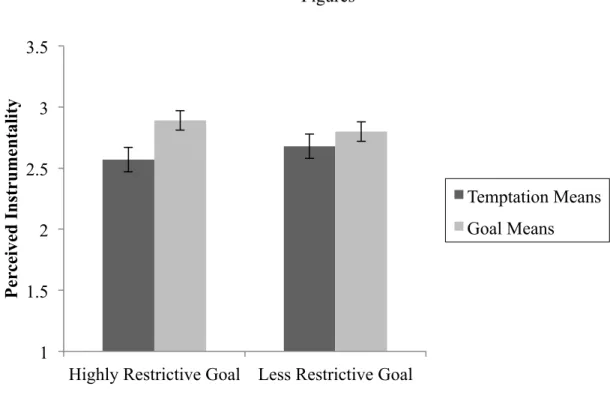
Critically, simple effects analysis revealed that this difference is driven by participants with a highly restrictive goal, F(1,105) = 6.95, p = .01, ηp2 = .06. There is no significant difference in perception of means instrumentality for participants with a less restrictive goal,
F(1,105) = 0.93, p = .34, ηp2 = .01. Specifically, participants with a highly restrictive goal found the temptation-related means (M = 2.57, SD = 0.64) significantly less instrumental than the goal-related means (M = 2.89, SD = 0.65), but participants with a less restrictive goal found the temptation-related means (M = 2.68, SD = 0.79) and goal-related means (M = 2.80, SD = 0.66) equally instrumental. Condition means are depicted in Figure 1.
Temptation desirability. To investigate the influence of a highly restrictive goal frame on the desirability of temptations, a 2 (goal restrictiveness: highly vs. less) x 2 (means type: temptations-related vs. goal-related) mixed methods ANOVA was conducted with goal
restrictiveness as the between subjects variable and means type as the within subjects variable. This analysis revealed a significant main effect of means type on perceived means desirability,
F(1, 105) = 16.24, p < .001, ηp2 = .14. Overall, participants perceived the temptation-related means (M = 2.95, SD = 0.93) as less desirable in satisfying their hunger than goal-related means (M = 3.40, SD = 0.77). There were no other significant effects.
Discussion
compared to the unifinal (goal-related) means. By including a measure of accessibility of the temptation goal, Study 2 was able to provide a proxy of temptation-goal activation, and ultimately provide experimental support for our hypothesis. Although the desirability of the temptation-related means, compared to the goal-related means, did not vary as a function of goal restrictiveness, we believe that this could be attributed to the temptations used (e.g., Ramen Noodles). It is possible that participants did not perceive the selected temptations as particularly desirable, and that the goal restrictiveness effect was not strong enough to overcome participants’ previously held attitudes towards the temptations. However, participants perceived the
temptations as less instrumental than goal-related means in satisfying their hunger in the context of a highly restrictive goal, but not in the context of a less restrictive goal. This difference in instrumentality supports our hypothesis and indicates that the temptations likely satisfied both the temptation and freedom goals, turning multifinal.
The results of Study 2 provide initial support for our hypothesis, but the comparison of temptation-related means with goal-related means is somewhat problematic. The introduction of goal-related means may have made salient the self-control dilemma at hand, and influenced the results. This may be one reason why the desirability results failed to support our hypothesis. In order to clarify this issue, and to provide greater support for our hypothesis, we next compared the instrumentality and desirability of restricted and non-restricted temptations (dropping the goal-related items from Study 2) when a health goal was highly vs. less restrictive in nature.
Study 3
The purpose of Study 3 was to bolster the confidence in the internal validity and
multifinality outcomes of restricted and non-restricted temptation-related means (as opposed to comparing temptation-related means and goal-related means). In this way, we can be more confident that differences in perceived instrumentality and/or desirability across temptations is due to the multifinal-nature of the temptations. We predicted that, in the context of a highly restrictive (vs. less restrictive) goal, the restricted temptations would have greater desirability and less instrumentality than the non-restricted temptations. These multifinality outcomes would provide further support of restricted temptations satisfying two goals, thereby transforming into multifinal means.
Method
Ethics statement. The author’s institutional review board (IRB) approved this experiment. Participants completed online informed consent questionnaires.
Participants. Eighty-five volunteers (47 female, 41 male) from Amazon Mechanical Turk participated in exchange for small monetary compensation. The age of participants ranged from 24 to 67 years, with a mean age of 40.79 years.
Procedure. Participants were told that the study was pilot testing a new healthy eating diet program, and that they would be introduced to one aspect of the new diet program and asked to respond to questions about the commonly consumed desserts.
Accessibility of the temptation goal. Study 3 utilized the same measure of goal
accessibility as Study 2. On the Personal Intake Form, participants indicated how hungry they were at that moment on a 5-point Likert scale that ranged from 1 (not at all hungry) to 5 (extremely hungry). This item served as a proxy of temptation-goal activation.
Goal restrictiveness. The second task was described as the “Desserts” component of the
restrictiveness. Half of the participants were randomly assigned to receive a freedom-threatening recommendation that forbade them from eating desserts that contained flour (e.g., doughnuts) (i.e., “You are simply not allowed to eat processed food.”) to frame the goal (i.e., to not eat desserts with flour) as highly restrictive. The highly restrictive goal threatened participants’ previous freedoms (e.g., to eat desserts with flour), thereby, activating psychological reactance. The remaining participants received a non-threatening recommendation that suggested that they do not eat desserts that contained flour as part of the control group. On the next screen
participants completed a one-item manipulation check (“I think that the diet’s recommendations are very restrictive.”) on a 7-point Likert scale that ranged from 1 (strongly disagree) to 7 (strongly agree).
Multifinality outcomes. The final task was described as a “Dessert Evaluation Scale”
desire (α = .77), and non-restricted instrumentality (α = .79). After completing the questionnaire, participants were checked for suspicion, fully debriefed, and thanked for their participation. Results
Temptation goal accessibility. We predicted that a temptation goal would be active for the participants who indicated that they were hungry at beginning the study. Therefore, we conducted a split half-analysis of the hungriness item and selected for those participants who self-described as hungriest (M = 2.67, SD = .84), based on their indication of how hungry they were on the Personal Intake Form. In all, 55 participants were included in the following analyses.
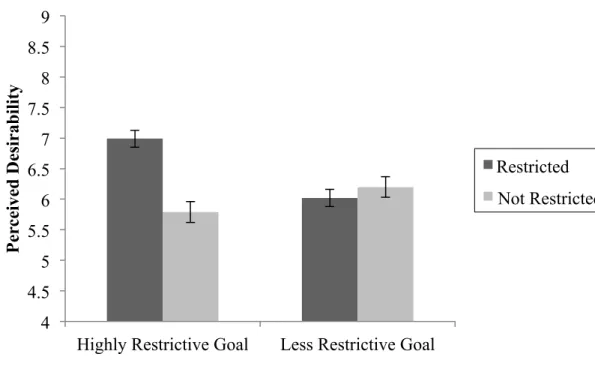
Manipulation check. In order to check on the effectiveness of our goal restrictiveness manipulation, we conducted a one-way ANOVA on the manipulation check item. Results indicated that the manipulation was successful, F(1, 54) = 15.70, p < .01. Participants in the highly restrictive goal condition found the diet plan’s recommendations to be more restrictive (M
temptations (M = 6.20, SD = 2.42), F(1,53) = 0.20, p > .05, ηp2 = .00. Desirability means are depicted in Figure 2.
Temptation instrumentality. To investigate the influence of a highly restrictive goal frame on the instrumentality of temptations, a 2 (goal restrictiveness: highly vs. less) x 2
(temptation type: restricted vs. not restricted) mixed methods ANOVA was conducted with goal restrictiveness as the between subjects variable and temptation type as the within subjects variable. This analysis revealed no significant effects, all Fs < 1.60.
Discussion
Study 3 extended the findings from Study 2 by revealing an increase in desirability of restricted (vs. non-restricted) temptations in a highly restrictive goal context, providing
additional experimental support for our hypothesis. In the presence of a less restrictive goal, the restricted temptations satisfied the single temptation goal. Thus, there was not a significant difference in perceived desirability between the restricted and non-restricted temptations. However, the highly restrictive goal increased the desirability of the restricted temptations
compared to the non-restricted temptations. A highly restrictive goal activates reactance (the goal to restore the threatened freedom). Indulging in the restricted temptation (but not the
non-restricted temptation) can satisfy the freedom goal. Thus, when there is an active temptation goal, the restricted temptations serve to attain two goals, whereas the non-restricted temptations attain just one. According to prior research on multifinality, participants perceive the added value of multifinal means as an increased desire for that means. Thus, our results are theoretically consistent with the temptations transforming into multifinal means.
While the desirability of the temptations was consistent with our predictions, the
vary as a function of goal restrictiveness. We believe these results could be attributed to participants’ previously held attitudes towards desserts. It is possible that participants did not believe that desserts, which are often viewed as “empty calories,” to be effective in satisfying their hunger. In turn, the goal restrictiveness effect was not strong enough to overcome participants’ previously held attitudes towards desserts.
General Discussion
Successful focal goal pursuit requires the exertion of self-control to resist indulgence in temptations and to engage in actions that promote focal goal attainment. However, the
characteristics of one’s goal could pull resources (e.g., motivation) away from focal goal pursuit and towards indulgence in goal-damaging temptations. Focal goals that are characterized by restrictive demands provoke a threat to an individual’s behavioral freedom, thereby activating psychological reactance and the goal to restore personal freedom. If a goal were framed in this manner, indulging a temptation would satisfy the freedom goal as well as the temptation goal, increasing its value. In such contexts, greater self-control is required to resist indulging in the temptation and maintain focal goal pursuit, increasing the likelihood of self-control failure. In the three studies, we have attempted to demonstrate that a highly restrictive goal transforms a
temptation from a unifinal to a multifinal means, thereby increasing its compounded value and diminishing its instrumentality.
temptations. However, it was unclear for which participants a temptation goal was active, and therefore, for which participants the temptations could satisfy a temptation goal. If a temptation goal was not active, then even in the presence of a highly restrictive goal, temptations would only satisfy the freedom goal. In such contexts, temptations remain unifinal means. A temptation goal must be active in order for temptations to satisfy two goals.
Study 2 therefore included a measure of temptation goal accessibility, in addition to manipulating goal restrictiveness and measuring multifinality outcomes. By asking participants to indicate how hungry they were, we were able to provide a proxy for temptation-goal
activation. Of the participants who had an active temptation goal, those who received a highly restrictive message perceived the temptations to be less instrumental than the goal-related means. In terms of Goal Systems Theory, associating the temptation with the additional freedom goal weakened the cognitive association between the temptation goal and temptation, thereby
decreasing the expectancy of attaining the temptation goal (i.e., decreasing instrumentality). The decreased instrumentality of the temptations in the highly restrictive but not in the non-restrictive condition provided support that highly restrictive goals transform temptations into multifinal means. However, Study 2 only measured the desirability and instrumentality of temptations against goal-related means. By their nature, temptations are desirable means, and we wanted to demonstrate that high restrictiveness could increase the desirability of select temptations.
desirability of the restricted temptations than the non-restricted temptations, indicating that the increase in value was the result of the goal restrictiveness effect. That is, the highly restricted goal likely activated psychological reactance, and consequently, the restricted temptations satisfied the freedom goal in addition to the temptation goal. As a result of attaining two goals, the temptations transformed from unifinal to multifinal means, as indicated by their increased desirability.
The results of Studies 2 and 3 are consistent with our prediction that highly restrictive goals transform temptations into multifinal means, increasing their perceived desirability and decreasing their perceived instrumentality. These studies are a foundation to uncovering why highly restrictive goals shift attitudes away from the focal goal and towards temptations. It appears that, in some contexts, the multifinality preference effect can overpower an individual’s self-control.
Future Directions
While we asked participants to indicate their hungriness as a proxy measure of temptation goal accessibility in Studies 2 and 3, the next step would be to manipulate the activation of the temptation goal in addition to the goal restrictiveness manipulation. Similar to the priming procedure of Buzinksi and Price (2015), our next study would randomly assign participants to receive an advertisement for either a health-related temptation item, activating a temptation goal (e.g., to eat something tasty), or an item unrelated to food to serve as a control condition.
non-health-related message. However, we would expect the perceived desirability and instrumentality of the temptations of the participants who received the health-related, restrictive message to be
consistent with the participants who received the restrictive messages of Studies 2 and 3. That is, if a temptation goal was activated, then participants would find the restricted temptations more desirable and less instrumental than non-restricted temptations.
To this point, we have only tested the influence of goal restrictiveness on the multifinality attitudes towards temptations. However, the goal restrictiveness effect extends into behavioral consequences, in which highly restrictive goals lead to greater temptation indulgence. The final study would be to include a behavioral measure of temptation evaluation. Adapting the
procedure of Stok et al. (2015), participants would be asked to participate in two experiments. Participants would first be asked to complete an unrelated task and refrain from eating a
presented temptation (e.g., Chips Ahoy cookies) to manipulate goal restrictiveness. In the second study, participants would then be asked to consume the initially presented temptation and a second, similar temptation (e.g., Oreo cookies) to evaluate the taste of each. Whereas the second temptation would only satisfy a single temptation goal, the initial temptation would satisfy two goals: a temptation goal and a freedom goal, activated by psychological reactance. Therefore, we would expect participants with a highly restrictive goal to indulge in (i.e., eat) more of the
initially restricted temptation. Conclusion
References
Baumeister, R. F., Schmeichel, B. J., & Vohs, K. D. (2007). Self-regulation and the executive function: The self as controlling agent. In A. W. Kruglanski & E. T. Higgins (Eds.),
Social Psychology: Handbook of basic principles. (2nd ed., pp. 516-539). New York: Guilford Press.
Brehm, J. W. (1966). A theory of psychological reactance. New York: Academic Press.
Brehm S. S., & Brehm, J. W. (1981). Psychological Reactance: A theory of freedom and control. London: Academic Press.
Buzinkski, S. G., & Price, A. (2015). Don’t tell me what to do: Highly restrictive goals promote temptation indulgence. SAGE Open, 5, 1-11. doi:10.1177/2158244015602751
Chun, W. Y., & Kruglanski, A. W. (2005). Consumption as a multiple-goal pursuit without awareness. In F. R. Kardes P. M. Herr, & Jacques, N. (Eds.), Applying Social Cognition to Consumer Focused Strategy. (pp. 201-217). New Jersey: Lawrence Erlbaum
Associates Publishers.
Chun, W. Y., Kruglanski, A. W., Friedman, R., & Sleeth-Keppler, D. (2011). Multifinality in unconscious choice. Journal of Personality and Social Psychology, 101, 1124-1137. Fishbach, A., Friedman, R., & Kruglanski, A. W. (2003). Leading us not unto temptation:
Momentary allurements elicit over-riding goal activation. Journal of Personality and Social Psychology, 84, 296-309.
Kruglanski, A. W., Köpetz, C. Bélanger, J. J., Chun, W. Y., Orehek, E., & Fishbach, A. (2013). Features of multifinality. Personality and Social Psychology Review, 17, 22-39.
Kruglanski, A. W., Shah, J. Y., Fishbach, A., Friedman, R., Chun, W., & Sleeth-Keppler, D. (2002). A theory of goal-systems. In M. P. Zanna (Ed.), Advances in experimental social psychology (Vol. 34 (pp. 331-378)). San Diego, CA: Academic Press.
Leander, N. P., Shah, J. Y., & Chartrand, T. L. (2009). Moments of weakness: The implicit context dependencies of temptations. Personality and Social Psychology Bulletin, 35, 853-866.
Locke, E. A., & Bryan, J. (1969). The direction function of goals in task performance.
Organizational Behavior and Human Performance, 4, 35-42.
Locke, E. A., & Latham, G. P. (2002). Building a practically useful theory of goal setting and task motivation: A 35 year odyssey. American Psychologist, 57, 705-717.
Maass, A., & Russo, A. (2003). Directional bias in the mental representation of spatial events: Nature or culture? Psychological Science, 14, 296-301.
Regan, J. W., & Brehm, H. W. (1972). Compliance in buying as a function of inducements that threaten freedom. In L. Bickman & T. Henchy (Eds.), Beyond the laboratory: Field research in social psychology (pp. 269-274). New York, NY: McGraw-Hill.
Stok, F. M., de Vet, E., de Wit, J. B. F., Renner, B., & de Ridder, D. T. D. (2015).
Communicating eating-related rules. Suggestions are more effective than restrictions.
Appetite, 86, 45-53.
Figures
Note. Error bars represent standard error.
Figure 1. The effect of goal restrictiveness and temptation type on instrumentality. 1
1.5 2 2.5 3 3.5
Highly Restrictive Goal Less Restrictive Goal
P
er
ce
ive
d
I
n
str
u
me
n
tal
ity
Note. Error bars represent standard error.
Figure 2. The effect of goal restrictiveness and temptation type on desirability. 4
4.5 5 5.5 6 6.5 7 7.5 8 8.5 9
Highly Restrictive Goal Less Restrictive Goal
P
er
ce
ive
d
D
es
ir
ab
il
ity